Toyota 1600GT (1967)
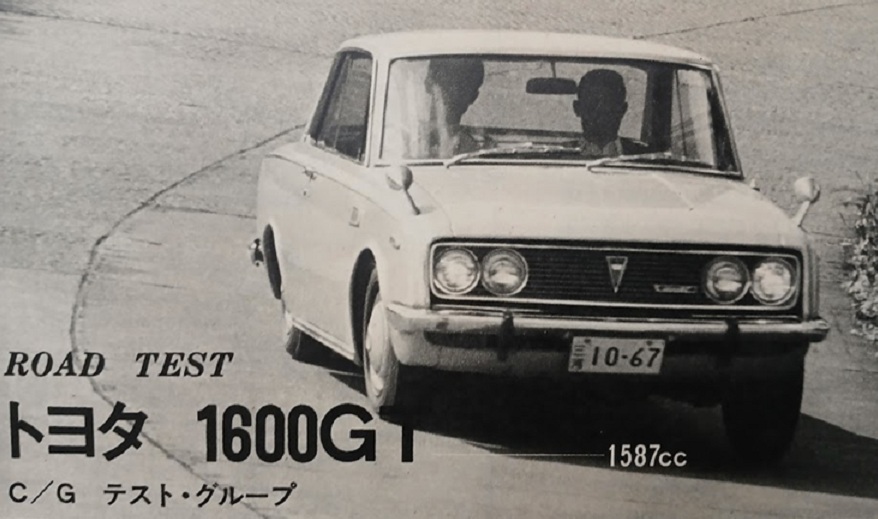
Publication: Car Graphic
Format: Road Test
Date: November 1967
Author: “C/G Test Group” (uncredited)
Road testing the Toyota 1600GT
For this test, we covered a total of approximately 800km in both the standard 4-speed model (1600GT4) and the optional 5-speed (GT5). The GT5 we tested was one of the very earliest production cars, while the GT4 was of the latest specification, so there were a number of detail differences between the two cars besides their gearboxes. We shall return to these later, but to give the conclusion first, each gearbox has its advantages and disadvantages. For ordinary use mainly in city driving, the GT4 is more suitable, while the sporting driver will probably choose the GT5 even at the cost of some inconvenience.
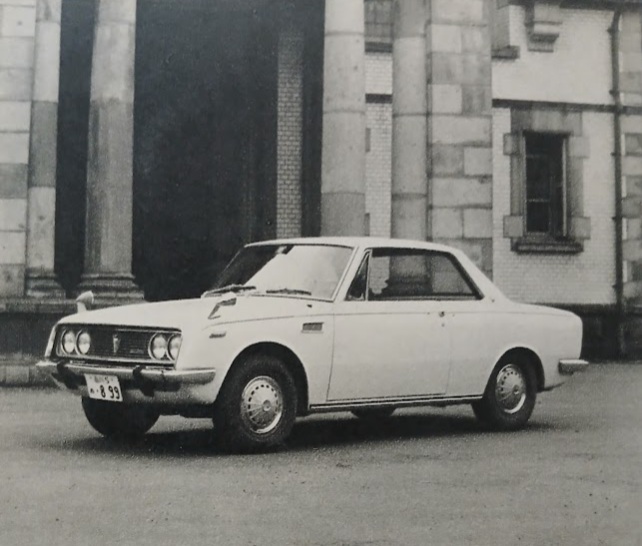
The 1600GT (internal designation RT55, or RT55-M with the 5-speed gearbox) is, of course, essentially a Corona Hardtop 1600S (RT51) equipped with a 110ps DOHC engine and strengthened suspension. So, in this report, we will omit the points that overlap with the 1600S as much as possible, and concentrate on the features unique to the 1600GT.
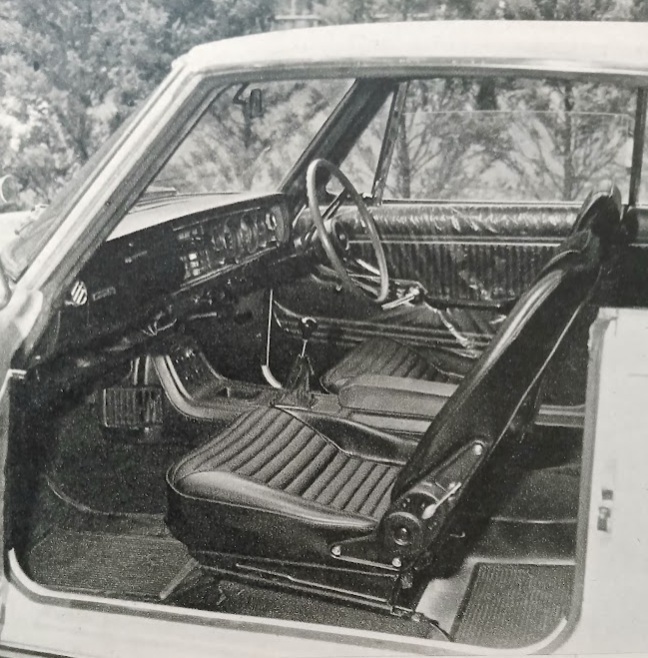
The 1600GT’s interior might well be described as a more affordable version of the 2000GT’s. Everything from the seats to the dashboard is unified in black, and both design and finish are of an extremely high standard. The front bucket seats have been “borrowed” from the 2000GT and are more generously proportioned than those of the 1600S. Lateral support is excellent even without the aid of the 3-point seat belts (which are standard equipment). The cushions, however, are extremely thin and lack “give,” feeling distinctly uninviting at first. But since nothing becomes particularly uncomfortable even after a long drive, the design must be sound. Although the seating position is slightly lower than in the 1600S, the driving position is natural, and forward visibility over the relatively low cowl is excellent.
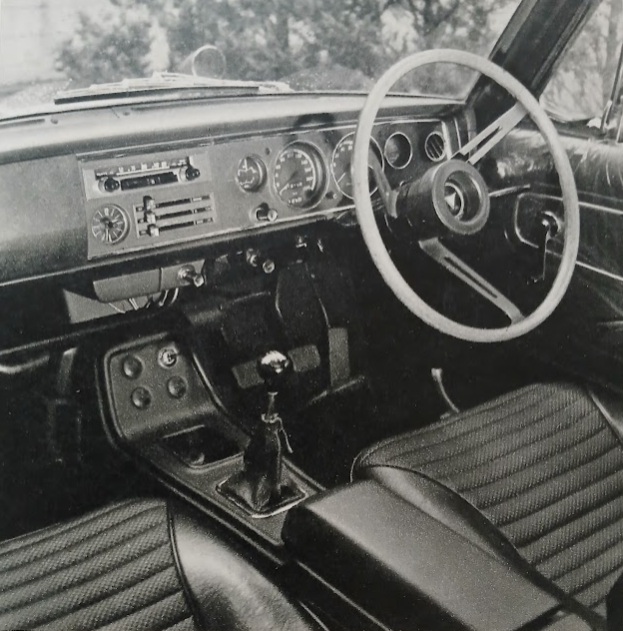
The steering wheel looks very much as if it is made of wood, and only when one’s hands become sweaty and begin slipping during fast driving does one realize that it is actually synthetic resin. Its three black-painted metal spokes are deeply dished, unlike those of the 1600S, and as on the 2000GT, there is a padded horn button at the center of the wheel. Since sounding the horn requires taking a hand off the rim, this is a puzzling choice in a car of this character. (In this respect, the 1600S, with its horn buttons embedded in the spokes, is better.)
The dashboard is exactly the same as in the 1600S, except that the speedometer and rev counter scales have been extended to 200km/h and 9000rpm, respectively. The gauges are well designed and arranged, and their white markings and red needles on a black background can be read accurately at a glance. One reason for this is that the instruments are relatively far from the seating position, so that when the driver’s gaze shifts from the road to the instruments, the eyes remain focused at roughly the same distance, rather like a long-focus lens. For the same reason, however, the light and wiper switches on the dashboard tend to be too far out of reach, particularly from the reclined driving position that a 1600GT driver will instinctively (or perhaps self-consciously) adopt.
One feature unique to the 1600GT is its center console. On its front panel is a switch for the electrically operated radio antenna, and, thoughtfully, three blanked-off switch openings are also provided for the various accessories the owner is likely to add later. The rear portion of the console is a fairly large storage compartment that doubles as an armrest. Since the inside of this compartment is carpeted, even a camera can be placed inside without a case. It does not have a lock, however.
The gear lever rises from this console, but the position and angle of the lever differ between the 4- and 5-speed gearboxes. Since the 4-speed is the same as that of the 1600S, its lever is bent quite sharply rearward, while the 5-speed lever stands almost vertically, like that of the 2000GT. In neutral, the knob is in almost the same position in both cars, but their movement is completely different. In the 5-speed, the knob moves in a horizontal plane, while in the 4-speed it moves around the shape of a sphere. With the 4-speed, the driver’s hand can sometimes get caught between the knob and the console box during quick shifts into second gear.
The pedals are identical to those in other Corona models. Consequently, the throttle pedal and brake are widely separated and badly offset in height, so that heel-and-toe braking and double-clutch downshifting—essential for driving a sporting car like a sporting car—are almost impossible.
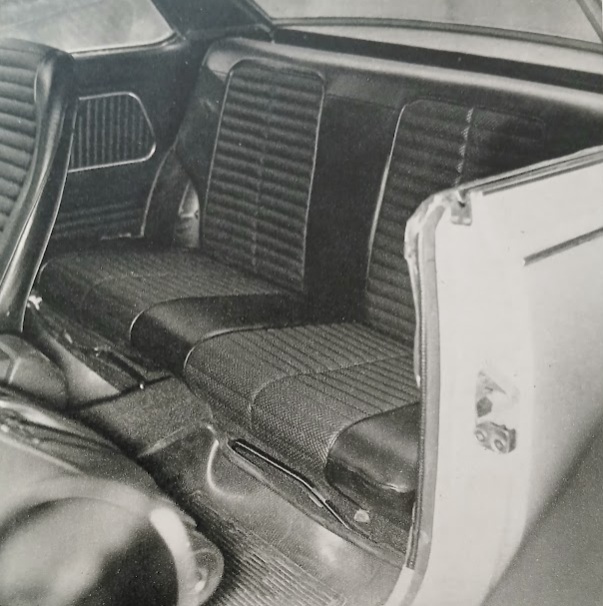
The rear seat is not merely the sort of “+2” arrangement often found in GT coupes like this. Although it is of course more cramped than a Corona sedan, there is enough room for two adults to sit without undue difficulty. The front seats, however, can be slid 20mm farther rearward than those of the 1600S, and in this position rear-seat knee room is insufficient, forcing passengers to sit at an angle.
It is good to see that several storage spaces for small items are provided around the interior. We have already mentioned the console box, and just ahead of it is a small, deep recess that is extremely useful for coins, cigarettes and the like. The glovebox is quite large, and in its right-hand corner are a map-reading lamp and a socket for an inspection lamp. Below the glovebox is a shelf for documents or a handbag, while pockets for road maps, newspapers and magazines are provided in a total of six places: in both doors, on either side of the rear seat, and on the backs of both front-seat backrests. In addition, behind the rear seat is a recess big enough to hold a small suitcase, though it is not as large as that in a Volkswagen. Fold the rear-seat backrest forward and secure it with the well-designed metal fittings, and the rear compartment becomes an enormous luggage space, completely covered in carpet. If we were to ask for anything more, it would be the addition of straps to secure luggage (or at least fittings for them), as on a Porsche. It would then be ideal for high-speed, long-distance travel by two people (after all, isn’t that the original meaning of gran turismo?).
In our experience with the two 1600GTs, the 110ps DOHC engine remained in consistently good tune and was completely trouble-free. Turn the ignition key and the electromagnetic plunger pump at the rear begins operating with a faint hum, filling the float chambers of the twin Solex 40PHH carburetors. Cold starts in the morning were always instantaneous if the choke knob was pulled out—the trick is not to touch the throttle—and the engine will not stall even if the choke is pushed back in immediately. Warm-up is rapid; in summer temperatures, the water-temperature gauge began to move after about three minutes. The idle, at around 700rpm, is quite rough even by sporting-engine standards, and the gear lever vibrates quite a lot.
In terms of performance, there was little difference between the 4- and 5-speed gearboxes, either in the catalog figures or in our own measured results, but their characteristics in everyday use are very different. First, for comparison, the gear ratios of the two models are shown below. The standard final-drive ratios also differ between the 4- and 5-speed versions, at 4.111 and 4.375 respectively. (Overall gear ratios are shown in parentheses.)
| 1st Gear | 2nd Gear | 3rd Gear | 4th Gear | 5th Gear | |
|---|---|---|---|---|---|
| GT4 | 3.673 (15.09) | 2.114 (8.69) | 1.403 (5.77) | 1.00 (4.111) | - |
| GT5 | 3.143 (13.75) | 1.636 (7.16) | 1.179 (5.16) | 1.00 (4.375) | 0.844 (3.69) |
We tested the 5-speed car (GT5) first. This test car was one of the very earliest production models, and had several shortcomings that had already been corrected in the 4-speed car (GT4) we tried later, so we will begin with the GT5. The GT5’s all-synchromesh 5-speed gearbox was “borrowed” from its big brother, the 2000GT, so its ratios are by no means ideal for the 1600GT’s power characteristics and weight. First gear is too high for the car’s weight (1035kg), and there is also far too wide a gap between first and second. (Step-up ratios: 1st-2nd 0.52, 2nd-3rd 0.72, 3rd-4th 0.84, 4th-5th 0.84.) As a result, almost every driver who tried the GT5 for the first time made the same complaint: it lacked punch off the line. To exaggerate slightly, starting off was so sluggish that it felt almost as if the handbrake had been left on.
The extremely heavy throttle pedal adds to this impression. In fact, it is not only a matter of feel; over the first 10 meters or so (which is what counts in the “traffic-light GP”), the GT5 would probably be no match for even a well-driven Corolla. On the other hand, first gear extends to over 50km/h, so it can quickly catch and pass most cars in less than 20 meters. It is also necessary, as a matter of self-preservation, to hold first gear to fairly high revs, since shifting into the widely-spaced second gear causes acceleration to fall off badly.
The clutch of the GT5 we tested required considerably more pedal effort (10kg) than that of the GT4 we drove later, to the point of being unsuitable for frequent use in the city, although its action was positive and there was little slip. The 5-speed’s near-vertical gear lever falls naturally to the driver’s hand when lowered from the steering wheel. Its short movements are welcome, but in our test car, which had covered about 3,400km, the shift action was extremely stiff. As mentioned above, second gear is tall, and after turning a street corner at little more than walking pace it is often necessary to shift down into first. But engaging first while the car was moving required an almost violent amount of force. Moreover, after coming to a stop in second gear, there were several times when the gear could not be disengaged.
The character of the 1600GT’s engine is extremely difficult to describe. Since it is a high-output DOHC unit with 68ps per liter, one is likely to imagine a so-called “peaky” engine (one with a very narrow range in which strong torque is produced, and consequently a sharply peaked torque curve) that requires constant gear changing to run properly. In fact, the exact opposite is true. The torque curve is as flat as that of a tractor engine, with more than 12kgm available over a broad range from about 2000-5500rpm. At first, most drivers of this car tend to use only first and second gears around town, but before long they realize that it will run quite easily in the higher gears as well.
In city driving, we eventually adopted the lazy technique of holding second to about 50km/h, then skipping third and shifting directly into fourth. With this close-ratio gearbox, there is little point in going through the gears one by one at speeds of only around 60km/h. Moreover, the engine is so flexible that the curious situation arises in which, if the car can be driven in second, it can generally be driven in fourth without difficulty as well. On the other hand, although fourth will run smoothly at as little as 40km/h (about 1300rpm), the pulling power in second at very low speeds is not nearly as strong as this might lead one to expect. For example, after turning a street corner at around 15km/h (about 1000rpm), it is too much to ask the engine to accelerate away in second. Strange though this may seem, the reasons are probably the too-wide gap between first and second and the sharp fall in engine torque below 1500rpm.
In our view, a more “peaky” engine would be better suited to the character of a sports car, even at the cost of being somewhat less tractable at low speeds. Although it actually produces very strong torque, there is no real climax where the power suddenly swells at a certain engine speed, and as a result it feels rather lacking in excitement.
The 1600GT, which seems rather uninspiring around town, suddenly comes to life on the open road. Its maximum speed of 175km/h would probably require a long straight such as those on the Meishin Expressway, and perhaps the help of a downhill slope, but 160km/h can be reached easily in both fourth gear and the overdrive fifth. Taken to 7000rpm, third gear reaches about 150km/h, and even second reaches nearly 110km/h. As one would expect from 110ps, there is plenty of power, and acceleration in third and fourth remains quite strong even beyond 100km/h.
At around 100km/h, where the ordinary 1600S Hardtop begins to run out of acceleration, the 1600GT actually becomes livelier. Because third, fourth and fifth are so closely spaced, not only 100km/h but even 150km/h can be attained in any of the three upper gears. The luxury of having three gears to choose from at 150km/h is something one rarely experiences, and in a practical 1600cc-class GT there can surely be few, if any, parallels anywhere in the world. The gearshift actually seems to become lighter at high speeds, and the synchromesh is effective. As already noted, the GT5 can be quite inconvenient around town, but the sporting driver will probably be prepared to overlook this for the enjoyment of its high-speed performance.
The overdrive fifth is intended to provide quiet and economical cruising. But at the 100km/h maximum permitted on Japanese public roads, shifting from fourth into fifth (about 3100rpm) instead causes the transmission to emit a high-pitched gear whine, raising the overall noise level. This is particularly regrettable because mechanical noise from the engine is remarkably low. Exhaust noise increases suddenly above 3500rpm and resonates inside the body.
Although the GT5’s high-speed performance is excellent, the engine of our test car, at least, lacked smoothness at high revs. At around 5500-6000rpm the characteristic four-cylinder vibration appears, while above 140km/h in third, fourth and fifth, a fairly severe vibration develops throughout the driveline. We did not have the nerve to sustain such speeds for very long.
As we have repeatedly mentioned, this GT5 was one of the very earliest production cars. When we asked the manufacturer about this problem, we were told that countermeasures had already been taken. In the more recent GT4 that we tested later, the vibration period had indeed been moved outside the normal operating range, and we also confirmed that there was no longer any problem with driveline balance at high speed.
Next, let us discuss the GT4. Its 4-speed gearbox is exactly the same as that of the 1600S, but the final drive is lower (4.1 compared to 3.7 for the 1600S), and the engine has an additional 20ps, so acceleration is overwhelmingly better than in the 1600S. Even compared with the GT5, first gear is considerably lower, making acceleration from rest much quicker. Both the gearshift and clutch are also much lighter in the GT4, making it better suited than the GT5 to practical use around town. At least there is no danger of being left behind by a 1600S or the like in the traffic-light GP.
Nevertheless, our measurements showed that in absolute acceleration the GT5 still has a slight advantage. Comparing standing-start acceleration, the GT4 recorded 7.8 seconds from 0-100m (GT5: 7.4 seconds), 11.85 seconds from 0-200m (11.3 seconds), and 18.25 seconds from 0-400m (18.0 seconds). For various reasons, the more detailed tests were conducted with the GT4, and what they demonstrated was the remarkable flexibility of the DOHC engine. In third-gear passing acceleration, for example, the times for each 20km/h increment between 30 and 110km/h are all exactly 5 seconds. This directly reflects the flat torque curve; but put another way, the power delivery feels almost syrupy, lacking something of a sports-car character. Also, when the GT4 is driven in a sporting manner, the gap between third and fourth gear is clearly felt.
Taking everything into consideration, the GT4 is the better choice for practical use mainly in city driving, while the GT5 is the one for hot-blooded speed enthusiasts.
The 1600GT’s suspension is basically the same as that of the 1600S Hardtop, with only a torque rod added at the rear. In general it is firm and gives a flat ride, with very little roll for a practical car. One of our testers described the 1600GT as a scaled-down Shelby Mustang GT350 (in both dimensions and performance), and this seems exactly right. The suspension design is utterly simple, with an emphasis on ease of production, and the idea of compensating for this with wide tires also has something in common with the Shelby (and American so-called sports sedans in general). The 1600GT is fitted as standard with low-profile 6.45S-14-4PR tires, one size wider than those of the 1600S (Dunlop Grand Speeds on our test cars), while 6.45H-14 tires are also available for still higher-speed use. Due in part to the effect of the limited-slip differential, these tires provide excellent grip even in the wet. Even during a full-throttle racing start, they grip the road firmly after only a few meters of wheelspin. The effect of the torque rod is clearly evident, and we experienced no rear-axle tramp even under hard acceleration or deceleration.
Considering that the suspension is basically the same as the Corona’s, the handling is surprisingly good. The steering, at 3.75 turns lock to lock, is also the same as the Corona’s, so it is rather busy in tight corners, and there is about 5cm of elastic play at the rim around the straight-ahead position. Once one gets used to initially turning the wheel a little farther than expected when entering a corner, however, the response is surprisingly good, and the steering is quite precise. Steering effort is exceptionally light except when parking.
To compensate for the weight distribution of 54/46 even with two occupants, tire pressures are specified at 1.9/1.7kg/cm² (for speeds up to 175km/h), yet the handling still shows strong understeer. Since there is very little sense of roll, at least to the driver, there is a tendency to enter corners at speeds beyond the capabilities of either the car or the driver. The cornering-speed limit feels more than 30% higher than that of the 1600S, although all four wheels tend to begin sliding at once.
As for the brakes, we are still unable to reach a definite conclusion. The GT5 produced very powerful braking with light pedal effort from low speeds to more than 150km/h, while remaining completely stable, and our unanimous opinion was that we had never experienced such excellent brakes. The GT4 we tested later, however, seriously shook our confidence. Its braking power itself was just as strong; for example, the total time to accelerate from 0-100km/h and then come to a complete stop was just 16.9 seconds. But when we repeated this two or three times, fade appeared almost immediately, increasing the stopping distance and pedal effort. After resting for a few minutes, the brakes returned to normal. We also drove hard up and down a mountain road consisting of a succession of gentle corners that could be taken at 70-90km/h, repeatedly braking hard, and here too the brakes faded. On the downhill sections, despite the pressure-control valve in the rear brake circuit, the left rear wheel locked and made the car unstable. Our honest impression was the GT4 and GT5 we tested may have used different brake pad materials.
Finally, as for fuel consumption, accurate measurements could be made only with the GT5. Over 282km of driving in Tokyo and on the Third Keihin Expressway, it averaged 6.43km/l. The GT4 seemed quite obviously to have an overly rich carburetor setting, but our rough measurements suggested its consumption was around 5km/l.
Postscript: Story Photos