Toyota 1600GT vs Nissan Bluebird 1600SSS (1967)
Publication: Auto Sport
Format: Auto Sport Test
Date: October 1967
Author: Auto Sport Editorial Staff (uncredited)
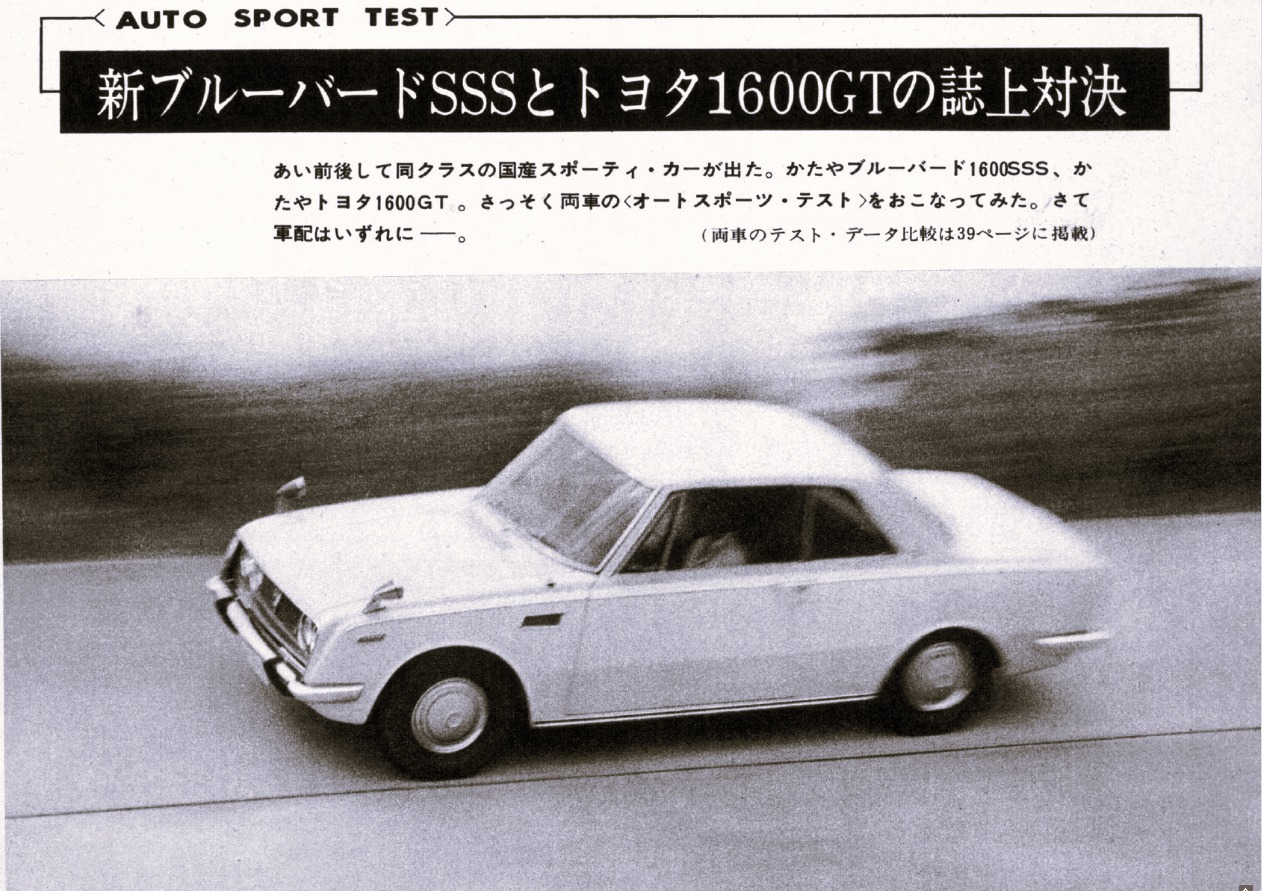
Two domestic sports cars of the same class have made their appearance at the same time. One is the Bluebird 1600SSS, and the other is the Toyota 1600GT. We promptly set about putting both through Auto Sport testing. The question is, how will each measure up?
Built With the Experience of International Rallies: Bluebird SSS Reborn
Unlike the Toyota 1600GT, the Bluebird SSS was not developed through competition on domestic racing circuits. However, Nissan has plenty of experience competing in international rallies. This has resulted in the development of an OHC 1595cc (82mm x 73mm) engine and a car that boasts outstanding driving stability thanks to its all-wheel independent suspension.
Although the new Bluebird is still called a “Bluebird,” is a completely different car from its predecessor. Its design is all-new and it has no discernable relationship to the previous model.
The design trends that have evolved in the high-speed era–wider, longer, and lower–have been fully incorporated into the body, and the exterior dimensions have become much larger. The tread width has increased, and the interior feels much more spacious due to the use of curved glass. Notably, the front seats have an increased sliding range of 160mm, and of course, they are fully separate with reclining backrests.
The steering wheel is a wood-rim “cone” type, and wood is also used for the shift knob. The dashboard is finished all in black. Directly in front of the driver are a speedometer (scaled up to 180km/h) and a tachometer (up to 8000rpm). The tachometer has a yellow zone from 6500rpm to 7000rpm and a red zone beyond that. Inside the speedometer is an oil pressure gauge.
The instrument panel also has a large clock which can be used for checking times at a glance during rallies. Unfortunately, there is no second hand. Speaking of the usability of the car, there are horn buttons located in the three spokes of the cone-type steering wheel. This allows you to sound the horn with your fingertips without taking your hands off the steering wheel. We think this is essential for reducing the risk of accidents.
The absence of triangular front windows gives the SSS a wide field of view and a spacious atmosphere, something it shares with the standard model, while the only external differences are in the front grille, racing-style front fender mirrors, and the SSS emblem with a checkered flag on the rear quarter panels and tail.
Incredible Flexibility
The metallic gray test car was brought out to us directly from storage. It was still brand-new and had hardly been driven, with only 300km on the odometer. However, when we drove it on public roads from the city center to the test course in Higashimurayama, it demonstrated surprising quickness and flexibility.
The engine has a flat torque curve from around 2500rpm to 5000rpm, and produces more than 12kgm of torque over a wide range, from 1800rpm to 4600rpm. The maximum torque is 13.5kgm at 4000rpm.
The maximum output of 100ps is generated at 6000rpm, and the top speed of 165km/h is achieved in fourth gear at 6000rpm.
The above data is calculated based on the engine’s performance curve, but during actual driving, it was faithfully reflected in both the feeling and the numbers on the tachometer and speedometer. In fact, rather than being faithful to the calculated data, it should be said that its performance seemed to exceed it.
Of course, the OHC engine has a higher rotation limit than the OHV unit in the original SSS, but its throttle response is surprisingly effective even in top gear, and as long as the vehicle speed is over 40km/h, it accelerates smoothly with linear response to the accelerator pedal. When the speed exceeds 60km/h, the response when opening and closing the throttle becomes extremely sharp. This is the result of the flat torque and ample reserve power.
The transmission is the traditional Porsche-type (fully synchronized), and using the wooden shift knob, it is extremely smooth-shifting. The synchro is powerful, so even beginners will not experience any clashing while changing gears. However, some people find the shift feel too “floppy” and “soft.” Some also say that first gear is too low. Structurally, the transmission is identical to the previous Porsche-type, but some additional measures have been taken to prevent the shift lever from balking, which may be why it feels even softer than before. This seems to be a matter of personal preference.
The gear ratios are 3.657 for first gear, 2.177 for second, 1.419 for third, and 1.000 for fourth, with a final drive ratio of 3.90. An option is available for even higher speeds, and although the top gear is the same 1.000, the other ratios are 3.382 for first gear, 2.013 for second, and 1.312 for third, with a final drive ratio of 3.70, making it a closer ratio gearbox.
For reference, the speeds in each gear at the 6000rpm power peak are 45km/h in first gear, 76km/h in second, 118km/h in third, and 167km/h in top.
Extraordinary Road Adhesion
Response to the steering is quite sharp. The SSS shows a moderate tendency to understeer, and there is a good sense of return force in the steering wheel’s return to center motion. Overall, the steering has improved significantly compared to the previous model.
Accelerating in a circle on the 15m radius skid pad, the Bluebird SSS surprised the Auto Sport test team by being the first car capable of exceeding 70km/h in this test, making it the fastest car we have recorded on the skid pad. This is no doubt due to the new suspension design and the fact that the front and rear wheels have unusually good road grip. Certainly, at 70km/h, the outside front tire was rolled under with the wheel rim nearly striking the road surface, and the inside rear wheel was spinning and smoking furiously. But the tires did not break away. When we reached about 50km/h, we felt the steering wheel start to “catch” on the inside with a binding feeling, and it became difficult to turn.
This cornering performance seems to be especially attributable to the new rear suspension. It is a newly designed semi-trailing independent type, and its mechanism absorbs not only vertical motions but also lateral centrifugal force, which is thought to be what gave the car such excellent adhesion.
This proved to be counterproductive in the slalom test, in which we set up pylons at 10m intervals over a 100m distance. In such a sharp slalom, it is impossible to improve the best time without a certain amount of power sliding, which we could not achieve in the SSS. Instead, with this level of adhesion, it was necessary to crank the wheel sharply one way and then wind it back the other way as quickly as possible. The steering gear ratio is 15.0:1. As such, it should feel quite sharp, but even so we had a lot of trouble with the slalom.
The 0-400m acceleration time of 17.7 seconds was rather surprising considering that the car had not yet been run in. When passing the 400m mark, the car was in third gear and revving just over 6000rpm, but the SSS’s engine was still pulling at full strength, and the speedometer was indicating 130km/h.
As mentioned earlier, the new Bluebird was released as an all-new model, and one notable contrast with the previous SSS is in the planning of the engine compartment. The old model had a small engine bay, so the installation of the 1600cc engine felt like a forced fit. The new Bluebird SSS’ engine bay is very spacious, making it easy to work on the engine, and even more conveniently, it includes a service light, so the engine can be adjusted at night.
There is still plenty of room for tuning. The springs can be strengthened to make the onset of understeer occur more smoothly, and the car height can be changed to adjust the camber angle.
After Nissan releases its sports kit for the Sunny, which is expected soon, one for the Bluebird SSS should become available in due course. The Bluebird is highly versatile, and its fundamental character should make it well-suited to races, rallies, and even touring on public roads.
A Feminine Appearance Hides a Tiger’s Power: Toyota 1600GT, the Phantom Racing Corona
It has been a year and a half since the “RTX,” a prototype Corona equipped with a racing engine, made its first appearance on the circuit in March 1966. This was a full month before last year’s Japanese Grand Prix, making its debut at a clubman race at Fuji Speedway.
With this kind of background, even those who are not motorsports fans are bound to have high expectations for this “phantom racing Corona.” It looks much like any other Corona hardtop from the outside, but the mechanism underneath includes a high-performance DOHC engine, evident from the powerful exhaust sound, and a 5-speed gearbox.
However, the year ended with nothing but dreams, as domestic races continued to be dominated by cars such as the Skyline 2000GT, Bluebird SSS, and Bellett GT, while the somewhat feminine Corona 1600S did not make much of an impact in races.
It was in July of this year that the RTX, after a long absence, finally reappeared in an endurance race. Toyota’s factory team entered two RTXs in the 12-hour race at Suzuka. This surprised the Nissan team, which was participating in an endurance race for the first time with the Fairlady 2000. Moreover, this time, the RTX was no longer a hastily-finished prototype, but had an engine that was prepared to closely resemble that of the Toyota 2000GT. The lettering on the cam covers read, “Toyota 1600GT.” The result was a clean sweep of first and second place in the 12-hour race.
The production 1600GT was released onto the market not long afterwards.
In other words, by the time the Toyota 1600GT finally went on sale, a year and a half had passed, and it had appeared in competition twice, giving its development a character that was quite different from the Corona 1600S’s sudden transformation into the 1600GT in prototype form.
The development of the racing 1600GT was pursued through actual competition, including the fight for the endurance race speed record at Suzuka. The lessons gained during from that experience is reflected in the production 1600GT as well. In addition, although it only participated in two races, the 1600GT was developed in parallel with, and with thorough study of, the development of the 2000GT.
In particular, there seems to have been close cooperation between the two development teams in the creation of the DOHC engine. In fact, it is said that the development of the 1600GT’s four-cylinder DOHC engine began before the 2000GT’s six-cylinder DOHC engine. Therefore, this three-bearing engine could be considered something of a test bed that led to the completion of the 2000GT’s engine.
Since then, the production Toyota 2000GT has been released as a high-end model even by international standards, but the price of over 2.3 million yen is too expensive for the “young age” of affluence in Japan. This gap was predicted from the very beginning, and the 1600GT project was intended to close it.
A Tiger With the Face of a Cat
The Toyota 1600GT is a car that combines the sporty mood of the Corona Hardtop with the high performance of the Toyota 2000GT. The feeling is psychologically different when this level of performance is delivered in a sedan body, which could be that of a simple passenger car, and it evokes the specialized atmosphere of the Alfa Romeo 1600GT or Lotus Cortina.
The problem was to bring to market a car that had high performance and was also relatively affordable, and would appeal to those who had previously only found cars like this from foreign manufacturers.
There are also buyers who have wanted to buy a two-seater sports car, but whose family circumstances did not allow it, and the 1600GT aims to appeal to them as well.
The adoption of a DOHC engine was a brilliant way to create a specialty GT car using the body of the Corona Hardtop, which is already so common on the streets that it is hard to notice. However, this appeal may be a hidden pleasure for the owner. The only things that distinguish the body from the original hardtop, with its feminine feel, are the vents on the side fenders, the inverted triangular edging on the front grille, and the “1600GT5” emblem on the rear trim panel.
One thing that does stand out is the racing mirrors, which are shared with the 2000GT, protruding from the front fenders, but hardly anyone noticed these during our testing. This is perhaps the appeal of the “wolf in sheep’s clothing” concept. Actually, a “tiger with a cat’s face” is perhaps a better fit for the 1600GT. It looks like nothing more than a Corona Hardtop at first glance, but when you step on the accelerator, it instantly transforms to show the true strength of the 1600GT.
Although the body is that of a Corona Hardtop, the atmosphere in the interior is surprisingly different. The front seats are the same full-fledged reclining sport seats found in the 2000GT, and their moderate stiffness and bolstering give a sportier driving position than you would expected in such an upright car. The speedometer is scaled up to 200km/h, and the tachometer goes to 9000rpm, with the red zone above 7000rpm. The steering wheel is made of resin so intricately textured that it fools you into thinking it is genuine wood, and in the center is a sports-type padded horn button similar to that in a Mustang. The short floor shift lever protruding from the console gives it a feel similar to the 2000GT.
The interior is finished in all black, creating a sporting mood, and the rear seatbacks can be folded down, giving a strong 2+2 impression. The yellow exterior paint of this example matched the masculine interior particularly well.
The Scent of High Performance
When we opened the hood, the DOHC head cover was splattered with spilled engine oil, which was anything but elegant. It smelled of high performance, like a Lotus Cortina or Alfa Romeo.
This engine is called the 9R, and is manufactured by Yamaha. Its displacement is the same as the Corona 1600S, but it has a new 45mm intake inlet, a cross-flow aluminum head, and two chain-driven camshafts. The two carburetors are twin-choke Mikuni Solex rather than SU types. The exhaust is a single pipe that is sintered to avoid exhaust interference, and it exits through two outlets at the rear of the car, producing quite a powerful exhaust note. The compression ratio has been lowered from 9.2 on the 1600S to 9.0, and it is clear that the engine is significantly detuned in standard form.
Output is 110ps at 6200rpm, and the maximum torque is 14.0kgm at 5000rpm. However, factory-tuned machines for endurance races can produce around 140ps at 7500rpm within the scope of modifications allowed by the International Sporting Code for Group 2. This is possible by changing the compression ratio using different pistons and adjusting the camshaft and carburetors. A racing kit that includes these parts is scheduled to be released to the public at some point.
However, the key feature of this engine is not the high-speed torque range found in racing engines, but rather its practicality. DOHC is often thought of as something that cannot show its potential unless it is always running at high revolutions, but this engine is flexible enough to accelerate from as low as 1500rpm, just like the six-cylinder unit in the 2000GT. As revolutions increase, the high-speed efficiency made possible by DOHC produces an exceptionally flat torque curve.
During the test, when we allowed the speed to drop to 40km/h in fifth gear, the revs fell to only about 1400rpm, but it was still possible to accelerate slowly without knocking. The test car was not fully run in, and it did feel a bit sluggish, but in practical terms this flexible character is very useful.
There are two types of gearbox available for the 1600GT. The 4-speed unit is the same as that in the 1600S, and the 5-speed unit is the same as the 2000GT’s. They are visually differentiated by a GT4/GT5 badge on the rear of the car. The test car was the GT5, officially known as the RT55M. The shift pattern is the same as in the 2000GT, with fifth gear in the reverse plane, up and to the right. Since it was a new car with only 800km on it, shifting into the higher gears felt stiff, but the movements from neutral were short and the lever went into gear with a precise “click.”
For the GT5, the gear ratios are 3.143 (first), 1.636 (second), 1.179 (third), 1.000 (fourth), and 0.844 (fifth), and the final drive is 4.38 as standard. For the GT4, they are 3.673 (first), 2.114 (second), 1.403 (third), and 1.000 (fourth), the same ratios as the 1600S, but with the final drive lowered from 3.70 to 4.11.
In the case of the GT5, it is not especially easy to move away from rest in low gear. As this gearbox is originally from the 2000GT, its gearing is quite tall compared to other sports sedans, so acceleration feels somewhat sluggish from a start. Moreover, because the gears are far apart from each other, it feels like it is difficult to keep up momentum when shifting into second. Once you get moving, though, acceleration becomes easy because the ratios from second gear up are full-fledged close ratios.
The peak output speed of 6200rpm corresponds to 50km/h in first gear, 90km/h in second gear, 130km/h in third gear, 155km/h in fourth gear, and 175km/h in fifth gear. However, if you want to use the fifth gear to its full potential on public roads, the optional 4.62 final drive is recommended. This will reduce the top speed by about 6%, but improve acceleration.
During the city driving portion of the test, we ended up mostly using second gear in crowded areas where we had to accelerate and decelerate often, but once the traffic smoothed out, we found that fourth gear could be maintained even at slower speeds of 40 to 50km/h. The ratios of the third and fourth gear are only 18% apart, so we rarely found it necessary to shift between them on public roads. Instead, we could instinctively keep pace simply by pressing and releasing the accelerator, without having to do anything with the gearlever.
An Inescapable Heavy Feeling
On the other hand, the 1600GT does not deliver the sharp, sudden acceleration of some other sports sedans. Instead, it is the type of car in which the faster you go, the better the acceleration gets. This is due to the gear ratios and flat torque characteristics mentioned above, as well as the heavy body. For reference, the Bellett 1600GT weighs 940kg, the Skyline 2000GT 1070kg, the Bluebird SSS 915kg, and the Corona 1600S 980kg. In comparison, the Toyota 1600GT is quite heavy at 1030kg. This is because it uses the mass-produced hardtop body derived from the Corona sedan virtually unchanged, and if it were 100kg lighter, it would have a very different character.
Another characteristic that stands out when driving the 1600GT is the dramatic improvement in full-throttle starts and cornering performance due to the combined effects of the new V-shaped torque rod on the rear axle, the standard limited-slip differential, and the wider 6.45-14 low-profile tires. With the 1600S, the axle would wind up so much that the tires would judder and squeal when accelerating from rest, and even once underway, the rear end would swerve. But with the 1600GT, you can make sudden starts while maintaining a stable posture. The car seems to leave the line smoothly even if you abruptly drop the clutch.
In cornering, the effect of the limited-slip is obvious in that it is difficult to oversteer by power sliding. Even when pushed through tight corners at the Murayama test course in third gear at 50km/h, where the driver would naturally expect understeer, the car just went along with the corner as the steering wheel was turned further to the inside. In other words, it was close to neutral up to a certain limit, but once that limit was exceeded, the tires suddenly started to break away and the car would slide into oversteer. Compared to the front wheels, which have good grip, the weight distribution over the rear wheels is light, so the rear end loses grip first. This tendency was clearly evident in the slalom test. However, the steering response still retains the character of a normal passenger car, and seems to lack sharpness.
The brakes are front discs and rear aluminum drums with servo assist as standard, so they are sharp even at low speeds. In addition, a new pressure control valve has been added to prevent rear wheel lockup during sudden braking, so the car maintains directional control even when braking suddenly from high speed.
It was unfortunate that the test car had not yet been broken in, and could not deliver better test data as a result. On the other hand, we were able to fully enjoy this car in terms of its driving feel. The Toyota 1600GT is a car that is designed not only for sports driving, but one that can also be driven in city traffic without fuss, and in that sense, it can be said to be free of bad habits. It is a GT car that can also be enjoyed by the whole family and beginners.