Suzuki Fronte 800 (1967)
Publication: Motor Fan
Format: Road Test
Date: June 1967
Authors (roundtable): Tsutomu Ema, Osamu Hirao, Kazuo Kumabe, Kenji Higuchi, Yoshihiko Takada, Atsushi Watari, Akio Miyamoto, Kenzaburo Ishikawa, Yasuhei Oguchi, Taizo Tateishi, Taizo Miyake, Toshihide Hirata, Minoru Onda, Yoshiyuki Terada, Tetsuo Oshima, Motor Fan Editorial Staff (uncredited)
Suzuki Is About More Than Kei Cars
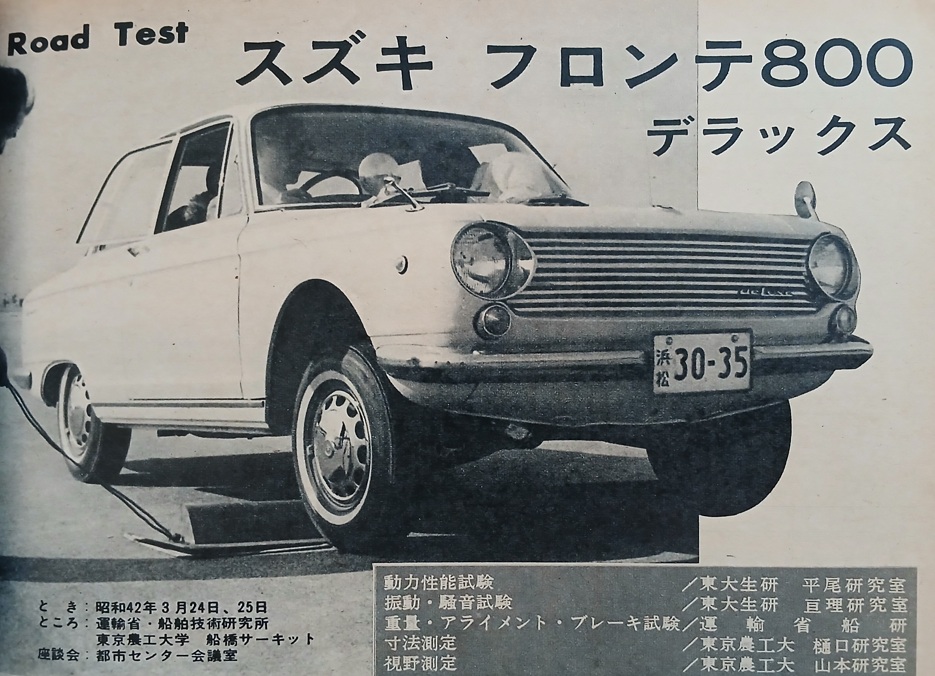
Magazine: Over the past two days, yesterday and today, with the cooperation of Suzuki Motor Co., we have conducted a road test of the unique Fronte 800, with its two-stroke, three-cylinder engine and front-wheel drive. We understand that Suzuki will shortly be announcing a revolutionary new kei passenger car, something we are also looking forward to with considerable interest. We can leave that for another time, however, and for now we would like to confine our discussion to the Fronte 800.
First, we would like to ask Mr. Ema of Suzuki to tell us something about the history of the Fronte 800 and the background to its development.
Ema: Suzuki first became involved with kei cars around 1954. By about 1962, production of our four-wheeled kei vehicles had entered a stable phase, and we had reached the point where, as a car manufacturer, we were ready to take another step forward.
In other words, we decided that the time had come to tackle a car one class above—the so-called small passenger-car class—and development was begun on that basis. There were several aims behind the project:
- To raise Suzuki’s corporate image. We wanted the public to recognize that Suzuki did not make only motorcycles and kei passenger cars, but larger cars as well.
- When owners of Suzuki kei four-wheelers outgrew the kei-car class and wanted to move up to a larger car, we wanted them to choose another Suzuki rather than a car from another manufacturer.
- Finally, we wanted to bring together the technical expertise of the various departments within the company and raise it to an even higher level.
Planning began around the spring of 1962, but the car did not actually appear at the Tokyo Motor Show until the following year, at the 10th Motor Show in 1963. It was exhibited again at the 1964 and 1965 shows, with improvements being made continually along the way. It was finally decided to officially put the car on sale in December 1965.
A Body Design of Entirely Japanese Origin
Magazine: What points were given particular emphasis as the basic principles of the project?
Ema: The first thing we considered in designing the car was that, above all, it should have a distinctive character of its own as a Suzuki. We decided that its basic character would be that of a family car with sporting elements.
With the design in particular, we imposed very few restrictions and instead allowed the people within the company a considerable degree of freedom. We let the designers exercise their abilities to the fullest. The use of curved glass for the side windows, for example, was still unusual when the car was first shown, but that too had been part of the policy from the beginning. In both its exterior styling and its other features, we tried to make the car fresh and unconstrained by the conventional framework of the family car.
Hirao: I think this is the first Suzuki to have the styling of a “real car.”
Magazine: Could you give us an outline of the mechanical layout?
Ema: Its most distinctive feature would have to be the combination of a two-stroke, water-cooled, three-cylinder engine with front-wheel drive.
Through both motorcycles and four-wheeled kei vehicles, we have accumulated many years of experience with two-stroke engines, and we also have a certain degree of confidence in front-engine, front-wheel-drive layouts.
Another factor was the separate lubrication system for the two-stroke engine. We had already brought this technology to a satisfactory level of development, so we adopted a two-stroke engine using that system. As for the three-cylinder configuration, there were already precedents in DKW and Saab, and we also felt that it offered smaller torque fluctuations and the possibility of obtaining high performance through the effects of exhaust-pulse interaction. The advantages of front-wheel drive have already been discussed in many places, so I will omit them here, but in any event, we believe it offers particular advantages for a car in this class.
These basic mechanical features have remained almost unchanged since the first model, but many refinements have been made in other areas. In the interior, for example, the front seat was originally a one-piece bench type, but this was changed to separate seats. We also reconsidered and changed the colors, and a great many other improvements have been made to the finer details.
Making the Most of the Two-Stroke Engine
Magazine: So this is a front-wheel-drive car designed to make the most of the characteristics of the two-stroke engine. Professor Kumabe, what was your overall impression from driving it?
Kumabe: Actually, many years ago in Germany I did quite a bit of driving in a car with this same combination—a two-stroke, three-cylinder engine and front-wheel drive. That was already forty years ago, though. Naturally, compared with the cars of those days, this one makes you realize just how much times have changed… At the same time, I felt a great sense of nostalgia in seeing that the two-stroke has remained very much alive even today.
Back then, the advantages always cited for the two-stroke engine were its simple construction, light weight, and low cost. If you wanted a layout that made the most of those qualities, front-wheel drive was the natural choice. And with three cylinders, the engine could be made smoother still. The trouble was that these cars had very pronounced quirks and could be difficult for ordinary drivers to handle. But there were also people who liked that character, and even today there are people in Germany who say, “I won’t drive anything but a two-stroke…”
Compared with those old cars, this Fronte 800 has become something that anyone can use without difficulty. Above all, now that the separate lubrication system has been fully developed, there is no longer the inconvenience of having to use troublesome pre-mixed fuel.
Then there is the sound of the two-stroke engine. Quite a few people seem to dislike it, but it has come to be understood theoretically that using three cylinders greatly reduces this problem, and I think it is fair to say that it has largely been overcome. Even so, I think the noise level of the car we drove today could be lowered a little further…
Magazine: Professor Higuchi, what did you think?
Higuchi: In our normal work, we see and work on almost nothing but four-stroke engines, so when we occasionally look into the engine compartment of a two-stroke car, there are quite a few unfamiliar things in there. We had each of them explained to us one by one, and it really brought home just how much effort had gone into the car.
From the user’s standpoint, however, it doesn’t matter whether the engine is a two-stroke or a four-stroke. All that matters is that it runs quietly, powerfully, and economically. But when we hear “two-stroke,” what immediately comes to mind is that “pop-pop” sound of the old kei four-wheelers. That was always one of the two-stroke engine’s weak points. In the Fronte 800 we tested today, however, there was none of that unpleasantness at all. If you simply got in and drove it without being told, you would never know that it was a two-stroke car.
The only time you do notice it is when starting off. If you try to move away smoothly without raising the engine speed very much, just as you would in an ordinary car, the engine stalls. That’s about the only point at which you suddenly remember, “Ah, that’s right—this is a two-stroke.”
In other words, you could say that, as I mentioned earlier, a great deal of ingenuity and effort has gone into the engine to bring it closer to the characteristics of a four-stroke… Of course, it still retains the advantages of the two-stroke.
The Question of Engine Braking
Magazine: What other disadvantages are there with a two-stroke engine?
Kumabe: One is that there isn’t much engine braking. As a result, you have to use the foot brake frequently, and that inevitably means the brakes tend to wear more quickly.
Hirao: Another thing is “car knock”— that bucking or jerking you get when using engine braking. It seemed to occur at around 40km/h.
Higuchi: When I looked into the engine compartment, I saw something unfamiliar and asked what it was. I was told it was the fuel pump.
Takada: The engine’s fuel pump isn’t mounted on the crankcase. It’s mounted on the body and operated by pressure fluctuations from the engine. A pipe runs from the crankcase to the fuel pump and operates it that way. With two-stroke engines, this type of pressure-operated pump is common, and some are mounted directly on the crankcase. On the Fronte 800, however, because of the space available, the pump itself is mounted on the body.
I should add that the muffler is located underneath and gives off quite a bit of heat. If the pump were mounted on the crankcase, the pump itself would also heat up, which could potentially cause vapor lock. So we positioned it a little farther away and mounted it on the body instead.
Noise Is the Two-Stroke’s Weak Point
Kumabe: Coming back to the question of noise, since you’ve gone with three cylinders, I would have thought it could be reduced a little further. Is this about as far as you can go?
Takada: The sound varies considerably depending on things like the thickness of the manifold walls. I’m referring to that “paran-paran” sound at idle. Because it isn’t a continuous sound, it’s particularly irritating to the ear. We’ve done what we can to suppress it, but the fact is that what you hear now is about as far as we’ve managed to improve it.
Higuchi: The car I drove didn’t have that paran-paran sound, and its overall noise level seemed quite good…
Watari: I also started out today thinking that it was no different at all from a four-stroke, but when I let the car coast, I could tell after all that it was a two-stroke. Once I noticed it, it started to bother me… And at idle, I did hear that characteristic sound.
Higuchi: Yes. Except when starting off gently and in situations like that, it was no different from a four-stroke. Perhaps the car Professor Kumabe drove was particularly out of tune.
Kumabe: In any case, when you start the engine and the car is standing still, it’s extremely noisy.
Watari: It’s noisy if you let the engine run at low speed. It’s better if you keep changing gears as necessary and drive in such a way as to maintain a suitable engine speed.
Higuchi: What about raising the idle setting a little? What is the idle speed?
Takada: We currently have it set at roughly 600–800rpm.
Watari: A two-stroke engine certainly has many advantages over a four-stroke, but noise is its weak point. In that respect, I thought a great deal of work had gone into this car.
Since it’s front-wheel drive, I also paid particular attention to the steering when I drove it, and it showed a fairly strong tendency toward understeer. You come to a curve and suddenly think, “Oh!” I wonder if it might be dangerous in the hands of an inexperienced driver.
Hirao: And inexperienced drivers tend to turn the steering wheel too much in the first place…
Higuchi: If you drove it without being told anything, you wouldn’t realize it was front-wheel drive. I only really became aware of it myself when I tried driving it around in tight circles.
Hirao: I thought the steering was very good.
Miyamoto: If you drive with the windows closed, without hearing the engine, you wouldn’t know it was a two-stroke either.
Higuchi: The looks are very good, too. It’s the sort of car that makes anyone turn around for another look. And drivers like it when people turn around to look at them, you know.
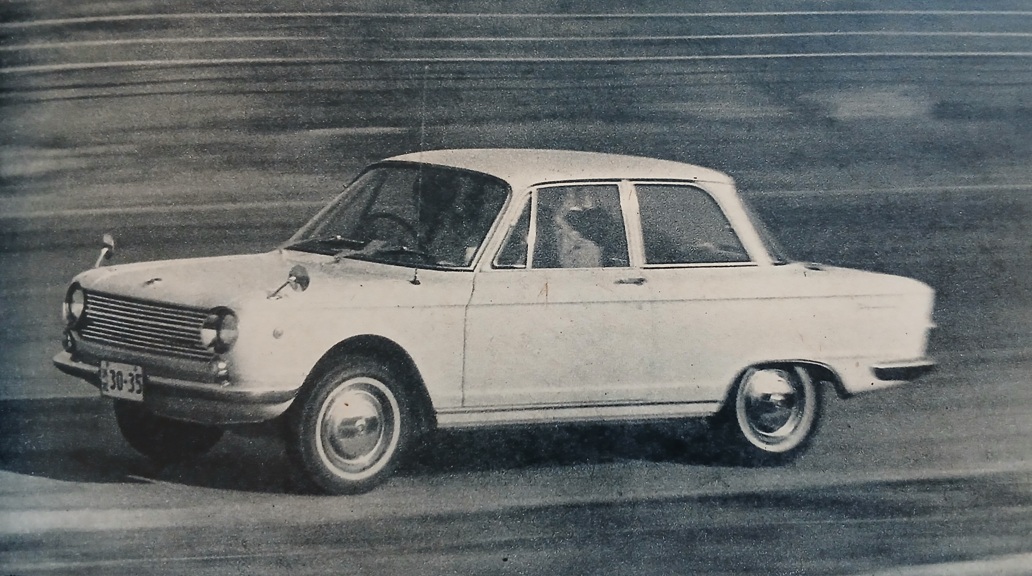
Kumabe: It’s a fine-looking car. The lines are beautiful and quite unlike the usual Japanese car.
Magazine: The body styling isn’t “foreign-made,” then?
Ema: No, it was done entirely in-house.
Higuchi: Quite a few people seem to assume that the design came from Turin.
Kumabe: The car has a 4-speed transmission, but it seems to run extremely well around town if you don’t insist on putting it into fourth and simply use third. Of course, there’s hardly any gear noise even in third.
Watari: That’s exactly right. If you put it into fourth when you shouldn’t, you can get “car knock” and so forth…
Hirao: Even so, because the torque suddenly falls away at low engine speeds, I still felt that you really do need a 4-speed. I think this is another difficult aspect of the two-stroke.
Weight Distribution Is 52:48 with a Full Load of Passengers
Magazine: Let’s move on to the test data. Mr. Ishikawa, could you begin with the results of the tests conducted at the Ship Research Institute?
Ishikawa: Here are the results of our measurements at the Institute. First, as for weight, the car weighed 770kg with the spare tire and tools on board. The catalog figure is also 770kg, so the test car itself was actually lighter than the stated weight by the weight of the spare tire and tools—about 30kg.
Domestic cars in the 800cc class generally weigh somewhere between 550kg and 880kg, so the Fronte 800 can be said to fall roughly in the middle. Next, if we calculate the weight per unit of occupied area, it comes to 134kg/m². Here again, the usual range is 115–140kg, so the Fronte is toward the heavier end of that range.
Since this is a front-wheel-drive car, the front-to-rear axle weight distribution is approximately 59:41. That’s about average for a front-wheel-drive car. As another example, the Subaru 1000 is 64:36.
With the Fronte 800, that ratio changes hardly at all with one person in the front seat. With two people aboard, the front-to-rear percentages begin to change slightly. With the full load of five occupants, the distribution becomes 52:48—in other words, close to 50:50.
One thing I found a little curious in these measurements was that the weight distribution between the left and right wheels is not equal. With the car unladen, the left front carries about 30kg more, while at the rear it is the opposite, with the right wheel carrying 50kg more.
Higuchi: The engine is inclined toward the left, and the battery is on the right at the rear, so I would expect some tendency along those lines, but that does seem rather excessive.
Ishikawa: As for wheel alignment, measurements with the side-slip tester showed fairly large amounts of both toe-in and camber at the front. However, the two are well balanced, so the resulting side slip is practically zero. At the rear, there is virtually no toe-in or camber. We found very little change in any of these figures whether the car carried one person or five.
Next, the brakes. The front brakes are of the twin-leading drum type, while the rears are leading-trailing drums. Our measurements show that the braking is biased strongly toward the front, with the distribution of brake force at about 65:35. The pedal effort required for 0.6g deceleration is 21kg, which is quite low. However, because the front brakes are twin-leading, when they are asked to operate in the reverse direction their effectiveness falls to about 25%. So if the rear wheels should slip off the road on a slope, some care is necessary, because the front brakes will not be very effective in the reverse direction.
Then there is the feel of the brake pedal. The brakes begin to come in at about 5kg of pedal effort, while the brake shoes make full contact with the drums at around 6-7kg. Beyond that point, pedal effort increases almost linearly with pedal travel, at about 1.3kg/mm. Older cars were around 1.5kg/mm, while today’s cars are generally around 1.0kg/mm, so by current standards this can be considered a somewhat firm brake pedal.
The parking brake is an umbrella-handle type operating on the two rear wheels. The operating force required for 1.2g is about 33kg, which is a little heavy. On an ordinary passenger car, the figure for 1.2g is generally around 20-25kg. As for the ratchet action, however, we pulled it with a force of 30kg and 40kg and then released the handle; the braking force was fully maintained, and the ratchet held cleanly.
Generally Light Operating Efforts
Magazine: What figures did the Ship Research Institute obtain for the operating effort of the various controls?
Ishikawa: The 4-speed column-mounted gearshift can be operated with a force of between 1kg and 2kg in all positions, so the effort is very low. As for the pedals, the accelerator effort when maintaining a steady 50km/h in top gear is 2kg, rising to 4.2kg when accelerating hard from that speed. That’s somewhat higher than on other cars, but since it’s still below 5kg, the pedal cannot be called heavy in absolute terms. The other controls, such as the window winders, are also very light.
The clutch pedal requires 5kg to engage and 4.5kg to disengage, so there is very little difference between the two. On an ordinary front-engine, rear-wheel-drive car, the corresponding figures would be about 5kg for engagement and 10kg for disengagement, so the behavior is quite different. Perhaps this is one of the characteristics of front-wheel drive.
Miyamoto: Coming back to the difference in weight between the left and right sides, in countries like Japan where we drive on the left, it’s generally preferable for the wheels on the right side to carry slightly more weight. American cars are all the opposite. Since they drive on the right, the left side is made slightly heavier. It’s said that this is better for keeping the car running straight, and also helps even out tire wear.
Higuchi: Maybe there’s no particular reason why the weight on the left and right absolutely has to be equal. (laughs) After all, there are even cars in France with a different wheelbase on the right and left sides.
Still, if the weight differs from side to side, I imagine it also becomes a question when it comes to things like brake-force distribution at the point where the wheels lock. So I suppose there’s no harm in having the two sides equal…
Miyamoto: I’ve also heard that, since cars in Europe and America are often driven with only one person on board, weight is sometimes deliberately added to the side opposite the driver’s seat.
Watari: Speaking of the brakes, the position of the parking brake is a little unusual. In that location, isn’t it rather awkward to reach when starting on a hill, or if you need to grab it in an emergency? It seems to me that if it’s going to be on the right, it would be better to move it farther over to the right.
Acceleration Tests at Funabashi Circuit
Magazine: Next, could we have the performance test data from Professor Hirao’s laboratory?
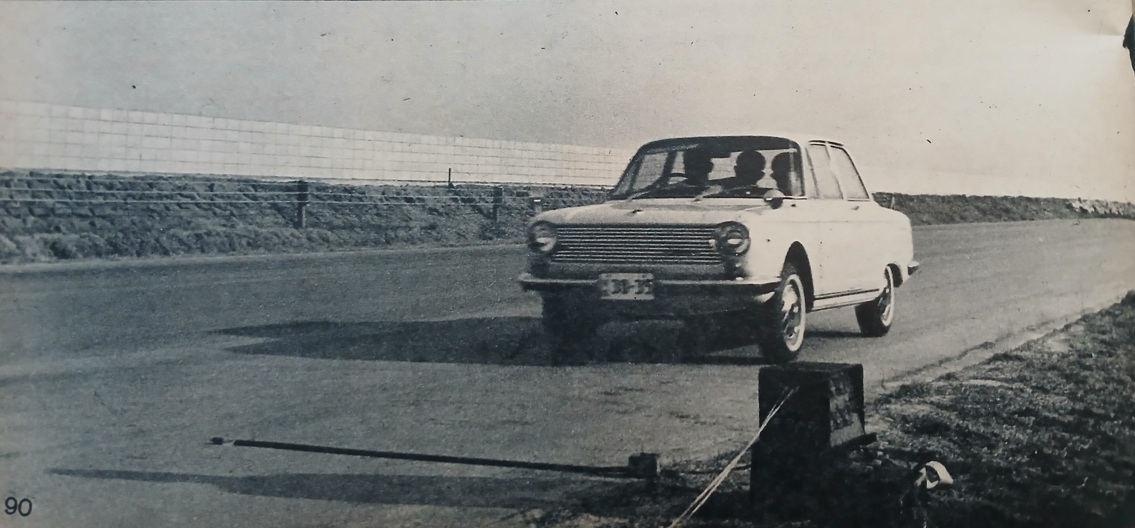
Oguchi: As usual, the tests were conducted with three people on board plus the measuring instruments, for a total load of 198.5kg. This time, however, we used Funabashi Circuit, since the Higashimurayama course was unavailable, apparently due to repair work. This made the conditions somewhat different from those for the other cars we have tested. Still, there was no wind and the road surface was good, so the test conditions were quite favorable overall.
First, standing-start acceleration. In terms of time to distance, 0-50m took 5.8 seconds, 0-100m 9.0 seconds, 0-200m 14.1 seconds, and 0-400m 22.5 seconds. Looking at time to speed, the results were 0-40km/h in 6.2 seconds, 0-60km/h in 11.0 seconds, 0-80km/h in 16.8 seconds, and 0-100km/h in 22.2 seconds. So in the 0-400m run, the car was traveling at a little over 100km/h as it crossed the 400m mark.
Next, for passing acceleration, from 30km/h in third gear, it took 7.0 seconds to reach 60km/h, 12.8 seconds to reach 80km/h, and 21.4 seconds to reach 100km/h. In top gear from 40km/h, it took 8.6 seconds to reach 60km/h, 17.6 seconds to reach 80km/h, and 22.8 seconds to reach 90km/h.
That’s all for the test data, but there was one thing I noticed. On the speedometer scale, there are markings for I, II, and III. I—low gear—is marked at 15km/h, II—second gear—at 25km/h, and III—third—at 50km/h. Normally, these kinds of markings indicate the upper limit for each gear, but these seemed far too low for that. I thought it was rather strange, and during the tests I took each gear considerably beyond those points anyway…
Watari: I did the same thing during my test drive. I remember thinking that it got away from intersections quite well, and I think I was taking even low gear up to around 25km/h…
Higuchi: I didn’t understand what the markings meant at first either. But although the I mark is at 15km/h, it doesn’t mean that 0–15km/h is the operating range for low gear. What it’s telling you is that if you’re running in second and your speed falls to 15km/h, you should be shifting down into low…
Hirao: Yes, if you don’t change down at that point, you begin to feel that there isn’t enough torque.
A Tachometer Would Be Welcome
Takada: Actually, this relates to the “car knock” we were discussing earlier. Since it occurs when the engine speed falls too low, those markings indicate the lower limit for each gear. In other words, when your speed falls to 50km/h, they’re telling you to shift down into third, and at 25km/h to shift down into second. If you do that, the car will run comfortably. As for how far you can wind it out, ordinarily you would take low to around 25-30km/h, second to 60km/h, and third to about 90km/h.
Watari: Still, I think you have to take low up to around 30-40km/h, or you’ll get left behind when pulling away from an intersection.
Higuchi: The owner’s manual calls them the “speed limits,” but that doesn’t explain them adequately.
Watari: No, you can’t really tell what they mean from that alone. Once it’s explained to you, it makes sense.
Oguchi: In that case, I would rather see the car fitted with a tachometer. If you’re aiming for a sporting character, I think it would suit the atmosphere of the car as well.
Higuchi: Conveniently enough, there’s an empty space on the instrument panel to the right of the speedometer. (laughs)
Takada: Regarding the performance figures we just heard, I believe our own in-house figures were somewhat better. The test load today was quite heavy, and there also seemed to be a fair amount of wheelspin at the start. That car has covered only about 190km since it was delivered, so perhaps it hasn’t loosened up yet either.
Oguchi: It certainly felt like a car that had only just come off the line, with the various parts not yet fully bedded in. What figure did you obtain in-house for 0-400m?
Takada: About 22 seconds for 0-400m, and around 13 seconds for 0-200m.
Watari: If I were to ask for one improvement, the shift between low and second felt a little less crisp than it could have been. At first I thought it was simply because the gears hadn’t yet bedded in, but it didn’t seem that was necessarily the whole explanation.
Exterior Noise Below 80 Phons Under Full Acceleration
Magazine: Next, could we have the results of the vibration and noise tests conducted by Professor Watari’s laboratory?
Tateishi: First, the ride vibration frequencies. In the obstacle-crossing test, the sprung-mass frequency was 1.5cps at the front and 1.4cps at the rear, equivalent to 84-90 cycles per minute. The unsprung frequency was the same at the front and rear, at 15cps.
As for the noise measurements, conditions at the Higashimurayama test course and Funabashi Circuit differ in various respects, so the figures cannot really be compared. For reference, though, interior noise was 65 phons at 40km/h, 67 phons at 60km/h, 72 phons at 80km/h, and 73 phons at 100km/h. Exterior noise under acceleration was measured by the ISO method, under full acceleration from the specified 50% and 75% points. Here too, the readings were all below 80 phons, which is relatively low.
Watari: If I were to ask for anything else, I would like to see the sprung-mass frequency lowered a little further. I think that would improve the ride still more on washboard roads and cobblestones. As for noise, at first I drove it without particularly thinking about the fact that it was a three-cylinder, and I thought it was fairly good. But as soon as we reached a rough road, it became considerably worse. Even so, for an 800cc car in this class, I think it’s on the quiet side.
Takada: We feel the noise is fairly good except at idle.
Miyamoto: Of course, there is no valve noise.
Watari: On the other hand, road noise from the pavement surface does seem relatively prominent.
Kumabe: You use torsion-bar springs that allow the ride height to be adjusted. How much adjustment is available?
Miyake: With the car jacked up, the ride height can be changed simply by adjusting two bolts at the front wheels and one bolt at the rear. The range of adjustment is 30mm at both the front and rear.
Higuchi: Last winter I borrowed a Fronte 800 for a skiing trip, and I was able to make it all the way to my destination without fitting the tire chains. Even modest hills presented no difficulty at all. Where ordinary cars were struggling away, the Fronte simply continued without trouble, and it really brought home once again the advantages of front-wheel drive. It didn’t slip, and its directional control in the snow was very sure. I could drive it with complete confidence.
Very Small Blind-Angle Area
Magazine: Next, could you give us the visibility measurement data from Professor Yamamoto’s laboratory?
Hirata: Actually, we only made the measurements this afternoon, so we haven’t finished organizing all the data, but I’ll report what we have been able to put together so far. The details can be presented in the data tables.
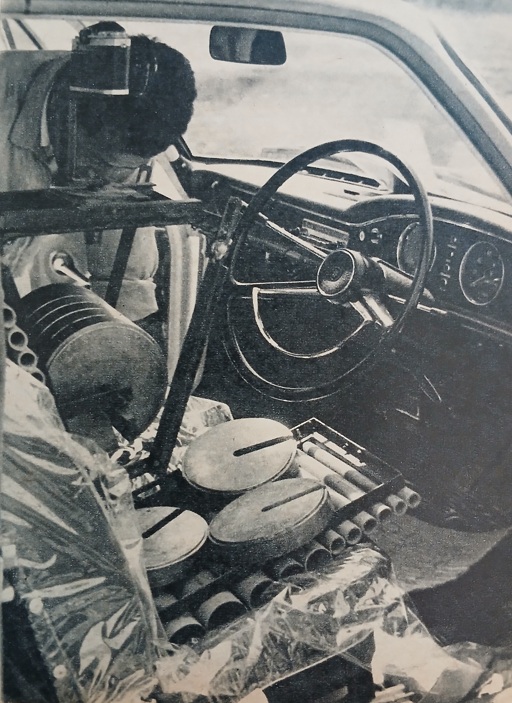
As usual, we positioned a fisheye lens at the driver’s eye point and took a series of photographs looking forward and rearward. The height of the eye point above the ground was 116.5cm with the seat in its full forward position, and remained the same with the seat all the way back. The distance from the lens cap to the windshield was 36.5cm with the seat forward and 47.5cm with it back.
We took ultra-wide-angle photographs forward and rearward at both of these seat positions. With the seat forward, the horizontal field of view to the front was 46° to the right and 69° to the left, for a total of 115°. With the seat back, it was 37° to the right and 62° to the left, for a total of 99°.
The windshield is also very wide vertically. With the seat forward, the vertical field of view was 19° upward and 14° downward, for a total of 33°. With the seat back, it was 18° upward and 9° downward, for a total of 27°.
Through the rear window, the total field of view was 56° with the seat forward and 61° with it back. Then there is the area swept by the windshield wipers. This is something that can best be seen in our actual photographs, but the swept area seems a little narrow in the vertical direction.
The total blind angle in the horizontal plane passing through the driver’s line of sight was 52° with the seat forward, or 14.5% of the full circle, which is very small. A typical passenger car is generally around 16%. With the seat moved back, the figure was 51°, again about 14.5%. Looking only at the forward blind angle, it was 29°, or 16.1%, which is about average.
Magazine: We imagine this has some bearing on visibility, but what did you think of the seats in the Fronte 800?
Watari: I think the seat itself is comfortable, but because the steering column isn’t parallel to the centerline of the body, some people may find the driving position awkward, and the car difficult to drive.
Higuchi: The seat itself is good. The problem is farther down, at your feet.
Watari: Does the seat slide fore and aft parallel to the longitudinal axis of the car?
Onda: Yes, it moves parallel to it.
Watari: That’s why, when you move the seat, the relative position of the seat and pedals changes. I think it would be better if the seat slid parallel to the steering column, so that their relative positions wouldn’t change.
The Relationship Between the Steering Wheel and Pedals…
Higuchi: It feels as if the angle of the steering column, the arrangement of the pedals, and the direction of the seat slide were all determined independently of each other. And I also wonder if something couldn’t be done about the angle of the seatback. Even in its most upright position, it still leans back slightly, and it won’t come any farther forward. These days, quite a few women, for example, drive in a very upright position, so I think it would be better if the seatback could be brought forward another one or two notches…
Terada: The early models were actually like that, but we received various complaints and changed them to the present arrangement.
Watari: At the very least, I’d like to see one ratchet position that brings the seatback up to a right angle—fully vertical.
Miyamoto: There was a foreign car that had a bulge in the center of the seatback. The bulge could be moved up and down, and it made long-distance driving much less tiring.
Higuchi: The steering column is at quite a pronounced angle, but on a long drive we often rest an arm on the window frame and drive sitting somewhat at an angle anyway, so the fact that the column itself is angled doesn’t really bother me. The problem is that the seat and pedals are pointing in a different direction. If the steering is angled, and the pedals and seat were turned to match that angle, I don’t think it would feel awkward at all.
Magazine: Just how far off-center is the steering column?
Higuchi: According to our measurements, the steering wheel is positioned about 50mm to the left of the center of the seat. And the centerline of the seat runs toward the accelerator pedal. So if you sit normally, straight in the seat, facing directly forward, both the steering wheel and the pedals are off to your left.
Watari: That’s why, if you approach it as you would an ordinary car, the accelerator pedal is positioned about where you would expect the brake pedal to be. But if you put your left foot on the clutch first and then locate the other pedals in relation to it on the right, there’s no problem.
Body Dimensions Comparable to a 1000cc Car
Onda: Although this is an 800cc front-wheel-drive family car, its body dimensions are comparable to those of a typical 1000cc-class car. It’s a two-door, but the doors are wide and open through a large angle, so getting in and out is very easy. The overall height is somewhat low, which adds to the sporting impression, and because the styling is rounded throughout, the car is actually a little larger than it looks.
The dimensions inside the cabin are correspondingly generous, and because the floor is flat, the available space can be used particularly effectively. Curved glass is used for the side windows, and there is a fair amount of shoulder room, so I think five people can be accommodated reasonably well. The separate front seats are mounted low, while the steering wheel is set at a fairly upright angle. In terms of sporting character, though, it could stand to be even a little more upright, and I would certainly like to see a floor shift incorporated somehow.
Another feature is the large trunk, although that battery just sitting there does get in the way a little. It seems like there must be some better way of arranging it.
Inside the car, the thing that struck me most about the instrument panel was that all the various switches, levers, and instruments are concentrated too far to the left. On the right there is only the parking brake, starter button, and then the turn-signal and headlamp-dimmer controls; practically everything else is grouped toward the left hand. It gave me the impression that rather too much effort had been made to spare the driver’s right hand. Even in the gauge layout, there is a large empty space to the right of the speedometer. Putting a tachometer there would improve the balance as well.
We’ve already discussed this quite a bit, but the pedals are offset toward the left. Since the floor is flat, I wonder whether it might have been better simply to angle the seat slide decisively in that same direction.
Magazine: Professor Higuchi, could you tell us about the safety aspects and the other points you examined?
Higuchi: Our safety rating system is based on the American GSA standards, with certain considerations specific to Japan and some of my own ideas added. We have drawn up a fixed checklist and use it to rate each item from a maximum of five points down to one. Five points means something so good that it could serve as an example to other cars, while one point means something we would like to see corrected immediately. Three points is average.
The items are divided into such categories as the body, the seating area, and driving-related matters, with 30 items in all. That makes a possible total of 150 points. This car scored 97 points, which converts to 65 out of 100. Japanese cars ordinarily score around 60, so this one can be regarded as slightly better than average.
The one item receiving five points was the absence of projections on the exterior of the body and its extensively rounded form. Four points were awarded for such things as the sturdy body shell with substantial reinforcing members, the safety padding inside the cabin, the wide field of vision, the three-point seat belts, headrests, strong seats, and the padded instrument panel.
At the other end of the scale, the absence of safety grips inside the cabin received one point. The fuel tank in the trunk, the interior door handles that project into the cabin, and the twin-leading front and leading-and-trailing rear brakes each received two points.
These days, of course, many cars emphasize safety as a selling point, but I think it’s quite impressive that this car incorporated safety measures to this extent several years ago.
New Factory Will Provide Full Mass-Production Capacity
Magazine: Since this is a front-wheel-drive car, we had hoped to conduct our oversteer and understeer tests as well, but circumstances at Professor Kondo’s laboratory at Tokyo Institute of Technology made it impossible to do so. Professor Kondo will have an opportunity to drive the car at a later date, but for now, could you briefly explain its handling characteristics on the basis of Suzuki’s own test results?
Oshima: This test data is from around last summer. In both right- and left-hand turns, the car maintains a mild understeer characteristic all the way through. As the understeer-oversteer graph shows, the steering effort is about 4.5kg at a lateral acceleration of 0.6g. Generally speaking, I don’t think that can be considered particularly heavy.
Next is the steering effort at low speeds, measured in a figure-eight test. At a lateral acceleration of 0.3g, this is approximately 3kg. The roll angle, determined from photographs, is 5°20′. That’s also quite ordinary, and there are no particular shortcomings as a result of the front-wheel-drive layout. On the other hand, there aren’t any particular advantages apparent here either. When the car is actually driven over rough roads, however, improvements such as reduced lateral wandering become apparent—qualities that don’t show up in the data.
Magazine: Finally, could you tell us a little about the price?
Ema: The car tested today was the C-10 DB model, priced at 525,000 yen. There is also the Deluxe A, which does without reclining seats and uses ordinary glass, priced at 520,000 yen. Those are the two versions currently available.
It has been said that the car is somewhat expensive for an 800cc passenger car, but rather than trying to make it inexpensive at any cost, our aim has been to make it a solid, high-performing car. In terms of performance as well, we have tried to make it capable of withstanding comparison with cars one class above.
Magazine: What about production?
Ema: At present, production is around 200 cars a month, so you might say that the economies of mass production are not yet reflected in the price. However, a new factory is now under construction, so I think that side of the problem will be resolved before long.
Magazine: Thank you very much for your time and for the information.
Postscript: Story Photos