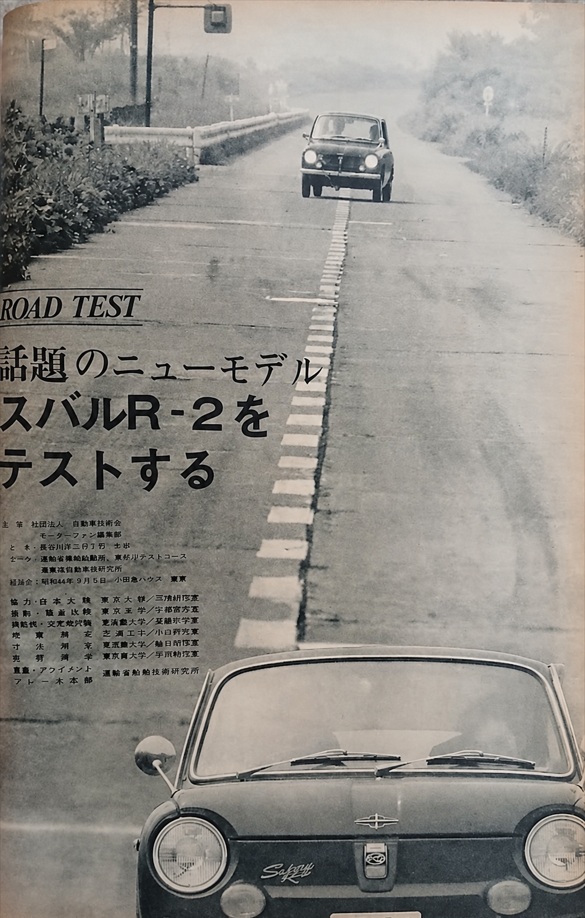
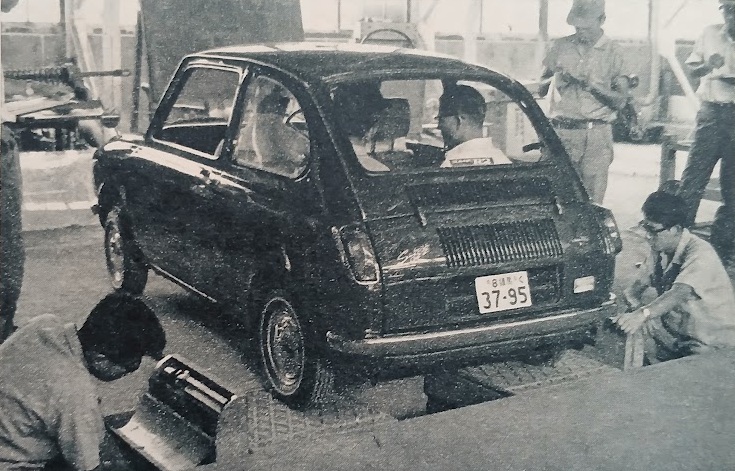
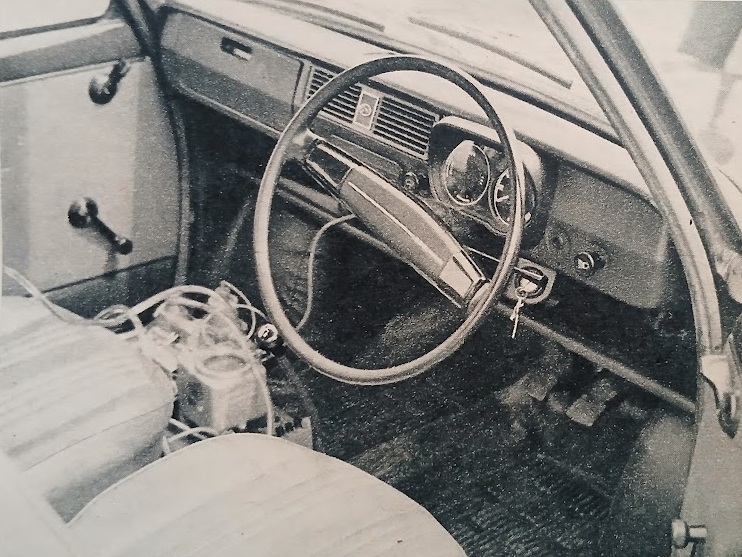
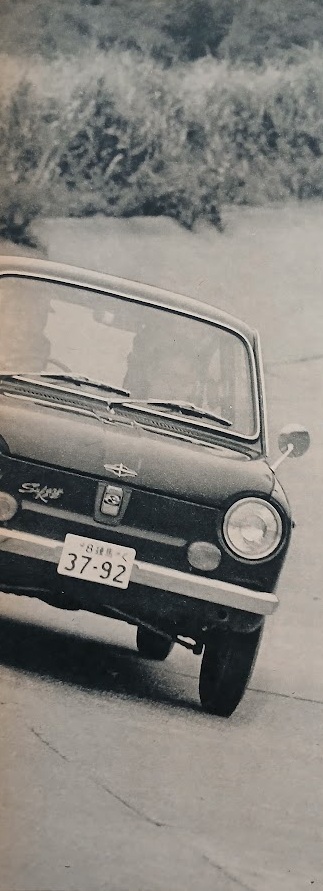
Subaru R-2 (1969)
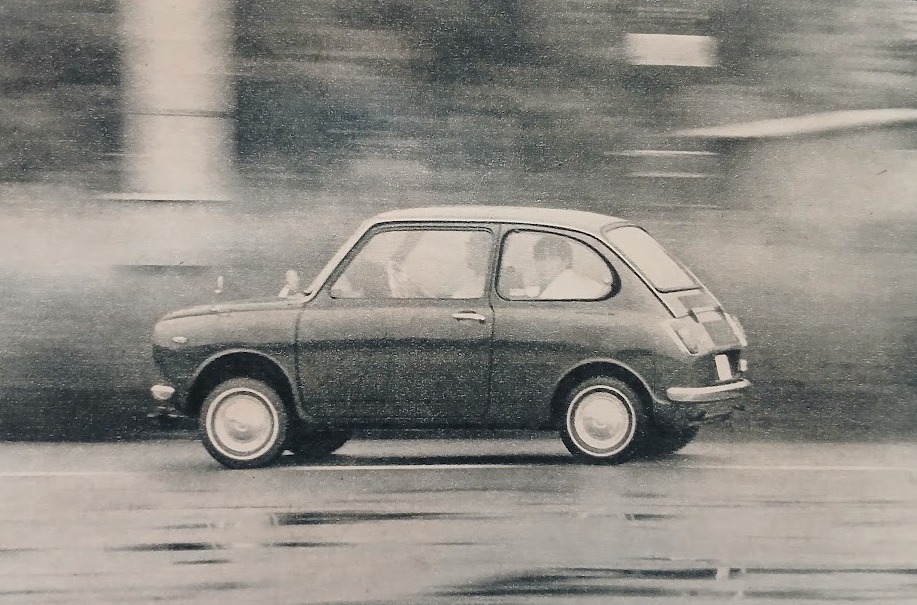
Publication: Motor Fan
Format: Road Test
Date: November 1969
Authors (roundtable): Hiroshi Yamamoto, Osamu Hirao, Akio Miyamoto, Nobuo Tsuboi, Mineo Yamamoto, Yasuhei Oguchi, Haruo Shoda, Kohei Matsumoto, Isao Yasui, Kenji Higuchi, Hiroshi Hoshijima, Yasu Saito, Zo Doi, Kunitaka Furutani, Shigeru Hoshino, Koichi Sakai, Ryuichiro Kuze, Taizo Tateishi, Masahide Sano, Kenzaburo Ishikawa, Toshihide Hirata, Minoru Onda, Kazuo Kumabe, Motor Fan Editorial Staff (uncredited)
The R-2 Is Not a Model Change
Magazine: First, we would like to ask General Manager Yamamoto to tell us about the thinking behind the introduction of the Subaru R-2 and give us an outline of the car.
Yamamoto: The R-2 went on sale on August 15, so it has been on the market for about three weeks now. Fortunately, it has been extremely well received, and orders have far exceeded our ability to keep up with them. We very much regret the inconvenience this has caused.
Let me begin, then, by explaining briefly how the R-2 came about and the thinking behind it. First of all, we introduced the Subaru 360 eleven years ago, and it was very well received. But to speak quite frankly, once newer cars from other manufacturers began to appear, the difference in speed became apparent. Younger drivers in particular, setting aside traffic regulations and other such considerations, are attracted by the feeling of acceleration and by maximum speed. The Subaru 360 may have been extremely economical, with good safety and durability as well, but it lacked appeal in that respect, and this was something we had already been considering within the company. If anything, we had placed too much emphasis on practicality.
That realization led us to conclude that, in addition to the practicality that is characteristic of Subaru, we also needed maximum speed and high-speed performance equal to, or better than, those of other manufacturers’ cars. The R-2 was therefore created as a car that would address, all at once, everything we had wanted to add to the Subaru 360 in response to the criticisms we had received over those ten years—from specialists such as yourselves, as well as from users and dealers.
There have been comments that we were rather slow in developing it, but for our part, we believe we introduced the car with an appropriate degree of confidence and preparation. The fact that it has been accepted by the public, and that its merits are being recognized by all of you rather than merely satisfying ourselves, is, I think, reflected in the strong growth we’ve seen since its introduction. Of course, no car is perfect, so rather than being content with what we have achieved, we intend to move on to our next stage of research.
Magazine: Various magazines and newspapers have described the Subaru R-2 as the first model change in eleven years. But since the Subaru 360 will continue to be sold alongside it, this isn’t actually a model change, is it?
Yamamoto: That’s right. The Subaru 360 is a unique car with excellent economy and practicality, and there is also the matter of after-sales support for used cars and so on, so we intend to continue selling it. In fact, even in August, actual registrations amounted to about 500 cars. So we would like the R-2 to be regarded as a new model added to the same kei-car class, one designed to meet the needs of the times.
A Dynamic Style with a Sense of Stability
Magazine: We had been expecting something more novel in terms of styling and image. What was everyone’s impression when you first saw the car?
Hirao: What would you have to do to make it novel, I wonder? (laughs) Still, somehow, particularly around the rear, it does still have that Subaru silhouette.
Miyamoto: I think the body styling is relatively conventional, but does it offer any advantages over the previous car in terms of manufacturing productivity or ease of repair?
Tsuboi: As far as production is concerned, the previous Subaru began as a low-volume car, so for many years we produced it using methods that involved a relatively large amount of handwork. With the R-2, however, we began with various methods used internationally. We then used what we call a “stacking model”: an actual model is broken down into its individual parts and then assembled again as a complete model. Taking into account the alignment of the dividing lines and the matching of the surfaces, this is then used as the master for the press dies. As a result, the fit of the parts is much better suited to mass production, and I think the manufacturing time has also been considerably reduced.
As for ease of repair, we investigated the rate at which replacement parts such as front fenders, the hood, and doors had been supplied, and used that as a reference in considering interchangeability and ease of removal and installation. But the previous car was already quite satisfactory in those respects, so I don’t think there has been any great change.
Yamamoto (Mineo): I think I understand what you’ve just explained. When we got inside the car, what struck us was how spacious the interior is. It feels more like a car of around 1200cc, and even when you’re sitting in the rear, your knees don’t knock against one another. I think that’s something to be very grateful for.
Oguchi: I’m no expert when it comes to styling, but the car has a very round, plump appearance. Given the requirements of space utilization, I suppose a minicar naturally tends toward this sort of shape. But in terms of what you might call a dynamic sense of stability, I think there is a certain relationship involved.
With static beauty, a proportion of 8:5 seems pleasing to the eye, whereas if you look at something dynamic in a proportion of 8:3, it gives a very strong sense of stability. And if that 8:3 were reduced still further, say to 8:2.5, I think the sense of stability would become even greater. In that sense, I felt that the R-2 has what you might call a dynamic sense of stability—it has more of a beauty of that sort.
Tsuboi: As you have just said, Professor, we also used to think about form in static terms, and in the past we generally determined the shape on that basis. This time, however, we added another way of looking at it: a car is something that moves, and what we see is something in motion, so its shape ought to be determined with that in mind.
We therefore made a full-size FRP dummy of the car, with the window openings cut out, towed it around the test course, and made various changes to the shape as a result. We paid particular attention to the front from that standpoint. We also considered the fact that a car is often seen from behind, so we placed considerable emphasis on how to make it look attractive from the rear as well. As far as possible, we judged the design in terms of how beautiful it looked in motion, and the form that emerged from that process is the R-2.
A Shape More Resistant to Crosswinds
Hirao: On the question of the shape we were just discussing, if you’re going to drive a minicar like this at high speed, it’s inevitably going to be susceptible to the effects of the wind. Wheelbase is one factor in that respect, and among the recent minicars designed for high-speed driving, this one has the shortest wheelbase. Wouldn’t it have been better to aim for a longer one instead? It seems to me that making the most of the wheelbase is one of the most important considerations with a small car.
Shoda: We actually gave that a great deal of thought. There were various factors involved in deciding what wheelbase to aim for, such as improving the ride, but there were also questions such as mud being splashed up, and the minimum turning radius…
Hirao: The minimum turning radius is important too, of course, but so is being able to drive with confidence on expressways from now on. It seems to me that this is important in much the same sense as your efforts to give the R-2 a top speed of 115km/h.
Oguchi: Speaking of crosswinds, I was wondering about the relationship between the center of gravity and the neutral square point. Where does the aerodynamic center of force lie on this car? Somewhere around the dashboard, maybe, or around the steering wheel? I ask because I thought the R-2 seemed to have an advantage in this respect.
Matsumoto: Compared with the Subaru 360, the aerodynamic center is farther toward the rear.
Oguchi: That’s what I thought. And I imagine it has moved much closer to the position of the center of gravity.
Yasui: As for stability at high speeds, such as on an expressway, I think there is a relationship between stability in crosswinds and ordinary straight-line stability. Steering effort is another factor: compared both with the previous Subaru and with other cars, the steering does not become excessively light at high speeds. So I think both its stability on expressways and its stability in crosswinds have improved.
The “Subaru Cushion” Remains
Magazine: We understand that the suspension uses semi-trailing arms at both front and rear. Could you tell us about the underpinnings and the engine?
Shoda: On the previous Subaru, the front suspension used trailing arms and the rear a swing-arm arrangement, but on this car we use semi-trailing arms at both ends. This wasn’t done simply for handling and stability or ride comfort. Within the prescribed kei-car dimensions of 3m overall length and 1.3m overall width, there were also considerations besides improving dynamic performance, such as increasing passenger space while retaining adequate luggage space. Those various requirements led us to this suspension layout.
At the rear, too, the swing-axle system had certain shortcomings in handling and stability on gravel roads, so we made substantial changes around the axle. Improving handling and stability was one of our main goals here, along with making better use of the available space.
Yamamoto (Mineo): At the front, the left and right sides aren’t interconnected, are they? Are they interconnected at the rear?
Shoda: No, they aren’t at the rear either. At the front, there is one torsion bar for each side. At the rear as well, the arrangement is divided in the center.
Yamamoto (Mineo): When you actually drive it, compared with the old car, the vertical motion in bounce has become very soft—it still has that floating, gently bobbing quality. That was a Subaru characteristic, of course.
Oguchi: This is only a subjective impression, so it may not be at all reliable, but I felt that the car had become considerably more resistant to crosswinds. That made me curious about the suspension, so I gradually increased the speed to 60km/h, and then 80km/h, and made some small steering inputs from side to side. Kei cars generally tend to settle rather slowly after this sort of disturbance, but even allowing for that, I felt that this one still didn’t settle particularly well. What I mean is that it hasn’t changed very much from the previous car in this respect.
And the bouncing Professor Yamamoto mentioned may indeed be somewhat pronounced, but in any case it is still there. So my impression was that this is still very much a suspension layout in which ride comfort has been given priority.
Hirao: The nose-dive is much less noticeable than in the previous car, though.
Higuchi: The nose-dive and such is certainly much better, and I think it has been reduced a great deal. But compared with other cars, it’s still there. So when you describe it as “hard,” that means hard in comparison to the Subaru 360, doesn’t it?
Hoshijima: I’ve driven it about three times, and on one of those occasions it was a very windy day. I was traveling fairly quickly as well, and on the round trip to Haneda I found it a little frightening. Not as much as with the previous Subaru, though. As for the ride, that floating sensation has certainly been reduced compared with the Subaru 360, and I think the nose-dive has been reduced as well. But the ride itself is still quite soft.
Greater Stability in Handling
Magazine: Professor Saito, what were your impressions from the handling and stability tests?
Saito: I tend to concentrate mainly on the data, but the steering shows fairly strong understeer. I had several people from my laboratory drive the car and discussed it with them afterward, and the most common opinion was that it had improved over the Subaru 360. There were some comments, however, that its stability after a quick steering input and the like was not particularly good.
In the hands-off stability test, however, as the speed rises the damping decreases gradually. What’s noteworthy is how smoothly it decreases. With a car such as the Fronte, for example, the loss of stability becomes progressively more apparent as speed increases, whereas with the R-2 it develops much more gradually. So even at high speeds, a surprising degree of composure remains. This shows up in the data, and the people in the laboratory who evaluated the car subjectively expressed much the same opinion.
Magazine: Could we please have the data next?
Saito: The practical minimum turning radius measured 4.00m at the outer wheel and 2.37m at the inner wheel; the catalog figure is 4.00m. This puts it roughly midway between the Honda and the Fronte—smaller than the Honda and larger than the Fronte.
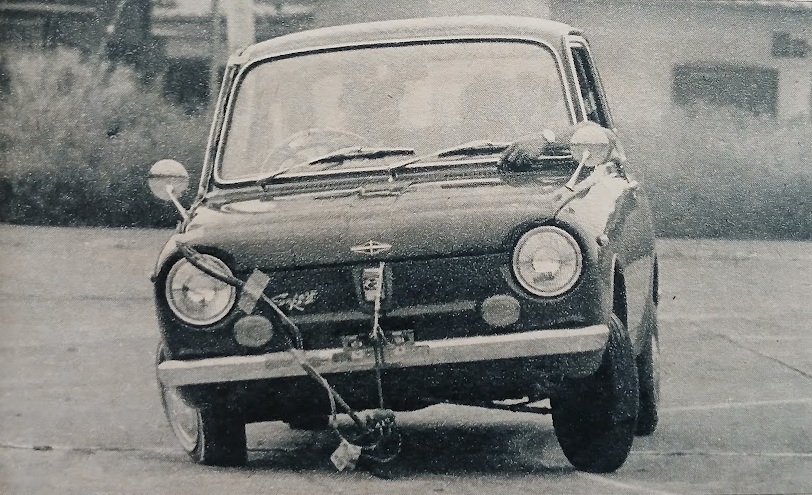
Maximum effort to hold the steering in a turn was 2.4kg, at which point lateral acceleration was 0.55g. That’s about the same as the Fronte and Honda.
During cornering, at a lateral acceleration of 0.5g, the roll ratio was 0.135 in sine terms, corresponding to an angle of 7.75°. That’s considerably larger than the other two cars: 6.6° for the Honda and 4.6° for the Fronte.
Stationary steering effort was also somewhat lighter than on those two cars. Turning to the right, it was 4kg at 90°, 6kg at 180°, 6.5kg at 270°, and 7kg at 360°, with a maximum of 8kg. To the left, it was 6kg at 90°, 7kg at 180°, 7.5kg at 270°, and 8kg at 360°, with a maximum of 8kg. These figures are somewhat lighter than those of the other cars.
In the low-speed steering-effort test, at a lateral acceleration of 0.25g, steering effort was 4.5kg on entering the curve and 2.1kg when exiting. This is fairly similar to the Honda, which measured 5.2kg at the entrance and 0.8-1.7kg at the exit.
In the high-speed slalom test, at 0.25g lateral acceleration, steering effort was 2.9kg to the right and 2.7kg to the left. There was some discussion earlier about whether the steering had become heavier, and compared with the Fronte and Honda, it is indeed considerably heavier. The opinion among those who drove it, however, was that this amount of weight is preferable.
As I mentioned earlier, a fair degree of hands-off directional stability remains. Looking at the recordings, they show very clearly the smooth progression I described before. There seems to be a little pitching, but judging from the data, the car is relatively well-behaved.
Magazine: Mr. Hoshijima, what did you think of the handling and stability in actual driving?
Hoshijima: First, to return to the styling, quite a few younger people said it was “good.” There was some comment, though, that the front emblem is a little too large, and that if it were made somewhat smaller, the car would look larger—or perhaps wider.
As I said earlier, the ride is soft, but the cornering has improved tremendously, and the car is very easy to control. Compared particularly with the previous Subaru, I felt sure that you could take just about any curve at least 10km/h faster.
As for the hands-off stability that was just mentioned, I don’t think it’s something to be particularly concerned about. I think the car can be driven with confidence.
Hirao: I agree.
Hoshijima: Among kei cars, I found it extremely easy to control. Strong understeer was mentioned, but I didn’t notice it very much myself, and the car is extremely easy to control. I imagine that’s due to such things as the lightness of the steering and its good response. After all, no one is foolish enough simply to let go of the car once its attitude has been disturbed, so judged in terms of how easy it is to bring under control, I think it’s a very good car.
Magazine: Professor Saito, you also carried out a cornering test in the rain. How did you find it?
Saito: We haven’t yet analyzed the data from that test, so I can’t give you the results. But I think it’s a good thing for the understeer characteristic to become stronger as speed increases.
Yasui: If I may add something concerning handling and stability, Mr. Hoshijima said earlier that you can take corners about 10km/h faster. We’ve conducted various tests ourselves, and the average speed at which the car can be driven safely on gravel and rough roads is also considerably higher than with the previous 360.
For example, the people who conduct our in-house durability tests drive at what you might call a comfortable pace—or rather, at speeds that an ordinary user could reasonably drive. Comparing that data, too, they seem to be traveling at considerably higher speeds in the R-2. In that sense as well, I think its handling and stability on rough roads have improved considerably.
Hoshijima: The grip of the rear wheels has improved tremendously, and the tail doesn’t swing around nearly as much. I tried it over a particularly bad section around the timber yards at Harumi, and compared with the previous Subaru, I thought the difference there amounted to much more than 10km/h.
Higuchi: I also drove it at 60km/h over an extremely rough gravel road at the university. The previous Subaru would have had me bouncing right out of the seat, but the R-2 has improved considerably in that respect. Of course, if we’re comparing it with other cars, I can quite understand the comments made earlier.
Yasui: We made a point of thoroughly investigating the question of “tire steer” as the suspension moves through its travel.
Higuchi: Looked at in that light, its softness actually works the other way around—it makes this a car you can really drive quickly, and I think that’s a good thing. Other cars that can be driven very fast tend to be extremely firm in ordinary driving. In that sense, I thought this was excellent.
A Different Character to the Steering
Magazine: The character of the steering seems to have changed somewhat, even though it’s still rack and pinion, hasn’t it?
Oguchi: Yes, in terms of handling and stability, my impression is that the steering has taken on a different character. Of course, there’s nothing as unreliable as subjective feel, so perhaps there’s little point in saying this or that purely on that basis, but my impression was definitely that its character has changed.
Hirao: Is that what you meant when you said it was easy to control?
Oguchi: I think the two are related. I also had the impression that the steering feel has moved up a little—toward that of a car in, say, the next class above. I was wondering whether something has changed mechanically, maybe in the rubber bushings or something like that, or whether the mechanism is basically the same and simply produces that result.
Matsumoto: The suspension has changed quite a lot. In developing the car, we wanted above all to make it as easy to control as possible, and that’s how we arrived at this arrangement.
There’s one thing I’d like to ask, though. Our own data give a roll figure of 5.15°. I understand that the methods of measurement are different, and we have discussed before how Motor Fan’s test figures can differ by around 10%, but even allowing for that, the difference seems quite large, and it had me a little concerned.
Higuchi: I would have estimated something closer to 6°, based on how it felt.
Oguchi: It was 7.5°, wasn’t it? I wondered whether it could really be that much.
Matsumoto: At 7.5°, I think it would rank among the softest cars. I don’t think it rolls quite that much…
Hirao: Could it be that it’s especially soft in the first small amount of movement? But once it goes that far, it comes up against some resistance and becomes stiffer?
Doi: We calculated the roll figure afterward, and we also took photographs so that we could compare them with the calculated figure. The photographs give roughly the same result.
Saito: Yes, they agree fairly well.
Hirao: In that case, at 0.5g the photograph actually shows the car leaning by 7.5°, correct? What I’m wondering is whether, for example, if you extrapolate from around 0.3g, the resulting figure might come out a little too high. If you’ve measured it all the way to 0.5g and have a photograph showing that it really is leaning 7.5° there, then yes, you’re right.
But I have the feeling that the roll may build fairly quickly at first and then become nonlinear, meeting much greater resistance so that it hardly rolls any farther. At first, over a very small range, it feels soft and rather loose, and you think, “This is soft,” but then it seems to firm up fairly quickly.
Saito: Looking at the photographs, there does seem to be a bit of that tendency.
Hirao: So the roll is relatively large at low g…. Perhaps at a certain point the rubber bushings come under full tension and stiffen, which would account for the curve straightening out.
Hoshijima: Going back to the question of mud splash, you mentioned that the front wheels had been moved inward because of that…
Shoda: That wasn’t necessarily the reason. (laughs) There are various advantages to having them farther forward, such as easier access.
Hoshijima: I had thought that was the reason, but the wheel housings protrude surprisingly far into the interior, and you get the impression that the driver’s footwell is rather narrow.
Oguchi: It is narrow, but the seat has a surprisingly large range of adjustment. I’m fairly short, but I tend to slide the seat quite a long way back, and with it adjusted that way I didn’t find the pedals difficult to operate.
Hirao: The seat itself faces straight ahead, doesn’t it? At one point, I made a false move and put my left foot down between the clutch and brake pedals. That made me think, “Ah, so the seat really is facing straight ahead.” (laughs)
Higuchi: I enjoy taking kei cars into the mountains, and I’ve noticed that it isn’t simply a question of overhang. Some cars get absolutely covered in their own mud, while normal minicars don’t seem to suffer from it.
Hirao: Even among cars of around 1500–2000cc, there are some that, when you’re driving at about 40km/h, invariably get covered in the mud they splash up. On the other hand, there are plenty of cars where you never even notice the problem. So it certainly isn’t simply a matter of the fore-and-aft position of the wheels.
Matsumoto: We tested that aspect quite thoroughly. Both the amount of overhang and the airflow around the car are involved.
80km/h in Third Gear Is an Attraction
Magazine: Then could we have the results of the performance tests from Professor Hirao’s laboratory?
Furutani: Vehicle weight, according to the manufacturer’s data, was 461kg including the spare tire and tools. Three people and the instruments added 181.5kg, giving a test weight of 642.5kg.
In standing-start acceleration, it covered 0-50m in 5.1 seconds, 0-100m in 8.8 seconds, 0-200m in 13.9 seconds, and 0-400m in 22.4 seconds, against a catalog figure of 21.9 seconds. That 22.4-second figure was the same as for the Minica 70. Expressed in terms of time to speed, the results were 0-20km/h in 1.9 seconds, 0-40km/h in 4.9 seconds, 0-60km/h in 9.0 seconds, and 0-80km/h in 16.5 seconds.
Next, passing acceleration. Starting from 30km/h in third gear, it reached 40km/h in 4.0 seconds, 60km/h in 8.7 seconds, and 70km/h in 11.6 seconds. Starting from 40km/h in top gear, it reached 50km/h in 6.5 seconds, 60km/h in 12.7 seconds, and 80km/h in 24.5 seconds.
Oguchi: In relation to the standing-start acceleration figures, the passing acceleration seemed a little weak. Have you set the gearing somewhat more toward the high-speed side? I think the passing acceleration could stand to be a little better.
Magazine: The gear ratios are very high, aren’t they? Are the engine and transmission basically the same as before?
Hoshino: The basic construction is the same, but the details have changed.
Oguchi: It seems that way. And it finally has full synchromesh, too.
Hoshino: A great deal has changed inside the transmission, and although the engine retains the same basic construction, almost all of its component parts have changed. For example, we changed the crankshaft journal diameter, adopted aluminum cylinders, and revised the piston form and cooling system accordingly. We also adopted reed valves in the intake system, while the exhaust system was redesigned around a new diffuser type.
Magazine: You’ve changed to aluminum cylinders. What are the advantages there?
Hoshino: Our data show that with aluminum, the temperature of the cylinder’s inner wall is about 40°C lower than with cast iron. Ultimately, the objective was to improve engine performance. With the increase in the car’s practical road speeds and the question of passing performance, we aimed to give the engine better high-speed performance.
At high speeds, it was necessary to reduce fan losses as much as possible while at the same time coping with the increased thermal load, but we didn’t want to resort to water cooling. From that standpoint, we regarded aluminum as virtually essential. At the same time, we made improvements at low speeds as well, including changes to the intake system, rather than concentrating solely on high-speed performance, but the main emphasis was on the use of aluminum.
Oguchi: Going back to the standing-start acceleration, the R-2 takes a little time to get going initially. Did you aim for the initial acceleration and then for maximum speed as well, with the result that the middle range has sagged a little?
Sakai: There is certainly some of that tendency. We adopted aluminum cylinders, and reduced the outside diameter of the Sirocco-type cooling fan from the previous 220mm to 190mm. That also made it quieter, but more importantly it reduced fan losses and improved high-speed performance.
Of course, the primary measure was to revise the cylinder timing for higher-speed operation, and we also used a larger diffuser to take advantage of exhaust inertia. We covered the low-speed range with the reed valves, but there is still an area in the mid-range that we haven’t been able to bring up quite as much as we would like.
Oguchi: In figures, I suppose the difference from 40-80km/h is only about 0.4 seconds. So perhaps it isn’t enough to worry about.
Kuze: With our car, in both third and top gear, you’ll get better performance if you start the passing test at a somewhat higher speed than the initial speeds used here.
Sakai: Yes, in top it certainly starts to get into its stride from around 60km/h.
Oguchi: In that case, I think the passing test in top ought to start at least around 50km/h, and the others could probably all be raised to around 60km/h as well.
Hirao: Around there, though, you can just use third, can’t you?
Yamamoto: That’s why there are four gears.
Hoshijima: Perhaps I see it a little differently, but I think it would be rather restrictive if you could only pull third gear to 70km/h.
Hirao: Yes, 70km/h in 3rd would be a problem.
Higuchi: I had thought it was 80km/h.
Hoshino: I thought it would comfortably do around 75km/h.
Hoshijima: What engine speed is it turning at 75km/h?
Hoshino: About 6500rpm.
Kuze: You can safely take second gear to 50km/h and third to 80km/h. It should have the widest range of any kei sedan.
Yasui: When you’re entering an expressway, it’s difficult unless you can reach roughly 80km/h in third. It will certainly manage that much.
Hirao: I would think that 80km/h in third is about the minimum acceptable limit.
Hoshijima: Yes. Personally, I think it could stand to extend a little farther still.
Oguchi: If we’re talking about an actual road speed of 80km/h, doesn’t that give it the widest range in this class?
Hoshijima: I think the Fronte and Honda could stand to go a little higher as well.
Noise That Isn’t Bothersome
Magazine: With an air-cooled two-stroke, noise is naturally a concern. Could we have the test results from Professor Watari’s laboratory?
Tateishi: Here are the suspension vibration and noise results. Sprung-mass frequency, measured at both the front and rear wheels, was 1.6cps. Unsprung-mass frequency was 17cps at the front and 16cps at the rear.
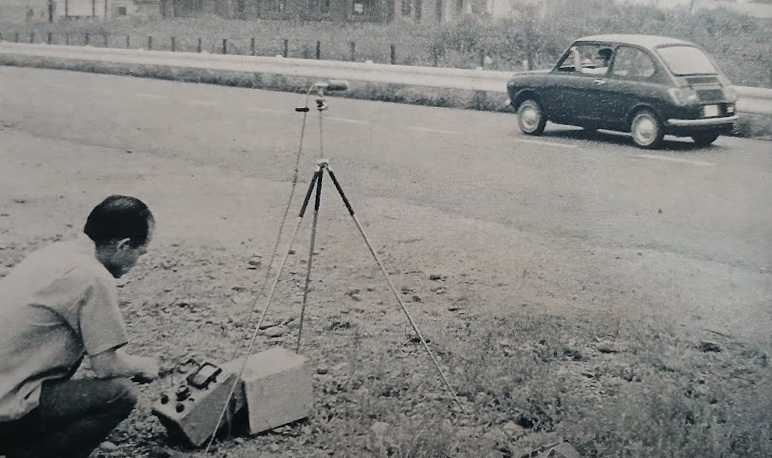
Next, noise. We measured interior noise from 40-90km/h in 10km/h increments. The results were 71 phons at 40km/h, 73 phons at 50km/h, 75 phons at 60km/h, 78 phons at 70km/h, 82 phons at 80km/h, and 83 phons at 90km/h. Exterior noise was measured at 40km/h, corresponding to maximum engine speed in the test gear. The average was 74 phons at steady speed and 80 phons under acceleration.
As for vibration and ride comfort, we have measured the Subaru on three occasions: the 1960 model, the 1964 K111, and now the R-2. Leaving aside the rather floaty 1960 car, when we measured the 1964 K111 the damping had been increased considerably and the ride had improved. The R-2 shows roughly the same sprung- and unsprung-mass frequencies, and consequently similar damping characteristics, so my impression is that its ride comfort is about the same.
Hoshijima: Judging from the cars I drove, noise was one thing I found very unsatisfactory about the Subaru—particularly the sound when running in top at around 40-50km/h.
Hirao: What sort of noise?
Hoshijima: Engine noise. A pronounced vibration—a sort of beating sound. It was quite a harsh sound. There are some very noisy minicars, of course, but I had the impression that the Subaru was noisy even compared with those.
Kuze: There is a slight peak between about 85-95km/h, and once you get beyond that and above 100km/h, it becomes quieter again. So we’ll have to work on eliminating that peak in the future. Even so, I don’t know which particular car Mr. Hoshijima drove, but it shouldn’t produce any noise that is especially bothersome. There was an article to that effect in one of the weekly magazines, so I’d been hoping we could persuade you to drive it again. (laughs)
Tateishi: Mr. Hoshijima, perhaps you weren’t feeling quite yourself that day. On the instruments, at least, it is certainly no worse than the other cars on either the A or C scale. From about 40-70km/h in top, the noise level rises in a relatively straight line, so I don’t think it’s too bad…
Magazine: Next, could we have the fuel-consumption data from Professor Oguchi’s laboratory?
Sano: I’ll start with the constant-speed fuel-consumption figures. At 30km/h it returned 20km/l; at 40km/h, 25.2km/l; at 50km/h, 25.1km/l; at 60km/h, 23.3km/l; at 70km/h, 21.4km/l; and at 80km/h, 19.5km/l. The best figure was 25.2km/l at 40km/h.
Next is our practical fuel-consumption test using a driving pattern modeled on Tokyo traffic. With a 40km/h target speed, the average speed was 22.5km/h and fuel consumption was 14.1km/l. With a 60km/h target speed, the average was 25.6km/h and fuel consumption 11.4km/l. Since the test involves starting from idle and accelerating at close to full throttle, the procedure may be somewhat severe for a kei car.
Wide Visibility and Easy-to-Operate Controls
Magazine: Next, could we have the results of the weight, brake, and alignment tests from the Ship Research Institute?
Ishikawa: First, the weight figures. We measured the car with the spare tire and tools, so it comes out slightly heavier than the nominal weight. With the fuel tank almost full, the total was 461kg. Of that, 186kg was on the front and 275kg on the rear, giving a distribution of roughly 40:60. With either one or two occupants, the proportion on the front increases. With four occupants, the distribution is 39:61, so there is only a slight shift toward the rear compared with the unloaded condition.
As for alignment, the readings on the side-slip tester showed somewhat more than a moderate amount of toe-in and camber at the front with the car unloaded. At the front, there was very little change in alignment with one, two, or four occupants. At the rear, with one occupant, both toe-in and camber became much stronger. With four occupants, this changed to somewhat less than a moderate degree of toe-in and camber.
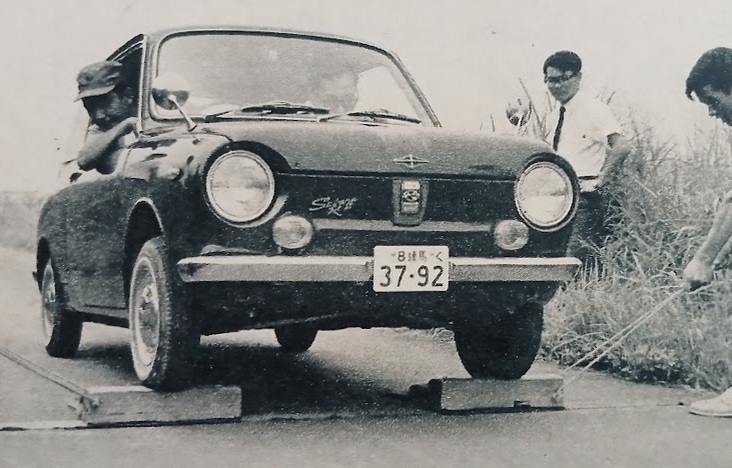
The balance of braking force between left and right was quite even. At a pedal effort of about 26kg, the front-to-rear distribution was 68:32. Since the front wheels carry the lighter load, this means that the braking force at the front is quite strong. The mechanically operated parking brake acts on the two rear wheels and uses a floor-mounted lever. An operating force of only 14kg produced a braking force equal to 20% of the car’s total weight, so it is very light in operation and works well.
The operating mechanisms generally—the gear lever, pedals, window cranks, and the release for the reclining seat backs—are all very light and easy to use.
Magazine: The R-2 is about 15kg heavier than the Subaru 360. What accounts for the increase?
Tsuboi: The body is still a monocoque, but the main reason is that the R-2 has a larger glass area.
Hirao: Is it tempered glass?
Tsuboi: Yes. We haven’t yet adopted partial tempering.
Magazine: Next, could we have the visibility data from Professor Hirata’s laboratory?
Hirata: These figures were taken with the seat set in its middle position. Through the windshield, the visible range was 26.5° to the right and 61° to the left, for a total of 87.5°. Vertically, it was 5° upward and 17° downward, for a total of 22°.
Through the rear window, the visible range was 7° to the right and 37.5° to the left, totaling 44.5°. Vertically, it was 5° upward and 9° downward, for a total of 14°. The windshield-wiper sweep covered 21.5° to the right and 45° to the left, totaling 66.5°.
The total dead angle in the horizontal plane passing through the driver’s eye point was 67°, of which 40.5° was to the front. Since the inside rear-view mirror is directly in this horizontal plane and accounts for about 22°, that increases the figure somewhat. At the front, the angle obscured by the right windshield pillar was 11.5°, and on the left it was 29°.
Expressed in solid angle, the total forward field of view was 1.54 steradians, of which the windshield accounted for 0.608 steradians. The area swept by the wipers was 0.365 steradians, or exactly 60% of the windshield’s solid-angle field.
The rearward visible range was 1.27 steradians, of which the rear window accounted for 0.179 steradians. The visible range through the inside mirror was 40°, or 0.125 steradians as a solid angle, amounting to 69.8% of the rear-window field.
Magazine: Would you say the visibility is good?
Yamamoto (Mineo): Looking at the total visibility, I suppose the best word for it is simply “clear.” The absence of vent windows makes the biggest difference. The visible range through the windshield and the area swept by the wipers are both quite good, I think. Overall, visibility has improved.
Spacious Interior, but Seat Adjustment Raises Questions
Magazine: What were the findings from Professor Higuchi’s laboratory in terms of dimensions?
Onda: As I always say with kei cars, there are first of all prescribed limits for the exterior dimensions, and that has to be taken into account. Inside the car, I think the seats are the main issue. The seat back can be reclined through three stages, giving four positions in all, but apparently this is intended for sleeping rather than for adjusting the driving position. That’s something that bothers me. I would like to see some kind of finer adjustment provided.
On the other hand, it has armrests, which is a first among kei cars, and that in itself shows how much room there is inside.
As for the levers, aside from the reach to the gear lever, I was concerned that your hand can come into contact with the passenger when operating it. In reverse particularly, the lever comes right up against your own knee and forces you into an awkward position. That can be resolved by moving the seat farther back, however.
A great deal of detailed thought has gone into the heater, but the heater switch, the defroster control, and the ventilator controls are somewhat scattered around. Perhaps it doesn’t matter once you’re used to them, but I think they would be easier to use if they were grouped together so that everything could be controlled in one place.
The other point, which came up earlier, is the relationship between the steering wheel and the seat. I was a little concerned about the angle of the pedals. Unlike some other cars, there is no tunnel or anything else to get in the way, so looking at that area alone, I think moving the pedals farther to the left would make the driving position much more comfortable.
Magazine: The ventilation brings in plenty of air, doesn’t it?
Yasui: It provides a very large volume of air. Even compared with efficient systems in 1200-1300cc cars, it brings in more than twice as much.
Hoshijima: The trouble is, with a car that has no vent windows, if you open the windows on a rainy day, the rain comes straight in.
Oguchi: In that respect, I don’t think there’s anything to worry about, since it has such effective ventilation. More importantly, one advantage is those large doors. The first thing that struck me was just how big they are. You really don’t feel as if you’re in a kei car. There’s no sense of confinement, and I had the impression that considerable priority had been given to the driver.
Higuchi: That’s true, but there’s something else: the R-2 is the only kei car in which you can get into or out of the rear seat while someone is sitting in the front passenger seat. In that respect it’s better than a larger car. It’s beyond even the 1500cc class. (laughs)
Yamamoto (Mineo): I thought the rear seat could have been a little softer.
Kumabe: I agree with you there.
Highly Rated Safety Equipment and Maintenance
Higuchi: I’ll cover safety and maintenance next. I drew up our usual list of 30 items and rated each on a five-point scale, giving a possible total of 150 points. The kei cars we’ve tested up to now have generally scored around 100 points or a little less, but the R-2 totaled 117, which is a high figure. Converted to a 100-point scale, that’s 78 points, and a score of around 80 was once the level of the 1500cc class. So in that respect, I think the R-2 rates very highly.
Among the areas that scored particularly well were the safety provisions inside the car, such as the armrests; the location of the fuel tank, which is in a safe position and should remain protected in a relatively minor collision; and the absence of projections from the body that could cause injury if the car struck a pedestrian.
As for maintenance, since it’s an air-cooled two-stroke, there’s really very little to do other than keeping the fuel tank filled, which I think is excellent. If the brakes were self-adjusting as well, there would hardly be anything left to do at all. It would be nice if you could offer that, even as an option.
Magazine: Finally, could you tell us about your production plans?
Yamamoto: From September onward, we’re working on a basis of 10,000 cars a month. We can’t increase production too suddenly, of course, but by stretching things a little, we’re hoping to reach 12,000 a month by this November. We have to keep a very close watch on the various conditions involved, so…
Magazine: Apart from this R-2 sedan, are you considering any other variations?
Yamamoto: We are considering them, but we haven’t yet reached the stage where we can tell you about them. I hope you’ll look forward to seeing what else we have planned.
Magazine: Well then, thank you all very much for your time.
Postscript: Story Photos