Subaru Leone Sedan 1400GL Custom (1972)
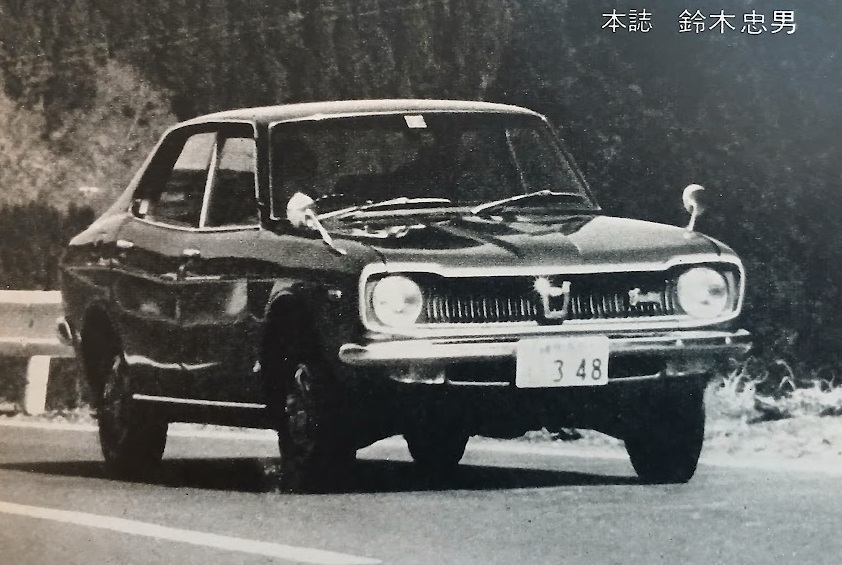
Publication: Motor Fan
Format: Test Drive Report
Date: April 1972
Author: Tadao Suzuki
Increased Utility Adds to Its Appeal
A sedan has been added to the Leone range, offering more interior space and the convenience of four doors. But is improved accommodation the only advantage over the coupe? What about its performance on the road…?
Was the 4-Door Sedan the Original…?
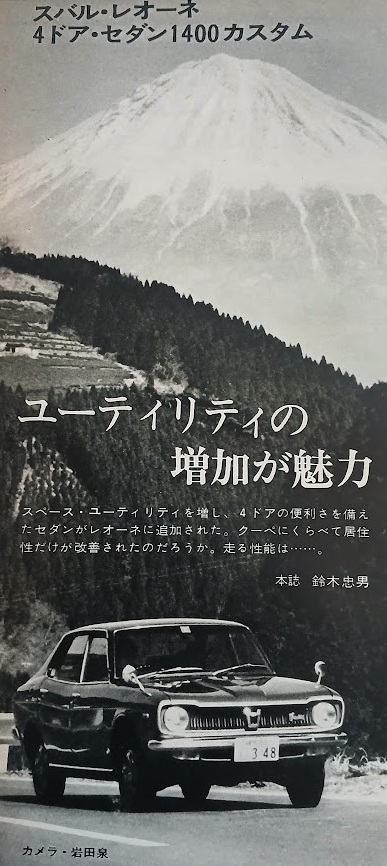
“A captivating sedan born from a coupe” is the advertising slogan the manufacturer has given the Subaru Leone four-door sedan. But was this sedan really born from the coupe? Certainly, the coupe went on sale first, appearing on the streets last October. Yet neither its styling nor the ideas and designs behind its equipment seem particularly convincing as a basis for the sedan. Rather, could the sedan have been the original Leone, with the coupe developed from it? Now that the sedan has appeared, the coupe seems very much like a deliberately contrived variation. And there surely must have been an element of sales strategy behind the decision to introduce the more specialized coupe first. Perhaps I am reading too much into things, but having driven the four-door sedan, I came away wondering whether the sedan was not, after all, the mainstay model in the Leone range.
The coupe has been criticized for its limited headroom, poor rear-seat accommodation, and lack of the space utilization one would expect of an FWD (front-wheel-drive) car. Although it would be going too far to say that the new four-door sedan has silenced all these criticisms at a stroke, it has certainly gone a long way toward resolving them.
If my earlier speculation is correct, Subaru had the sedan ready as its answer all along. On the other hand, if the advertising is to be believed, the sedan represents a successful refinement of the coupe, incorporating lessons learned from it.
Some sharing and rationalization of components is inevitable. Nevertheless, if the coupe can be considered a sporting car for the enthusiast, then Subaru devotees in particular must have found it difficult to part with the ff-1’s front suspension. They would surely have wished to see it retained, at least on the coupe, or perhaps only on the sporting versions. For better or worse, Subaru enthusiasts seem to have certain expectations based on the feeling that “only Subaru would do it this way.” In that sense, the new four-door sedan is a car that should interest a much broader range of buyers, not only the Subaru faithful. There is nothing about it that seems unfamiliar or out of place, and in some respects it could even be described as thoroughly conventional.
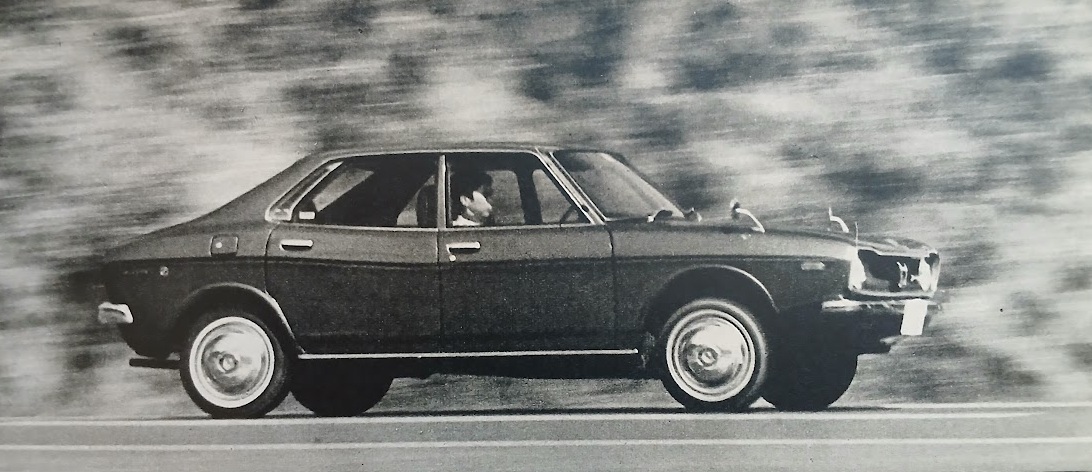
The long-nose, high-tail profile is one of the Leone’s distinguishing characteristics. Judged on styling alone, it suits the sedan particularly well, giving the car a composed, smooth appearance. Compared with the ff-1 sedan, the Leone looks almost smaller, perhaps because of its better-balanced proportions.
When test-driving a new model, I am usually subjected to a barrage of questions from sharp-eyed enthusiasts. This time, however, perhaps because the four-door sedan is so unassuming, the reaction was unusually subdued. As an experiment, I remarked at a gas station, “This is a new car, you know.” The attendant looked at the front, peered into the cabin, and replied, “It’s a Subaru Leone, isn’t it? Has it been updated?” Even when I explained that a new four-door sedan had just been introduced, he looked puzzled and asked, “Didn’t the Leone already have a sedan?”
Perhaps that is just how natural and understated the car’s appearance is. Paradoxically, one could also say that even with the sedan’s restrained design, its strong visual identity as a Leone remains unmistakable.
More Room in the Rear
With the change to a sedan, the roof has been raised by 40mm compared with the coupe. The main benefit is an increase of 35mm in rear-seat headroom. The more upright angle of the rear window also contributes to a greater sense of spaciousness. In a two-door coupe, rear-seat passengers inevitably feel somewhat confined, psychologically speaking, whereas four doors give a much greater feeling of openness. The Leone already had one of the larger bodies in its class, and in four-door sedan form, both accommodation and practicality have been improved.
In the front, however, the increase in headroom is not nearly so noticeable. The roof is certainly higher, but the seat cushions have also been raised, leaving a net gain of only 5mm, compared with 35mm in the rear. Whereas the coupe’s driving position is low and sporting, the sedan has higher seat mountings, with the steering-column angle adjusted to match. The result is an ordinary sedan driving position. Even so, unlike the ff-1, which seemed to insist that “this is how you must sit to drive an FWD car,” the Leone allows the driver to find a preferred position through seat adjustment.
The seats themselves have also changed. In place of the coupe’s backrests with openings, the sedan has conventional high-back seats. They provide reasonably good lateral support, and are quite sufficient for a sedan. On the door side of each two-point seat belt, a hook is fitted halfway up the center pillar. When the belt is not in use, it can be hung there, preventing it from being stepped on and soiled. Nor is there any need to grope around the floor looking for it.
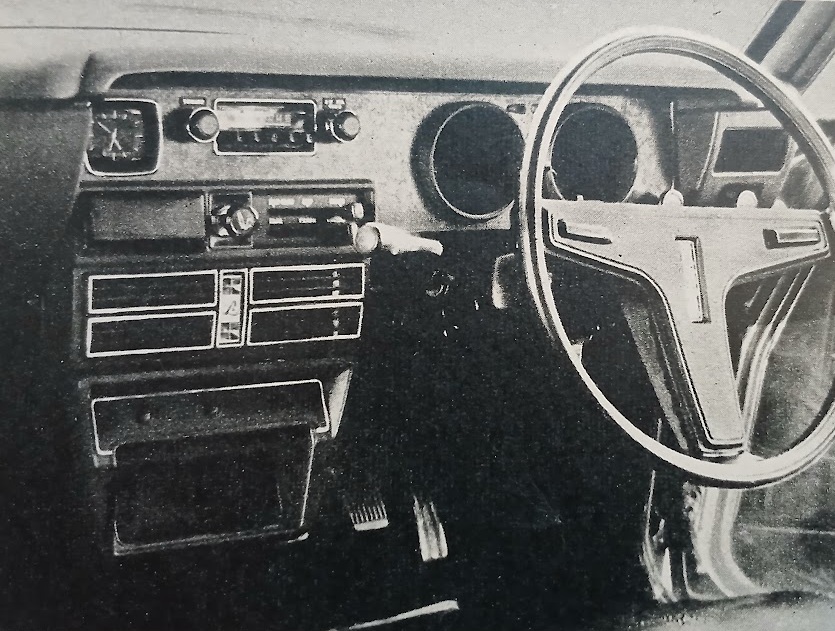
In terms of recovering the space advantages of FWD, the decision to dispense with the center console on the Custom is a step in the right direction. Since the Custom also has a column-mounted gearshift, I expected the center of the front floor to be especially spacious, but there are apparently reasons why it cannot be made completely flat. Although the absence of the center console provides some additional room, a fairly substantial hump remains between the seats and extends into the legroom area. It would hardly be practical to alter the floor pressing only for the Custom, and the shape must also serve some structural purpose.
In place of the console, a small storage compartment called the “Multi-Box” is suspended beneath the center ventilation outlets. This is very convenient, providing space for a built-in stereo amplifier as well as serving as a switch panel for accessories.
An Engine with Plenty of Potential
The Leone coupe does not emphasize its FWD character nearly as strongly as the Subaru 1000 or ff-1 did. Despite the increase in engine displacement, the emphasis has been placed on ease of use, with the improvement in performance remaining largely a matter of potential. The coupe is available with either the sporting EA63S engine (93ps/6800rpm, 11.0kgm/4800rpm) or the standard EA63 (80ps/6400rpm, 10.5kgm/4000rpm), but for now, the sedan range is equipped only with the standard engine.
With the increase to 1400cc, the engine has become more flexible. It may have lost the sharpness of the earlier 1300G, but the additional torque from the larger displacement has made it, to use a common expression, easier to drive. I wonder whether this standard engine might actually have been designed with the sedan in mind. The distinctive engine note has taken on a more rounded quality, losing some of its former sharp edge, but the engine pulls well from low speeds right through to the top end, delivering pleasantly brisk acceleration. There is no cause for anxiety when joining the Tomei Expressway from an entrance ramp. Entering in third gear, the car reaches a speed sufficient to merge with traffic well before the end of the acceleration lane. I do feel, however, that if third gear were brought a little closer to top, allowing another 10km/h or so, the ratios would be better suited to the expressway age.
At a cruising speed of 100km/h, the engine still has plenty of power in reserve, readily gaining speed when the accelerator is pressed further. According to the performance curves, 100km/h in top gear corresponds to approximately 3900rpm. Since maximum power is developed at 6400rpm, there is a margin of some 2500rpm. Furthermore, as maximum torque is produced at 4000rpm, cruising at 100km/h makes particularly effective use of the engine’s available torque.
As I also found with the coupe, the Leone is an exceptionally quiet car at normal road speeds up to around 100km/h. Even the wind noise from the body shape is no more than a faint rustling at that speed, noticeable only if one listens carefully, and is not unpleasant. In a crosswind, however, the sound becomes much louder and can be quite bothersome. At even higher speeds, the wind noise coming from the roof just above one’s head, as I also experienced in the ff-1, becomes quite pronounced.
Setting aside the question of whether the car is physically more or less resistant to crosswinds, I could not help feeling a certain psychological uneasiness. In the FWD Leone sedan, the effect of a crosswind is different from that experienced in an FR or RR car. The car seems to be pushed sideways just slightly after the gust strikes, and it is this delay that feels unfamiliar. Moreover, it is not just a matter of being displaced sideways; there is also the impression of a very slight yawing moment. At high speeds, this may be what produces the feeling of uneasiness.
On ordinary roads, perhaps owing to its substantial 2455mm wheelbase, the ride comfort is comparable to that of a sedan one class above. It is a comfortable car that places little strain on the driver, whether in terms of noise or the flexibility of its engine.
On winding roads, enthusiasts may find the handling somewhat unsatisfying, since much of the characteristic FWD behavior has been suppressed. At normal speeds, however, it should appeal to the average driver. The relatively slow steering ratio is not entirely beyond criticism. Through a succession of tight corners, the steering wheel requires a good deal of turning. It is almost as though the car were admonishing the driver that it is not meant to be cornered with squealing tires, hard braking, and sudden acceleration.
When trying to follow a line I had chosen in advance through a corner, I found it very difficult to place the tires precisely on that line. The relationship between steering angle and throttle application requires particularly careful judgment. It is good that the characteristic FWD tuck-in—the tendency to turn inward when the throttle is lifted—is mild and not excessive, but as I had also noticed in the coupe, there is a certain lack of precision in the car’s path through ordinary corners. It is not a matter of wandering or catching the driver off-guard, so there is no real cause for concern. Still, if I could ask for more, I would like the steering to offer somewhat more feel and just a touch more sharpness. Much of this probably depends on the tires, and the front-to-rear distribution of tire pressures must also make a difference.
The brakes, with front discs and rear leading-trailing drums, had good feel despite the absence of servo assistance.
A Busy Column Shift
The column shift, fitted only to the Custom, has four forward speeds and one reverse, with the same gear ratios as the floor-shift version. At a time when floor shifts are all the rage, I almost felt as though I had been given an unusual new toy to play with. On typical roads, such as in town, it works quite well. But on mountain roads, where frequent gear changes are necessary, I found it surprisingly tiring compared with the floor shift. It also seems to require more effort, while the combined effects of the linkage, the rigidity of the lever, and the directions of its movement make the shift action feel somewhat vague. Gear changes tend to be slower than with the floor shift.
I suspect that some of this complication may be due to having four forward speeds. It may be asking too much in the 1400cc class, but if the gear ratios could be suitably spaced to allow a 3-speed transmission, the car should be easier to drive. For a car intended for family use, I think a 3-speed column shift might work.
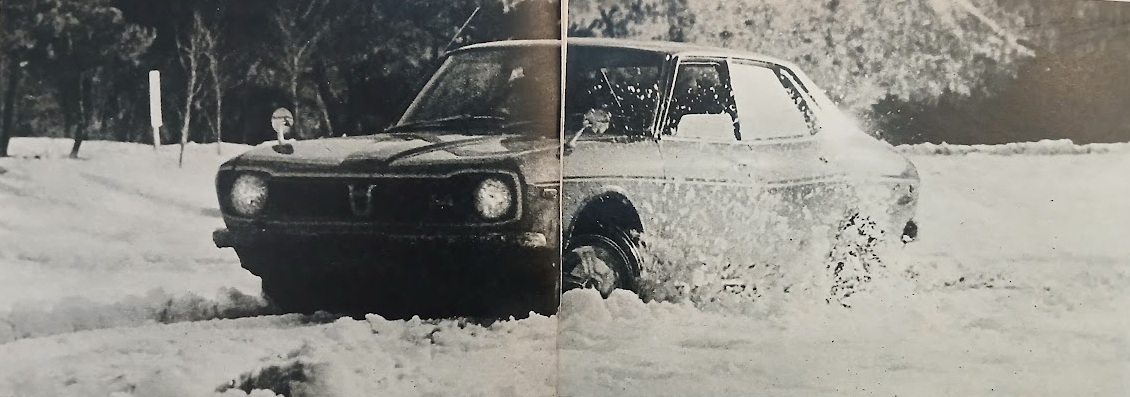
The Leone’s ability to negotiate rough roads and snow-covered surfaces is impressive. Here the generally recognized advantages of FWD are clearly evident. During the test drive, I happened to cross a mountain pass where the snow was melting, and the car coped well with the conditions. The fact that it could make its way through snow on ordinary tires, without getting stuck, should be especially welcome to drivers with families.
Even so, while it is largely true that FWD cars are better suited to snowy roads, and that an FWD car can sometimes negotiate snow that would stop an FR car, this should not be confused with an ability to handle every situation, particularly in the hands of a driver unfamiliar with snow.
Turning to a few minor details, the “illumination lamp” is an interesting idea in itself. But how many people will really appreciate its intended “mood” effect? The Custom is equipped with an electrically heated rear window, a welcome feature when driving in rain or snow. Unfortunately, its ON indicator is shared with the parking-brake warning lamp, so switching on the rear-window heater turns a red light on continuously.
Furthermore, at night, when the headlights are switched to low beam, another indicator lights up—a Subaru tradition stubbornly maintained throughout the range, right down to the smallest cars. The result is a rather colorful display of red and blue lights glowing in the instrument panel.
An indicator lamp on the instrument panel strongly suggests a warning. To my mind, this arrangement is rather like the story of “the boy who cried wolf.” A simpler solution would be to incorporate the rear-window heater indicator into the switch knob itself, and this would also be more convenient when the heater is offered as an option.
The steering wheel is not the four-spoke type used in the coupe, but a three-spoke design with a plain rim. The horn buttons, however, are fitted to only two of the three spokes. On mountain roads and similar routes, it would seem preferable to have them on all three.
As for the purpose of the four frameless doors, is it merely a matter of styling? I suppose they could also be seen as an expression of technical progress.
The ff-1 was also available with four doors. Yet in its styling, interior design, and overall quality, it seemed to offer relatively little that would appeal to the average driver. The new Leone sedan, by contrast, has a certain appeal, even if it is not the kind of car that inspires an overwhelming attraction. In that sense, it is a car well suited to its purpose, and to take a favorable view, one might even think of it as belonging to the class above. It seems equally suited to the middle-aged motorist as a family car, to younger drivers as a practical everyday car, or to a father and son who might share the same car.
Finally, fuel consumption was measured by the full-tank method. Over a test distance of 394.2km, the car consumed 33.54 liters of regular gasoline, giving a fuel economy of about 11.75km/l.
Postscript: Story Photos