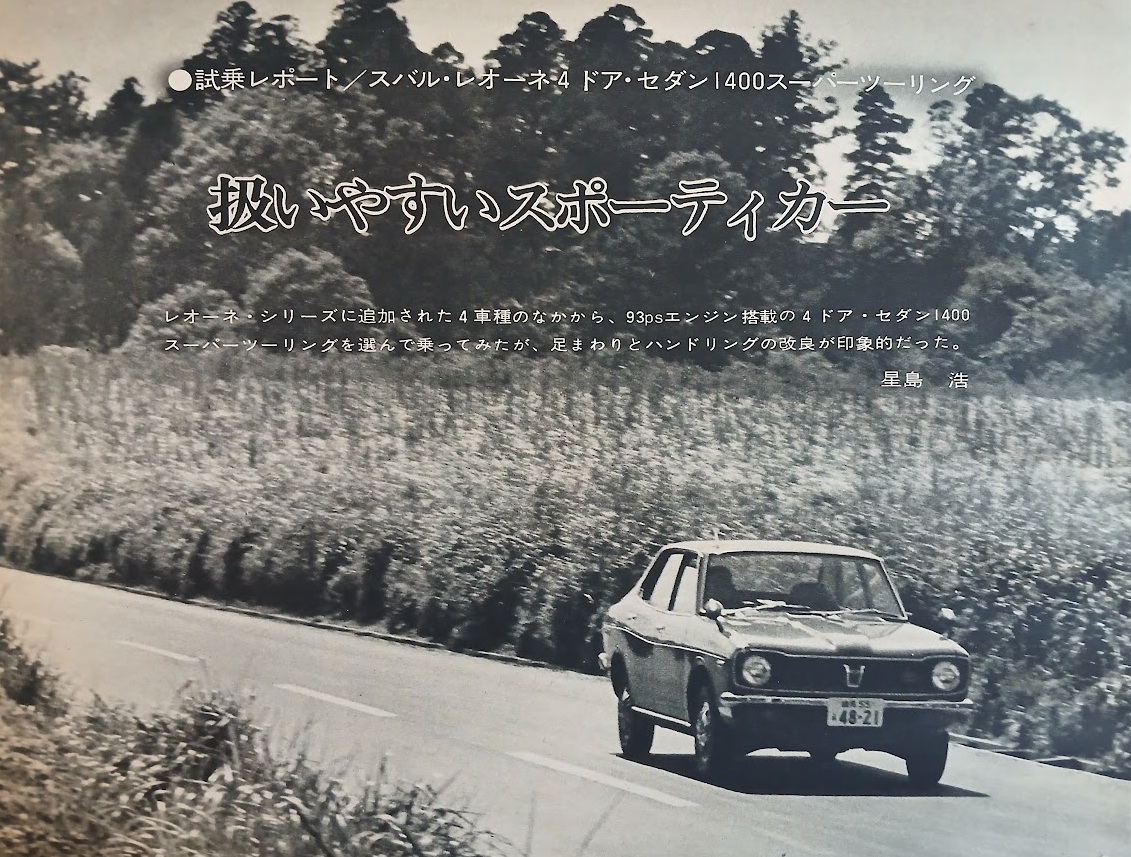
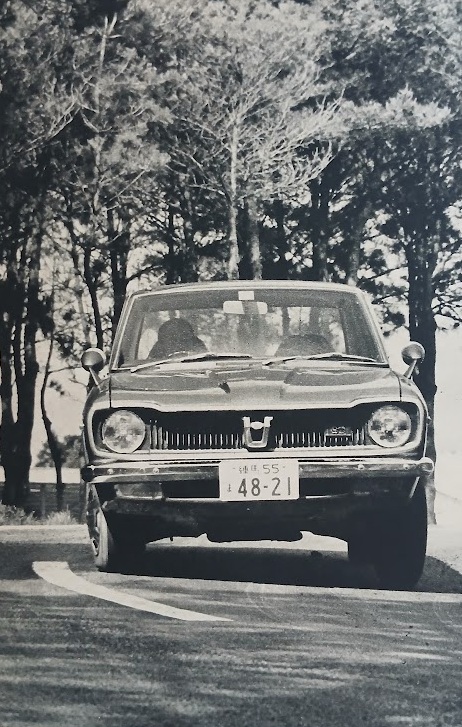
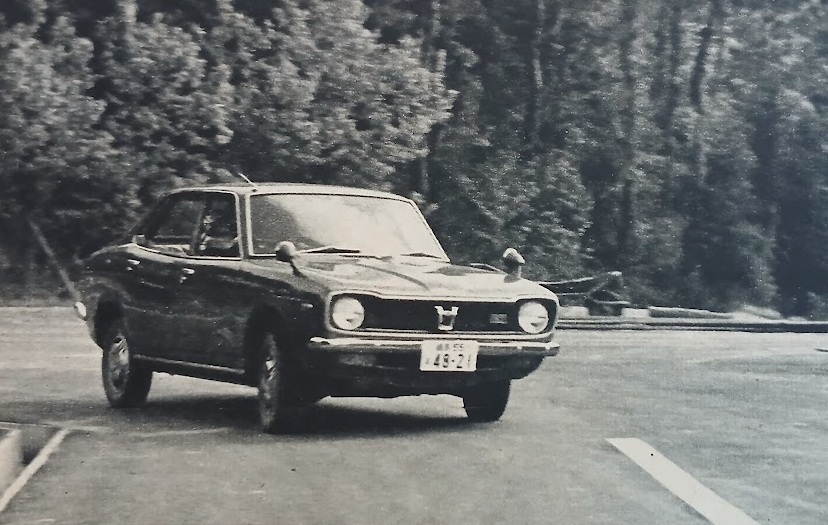
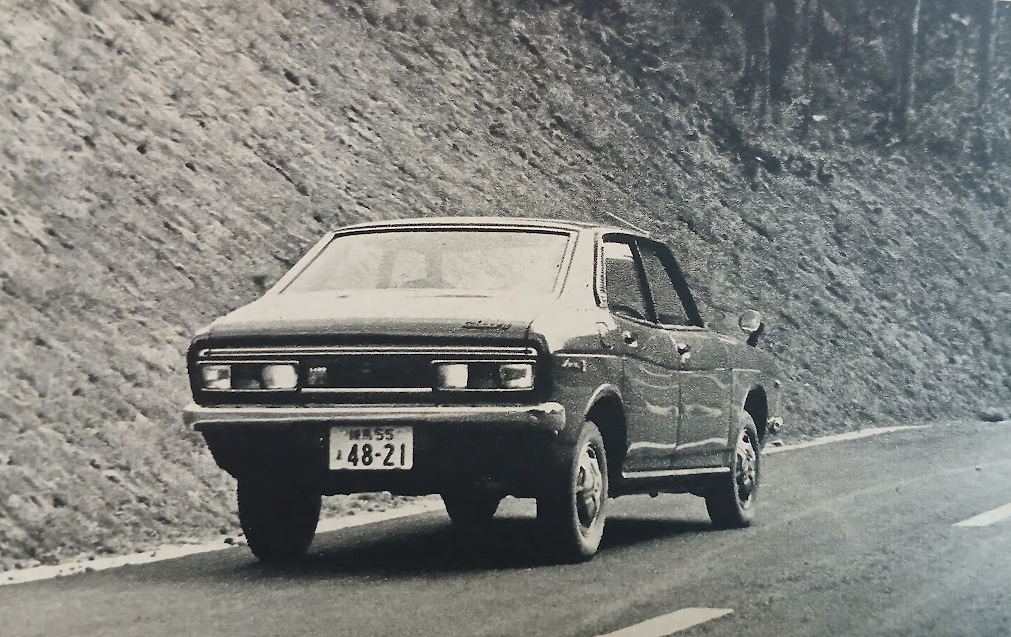
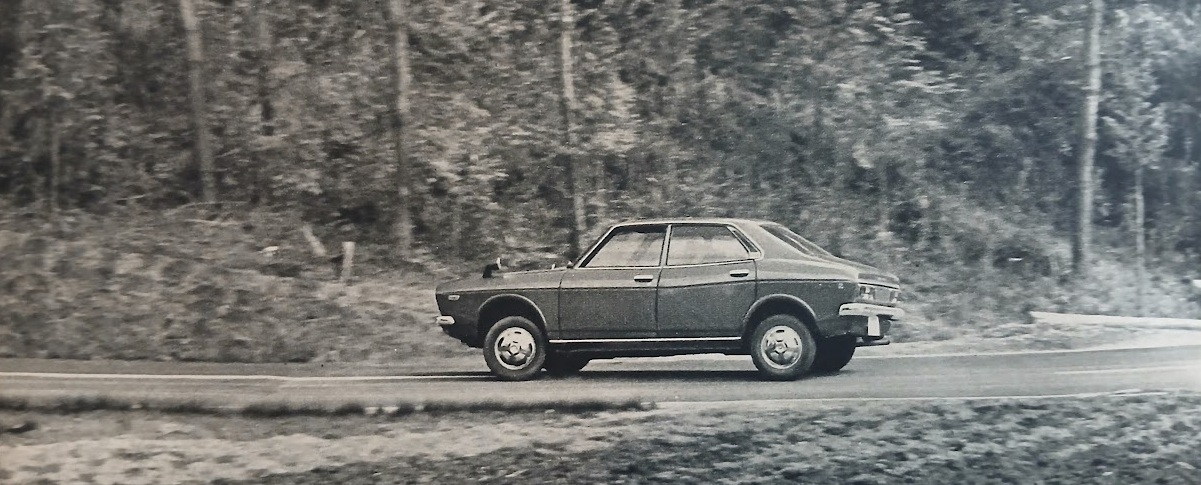
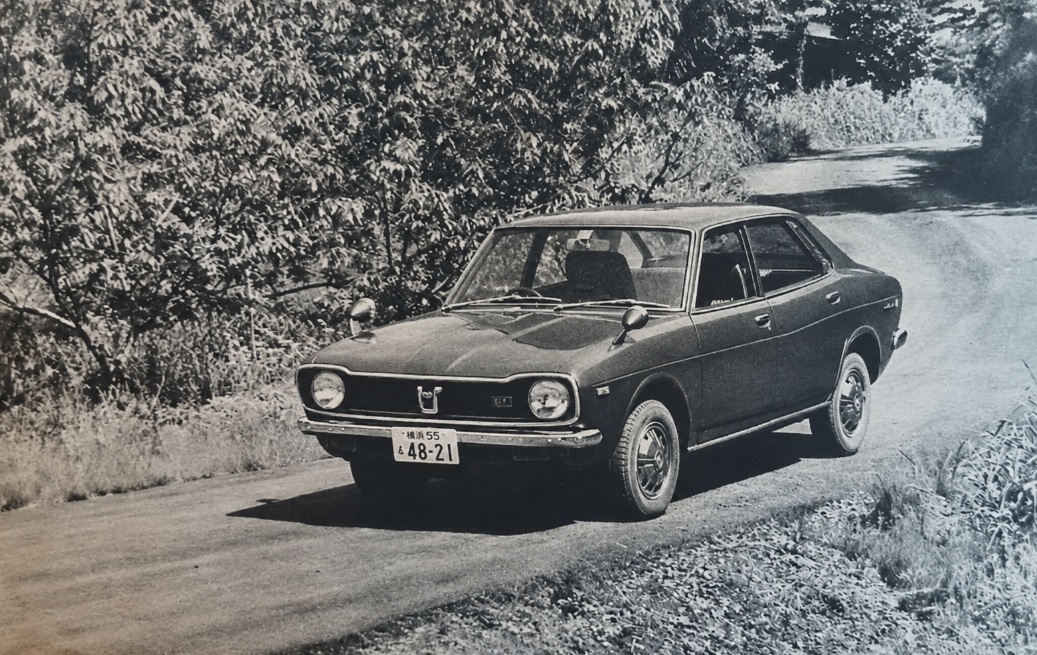
Subaru Leone Sedan 1400 Super Touring (1972)
Publication: Motor Fan
Format: Test Drive Report
Date: July 1972
Author: Hiroshi Hoshijima
A Sporting Car That’s Easy to Drive
Of the four models newly added to the Leone range, I chose to drive the 1400 Super Touring, a four-door sedan equipped with the 93ps engine. What impressed me most were the improvements in its suspension and handling.
Fifteen Models in Sedan and Coupe Form
From the introduction of the Leone coupe last autumn to the latest addition of the 1400 sedan Super Touring (hereafter referred to as the ST), Fuji Heavy Industries has been steadily adding to the range of variations, little by little.
Even leaving aside the estate van, the sedan and coupe lineup now comprises no fewer than 15 models. The coupe, of course, is available only as a two-door, with the twin-carburetor 93ps sports engine in the GSR and GS, and the standard single-carburetor 80ps engine in the GL and DL. The DL is available with either front disc or drum brakes.
The sedan was initially introduced only as a four-door with the 80ps engine, in Custom, GL, and DL versions. From April 22, however, the two-door GL, DL, and STD (Standard) sedans were added, along with the four-door DL and two-door DL and STD fitted with the 62ps engine carried over from the ff-1 series.
And now, in a development that was not entirely unexpected, the four-door sedan has also appeared in ST form with the 93ps sports engine.
Looking at the makeup of the model range, one finds that it bears a striking resemblance to that of the ff-1 and 1300G.
Since there were no coupes in the ff-1 or 1300G ranges, the Leone 1400 GS and GSR coupes correspond to the former sports sedans, while the new four-door ST can be considered the direct counterpart of the Super Touring in the previous range. There is as yet no two-door sedan with the sports engine in the Leone range, but Fuji Heavy Industries should be in a position to offer one quite easily if there is enough demand from customers.
Ultimately, it appears that Fuji Heavy Industries intends to phase out production of the old ff-1 and 1300G and transfer the entire range to the Leone series.
A Different Impression Every Time…
Since last autumn, I have driven the Leone coupe GL and GSR, the four-door sedan GL and Custom, and now the ST. In some cases, such as the coupe GSR and the present ST, I have had two or three opportunities to test-drive different examples of the same model.
My intention is not to boast about the number of test drives or the distance I have covered. The point is that, regrettably, my impressions and evaluation of the car have differed each time I have driven it. After driving cars of the same series eight or nine times, I should by now have formed a fairly clear impression, or mental picture, of the Leone.
And yet, somehow, that picture is still not clear. On broader questions such as the car’s character and its design philosophy, I have no remaining doubts. But each time I drive one, I come away with a different impression of the suspension, the way the engine runs, the effectiveness of the brakes, the weight and feel of the steering, and even such minor details as the operation of the windows.
Usually, the cars made available to us for test drives are some of the very first examples built by the manufacturer, sometimes including pre-production cars. As a result, compared with cars coming off a production line under proper quality control, they may be exceptionally good or, conversely, not very good at all.
It is probably inevitable that some pre-production cars will not be particularly well assembled, adjusted, or prepared, and it is simply one’s misfortune to be given such a car to test. In the case of the Leone, however, this tendency has been especially pronounced.
This presumably accounts for the widely differing opinions of the Leone among the journalists who have driven it. Although the responsibility lies with the manufacturer, if the Leone has received unfavorable reviews for this reason, one must say that it has been unfortunate for the car as well.
Improved Accommodation
To tell the truth, of all the Leones I have driven, I think this new 1400 ST was the best in a number of respects.
The frameless doors and windows, unusual on a four-door sedan, are a distinctive feature of the Leone sedan. When I drove the Custom and GL some time ago, the window regulator handles were so stiff that it was difficult to raise and lower the windows smoothly, but on this ST they were much lighter to operate.
I had the feeling that the quality of the cars was gradually becoming more consistent, although on one of the two STs I drove, there was an unfortunate rattling noise from the window regulator mechanism in the right front door while driving. Giving the door a sharp jab with my elbow from the inside would silence it temporarily, but before long it would start rattling again.
Setting aside the merits of the Leone 1400 ST itself, I prefer the styling of the sedan to that of the coupe.
The windshield has been made 8° more upright, the roof extended both forward and rearward, and the overall height increased by 40mm compared with the coupe. The ST, fitted with 145SR-13 radial tires, is 5mm lower than the other sedans, but it is still 40mm taller than the similarly equipped GSR coupe.
These changes have made the interior much more comfortable, and from a styling standpoint, the short rear overhang is no longer as noticeable as it is on the coupe.
The front grille of the GSR coupe might be described as aggressive-looking, but it strikes me as a rather contrived and exaggerated gesture. I prefer the cleaner appearance of the sedan.
Sporting Equipment and Deluxe Appointments
In terms of equipment, the sedan ST shares much of its specification with the GSR coupe, including the 93ps twin-carburetor sports engine, servo-assisted disc brakes, radial tires, the triple round gauge layout, and the large center console. But the ST is by no means simply a sedan version of the GSR.
The interior atmosphere is still closer to that of the GL sedan.
The first thing one notices is the steering wheel. Rather than the coupe’s distinctive X-shaped four-spoke design, it is a conventional T-shaped three-spoke wheel. The seats, too, are of the conventional high-back type rather than the GSR’s see-through design.
The instrument panel and console are the same as those of the GSR coupe, and as a result, the vent outlet at the far right, previously missing in the sedan range, is provided only on the ST. The light switch is also the pull-out type carried over from the coupe, with a small storage compartment beneath it.
The multi-purpose lever combining the turn signals, flasher, beam selector, two-speed wipers, and washer had previously been fitted only to the deluxe (?) column-shift Custom among the sedans, but it is also used on the ST. Apparently, it was deliberately withheld from the four-door GL and reserved for the deluxe model with the sports engine.
The printed-element rear-window defogger, previously exclusive to the Custom, has also been fitted to the ST. So, aside from the four-spoke steering wheel and overhead console, the ST has sporting equipment comparable to that of the GSR coupe, while within the sedan range it stands alongside the column-shift Custom as a deluxe model.
The rather conspicuous black-and-white checkered seats are on the firm side. They have reclining backrests, with Subaru’s distinctive fine-adjustment mechanism only on the driver’s seat. Unfortunately, the narrow gap between the seat and the door makes this fine adjustment knob extremely difficult to operate. If I could make one further request, it would be for another reclining position with the backrest one notch more upright. Could the fine-adjustment knob not be moved to the inboard side of the seat, to the left of the driver? It should not interfere with the handbrake.
Fastening the seat belts is also awkward. The driver must inconveniently get out of the car to pull the belt forward from behind and to the right of the seat. With the four-door configuration, the center pillar gets in the way, making it difficult to reach the belt.
Improved Suspension
The engine is as quiet as ever. There is a whirring sound when the accelerator is pressed, but the low interior noise level was favorably described in Motor Fan’s road test as being comparable to that of a 2000cc car. From outside, however, the engine has the distinctive sound of a horizontally opposed four-cylinder.
It is only natural that the accelerator pedal should be very slightly heavier than on the 80ps models. The clutch pedal is light, and thanks to the servo assistance, the brake pedal requires little effort.
I measured the timed runs with my wristwatch, so the figures are not precise, but acceleration from 0 to 80km/h took 7.5 seconds, and to 100km/h just under 11 seconds. The car had covered more than 2,000km and the engine was running well. It revved easily.
The gearshift lever appears to be more securely fitted now, as there was no buzzing caused by vibration. The lever travel was quite reasonable, and the synchromesh worked well.
I found the handling to be the best of any Leone I have driven so far. Rather than putting this down to a stroke of good luck, I think it should be taken as evidence that improvements have been made after listening to various opinions.
As I have always said of the Leone, the degree of understeer is so slight that it hardly feels like driving a FWD car. Unless the accelerator is pressed quite hard while cornering, the feeling is much the same as that of an FR car in the 1600-2000cc class. Of course, if one corners in a low gear with torque applied to the front wheels, or accelerates through an uphill bend, the front-wheel slip angles increase and the understeer becomes pronounced.
Conversely, on downhill bends, the rear wheels begin to slide earlier, to the extent that it becomes necessary to unwind the steering mid-corner. However, there is none of the feeling of uneasiness I experienced when driving at Tsukuba Circuit in Motor Fan’s test of FWD cars last autumn, and the suspension settings are much improved. On the other hand, the springs seem to have been stiffened somewhat, and the damping forces in particular appear to have been increased quite a bit. As a result, even when passing over minor irregularities in the road, there is a feeling that once the car has stopped bouncing, inertia gives one’s internal organs one more shake before settling.
Straight-line stability is good, and the car settles well after an abrupt steering input.
A Sporting Character
I do not think there is anything fundamentally wrong with the brakes, but on this test car, for the first time in a Leone, I experienced uneven braking at the rear wheels. When I braked hard from a speed of around 80km/h, only the left rear wheel locked completely, leaving a long, black mark on the road. I had been told that the braking force distribution was heavily biased toward the front wheels, around 80:20 or 85:15. I had also been told that, consequently, rear-wheel lockup was quite unlikely, but I actually experienced it, and this time even left a black mark as evidence.
Now for the conclusion. At 717,000 yen, the ST is 2,000 yen cheaper than the GSR coupe at 719,000 yen. If we take that difference to account for the overhead console and X-shaped steering wheel, it would seem that, thanks to the economies of mass production, we are getting two extra doors thrown in for nothing. It is common knowledge that coupes cost more to produce.
In attempting to give the car a more pronounced sporting character, it may have been necessary to stiffen the springs and increase the damping forces, since the Leone does not allow the ride height and spring stiffness to be changed as freely as on the ff-1 and 1300G. But if tires one size wider had been adopted, might it not have been possible to achieve much the same result without subjecting one’s innards to quite so much shaking? Wider tires might raise concerns about heavier steering, but surely, with appropriate steering geometry, some means could be found of keeping the steering at its current weight?
The four-door GL costs 629,000 yen. I do not know how much it would cost to add the rear-window defogger, multi-purpose lever, and rear-seat headrests, but since the Custom costs 647,000 yen, even with radial tires it should not be all that expensive. Somehow, I cannot help feeling that the Leone sedan does not really need the 93ps engine.
Postscript: Story Photos