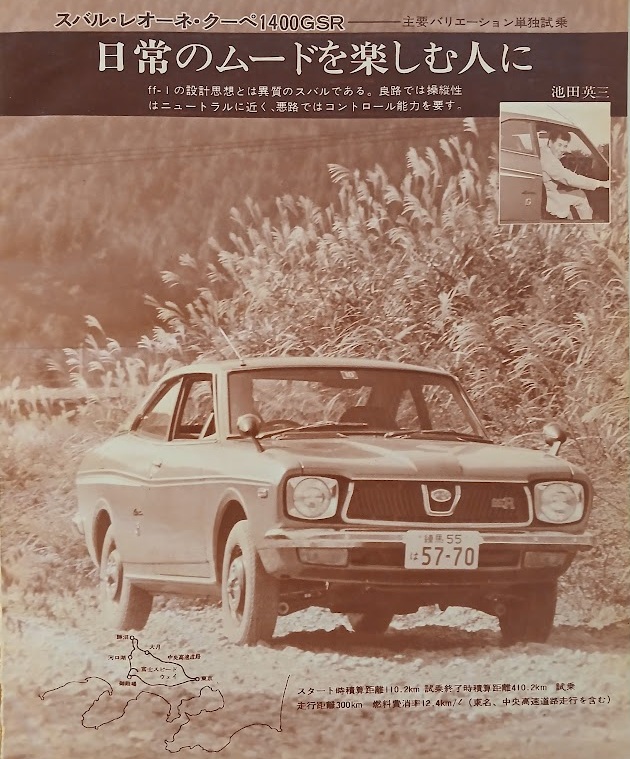
Subaru Leone Coupe 1400GSR (1971)
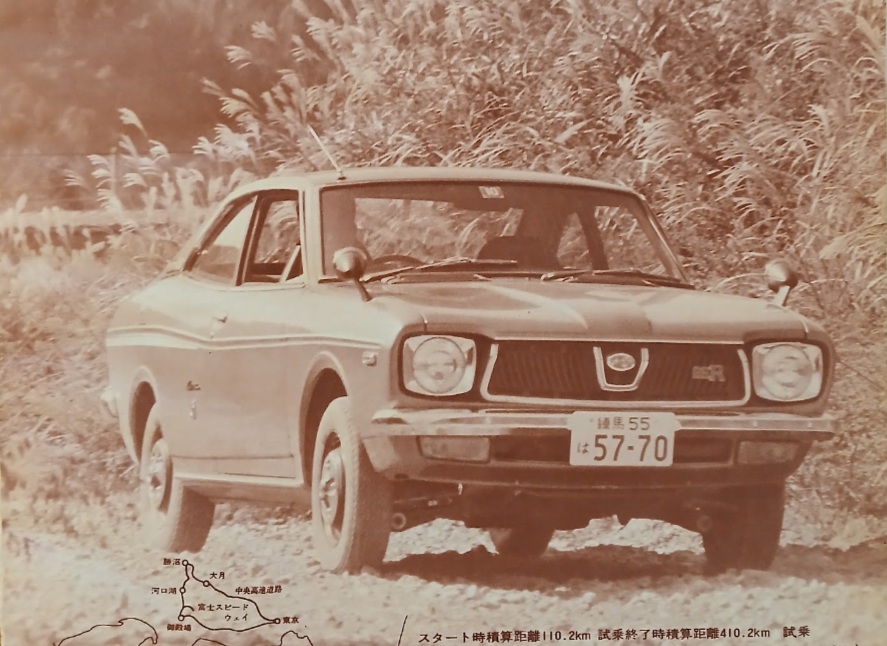
Publication: Motor Fan
Format: Test Drive Report
Date: December 1971
Author: Eizo Ikeda
For Those Who Enjoy the Everyday Mood
This is a Subaru of a different character from the design philosophy of the ff-1. On good roads, its handling approaches neutrality; on rough surfaces, it demands a more deliberate degree of control from the driver.
Styling: A 2+2 Approach
When I first saw the much-anticipated Subaru Leone Coupe in person, my impression was that it had come rather too close to other cars in the same class. In the process, something of Fuji Heavy Industries’ traditional “aircraft manufacturer” atmosphere seemed to have been lost. From the original Subaru 360 through to the front-wheel-drive 1300G, there had been a consistent spirit of advancing small-car technology across every model. Backed by a strong foundation in aircraft engineering, the confidence and ambition of Subaru’s technical team has long held a special appeal for devoted fans of the marque.
However, even Subaru could hardly ignore the realities facing the entire automotive industry–in particular, the emissions and safety regulations looming beyond 1975. In that light, it is only natural that they would have set out to create a car with more built-in leeway in various respects.
After all, the ff-1 itself showed no particular shortcomings or obsolescence, and few would deny that it remained an exceptionally well-balanced design. Starting with the Subaru 1000, it had taken years of development to refine the concept into something that could stand as a benchmark for front-wheel-drive cars in Japan. In that sense, the Leone can be understood as the beginning of a “second phase,” adapting the lessons of the ff-1 to meet the demands of a new era.
At the same time, it is worth noting that, even at the cost of some originality, the direction has shifted toward ease of maintenance and cost reduction. In this respect, Subaru has begun to take on a more conventional, mass-produced, “automaker-like” character.
Whether such sweeping changes will prove effective for a standalone model with a production base of around 4,000 units per month remains to be seen. In any case, it is clearly a different proposition from competing models produced in volumes exceeding 20,000 units per month.
Perhaps it is not an entirely appropriate way to begin a road test of a new model, but my first impression was that the unique appeal of the ff-1 is not something I could let go of easily, nor something I felt should be discarded.
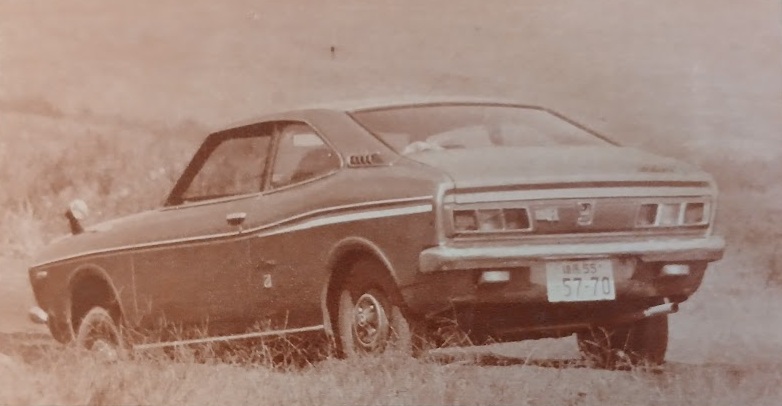
The name “Leone” is said to refer to a lion. This image seems to have strongly influenced the stylists, resulting in numerous decorative touches. Not only the lion’s whiskers, but even its eyebrows appear to have been penciled in. This somewhat excessive ornamentation disrupts what might otherwise have been clean, uncluttered lines reminiscent of Subaru’s aeronautical roots.
Compared with the ff-1, overall length has increased by 65mm and width by 20mm, while height has been reduced by 50mm. In practical terms, these dimensions suggest a car that is not very much different from the ff-1.
And yet, somewhat surprisingly, despite a 35mm increase in wheelbase and a 15mm reduction in ground clearance, the Leone appears visually high-sided. This impression is present not only when stationary, but also during hard acceleration and at higher speeds.
This impression likely stems from the relationship between the wheel-arch openings and the upper body, which appears somewhat compressed relative to the lower section.
Moreover, under hard acceleration, heavy braking, or sharp cornering, the suspension uses enough stroke to nearly conceal the wheel-arch gaps entirely, which only reinforces this visual effect.
In any case, even before attempting to evaluate the styling itself, one cannot help but feel that it sits at odds with Subaru’s long-held philosophy of selling front-wheel-drive cars on the basis of spaciousness.
After all, it is precisely because of the FF configuration that a low floor, a long wheelbase, and a roomy cabin can be achieved. In European cars, where FF has been widely adopted, the primary advantage lies in space efficiency; handling characteristics are, in a sense, a secondary consideration.
At the very least, it seems fair to say that the Leone departs from the thinking behind the ff-1 in this regard. Under the previous philosophy, one would expect this layout to have been developed into a four-door sedan. As it is, headroom is somewhat limited for taller drivers, and both rear-seat space and ease of access fall short for adults. It is, in essence, conceived as a 2+2 in the trendy coupe style, rather than as a truly spacious FF car.
Settling into the driver’s seat, the first thing that stands out is the X-shaped steering wheel, which lends a certain atmosphere reminiscent of a Porsche. The rim is thick, and despite being made of resin, offers a secure grip–good enough that I found no need for gloves. The instruments are also clearly visible through the spokes, making them easy to read. The fact that the steering wheel is not offset is particularly appreciated, and all the controls are within easy reach, giving an overall impression of sound ergonomics.
There are, however, several points that became noticeable during roughly 500km of driving over two days. Despite the otherwise all-black finish, the upper surface of the dashboard reflects in the windshield and intrudes into the driver’s field of view. The cowl ventilator directs air only toward the driver’s side. The decorative console–somewhat incongruous in an FF car–reduces footwell space. The reclining seat offers two-stage adjustment, with nominal fine-tuning, yet in practice the driving position always had to be dialed in within a single range. The door unlocking mechanism lacks clear markings, which could cause confusion in an emergency.
What especially stood out was that, while there is a washer-fluid warning lamp in the overhead console, I felt that a seatbelt warning indicator should take priority. Another very human sort of oversight is that the seatbelt interferes with the reclining lever; during cornering, I experienced the seat suddenly tilting backward. One hopes corrections will be made to avoid these kinds of design errors.
Improved Rough-Road Ability
Driving the top-spec Leone GSR, one comes away with the impression that this is a car with a distinct character–one that requires a degree of familiarization before it can be driven in a sporting manner. Needless to say, this is not simply a matter of it being front-wheel drive. This is also true even for those who have previously driven the ff-1. If anything, whereas the earlier ff-1 had something of the sporty feel associated with Swedish cars such as Saab, the Leone now seems closer in character to recent front-wheel-drive Audis. It does not fall neatly into the mold of the many FF cars from Britain, France, or Italy.
To begin with, there is the matter of driver visibility. On the ff-1, the gently rounded tops of the front fenders gave the driver a reassuring sense of compactness and maneuverability. In contrast, although the Leone’s dimensions are not significantly different, it feels considerably larger. This is not merely an impression: when driving on narrow roads, the position of the left front corner becomes a concern, and one no longer feels inclined to press on along mountain passes–the same terrain where Subaru has traditionally excelled. While this shape may have aerodynamic advantages, for a sporting car one would prefer shorter, lower front overhangs and fenders. (It should be noted, however, that the fender-mounted mirrors on both sides are very easy to use and provide excellent visibility.)
Perhaps this, too, is a matter of getting used to it, but it nonetheless represents a step away from one of the previous car’s strengths. The same can be said of rearward and rear three-quarter visibility.
Turning to the most interesting aspect—the car’s FF characteristics—it seems that models such as the 1300G had a more neutral, less idiosyncratic balance. There are several reasons for this, but foremost among them is the change in front suspension, from the torsion-bar double wishbone setup to the now-popular combination of coil springs and MacPherson struts. While the strut type offers advantages in terms of production cost and space efficiency, it is somewhat surprising to see this layout adopted even by a manufacturer that had previously made effective use of torsion bars. At the same time, the front brakes–formerly mounted inboard–have been relocated to the conventional outboard position. In this respect, the car has become much closer to contemporary competitors (most of them FR in layout). The parking brake, however, remains ingeniously applied to the front wheels.
In practice, the strut-type suspension provides increased stroke, improving rough-road capability. On the other hand, it also makes changes in vehicle attitude more noticeable when the load varies, or when driving and braking forces are applied. This has a significant effect on handling in an FF car. Put simply, the car’s character differs depending on whether it is carrying only the driver or a full load of passengers.
In terms of weight distribution, the front accounts for 64% with no load, which is not greatly different from the ff-1. However, possibly due to the adoption of smaller outboard brakes, the braking distribution is set at a pronounced front bias–on the order of 80:20. As a result, even under hard braking there is relatively little nose dive. However, as an example, when braking with only a driver aboard and then turning into a corner, the front end tends to bite while the rear feels somewhat light.
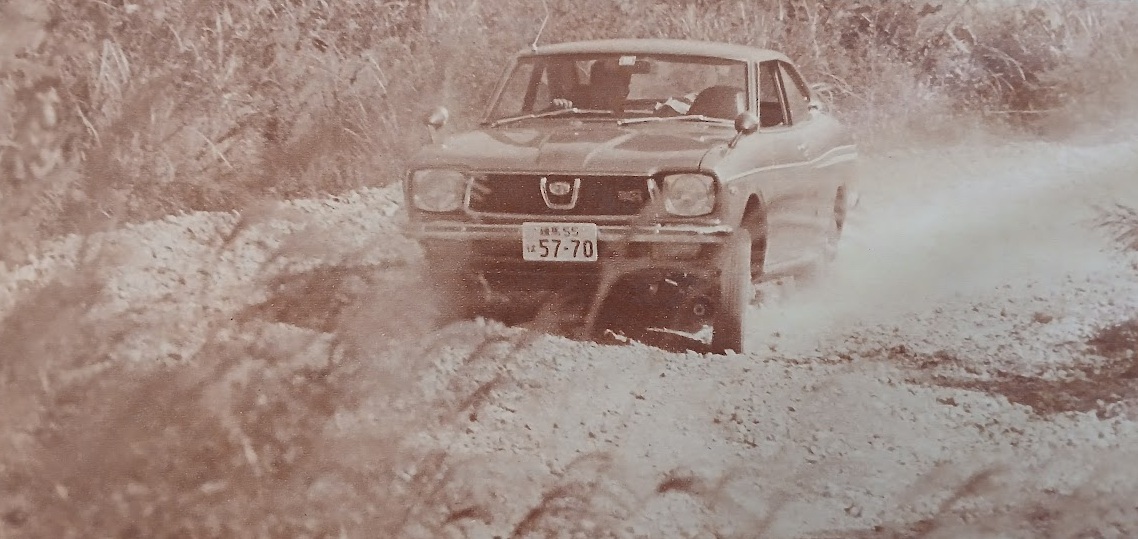
On ordinary paved roads, this tendency is rarely noticeable, and despite considerable body roll the car turns in well. But if the same maneuver is attempted on a slippery gravel surface, the behavior of the rear can change quite abruptly. In other words, changes in body attitude produce subtle variations in available grip. This is a characteristic not present in the ff-1.
The GSR is equipped as standard with radial tires (Bridgestone BS20), and as long as these are fitted, such tendencies are largely suppressed in normal driving situations. However, under more demanding conditions where the advantages of radial tires are reduced, it is something the driver should remain aware of. It is also worth noting that with three occupants aboard, this sense of instability was much less apparent.
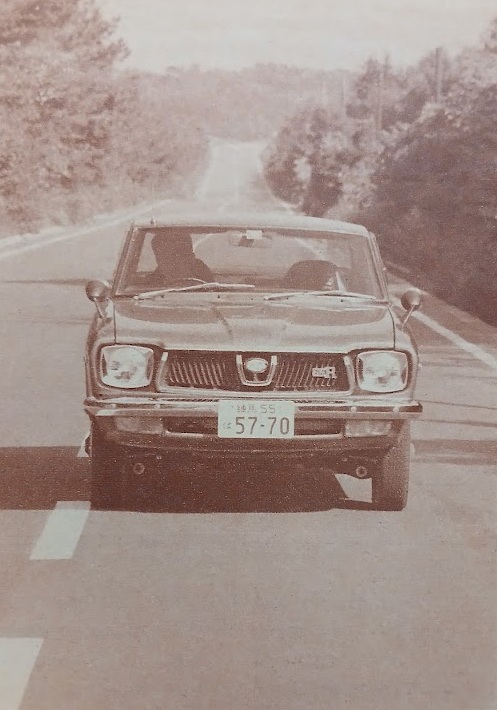
Perhaps it was simply a coincidence, but of the two GSRs tested, one sat noticeably high at the rear, while the other sat lower. Naturally, the one with the lower rear proved easier to drive. Straight-line stability also differed between the two: in one car, steering friction exceeded the self-centering force, requiring constant correction to maintain a straight path, whereas the other tracked far more cleanly. In this respect, the straight-line behavior of an FF car can be surprisingly difficult to generalize. In either case, to hold a steady line between the lane markings, the driver must direct the car with precision. The steering, with virtually no free play, is highly sensitive regardless of gear ratio–this being a matter of geometry rather than anything inherent to front-wheel drive.
As for the engine, the output figure of 93ps is nothing to place undue emphasis on in the 1400cc class. In the context of the overall balance, it is sufficient to say that it tends toward being somewhat overpowered. High-speed acceleration in top gear has naturally improved, but at low and medium speeds one makes frequent use of third gear, as second can feel somewhat overly sensitive in its torque response. In the lower gears, unless one keeps a close eye on the tachometer, it is easy to over-rev the engine.
For drivers already accustomed to making practical use of Subaru’s FF layout–particularly those in snowy regions who have learned to use its characteristics to their advantage–the 93ps version, with its higher-revving, higher-torque nature, may be more than is necessary. Unless one is specifically seeking maximum output, the 80ps version, with its gentler torque curve, would likely prove easier to manage with this chassis.
In general, front-wheel-drive cars tend to be more manageable–and less prone to exposing their weaknesses–when they are not overly powerful. Given the progression from 1000cc to 1400cc, it is debatable whether continuing to pursue this kind of sporty character is appropriate. With the increase in overall potential, one might instead wish for an engine that is more flexible and easier to handle.
On the other hand, if one approaches this engine as something to be actively managed as part of a sporting driving style, it does offer its own form of enjoyment. On a good surface, the clutch can be engaged smoothly even from above 3000rpm, and for the more aggressive, momentum-oriented young driver, there is a different kind of appeal here. That said, I would recommend fitting the available rally-style sports kit rather than leaving the car in standard form. In particular, those intending to drive on mountain roads should strengthen the braking system, as fade under repeated use appears to be a concern.
Finally, although the Leone GSR gives the impression of being the most sporting model in the Subaru range, if one looks beyond its coupe styling, the 1300G is in fact the more sporting car in terms of its front-wheel-drive character. The Leone, by comparison, feels closer in nature to a practical road car.
Postscript: Story Photos