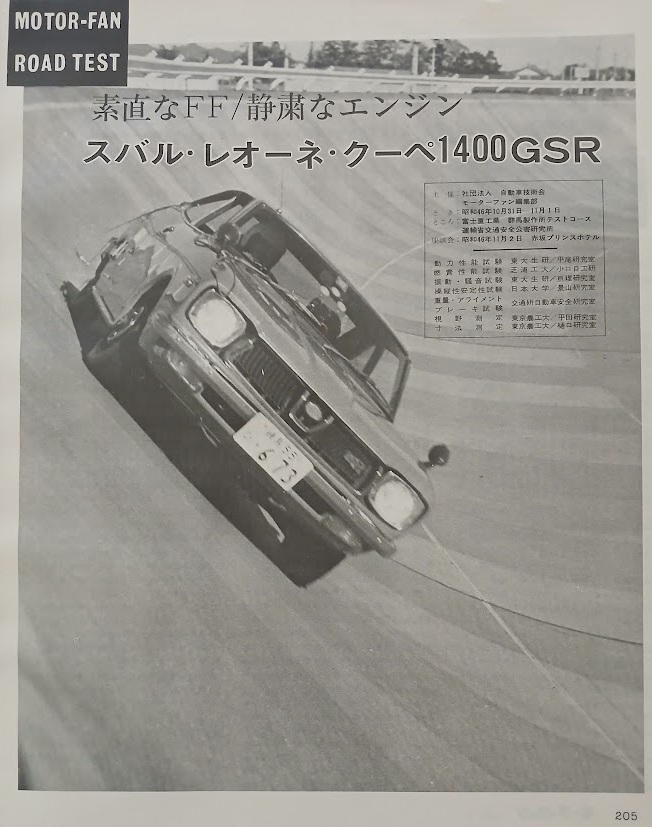
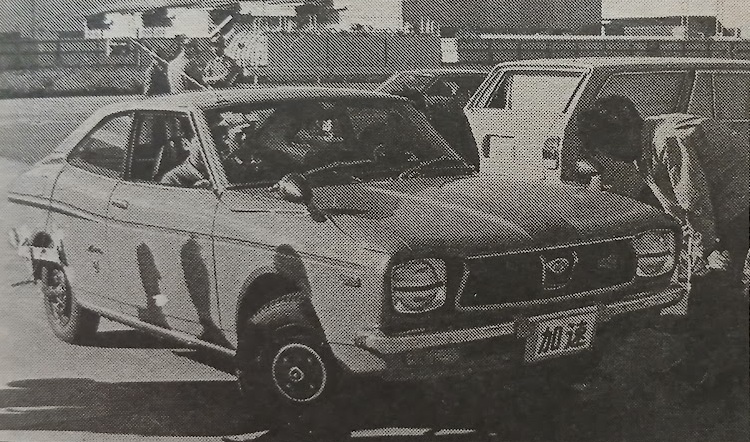
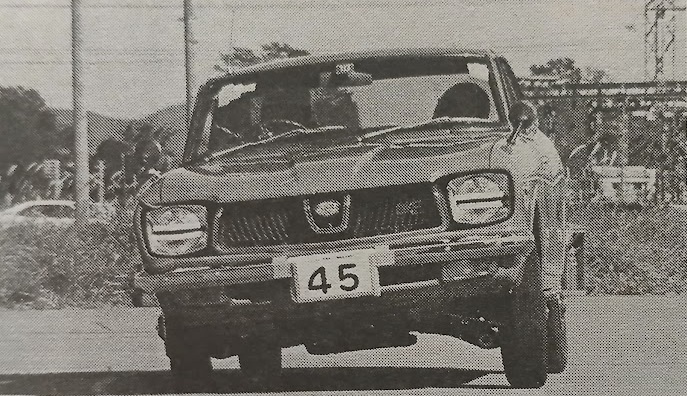
Subaru Leone Coupe 1400GSR (1972)
Publication: Motor Fan
Format: Road Test
Date: February 1972
Authors (Roundtable): Hiromichi Nakajima, Kozo Murota, Hiroshi Hoshijima, Osamu Hirao, Yasuhei Oguchi, Kenji Higuchi, Kohei Matsumoto, Sadanosuke Baba, Mitsuo Takahashi, Katsuzo Kageyama, Kunitaka Furutani, Toru Yamakawa, Toru Yuki, Masahide Sano, Hiroshi Fujita, Hiroshi Okazaki, Kenzaburo Ishikawa, Toshihide Hirata, Minoru Onda, Motor Fan Editorial Staff (uncredited)
Style Takes Priority
Magazine: To begin, could you tell us about the aims behind the Subaru Leone Coupe 1400 and give us an overview of the car?
Nakajima: In May 1966 we introduced the Subaru 1000, a compact front-wheel-drive car. Thanks to its unique character as a product, it was highly regarded both by automotive specialists and by the motoring public. As the market evolved, we increased engine displacement to 1100cc and then 1300cc, while expanding the range with models such as the Super Touring and Custom to meet growing demand for greater variety and higher levels of refinement. We were also honored to receive Motor Fan’s 1970 Car of the Year Mechanism Award, which was a source of great encouragement to all of us at the company.
Since then, market trends have continued to move toward greater sophistication and individuality. In response, we have added the Subaru Leone Coupe 1400 to our lineup.
Although Fuji Heavy Industries has long been known for its unique technology, there has also been a perception that our products were somewhat austere. We felt that an automobile should be something that excites the heart at first sight, and so, starting with Subaru’s FF layout as a basis, we set out to create a product distinguished by fresh, dynamic styling, a luxurious and distinctive interior design, and comprehensive safety and anti-pollution measures.
The car’s principal features are as follows.
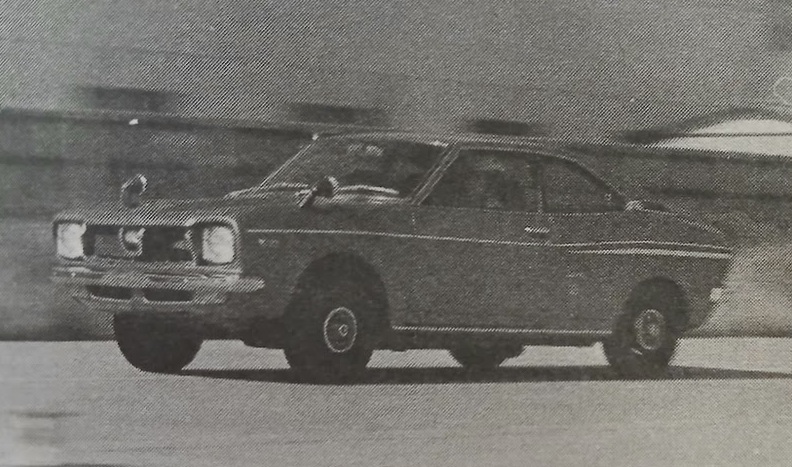
First, its dynamic styling, which we describe as a “long-nose, hot-tail” design. By adopting pillarless doors, we sought to give the side profile a clean, modern character.
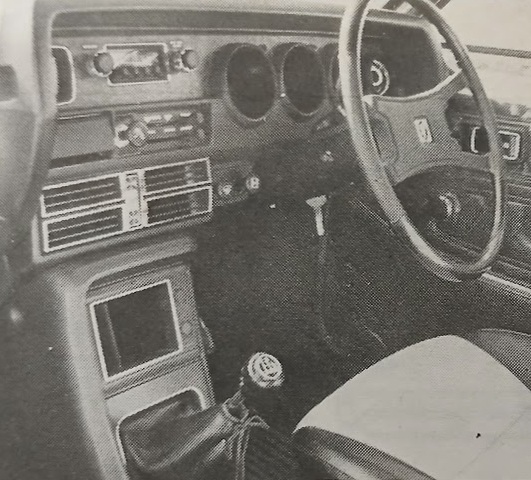
Second, the interior design combines luxury with functionality through features such as a dashboard that wraps around the driver, a four-spoke steering wheel, and see-through high-back seats.
Third, we carefully studied seat placement in pursuit of an ideal driving position, one that would allow younger drivers to sit comfortably with their arms extended. We also sought to improve comfort through such features as a fresh-air/recirculation heater system and forced ventilation.
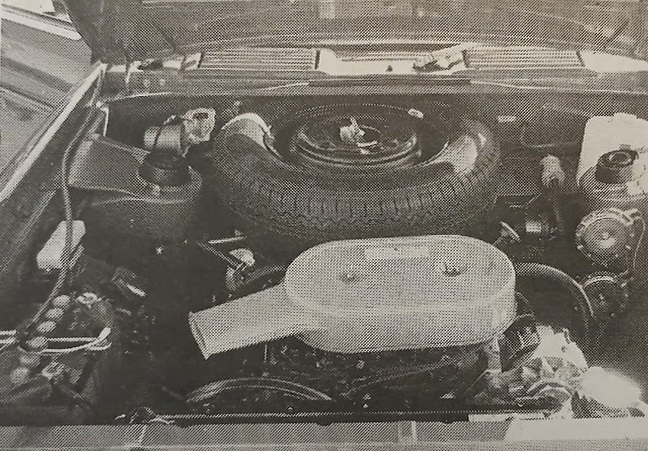
Fourth, the engine displacement has been increased to 1400cc, with particular emphasis placed on improving torque in order to enhance usability and flexibility. We have also adopted an electric cooling fan to reduce power loss, while at the same time achieving a quieter engine.
Fifth, we have given full consideration to the safety and environmental issues that are becoming increasingly important around the world.
Sixth, we have prepared a wide range of optional components so that owners can personalize their cars to suit their tastes. Marketed under the name “Leone Pack,” these accessories form an important part of our product strategy.
Murota: One thing we paid particular attention to in the design and engineering process was avoiding a problem we had sometimes faced in the past: too many people wanting to steer the project in different directions. Reflecting on that, we made a conscious effort to incorporate the ideas of our younger designers.
Perhaps for that reason, some have criticized the car for not seeming very much like a Fuji Heavy Industries product. On the other hand, there have also been criticisms that our previous cars may have been well-engineered products, but not necessarily appealing consumer products. We tried to keep that point in mind as well.
Magazine: Given the advantages of the FF layout, we wonder whether this styling direction is really the main objective, and whether a sedan version is also planned.
Hoshijima: What I find difficult to understand is introducing a coupe first. Or rather, what I find difficult to understand is introducing only a coupe.
It’s generally accepted that coupes sell in smaller numbers than sedans. In spite of that, you’ve chosen to launch only a coupe. Was there some special intention behind that decision? I can’t help thinking that a sedan will eventually follow.
Nakajima: One of our aims was to create, within the compact family-car class, something with the flavor of a specialty car–something that would appeal to younger buyers with sporting tastes, as well as customers who felt that typical cars left something to be desired.
That does not mean we intend to offer only a specialty car. As far as sedans are concerned, the FF-1 series will continue to be developed and marketed just as before.
Hoshijima: I sometimes feel that Japan still hasn’t produced a car that truly takes full advantage of the benefits of front-wheel drive. Whether it’s the FF-1 or the Honda 1300, neither really makes a point of being FF; both aim for much the same character as a conventional car. In Subaru’s case, even the engine itself is unconventional. It seems to me that it might have been even more interesting to pursue individuality and variety by making fuller use of those unique characteristics.
Hirao: There are probably all sorts of difficult considerations involved, but I do wonder about offering only a coupe. Since the FF-1 remains in production alongside it, couldn’t one simply think of the Leone Coupe as the coupe version of the FF-1? The price is a bit higher, but the specifications aren’t all that different.
Oguchi: The fact that there’s no sedan version and only a coupe gave me the impression that Fuji Heavy Industries’ tradition of individuality is reflected in this project as well.
Until now, the accepted formula has always been: sedan first, coupe second. Rather than establishing the sedan and then deriving a coupe from it, you’ve gone ahead and introduced the coupe first, saying in effect, “This is the definitive version.” I found that approach quite interesting.
Hoshijima: I imagine the front-wheel-drive car Alfa Romeo is said to be developing will probably use the Leone Coupe and 1300G as reference points. Yet I have a feeling their car will end up being far more distinctive. That’s the part I find somewhat disappointing.
Hirao: I assume a great deal of study went into the decision of whether to go with a coupe or a sedan. Did you conduct market research as well?
Nakajima: When we looked into it, we found that many people felt Subaru cars were excellent beneath the surface, but somehow lacking in styling appeal. So we decided to keep the substance much as it had been, while placing greater emphasis on style.
Higuchi: When you see the car displayed on a showroom platform and view it from a low angle, its styling features come across very effectively. Out on the road, however, where your eye level is higher, some of that impact is diminished.
People buying their first car often make their decision after looking at the front end in the showroom. By the time they’re buying their second or third car, though, they may be more likely to spot one from behind while driving and think, “Perhaps that’ll be my next car.” In that sense, I feel the rear view as seen from a driver’s eye level is especially important.
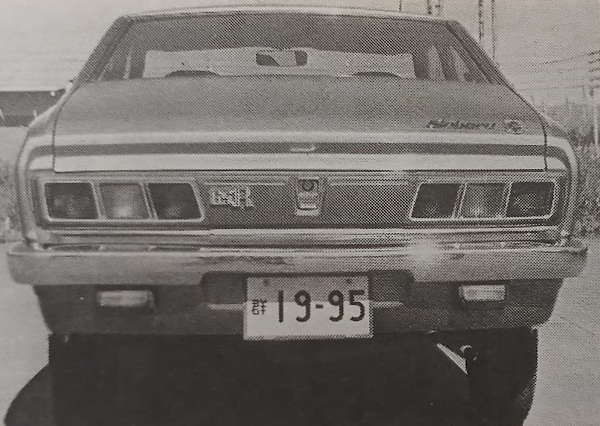
Nakajima: We devoted a great deal of study to the rear styling. The combination lamps, which we call the “cut-in” type, are swept over at an angle, and we emphasized the design by giving the rear fenders a raised, muscular appearance.
Magazine: Among Japanese cars, the roof section gives the impression of being unusually small. Is that one of the styling features as well?
Hirao: The upper section is short and the body sides are deep. That’s the general trend these days.
Matsumoto: From a safety standpoint, I think glass areas are gradually being reduced to the minimum necessary size. In rollover tests, for example, there are cases where the dummy’s arm is thrown outside the vehicle during the roll. In that respect, a smaller glass area is advantageous. That’s one reason we’re seeing a trend toward minimizing window size.
Magazine: Stylistically, the roof seems almost flattened down onto the body. Was that done solely for safety reasons, or was there another intention behind it?
Murota: If you look at the history of our cars, you’ll find that glass area has varied considerably. The Subaru 360 had very little glass, the Subaru 1000 had a lot, and now the Leone Coupe has relatively little again.
When the 360 was designed, the objective was to make it as simple and as light as possible. Steel panels were lighter and cheaper than glass, so that consideration clearly influenced the design. Unfortunately, the body sides ended up being a little too deep, which led to criticism that it had a rather “bathtub-like” appearance.
The Subaru 1000, on the other hand, was designed in response to the view that a car should have enough glass area that, if a woman were driving, her bust would be visible through the windows. But then we began hearing criticism that it was too bright inside, lacked a sense of enclosure, and that the balance between light and shadow was off.
With the Leone being a coupe, we therefore laid the windshield back more sharply and adopted a lower driving position.
The height of the side windows is also determined to a certain extent by the packaging requirements of the engine compartment, and those factors together led to these proportions.
Hoshijima: The low roofline certainly looks attractive, but I wonder whether it was really necessary to sacrifice so much rear-seat headroom in the process. Giving priority to the front occupants is fine, but with an FF car, shouldn’t one of the fundamental ideas be providing generous space in the rear as well?
Higuchi: In a coupe like this, people generally spend only a short time in the back seat. From a practical standpoint, it might have been better to sacrifice some rear-seat cushion thickness in order to gain additional headroom.
There’s almost a kind of enthusiast’s self-denial involved in insisting that a coupe’s rear seat ought to be cramped. It seems to me you could lower the hip point by 3-5cm and improve matters considerably. Of course, I’m only judging from the outside and don’t know what constraints may exist beneath the surface.
Murota: The floor pressing imposes limits on how far we can lower things, and that’s essentially where we reached the limit.
As for rear-seat accommodation, compared with other cars it certainly isn’t generous, but neither is it among the worst. It’s tight, yes, but I think we arrived at a fairly reasonable compromise.
Higuchi: My point is that an FF layout ought to make that sort of improvement possible.
Hirao: If you’re going to build an FF car, I think you should take full advantage of the benefits that FF offers.
Murota: You’re quite right that we emphasized the FF layout when we developed the Subaru 1000. The thing is, from the customer’s perspective, whether a car is FF or FR doesn’t really matter. What matters is that it can be driven naturally and comfortably, regardless of the layout.
There’s also a risk when a small manufacturer tries to distinguish itself by producing something too unconventional. That’s why we think in terms of individuality within standardization. The question is how to create individuality within the framework of mass production, where everything is inevitably standardized.
We felt that a car which expressed the advantages of FF one hundred percent–a car that merely satisfied its designers–might actually be the wrong approach. That’s a philosophy we consciously reflected in the Leone.
Magazine: In other words, a designer’s personal vision alone may produce a good product, but not necessarily a successful commercial product. Even so, the planned production volume for the Leone seems rather modest.
Baba: Some components have changed, of course, but the Leone still shares a considerable number of parts with the FF-1. By producing the two together, we hope to achieve the benefits of larger-scale production.
Initially we’re aiming for a combined FF-1 and Leone volume of around 5,000 units per month, eventually increasing that to 6,000. With exports accounting for roughly 2,000 units, we believe a total of 7,000 to 8,000 units should be achievable.
At that level we can obtain the economies of scale necessary to make the program profitable. Anything beyond that would simply be a welcome bonus.
What Are the Advantages of Front Struts?
Magazine: We’d like to hear a bit about the car’s mechanical features—particularly the front suspension and the cooling system.
Takahashi: Although we have not carried over the dual-radiator system that was one of the distinguishing features of the FF-1, its functional advantages have been retained.
We now use an electric fan. Under normal or high-speed driving conditions, the system relies on the airflow naturally supplied by the car’s motion. When traffic congestion or low-speed operation reduces the available airflow, the fan comes into operation according to coolant temperature. In this way, we eliminate power loss and reduce fan noise, so the fundamental benefits of the dual-radiator concept remain unchanged.
You might think of it as separating the auxiliary radiator and dedicating it to cabin heating. Since we’ve also added a separate fan for the heater, one could even say the system has been upgraded in keeping with the car’s more upmarket character.
Magazine: The front suspension has changed quite substantially.
Takahashi: Strut-type front suspensions seem to be very much the trend these days.
The advantages of a strut layout are particularly apparent in a unitized body structure. While it presents certain difficulties in a frame-type chassis, with a monocoque body it offers benefits in packaging, load distribution, and ease of maintenance and adjustment.
In fact, we had been studying the system even before the Subaru 1000 was introduced.
At the time, however, we still had reservations about committing to mass production, particularly in regard to guaranteeing the quality and durability of the strut assemblies themselves.
There’s often debate about whether wishbones or struts are better for an FF suspension, but either can be made suitable if properly developed and tuned.
Recently, strut suspensions have become increasingly common internationally, and advances in materials and manufacturing techniques have made their quality more consistent. That is what led us to adopt them this time.
Matsumoto: Actually, there’s another important consideration.
These days we have the growing issues of safety and emissions to contend with. In particular, it is becoming increasingly likely that engines will require devices such as thermal reactors and afterburners. A strut suspension makes it easier to create the space needed for such equipment.
In addition, we’ve moved the brakes from their previous inboard location to outboard mounting, which also frees up room in the engine compartment. Those considerations were very much part of our thinking with regard to future emissions-control measures.
Kageyama: You mentioned that strut suspensions are becoming more common internationally, but to put it bluntly, wasn’t cost reduction also one of the objectives?
Takahashi: Assembly efficiency is improved as well. Quite apart from the cost of the components themselves, installation becomes simpler. In addition, there are fewer maintenance items and no complicated adjustments to make. As a result, owners spend less time having their cars serviced and incur lower maintenance costs. Because there are fewer parts requiring adjustment, we also felt the design offered greater stability and safety as a mechanism.
Kageyama: One of the distinguishing features of the FF-1 was the ability to adjust the ride height as desired. I take it that’s no longer possible?
Matsumoto: That’s correct. In practice, however, relatively few owners actually made use of that feature. Of course, it’s preferable to have the capability if possible, but with the Leone we’ve prepared a range of variations, and we’d rather have customers choose the specification that best suits their needs.
Nakajima: Within the Leone Pack, for example, customers who prefer a firmer suspension can install one. It also allows ride-height adjustment. For those interested in rallying, we’ve prepared a sports kit as well. That’s the sort of product expansion we’re envisioning.
Higuchi: A suspension with adjustable ride height is something of a dream. The fact that it’s gone leaves Subaru enthusiasts and long-time Subaru owners feeling a little disappointed. The disappearance of the inboard brakes, the wishbones, and the torsion bars–those are things one can’t help missing.
Takahashi: When the Subaru 1000 was developed, front-wheel drive was still unfamiliar to Japanese motorists. We deliberately adopted features such as inboard brakes and center-pivot steering to make the car feel less alien to customers accustomed to FR layouts.
With the Leone Coupe, we’ve done away with those features. Packaging considerations played a role, as did advances in materials and manufacturing techniques that made other solutions practical. But we also studied what constituted the optimum form of strut suspension, braking system, and so forth for an FF automobile.
The hardware may appear more conventional now, but we have gone to great lengths to avoid sacrificing the inherent advantages of front-wheel drive, and we believe the resulting performance is in no way inferior.
Matsumoto: There were safety considerations as well. On the FF-1, the torsion bars projected forward, and even a relatively minor impact could affect them. On the Leone, the setup extends rearward, so even if it’s struck and deformed to some degree, the effect on wheel alignment is much smaller.
In that respect, it’s rather different from an ordinary strut suspension.
Higuchi: Hearing all this, it sounds as though a great deal of thought and effort went into the design.
An Engine Designed for Usability
Magazine: Let’s move on to the performance results.
Furutani: Standing-start acceleration figures were 0-50m in 4.9 seconds, 0-100m in 7.3 seconds, 0-200m in 11.6 seconds, and 0-400m in 17.6 seconds. In terms of time to speed, the car accelerated from 0-60km/h in 5.0 seconds, 0-80km/h in 7.3 seconds, and 0-100km/h in 10.6 seconds.
On the day of the test, we were running into a strong southerly wind of between 8-13.5m/sec, so the 17.6-second 0-400m figure is probably not entirely representative. For this car, I don’t think it’s an especially good result.
Magazine: The engine is essentially an enlarged version of the unit used in the 1300G, isn’t it? When the 1300 was developed, was a future 1400cc version already being considered?
Yamakawa: Going from 1100cc to 1300cc required fairly extensive modifications. When we developed the 1300G engine, however, we anticipated a future model and left roughly 100cc of room for expansion so that a simple bore increase would be sufficient. In that sense, the 1400 was achieved through what was essentially a straightforward bore enlargement.
Magazine: How much further could this engine be enlarged?
Yamakawa: This is about the limit. Because it uses wet liners, there simply isn’t enough surrounding material left to withstand combustion pressures if the bore is increased further. And once the liners become any larger, there is no longer sufficient space for the coolant passages.
Magazine: By sacrificing some peak power and increasing torque, were you effectively deciding that, for an FF car, this level of performance is fully adequate?
Yamakawa: Our thinking was based on the expressway era. The 1300G achieved top speeds of 160km/h in sedan form and 170km/h in sports-car form. Since conditions haven’t really changed since then, we saw no particular need to increase top speed further and therefore chose to restrain maximum power.
Magazine: I would imagine aerodynamic drag differs considerably between the FF-1 and the Leone Coupe.
Matsumoto: We conducted wind-tunnel testing and studied every possible way of reducing drag. Compared with the FF-1, it has been reduced by about 4-5%.
Magazine: In that case, if power remains the same, one would expect a higher top speed….
Yuki: The increase in frontal area and vehicle weight effectively cancels out the aerodynamic gains.
Magazine: Let’s move on to the fuel-economy results.
Sano: Constant-speed fuel consumption figures were 18.0km/l at 30km/h, 21.0km/l at 40km/h, and 21.0km/l at 60km/h. The actual peak occurs at 50km/h, between those points. Consumption at higher speeds was 18.2km/l at 80km/h, 15.3km/l at 100km/h, and 12.0km/l at 120km/h.
In the model-route fuel-economy test, the result was 12.0km/l with a 40km/h target speed and 9.9km/l with a 60km/h target speed.
Comparing these figures with those of the FF-1, the FF-1 produces better constant-speed fuel economy up to 40km/h, while from 50km/h onward–and particularly at higher speeds–the Leone Coupe comes out ahead. And by “higher speeds,” we’re not talking about especially high speeds.
Yuki: Until recently, many cars achieved their best fuel economy at 30 or 40km/h. Nowadays, however, opportunities to cruise in top gear at 40km/h have become less common, and traffic more often flows at 50-60km/h.
With that in mind, we deliberately shifted the point of optimum fuel economy somewhat higher up the speed range.
We also have the single-carburetor engine used in the GL. At around 100km/h, the GS and GSR actually return better fuel economy. In the GL, the power circuit is already coming into operation at that speed, whereas in the sport-oriented GS and GSR it has not yet begun to operate. As a result, the sport models deliver better fuel economy during high-speed cruising.
Oguchi: What is the fuel-tank capacity?
Murota: 50 liters. We started with 36 liters on the Subaru 1000, then increased it to 45 liters on the 1300G.
For the Leone Coupe, we wanted to extend cruising range further, so capacity was increased to 50 liters. On the FF-1 the tank was located beneath the seat, but there was no room to enlarge it there, so it was moved to the trunk compartment.
Hoshijima: Driving on the Tomei Expressway, I believe I averaged 11.3km/l on a round trip to Suzuka.
Fujita: That was a GL, wasn’t it?
Hoshijima: Yes, it was the GL.
Outstanding Quietness
Magazine: The noise-test results, starting with interior noise, were 64 phons at 40km/h, 67 at 60km/h, 71 at 80km/h, 73 at 100km/h, and 76 at 120km/h. Exterior noise measured 71.5 phons at a steady 50km/h and 77 phons under acceleration.
Oguchi: Comparing those figures against Motor Fan’s evaluation zone, the car remains near the lower end of the zone up to about 80km/h, and above that it almost drops below the evaluation zone altogether. Judging by those standards, I’d say it clearly shows a tendency to be especially quiet at higher speeds.
Hirao: It’s very quiet at high speed.
Hoshijima: My impression was that, aside from rotary-engine cars, it may be the quietest I’ve driven.
Oguchi: There are virtually no pronounced peaks in the noise curve, and it’s quiet at steady speeds as well. The slight rise at 120km/h–is that gear noise?
Hoshijima: This was my impression from the GL, but what I noticed more was a slight booming sound around 60km/h.
Magazine: From outside the car, it doesn’t seem to be especially quiet.
Higuchi: It has that distinctive Subaru sound. Personally, it’s a sound I rather like.
Matsumoto: We concentrated on preventing engine-compartment noise from entering the cabin. Rubber isolation was used wherever necessary in the transmission paths, and we made every effort to reduce noise transmitted through the structure rather than merely airborne noise.
Even components in the engine-control system were mounted at points on the body structure with high mechanical impedance.
One area where the Leone Coupe is improved over the FF-1 is wind noise. We put considerable effort into door rigidity and the flexibility of the surrounding structure.
Oguchi: Some time ago I rode in an FF-1 with Professor Kageyama, and we found ourselves discussing why there seemed to be so much wind noise. What struck me most about the Leone Coupe was how much that particular aspect had improved.
Murota: We were concerned about door-frame rigidity. Since we adopted pillarless doors this time, we worried it might make the problem even more difficult. Fortunately, we found a relatively simple solution, and I think it proved successful.
Higuchi: One can think of at least three possible factors: door rigidity, the sealing rubber, and aerodynamic design…
Murota: I can’t really claim any particular aerodynamic achievement. It was more a matter of finding the right combination of measures.
Oguchi: This may be a little off the subject, but I’ve often heard that the FF-1 tends to make passengers carsick. Of course that’s ultimately a human factor, so it’s difficult to say, but is it possible for a particular sound frequency–not vibration, but sound itself–to disturb a person’s sense of balance and cause motion sickness? The quality of the sound does seem somewhat different.
Murota: As an engineer, I really couldn’t say whether different sounds cause different degrees of motion sickness. It’s possible, though.
Matsumoto: In the case of my own children, it’s more often smells that make them carsick. New cars tend to have odors from adhesives and other materials, and unless the windows are opened, they become uncomfortable. Things like that certainly happen.
An FF That Doesn’t Feel Like It
Magazine: Let’s move on to the handling and stability results.
Kageyama: We didn’t have enough time after testing to complete a full analysis of the data, so I’ll report my impressions along with the figures we have.
The practical minimum turning radius was 5.4m on the outside and 2.89m on the inside. Since this is a car with a relatively long wheelbase, the turning radius feels a little large in relation to the overall length.
The overall steering ratio was 21.1, which is quite a high figure.
What was particularly noteworthy was the almost complete absence of any difference between the actual steering angles of the inner and outer front wheels. The data suggest that the steering geometry operates in a nearly parallel fashion.
Takahashi: The inner and outer wheel angles are 35° and 36°, respectively–a difference of one degree.
Kageyama: Then the figures must be correct. I hadn’t had a chance to examine them thoroughly and had been rather puzzled by the result.
Higuchi: That sounds as though there may be something to discuss regarding the difference from the center-pivot arrangement.
Takahashi: The previous center-pivot system also had very little difference between the inner and outer wheel angles.
Kageyama: As for roll rate, we have only the photographic measurements so far, but the figure is between 4.3°-4.5°. There’s about a 0.3° difference between front and rear, with the front clearly showing the larger value.
If that result is accurate, one has to wonder whether the body is actually twisting between the front and rear.
Oguchi: Could it be that the front suspension is rising because of the MacPherson strut arrangement?
Kageyama: I’ve encountered similar results on other cars, and we’re currently investigating statically whether that is in fact what’s happening.
The understeer/oversteer characteristics show fairly pronounced understeer, as one would expect from an FF car. Even so, it’s somewhat less than in a Crown. Up to about 0.4g, the figures are roughly comparable to those of the Crown.
We also measured steering effort during steady-state circular cornering, and my impression was that it was on the heavy side. Then again, there seems to be a general trend toward heavier steering in most cars these days.
We conducted hands-off stability testing up to 108km/h, and the results indicated good convergence characteristics.
Matsumoto: The steering ratio has definitely been increased. To compensate, however, we’ve reduced the steering-wheel diameter, so the two changes more or less cancel each other out.
Takahashi: Changing from the center-pivot arrangement inevitably affects steering feel, so we also took the steering ratio into account. One of our goals was to ensure that existing FF-1 owners would not find the car radically different in feel.
Okazaki: I think the overall character has become more subdued than that of the FF-1. By subdued, I don’t mean dull. Steering response remains sharp, there’s very little phase lag, and the car reacts promptly to inputs. My impression is that it’s an unusually straightforward FF car.
Was the suspension tuned more with lower-speed driving in mind than on the FF-1? On rough roads, particularly above about 70-80km/h, I found myself wanting a little more from it. Over rough surfaces, too, it feels as though a bit more damping might be better. Has wheel travel been increased?
Matsumoto: It’s been increased slightly, which has improved ride comfort. I also believe road-holding on poor surfaces has improved.
As for damping, front axle weight has increased by about 20-30kg, and with a full complement of passengers we’ve matched the vibration frequency of the FF-1 Sport. So I don’t think the damping level is especially low.
Okazaki: I tried taking the car through the flat section at the bottom of the banking on the test course, flat out in third gear. Under those conditions it exhibited something akin to sideways hopping. The front tires would alternately grip and release. I suspect it may actually be a consequence of the car’s relatively high cornering limit, but is it perhaps a matter of front-to-rear balance?
Matsumoto: The rear shows similar tendencies. At the limit, the tires don’t break away completely; instead they slip intermittently. Once you’re right at the limit, that sort of behavior is difficult to avoid.
Hoshijima: With the center-pivot FF-1, you get in expecting the steering to be light, only to discover that it’s remarkably heavy when maneuvering in and out of parking spaces. With the new car, you assume it will be heavy because it uses a conventional layout, but in fact it feels light. There’s an interesting contrast in impressions there.
Having driven it at Suzuka, I’d say that compared with something like the Honda 1300, it feels very subdued–or perhaps “well-mannered” is the better word. It feels more like an FR car than an FF. My impression is that, for an FF, it actually exhibits relatively little understeer.
Magazine: Was achieving that natural steering behavior one of the original objectives?
Matsumoto: Many owners will also have experience driving FR cars, so it wouldn’t have been desirable for the Leone to feel too different. We worked on steering rigidity, suspension rigidity, spring rates, and numerous other factors in order to arrive at what we felt was the best overall balance and the most natural feel.
Higuchi: It would be nice if owners could tune the car to suit their own preferences. Most people can’t do that themselves, of course. For customers who say, “I’d like it to feel a bit more like an FF,” how about offering settings that bring out more of the FF character?
Takahashi: That’s an area we intend to develop through optional equipment. Most buyers simply want a comfortable, pleasant car to drive. They place greater value on natural behavior than on handling characteristics as such, so inevitably we’ve had to lean in that direction.
Okazaki: With the Leone Coupe, many of the extreme traits we tend to associate with FF cars have been greatly subdued. Yet once you begin driving at speeds where genuinely sporting motoring becomes possible, the fundamental FF characteristics are still very much there.
Lift off the throttle and the car tucks neatly into the corner. Throw it sharply into a hairpin on dirt, and it will rotate readily enough to go into a full spin.
In that sense, the behavior of something like the Mini Cooper is perhaps less simply “interesting” than actually quite extreme. For an ordinary passenger car, I feel the Leone’s balance is about right.
Braking Biased Toward the Front Wheels
Magazine: Let’s have the Traffic Engineering Laboratory data.
Ishikawa: Vehicle weight, including the spare tire and tools, was 787kg. Weight distribution was 66:34, and it changed very little with one or two occupants aboard.
Alignment figures showed that with a single occupant, front-wheel toe-in and camber were both very nearly zero. Even with five passengers aboard, they remained essentially unchanged. At the rear, however, a full load produced a slight amount of negative camber and a fairly noticeable increase in toe-in.
The braking system uses front discs and rear leading-trailing drums, assisted by a power booster. Initial brake application occurs at 4kg pedal effort in front and 6.5kg at the rear, so for a disc-brake system the response feels somewhat delayed.
Pedal effort required to achieve 0.6g deceleration was 19kg in bench testing. At that point, pedal travel was a rather long 84mm. On the road, however, the figure dropped to a very light 11kg.
Front-to-rear brake-force distribution was 85:15, indicating a strong front bias. Side-to-side balance was generally good, although the right front brake provided a somewhat larger contribution.
The parking brake acts on the front discs. Achieving 0.2g deceleration required an operating force of 28kg. That’s a fairly high figure for a parking brake acting on disc brakes.
Hirao: One thing I noticed is that a surprisingly large pedal effort is required for light braking.
Since the car has a power booster, you’d expect the region around 0.1g deceleration to feel very light–just resting your foot on the pedal should be enough to keep the car from rolling. It seems to me that characteristic hasn’t been quite achieved. The upper end of the braking range is fine as it is.
Higuchi: You often get the same impression with drum brakes fitted with servo assistance.
Ishikawa: The problem is the initial response. Both front and rear brakes don’t really begin working together until about 6.5kg pedal effort, which is quite high.
Magazine: An 85:15 brake distribution sounds almost as though the car is stopping on its front brakes alone.
Matsumoto: That’s actually one of the characteristics of an FF car. Even Citroën, the traditional master of the FF layout, uses roughly this sort of distribution.
Magazine: The dual-circuit braking system is arranged diagonally–left front/right rear and right front/left rear. That’s still relatively uncommon, isn’t it?
Matsumoto: Saab may have used a similar arrangement. Even if one circuit fails, you still retain roughly half the braking capability. It’s therefore safer than a system in which only the rear brakes remain operational.
Ishikawa: But if one side fails on a wet surface, wouldn’t the wheel on the opposite side lock up?
Magazine: And wouldn’t that cause the car to spin?
Matsumoto: The same principle applies to aircraft. Without a vertical fin to provide lateral stability, directional stability would be extremely poor.
Even if one circuit fails, however, the remaining front and rear brakes on the opposite diagonal still provide the equivalent of that vertical fin. As a result, the car remains controllable and directional stability is preserved, even under those conditions.
Higuchi: Wasn’t the diagonal split system originally a Northern European idea? When you notice how common it is on cars from snowy countries, it certainly seems to make sense.
Magazine: Let’s move on to the visibility measurements.
Hirata: Overall driver visibility amounted to approximately 2.4 steradians, which is slightly below the class average. The visible area through the windshield was about 0.6 steradians, roughly average. Rear-window visibility was also close to the average figure.
The windshield wipers sweep approximately 60% of the windshield area. As for the driver’s-side blind spot, it fell below the average value of the roughly ninety vehicles we’ve measured to date.
Magazine: That’s surprisingly good, considering the relatively small window area.
Hirata: We didn’t measure total glass area, but these figures are independent of window size. So an average visibility score in this case would suggest that, despite its relatively small glass area, the car actually provides quite good visibility.
How Safe Is the Rear Structure?
Magazine: Let’s move on to the data from the Higuchi Laboratory.
Onda: Compared with the FF-1, one obvious change is that the windshield dimensions have been reduced considerably, even by comparison with other cars. The doors, on the other hand, have grown correspondingly larger.
I think one of this car’s distinguishing features is its long wheelbase: 2450mm within an overall length of 4000mm.
The body reaches its maximum width of 1500mm toward the rear, giving the impression that the front section is comparatively slim.
Inside, the steering wheel is notable for its very small 375mm diameter as well as its shape. The steering-column angle has also been reclined by about 5° compared with the FF-1, to 64°, giving it a more conventional passenger-car feel.
The rear seat has become smaller in dimensional terms as well.
The front seats, with their integrated headrests, are distinctive in appearance because the area beneath the headrest has been left open.
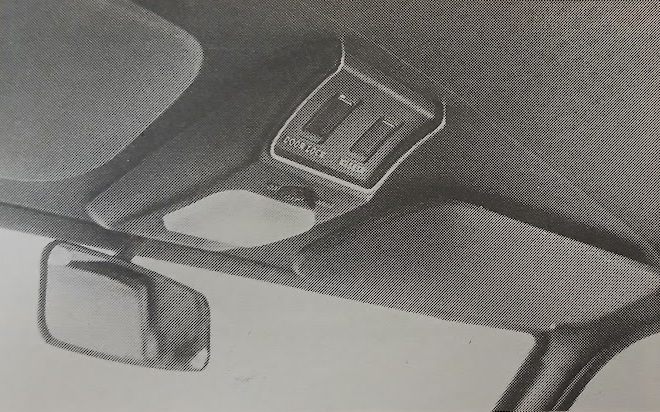
Another thoughtful touch is the provision of an illumination lamp that casts soft light over the instrument panel.
Magazine: The FF-1’s steering wheel has something of a bus-like feel to it, but on the Leone Coupe the diameter, grip, and angle all give a completely different impression.
Takahashi: Because of the car’s overall height, the seating position has been moved relative to the FF-1–lower and farther rearward. The steering wheel was adapted accordingly.
As a result, the steering column lies at a more reclined angle. To achieve this, we’ve incorporated a universal joint midway along the steering shaft.
Hoshijima: This may be a layman’s sort of question, but the trunk compartment is quite deep while not extending very far rearward because the rear overhang is so short. Doesn’t that make the car more vulnerable if it’s struck from behind?
Matsumoto: We’ve conducted extensive testing. The trunk compartment itself is designed to deform and absorb the impact energy. Beyond that point, the passenger compartment is engineered to undergo very little deformation.
Hoshijima: I understand that. My question is whether, compared with other cars, it isn’t still at something of a disadvantage.
Higuchi: Wouldn’t the absence of rear leaf springs actually make things easier?
Matsumoto: It certainly makes it easier to tune the structure to the desired strength.
When we’ve conducted comparative crash testing, we’ve often found that more conventional layouts are actually more prone to fuel leakage.
Hoshijima: Then would the car be even safer if the trunk extended a little farther rearward?
Murota: It’s certainly true that a longer crush zone is advantageous from the standpoint of energy absorption.
On the other hand, it’s equally true that a softer structure absorbs energy more effectively and reduces peak deceleration loads. Both points are clear.
Magazine: And how did it fare in terms of your evaluation?
Higuchi: It scored 90 points. That’s an outstanding result.
Cars costing over one million yen typically score somewhere in the nineties. In terms of visually apparent safety, I think we’ve already reached something close to the upper limit.
At this point, it’s necessary to rethink the whole question of safety. The era when manufacturers could sell cars simply by making them look safe is probably drawing to a close. I think consumers are beginning to see through that.
Magazine: Although it seems we could continue this discussion indefinitely, that’s all for now…
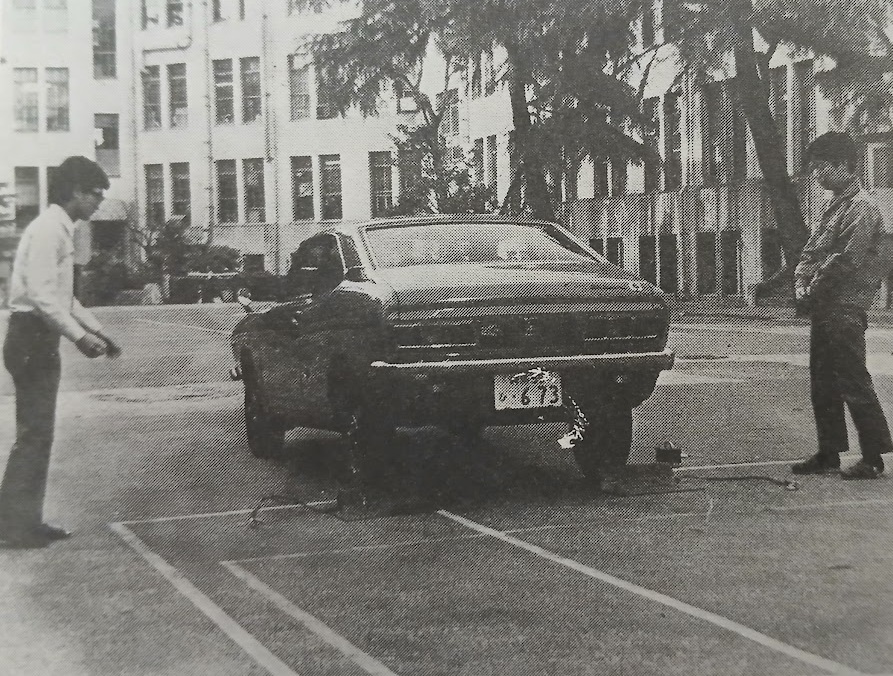
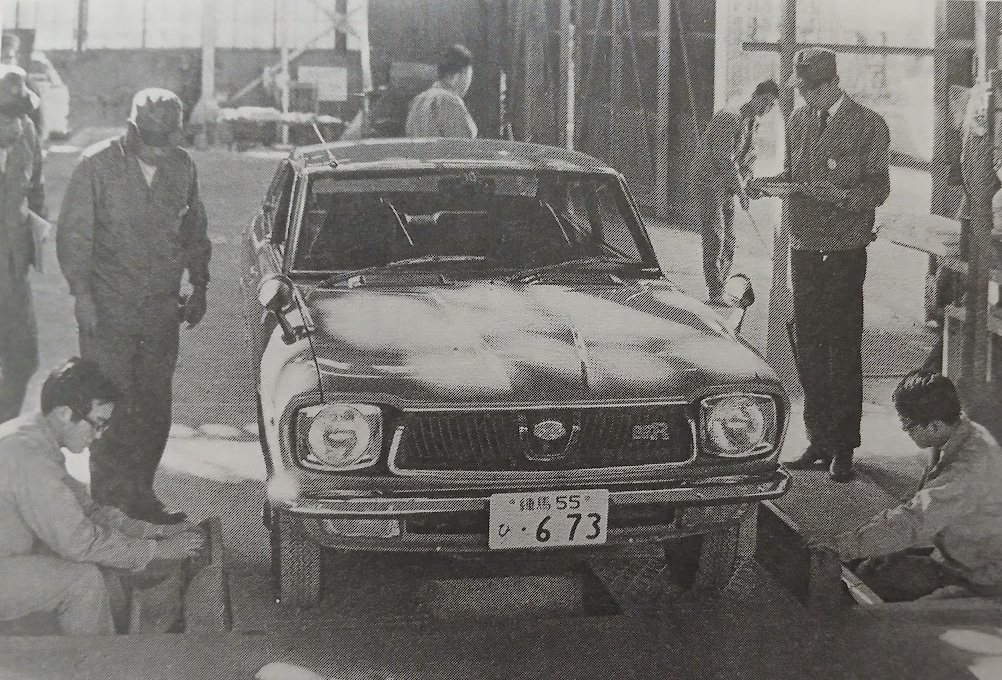
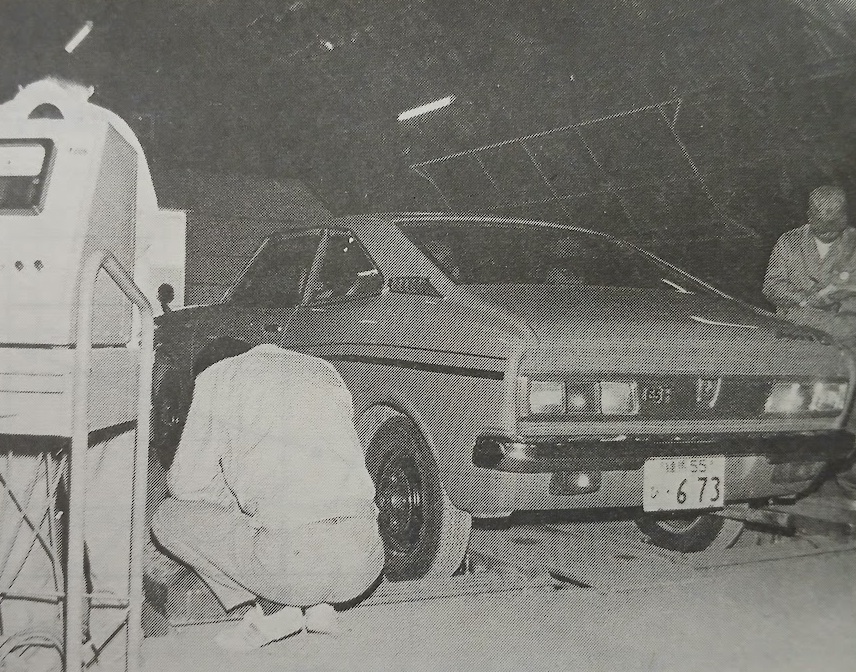
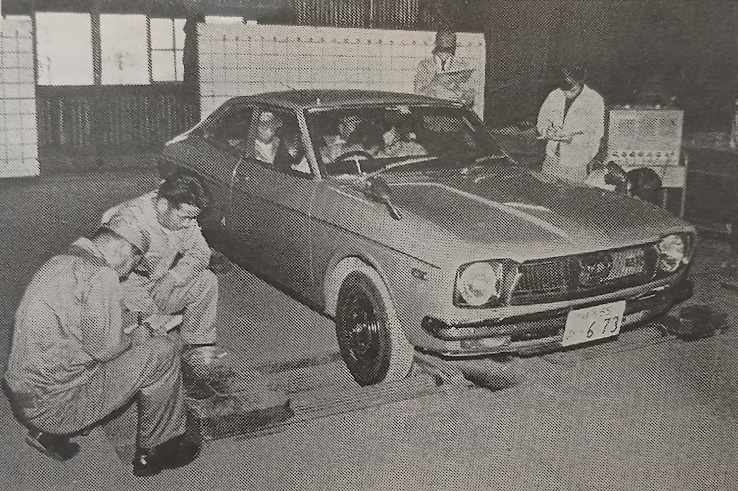
Postscript: Story Photos