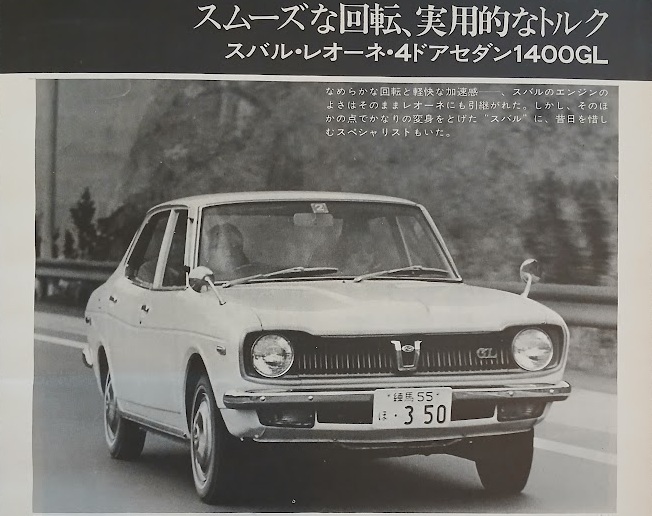
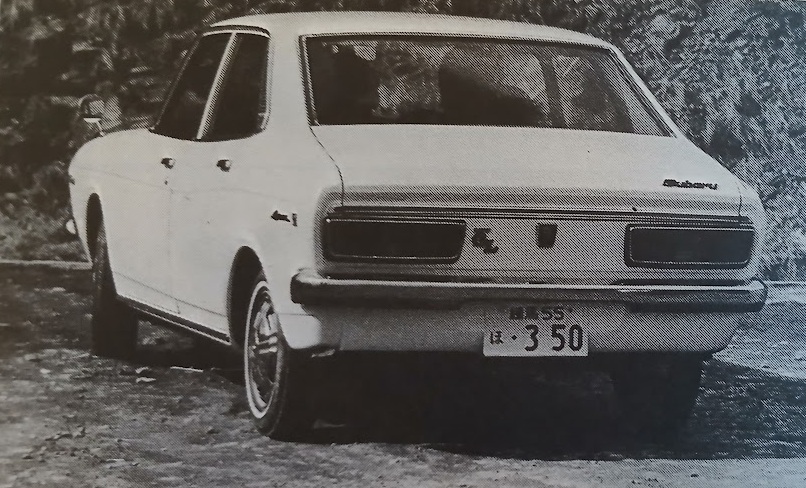
Subaru Leone Sedan 1400GL (1972)
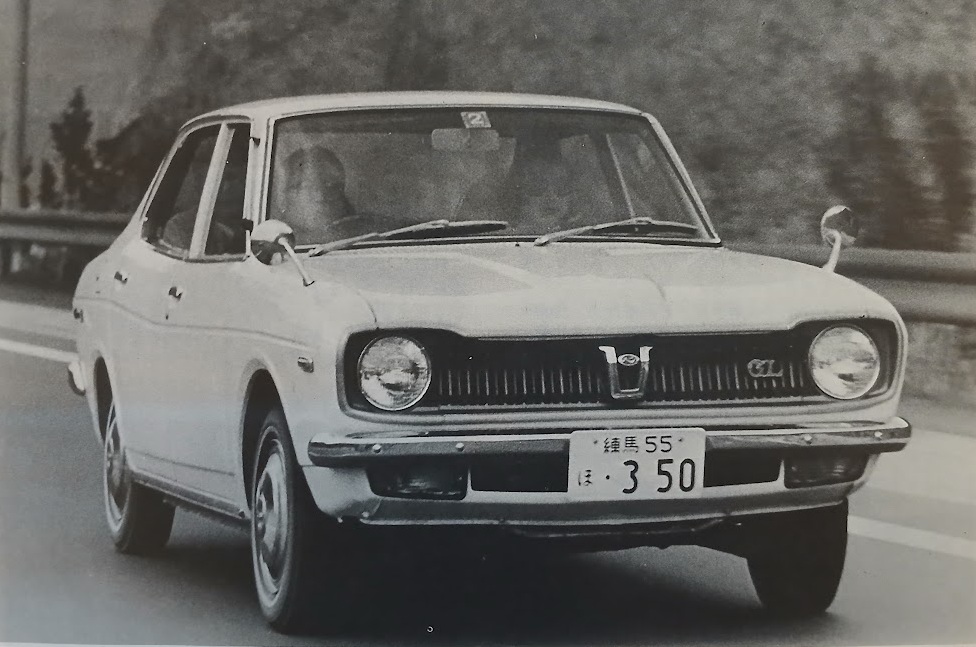
Publication: Motor Fan
Format: “Bubble Index” Road Test
Date: May 1972
Authors: Osamu Mochizuki, Katsuzo Kageyama, Shigeki Asaoka, Yasuhei Oguchi, Reiko Ikuuchi, Kensuke Ishizu, Motor Fan Editorial Staff (uncredited)
Smooth-Revving Engine, Practical Torque
The smooth-running engine and lively acceleration that have long been among Subaru’s virtues have been carried over intact to the Leone. In other respects, however, the “Subaru” has undergone a considerable transformation—and some of our specialists found themselves missing the old Subaru.
The Passing of the “Subaru” Character
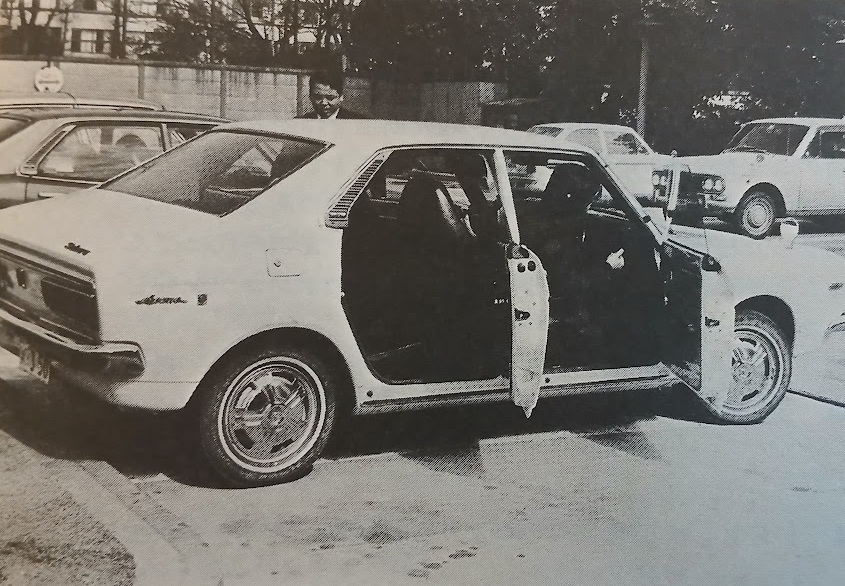
Our test car this month is Fuji Heavy Industries’ Subaru Leone 4-Door Sedan 1400. It went on sale on February 8 under the slogan, “Japan’s first sashless 4-door.”
As readers will know, the coupe version of the Leone series appeared first, in October of last year. As with other model series, the coupe and sedan share the same basic mechanical layout and construction.
And yet—the Leone represents a considerable departure from the Subaru we have known until now. This applies both to its mechanical design and to the way it feels while driving.
Take, for example, those mechanisms that were distinctively Fuji Heavy Industries’ own: the dual-radiator system first adopted on the Subaru 1000 and subsequently carried over to the 1100 and 1300; the inboard front brakes; and the wishbone front suspension. With the arrival of the Leone series, all of these have disappeared.
Even when driving the car, its front-wheel-drive characteristics are scarcely noticeable.
These mechanical changes have also been brought about by circumstances following Fuji Heavy Industries’ entry into the Nissan group, which made it necessary to reduce costs by sharing components with Nissan vehicles.
Even so, previous Subarus possessed a certain character of their own—a uniqueness, one might say—and something that gave their owners a certain sense of pride.
Whether as a result of competitive pressures or of market research, it is regrettable that the “Subaru” should have changed into a car with so little individuality.
This summarizes the opinions expressed by the various specialists after the road test.
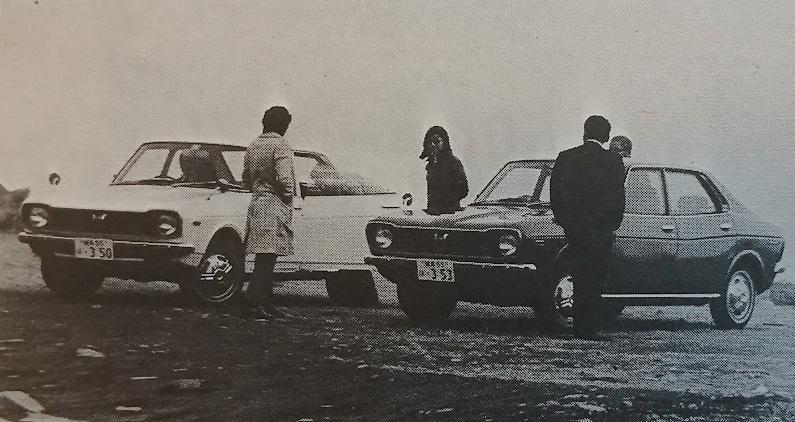
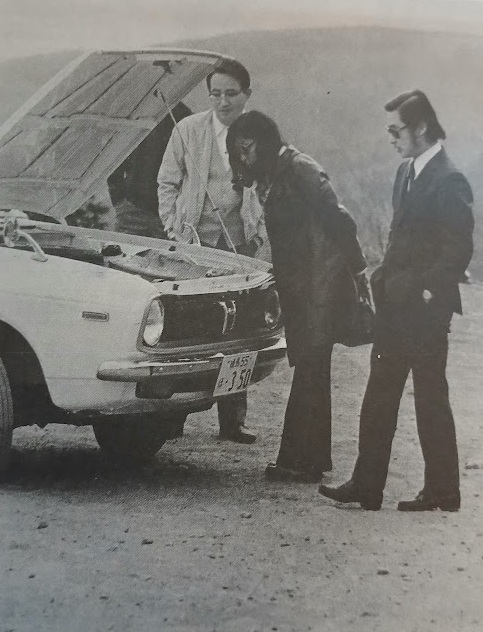
As usual, the test group set out from their base at “Fantasy” (a drive-in on Tamagawa-dori near the Tokyo Interchange of the Tomei Expressway), following a route from the Tomei’s Tokyo Interchange to Gotemba Interchange, over the Otome Pass, along the Hakone Turnpike, back over the Otome Pass, and then from the Tomei’s Gotemba Interchange back to Tokyo.
With its maximum output of 80ps, the Leone Sedan acquitted itself very well both on the Tomei and on the hillclimbs around Hakone. Even so, our specialists had some fairly severe criticisms to make.
For the details, we invite you to read the individual specialists’ reports on the following pages.
Performance: Outstanding Smoothness (Osamu Mochizuki)
The Leone four-door sedan, whose appearance had been anticipated ever since the coupe was introduced, has now arrived. As was already apparent with the coupe, the Leone series seems to have been conceived with an emphasis on all-round practicality in its performance.
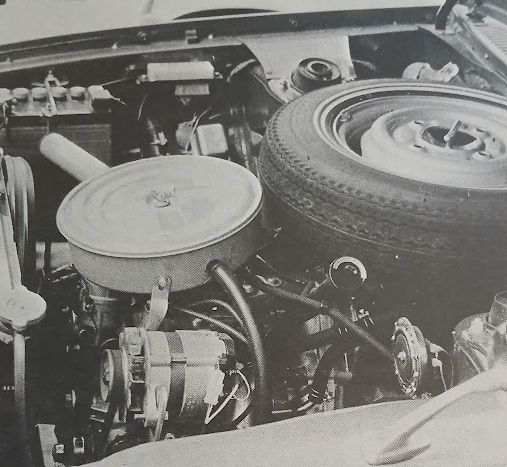
Driving the four-door sedan makes this point especially clear. The only engine offered in this model is the 80ps EA63; the 93ps EA63S fitted to the coupe is not available. The 63-series engine has a displacement of 1361cc, an increase of 94cc over the 1267cc 62-series. Yet output remains unchanged from the 62-series, at 80ps with a single carburetor and 93ps with twin carburetors.
In other words, the benefit of the increased displacement has been concentrated entirely on improving practical performance: output has been kept to exactly the same level as in the 62-series, while torque has increased and the engine speed at maximum power reduced.
The maximum torque of 10.5kgm is developed at 4000rpm, but useful torque seems to be available over a broad range on either side of that figure. Despite the high-geared 3.889 final-drive ratio, the car runs smoothly at low speeds in third and fourth gear, demonstrating the flexibility of its power characteristics.
There are cars with even more pulling power at low engine speeds. But when it comes to smoothness, an engine with upright cylinders is simply no match for a horizontally opposed unit. Even when given full throttle from around 1000rpm, the engine gathers revs exceptionally smoothly. The quality and feel of this response are outstanding. The same is true when accelerating at full throttle from around 80km/h.
Measured purely by the figures, performance is unexceptional. With 80ps propelling a curb weight of 785kg—which can hardly be called light—that is only to be expected.
From behind the wheel, however, the car gives a very pleasant impression. This is probably due in part to the low level of engine and other mechanical noise, while the exhaust remains quiet up to around 100km/h. In a car of this class and weight, the use of sound-deadening and insulating materials must necessarily be limited, but bearing that restriction in mind, it is apparent that considerable effort has gone into making the car quiet.
This quietness helps compensate for the unexceptional performance, and in this respect the Leone 4-Door Sedan benefits considerably.
The front brakes are discs, and fairly high pedal effort is required to produce strong braking. Braking force increases in proportion to that effort, however, so the brakes can be considered easy to control. The other pedals, as well as the gearshift, are also on the heavy side. Steering effort and the effort required to hold it at an angle are also somewhat above average.
The controls are generally heavy, and as a result the car somehow gives a substantial, weighty impression from behind the wheel.
“The smooth way it picks up and the pleasant feeling of acceleration are appealing. Climbing hills, though, it feels a little sluggish.” — Oguchi
Handling & Stability: Front-Wheel-Drive Characteristics Kept in Check (Katsuzo Kageyama)
When maneuvering into a tight parking space, turning the wheel back and forth fully from right-to-left and left-to-right, one soon becomes aware that the turning circle is large in relation to the car’s overall length. It also calls for a good deal of work at the steering wheel.
This is due to the long wheelbase and to the steering-gear ratio of 19.2, which is large for a car in this class. On the other hand, the effort required to turn the wheel while stationary is not particularly high for a front-wheel-drive car. This, too, is probably a result of the large steering-gear ratio.
Once under way, the first thing that struck me was how unusually heavy the steering feels around the straight-ahead position. Steering that is too light at high speeds is undesirable, and a certain amount of weight is necessary, but this particular heaviness can hardly be considered desirable. It makes small steering corrections while running straight ahead far from effortless. Having to constantly apply force while making small corrections to the right and left is extremely tiring on the nerves.
When a larger steering input is made to enter a bend, it does not feel particularly heavy; indeed, I found the weight quite appropriate. Nor is the effort required to hold the wheel during cornering by any means excessive. But the strong impression this car leaves is that “the steering is heavy.” This is probably because the small steering inputs around the straight-ahead position, as encountered in straight-line running or when changing lanes, require considerable effort. Friction may be responsible. And speaking of heaviness, the accelerator pedal and gearshift are heavy as well.
As one would expect of a front-wheel-drive car, there is a fairly pronounced tendency toward understeer. Even in hard cornering, however, the understeer does not increase suddenly, and the car can be cornered with stability. Nor is there much tendency for the car to tuck in when the throttle is closed during a turn.
Looked at this way, the Leone might be described as a front-wheel-drive car in which the characteristics generally regarded as its disadvantages have been suppressed as much as possible. This is probably a tradition carried over from the Subaru ff-1.
Roll is relatively slight for a sedan of this type. The steering returns well as the car straightens out after cornering, and when hands-off stability is tested, any disturbance dies away satisfactorily. In a slalom, however, I found the car’s response to steering inputs somewhat dull. This is only to be expected from its fairly pronounced understeer and the high ratio of the steering system, but….
Considering the intended use of this four-door sedan, this is only natural. Even so, I came away with the impression that stability has been given priority, while certain aspects of handling have inevitably had to take a step backward. I say this also from my own experience as a Subaru ff-1 owner. Conversely, it might equally be said to show that the Leone Sedan is a car likely to appeal to a broad range of drivers.
“There seems to be a certain amount of friction in the steering.” — Oguchi
“The steering feel has become heavier and duller than before.” — Asaoka
Interior & Comfort: Will This Last-Ditch Strategy Pay Off? (Shigeki Asaoka)
I have always maintained that unless there is a reason why a front-wheel-drive car should be front-wheel drive, it has no value at all. There are plenty of FF cars, but quite a few of them leave me wondering why on earth they need to be FF in the first place.
Subarus have long been well known as cars that appeal to the enthusiast. Every model in the Subaru line has conveyed a sense of originality, and while their styling has not produced beautiful silhouettes, it always seemed to have a reason for being. It was easy to appreciate the earnestness with which the company approached the business of building cars.
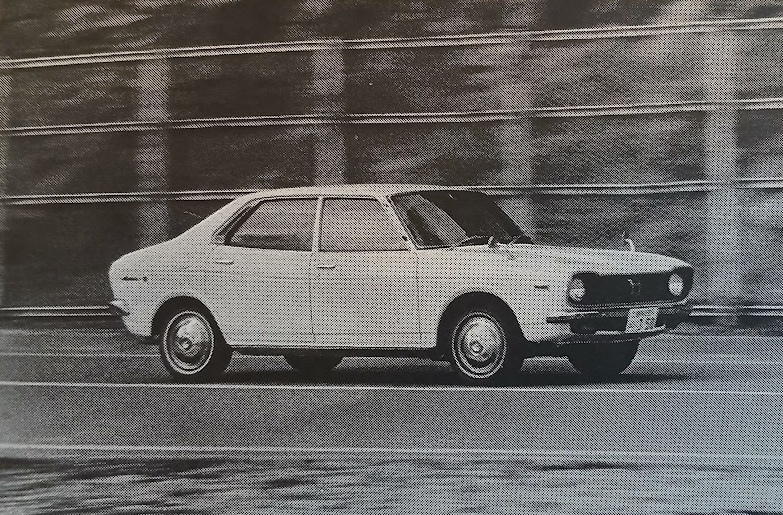
Yet Subaru, which had enjoyed a devoted following as one of the few Japanese makes with a genuinely distinctive character, seems to me to have taken a turn for the worse beginning around the time of the Leone Coupe introduced last year. The car tested here is the very recently introduced 4-door, and its styling is now just like that of every other manufacturer—anonymous, and superficially rather smart-looking.
In its long nose, short deck and low body, I can find nothing of the spirit that characterized Subarus until now. The price paid for selling its soul to the devil seems unexpectedly high. Cheapness of construction is now so conspicuous that the respect I have had for Subaru seems unlikely to last much longer. I am well aware, of course, that in a market dominated by mass-produced cars in which every possible corner has been cut, this may be Subaru’s only means of survival.
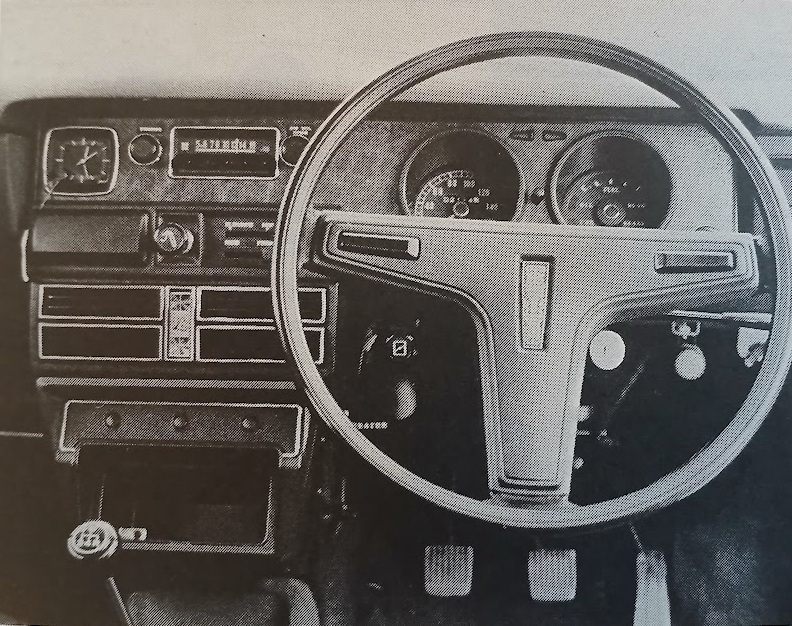
The instrument panel, so much like everyone else’s that one can hardly tell whose car it is, is neat and tidy enough, and its layout is good. But it has no conviction. The seats, predictably, are the currently fashionable high-back type, but they provide no real support.
The engine’s exhaust note alone remains unchanged, with that distinctive light poro-poro beat, almost as if to prove that this really is a Subaru.
The steering is something else entirely. Gone is the light, nimble feel that used to make one barely conscious of the front-wheel-drive layout; it has become heavy and dull. The surface of the steering wheel has a rough-textured pattern to prevent the hands from slipping, but when driving over a twisting mountain road, where the heavy steering has constantly to be turned and held against its forces, it feels as though the palms of one’s hands are being rubbed with a file.
Even changing gear requires a considerable application of force, giving something of the feel of an old Jaguar Mk VI. For someone without much physical strength, like myself, it feels as though the car is forcing me to exercise. With all this, the Leone simply does not feel like a Fuji Heavy Industries car at all. It is almost as though everything I had liked about previous Subarus has been changed for the worse.
I certainly do not resent Fuji Heavy Industries for having made the car this way; rather, I cannot help sympathizing with its efforts to pull itself back from the brink. Personally, I would be many times happier to encounter a car that may be somewhat homely but has real conviction than yet another ordinary car styled to look like all the others. But perhaps, in this day and age, saying such things merely proves that I am the obsolete old clunker.
“The engine has little vibration, and acceleration is smooth.” — Kageyama
“There is ample rear-seat legroom and it is comfortable, but the oppressive feeling created by the high-back seats is a drawback.” — Oguchi
“For a front-wheel-drive car, there is less interior space than I had expected.” — Mochizuki
Safety: The Advantages of a Diagonally Split Hydraulic Circuit (Yasuhei Oguchi)
There seem to be few cars whose coupe and four-door variations each have a distinctive style of their own, yet still come together convincingly as members of the same series. In this respect, the Leone seems to have achieved a reasonable degree of unity.
In terms of its mechanical design and performance, some of the uniqueness and thoroughly developed high-performance character found in previous Subarus seems to have been diluted. Even so, the horizontally opposed four-cylinder engine has been retained, while the diagonally split dual hydraulic brake circuit and sashless four-door body remain distinctive features.
This diagonally split dual hydraulic circuit is a so-called “fail-safe” measure, and I seem to recall that Volvo was an early adopter of this system. In the unlikely event of trouble in one of the hydraulic circuits, the arrangement is intended to preserve braking at one front wheel and the diagonally opposite rear wheel. Considering that nearly 80% of the Leone’s braking force is apportioned to the front wheels, the advantages of this system should be significant.
The use of disc brakes at the front should make the arrangement even more effective, given the Leone’s brake-force distribution. If I could ask for one further improvement, considering that the car’s weight distribution is necessarily biased heavily toward the front, it might also be worthwhile to provide a proportioning valve for the rear brakes, though this may be difficult in practice.
In any event, what impressed me during the road test was the stable, consistent feel of the brakes.
As for other safety equipment, all of the now-familiar features are present, from a collapsible steering column to separately fused headlamp circuits.
From the standpoint of preventive safety, I would like the handling to be more decisive, for example during an emergency avoidance maneuver. The car is also said to use low-profile tires (6.15-13-4PR) for improved running stability, but I felt that somewhat greater cornering power would be desirable.
And when the car is subjected to excessive steering inputs at high speed, it seems to take a little time to settle afterwards. Perhaps this impression was heightened by the outstanding straight-line stability at high speed when the steering wheel is held lightly…
As for visibility, the relatively high seat cushion helps provide good practical forward vision. Despite the relatively shallow glass area vertically, I felt no shortage of upward-forward visibility, and rearward visibility was also satisfactory. To pick at a minor detail, however, the images in both the fender mirrors and the interior mirror tend to be distorted. I do not think this was done deliberately to increase the field of view, but the same image appeared tall and narrow in the fender mirror and wide in the interior mirror. A particularly sensitive driver might find this bothersome.
“There is far too much distortion in both the fender mirrors and the interior mirror.” — Mochizuki
“It’s convenient that the seat belt can be hung from the side pillar when not in use. But the hook itself could be a little easier to use.” — Ikuuchi
Economy: No Longer Seems Overpriced (Reiko Ikuuchi)
The standardized Tokaido-region price of the Leone 4-Door Sedan 1400GL is 629,000 yen. The DL costs 584,000 yen, while the Custom is 647,000 yen.
The first thing that strikes me is that the car no longer seems overpriced. Until now, Fuji Heavy Industries’ cars have had a reputation for sophisticated mechanical design, but also for being rather expensive. There is no such impression with the pricing this time. It costs about the same as other manufacturers’ 1400cc cars.
To be fair, with the ff-1 and 1300G as well, perhaps Fuji Heavy Industries was so confident in the cars’ mechanical design that it paid too little attention to the appearance of luxury, with the result that they came to be generally regarded as overpriced. Previously, the company seems to have believed that as long as a car had excellent mechanical qualities, it was actually better for its appearance and accessories to remain plain. Perhaps it came to realize that this would leave its cars appealing only to a small group of enthusiasts.
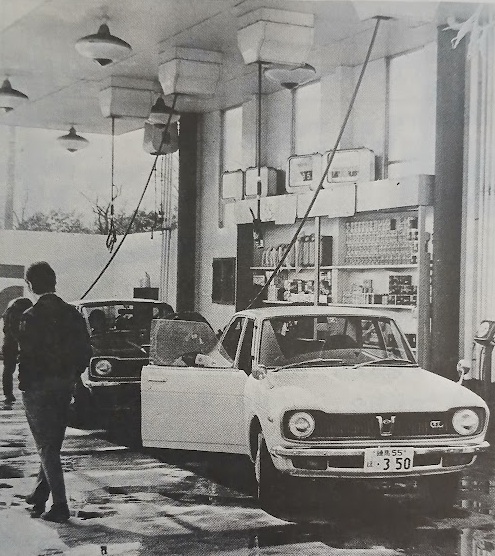
Possibly for this reason, the Leone projects a considerably more flamboyant image. Whereas the ff-1 and 1300G had relatively plain body designs, the Leone makes extensive use of curved surfaces. The grille and tail treatment are aimed at younger buyers as well. The effort to make the entire car look larger can also be considered successful.
Money has been spent not merely on appearances, but also on improving passenger accommodation and everyday usability. The sashless windows are one example. To prevent the glass from lifting away or flexing, 5mm-thick glass is used instead of the usual 4mm.
We are also told that the glass retainers and weatherstrip rubber have been reinforced. Particular attention was paid to the weather resistance of the weatherstripping; because it is exposed, it is especially susceptible to deterioration from ozone and sunlight.
There are no particular economic advantages from the FF layout itself. If one had to name one, it would be the absence of a propeller shaft, which allows a flat floor and makes it easier to seat three people in the rear. Also, as a result of the car’s weight distribution, the spare tire and tools are stowed at the front, leaving a large trunk and improving its “transport efficiency.”
According to the manufacturer’s own measurements, when the trunk is filled with volleyballs, the Leone will hold 42, compared with 31-38 in other 1400cc cars.
Joining the Nissan group has allowed components such as the headlamps and electrical equipment to be shared with the Sunny, and there appear to have been some economic benefits here as well.
The overall length of 3995mm also saves money when taking the car aboard a ferry. Another 5mm would put it into the next higher class, and on a long-distance route such as Kawasaki–Miyazaki, the difference in a one-way fare can amount to as much as 4,000 yen.
“I don’t really understand what advantage sashless doors offer on a four-door sedan.” — Kageyama
Product Appeal: Leone, You Too! (Kensuke Ishizu)
When I drove the Subaru Leone Sedan, my first reaction was, “What’s this?”
I could not find the familiar Subaru feel. It left me wondering just what sort of car I was driving.
When I asked the reporter accompanying us, I learned that several of Subaru’s distinctive mechanical features, beginning with the dual-radiator system, had disappeared as well.
The name “Subaru” has always brought a certain preconception—or perhaps a particular image—to my mind. It was one of freshness and originality, of adopting new mechanisms that other car manufacturers had yet to introduce. I believe the existence of a manufacturer like Subaru has become particularly valuable in today’s automotive world.
Yet looking at the new Leone, that Subaru originality seems to have receded, leaving an extremely conventional car. Precisely because it bears the Subaru name, the disappointment is that much greater.
The finish of the dashboard, and particularly such things as the decorative trim in the center of the steering wheel, seem to recall the sort of image one finds in any number of other cars.
I am well aware that wanting to hang a chandelier in a modest 2DK apartment is a typical pattern of Japanese taste. But that Subaru, too, should have gone down this road…. It makes me want to say, “Subaru, you too!”
The “bad-taste look” is a term from the world of fashion, and it originated in America. In America, discrimination is widespread. Under such conditions, disadvantaged people adopt the clothes worn by more advantaged groups in an effort to attain the same standing. Conversely, more advantaged people, amused by what they regard as a kind of bad taste that would never occur to them, incorporate aspects of disadvantaged groups’ fashions into their own.
This was a way of breaking down styles such as the “total look,” in which clothes are coordinated according to a single policy or set of rules. It represented a new movement aimed at overturning conventional methods and established patterns.
Why should there not be a similar movement in Japanese cars? Perhaps it is time to reconsider the pretentious sort of luxury intended to satisfy conventional Japanese tastes. As people’s living environment changes, cars will change with it. I look forward to seeing not merely stereotyped cars, but distinctive ones designed to suit particular purposes.
“It’s too bad that so much of the distinctive Subaru character has disappeared and that the mechanical design has become more conventional.” — Kageyama
“The sashless doors make a noticeable difference when getting into and out of the car.” — Oguchi
“In side view, the long-nose character comes through clearly. Seen from other angles, the styling is ordinary.” — Mochizuki
“I’d like to see a few more body colors offered. Only four colors across the three models is rather a poor selection.” — Ikuuchi
How to Read the Bubble Index
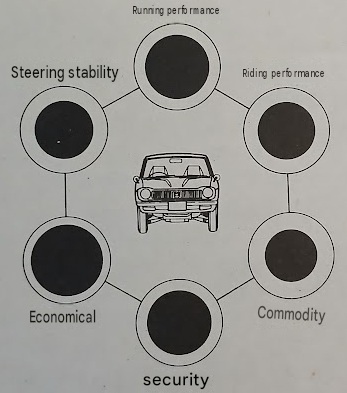
Every car has what might be called character. It can be said that this character emerges from a combination of factors such as performance and functionality, intended use, vehicle class, and design philosophy. However, not all aspects of the car’s character are clearly revealed to the user. The purpose of this series is to unravel the character of a car by evaluating six important aspects of its performance.
The size of the circle at each vertex of the index represents a rating of the attribute indicated there, and by comparing the six circles, one can also get a sense of the balance among them. In the case of the Skyline 2000GT, it received a particularly high rating for economy, but this is because it is a 2000cc class car priced at 860,000 yen, making it exceptionally economical within the context of its class. Otherwise, apart from some issues with handling stability, the six performance areas all received good scores and were well-aligned, making it a well-balanced model overall.
We have explained our methodology for this test series, but our hope is that, using these tests as reference material, the final judgment will be made by the readers themselves.
Postscript: Story Photos