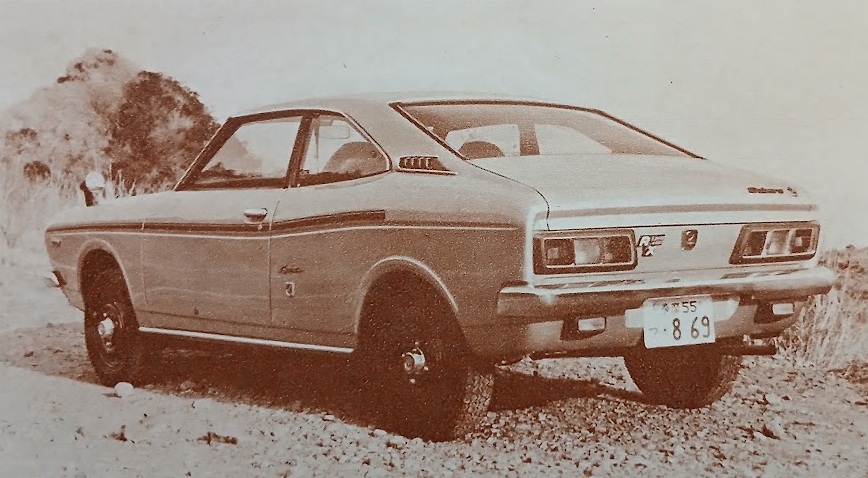
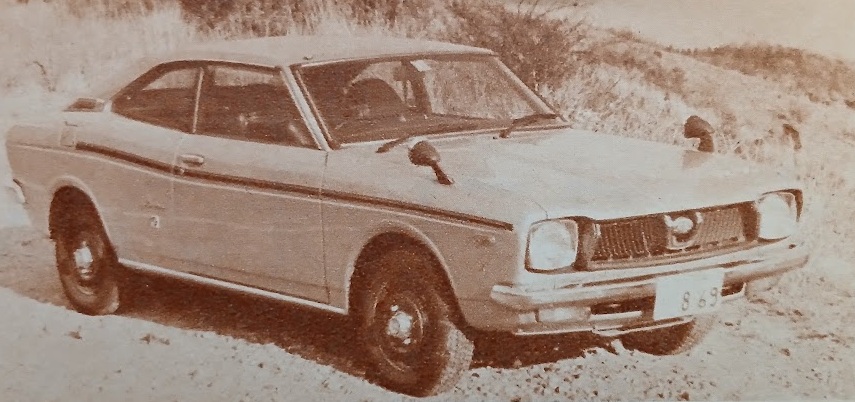
Subaru Leone Coupe 1400RX (1973)
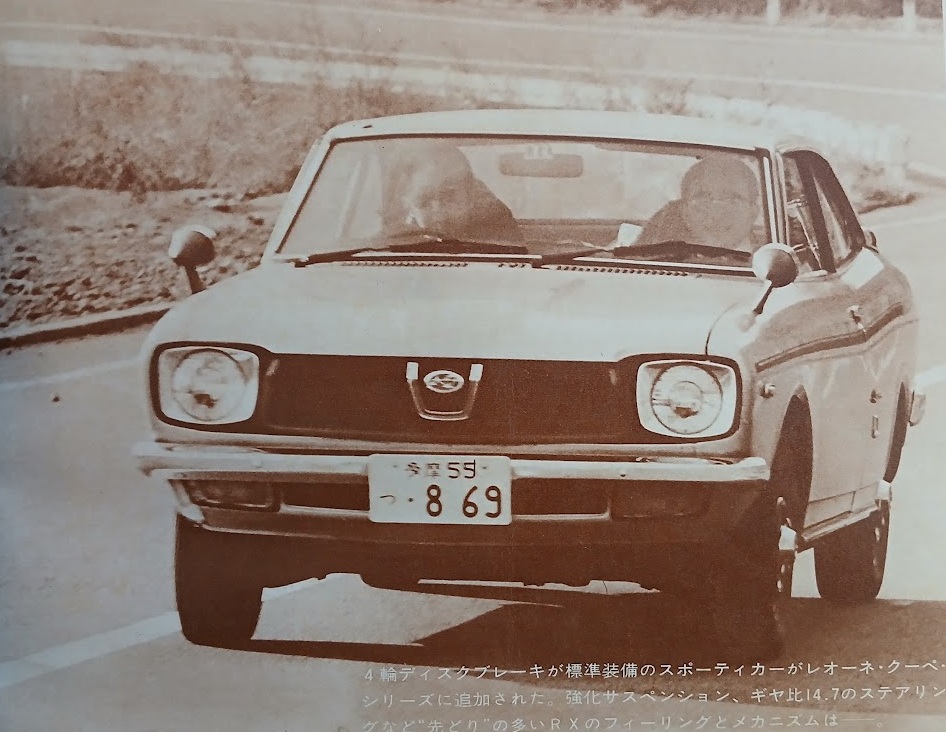
Publication: Motor Fan
Format: “Bubble Index” Road Test
Date: February 1973
Authors: Osamu Mochizuki, Katsuzo Kageyama, Shigeki Asaoka, Yasuhei Oguchi, Reiko Ikuuchi, Kensuke Ishizu, Motor Fan Editorial Staff (uncredited)
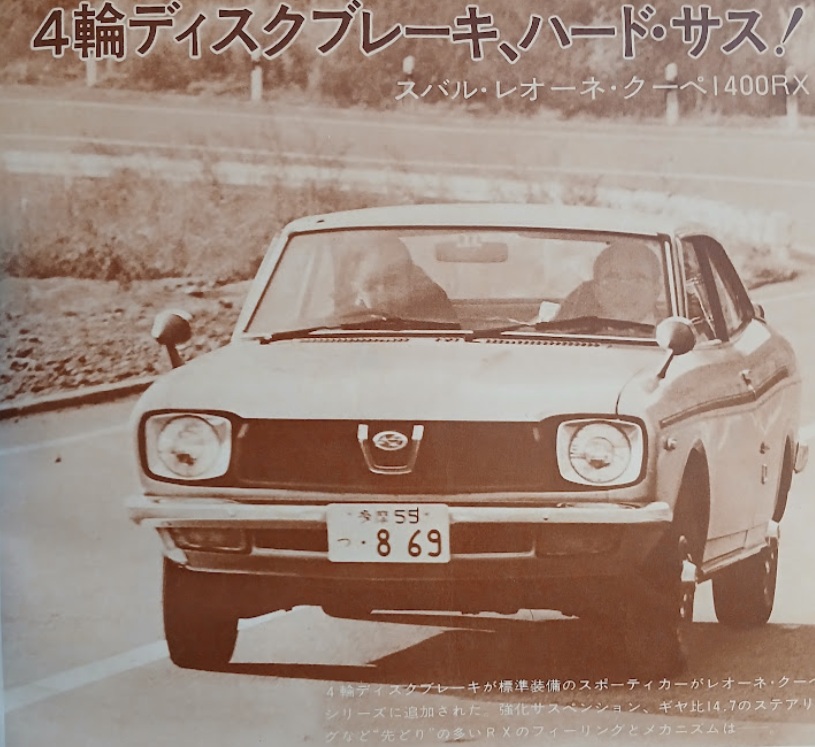
Four-Wheel Disc Brakes, Hard Suspension!
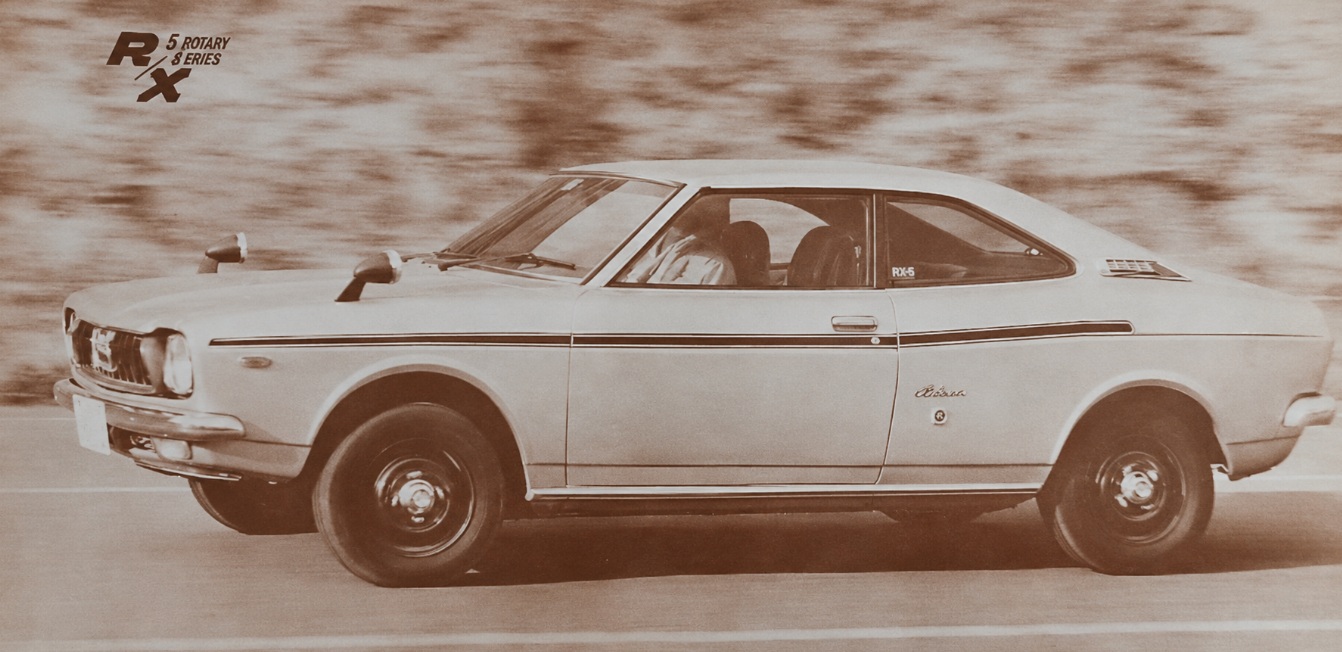
A new sporting model equipped with four-wheel disc brakes as standard has been added to the Leone Coupe range. With its uprated suspension, 14.7:1 steering ratio, and other advanced features, what are the driving characteristics and mechanical details of the RX?
Sparing No Expense on Mechanism!
Fuji Heavy Industries has chosen “7 POINTS” in its publicity material to emphasize the outstanding “driving performance and safety” of the Subaru Leone Coupe 1400RX. To list them first:
(1) Subaru’s FF system, (2) twin-carburetor, horizontally opposed aluminum engine, (3) 5-speed transmission, (4) four-wheel disc brakes, (5) hard suspension, (6) quick steering, and (7) 155SR-13 block-pattern radial tires.
These are the main features of the Subaru Leone Coupe 1400RX, the latest addition to the Leone series.
Sales began simultaneously throughout Japan on December 1, at a cash price of 734,000 yen in the Tokyo, Nagoya, and Osaka areas. Initial production is planned at 300 cars per month.
Newspaper advertisements and other publicity have adopted the slogan “The Only Japanese Car with Four-Wheel Disc Brakes." Considering its limited production volume, as well, the RX can reasonably be considered a “specialized car” with an emphasis on sporting characteristics.
“Sparing no expense on mechanism”—this is also a philosophy that Fuji Heavy Industries has consistently upheld and actively applied to many of its products.
Among cars that come standard with four-wheel disc brakes, Porsche and Alfa Romeo come to mind. Yet even among these expensive cars, certain models use a separate drum brake for the parking brake (commonly known as a kankanbo or boating-hat arrangement).
The Subaru Leone Coupe series, however, uses the front discs for the parking brake as well. Pulling the handbrake lever operates, through a cable, a lever on the front brake calipers. Thus, the parking brake acts on the driven wheels of this FF car, which also carry most of the vehicle’s weight.
In tackling such technical difficulties head-on and overcoming them, Subaru demonstrates a considerable degree of engineering ingenuity.
The parking-brake mechanism is only one example of this willingness to spare no expense on mechanical design. The RX’s main sporting features can be narrowed down to the following five points:
(1) Four-wheel disc brakes, with a dual-circuit hydraulic system and vacuum servo assistance; (2) “hard” suspension with increased spring rates and a strengthened stabilizer; (3) a newly designed close-ratio 5-speed transmission; (4) wide 155SR-13 radial tires; and (5) steering with a ratio of 14.7:1.
Unfortunately, limited space prevents us from having each specialist examine all “7 POINTS” in detail. Nevertheless, through our Bubble Session discussions of the RX’s driving characteristics and mechanical features, we have arrived at an objective assessment of the car. We believe the reports that follow will give readers a clear picture of its distinctive qualities and the forward-looking thinking behind its design.
Performance: Adaptable to All Road Conditions (Osamu Mochizuki)
The RX is a car “based on the Leone Coupe 1400 GSR, but with its sporting character developed further.” This explanation from the manufacturer sums up the RX’s character perfectly. The addition of a close-ratio 5-speed transmission, steering with a numerically low ratio of 14.7:1, strengthened suspension, and four-wheel disc brakes—all the measures needed to emphasize sportiness have been incorporated.
From these specifications, it is clear that the RX is a car developed with a strong emphasis on sporting performance. Seen in this light, the very closely-spaced ratios of its 5-speed transmission, unusual for a passenger car, can also be considered quite natural.
The overall gear ratios are 12.860 in first, 8.389 in second, 5.904 in third, 4.496 in fourth, and 3.663 in fifth. Of these, the first-gear ratio of 12.860 is particularly noteworthy. With an engine in the 1400cc class, a certain amount of difficulty in moving away from a stop becomes unavoidable.
With a load equivalent to about three occupants, the wheels will not spin even when making a half-clutch launch from 5000rpm. Leaving aside the question of how much wheelspin is desirable or useful for a quick start, there is no denying that the available driving force is less than sufficient when moving off with a heavy load. The same applies to starting on an uphill gradient.
However, this difficulty in moving off is minor, and certainly not enough to present a practical problem. There is no disadvantage when starting normally on level ground. It is just the sort of thing that makes the driver think, “That’s odd,” the first time it happens, and the initial concern soon passes.
Throttle response is not particularly sharp, but acceleration is consistently strong and sustained. With a suitable gear ratio available at virtually any road speed, the RX’s acceleration is at a high level for the 1400cc class.
The advantages of the close-ratio transmission are especially apparent during full acceleration. If each gear is held to the maximum of 6800rpm before shifting up, even the change from first to second, which produces the greatest drop in engine speed, brings the revs down only to 4550rpm. Maximum torque is developed at 4800rpm, and the engine has a pronounced flat-torque characteristic, so this is more than satisfactory for the change from first to second. A shift from fourth to fifth leaves the engine turning at 5500rpm.
The engine runs extremely smoothly, with very little vibration. Even when taken to 7000rpm, there is no sign of valve surging, so it can be revved confidently to high engine speeds. The car also pulls exceptionally well at high speeds, probably because of its low aerodynamic drag and the broad power curve resulting from its flat torque characteristics.
The four-wheel disc brakes are outstanding in both their feel and stopping power. Stability is naturally excellent as well. One particular characteristic is the strong braking effect from the initial application of the pedal.
Taking all these qualities together, it seems fair to conclude that the RX’s performance makes it well suited to every kind of driving condition, whether in town, on the highway, or on mountain roads.
Kageyama: “The speedometer is difficult to read.”
Oguchi: “It has good acceleration response at high speeds.”
Handling & Stability: Excellent Ability to Avoid Danger (Katsuzo Kageyama)
I was immediately struck by the very quick steering gear ratio. The Subaru Leone has traditionally been distinguished by an unusually slow steering ratio, so this felt like a completely different car from the previous Leone models. I noticed the difference even when making 90° turns in town, but on the expressway, during lane changes and small steering corrections, I was positively astonished by the sharpness of the response.
Of course, the high cornering power of the wide radial tires contributes to this, as well as the quick steering ratio. When I later looked at the catalog and discovered that the ratio was 14.7:1, I could only nod in understanding. There seems to be almost no play in the steering mechanism, which makes the response feel sharper still. On second thought, though, this is only natural. With such a quick steering ratio, any noticeable play would surely make the car dangerously difficult to control.
The steering has a substantial weight to it, giving a reassuring sense of resistance through the wheel that is well suited to high-speed driving. Indeed, anything lighter would probably make the car rather unnerving to drive.
I tested the car’s hands-off stability at high speed and found that any oscillations died away exceptionally well. There was none of the unpleasant wandering that sometimes occurs. Naturally, a number of factors must contribute to this excellent hands-off stability at high speeds, but I suspect that the car’s unusually quick steering ratio plays a significant part.
Although I was unable to drive the car particularly hard, I noticed little of the change in steering effort when applying and releasing the throttle while cornering that I had been concerned about.
The suspension appears to have been strengthened a great deal, and body roll is only slight.
I had no opportunity to fully explore the characteristics of the four-wheel disc brakes, one of the car’s main selling points, but the feel and response of these servo-assisted brakes were exquisite.
The handling and stability of this car have a character quite unlike those of most ordinary production cars. It may not appeal to middle-aged and older drivers who prefer a leisurely pace, but young driving enthusiasts will be overjoyed. At a time when so many cars are designed to be competent all-rounders that appeal to everyone, I welcome the arrival of something with such a distinctive character.
In fact, our test route was far too tame to bring out the best in this car. Even someone like myself, when driving it, feels tempted to forget his age and go charging down a dirt course. That is the kind of car this is.
But I do not believe it is merely a car for reckless drivers. Its exceptionally sharp steering response also means that it has an excellent ability to avoid danger, and I consider it a car with a high degree of safety.
Mochizuki: “The gearshift lever is stiff to operate.”
Oguchi: “The handling is far more precise than that of the sedan.”
Comfort & Accommodation: An Easy-to-Use 5-Speed Transmission (Shigeki Asaoka)
Subaru has long been a carmaker with a devoted following, but since the release of the Leone, many of its former enthusiast fans have drifted away. Yet sales are said to have increased substantially with the introduction of the Leone, a coupe with styling that hardly looks like that of an FF car. The ways of the Japanese market are certainly mysterious.
The RX is an FF sports coupe equipped with a 5-speed transmission, four-wheel disc brakes for the first time on a Japanese mass-produced car, and suspension that is firmer than that of the other models.
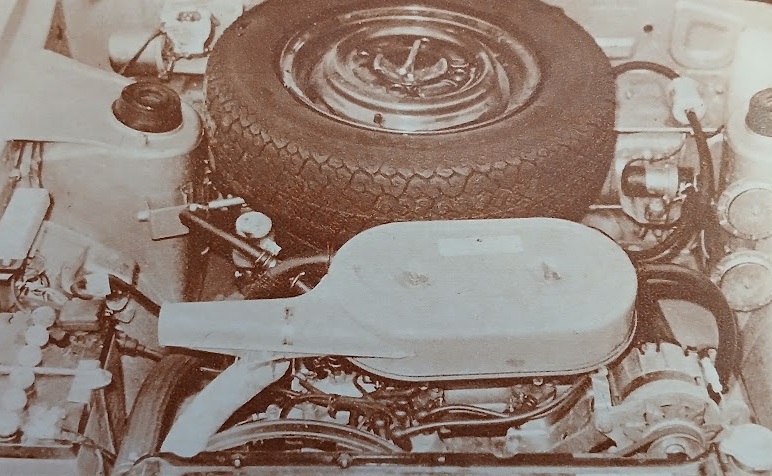
The engine, with its distinctive burbling exhaust note, is an excellent unit, ranking among the best in the 1400cc class for both torque and horsepower. However, measures to reduce costs, such as adopting strut-type suspension, have deprived it of some of the uniqueness of the earlier Subaru 1300.
Whether an FF car with 93ps really needs four-wheel disc brakes is open to question. But considering the Japanese market’s fondness for anything new, necessity seems to have taken second place. I cannot help feeling that the whole thing is a marketing exercise intended primarily to secure the title of “Japan’s only.”
The gear ratios of the 5-speed transmission are well chosen, and the smooth hand-off from one gear to the next makes it a pleasure to use.
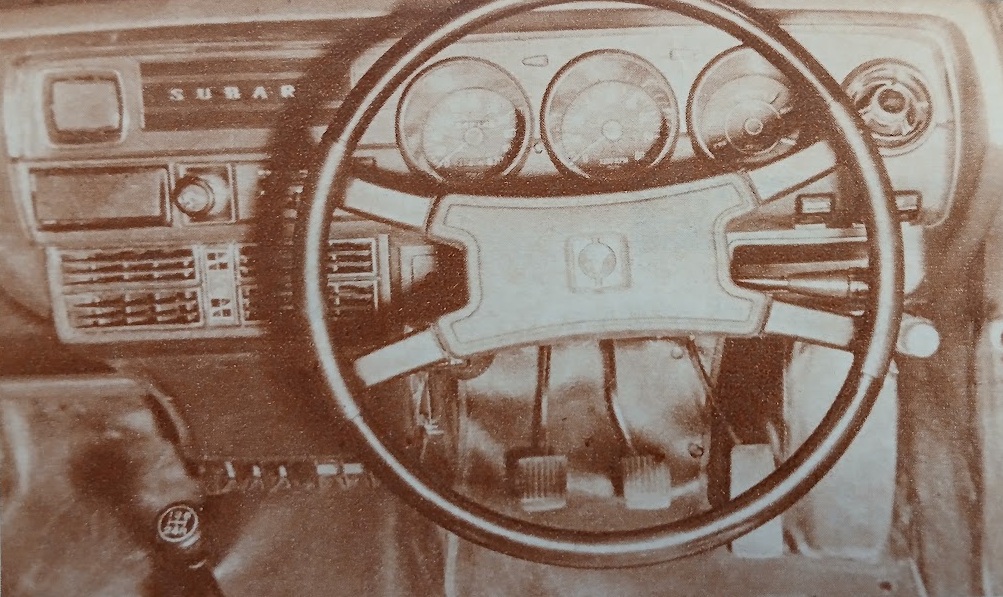
The interior has the sort of oversized dashboard that has become fashionable in recent cars, but Subaru has kept it relatively uncluttered by making such items as the radio and clock optional rather than standard equipment. Above all, the absence of a center console seems to me at least some evidence of good sense. Subaru’s distinctive three round gauges have always had a simple appearance that I find appealing, but it’s too bad that the combination gauge contains only fuel level and water temperature.
There is a headlight switch on the dashboard that pulls out like a drawer. Perhaps because it is such an unusual arrangement, unlike anything I have encountered before, I found it difficult to use. You have to hook your fingers underneath and pull it out, but it is hard to judge how much force to apply. Several times, when I intended to switch on only the parking lights, I inadvertently switched on the main lights as well. On other occasions, when trying to change from the main lights to the parking lights, I accidentally switched them all off.
There is also a parking-light switch beside it. If you mistake this for the headlight switch, everything else continues to operate normally, so you could end up driving with only the parking lights on. For safety’s sake, I think switches like this should be conventional and straightforward, rather than designed merely to be novel.
This model is equipped with three-point safety belts, but the shoulder-belt anchor point is positioned too high, so the belt rubs against the neck. This can hardly be called comfortable, and when turning around to check behind the car before moving off, the belt presses directly against the cheek, which is especially unpleasant.
The seats are the currently fashionable type with integral head restraints, but there are small openings near the tops of the backrests. Surprisingly, these do quite a lot to reduce the sense of isolation from the front-seat occupants for passengers sitting in the rear.
The car as a whole seems to have been designed to avoid making too strong an impression. But rather than just producing a car that looks good on paper, I would like Subaru to recover some of the human warmth that its cars once possessed.
Kageyama: “The light switch is difficult to operate.”
Mochizuki: “The ride is too hard.”
Oguchi: “The suspension has been strengthened to the point that the ride is extremely stiff. But with driving performance as the objective, that’s only natural.”
Safety: Consistent Deceleration (Yasuhei Oguchi)
In short, this car has been developed into something of a model sporting sedan. Recent cars have become increasingly burdened with “deluxe” equipment that has little bearing on drivability or performance. For an ordinary sedan, perhaps that is as it should be. But if a car claims to be a grand tourer or a sporting model, the first requirement must surely be a “deluxe” standard in its driving functions, rather than only in its appointments.
This model should bring the mechanically minded Subaru enthusiasts back to life, like fish returning to water. If it doesn’t, perhaps those self-proclaimed mechanical enthusiasts have simply been pretending all along.
The addition of a 5-speed transmission is a natural development, but the choice of gear ratios is interesting. One thing that is immediately apparent while driving is the strong throttle response at higher speeds, probably resulting from the changes to the ratios of third and fourth gears.
The most distinctive features of the 1400RX are undoubtedly its four-wheel disc brakes and diagonally split dual-circuit hydraulic system. The stable performance of these brakes during emergency stops goes without saying, but their advantages are apparent even under moderate braking.
The build-up of deceleration–or, in other words, its time constant–seems somewhat quicker than with drum brakes. It is often said that disc brakes have a certain weakness in their initial response, but in many cases this seems to refer to the time constant of deceleration in relation to pedal effort. Consequently, the greater the pedal effort required, the more pronounced this weakness tends to feel.
For a sporting car, however, good braking response at deceleration rates of around 0.1-0.3g is not enough. It is also important that deceleration remain consistent at around 0.7g. From this standpoint, slight differences in time constant should be disregarded. What matters first is the total value of deceleration over time, and the time taken to achieve the desired result.
During the test drive, I took a few measurements of these characteristics, and judging from the resulting waveforms, the brakes demonstrated an effective deceleration pattern.
Another point worthy of attention is that the parking brake is incorporated into the disc-brake mechanism itself, without requiring a separate drum brake.
The better a car’s acceleration and sustained high-speed performance, the more desirable it is, in terms of safety, for its braking capabilities to exceed those demands. In adopting what is claimed to be the first Japanese four-wheel disc-brake system, the 1400RX demonstrates a commendable commitment to preventive safety.
Aside from the brakes, nothing else was particularly noteworthy. One disappointing omission, however, was the absence of an electrically heated rear window. With the steeply inclined glass of a coupe, a heated rear window should naturally be provided as standard equipment to ensure adequate rear visibility.
Mochizuki: “It’s difficult to find somewhere to place your left foot from the driver’s seat.”
Economy: Modestly Priced For Its Actual Cost (Reiko Ikuuchi)
The Subaru Leone Coupe 1400RX tested here has a standard cash price in Tokyo of 734,000 yen. This makes it the most expensive model in the Fuji Heavy Industries range. Its main distinguishing features are four-wheel disc brakes, the only such installation on a Japanese mass-produced car, and a 5-speed transmission. The rear disc brakes are of a unique new design, while the 5-speed transmission has also been newly developed.
With initial production of the RX planned at only 300 cars per month, the development expenses and manufacturing costs of these new components must make the price of 734,000 yen rather unsustainable for the manufacturer. This makes it a welcome price from the buyer’s standpoint–although, considering the prices of competing cars, Subaru probably could not have set it any higher.
For comparison, here are the prices of other 1400cc twin-carburetor models: Corolla 1400 Coupe SL, 5-speed floor shift: 664,000 yen (the Sprinter is the same price). Sunny Excellent 1400 Coupe GX, 4-speed floor shift: 665,000 yen. Galant Coupe FTO GIII, 4-speed floor shift: 660,000 yen. Leone 1400 Coupe GSR, 4-speed floor shift: 719,000 yen.
Moving up a class to 1600cc sporting cars such as the Sprinter Trueno, Corolla Levin, Celica GT, and Carina GT means entering the 800,000-yen price range. Perhaps, then, the RX’s price of 734,000 yen places it in a particularly well-judged position.
Even so, however much emphasis has been placed on performance, the absence of a radio and clock is a little disappointing. Admittedly, car clocks are rarely very accurate, so perhaps one is better off without them anyway. For reference, the optional radio costs 18,000 yen, including installation, while the clock costs 6,500 yen, also including installation.
From a safety standpoint, the most troublesome omission is the electrically heated rear window, which cannot even be fitted as an option.
Fuel economy over the first, second, and third sections of our test route, as shown in the table below, was 12.8km/l, 10.7km/l, and 14.2km/l, respectively. The Leone 1400 4-door Sedan GL, which we tested in this series in the May 1972 issue, returned 12.6km/l, 10.1km/l, and 12.6km/l over the same sections, so the results this time were considerably better.
The twin-carburetor engine’s good fuel economy at high speeds, together with the effects of the 5-speed transmission and wide radial tires, probably accounts for the improvement.
The RX’s official constant-speed fuel economy at 60km/h is 21km/l, compared with 20km/l for the GSR (twin carburetors, 4-speed) and 19km/l for the GL (single carburetor, 4-speed).
As for maintenance, adjusting the rear drum brakes on a drum-braked car costs 700 yen, whereas disc brakes require no such adjustment. This is another advantage.
Cars in this class generally retain their value better than most, but it is difficult to predict the future resale value of such an individualistic model as the RX. That will depend on how popular it becomes.
Kageyama: “Is the omission of equipment relative to the price intended to make the car suitable for production-car racing and rallies?”
Product Appeal: Safety Depends on the Driver (Kensuke Ishizu)
I wrote in one of these reports some time ago about being caught by an unmarked police car on the Tomei Expressway. I was speeding—31km/h over the limit.
I generally spend my weekends at my villa near Lake Yamanaka, so the Tomei was a road I knew like the back of my hand. Yet a momentary lapse in concentration was enough to get me caught and even have my license suspended.
Since that day, although the Leone Coupe 1400RX tested here has a top speed of 170km/h, I’ve made a point of keeping below 90km/h where the limit is 80km/h, and below 110km/h where it is 100km/h. At those speeds, there’s little chance of being caught, and I don’t have to put up with the warning buzzer either.
The consequence is that almost every car on the road overtakes me, except for the little kei cars. At first, I found this rather irritating. Lately, however, I’ve developed a peculiar sense of superiority, thinking to myself, “Why are you all in such a hurry, you maniacs!”
And by calmly observing the movements of other cars and the faces of their drivers, I’ve come to realize something. Drivers of popular-priced cars, particularly those in the 1400cc class, have especially poor road manners. They go tearing past at high speed, with no regard for the difference between the driving and passing lanes.
Naturally, that means a higher accident rate. Indeed, among the wrecked cars one often sees kept in the open areas around expressway interchanges, cars in this popular class seem particularly numerous.
It is often said that making a car go fast is relatively easy, but bringing it to a stop, quickly and safely, is difficult. In this respect, the RX has been developed with an emphasis on total driving performance and safety, incorporating four-wheel disc brakes, strengthened suspension, wide radial tires, and other such features.
Having driven it, I can certainly confirm that its braking performance is excellent and that its safety has been improved. This is all very commendable, and the car deserves high marks for its product appeal. I also fully understand the manufacturer’s intention in emphasizing the distinction of being the “only Japanese car” with four-wheel disc brakes.
There is, however, one thing that concerns me: the mentality of the drivers who buy this kind of car. Might excessive confidence in the advantages of four-wheel disc brakes and its other features actually have the opposite effect?
I once asked a foreigner who had been living in Japan for more than a year what he considered to be the difference between Japanese and European attitudes toward driving.
He replied, “Changing lanes is something that calls for a deliberate decision, yet the Japanese do it almost without thinking. And it’s not just on the highways. Even when stopping and starting at intersections, everyone is trying to catch up with and overtake everyone else, determined to get even one car length ahead. Now that’s GNP for you!”
And how many drivers there are who fit that description! For people with this mentality, whether they drive a car with four-wheel disc brakes or even one of the ESVs (Experimental Safety Vehicles) of the near future, safety will remain a goal that recedes forever into the distance.
Finally, a word about equipment. Unlike the Coupe GSR on which it is based, the RX does without a radio, clock, console, and electrically heated rear window. These are treated as options, to be fitted if the buyer wishes.
In a sense, I consider this a step forward in thinking. Yesterday’s standard car has become today’s deluxe model, and the standard model is virtually disappearing. At such a time, I have nothing but praise for a manufacturer willing to take the bold step of selling a car in this way.
After all, we live in an age when selling things in their “bare” form has become fashionable even in the condominium business…
How to Read the Bubble Index
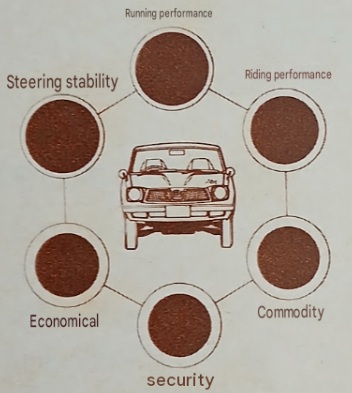
The purpose of this comprehensive road test is to evaluate a car’s overall capabilities through six principal categories: performance, handling and stability, comfort and accommodation, safety, economy, and product appeal.
The evaluation method is what we call the “Bubble Session.” Borrowing an approach from systems engineering, six specialists from different fields gather around a hexagonal table–the “bubble” referring to a honeycomb cell–and discuss the car from their respective viewpoints.
The black circles shown within the six evaluation fields indicate the rating assigned in each category. A car whose circles are relatively equal in size may be regarded as a well-balanced design, whereas one with larger disparities can be said to have a stronger individual character.
Postscript: Story Photos