Subaru Leone Coupe 1400GSR (1971)
Publication: Car Graphic
Format: Road Impression
Date: December 1971
Author: Shotaro Kobayashi
Road testing the Subaru Leone Coupe 1400GSR
The Subaru Leone Coupe is more than simply a two-door adaptation of the current FF-1 sedan. Significant changes have been made to both the engine and chassis, and from behind the wheel it gives the impression of being an entirely different car. As with the 1300G sedan, the Leone 1400 engine is available in two states of tune. The sporting versions are the GS and GSR, the latter of which comes standard with radial tires and servo-assisted brakes. Priced at 719,000 yen, 25,000 yen more than the GS, the GSR is the model we tested this time.
Once on the road, one immediately notices the 1361cc flat-four engine’s remarkable flexibility. This unit is derived from the previous version, but its bore has been increased by 3mm. Until now, the engines in Subaru’s sports models have had an extreme high-speed character, with little torque to speak of below 3500rpm; this trait demanded frequent downshifts into low gear even when driving at moderate speeds. The Leone GSR’s output is 93ps at 6800rpm, the same figure as the 1300G SS, but torque has increased from 10.5kgm at 5000rpm to 11.0kgm at 4800rpm. This 0.5kgm gain appears modest on paper, but the result is a complete change in the engine’s character.
With a light load of two people aboard, starting off in second gear presents no difficulty whatsoever, and the need to downshift into first while underway, as often required in the 1300G SS, has been virtually eliminated. Previously, fourth gear could only be used above 60km/h, making it effectively an overdrive gear, but in the Leone it is possible to leave the transmission in top from as little as 40km/h (around 1600rpm) and still accelerate smoothly. We wondered if the gear ratios had been changed, but they are identical to those of the 1300G. Where the 1300G SS nearly always demanded to be held one gear lower than surrounding traffic, the Leone can make more frequent use of top gear than is typical even among sporting cars. As a result, it is significantly easier to live with in urban driving.
What is surprising, however, is that this improvement in low- and mid-range torque appears to have come at almost no cost to high-speed performance. In the lower gears the engine still spins willingly beyond 7000rpm, remaining every bit as smooth and vibration-free as one would expect from a flat-four. The increase in torque is demonstrated by the fact that, even in top gear, the engine will pull all the way up to its 7000rpm redline (corresponding to an indicated speed of 180km/h). The 1300G SS sedan previously tested by C/G managed only 6500rpm (around 170km/h). Although no timed runs were recorded, it’s easy to infer that acceleration performance has improved overall.
On the other hand, one no longer feels the sparkling throttle response of the previous model–its immediate, eager reaction to even the smallest movements of the accelerator–and the flat-four’s once instantly-recognizable exhaust note has been quieted to the point of near anonymity. The Leone’s engine characteristics are clearly a major improvement, in that it is far more flexible and suited to a wider range of drivers. However, for die-hard Subaru fans who have found joy in skillfully covering a narrow power band with frequent gear changes, the Leone may no longer feel like a Subaru at all.
The same can be said when it comes to handling. Compared to the 1300G SS, which had wonderfully sharp steering at high speeds, the Leone GSR’s responses feel surprisingly dull. Where the 1300G SS’s steering ratio was a quick 14.8:1, all Leone models use a much slower 19.2:1 ratio. In addition, the adoption of MacPherson strut front suspension (replacing the former torsion bar and wishbone arrangement), together with the addition of a stabilizer bar, has almost certainly contributed to the increased understeer and sluggish-feeling steering. Despite the rack-and-pinion system, there is a distinct amount of elastic play around the straight-ahead, so that even if one swings the steering wheel back and forth some 20cm at the rim, the car’s trajectory scarcely changes.
In past tests, the C/G test group has pointed out on several occasions that the high-speed cornering of the 1300G SS was compromised by its significantly undersized 145SR13 tires. In the case of the Leone, which is heavier by some 45kg and carries an even more pronounced front wheel load, this inadequacy of tire capacity and rim width is even more obvious. The test car was fitted with Bridgestone Radial 20 tires, set to the manufacturer’s recommended high-speed pressures of 1.7/1.5kg/cm², but they squealed loudly even at unadventurous cornering speeds. Drivers who enjoy brisk cornering would be well advised to raise pressures to at least 2.3/1.7kg/cm². Even then, the outer front tire reaches its limit sooner than expected, and the front end breaks away abruptly.
Moreover, the tendency to tuck in when the throttle is lifted mid-corner is much less evident than it was in the 1300G SS. Or rather, we should say that in the earlier car, it was possible to tighten one’s line by allowing the tail to step gently outward, and using this technique came fairly naturally. By contrast, in the Leone, changing the car’s attitude through throttle modulation is difficult, and its chassis is generally duller and less responsive. We would like to emphasize again that 145-section tires on 4J rims are absolutely inadequate for the car’s speed potential, and that it requires 155-section tires on 4.5J rims at a minimum.
The ride is softer than in the 1300G SS, and comfort is excellent on all types of road surface. The 1300G SS uses very firm damping, reacting sharply to irregularities and transmitting harsh vertical impacts, whereas in the Leone this has been moderated to a more appropriate degree. On the other hand, at sustained high speeds on good road surfaces the suspension is perhaps a little too soft, sometimes feeling a bit floaty. The stiffening effect of the stabilizer bar is offset by the softer springing, and as a result body roll has actually increased.
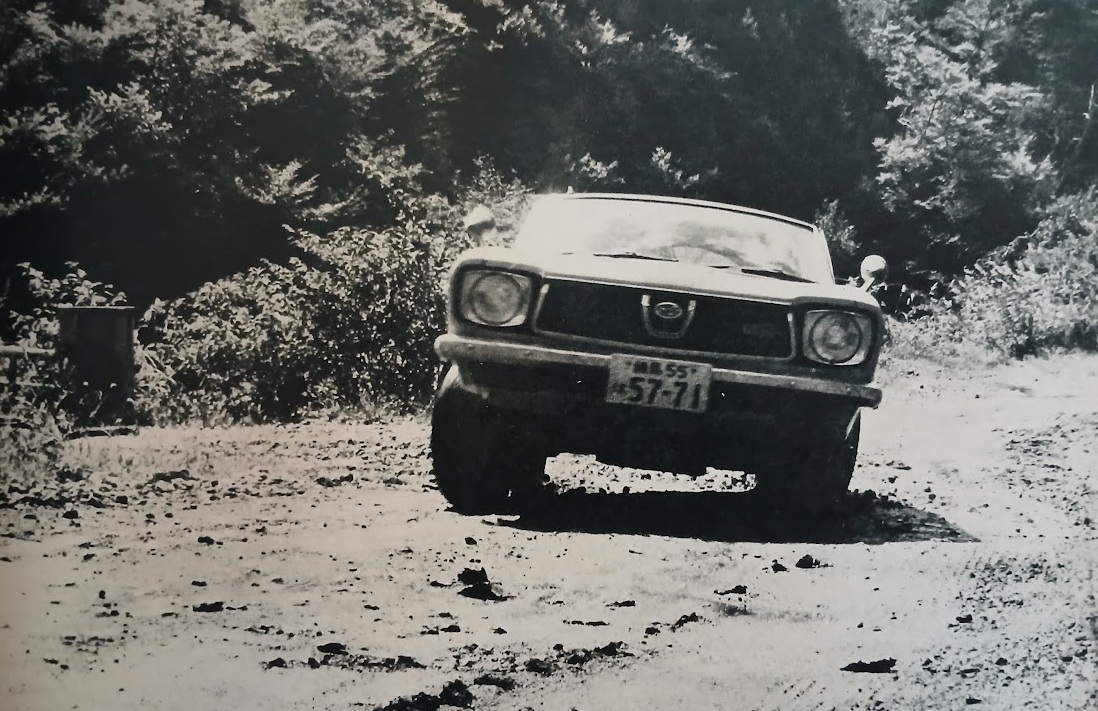
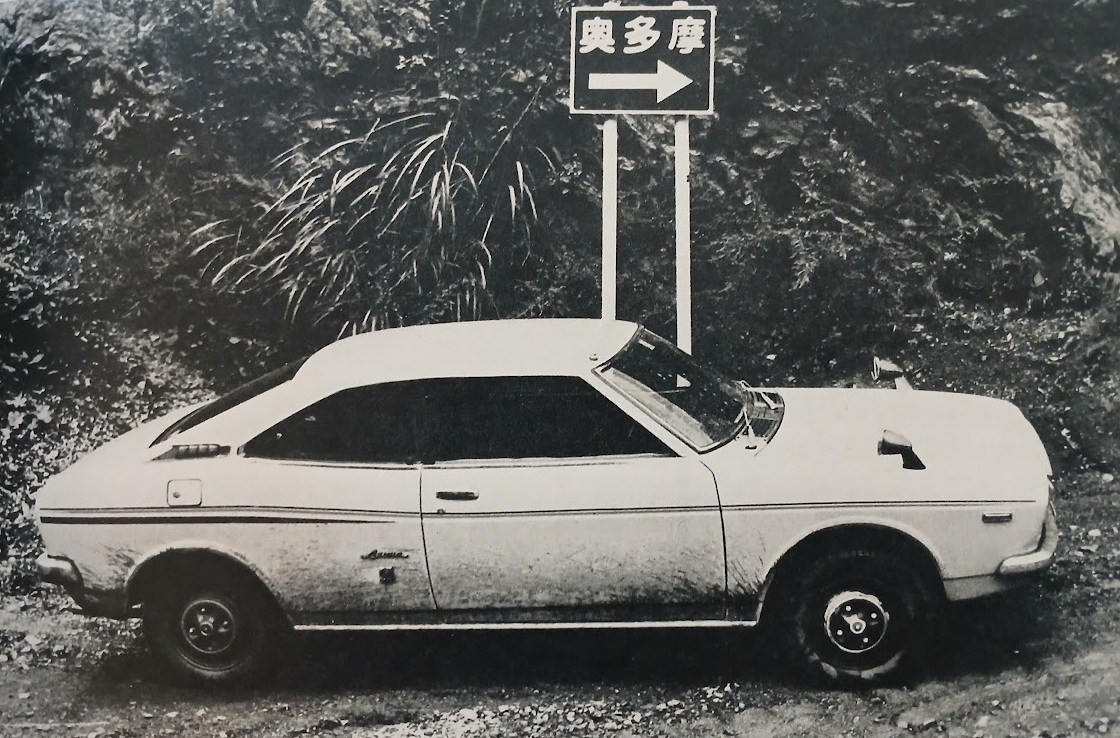
The Leone’s suspension was at its best when we forced our way over a badly deteriorated mountain pass north of Otsuki toward Okutama. The conditions were as brutal as those one might encounter in the Alpine Rally, yet not once did the car strike its underside, nor did its suspension bottom out, and we were able to maintain speeds of 40–50km/h throughout. It was truly remarkable that the ride could remain so comfortable even on such road surfaces. A prolonged, heavy rain had fallen just before our drive, and the road was a continuous succession of deep puddles and muddy ruts, yet even when one wheel briefly spun under power in a corner, directional stability was not affected. In this respect, the car demonstrated the best aspects of front-wheel drive and all-independent suspension.
Another thing that became apparent during this portion of the drive was the length of the front overhang. This was beneficial in that it blocked mud and water thrown up by the front wheels, leaving the windshield remarkably clear. This was in marked contrast to the Nissan Cherry accompanying us, which was covered in mud and spraying its windshield washers almost continuously. On the negative side, however, this frontal length, combined with the raised contours along the sides of the bonnet, makes it difficult to see the road surface immediately ahead when entering a corner.
Styling is inevitably a matter of personal taste, so we hesitate to make hasty judgments in this regard. That said, those who are accustomed to Subaru’s traditionally functional forms cannot help but find the Leone somewhat jarring. Viewed from the side, the visual center of the car’s mass lies conspicuously far ahead of the center line, and one sharp-tongued staff member remarked that it looked like a car that had been rear-ended and shoved bodily forward over its wheels.
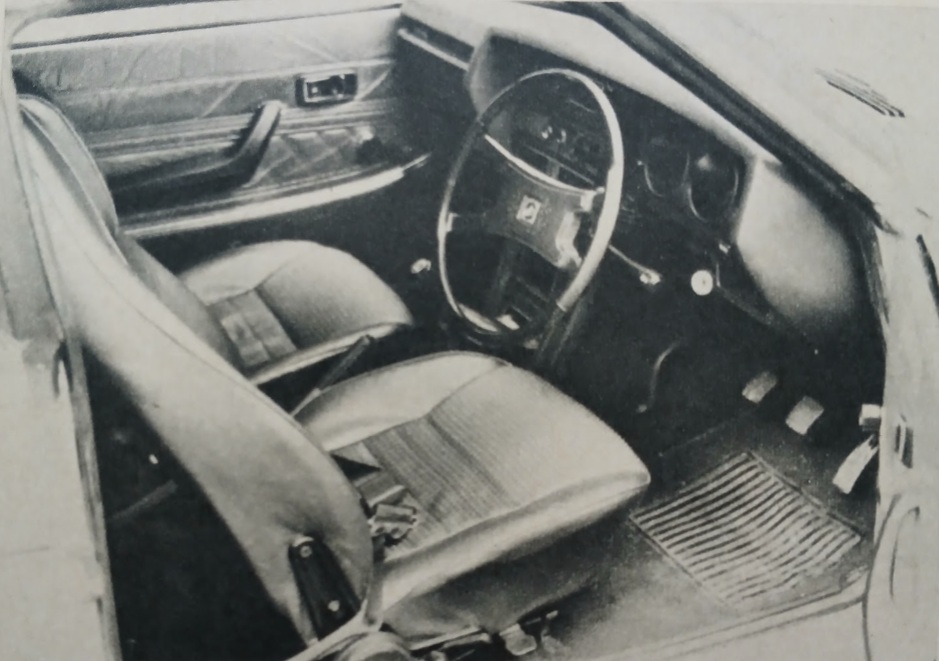
From the driver’s seat, one’s first impressions are of the reduced interior height (55mm lower than before), the steeply raked windshield that slopes close to one’s forehead, and the somewhat exaggerated instrument panel that looms intimidatingly ahead, all of which make the car feel more cramped than it actually is. The seats, positioned low relative to the scuttle, leave the driver feeling uncomfortably low in the car, and their side support is poor. This is particularly noticeable from the passenger seat, which lacks a roof-mounted grab handle; the door pull that should double as a grab handle is positioned too far back to be of much help. Rear-seat comfort is constrained by the styling, with insufficient headroom and legroom, making long rides difficult for adults. The only remaining packaging benefit traditionally associated with front-wheel drive is the unusually deep trunk (the spare tire and tools are housed in the engine compartment).
Since we’ve devoted so much space to driving performance, there is no space left to go into detail about the interior, but suffice it to say that it is fully equipped with all the accessories one would expect from a domestic car in this class. The most substantial change is that the heater, previously a double-radiator type with an electric fan, has been sensibly replaced with a conventional heater and blower. As a result, cool air can now be drawn in with the blower when desired. A small point, but one we found bothersome, is that the upper edge of the dashboard (finished in glossy black vinyl leather) is reflective enough to cast glare across nearly half of the steeply raked windshield in direct sunlight.
Finally, a word on fuel consumption. We took measurements over a 149.8km route, running from Tokyo along the Chuo Expressway to Otsuki, then approximately 30km into the mountain roads toward Okutama before turning back due to a landslide. Over this distance, the car consumed 14 liters of fuel, resulting in an average of 10.7km/l. Almost the entire mountain section was driven in second gear, and the route also included roughly 30km of urban driving in Tokyo. It is often said that Subaru’s sporting models return much poorer fuel economy than their standard counterparts, but with its engine’s newfound flexibility and reduced need for frequent downshifts, the Leone proved to be considerably more economical in this regard. The fuel tank capacity is a generous 50 liters.
Postscript: Story Photos