Subaru Leone Coupe 1400GSR (1971)
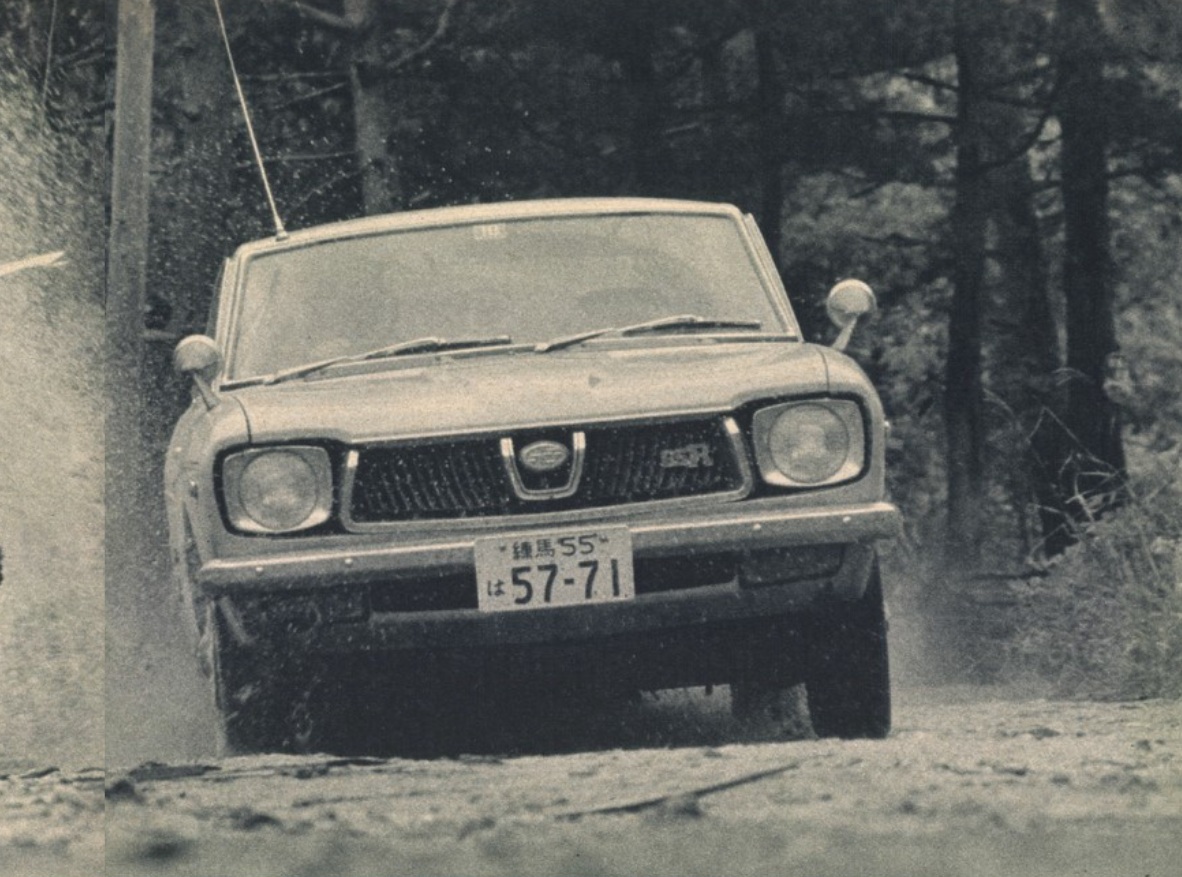
Publication: Auto Sport
Format: Road Test
Date: December 1971
Author: Yoshio Takaoka
An FF Coupe Through the Autumn Roads of Inner Kinugawa
No matter how many winding passes we crossed, all we could see was mountain after mountain in full autumn colors. Into these remote Okukinu forest roads we brought Subaru’s newly introduced hot model, the Leone GSR, to explore the full driving character of this front-wheel-drive coupe.
A Car Looking Several Years Ahead
Today, we are told, is the age of the specialty car–or perhaps more accurately, the age of “feeling.” Even Subaru, a company long associated above all with engineering integrity and technical individuality, has now entered the 1400cc coupe market with the new Subaru Leone Coupe.
This new model appears to be aimed squarely at younger buyers, yet at the same time it has clearly been conceived with several years of future development in mind. Its guiding philosophy seems to have been the harmonious combination of functional excellence with a stronger sense of mood and visual impact. As a result, the body has grown noticeably larger, while the styling has undergone a complete transformation into something far more dynamic in appearance.
Naturally, there are many mechanical changes as well. Although the rear semi-trailing-arm suspension has been retained, one of the most significant revisions is the use of a strut-and-coil front suspension in place of the former wishbone-and-torsion-bar arrangement.
Engine displacement, meanwhile, increases from 1276cc to 1361cc through a 3mm enlargement of bore, from 82mm to 85mm. Even so, output remains unchanged at 80ps for the standard version and 93ps for the sporting model. Rather than pursuing higher horsepower figures, Subaru has instead used the increased displacement to improve torque.
In standard form, torque rises from 10.1kgm/4000rpm to 10.5kgm at the same engine speed, while the sporting version improves from 10.5kgm/4000rpm to 11.0kgm/4800rpm. The intention is clearly to improve drivability and acceleration in the low- and medium-speed ranges.
Many who were seeing this new model for the first time reacted to its bold styling and lavish interior appointments by remarking that “it doesn’t seem like a Fuji Heavy Industries car.” Yet the decision to restrain horsepower while increasing torque in pursuit of a more agreeable driving character can be seen as proof that Subaru’s traditional engineering philosophy remains very much alive beneath the surface.
The lineup consists of the DL and GL with the 80ps engine, and the GS and GSR equipped with the 93ps version. The model tested here was the hottest of the range: the GSR.
Its carburetors are twin fixed-venturi two-stage two-barrel units, while compared with the GS, the GSR is further distinguished by the fitment of 145SR-13 radial tires and a brake servo as standard equipment. The brakes themselves are identical on both models, consisting of outboard front disc brakes and leading-trailing rear drums.
As with the earlier FF-1, it seems almost certain that rally competition will be the central focus of the Leone’s future in motorsport. With that in mind, we decided to take this freshly introduced Leone directly onto rally roads in order to explore both its responses and the differences in character between it and the FF-1.
New Cooling System and Heater Design
With a thin autumn rain continuing to fall under lingering clouds, we left Tokyo at dusk and headed north along National Route 4–the Oshu Kaido.
The planned route was as follows: from Utsunomiya to Shirakawa via Route 4, then left onto Route 289 at Shirakawa, crossing Kaishi Pass toward Narahara. From there we would loop back in a broad U-shape along Route 121, continue from Tajima to Hashio, turn right, cross Nakayama Pass, and enter the Yasuga Forest Road from Tateiwa Village. Beyond that lay the Yunishigawa, Kawamata, and Sanno forest roads before finally emerging onto the Senjogahara plain near Nikko.
Threading our way between long-haul trucks while avoiding the spray of muddy water, we pressed onward into the night.
The operation of the wipers proved extremely smooth, perhaps owing to the more aerodynamic shape of the windshield itself. Even at higher speeds there was no sign of blade lift, and–possibly because the car was still new–wiper motor noise was almost inaudible.
The steeper rake of the windshield also improves defroster effectiveness considerably. In the Leone, Subaru has abandoned the FF-1’s dual-radiator arrangement in favor of a single crossflow radiator design, in which coolant flows laterally across the core. As a result, separate electric fans are now provided for the radiator and heater systems.
Previously, the heater and defroster reused airflow from the auxiliary radiator fan, which occasionally resulted in water entering the system and emerging as steam through the defroster outlets. With the new arrangement, however, the heater core and fan are housed between the bulkhead and instrument panel, eliminating this problem.
That said, the shape of the hot-air outlets themselves still leaves room for improvement. The upper half of the passenger-side window stubbornly refused to clear completely, which remained a concern.
The driving position, meanwhile, represents a considerable step forward, as do the materials and shape of the seats. Gearshift feel is likewise well judged and inspires confidence.
Perhaps because the wheelbase has been lengthened by 35mm and the front track widened by 25mm–together with the generally larger body dimensions–the sensation of speed is surprisingly subdued. The effect may stem in particular from the additional 95mm of overall length and the noticeably longer hood section.
At the same time, vehicle weight has increased by 45kg over the Subaru 1300SS, rising from 730kg to 775kg. As a result, the sprung mass now feels reassuringly substantial, while ride quality on paved roads is soft and composed. This may partly reflect the characteristics of the new strut-type suspension, but even on radial tires, expansion joints and surface seams were absorbed so effectively as to be almost imperceptible.
We arrived in Shirakawa at around 11:00pm. Since it had been raining for such a long time, we began to feel uneasy about road conditions around Kaishi Pass, and decided to stop by the local police station for advice.
“What? You’re planning to cross that pass now? Look outside–the fog’s already rolling in. That’s reckless. There are places up there where one of you would have to get out and guide the car through. And if you go off the road, nobody’s coming to rescue you until tomorrow.”
Such was the “advice” offered by the officer on duty.
He continued with further “encouraging” information: “There’ve been cases where crashed cars and bodies weren’t discovered until four days later. And since it’s technically a forest road, even if it’s closed off, we don’t necessarily get notified here.”
Under the circumstances, it would have been rather irresponsible to insist, “We’re rally drivers, so we’ll be fine.” Instead, we decided to stop for the night in Shirakawa and, early the following morning, head toward Yunokami via Hatori Lake and Yumoto Onsen before rejoining Route 121.
Hopping and Understeer
Through the crisp morning air, we made our way from Lake Hatori high in the mountains toward Yunokami. The surrounding hills had already entered the height of autumn colors. Passing through tunnels of forest with the mountain stream of the Tsurunuma River running below us, we reached Route 121 from Shirakawa in barely an hour.
The police officer the night before had insisted even this route would take at least two.
Beyond Tajima, we turned onto the road leading from Hashio toward Tateiwa Village. This had been one of the checkpoints in last year’s Motor Fan/Auto Sport Rally. It was impossible not to remember that event, and our struggles in a Publica whose second gear had given out altogether.
Not long after passing Takinohara, the terminus of the Aizu railway line, we entered the gravel surface of Nakayama Pass. We attacked the pass at an average speed of roughly 45km/h.
Perhaps because the road surface in the corners had become badly corrugated, the front wheels began hopping violently–do-do-do-do–across the surface. Presumably the damping force is insufficient, allowing the tires to lose their grip against the road. With stronger damping, the tires would likely be pressed more firmly into the surface, improving adhesion correspondingly.
Even so, the softness of the springs proves effective on gravel. Sharp impacts from potholes and depressions are largely absorbed by the suspension itself before they can reach the body. In the FF-1, by contrast, such shocks tended to transmit themselves much more directly into the structure of the car.
The Leone’s handling balance also displays a stronger tendency toward understeer than the FF-1.
In the Subaru 1300, one could enter a corner under power and, with a certain amount of steering lock applied, provoke the rear into sliding fairly easily. In the Leone, however, the wheelbase extension and the fact that the increase in rear axle load exceeds that at the front (up 25kg at the rear versus 20kg in front when unladen) appear to have improved rear-end grip substantially, resulting in a correspondingly stronger understeer tendency.
Naturally, this is of little importance in normal driving. But in rally competition, where fractions of a second matter, one imagines the effect could be reduced by fitting wider 4.5J wheels in place of the standard 4J items, together with 155-13 tires instead of the existing 145-13s, or perhaps by changing the diameter of the stabilizer bar.
Beyond that, it would likely help to adopt a driving style that takes the clipping point slightly earlier in the corner.
Having climbed to the summit of Nakayama Pass, we began the descent. One immediately appreciates the improvement in visibility through right-hand corners now that the old vent windows have been eliminated.
Descending at a fairly brisk pace, it also became clear that the servo-assisted brakes now offer a very high level of confidence. They provide stable and reassuring stopping power with only light pedal effort.
Brake capacity had been something of a weak point in the FF-1–particularly during long downhill sections–but here, one feels almost completely at ease.
In addition, the substantial reduction in rolling and pitching motions makes fast downhill driving considerably easier. Much of this improvement is likely attributable to the effectiveness of the stabilizer bar.
Recovering over “Mountain Vegetable Hot Pot”
Just before reaching the village settlement of Tateiwa, we turned left at an Aizu Bus stop marked “Masuzawa Iriguchi” and finally entered the Yasuga Forest Road.
The road was narrow and the surface not particularly good. Although there were only three of us aboard, the underside of the car began striking the ground more easily than expected. A ridge of gravel only 6-7cm high along the center of the road was already enough to produce a scraping noise underneath.
The contact appeared to come primarily from the section where the left and right exhaust pipes merge at the center of the car, together with the main muffler suspended beneath the rear floor. The front transverse links (lower arms) and the front crossmember beneath the transmission were not striking the surface.
In rally trim, however, ride height can apparently be increased through the sports kit, so this should not present a serious problem.
What was more concerning was that on heavily corrugated surfaces–or after lightly striking objects with the crossmember area–the gearbox would occasionally jump out of first or second gear. This may have been peculiar to this particular test car, but it is certainly an issue that deserves investigation.
The Yasuga Forest Road descends toward Yunishigawa Onsen along the shoulder of Mt. Yasugamori (1,654m), with the summit marking the border between Fukushima and Tochigi prefectures.
On the Fukushima side, the surface consists largely of hard limestone-based gravel. Here, the tread pattern of the Bridgestone Super Speed Radial 20 tires fitted to the test car occasionally packed up with fine gravel, causing moments where we nearly lost grip on corner exits. A more aggressive rally-type tire pattern would presumably clear itself much more effectively under such conditions.
The Tochigi side of the pass opens up considerably, with longer sightlines and more straight sections, making for a far more relaxed and enjoyable drive.
At the bottom of the descent lies Yunishigawa Farm, where we spent a short while amusing ourselves with a group of goats wandering freely about the grounds.
Here, using an open dirt area, we attempted several tight turning maneuvers. Once again, perhaps because of the narrow tires, the front end tended to push wide while the rear stubbornly maintained its grip. At higher speeds and through larger corners, the behavior might well change, but even with deliberate throttle-on and throttle-off inputs through medium-speed turns, the attitude remained essentially the same.
The tendency of the rear end to rotate under combined steering and throttle inputs has always been one of the characteristic traits of front-wheel-drive cars, but in the Leone that character has been noticeably reduced.
Yunishigawa Onsen itself is said to have originated as a refuge settlement for defeated Heike clansmen, and even today many old thatched-roof houses and historical remnants survive, preserving something of that atmosphere.
Most memorable of all was the local “sansai nabe,” or mountain vegetable hot pot. Served in a heavy iron bowl worthy of Miyamoto Musashi himself, it contained pumpkin, shiitake mushrooms, bracken fern, shimeji mushrooms, chicken, and all manner of ingredients thrown together and seasoned simply with soy sauce. Rustic and hearty, it was exactly the sort of meal we could appreciate after a long stretch of demanding driving.
From Yunishigawa toward Kawamata Onsen, the Yunishigawa Forest Road was still under construction in places. Some sections had become deeply muddy and rutted, while others were strewn with large rocks. Even so, the front-wheel-drive Leone traversed these difficult stretches with surprising ease.
That said, the absolute narrowness of the forest roads in this region becomes exhausting after a while. More than once, we found ourselves nostalgically recalling the far broader Komagoe Forest Road in Utsukushigahara, which we had driven during the Alpine Rally.
There were also two or three suitable spots for jumping the car along this route. Unlike the harsh, crashing landings of the Subaru 1300, the Leone settles back onto the ground in a far calmer and more composed manner.
Despite the softness of the dampers, the sensation is actually quite pleasing. Presumably this is due to the extensive use of rubber bushings throughout the suspension system.
Strong Mid-Range Torque as Its Weapon
The front brakes use 184mm discs with an auto-adjustment mechanism. As mentioned earlier, the discs are mounted outboard, and this arrangement brings several advantages. With the previous inboard setup, fitting an underguard could compromise airflow and raise the risk of vapor lock, but that concern has now been eliminated. Serviceability is also improved. And perhaps most importantly for rally use, the tendency for sand and gravel to become trapped between the pad and disc–a common issue with inboard systems–has been reduced almost to zero.
From Yasugamori to Yunishigawa and Kawamata, the mountain ranges rolled on one after another, each just entering the height of the autumn colors. Our mustard-yellow (“Babu Yellow”) Leone Coupe seemed perfectly at home in this landscape, pressing on with a crisp, eager exhaust note echoing through the valleys.
Kawamata Onsen lies deep below the roadway along a narrow ravine, its old ryokan lining the riverbank with steam billowing from the local hot spring tower. But there was little time to linger over the atmospheric scenery, because ahead lay the final forest road section leading toward Nikko and the Kotoku Ranch area.
Perhaps because we were drawing closer to Nikko, oncoming traffic suddenly increased. In tight blind corners, first gear became mandatory, entering with the clutch held at half-engagement. If the road ahead proved clear, we would feed in just enough throttle to match second-gear revs, then upshift cleanly without spinning the wheels. If an oncoming vehicle appeared, however, the procedure changed immediately: off the clutch in first gear, using engine and foot braking combined to avoid trouble.
On S-bends and corners where visibility was uncertain, we also experimented with keeping the left foot lightly resting on the brake pedal, maintaining extra margin for sudden braking inputs.
The reason front-wheel-drive cars are generally faster through S-curves and slaloms than FR machines is fairly straightforward. In an FF car, even while the body is still rolling through one corner, steering input can already begin toward the next clipping point. And where an FR car may need to lift off the throttle mid-corner, the FF machine can often continue through while maintaining engine speed. On corner exit as well, places where an FR car might begin to weave under power, an FF chassis tends to remain comparatively stable.
That said, FF layouts have their own dangers. If the clutch is engaged too abruptly while steering lock is applied, or if braking is carried too deep into the corner, grip can vanish instantly and the car will run wide. For that reason, the key to increasing cornering speed is to decelerate as fully as possible while still in a straight line, then maximize exit speed on the way out.
And it is exactly in these situations that the Leone’s strong mid-range torque becomes an advantage. It feels ideally suited to high-average-speed rallies, and over the course of this drive, we were able to appreciate that character thoroughly.
The Leone GSR possesses a personality almost completely opposite to Subaru’s earlier SS models. The FF-1 SS, for example, used a fast-ratio steering gear and could become an effective sports machine with little more than upgraded dampers–a car aimed squarely at enthusiasts. The Leone GSR, by contrast, uses the same steering gear and suspension as the standard model.
This is partly because Fuji Heavy Industries already intends to offer dedicated sports kits specifically for the Leone.
At present, those kits are reportedly under development by Fuji Heavy Industries’ experimental division. Two versions are said to be planned: one aimed at general sporting driving, and another intended for gymkhana and hard rally use. According to what we heard, they may be introduced as early as next spring.
Once equipped with those sports kits, there is little doubt the Leone will reveal itself as a genuinely formidable machine.
(The author drove a Subaru 1300 to 2nd place overall in the 13th Alpine Rally.)
Supplement: Leone GSR Mechanicals and Sports Kit
As mentioned in the main text, the suspension specifications of the Leone 1400 Coupe series remain unchanged between the sports models and the standard cars. This represents a major shift in philosophy from the days of the FF-1 1300, when Subaru’s thinking was that “town use and sports use can both be satisfied without resorting to special kits.”
Now, the idea seems to have changed considerably: even in the sports model, the typical user is expected to mainly enjoy the atmosphere and image of the car, while truly serious sporting use is to be pursued through the installation of dedicated sports kits.
Take the Subaru 1300 as an example. The steering gear ratio on the standard model was 18.43, while the Super Touring and SS versions used a much quicker 14.8 ratio. In other words, those cars effectively came from the factory with a built-in sports kit. The thickness–and therefore spring rate–of the front and rear torsion bars also differed, and for rally use it was often sufficient simply to replace the dampers.
With the Leone, however, the DL, GL, GS, and GSR all share identical damper settings and spring rates. Even the GSR, then, is clearly intended as a model aimed at a broader range of users.
Mechanically, a number of improvements are concentrated around the front end. Cooling now uses a single-radiator system. When coolant temperature remains below 82°C, the coolant circulates only between the carburetor, intake manifold (which uses hot-water preheating), and water bypass passages. Once temperature exceeds 82°C, the thermostat opens and coolant begins flowing through the radiator for cooling by ram air. If temperature rises further to 92°C, the electric cooling fan switches on.
The advantages of this arrangement are quicker warm-up of cold coolant, reduced power loss from the fan, and lower operating noise.
The brake servo unit is a compact 114.3mm-diameter unit supplied by Jidosha Kiki. Naturally, the master cylinder uses a dual-circuit system, though up through the GS–which does not receive the servo–the front and rear brakes operate in an X-pattern split. Only the GSR adopts a true front/rear dual-circuit arrangement.
The carburetors are Hitachi downdraft units: single-carburetor setups on the DL and GL, twin-carburetor arrangements on the GS and GSR.
Fuel tank capacity has been increased from the previous 45 liters to 50 liters, reflecting the demands of this new era of long-distance touring. The tank itself has also been relocated–from beneath the rear seat floor to a position between the rear seat and trunk compartment. Naturally, Subaru’s “EECS” system, which routes evaporated fuel vapors back into the air cleaner, is also fitted.
The optional equipment packages are divided into three categories: Sporty, Variety, and Touring. Of particular interest for rally use is the Touring Pack, which includes coil springs, complete strut assemblies, steering gearbox, stabilizer bushings, reinforced 4-inch rims, 155SR-13 radial tires, torsion bars, and shock absorbers.
The Sporty Pack, meanwhile, offers items such as large and small nose fins, a rear spoiler, and an underguard.
All of these components are reportedly scheduled for release next spring, sometime between February and April.