Subaru FF-1 Super Touring (1969)
Publication: Motor Magazine
Format: Test Drive Report
Date: December 1969
Author: Kazuhiko Mitsumoto
FF-1 Super Touring: Luxury Appointments and Lively Performance
As manufacturers of distinctive domestic passenger cars, Fuji Heavy Industries and Honda stand as a pair of equals, and one senses that both companies share a similar vision of the future in their commitment to high-performance front-wheel-drive automobiles.
In its emphasis on function above all else, the philosophy of Fuji Heavy Industries–also an aircraft manufacturer–is remarkably consistent and places great value on originality. Indeed, that originality has cultivated a small but fervent following of Subaru enthusiasts.
In the Subaru FF-1 lineup, the newly added “Super Touring” model is a higher-performance version of the Subaru FF-1 Deluxe. Combining the more sophisticated image of a four-door sedan with the spirited performance of the FF-1 Sport, it may well succeed in attracting a new generation of Subaru fans.
Given the peculiar enthusiasm for all things “sporting” that has accompanied Japan’s motorization, and the market demand for cars of this type, the timing may seem slightly late. Yet it is interesting that Fuji Heavy Industries, with its strongly engineering-driven approach, did not simply meet the need by adding a four-door version of the FF-1 Sport, but instead chose to introduce an entirely new model.
Subaru enthusiasts tend to include a large number of the sort of enthusiasts one might call “technical-minded.” Teachers, civil servants, doctors, academics, engineers–people who are not professionally involved in automotive engineering, yet who are nevertheless deeply particular about mechanical matters. The Subaru FF-1 series has consequently earned a notably high reputation even among the automotive press. It is, one might say, a passenger car with a distinct connoisseur appeal.
A close examination of the Subaru FF-1 Super Touring reveals that Fuji Heavy Industries had little need to introduce new production equipment for this model. The body shell is taken directly from the four-door sedan, while the powertrain is carried over from the FF-1 Sport. In that sense, the objective has been achieved through the effective use of existing components.
The interior, however, has undergone substantial changes. One therefore suspects that subcontract suppliers have become considerably busier, while product management at Fuji Heavy Industries has likely grown rather more complex as a result.
The principal new design features are mostly limited to the interior, carburetor, steering shaft, and silencer.
A New Instrument Panel
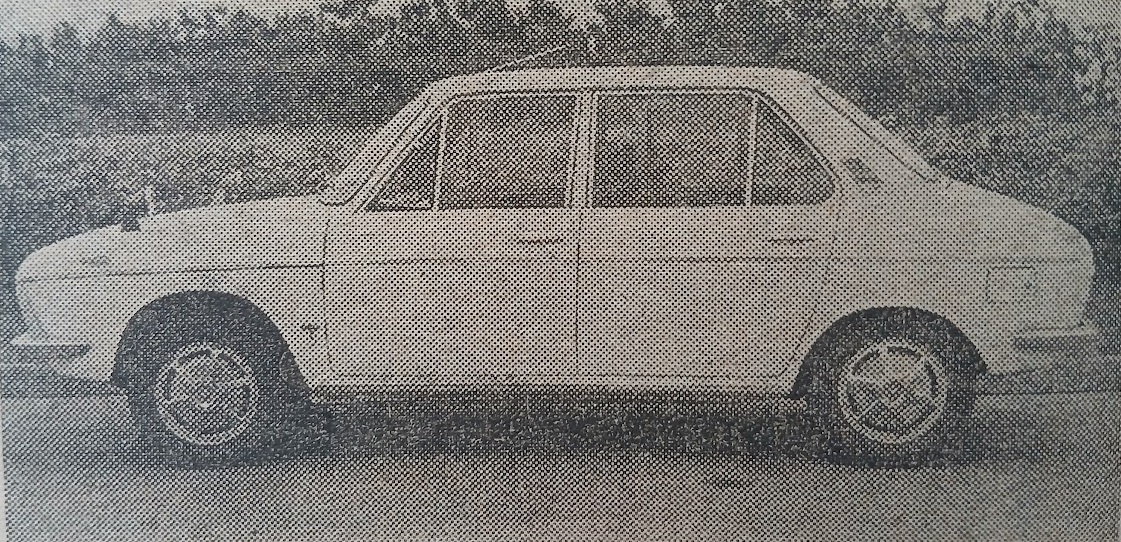
Externally, the Super Touring is difficult to distinguish from the Super Deluxe, with only a few trim details setting the two apart. Inside, however, it is clearly the most luxurious version in the FF-1 lineup, and succeeds in visually presenting itself as a more upscale sporting model.
The Super Touring provided by Fuji Heavy Industries’ public relations department for this test had already accumulated some 2,200km despite having been introduced only recently. Moreover, it showed unmistakable signs of careless treatment by previous testers.
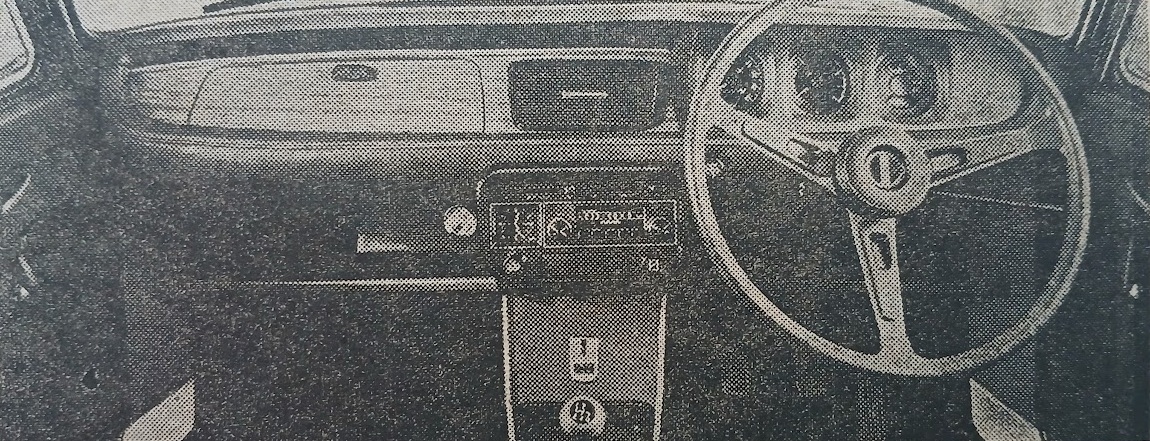
The most eye-catching feature of the interior is the instrument layout, which combines elements of both the Sport and Super Deluxe models. Particularly distinctive is the projecting binnacle housing three round gauges. The steering wheel is molded from a synthetic resin that at first glance appears to be wood, and the shift knob is made from the same material.
Whereas the Sport’s interior is all-black and conveys something of a stealthy atmosphere, the Super Touring uses a brighter maroon color scheme that gives it a tasteful and sophisticated character. The seat upholstery is made from a vinyl-based synthetic material, but it imitates suede remarkably well and has an attractive appearance.
There are separate seats in the front and a rear bench, making it legally a five-seater. In terms of its actual design, however, it seems intended more for four people traveling in comfort.
The rear-seat armrest is unusual. Rather than a conventional fold-down design, it is more like a separate cushion carried in the car and positioned according to the passenger’s preference. Its shape reflects a bold ergonomic approach and is unlike anything found in class rivals.
Interior space is another of the car’s strengths. It creates a sense of roominess seldom found among cars in the 1000-1500cc class, and because there is no propeller-shaft tunnel–a natural advantage of a front-wheel-drive layout–the rear seating area feels genuinely spacious.
At the front, one is left wondering what criteria were used to determine the seat height, because it sits quite high. Rather than extending one’s legs forward in the usual manner, the seating position feels more like sitting upright on a chair. Since the backrest can easily be adjusted to the desired angle, it is possible to settle into a position that suits one’s preference, but when getting in directly from another car, the height of the eyepoint feels somewhat unusual.
A particularly nice feature of the front seats in the FF-1 series is that, in addition to the normal reclining notches, they are equipped with a separate knob that allows stepless adjustment of the backrest over a range of approximately five degrees. If one were being demanding, however, it would be nice to have more than ten degrees of fine adjustment available. Ideally, of course, a fully stepless reclining mechanism extending all the way to flat–as found in Mercedes-Benz seats–would be best, but from a practical standpoint Subaru’s arrangement is entirely satisfactory.
Once seated in the driving position, I found little to criticize in the relative placement of the various controls. The suspended pedals, however, are shaped and angled less for operation with the legs extended forward–or with the heels resting on the floor–than for being stepped on from above. This is especially noticeable when operating the clutch. The left foot must first be pulled out from its resting place behind the pedal, brought around from underneath it, and then moved into position to depress the clutch.
This is because the center console leaves no suitable place to rest the left foot other than beneath the clutch pedal itself. Once accustomed to it, this presents no problems. Yet when getting in directly from another car, even such a minor detail becomes noticeable. If one attempts to use the same clutch technique as before, it is easy to catch one shoe on the pedal, prompting an irritated “tsk.”
An Easy-to-Use High-Performance Engine
Turning the key in the ignition–which combines the starter and steering lock–brings the engine to life immediately.
The exhaust note has been toned down considerably compared with the Sport’s somewhat dramatic, attention-grabbing sound, but once past 3000rpm it still develops a fairly aggressive growl. Given how quiet the ordinary FF-1 is, it is difficult to understand why the Sport and Super Touring models need to be burdened with louder exhaust notes in the first place. Certainly, silence comes at some cost in power, but in a country as small and densely populated as Japan, quieter is generally preferable. Whatever the requirements of export markets, domestic models would be better received if they were made even a little quieter.
If this is simply an attempt to cater to the idea that “young buyers won’t be interested in a car unless it makes noise,” then it is all the more regrettable.
To be sure, the Super Touring is quieter than the Sport. Even so, I would like manufacturers to recognize that the number of people who do not want a “rousing” or “spirited” exhaust note is many thousands of times greater than the number of self-styled enthusiasts attracted to such things.
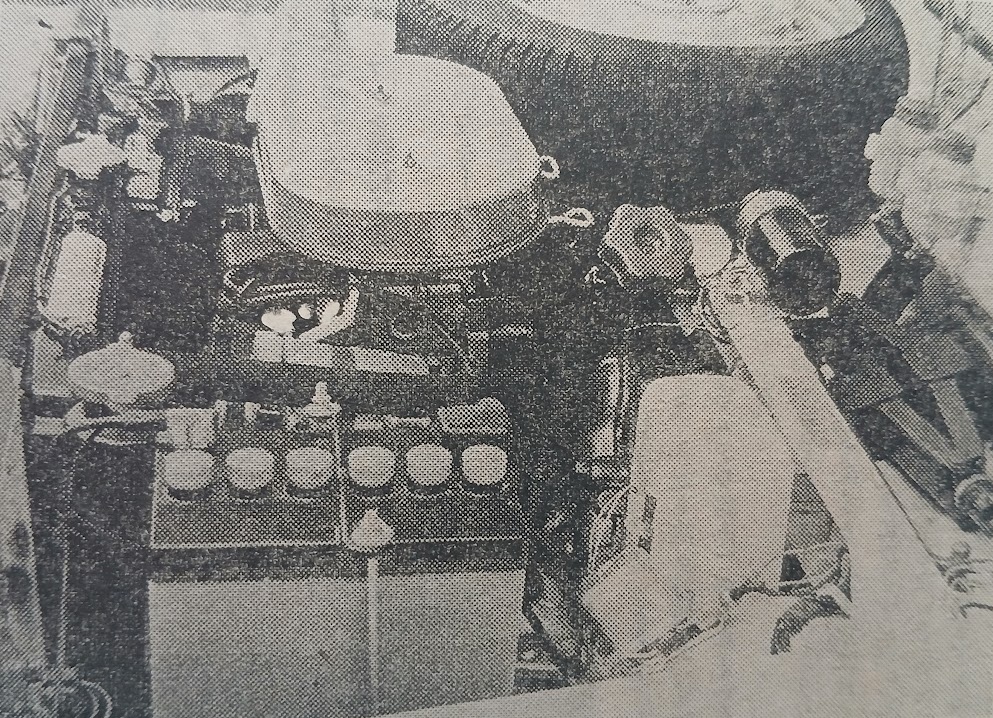
Based on Subaru’s distinctive horizontally opposed four-cylinder EA61 engine, the EA61S uses a pair of two-barrel carburetors rather than the twin variable-venturi carburetors used on the Sport. The result is an engine that revs smoothly and responds sharply to throttle inputs. Output is rated at 77ps/7000rpm, making it a decidedly high-revving unit, while maximum torque of 8.8kgm/4800rpm also arrives relatively high in the rev range. Even so, torque delivery is broad and practical, requiring neither special technique nor familiarization from the driver. It maintains strong pulling power even at low engine speeds, making it a highly usable engine in everyday driving.
The clutch pedal requires no more effort than one would expect, though engagement is somewhat abrupt, enough so that a novice driver might find it slightly difficult. The fully synchronized transmission, operated through a floor-mounted shifter with a slightly stiff, springy feel, has a suitably short shift stroke and is easy to use even on first acquaintance. Because the test car was still relatively new, the shift action retained traces of friction.
The gear ratios are somewhat unusual, with first at 3.540, second at 2.235, third at 1.542, and fourth at 1.033. Yet the fact that they produce no particular awkwardness suggests that they are quite well-matched to the engine’s output characteristics, torque delivery, and vehicle weight. The final-drive ratio is 4.125, a choice that appears to place greater emphasis on standing-start acceleration than high-speed cruising.
On the test course, I observed the speeds reached at both the engine’s maximum torque point of 4800rpm and at 6500rpm, the beginning of the yellow zone on the tachometer. The results were approximately 37km/h (50km/h) in first gear, 55km/h (77km/h) in second, 80km/h (110km/h) in third, and 120km/h in fourth. From these figures, it is clear that at the engine speed corresponding to maximum power, the Super Touring should be capable of attaining its catalog top speed of 160km/h.
Response remains sharp even in fourth gear once the engine is turning above 3000rpm, while from around 1800rpm upward it already displays more than adequate flexibility for practical driving. At the legal maximum speed of 100km/h, the engine turns roughly 6000rpm in third gear, leaving another 1000rpm in reserve, while in fourth it is at about 4000rpm, leaving a substantial 3000rpm margin. In either case, it responds eagerly to changes in throttle opening.
Using a stopwatch and the speedometer, I also conducted informal acceleration test runs. The Super Touring required 9.8 seconds to accelerate from rest to 80km/h, and 15.3 seconds to reach 100km/h. These figures confirm that performance is considerably quicker than one would normally expect from a car of this displacement.
Individuality with Real Merit
On the day of the test, the Super Touring was subjected to crosswinds of roughly 6m/s, yet its straight-line stability, typical of a front-wheel-drive car, proved entirely unaffected. The handling behavior demonstrates another traditional strength of the FF layout, and the Super Touring’s rack-and-pinion steering, with its light, sharp action and quick 14.8:1 ratio, further contributes to the car’s lively and sporting character. Particularly noteworthy is the diaphragm clutch, whose low slip losses transmit power very effectively and help give this sedan the feel of a sports car.
The oversteer tendencies that can sometimes become an issue in front-wheel-drive cars have also been reduced to the point of being mostly unobtrusive in the Super Touring. Even so, if one grows overconfident, charges into a tight corner too fast, and is clumsy with the throttle, the results can be unexpectedly dramatic. This is true of any car, of course, but it serves as a reminder that high-speed cornering is best approached with appropriate caution.
A fully independent suspension is generally expected to deliver good ride comfort, and the Super Touring is no exception in this regard. It delivers a level of road-holding composure and ride quality that would not seem out of place in a 2000cc-class car. Pitch and roll are naturally kept to a minimum, while none of the yawing tendencies often associated with nose-heavy vehicles are apparent. Although supple in character, the suspension still feels firmly supported by well-matched shock absorbers, and its ability to maintain comfort during high-speed touring over rough roads deserves special mention.
The effectiveness of the cabin ventilation was also impressive. Even with all the windows closed, a most welcome volume of fresh air flows into the cabin. This appears to be a result of the high extraction capacity of the ventilation outlets, an admirable feature of the design.
Less impressive was the unexpectedly high level of wind noise. Airflow catches not only around the vent openings but also around the body itself. I drove at 100km/h with everything closed, yet a considerable amount of wind noise was still audible inside the cabin. Opening the ventilators made matters worse, as the ram-air effect added the sound of rushing air in the interior. In fact, the resulting noise became so pronounced that it could drown out both engine and tire noise, which is quite unfortunate.
Any experienced driver knows that on a long high-speed journey, a certain amount of wind noise soon becomes one of the principal sources of irritation, surpassed only by engine and exhaust noise. Even if it is impossible to eliminate a sound entirely, altering its character can create a greater psychological sense of quietness. There are, after all, cars that feel quiet in actual driving despite producing unimpressive results on a noise meter.
Taken as a whole, the Super Touring is a well-balanced high-performance car, though one cannot help feeling that a little more thought devoted to the interior would have made it even better. The center console, for example, seems more for appearance than practicality. The console tray is positioned so low that if one places coins or small objects there, they can only be retrieved by bending awkwardly forward. It would seem far more practical to raise the console and integrate the switches, radio, and ashtray into it. Alternatively, even relocating the radio unit to the speaker position and incorporating the speaker into the console would, in this author’s humble opinion, improve the overall impression considerably.
As a special model intended for owner-drivers who value individuality, the Super Touring deserves to be counted among the most practical high-performance cars available. In that respect, one could say it offers value not merely among Japanese cars, but on a global level as well.
Fuji Heavy Industries has skillfully resolved the drivetrain and steering challenges inherent in a front-wheel-drive layout, equipped the car with brakes fully suited to its performance, and devised what may be considered a quite elaborate dual-radiator arrangement to guard against engine overheating while ensuring effective cabin heating. Combined with a low center of gravity that contributes to high-speed stability, these measures display a thoroughly considered and comprehensive engineering approach.
The car undeniably possesses the kind of qualities that appeal to enthusiasts. Indeed, there are engineers working for rival Japanese manufacturers who, setting aside questions of styling and interior presentation, regard it as perhaps the finest domestic car yet produced.
The spacious cabin and generous luggage compartment are entirely worthy of the Super Touring name, while its road manners make an unusually vivid impression by domestic-car standards.
One can only hope that Fuji Heavy Industries, a company committed to individuality, will continue to follow its own course and resist being swayed by fashionable trends or pressured into pandering to youthful tastes.
Postscript: Story Photos