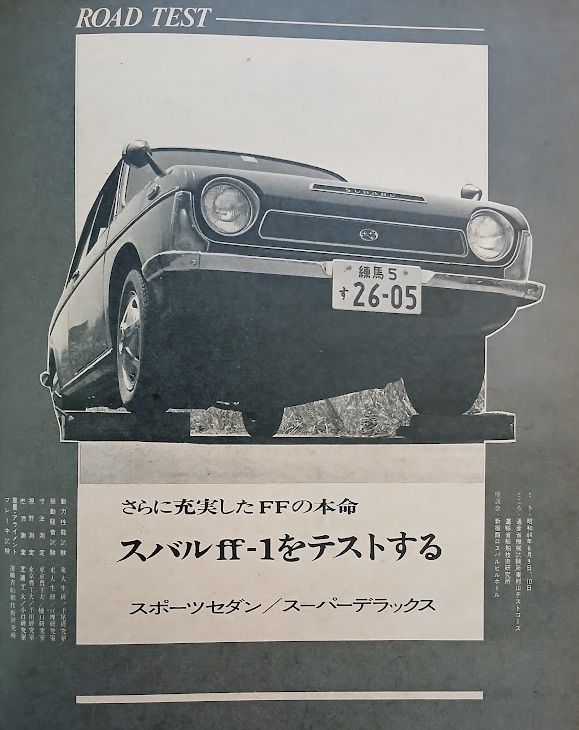
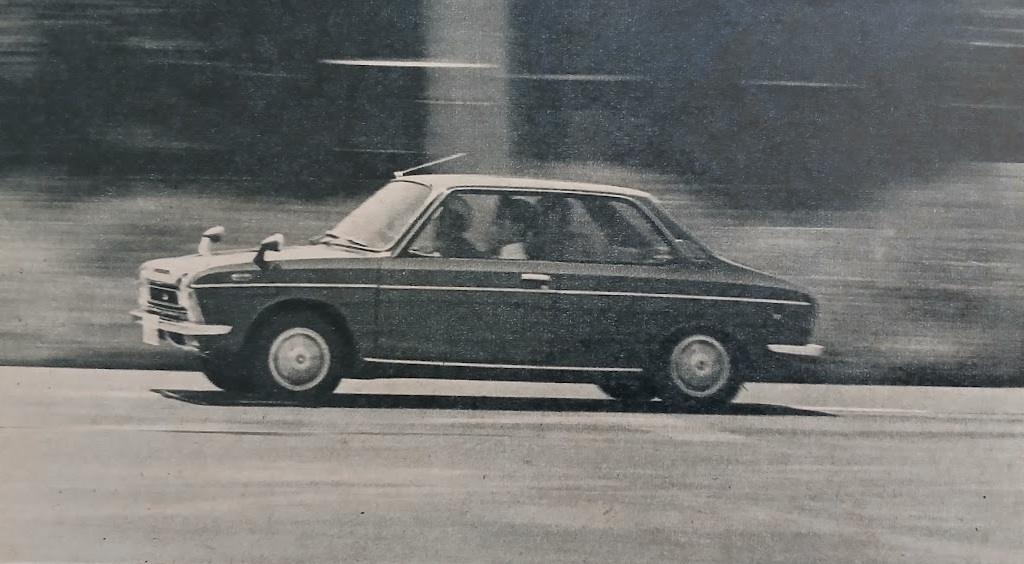
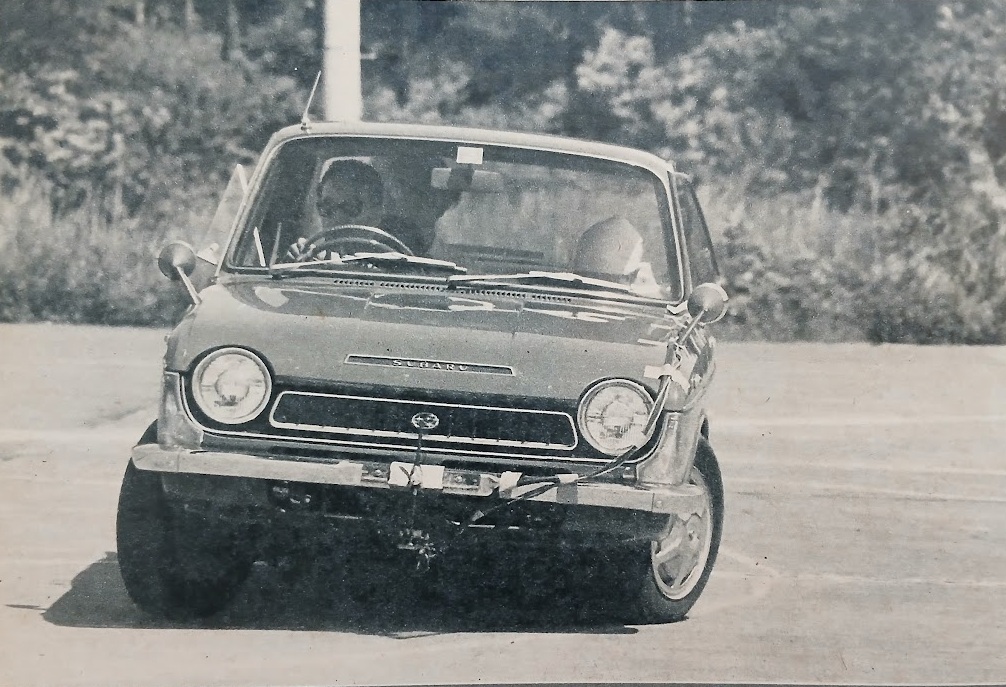
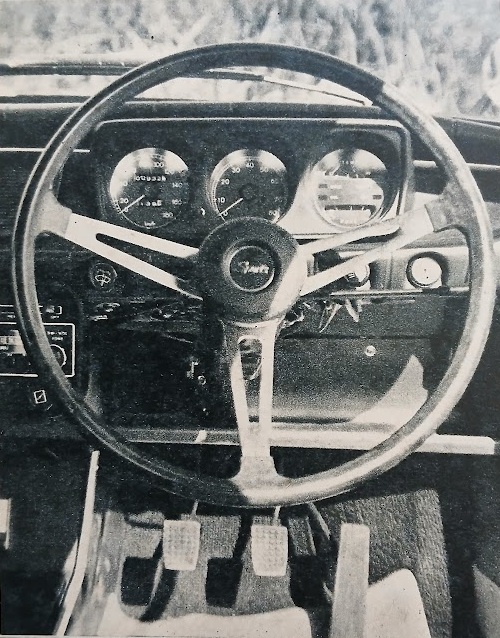
Subaru FF-1 Sports and Super Deluxe (1969)
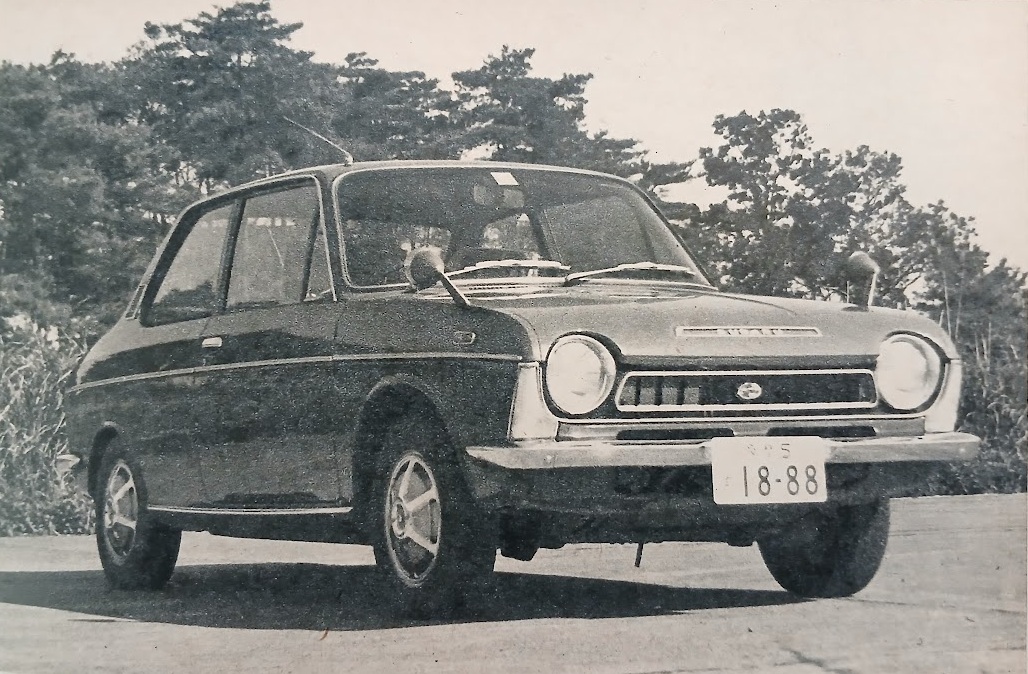
Publication: Motor Fan
Format: Road Test
Date: August 1969
Authors (Roundtable): Hiroshi Yamamoto, Motomitsu Honda, Osamu Hirao, Kenji Higuchi, Kozo Murota, Mineo Yamamoto, Kunitaka Furutani, Hiroshi Hoshijima, Taizo Tateishi, Takaaki Kimura, Yasuhei Oguchi, Yasu Saito, Kenzaburo Ishikawa, Toshihide Hirata, Minoru Onda, Motor Fan Editorial Staff (uncredited)
Adapted for the High-Speed Era
Magazine: To get started, could you tell us about the development aims and overall outline of this new Subaru FF-1?
Yamamoto: It has now been twelve years since we entered the market with the Subaru 360. In that time we introduced the Subaru 1000, and thanks to your continued support, it has been on sale for nearly three years. Throughout that period, we have received a great deal of advice and guidance from the distinguished experts present here, and our engineering staff has devoted every effort, examining every possible angle, to improving performance and creating a car that represents even the smallest step forward. The FF-1 is the result of those efforts.
Magazine: And the name, FF-1?
Yamamoto: We have increased the displacement from 1000cc to 1100cc. However, as there may be further variations in the future, we chose the name “FF-1” rather than tying it directly to engine size. In that sense, the name goes beyond simple cubic capacity.
Magazine: Can you tell us a bit about performance, from the technical side?
Honda: From the standpoint of power performance, we had previously thought that 1000cc was sufficient. However, with the recent development of expressways in particular, it has become necessary to adapt the engine–and indeed all systems of the vehicle–to sustained high-speed driving. For that reason, we increased displacement to 1100cc.
In other words, our aim was to create a car that is safer, faster, and more spacious. The automobile of the future cannot be merely fast. Safety must always be the primary consideration. With that in mind, our desire was to create a car with an entirely “new car feeling.” This is how the Subaru FF-1 came about.
Magazine: What sort of mechanism does the engine use?
Honda: Displacement has been increased by approximately 11 percent, from 977cc to 1088cc. It is a horizontally opposed four-cylinder, water-cooled, four-cycle unit. There are two types: the EA61 for the sedan and van models, and the EA61S for the Sports Sedan.
One point I would especially like to emphasize is that many components are shared between the Subaru 1000 engine and this new FF-1 engine. This commonality is highly advantageous, both from a service standpoint and in terms of production efficiency.
Magazine: And the power output?
Honda: The bore and stroke measure 76 x 60mm, an oversquare configuration. Its three defining characteristics are light weight, compact dimensions, and high output.
We have used aluminum alloy extensively, and by integrating the engine, transmission, and differential into a single unit structure, we have achieved a very compact package. As for output, a newly designed combustion chamber with greater resistance to knocking allows the engine to deliver flexible performance from low to high speeds.
Furthermore, the inherently well-balanced horizontally opposed layout, combined with our dual-radiator system that eliminates the need for a cooling fan, contributes greatly to quiet operation.
These features are all part of an FF system entirely of our own development. It is something we take pride in, and something not easily imitated by other manufacturers.
As indicated in the catalog figures, we have raised maximum output from the previous 55ps by 7ps, to 62ps–an increase roughly 12 percent. The Sports Sedan produces 77ps at 7000rpm. In preparation for the high-speed era, we have increased horsepower by 12 to 15 percent across the model line, while also refining low- and mid-range torque characteristics, acceleration performance, and the engine’s willingness to rev. Efforts to improve performance have been made down to the smallest details.
For example, at around 45km/h in top gear the engine turns approximately 2000rpm, and top-gear acceleration has improved by about 10 percent. We believe this nearly achieves the characteristics we targeted.
Magazine: Thank you. With so many distinctive features, the car has drawn attention even abroad. Professor Hirao, what are your impressions?
Hirao: As we have just heard, to run comfortably on the expressways, it is necessary to make many careful improvements. The first thing that struck me was how remarkably quiet the engine is. Even as the revs rise beyond 7000rpm, it remains well balanced. And perhaps because there is no cooling fan, the quietness is maintained as speed increases.
Higuchi: I imagine there are many people who are fond of Subaru, and the reason is not only the front-wheel-drive layout. There are numerous features not seen on other cars, and I believe these are part of its appeal.
For example, the standard model produces 62ps at 6000rpm, with maximum torque of 8.7kgm at 3200rpm, and a top speed of 145km/h. The Sports Sedan reaches 160km/h. These figures suggest more than sufficient capability for the high-speed era. To achieve such performance from 1100cc–it would be difficult to ask for more.
Magazine: We understand that considerable attention has been given to safety equipment. Could you explain the details?
Murota: Yes, we paid particular attention to safety measures and made numerous improvements.
First, regarding what might be called primary safety, there is the inherent safety of front-wheel drive: the excellent stability and controllability of the FF layout. The benefits of systems that use the same front wheels to steer and pull the car forward are recognized worldwide, and it connects directly to safety in the expressway era.
Secondly, as a matter of secondary safety, we have revised both interior and exterior design elements and modified various mechanical parts to improve overall safety. Items that appeared visually hazardous have had their protrusions removed and replaced with rounded forms. The fuel tank has been repositioned and the design of the instrument panel has been improved with safety in mind. The seats, which had drawn some criticism in the past, have been completely redesigned.
Additionally, the sedan’s rear-pillar ventilation system extracts cabin air from beneath the rear glass and routes it through the rear pillars, which also contributes to a demisting effect for the rear window.
The key, incidentally, is of the reversible type—symmetrical top and bottom—so it may be inserted in either direction.
Yamamoto (Mineo): The opening mechanism for the triangular vent window is interesting, isn’t it?
Hirao: Some people say it’s difficult to operate…
Yamamoto (Mineo): It’s small, but once you get used to it, it’s fairly easy to use, don’t you think?
Hirao: The door lock button, however, is positioned toward the rear, which makes it rather awkward to reach. If one is driving with it locked and the car were to overturn, for example, and especially if wearing a seatbelt, it might be difficult to release it oneself. It’s possible that someone who could otherwise survive might not simply because the door cannot be opened. It could also happen that rescuers arrive and are unable to open the door. In that sense, wouldn’t it be better to place it somewhere more convenient? With a two-door model, it would likely be even more difficult to operate.
Murota: In the case of the two-door, there may indeed be an issue. We are studying the matter.
Hirao: That aside, when driving on the expressway, one wears a seatbelt. In that case, is the door lock even necessary?
Murota: Wouldn’t it be safer to have it locked?
Hirao: Would it? I rather think it may be safer not to lock it on the expressway… In any case, whether it’s safer to lock or not lock the doors at high speed is an issue for the entire industry.
Magazine: It is certainly a question that applies more generally.
Hirao: If the seatbelt were to fail, then surely the occupant would not survive in any case. This is something that ought to be thoroughly studied by the Safety Committee of the Automobile Manufacturers Association.
Overtaking Acceleration Much Improved
Magazine: Let’s present the results of the performance tests.
Furutani: Starting with the four-door Deluxe: the test car had covered only 3,507km. Unloaded vehicle weight was 700kg; with three occupants and instruments totaling 179.5kg, the test weight came to 879.5kg.
First, the standing-start acceleration results. The car reached 50m in 5.5 seconds, 100m in 7.7 seconds, 200m in 12.1 seconds, and 400m in 19.2 seconds. In terms of time to speed, the results were 0-20km/h in 1.8 seconds, 0-40km/h in 3.8 seconds, 0-60km/h in 6.4 seconds, 0-80km/h in 10.1 seconds, and 0-100km/h in 15.4 seconds.
Turning to the FF-1 Sports, vehicle weight was 705kg; again, three occupants plus instruments added 179.5kg, giving it a test weight of 884.5kg.
In standing-start acceleration, the car reached 50m in 4.7 seconds, 100m in 7.2 seconds, 200m in 11.2 seconds, and 400m in 17.8 seconds. In terms of time to speed, it accelerated from 0-20km/h in 1.6 seconds, 0-40km/h in 3.7 seconds, 0-60km/h in 6.0 seconds, 0-80km/h in 8.8 seconds, and 0-100km/h in 13.2 seconds.
For overtaking acceleration, starting in third gear from an indicated 30km/h (actual speed, 27.7km/h), the car reached 40km/h in 3.3 seconds, 60km/h in 6.3 seconds, 80km/h in 10.7 seconds, and 100km/h in 15.3 seconds. When starting in top gear, from an indicated 40km/h (actual speed 37.5km/h), it reached 50km/h in 5.1 seconds, 60km/h in 8.7 seconds, 80km/h in 16.2 seconds, and 100km/h in 23.1 seconds.
For comparison with the previous Subaru 1000 SS, that car recorded 18.2 seconds for the 0-400m run, so the FF-1 Sports is 0.4 seconds quicker.
Compared with other cars in the same class, the Corolla Sprinter recorded 4.5 seconds for 0–50m, while this FF-1 is very slightly behind at 4.7 seconds.
Hirao: That is likely because it is front-wheel drive; the front wheels slip more easily under hard acceleration. The gear ratios have also changed. On a higher-grip surface, the results might have been better.
Honda: The gear ratios are 3.540 for first, 2.235 for second, 1.542 for third, and 1.033 for fourth.
Hirao: The Murayama test course has become rather worn, and the coefficient of friction is lower than it used to be. That would explain why the results fall slightly short of the catalog figures.
Furutani: At the section of Murayama that we use for acceleration testing, the starting area is asphalt that transitions to concrete from the middle of the course onward, so initial tire bite is less than ideal.
At launch, the clutch felt somewhat soft. Perhaps this is intended to prevent novices from stalling, but in any case, that was the impression it gave.
That said, perhaps owing also to the car’s light weight, acceleration is very good. Overtaking acceleration in particular is considerably improved over the previous 1000cc model.
One concern, however: in second gear, the engine enters the yellow zone at 70km/h. In third, the yellow zone is reached at 100km/h, and by 110km/h it is already in the red. Now that we have entered the high-speed era, it might have been better to allow a little more margin in the gearing.
Another point: it is said that torque between 1500-2500rpm has improved by as much as 16 percent. Yet the handbook states that top gear should not be used below 2000rpm. Isn’t that something of a contradiction?
Honda: My explanation earlier referred to the sedan engine.
Furutani: I see. So at 45km/h one should not actually use top gear, but remain in third.
Yamamoto: When acceleration is required, yes.
Furutani: In actual use, it feels as though the gap between third and top is wider than that between second and third.
Hirao: I agree. One should be able to pull confidently in third. It’s bothersome for it to enter the yellow zone so quickly.
Hoshijima: Yes. The red zone begins at 110km/h, and the yellow at 100km/h.
Honda: The car reaches 7000rpm at 110km/h, so it is fully usable up to that point. As for the clutch, both the sedan and the Sports use the same unit.
Furutani: In the case of the Sports, I would prefer it to feel a little firmer.
Strong Points in Cornering
Magazine: Now we’d like to hear the vibration and noise data measured by the Watari Laboratory.
Tateishi: Starting with the Sports model, the sprung-mass natural suspension frequency is 1.5cps, front and rear. The unsprung frequency is 15.0cps, again both front and rear.
The recorded interior noise levels were 66 phons at 40km/h, 69 at 50km/h, 70 at 60km/h, 71 at 70km/h, 74 at 80km/h, 75 at 90km/h, 76 at 100km/h, 77 at 110km/h, and 81 at 120km/h. Exterior noise at a steady 50km/h was 72 phons while under acceleration it reached 83 phons. At idle, the Sports registered 52 phons inside the cabin, and 73 phons outside the vehicle.
Turning to the Sedan, the sprung frequency is 1.4cps front and rear, with the unsprung frequency again at 15.0cps.
Interior noise levels for the Sedan were 65 phons at 40km/h, 67 at 50km/h, 68 at 60km/h, 70 at 70km/h, 73 at 80km/h, 74 at 90km/h, 76 at 100km/h, 78 at 110km/h, and 79 at 120km/h. Exterior noise at a steady 50km/h was 68 phons, and 75 phons during acceleration. At idle, interior noise measured 45 phons on the A scale and 68 phons on the C scale.
As mentioned earlier, interior noise levels are generally within the normal range. As for exterior noise, we would prefer it to be kept within 80 phons if possible.
Regarding noise, vibration and ride comfort in the Sports model, the frequencies are about the same as those recorded previously for the 1000cc version. The Sedan, however, shows considerable improvement compared with the Sports. Its interior noise curve rises smoothly and progressively in a straight line, which is highly commendable. Compared with previous data, both low- and high-speed noise levels are reduced by 2 to 3 phons. Exterior noise has also become quieter.
There was, however, some opinion that the exterior sound has a rather spirited character…
Hirao: Something to make one’s girlfriend say, “How dashing!” perhaps? (laughs)
Yamamoto: No, not quite like that. The idea is more that when one hears that sound, one feels, “I would like to drive that car.” For the Sports model, much like a GT, we felt that a certain spirited note might indeed be appropriate.
Tateishi: I’ve also heard that intake noise has been reduced. Has the air cleaner been changed as well?
Honda: Yes, both the Sports and the Sedan have revised air cleaners. The Sports is fitted with a duct to suppress intake noise. On the Sedan, the duct has been made longer.
Magazine: How about ride comfort? We understand the springs themselves have not changed…
Kimura: Compared with the Sedan, the Sports has firmer settings.
Hirao: The steering system is the same as before, I assume?
Kimura: That’s right, there have been no changes. The Sports is equipped with radial tires–how did you find the ride?
Hirao: When I drove the Sports, it felt somewhat firm, and I assumed this was due to the springs. But it was the tires, then.
Oguchi: At idle, I was struck by how quiet it was. Were the engine mounts changed–perhaps the type of rubber?
Kimura: The rear engine mount has been revised, yes.
Magazine: Professor Miyamoto, what were your impressions in terms of ride comfort?
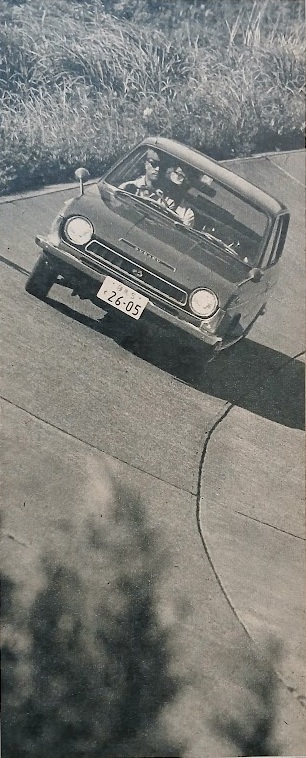
Miyamoto: Regarding the Sports model, I found its cornering to be very good. It left a strong impression of stability. Even someone accustomed to rear-wheel-drive characteristics would not feel apprehensive stepping straight into this FF car.
At the same time, I have one request. It seems to me that it is necessary to explain more clearly why the FF system has been adopted. People who are knowledgeable about automobile structures and mechanisms tend to appreciate FF, but the general public does not approach unfamiliar concepts so easily. Its advantages ought to be presented more distinctly.
In addition, ordinary buyers tend to gravitate towards vehicles sold in large, impressive showrooms by dealers with extensive sales networks. Speaking frankly, a more revolutionary body style–something capable of rivaling foreign cars–might be desirable in this case. As it is, the styling gives a somewhat conventional impression.
Higuchi: Even the name “FF-1” is insufficient. Unless “Front Drive” is boldly displayed alongside it, the meaning is not immediately understood.
Hirao: Like the badges that call attention to an air-conditioned model.
Higuchi: Exactly–and using that label consistently. Same as with “BW Automatic.” Owners derive a certain sense of superiority from such distinctions.
Miyamoto: Recently, smaller American cars have begun entering the market. Having driven them, I find myself thinking about the earlier discussion of speed and yellow and red zones. Perhaps, instead of concerning ourselves with such matters, the maximum speed could be limited to around 130km/h, and in exchange a torque converter could be fitted, allowing more relaxed driving.
Since the road tax is the same whether the displacement is 1100cc or 1500cc, one might even consider retaining the present piston size but adding two more cylinders to improve acceleration. What do you think of that idea?
Hirao: Regarding Professor Miyamoto’s suggestion of 130km/h, I consider this a serious matter. To state my own view, I believe maximum speed should lie somewhere between 160 and 200km/h.
These days it is often said that if the speed on the highway is 100km/h, there is no need for a car to be capable of 160km/h. But if one is driving into a 10m/s headwind, that alone effectively erases 35km/h. And on an incline, if one wishes to maintain 100km/h, a car that can only reach 130km/h on a flat road simply will not suffice.
Another point concerns merging from expressway ramps. Unless the car is capable of approximately 160km/h at its maximum, such situations can become dangerous.
Some argue that cars capable of these kinds of speeds are precisely what cause accidents. But is there statistical evidence correlating accident rates with maximum speed? If statistics were to show that cars capable of 200km/h have higher accident rates than those limited to 130km/h, that would be another matter.
However, as far as I have been able to determine, no such statistics exist in Japan. In America, however, there are such figures, and they show the opposite result. The higher the maximum speed of the car, the lower the accident rate.
In other words, there is no evidence whatsoever to suggest that simply lowering maximum speeds will reduce accidents. In fact, the available data suggests the opposite. This is a matter of great consequence for determining the direction of Japan’s entire automobile industry, and we should not advocate one way or the other without proper statistical material.
What Subaru should do first is clearly establish the accident rate of the 1000, and then determine the rate for the Sports model. If the results show that the Sports has an excessively high accident rate, then one could say that it would be better if such a car were not built.
I telephoned the Prime Minister’s Office and asked for accident rates by vehicle type and model–or, failing that, accident statistics categorized by maximum vehicle speed. I was told that in Japan there are no data available that would permit such analysis.
If we are to have this discussion, then those materials must first be compiled. The industry association should make clear that such accident statistics are necessary. For example, what is the accident rate of the Corolla? If the Subaru’s rate were higher, one could urge Subaru to undertake serious safety research. Conversely, if it were lower, there would be every reason to advertise it as a safe car.
Miyamoto: What Mr. Hirao has just said is entirely reasonable. I myself often say on the expressway that even if a car is capable of 150km/h, one should keep it to 100km/h.
Hirao: A kitchen knife must, after all, be sharp. But one must not advertise it by saying, “With this knife, you can cut someone very effectively.” A car, too, must have speed capability. There has been a tendency in the industry to boast, “This car will do 150km/h,” in much the same way.
What we should be saying is this: “Yes, it will reach 150km/h. This makes it very safe if you drive at 100km/h—so please drive at 100.”
Miyamoto: A knife that cuts well is, in fact, safer.
Hirao: Exactly. To blunt the blade in the name of safety makes little sense. Can one not kill with a dull knife? Of course one can. One could even kill with a fountain pen. So if we build cars that cannot exceed 100km/h, will there be no speeding violations? Certainly there will be.
Yamamoto (Mineo): There is also the matter of certain press commentary, and some politicians seizing upon it. I would hope that Motor Fan might help to enlighten public opinion on this point.
Hirao: I see the Subaru FF-1’s top speed is listed as 160km/h.
Higuchi: In other words, the sharper the car, the safer it is.
Miyamoto: On that point, I am in full agreement.
Milder Understeer
Magazine: Now, let’s hear Professor Saito’s findings on handling and stability.
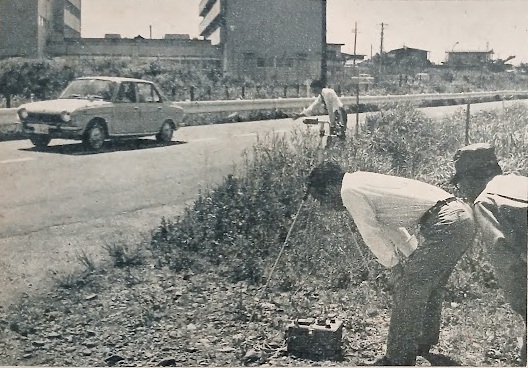
Saito: First, the practical minimum turning radius was measured at 5.3m on the outside and 2.9m on the inside. Comparing this with data previously measured at the Kondo Laboratory, it is roughly equivalent to larger cars in the 1500cc class. In particular, when compared with the previous Subaru 1000–which, of course, was also FF–even though vehicle length remains the same, the turning radius has increased by approximately 0.5m. I find this somewhat puzzling.
As for understeer and oversteer, the earlier Subaru 1000 exhibited strong understeer in our tests. In the FF-1’s case, however, the R/R₀ ratio has reduced to 1.45, compared with 1.7 for the previous model. Understeer has been lessened considerably, and can now be described as more moderate.
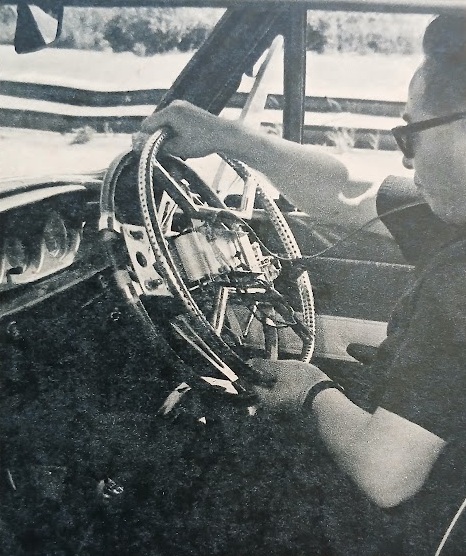
While accelerating gradually in a circle, the maximum steering effort was approximately 4kg. Drivers who tested the car report that it feels noticeably lighter. Compared with other cars in this class, it is certainly not on the heavy side.
Next, the roll angle during cornering measured 3.7°. Compared with others in this class, this is on the smaller side.
In the stationary steering effort test, even when the wheel was turned through a full 360°, it never went off the scale; the maximum value recorded was 14kg. The previous 1000 model had already gone off-scale at 180° by exceeding 16kg, so this represents a marked improvement.
In the low-speed steering effort test, measured while cornering at a lateral acceleration of 0.25g, steering effort when entering the curve was 7kg, and 1.8kg when exiting. This, too, can be said to be a considerable improvement.
In slalom turns at higher speeds, again at 0.25g lateral acceleration, steering effort was approximately 2.2kg to the right and 2.5kg to the left. Compared with the previous figure of 3.3kg, this may even have become slightly too light.
As for the standing-start acceleration test we conducted separately here, we did not push the car particularly hard, so the result was not outstanding: around 20 seconds for 0–400m. This is not much different from the 1000SS.
Finally, in the free-release directional stability test, its character has changed slightly compared with the 1000. It is nothing serious, but it is marginally less stable than before. Taken as a whole, however, the results may still be described as good.
Magazine: We understand the steering has become considerably lighter. Is it rack-and-pinion?
Kimura: Yes, that’s correct.
Magazine: Vehicle weight has increased by about 5kg–is that due primarily to the heavier engine?
Kimura: It’s largely the engine, as well as additional safety-related components.
Hirao: Wasn’t the fuel tank located at the front before?
Murota: No, it’s beneath the rear seat.
Magazine: Mr. Hoshijima, how did you find the steering? Was it either too heavy or too light?
Hoshijima: Compared with the earlier 1000, this car’s steering feels lighter at high speed. On the Tomei Expressway in particular, it seemed light to me. Personally, I think steering ought to be a little heavier at high speed.
As for cornering, I found the feel much improved. Especially on downhill sections. Braking lightly before entering the corner, turning in, allowing the tail to move just slightly, then applying the throttle decisively… the sensation is more enjoyable than in the previous 1000.
Hirao: Perhaps a touch of character makes it more interesting.
Higuchi: The handbook for the Sports model seems preoccupied with servicing. It would be good if it also explained how to drive the car properly.
Magazine: You mean, not only general advice, but guidance on how to enjoy it as a sports car.
Hirao: Maybe Hoshijima could write it…
Hoshijima: It would not be inappropriate to emphasize that at higher speeds the car offers a distinctly different driving style.
Hirao: A sort of guide to FF driving.
Higuchi: You could omit some of the finer points of maintenance and instead add something about the pleasures unique to the Sports model.
Kimura: When ordinary users have grown more accustomed to FF and begin to seek such enjoyment from the Sports model, we may well consider including such material. At present, however, it may be somewhat premature.
Hirao: How does it behave in crosswinds?
Hoshijima: To be honest, it is not especially strong against crosswinds. However, corrections are easy to make.
Magazine: Is that related to the body structure?
Hirao: It may also be due to the car’s light weight.
Hoshijima: On the Tomei Expressway I followed closely behind other cars, observing which of us would be deflected more. I would not say that this car is particularly less affected. So long as one keeps a hand on the wheel, though, it does not present a serious problem.
Yamamoto: So although one may feel it wandering somewhat, the actual effect is not excessive.
Magazine: Next, let’s please review the fuel economy test results.
Oguchi: For the Sports Sedan, in terms of steady-speed fuel economy, the best result of 22.4km/l was recorded at 40km/h. At 60km/h, the figure was 19.6km/l; at 80km/h, it was 16.2km/l, and at 100km/h, it was 12.2km/l.
In the same steady-speed testing, the Super Deluxe returned 25.4km/l at 30km/h, 24.4km/l at 40km/h, 22.0km/l at 60km/h, 18.5km/l at 80km/h, and 14.6km/l at 100km/h.
Test conditions were favorable, and the weather was not overly hot.
To approximate urban use, we conducted a model driving-cycle test. Since results vary depending on route and driving style, we adopted a standardized Tokyo city pattern: accelerating over 400-meter sections, stopping for either 15 or 30 seconds as one would for traffic signals, and following fixed acceleration and deceleration parameters.
With a target speed of 40km/h, and an average speed of 22.2km/h, the Super Deluxe returned 14.4km/l, while the Sports Sedan achieved 9.1km/l. When the target speed was 60km/h, with an average speed of 25.6km/h, the Super Deluxe returned 12.0km/l, while the Sports recorded 7.6km/l.
One might have expected that, as a high-speed-oriented car with strong power performance, fuel consumption would suffer. However, the actual figures are quite commendable.
Sakai: In the 1000cc class, increasing displacement by 100cc does not necessarily worsen fuel consumption. We devoted considerable effort to achieving good economy.
Kimura: The fuel filter is of the cartridge type, with a replacement interval of 20,000km.
Magazine: Next, let’s hear the brake data from the Ship Research Institute, please.
Ishikawa: Beginning with weight measurement, with the spare tire and tools on board and 36 liters of fuel, nearly a full tank, the vehicle’s test weight was 715kg.
Weight distribution was 484kg front and 231kg rear, with no significant left-right imbalance. In percentage terms, that equates to 68:32. With one occupant in the front seat, the balance shifted to 67:33, with two occupants, it became 66:34, and with five occupants it was 58:42.
Regarding wheel alignment, with one occupant on board, the front wheels exhibit slightly pronounced toe-in and a small amount of camber. The rear wheels show zero toe-in and zero camber. With five occupants, front toe-in and camber both decrease, though the change in toe-in is substantial. The rear wheels show no significant change.
Turning to the brakes, the system uses discs at the front and leading-trailing drums at the rear. The master cylinder is of the tandem type, providing a dual-circuit system for improved safety. The disc brakes are not servo-assisted.
Initial brake application begins at approximately 2.5kg pedal force for the front and 5.5kg for the rear. Pedal travel is only about 25-26mm, and the initial feel is somewhat firm. Brake force distribution is 85:15, strongly biased toward the front.
As for other control weights, the gear lever requires between 3kg and 4.5kg to engage each of the four forward gears and reverse. The clutch pedal requires only 10kg to depress fully, giving a light feel–20kg is more typical.
The accelerator pedal effort measures 1kg during acceleration and 0.5kg to hold a steady speed. This is also very light. The safety headrest lifts with 4kg effort–the lightest we’ve measured among recent cars.
Magazine: What is the standard angle of the seatback?
Murota: Around 20°.
Seats and Handbrake - Character Reduced?
Magazine: Dr. Hirata, could you provide your results on visibility measurements?
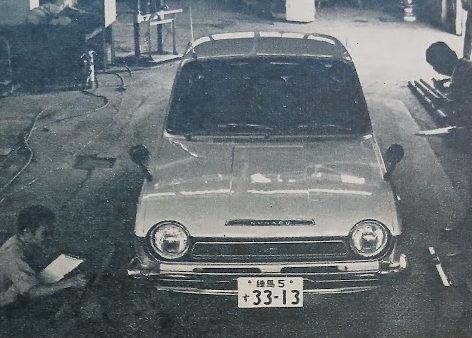
Hirata: We took measurements with the seat in three positions: fully forward, in the center of its slide travel, and fully rearward. With the seat in the center position, the eyepoint height from the ground to the lens was about 116cm. The distance from the windshield to the lens cap was 56.5cm, and from the lens cap to the center of the rearview mirror was 48.5cm.
The forward visible range measured through the windshield was 35.5° to the right and 58.5° to the left, for a total horizontal range of 94°. The vertical visible range was 12° up and 16° down, for a total of 28°.
The visible range through the rear window was 14° to the right and 37° to the left, for a horizontal total of 51°, and 4° up, 9° down, for a vertical total of 13°.
Wiper coverage was 27° to the right and 41° to the left, for a total wiping range of 68°.
Dead angles in the horizontal plane totaled 42.5°. Of that, 16° is forward, mostly caused by the front pillars, of which 9° constitutes blind spots created by the pillars themselves. The front-left pillar accounts for 7°.
Expressed in steradians, the view to the front totals 1.477, of which the side windows account for 0.645, wiper coverage is 0.354, and the rear window is 0.199. The view through the rearview mirror spans 39°, which corresponds to a solid angle of 0.149 steradians, and 74.9% of the rear window is visible.
Magazine: Next, let’s please hear the data on dimensions.
Onda: From an exterior standpoint, the most obvious change is the addition of the ornamented grille. What seems to have lost some of its distinctive character, however, is the interior. Previously, the seat slides had a unique design, but now they use a standard sloping track with 120mm of travel. This feels a bit unnecessarily short.
The distance to the pedal toe board measures 180mm. By comparison, the usual range is 140-160mm, and even Volkswagens, which are often cited for pedal placement issues, stop at 170mm, so this strikes me as somewhat unusual.
As for seatback angle, it adjusts in four steps. The seatback is quite reclined, and I feel one more step beyond the most upright setting, to bring it closer to vertical, would be useful. The adjustment handle is cleverly designed, which users will likely appreciate.
Also, although it’s not actively promoted in the catalog, if the seatback can be removed, I’d like to see clear instructions on how to use that feature.
In the trunk, a lot of exposed piping is quite noticeable. Couldn’t this be at least partially hidden?
We carried out the dimensional measurements on the Super Deluxe. Being a front-wheel-drive car with a long wheelbase, one would expect the interior to feel spacious, but with various items hung toward the front under the dashboard, the impression of spaciousness is somewhat diminished.
Additionally, the handbrake has been changed from the previous unique design to a standard type, so some of Subaru’s distinctive character is lost. The seat cushions themselves, particularly where they extend to the outer edges of the body on the Super Deluxe, feel somewhat unusual.
Finally, regarding the ventilators, it seems that you must use the three-way shutters for every adjustment, which seems somewhat cumbersome.
Higuchi: I would like to make some final comments on safety. As was mentioned earlier, since the previous Subaru was introduced, the safety regulations have been revised. In light of that, I believe there is still room to add further safety equipment. For example, items such as a collapsible steering column could be adopted relatively easily and at modest cost.
The safety evaluation score was 81 out of a possible 100 points. That is a good result, but there remains room for additional fittings and improvements. For instance, covering the interior door handles with padding would further enhance safety.
As for service, the schedule is very comprehensive. The vehicle is checked at the first 1,000 km, again at 3,000 km, and at 5,000 km the oil is replaced, so there should be no cause for concern. Cars are now being used in a thoroughly practical manner, and driving distances have increased; for the majority of users, an oil change approximately once every six months is sufficient.
Magazine: One question regarding options: is an air conditioner available?
Yamamoto: Yes, air conditioning is optional. In addition, various other items are available as options, including a car stereo.
Onda: And the body colors, are they the same as before?
Yamamoto: The body colors are as listed in the catalog.
Magazine: What are the production and export plans for this year?
Yamamoto: This year we plan to produce an average of 5,000 units per month. Even now, depending on the model, there are some for which supply does not fully meet demand. However, amid the intense competition among domestic manufacturers, we have not adopted a policy of simply increasing volume as much as possible. Instead, we are proceeding steadily with a target of 5,000 units per month. We will continue to develop the model range in accordance with our customers’ needs.
As for exports, we are taking a cautious approach. We will be entering Australia, and from June, the United States. We intend to move forward by building a record of solid results step by step.
Magazine: That concludes the roundtable discussion on the Subaru FF-1. Thank you very much.
Postscript: Story Photos