Subaru FF-1 Super Touring (1969)
Publication: Motor Fan
Format: Test Drive Report
Date: December 1969
Author: Jun Todoroki
A Luxuriously Appointed High-Performance Sedan
At a time when front-wheel drive is becoming a worldwide trend, the Subaru FF-1–an evolution of the Subaru 1000, an early adopter of the layout–stands out as a unique presence among domestically produced passenger cars. Newly added to this series is the Super Touring model, a variation that pairs the existing Sport engine with a four-door body.
As the advance of Japan’s motorization continues to accelerate, the rising popularity of so-called “sporty cars” represents a noteworthy development. In 1965, sporty cars accounted for less than 10 percent of all passenger cars; by 1968, that figure had grown to 16 percent. Given the overall increase in production volumes during this period, this naturally represents a substantial rise in absolute numbers as well, showing that sporty cars have begun to appeal strongly to the general public.
The reasons for this can be found in changing attitudes toward passenger cars, as values and patterns of use have shifted from basic practicality towards greater individuality.
On the other hand, while many users were emotionally drawn to the appeal of sporty cars, when daily driving conditions were taken into account, there were many who ultimately preferred a four-door car, or settled instead on a vehicle with better fuel economy.
This way of thinking was apparently no exception among Subaru FF-1 users. While admiring the strong performance of the FF-1 Sport model, it seems there were customers who also wanted the convenience of four doors, and as a result purchased a four-door model and had the Sport engine installed by the dealer.
Consequently, dealer requests gradually began to reach the manufacturer for “a more luxuriously appointed variation with four doors and the Sport engine.”
Thus appeared the FF-1 Super Touring. But rather than being merely a four-door version of the Sport, it turns out to be a car fitted with a level of luxury equipment that is quite surprising for this class.
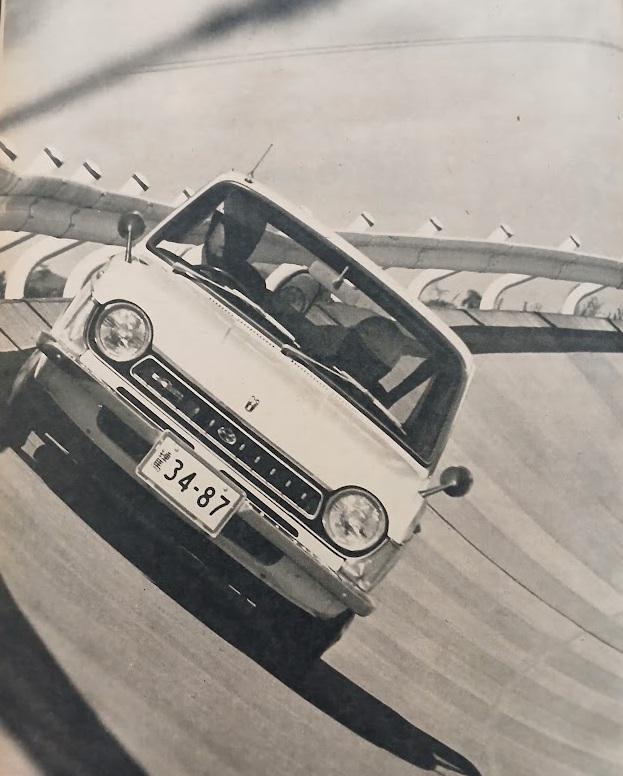
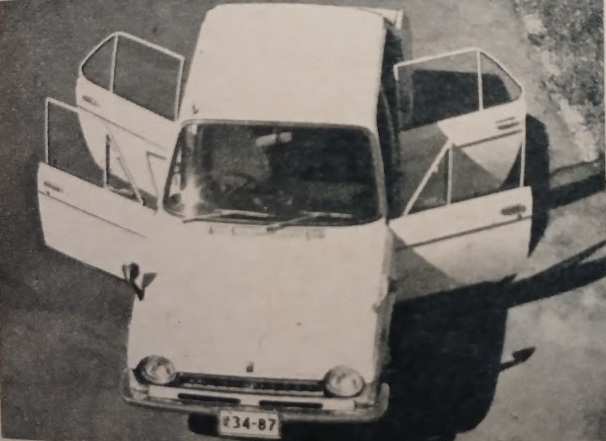
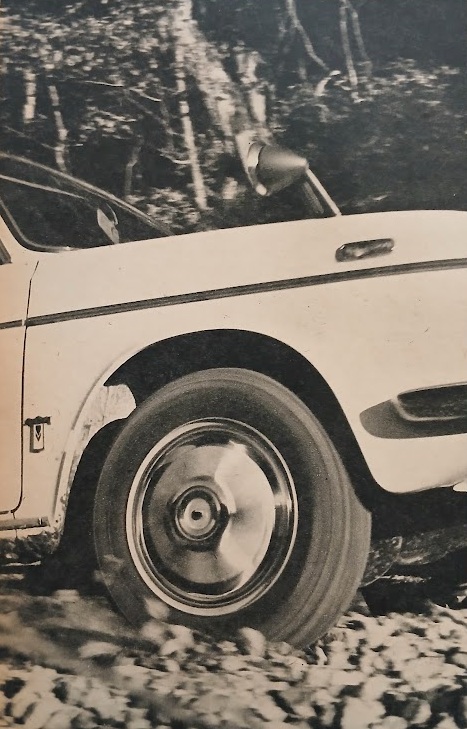
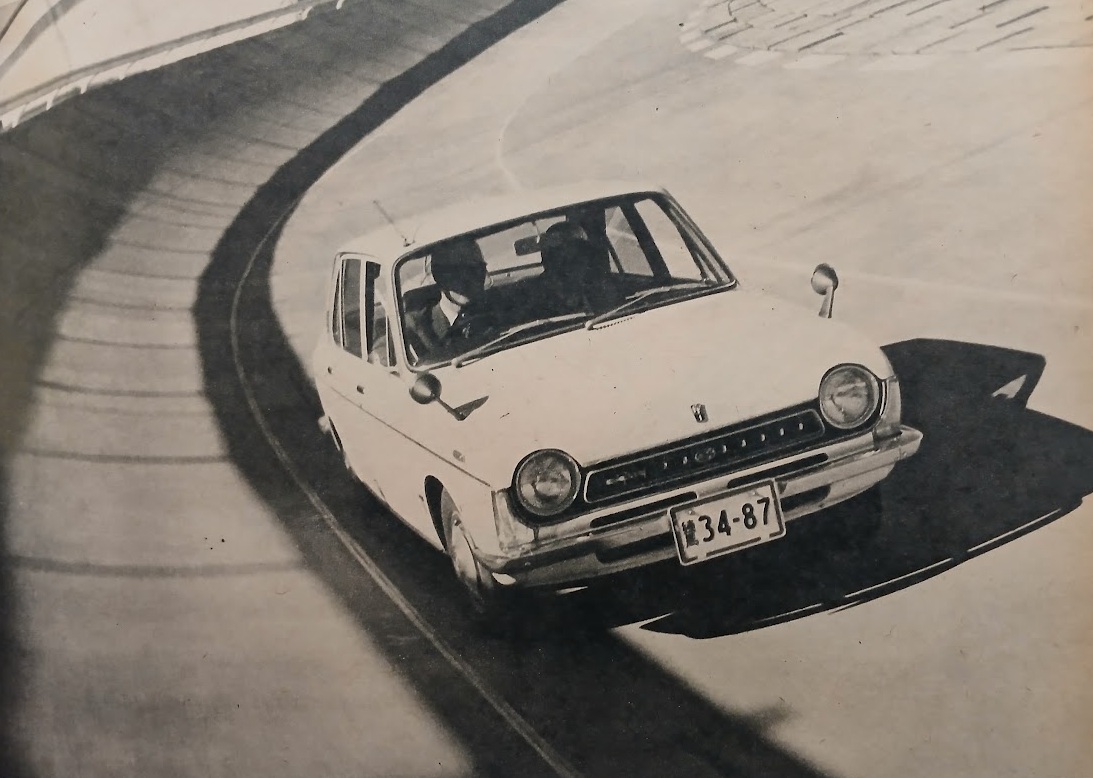
Viewed from the front and side, the Super Touring differs little from the Super DX four-door (aside from the fitment of Bridgestone Radial 10 tires). Step inside, however, and the seats immediately stand out, giving an impression of quality quite unlike the compact cars we have seen up to now.
Finished in a material that might be described as suede-like–it feels like velour to the touch (though reportedly vinyl-based)–this attempt to convey both freshness and luxury can be considered a success.
Likewise, the use of a deep chocolate color for the interior trim, rather than the usual black, is another welcome novelty.
The instrument panel uses three round dials, the same layout as that in the FF-1 Sport. Centered behind the steering wheel is a tachometer scaled to 8000rpm (with a yellow zone beginning at 6500rpm and a red zone from 7000rpm). To the left sits the speedometer, marked up to 180km/h. On the right is a combination meter incorporating the fuel gauge, water temperature gauge, and warning lamps.
The white needles stand out well, and from a design standpoint the panel is quite well executed. Unfortunately, the non-reflective glass appears slightly cloudy, detracting from legibility. The hood over the gauges also seems designed more for appearance than function, and does not do much to block ambient light.
The steering wheel is a woodgrain type–though unlike Toyota’s, it is not overly coarse or rough to the touch. Instead, the woodgrain finish is deep and rich, with a glossy appearance that at first glance looks as though it were carved from solid walnut, giving an impressively high-class feel.
Compared with the flat, spacious floor area in the rear seat, front-seat legroom is somewhat tight, but the wide range of seat adjustment gives an upscale impression.
That said, it does seem a bit wasteful to place a console box over what is otherwise a nicely flat front floor.
Responsive Character
In keeping with the luxury-oriented specification, the FF-1’s ignition switch, located beside the steering column, is fitted with a steering lock. Interestingly, the key cannot be removed unless the steering is locked. Normally, keys can be withdrawn at a marked “garage” position, without engaging the steering lock, and while the FF-1’s system may be better from a security standpoint, it also seems slightly inconvenient.
Engine noise is extremely low. Especially at idle, with the windows closed, one might not even realize the engine is running without looking at the tachometer. Whether due to the inherent balance of the horizontally opposed four-cylinder engine, or the effectiveness of the sound insulation, impressively little noise or vibration reaches the cabin.
Press the accelerator and the revs rise smoothly. The engine’s twin Solex carburetors might lead one to expect it to be temperamental, but in practice the throttle response is smooth and predictable, allowing for extremely precise engine control.
The large, organ-type accelerator pedal makes heel-and-toe operation easy, and it is also well-placed relative to the brake pedal.
Because of the FF layout, the remote, floor-mounted gear lever operates through a linkage, but its action is impressively sharp, with good shift feel and very little free play. Almost no vibration is transmitted to the lever, and while this is no doubt helped by the engine’s inherently low vibration, it also clearly shows how carefully the system has been finished.
A Highly Usable Third Gear
Our route took us north from Shinjuku in Tokyo, crossing Sasame Bridge, following the Shin-Omiya Bypass, and then running up National Route 17 as far as Kumagaya. From there, we turned off to visit this car’s birthplace: Fuji Heavy Industries’ Gunma plant. The idea was not only to test the car’s performance to our satisfaction on the company’s own test course, but also to learn directly from the manufacturer about their design intentions.
Next, we took on a demanding hill climb up Mount Akagi, with an elevation difference of more than 800 meters, then put the car’s FF characteristics to the test on the rough roads around the Akagi area.
With a route like this, a single test drive can cover everything: congested city traffic, high-speed cruising, winding mountain roads, and even the driving character on unpaved surfaces, leaving little unexamined.
As expected, from Tokyo through the Omiya area, we were quickly caught up in heavy traffic.
This is the unavoidable fate of a small-displacement sports-type car: in conditions where you creep along at around 30km/h, constantly stopping and starting, smooth progress requires frequent shifting to stay within the appropriate torque range. Even so, throughout this stop-and-go driving, it became clear that the engine itself is extremely robust and has not sacrificed everyday usability.
As traffic thinned out, we appreciated the wide effective range of third gear. It can be used from around 25km/h up to well over 100km/h, reducing the need for constant shifting, and even allowing you to be a bit lazy with gear changes if you feel like it.
The engine’s torque peak arrives at 4800rpm, which may sound rather high, but the torque curve itself is surprisingly flat, and since it remains perfectly usable from around 1800rpm, there is not the slightest sense that it is difficult to live with in city driving.
That said, if you pull hard in low gear, the revs will leap to the red zone (7000rpm) with ease. To the uninitiated, this might give the impression that the engine may be easy to damage accidentally.
More likely, however, is that the manufacturer has marked the red zone with a built-in safety margin, in order to protect the free-revving engine. With this engine, spinning beyond 7000rpm in short bursts would probably not be a problem–but if the red zone were set right at the engine’s absolute limit (as is technically “correct”), there would inevitably be drivers tempted to test it, which probably explains the cautious approach.
Quietly, and With Agility
Even though the FF-1 is classed as a sporty car, the primary driving controls–clutch, shift lever, and pedals–are all light in action, and it does not give the sense of “grabbing the car by the scruff of the neck.” True to its name, it is better suited to touring, and given the rather upmarket owner profile it seems to target, some may say that it is almost too refined for those seeking an intense, visceral driving experience. But for those buyers, the manufacturer offers the FF-1 Sport.
This philosophy is clearly expressed even in such details as the exhaust note. In the case of the FF-1 Sport, efforts were made to enhance the sporting mood, with a specially tuned muffler producing a bold, assertive sound. In the Super Touring, by contrast, the exhaust note is deliberately subdued, following a philosophy of “quietly, and with agility.”
There is probably little need to dwell on the characteristics of the FF layout itself. Its virtues–responsive handling, stability that contributes to safer driving, and the ability to maximize cabin space within set overall dimensions–are all well known to readers of this magazine.
Precisely because these advantages have come to be widely recognized, we have seen FF layouts adopted with increasing frequency in recent domestic models such as the Honda N360, Honda 1300, and the Luce Rotary Coupe. This trend is even more pronounced overseas, particularly in Europe, where FF has begun to feel like the mainstream choice, led by famous examples such as the BLMC Mini.
In Subaru’s case, having committed to FF earlier than any other manufacturer in Japan–excluding Suzuki and its Fronte 800–the company’s technical standard in this area is correspondingly high. This is evident in the way Subaru has sought to suppress the distinctive steering traits of FF as much as possible, aiming instead for a car that can be driven using familiar techniques from conventional FR vehicles–and has, by and large, succeeded in doing so.
In other words, the good points of FF are fully utilized, but the difficulties inherent to driving an FF, such as a larger turning radius, stronger understeer when cornering with power on, and a tendency toward oversteer when lifting off mid-corner, are deliberately kept to a minimum.
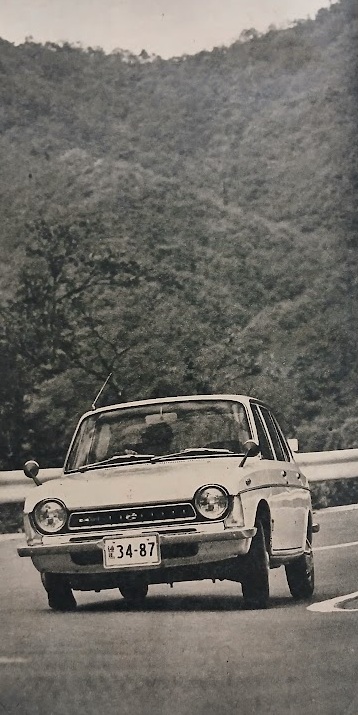
As a result, when driving on straight roads or around city corners, it is nearly impossible to tell which are the driven wheels, even if you are paying close attention. However, once you are navigating a twisty mountain road at speed, the steering delivers a subtly refined feel and remarkably stable handling, almost as if it were anticipating the driver’s inputs.
The tires are the same Bridgestone 10-inch radials as on the FF-1 Sport, and their effect on road feel is every bit as significant as the FF layout itself. The strong grip characteristic of radials, combined with excellent lateral bite during aggressive cornering, allows the car to track cleanly without the need for steering corrections, and without slowing down.
Questions About Rear-Seat Comfort
Compared with the four-door sedan, the Super Touring’s spring rates are about 40% stiffer, making the suspension basically the same as that of the FF-1 Sport. This contributes to the good road holding, but in terms of ride comfort, it feels almost Spartan, at odds with the interior’s luxury. This is not so noticeable for passengers in the front seats, but in the rear, the vibrations are pronounced enough that it cannot honestly be called comfortable. One of the hidden drawbacks of an FF layout seems to be rear-seat ride comfort. In this car, perhaps a slightly softer suspension would have been more appropriate.
The four-door design was presumably developed with significant consideration for rear-seat usability. But if that was the intention, simply stiffening the springs for sporty performance leaves the car feeling a bit unresolved. That said, these types of cars are often used with just two adults in the front seats, with the rear used for children–or even a dog–so perhaps the rear comfort issue was deemed less important. Nevertheless, it caught our attention, so we asked Fuji Heavy Industries about it. Their reply was: “In typical driving conditions, 90% of the time, the car will be carrying two passengers on good roads. For that reason, we adopted suspension similar to the FF-1 Sport, prioritizing enhanced performance.”
Price, Class, and Performance
Even if one does not consider the suspension tuning a serious flaw, another point that may sting the user is the price: 680,000 yen (delivered in Tokyo, Osaka, or Nagoya). The 60,000 yen premium over the FF-1 Sport itself is probably not excessive, given the car’s feature content. In terms of safety equipment, it incorporates almost all the latest advances: collapsible steering column, dual-circuit brake system, and retractable three-point safety belts. The body structure itself is also designed so that in a collision the weak points at the front and rear deform extensively, reducing the energy transmitted to occupants–a so-called “crumple zone” construction.
Performance from the high-output 77ps/7000rpm engine lives up to the price as well, delivering a catalog 0-400m time of 17.2 seconds (with two occupants). It is also true that the interior space and luggage capacity are equivalent to a class above.
Yet when it comes to value, the measure by which Japanese passenger cars are judged today is less about these functional qualities and more about what one might call “vehicle class.”
As a philosophy toward their products, Fuji Heavy Industries has long operated on the principle that “if the product is good, it will sell, even if it is priced accordingly.” There seems to have been a decision to allow this car to include everything the engineers knew was desirable, but had previously been ruled out by cost limits.
As a result, compared with other cars in the same price class, the FF-1 Super Touring is in a league of its own. That said, one must not forget that Subaru’s customer base tends to include relatively car-savvy enthusiasts, and there is a considerable segment who buy a car for the mechanisms it contains rather than its sticker price.
For those fans, this car holds an almost irresistible allure–so perhaps it is best described as a model aimed squarely at the enthusiast.
An Exterior That is Almost Too Restrained
On Fuji Heavy Industries’ test course, it was relatively easy to reach speeds beyond those listed in the catalog–and on mountain roads, one could enjoy the kind of European-style driving feel that comes from a small body packed with charm.
For a large, full-line manufacturer that produces everything from large to compact cars, it might be unimaginable to offer this level of luxury in a car of this class and still try to market it effectively. But in the case of Fuji Heavy Industries, where the FF-1 serves as the company’s flagship model, perhaps this is precisely why such careful attention was possible–it is that kind of car.
Take, for example, the seatback adjustment: it moves in three large steps using a lever, then allows infinite fine control via a knob. For enthusiasts, this level of detail is irresistible.
In that sense, features like the emphasis on primary safety, or the dual radiators combined with an electric fan that adjusts cooling in three stages according to driving conditions, are ideal for a car like the FF-1.
Yet compared with the brilliance of these mechanical systems, the body design–particularly the impression conveyed by the exterior–feels far too restrained for the Super Touring’s top-of-the-line positioning. It simply doesn’t match the richness of the car’s content. From the days of the Subaru 1000, this series has always started with a four-door body, so one can tell that functionality and structural strength were the primary design considerations.
At the very least, for this particular car, shouldn’t they have done more than simply use the existing four-door sedan body as-is? Couldn’t they have added some charm points, something fresh and distinctive?
Both the front and rear views reveal almost nothing beyond a small trim badge. The body design itself is starting to show its age, and because it was originally focused on function rather than visual allure, the exterior comes off feeling bland despite the luxury contents underneath.
A Car For Japanese Enthusiasts
The recent trend in domestic engines has been a wholesale switch to OHC designs. Within that context, the FF-1 retains a pushrod layout for its horizontally opposed engine–a design that would have been extremely difficult to implement as an OHC. Rather than going against the times, the remarkable achievement is that they completed a horizontally opposed engine, a feat other manufacturers did not attempt, and one truly worthy of praise.
Why a horizontally opposed engine? Needless to say, it allowed the engine length to be shortened in order to adopt the FF layout. In the case of this FF-1 Super Touring, the compression ratio has been raised to 10.0, and it is equipped with twin Solex-type carburetors for increased output. Yet it never feels difficult to use, and even at high revs, there is no valve chatter or other issues–its performance rivals that of an OHC engine, which is nothing short of remarkable.
In particular, the engine’s immediate response and acceleration over the first 200 meters makes a strong impression, easily keeping pace with 1600cc or even 2000cc cars off the line–something we experienced repeatedly during our drive.
Overall, considering its size, seating capacity, performance, and mechanisms, this car can be said to be very much a Japanese car, designed specifically for Japanese driving. While it might be a stretch to call it a true GT, taking into account Japan’s current road conditions and the average driver’s skill, it is in fact a clever combination that satisfies the desires of car-loving Japanese.
In that sense, although it carries the name Super Touring, it is more than just a touring car—it is a fun car to own, a car that gives a slight sense of pride, a charming little vehicle that can serve both city driving and leisure purposes. It might be more accurate to describe it as a high-end, versatile compact car. In any case, one thing is certain: its arrival marks the appearance of yet another interesting choice on the market.
Postscript: Story Photos