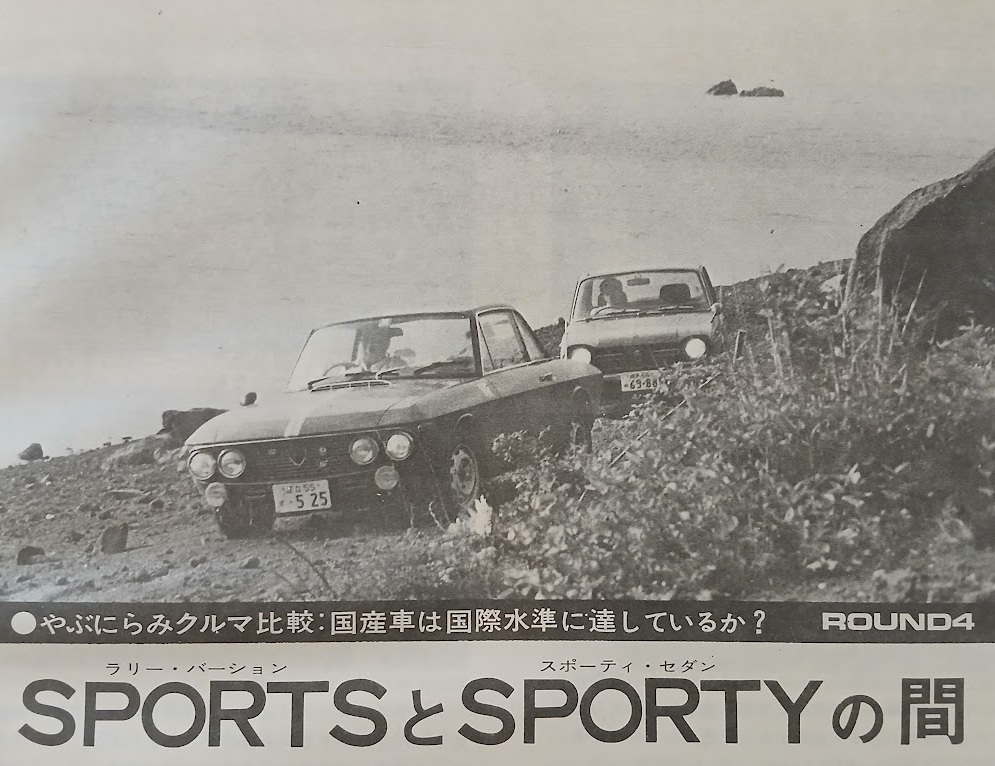
Subaru 1300G Sports Sedan vs. Lancia Fulvia Coupe Rallye 1.3HF (1971)
Publication: Motor Fan
Format: Group Test
Date: July 1971
Author: Joji Obara
Have Domestic Cars Reached International Standards? Round 4: Between “Sporty” and “Sports”
Two 1.3-liter front-wheel-drive machines, each boasting its own distinctive mechanical layout. And yet, between them, one can clearly feel a gap in history and tradition that can hardly be captured in words.
Prologue: A 1.3-Liter FF That Punches Above Its Class
When I told a few friends in the auto world, “I’ve been driving the Subaru 1300G Sports Sedan,” they all jumped in before I could say another word: “That’s an interesting car, isn’t it?” Several of them used the same word: “interesting.” Of course, that term can mean many things.
In Subaru’s case, I’d take it to mean the kind of interest that comes from genuinely enjoyable, sporty driving and a certain atmosphere one feels behind the wheel. No doubt that’s how my friends meant it as well. And indeed, the Subaru 1300G Sports Sedan delivers a driving feel that lives up to its name.
However, the opposing car in this test–the Lancia Fulvia Coupe Rallye 1.3HF–goes far beyond being merely “interesting.” It’s the kind of machine that fills you with sheer delight, the kind of excitement that borders on delirium–a true sports car in the fullest sense. Next to that, the Subaru’s sporty mood begins to feel rather subdued, almost like a mild, family-friendly, at-home sort of experience. That shift in impression comes entirely from how sensorily overwhelming the Lancia is. For the Subaru, it’s an unfortunate matchup–hardly a fair fight, and perhaps even a little bit cruel.
Speaking of Lancia, earlier models like the Aurelia and Flaminia were, not so long ago, high-end sports cars that could stand shoulder to shoulder with Maseratis. With that in mind, some friends remarked, “Even for a deliberately skewed comparison, putting a Subaru up against a Lancia is a bit much…”
But this Fulvia, evolved from the more affordable Appia and powered by Lancia’s distinctive V4 engine, is a small front-wheel-drive sports model–just like the Subaru.
In terms of displacement, the Subaru comes in at 1267cc and the Lancia at 1298cc–both firmly in the 1.3-liter class. And since the Fulvia is one of the more attainable models in the Lancia lineup, it was chosen deliberately for this comparison test.
In recent years, Lancia has been deeply involved in rallying, even adopting “Rallye” as a model name. It’s been showing off its rally-bred creations in places like this year’s Dunlop calendar. Alongside this coupe, there’s also the more upscale Fulvia Sport with Zagato bodywork, as well as a 1584cc 1600HF model. It’s that 1600HF that’s been making its mark in events like the Monte Carlo Rally and the Safari Rally.
Styling: Italian Character, Expressed in the Lancia
One of the consistent design policies at Fuji Heavy Industries–seen in everything from the Subaru 360 and R-2 to this Subaru 1300G–is an almost obsessive attention to maximizing interior space.
At first glance, its boxy shape looks plain, even uninteresting. But take a closer look, and you begin to notice a freshness in the way the front and rear ends are treated, how the edges of the body are accented, and in the design of the front “mask.” There’s a distinct personality in its profile, something that keeps it from looking like just another dull, ordinary car.
That aforementioned emphasis on interior space and weight reduction seems to draw on the company’s wartime experience building high-performance aircraft. There’s more than enough consideration given to those aspects here. Despite being front-wheel drive, there’s no intrusion from the wheel housings into the cabin, and the footwell space feels roomier than you’d expect in even a 2.0-liter class car.
The Lancia, for its part, is also built with lightness in mind. Its hardtop coupe body is formed with an extremely thin roof and slender pillars, and despite being front-wheel drive, it devotes what almost feels like excessive space to the front seats, clearly prioritizing the two occupants. By contrast, the rear seats are little more than an afterthought. It’s nominally a 2+2 coupe (it officially seats five), but the rear seats will really only accommodate children, mostly thanks to the relatively high roof. On the other hand, the trunk is quite large–big enough, it seems, to carry plenty of rally spares and extra fuel.
The Lancia’s chopped-off tail is particularly well done, with a distinctive sharpness. From the front, the flat-deck body lines and the triangular Lancia badge centered in the grille bring to mind something like the Mazda Familia Rotary–broad, bold, and rather frog-faced. From the side, the roof and pillars appear almost too thin, leaving the profile feeling a bit unresolved.
But seen from a rear three-quarter angle, the Lancia is genuinely beautiful–sporty, stylish, and full of flair. The front mask and headlamps (iodine type) reflect its hot-blooded Italian character; there’s a keen, aggressive look to it that delivers a proper sense of a true sports machine.
Interior: A Very Japanese Kind of Good Looks…
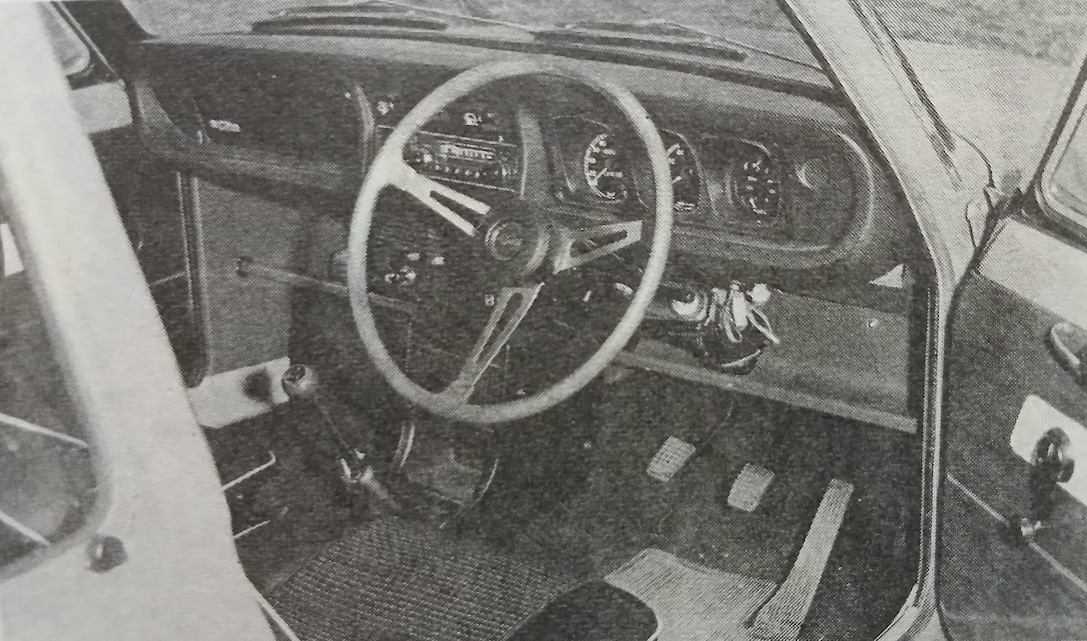
In interior design, the Subaru presents itself as a mature, well-behaved honor student. Its all-black interior, with the dash panel and trim darkened to minimize reflections, creates a calm, composed atmosphere.
The gauges are easy to read, and controls like those for the heater are grouped centrally, making them simple and intuitive to use. There’s a small console and a parcel tray, and plenty of places to store odds and ends–very much in keeping with Japanese tastes. The gear lever rises up from the floor through the console, sticking up rather prominently, but it’s light to operate, with short, manageable throws–perfectly acceptable in use. The seats are similar in shape to those of the Volvo 144S, and it’s easy to find a good driving position. Compared to the earlier 1000, the driving position is more natural, with none of the awkward, twisted posture often associated with front-wheel-drive layouts. That said, the heavy use of plastic throughout does give it a somewhat cheap feel, which is hard to ignore.
Visibility is excellent, and the side windows can be opened and closed easily in just two turns of the regulator handle–very convenient. The triangular vent windows also open and close smoothly thanks to a well-designed stopper. Rear seat space is ample, making this two-door sedan perfectly suited to family use.
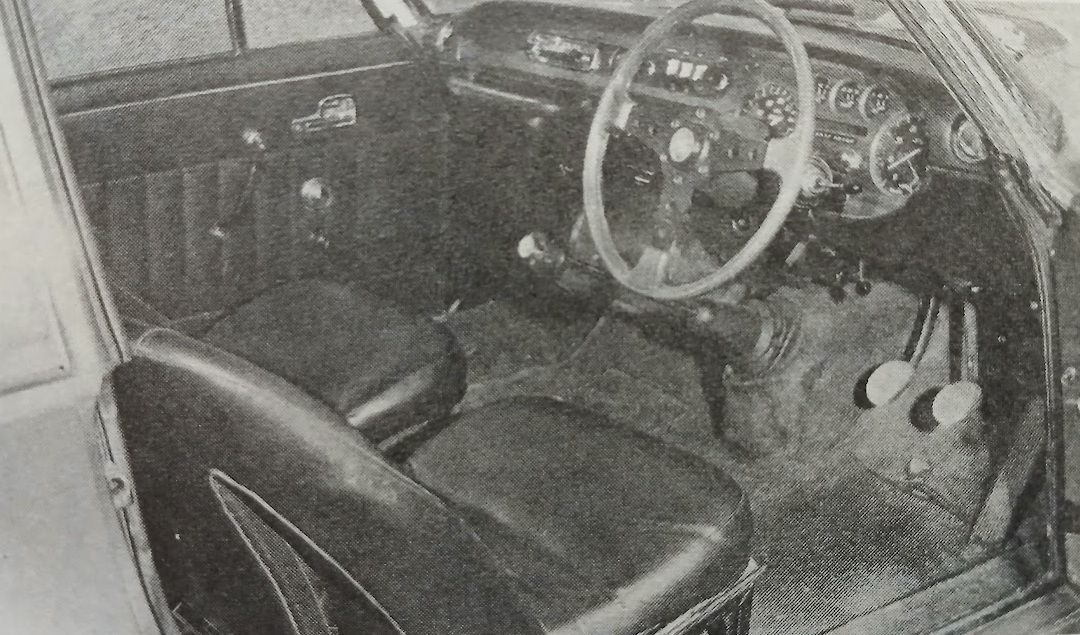
The Lancia’s instrument panel, on the other hand, feels like a pure expression of the Italian GT spirit. The woodgrain dashboard, large round black-faced gauges, and rows of toggle switches–these are all exactly the sort of things cherished by enthusiasts.
The gear lever juts out at an angle from the toe board, almost like something from a truck. Alfa Romeo uses a similar setup, and once you get used to it, it’s actually very easy to operate, with little risk of missed shifts.
The seats are excellent. These bucket seats support the hips firmly, and they’re more than worthy of the “Rallye” name. The Subaru’s seats lean more toward family comfort, but the Lancia is designed as a personal sports machine, so it sacrifices a bit of versatility in exchange for maximum hold in spirited driving.
The Lancia we tested even had small flaps on the wiper blades to prevent them from lifting at high speed. This is probably an optional feature, but an interesting detail from a design standpoint.
As mentioned, the dashboard delivers on sporting atmosphere, but when it comes to usability, it cannot hope to match the Subaru. The Lancia’s layout is cluttered, to the point where it feels as if the various levers and controls were added haphazardly after the fact. It doesn’t give the impression of a carefully organized design. Rather, it looks as if a single enthusiast kept bolting on accessories one after another.
To make matters worse, the vent windows are fixed and can’t be opened. At one point, driving with the windows closed, the windshield began to fog up, so I tried to operate the defroster–but couldn’t immediately tell which control it was. Still driving, I pulled this, turned that, pressed various switches–to no avail. Eventually, I discovered that pushing on a lever under the dash opened the ventilation duct. In contrast, in the Subaru, a quick glance at the panel is all it takes to locate the correct control.
That said, the horn setup is better in the Lancia. Operated via a column-mounted lever, it produces a beautiful, resonant tone, while the button in the center of the steering wheel, usually used for the horn, instead flashes the passing lights. This lever-operated horn appears to be a custom modification by the owner, but it’s very easy, and quite enjoyable, to use. In the Subaru, the horn button is in the center of the steering wheel, which means you have to take a hand off the wheel to use it. From a safety standpoint, it might be better to rewire it in the Lancia’s style.
Performance: A Difference in How Catalog Data Is Interpreted
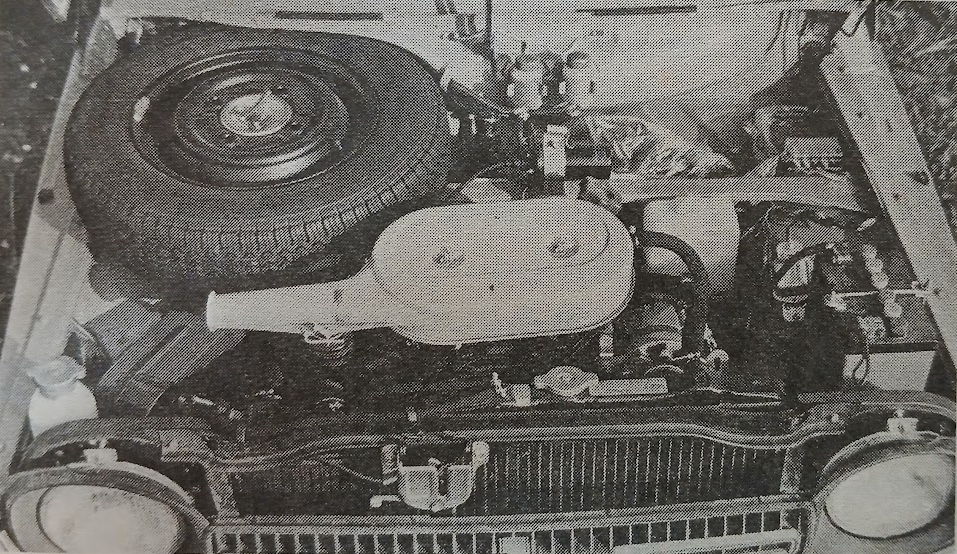
The Subaru’s engine is a water-cooled, horizontally opposed OHV four-cylinder displacing 1267cc. In this sporty specification, the compression ratio has been raised from 9:1 to 10:1, and twin Zenith-Stromberg downdraft carburetors are fitted, bringing output up to 93ps at 7000rpm.
The radiator is a split, dual-core type with a sub-core, and the cooling fan is an electric unit operated by a thermostat, much like those used in the Lotus and Jaguar E-type. As a result, fan noise is subdued and operation is smooth, giving the Subaru engine a notably quiet character–quiet enough, in fact, to feel somewhat at odds with the “Sports Sedan” label.
Despite being a water-cooled four-stroke, the dual exhaust produces a somewhat fluttering, motorcycle-like note. If anything, it resembles a softened version of the sound from a Porsche or a Volkswagen. Perhaps this similarity is only natural, since they all use horizontally opposed engines. Even so, the sound is light rather than forceful, lacking any real sense of drama. That said, the engine is highly flexible and very easy to use.
With front-wheel drive, a forward weight bias is inevitable: the Subaru’s fore-and-aft weight distribution is 59:41, while the Lancia is slightly more nose-heavy at 61:39.
The Subaru 1300G Sports Sedan comes standard with radial tires. Its suspension consists of independent front suspension with torsion bars and upper and lower A-arms, while the rear uses a semi-trailing arm setup with torsion bars and oil dampers. The result is excellent stability. Despite its “sports sedan” billing, the ride is quite soft–in some ways, its behavior is reminiscent of British Leyland Motor Corporation’s Hydrolastic suspension systems.
The abrupt changes in steering often associated with FF cars under acceleration and deceleration are largely absent, and handling is extremely easy and reassuring. However, the shock transmitted when getting on and off the throttle is quite pronounced, as the car reacts with a noticeable jolt.
Steering requires 2.9 turns lock-to-lock in the Subaru, compared to 4.2 in the Lancia, making the Subaru markedly lighter and quicker in its response to the wheel. This is thanks to its center-pivot steering system and the use of constant-velocity joints on both the wheel and differential sides–a fairly sophisticated setup.
Braking on the Subaru consists of inboard disc brakes at the front and leading-trailing drum brakes at the rear. Looking at the combined engine, transmission, and differential assembly, complete with those inboard discs, it almost resembles a Formula racing engine and chassis layout.
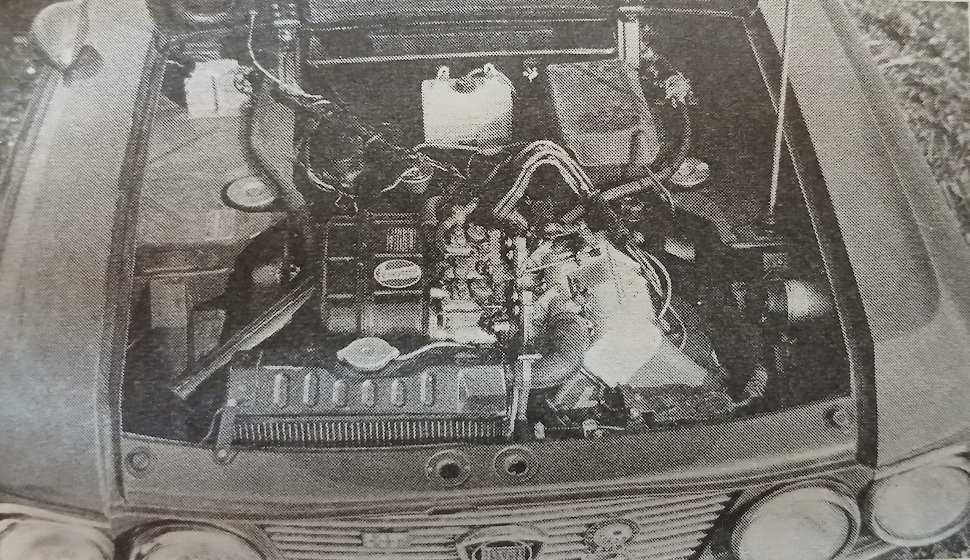
The Lancia’s engine, meanwhile, is a water-cooled SOHC V4, displacing 1298cc and producing 101ps at 6400rpm. It uses twin Solex C32PHH carburetors, but in this case, the setup feels extremely over-carbureted. When starting the car, if you botch it even once, it may stubbornly refuse to start at all.
Idle speed is set high, around 1100rpm, and if it drops below that, the engine simply stalls. It is, in short, a temperamental unit. With a compression ratio of 10.5, some foreign publications even suggest using 100-octane super-grade fuel.
Even so, the engine is not especially loud. With the windows open during a cruise, the exhaust note is crisp and pleasant, lending a light, cheerful quality to the drive.
In terms of handling, the Lancia exhibits mild, predictable understeer, much like the Subaru, with no sudden changes in behavior. It is an easy car to drive. Steering effort is heavier than in the Subaru, but not excessively so.
The Lancia’s suspension uses upper and lower A-arms at the front, like the Subaru, but employs a transverse leaf spring for damping. At the rear, a live axle is supported by conventional leaf springs. The tires are Michelin XAS radials. True to its “Rallye” name, the suspension feels distinctly firm, quite unlike the Subaru’s more compliant setup.
The engine revs eagerly, climbing with a sharp, lively note that makes driving genuinely entertaining.
Braking is handled by outboard disc brakes on all four wheels, and the feel is excellent–almost faultless.
The Lancia’s catalog lists top speed as 174km/h (the Subaru’s is 170km/h), with 0-400m acceleration at 18.6 seconds (16.8 seconds for the Subaru). Yet in actual driving, the Lancia feels like the stronger-performing car.
It’s not that the Subaru’s figures are untrue–but Japanese manufacturers have a habit of quoting the very best results obtained momentarily under ideal conditions. By contrast, German cars are said to be held to a stricter standard: if they cannot deliver the catalog figures under normal conditions, customers will reject them outright. A very German kind of logic. In this case, a stated top speed of 174km/h is taken to mean that the car can sustain 174km/h for hours on end.
From the standpoint of earning trust overseas, Japan’s approach to catalog data may need reconsideration.
Interpreted from that same German perspective, one wonders what the Subaru’s claimed 170km/h really amounts to…
Finally, the Lancia’s engine is quite cleverly mounted, sitting neatly on a separate, angled subframe at the front. The body itself is a unit-construction steel shell, but aluminum alloy is used in various places to reduce weight.
The Subaru, too, uses a unit body, but with a crushable structure designed to absorb major impacts in a collision. In terms of body safety, the Subaru seems to have the advantage.
Epilogue: A Longing for Somewhere Far Away…
Having ventured into conclusions from the very beginning, it has become somewhat difficult to bring things neatly to a close. Still, to put it simply: even though it bears the name “1300G Sports Sedan,” the Subaru is, in many ways, a kind of all-purpose machine–something like an “all-weather patrol fighter-bomber” in automotive form.
The Lancia, by contrast, is better described as an “interceptor fighter”–a sports car with a far more focused, specialized character.
That said, this conclusion does not mean the Subaru lacks sportiness, nor that the Lancia is an unruly brute. When my friends described the Subaru as “interesting,” they were surely referring to its genuinely sporty feel. As for the Lancia, its owner–Mr. N–is a mild-mannered gentleman, and the car even serves as his wife’s daily runabout. The fact that she prefers to drive it herself speaks to how manageable it is.
Yes, the idle speed is high at 1100rpm, but once you bring it up into the 2000-3000rpm range, it proves perfectly usable in city driving.
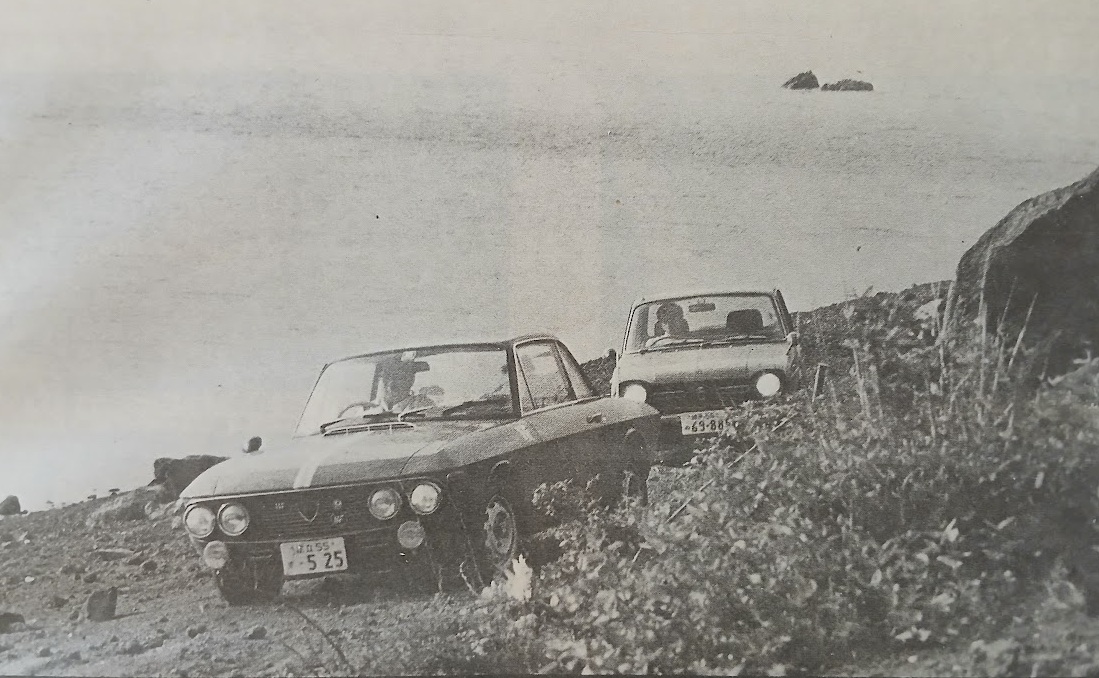
The Lancia Fulvia Coupe Rallye 1.3HF–today, there are only a handful of these 1300cc models in Japan. Officially a 2+2, in reality it is very much a two-seat coupe. The price is 2.3 million yen, making it still very much a plaything for a select, well-heeled few.
After finishing the test, I found myself recalling a racing film I once saw, with footage from the 24 Hours of Le Mans, and the announcer introducing the entrants in elegant French: “…Alfa Romeo! Ferrari! Gordini! Maserati! …et Lancia!”
Spending time with these cars–one “interesting,” the other “enthralling”–left a lasting impression. It stirred in me, for the first time in quite a while, a simple desire: to keep driving, endlessly… and to go somewhere far away.
Postscript: Story Photos