Subaru 1000 Sports Sedan (1968)
Publication: Auto Sport
Format: Road Impressions
Date: February 1968
Author: Junji Shirai
The Flavor of an International Rally Car
A powerful front-wheel-drive car—that is the character of the Subaru 1000 Sports Sedan. 67ps, disc brakes, and radial tires. Combined with its front-wheel-drive mechanism, these features demonstrated their true strength on both rough roads and the highway.
A Sports Version for International Rallying
It was still in the heat of summer. I remember international rally driver Erik Carlsson, then visiting Japan, trying the Subaru 1000 and telling us this:
“I’d like another 20 horsepower. And if the suspension were strengthened and disc brakes fitted, I think it would be a car capable of competing on equal terms in Europe’s international rallies.”
By the time autumn was well along, the long-awaited Subaru 1000 Sports Sedan had gone on sale. It had 67ps, 12ps more than the standard sedan. Strengthened suspension. Radial tires. Disc brakes at the front. The power was still a little short of Carlsson’s prescription, but here at last was a sports sedan approaching the sort of car he had described for taking on international rallies.
I said the power was still a little short, but if the car were tuned as a works machine, finding another 10ps or so should be easy enough. International rallies these days are contested by Group 5 Special Touring Cars and Group 6 prototypes, and if the Subaru 1000 Sports Sedan were modified to Group 5 specification, I believe it could hold its own internationally as a competition model.
That is my conclusion after driving the Subaru 1000 Sports Sedan.
The test car was a two-door model in “Beach White”—all Sports Sedans are two-doors. It had covered 3691.7km and was only just run in.
After checking everything over in the underground parking garage of the Subaru Building in Shinjuku, Tokyo, I drove up to street level. Quietness is one of the Subaru 1000’s strong points, but in Sports form its sound is altogether more powerful: on the underground ramp, the low, heavy exhaust note reverberated from all sides, giving the car a distinctly wild character.
I filled the tank and set the trip recorder to zero. The idle was steady at about 900rpm. As I discovered later, however, after hard driving the idle became somewhat rough, the needle wavering unsteadily between 600-700rpm. I was told that this is unavoidable in a car with SU-type variable-venturi carburetors and nothing much to worry about.
I use a standard Subaru 1000 for my everyday transportation. On settling into the driver’s seat, the first thing I noticed was that the seat had been improved. It is firmer around the edges and softer in the center, so that the body sinks slightly into it, producing much the same effect as a bucket seat. Seats are always a problem in a grand touring car. The firm support needed for sporting driving and a comfortable reclining mechanism are conflicting requirements from a design standpoint. In this respect, the Subaru 1000 Sports seat deserves a passing grade.
The dashboard has the same general feel as in the sedan, though the gauges are different. From left to right are the speedometer, with trip recorder; tachometer; and a combination gauge for fuel level, water temperature, and the various warning lights. All are set beneath a padded hood and positioned for easy reading. The switches are the same as on the sedan and appear to be scattered about almost at random, but when used while driving, they prove surprisingly convenient.
The one real nuisance is the supposedly non-reflective glass over the gauges. “Non-reflective” merely means that the surface has a frosted-glass finish, and light still reflects from it in a diffuse glow. As a result, while driving there is always some part of the gauges that cannot be seen—a so-called blind spot. It is particularly bad when driving away from the setting sun. This is one thing I would definitely like to see corrected. Surely it could be solved quite easily by giving the glass a steeper angle, or something along those lines.
Showing Its Strength on Rough Roads
Astonishing Power: Performance can be summed up in one word: astonishing. The power is such that it is hard to believe this is only a one-liter car. Above 4000rpm in particular, the engine is exceptionally strong, and in first or second, unless you keep an eye on the tachometer, the needle will quickly leap into the red zone.
With 67ps against a vehicle weight of 705kg, the weight-to-power ratio is about 10.5kg/ps. This is no different from a 1.6-liter-class sports sedan. For comparison, the Bellett 1600GT has a weight-to-power ratio of 10.7kg/ps.
Since both the transmission ratios and final-drive ratio are exactly the same as on the standard sedan, the higher engine speed translates directly into a higher maximum speed. The catalog figure is 150km/h, but an acquaintance of mine who tested the car tells me that it exceeded 160km/h. He was delighted: “A one-liter car that can do 100mph!”
The torque curve can hardly be called flat. According to the manufacturer’s chart, torque first reaches 7kgm at around 2200–2300rpm, then falls off somewhat before rising again to its maximum of 8.2kgm/4600rpm. In other words, there are two peaks in the torque curve, and this can be clearly felt while driving. If the engine speed is allowed to fall below 2000rpm in third before accelerating to overtake, there is a moment’s hesitation; once past 4000rpm, however, the car accelerates sharply and in one rush reaches 7000rpm, the upper limit of the yellow zone. The owner’s manual says, “Do not use top gear at 2000rpm.” The same applies in third: for quick acceleration, it seems there is no getting around a downshift into second.
The red zone begins at 7000rpm, but as an experiment I kept the accelerator down, and valve surge did not occur until the engine was approaching 8000rpm. Only as it tried to go beyond 8000rpm did I finally feel the power fall off sharply.
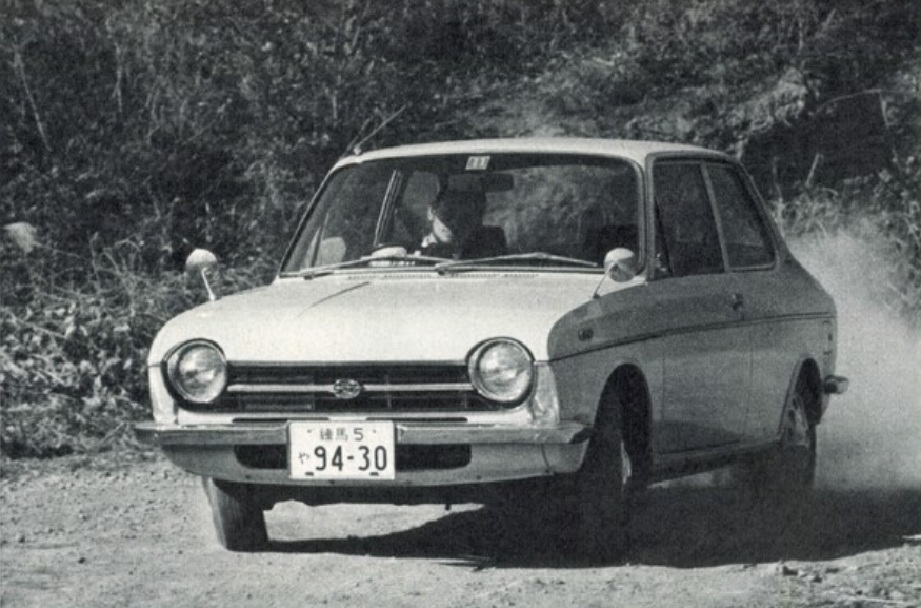
The Strength of Front-Wheel Drive: In low-speed driving around Tokyo, the advantages of front-wheel drive are hardly noticeable, but once the road turns to steep mountain curves and gradients, its strengths suddenly come to the fore. The steering response is particularly impressive when driving fast over a winding gravel road. The Bridgestone radial tires fitted to the car had been inflated to slightly higher pressures for highway driving, to 1.9kg/cm² at the front and 1.2kg/cm² at the rear, so on gravel the car bounced about quite a bit. Even so, its good roadholding was not lost, and it faithfully held the intended line.
My own Subaru 1000 is fitted with Michelin X tires, and by comparison I feel that the Michelin X still has a slight advantage. There is a subtle difference in stability at the instant the wheels come back down under power after leaving the ground. The Michelin X reliably regains its grip the moment it touches down and faithfully points the car in the direction the steering is turned, whereas the Bridgestone radial, manufactured under Pirelli patents, is slightly loose at the moment of contact, with a small loss of directional stability. As a result, constant steering corrections were necessary on rough, winding mountain roads. However, this would probably be greatly improved by setting the tire pressures correctly.
The dampers, on the other hand, still feel too soft. I am told that the torsion-bar springs are 0.5mm larger in diameter than those of the standard model, but the dampers have not been stiffened to match them, and this seems to spoil the otherwise excellent roadholding somewhat.
One characteristic of front-wheel-drive cars particularly worth noting is that, so long as power is being applied and the tires do not lose contact with the road, the car will go where the driver intends. Put another way, tires for a front-wheel-drive car should be chosen to provide the best possible contact with the road. In this sense, there is real value in the Subaru 1000 Sports being the first Japanese car to come standard with radial tires. Unless the driving is exceptionally hard, the Bridgestone radials demonstrate their advantages more than adequately.
It is generally said that “front-wheel-drive cars are poor on uphill grades.” In actual driving, however, they are much easier to get up steep grades with rough surfaces than rear-wheel-drive cars. Particularly with a powerful car, front-wheel drive has the advantage in straight-line stability while climbing. With delicate control of clutch engagement and accelerator, the Subaru 1000 Sports will climb even a breathtakingly steep slope along exactly the course the driver intends. And considering what it would be like to climb a muddy slope in a rear-wheel-drive car after the frost has thawed, how welcome a powerful front-wheel-drive car can be!
Outstanding High-Speed Stability
Some Objections to the Shift Lever: One of the pleasures of sporting driving is changing gears. But I have some objections to the Subaru 1000 Sports in this respect. Every time a quick shift is made, there is a loud clunk, no matter which gear is selected. At first I thought the synchromesh might be weak, but that is not the case. According to the manufacturer, in order to eliminate vibration of the lever while driving, the lever itself is fixed to the body, with rubber inserted in the linkage to the transmission. The noise is caused by movement between this rubber and a pin fitted to the linkage. The feel of the gear change, therefore, can be described as “Porsche-type” if one is being charitable; if not, it is simply vague and rubbery. A shift lever that vibrates constantly while driving is certainly unpleasant, but one that does not engage with a positive “click” can hardly be called sporting either. This may well be largely a matter of personal preference, but at the very least I would like something done about the clunking noise.
For those who prefer a more positive shift, there is apparently a floor-shift kit developed by Itochu, the Subaru distributor. This one is said to trade the noise for some vibration, but to engage with a positive click like that of a British sports car. At 38,000 yen including installation, it may prove surprisingly popular.
The gear noise that was said to be bothersome in the standard Subaru 1000 is effectively shut out by the console box housing the floor-shift mechanism and is almost impossible to hear. Or perhaps, even if it can be heard, it is simply drowned out by that powerful exhaust note….
Excellent High-Speed Stability: Having finished with the rough roads around Lake Sayama in Saitama Prefecture, the Subaru 1000 Sports Sedan entered the Chuo Expressway from Hachioji. This newly opened section (18.1km between Chofu and Hachioji) only came into service at the end of last year. Just after the toll gate, I stopped the car and carefully checked the tires for embedded stones and damage. On the smooth pavement, the Bridgestone radials produce little tread noise and run extremely smoothly. Acceleration is superb: taking the engine to 7000rpm in each gear gives 43km/h in first, 73km/h in second, and 105km/h in third. Among one-liter sports sedans, this is a very fast car even by international standards, fully on par with cars such as the NSU 1000TTS.
High-speed stability is likewise outstanding, thanks in part to the car’s front-wheel drive and the low unsprung weight of its suspension.
Wind noise from around the rain gutters was quite pronounced. Above 120km/h, the door frames began to vibrate.
Braking from high speeds is greatly improved over the standard sedan. The front disc brakes show no change in effectiveness or pedal effort even after repeated high-speed stops. In a car with this level of performance, however, one would like to see disc brakes at the rear as well.
At 100km/h in top gear, the tachometer reads 4500rpm. This is only 68% of the engine speed at maximum power. In other words, the car can cruise on the highway without the slightest sense of strain. Press the accelerator from this speed, moreover, and it accelerates so strongly one could imagine it were in third gear. Above 140km/h, however, acceleration naturally begins to fall off, and a long straight is needed to reach the maximum speed of 150km/h.
Points of Concern: Among the smaller details, I was bothered by the position of the horn button. When the left hand is on the shift lever and the right is holding the steering wheel, there is no free hand to press the button in the center of the three-spoke wheel if the horn is suddenly needed. Yet on a winding mountain road, situations like this occur quite often. I would like to see this problem solved somehow—either by relocating the horn button, incorporating horn buttons into the spokes as on the Alfa GTV, or providing a separate switch as on the Honda S800.
Another inconvenience I encountered while driving was the fine-adjustment knob for the reclining seat. After leaving the city for the suburbs, I decided it was time to stretch out a little and reached for the adjustment knob. But there was so little space between the seat and the door that, although I could just fit my hand in, I could not turn the knob. This is also something I would like to see corrected.
Fuel consumption was 19.5 liters over 172km—in other words, approximately 9km/l.