Prince Skyline Sports (1962)
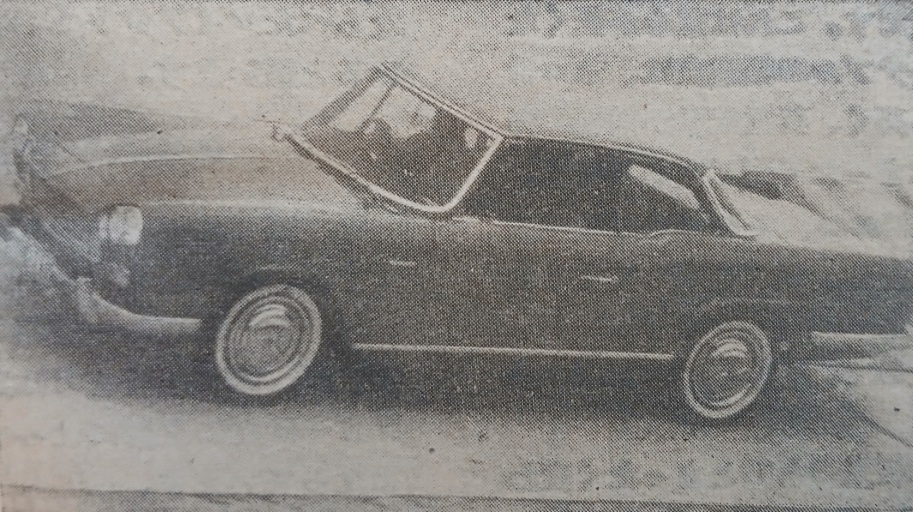
Publication: Motor Fan
Format: Road Test
Date: June 1962
Authors (roundtable): Jiro Tanaka, Tomochika Murakami, Osamu Hirao, Toshiaki Nakamura, Yasuhei Oguchi, Atsushi Watari, Kenichi Goto, Kazuhiko Aoki, Masaichi Kondo, Akio Miyamoto, Yuji Tsukada
, Motor Fan Editorial Staff (uncredited)
A “Semi-Sports” Car
Tanaka: This sports car was planned around three main objectives. First, with automobiles becoming as widespread as they have today, the sedan tends to become a car used mainly for “business”—for work, in other words—and we believe there is a need for a car intended simply for the enjoyment of driving. In that sense, one of our objectives was to create what might be called a “leisure car.”
Second, although the styling of Japanese automobiles has been improving year by year, we believe that further progress in this area requires stimulation from outside. With that in mind, we turned to Italy, by far our senior in the field of body design, in the hope that it would provide the stimulus for our next leap forward.
The third objective concerns exports. As you know, since the introduction of compact cars in America, exports to the United States—including those of European cars—have declined considerably. Even so, there are some types that have managed to survive quite well.
Looking at these, one type is the car thoroughly dedicated to the role of a “second car”—the Volkswagen and the Renault Dauphine, for example. These are relatively small, genuinely practical models. The other type that continues to find strong demand is the sports car. We therefore decided to build a sports car as a means of expanding our exports.
Sports cars in general are said to fall into three categories.
The first is the semi-sports car, the second the pure sports car, and the third the racing car. The Skyline Sports belongs to the first of these categories: the semi-sports car.
Given Japan’s road conditions and the fact that automobiles have not yet become thoroughly widespread here, such a car must still be capable of being used for business to some extent, while there is little need for extremely high speeds. So, we felt that what might be called “a car for enjoying a sporting atmosphere” would be the most appropriate approach, and planned the car accordingly. Among foreign cars, it falls into roughly the same category as the MGA, Fiat 1500, Renault Floride, and Karmann Ghia.
Planning for this car began exactly two years ago, in March 1960. In June of that year, we commissioned the famous Italian car designer Giovanni Michelotti to design it. The car was completed five months later and exhibited at the Turin Motor Show in November. It was then brought back to Japan and shown to you in March of last year.
The bodywork in Italy was carried out by a company called Allemano. In preparation for building the car in Japan, we invited Italian craftsmen here to teach us the methods used in constructing sports cars.
The car exhibited at the Tokyo Motor Show last autumn was one we had built ourselves. The car you drove today incorporates further improvements over that version and was built entirely by Japanese hands.
Small Frontal Area
Magazine: It’s certainly a splendid car—one you can’t help admiring—but we imagine a great deal of effort went into achieving it. Could you give us an outline of the technical specifications?
Murakami: The car is generally known by the name “Prince Skyline Sports,” but its official model designation is BLRA-3. There are two versions, a coupe and a convertible, but taking the coupe as our reference, overall length is 4,650mm, width 1,695mm, and height 1,385mm. Compared with the previous Skyline, it is approximately 280mm longer and 20mm wider, but as much as 150mm lower. The body itself is somewhat narrower, with the car’s maximum width occurring at the front bumper, and its frontal area is consequently quite small.
We are quoting a vehicle weight of 1,350kg. Weight distribution is 50:50 front to rear, and it remains the same when the car is loaded. The wheelbase is 2,535mm, the same as the previous model, although the track dimensions have been changed to 1,338mm at the front and 1,374mm at the rear. The tires are 5.90-15 four-ply, a size still rather uncommon among Japanese-made tires. Despite the slightly narrower track, the maximum static rollover angle has been improved to 52°, owing to the lower center of gravity.
The only differences with the convertible are that, because of the folding-top frame, its height is slightly greater at 1,410mm, and 52% of its weight is carried on the front axle. In all other respects, it is exactly the same.
Ground clearance remains unchanged at 210mm, and there have been no changes to the suspension or related components either. As I shall explain later, however, modifications to the engine have made higher engine speeds possible by allowing it to withstand over-revving, and as a result the maximum speed has been raised to 150km/h.
Magazine: So the mechanical components are otherwise completely unchanged from the previous model?
Engine Modifications and Body Construction
Murakami: Yes, you could say that. However, since several of you have asked how the engine was changed, I would like to explain it briefly. Our basic policy was to retain all of the engine’s existing performance while adding better low-speed performance and the ability to run safely beyond its normal rev range.
To begin with, we reduced the mass of the rotating components as much as possible—for example, by using a smaller flywheel. Next, we paid particularly close attention to the balance of the rotating assembly, bringing the imbalance down to virtually zero. The carburetor was changed to a “power kit” unit giving better response and acceleration, even at the expense of a certain amount of fuel economy. We also increased the rigidity of the rocker-arm assembly and made changes to the distributor. Those are the main modifications.
Thus, while retaining the GB4 engine’s existing specifications—1862cc, an 8.5:1 compression ratio, maximum output of 94ps/4800rpm, and maximum torque of 15.6kgm/3600rpm—we have made possible the over-revving capability I mentioned earlier, while at the same time improving low-speed performance and acceleration.
Next, I will explain the changes made to the chassis compared with the Skyline. The steering geometry itself is unchanged, but the steering column has been inclined farther downward, lowering the top of the steering wheel by approximately 60mm. This was done to provide a safe driving position with the car’s lower seating posture. The steering wheel is a sporty European-style three-spoke design, a domestically produced version of the Italian Nardi type.
The muffler has twin tailpipes, and we have also altered the exhaust note. No presswork whatsoever is used for the body; it is constructed entirely by hand, with particular emphasis on the quality of the finish, which is why we describe it as “tailor-made.” In essence, we took the best of Italian technical expertise and adapted it to Japanese operating conditions, using an all-welded construction to provide considerable strength and durability. Particular attention was paid to joining the body to the tray-type frame. It is welded through substantial structural members, giving it plenty of strength under all operating conditions.
Perhaps the car’s most distinctive features are its seats and luxurious appointments, although we have tried to incorporate a thoroughly sporting atmosphere throughout. The seats are fully leather-upholstered reclining bucket seats, which I believe is a first for a Japanese car. The instrument panel, with its tachometer and five other instruments arranged together, also has a character quite unlike that of conventional Japanese cars.
Equipment and Design Worthy of Attention
Hirao: You say the engine can be over-revved, but how high can it safely be taken?
Murakami: The standard engine currently develops its maximum output at 4800rpm, but it can be used within the practical range up to 5300rpm. With the further modifications made for the sports car, it can safely be taken as high as 5800rpm.
Hirao: “Semi-sports car” is a very apt expression. There are undoubtedly various considerations involved, but I take it to mean a car in which one can enjoy the atmosphere of a sports car. That’s why so much emphasis has been placed on the seats and appointments, and they certainly give the car an authentic European flavor. The fact that this is also the first sports car to be offered for general sale in Japan adds considerably to its appeal.
In that sense, I think the car has been brought together very successfully. But if I may ask for a little more, I would like to see something done, even at the level of the transmission—perhaps changing the gear ratios—to give the car a somewhat more sporting character under acceleration. The engine may have been made capable of higher revs, but when it is extended through each gear, I would like to feel a little more urge toward the top of the range.
The appointments, seats, and other aspects of the design are certainly excellent—indeed, they are worthy of particular attention. As for the steering, from what I experienced behind the wheel—and I imagine we’ll discuss this later—I certainly felt that it had been given a sporting character.
Magazine: The appointments are certainly impressive. The dashboard layout has the atmosphere of a sports car as well.
Hirao: The layout is very sophisticated and succeeds in creating a luxurious impression. But if I may be greedy and ask for still more, the instrument needles are constantly trembling, and somehow that seems out of keeping with the atmosphere of the car. (laughs) The tachometer itself is very appealing, but the movement of its needle strikes me as somewhat rough.
From a design standpoint, I think a little more thought could be given to such things as the dial faces and the length of the needles. There are also the ammeter, oil-pressure gauge, and various other instruments, and I think they would be even better if they could give more of an impression of indicating their readings with real precision.
Compared with Other Semi-Sports Cars
Magazine: Was the dashboard designed in Italy as well?
Tanaka: The Italian design served as the basis, but the original had fewer instruments. We redesigned that part of it ourselves.
Mr. Hirao also mentioned the acceleration performance. We have tested the performance of a number of foreign sports cars, and when we compared the results, we found that the Skyline Sports is by no means inferior to its foreign counterparts.
Nakamura: From among the considerable number of foreign cars that we have tested in-house or encountered while assisting with Ministry of Transport testing, we made a comparison of the performance of several so-called sports-like cars in roughly the same category as the Skyline Sports. These included the Volkswagen Karmann Ghia, Fiat 1500, MGA 1600, and Abarth 1600 and 850S. Comparing top-gear acceleration, the Skyline Sports gives the best performance of the group.
In standing-start acceleration through the gears, it is also quicker than the Fiat 1500 and MGA, and gives approximately the same performance as the Abarth 1600. Its standing quarter-mile time of around 20 seconds is also among the best. We compared not only our own test results but also data published by foreign magazines such as The Motor and The Autocar, and in acceleration from 0–80km/h, 0-400m, and maximum speed, the Skyline Sports likewise ranks among the better cars in the semi-sports category.
Hirao: I think the reason I said the acceleration seemed to lack that sense of extension is because, as you’ve just explained, its acceleration performance is good. In other words, the gear ratios are numerically quite high. What I mean is that the gearing feels short enough that you find yourself wishing it had an overdrive.
Magazine: Since we’ve come to the subject of acceleration, what did the test results show?
Acceleration and Fuel-Economy Data
Oguchi: The tests were conducted with the coupe. In standing-start acceleration, it took 5.4 seconds to reach 50m, 8.4 seconds to 100m, 13.2 seconds to 200m, and 20.9 seconds to 400m. We were told that these figures were slightly slower than the manufacturer’s own test results, so we asked for their data. Their figures were 4.6 seconds to 50m, 7.7 seconds to 100m, 12.5 seconds to 200m, and 20.1 seconds to 400m. There was a fairly strong headwind blowing from the left today, so I think that had some effect on our results.
For overtaking acceleration, in third gear from 20km/h, the car reached 30km/h in 1.2 seconds, 40km/h in 3.0 seconds, 50km/h in 4.5 seconds, 60km/h in 6.6 seconds, 70km/h in 8.4 seconds, 80km/h in 10.6 seconds, and 90km/h in 14.0 seconds. In top gear from 30km/h, it reached 40km/h in 2.0 seconds, 50km/h in 6.0 seconds, 60km/h in 9.0 seconds, 70km/h in 12.4 seconds, 80km/h in 15.8 seconds, 90km/h in 19.6 seconds, and 100km/h in 23.4 seconds.
Next, we measured fuel economy. The results were 17.4km/l at 30km/h, 14.7km/l at 40km/h, 14.7km/l at 50km/h, 13.1km/l at 60km/h, 11.8km/l at 70km/h, 11.7km/l at 80km/h, and 19.8km/l at 90km/h.
During the third-gear overtaking-acceleration test, we were also able to take the car up to 100km/h, so I felt that overtaking should be relatively easy.
Magazine: The fuel economy is very good, isn’t it? I seem to recall that the Skyline gives about the same figures.
Nakamura: Yes, it’s roughly on the same level as the Skyline. Since we’ve made the engine capable of higher speeds, and changed the carburetor to a power kit that sacrifices some fuel economy for better acceleration, one would naturally expect fuel consumption to increase. In practice, however, it isn’t all that different from the Skyline.
The reason is that when we actually measured the car’s running resistance, we found it to be lower than the Gloria’s. In particular, changing the tires and raising the inflation pressure to 26lb has reduced rolling resistance. The car is also lighter and, as I mentioned earlier, its frontal area has been reduced by more than 10%. In addition, the coefficient of drag is lower. All of these factors contribute to good fuel economy.
Murakami: You mentioned that you took it up to 100km/h in third gear. At that speed the engine would be turning at around 6000rpm. (laughs) It certainly will rev that high, but cars in the Gloria class normally reach only about 80km/h in third, and even with this Sports we regard somewhere around 95km/h as the practical limit in third.
Excellent Ride Comfort
Magazine: So it can stand up even to that kind of severe testing. (laughs) Incidentally, couldn’t you sacrifice a little more fuel economy in order to improve the acceleration?
Hirao: As it is, I don’t think sacrificing fuel economy would do any good. And I doubt there’s really any more fuel economy to sacrifice. It would be a different matter if you changed some of the specifications, of course…
Magazine: The suspension remains unchanged from the previous model, but what did the vibration tests show?
Watari: The running gear is the same as the Gloria’s, with independent coil-spring suspension at the front and a de Dion-type rear axle with leaf springs. On this car, however, the tires are slightly different, and their higher inflation pressure makes them rather stiff.
Murakami: The track dimensions have also been changed somewhat.
Watari: With our usual measurements, the sprung-mass frequency was 1.1Hz, or 66 cycles per minute. The higher-frequency pitching mode, I believe, was 75 cycles per minute. The unsprung frequency was around 20 cycles per second, which is relatively high.
As for the ride itself, I think everyone who drove the car will agree with the catalog’s description: “the excellent ride comfort for which the Prince Gloria has earned a fine reputation.”
When overall ride comfort is considered, however, there is also the question of noise suppression. Here again, if one were to go as far as the Karmann Ghia has, the car would become heavier and its acceleration would suffer, but in return it would be quieter and the ride would improve still further. The question is where to strike the balance.
The use of a four-cylinder engine is one reason vibration is transmitted to the body, while the monocoque body itself also tends to transmit vibration to the seats. If one set out to prevent that thoroughly, the car would become heavy like the Karmann Ghia, and more expensive as well.
Whether the Skyline Sports should go that far, or whether it should instead be kept as light as possible, with correspondingly high performance, while at the same time satisfying the requirements of a semi-sports car, is a difficult question. The seats themselves are comfortable, and in terms of what we normally mean by ride comfort, I think the car is very good indeed.
The Elements of a Semi-Sports Car
Hirao: The Jaguar Mk 2 we tested recently is also what I would call a semi-sports car. It’s noisy when you hear it from outside, but once you’re inside it’s astonishingly quiet. Of course, it’s heavy as a result.
Goto: It’s very difficult to draw distinctions among sports cars, semi-sports cars, and racing cars, but one way of doing it is by the relationship between a car’s volume and its weight—its “specific gravity,” so to speak. Semi-sports cars tend to be relatively heavy for their size, while sports cars are light. Then, when you get to racing cars, they become relatively heavy again. That seems to be the general tendency.
Watari: With a semi-sports car, considerable effort goes into sound insulation, and that makes it heavier. In many cases, its performance is consequently inferior to that of the original car. This is something that will require further study. Leaving racing cars aside, as various kinds of sports cars come to be built in Japan, the important question will be what qualities we should aim for.
Hirao: Well, if it’s to be semi-sports, I don’t think we need to be too particular about performance figures. It seems to me that things such as having acceleration with strong extension, sporting handling, and quietness are more important.
Watari: And then there’s being a little faster than other cars, having a good feeling of acceleration, having attractive styling, and not having too many other cars around that look much the same.
Aoki: Taken as a whole, I think what matters more than numerical performance is that the car should have a strong individuality—that whether it’s seen by an ordinary person or an expert, it should immediately give the impression, “This is something different.”
Kondo: On the question of how the acceleration feels, looking at the figures recorded by the acceleration meter, low and second gears are each being used for only about three seconds. They’re held for a very short time, and beyond that the rate of acceleration falls off. I think that may be one reason it feels as though the acceleration doesn’t continue to build…
Hirao: I think that’s certainly one part of it.
Murakami: What we’d really like, if anything, is for the acceleration to build more strongly toward the upper end.
Watari: On this point, the way drivers are taught in Japanese driving schools is at fault. They’re taught that whatever happens, they should hurry up and get into top gear. Go to take your driving test, and if you don’t get it into top, they’ll decide you can’t drive and fail you. (laughs) There’s something wrong with the way drivers are taught.
As a result, Japanese drivers develop the bad habit of using top gear even where they ought to be driving in second or third. Then the manufacturers build cars to suit what those drivers demand. (laughs) We really ought to break this bad habit somewhere along the way, but somehow we can’t quite bring ourselves to do it.
Lighter Steering Effort and Holding Force
Hirao: Since we’ve come to the subject of the gearbox, if this is to be a semi-sports car, I’d still like to see a floor shift. (laughs) I’d like a short, solid lever that you can push firmly into gear. Even if the column shift is retained, I’d like its action to be smoother, so that the lever almost seems to draw itself into gear.
Watari: I’d prefer a floor shift myself, but I imagine it would be difficult if the car is to be put together with this sort of overall character.
Goto: About one-third of semi-sports cars have column shifts. Of the remaining two-thirds, many were originally column-shift cars that have been converted to floor shift. Not that this necessarily justifies it, of course. (laughs)
Magazine: Mr. Kondo, could you give us the results of the understeer and oversteer tests?
Kondo: Unfortunately, I wasn’t able to take part in the testing myself, but the results have been compiled, so I’ll report from those. As far as understeer and oversteer are concerned, the characteristics appear almost unchanged from the Gloria, with strong understeer. The steering holding force is lower than on the Gloria, measuring only 3kg even at 0.65g. The figure-eight test results are also virtually identical to the Gloria’s, but despite cornering at more than 16km/h, maximum steering effort remains about the same as the Gloria’s, at around 13kg. Here too, it appears to have become somewhat lighter.
If time permits, we hope to gather more data in the future, but on this occasion we also carried out a slalom test for the first time. We made two runs at 80km/h. This should enable us to determine the relationship between lateral acceleration and steering effort at high speed. The data has not yet been analyzed, so we intend to publish it later as part of the test report.
Next, we measured the steering effort required with the car stationary, using a simple steering-effort gauge. This too is lighter than on the Gloria, but the needle still went right off the scale, exceeding 11-12kg, so I would still regard it as heavy.
Aoki: For a sports car, though, I don’t imagine that sort of characteristic is demanded to quite the same extent as it is in an ordinary car…
The Steering Has a “Dry” Feel
Kondo: I think that’s true. But considering the difficulty of parking in Japan today, I think drivers would appreciate reasonably light steering effort when the car is stationary. Of course, how much importance should be placed on that is another question…
Next, we tested hands-off stability. Mr. Nakamura drove the car at speeds up to 120km/h, and even at 120km/h its convergence was extremely good. I think this too is somewhat better than in the Gloria, although one noteworthy point is that another, shorter-period oscillation is superimposed on the response. I wondered whether this might be because the steering wheel had been made smaller, and the material of the wheel itself thinner and lighter…
Murakami: The diameter of the steering wheel hasn’t changed, but it does have aluminum spokes.
Kondo: In that case, I would imagine that its moment of inertia has been reduced, making the period of oscillation in the steering system shorter and therefore more noticeable. I don’t mean that as a criticism.
Hirao: What I felt from this steering wheel was that the steering has moved in a “drier” direction than the Gloria’s. It’s difficult to explain exactly what I mean by “dry,” though. (laughs) It feels somehow less rubbery—there is less of that sensation of pulling against a rubber cord. In the Gloria and similar cars, there is a certain elasticity to the steering, and that seems to have been reduced here.
I think this is partly because the steering wheel itself is lighter and the steering effort has also been reduced. At the same time, the lower center of gravity reduces the amount of transverse load transfer, and in the same way probably reduces the increase in self-aligning moment caused by changes in tire loading.
Tanaka: I think the single biggest factor is the higher tire pressure.
Kondo: Yes, I think that’s probably the primary cause.
The Effect of a Lower Center of Gravity
Watari: I didn’t drive particularly fast, so I couldn’t really tell, but when you’re driving through a mountain pass with a lot of curves, I think there’s something else to consider. With ordinary passenger cars we’ve always said that lighter steering is better, but once you start driving a car like this at higher speeds, there’s also the possibility of inadvertently putting in too much steering.
Kondo: When I drove over Otarumi Pass the other day, the steering was so well judged that I could handle it with one hand. I thought it was very good indeed.
Hirao: Gear ratio also has something to do with that, but I prefer the steering of this Sports to the Gloria’s myself.
Watari: You say the center of gravity has been lowered on this Sports. By about how many millimeters?
Tanaka: It’s 15mm lower. That makes quite a considerable difference.
Watari: Lowering it that much contributes enormously to stability. It also has a very beneficial effect on ride characteristics.
Miyamoto: And despite that, the ground clearance is 210mm, which is very generous. I think that can be regarded as one of the car’s strong points. It’s a car well suited to mountain rallies and endurance races. In the end, it combines practicality with sporting qualities. The styling is restrained and free of eccentricities as well. If this car had appeared two or three years ago, I think it would have sold extremely well. (laughs)
Magazine: Oh, it’ll sell even now. I hear the manufacturer is already having trouble keeping up with production. (laughs) Mr. Kondo, what about the roll angle?
Kondo: We haven’t finished analyzing the roll-angle data yet, but from a preliminary look it appears to be around 5.5°, which puts it among the smaller figures.
Hirao: It seems that considerable hopes are being placed on exports. In that case, will you be building a left-hand-drive version?
Tanaka: Yes, we intend to introduce one in due course.
Magazine: Since you don’t use presses to build the body, I suppose that sort of change presents no particular problem. Do you intend to continue without using presswork in the future?
Murakami: Yes, we do. The fact that it is a genuinely “tailor-made” car is one of its distinguishing features.
Light, Effective Brakes
Magazine: Could we have the results of your tests, Mr. Aoki?
Tsukada: We measured the vehicle weight. Unladen, it was 733kg at the front and 612kg at the rear, for a total of 1,345kg, almost exactly matching the quoted figure. With five people aboard, it was 829kg at the front and 813kg at the rear, for a total of 1,642kg. We also measured it with two people aboard and the spare tire fitted. In that condition it was 784kg at the front and 789kg at the rear, for a total of 1,473kg. The spare tire weighs approximately 20kg, and the weight distribution in this condition is 50:50.
Next, the brakes. We had driven through extremely heavy rain that day, so the drums and other components had become wet and we were unable to obtain entirely conclusive data. However, we are told that the brakes are entirely unchanged from those of the previous Skyline, and both the earlier figures and our own measurements show that only about 18kg of pedal effort is required to produce 0.6g, which is very light. This is lighter than the figure for the Gloria. The braking distribution is also approximately 60:40 front to rear.
Aoki: The tire size has been changed, but the diameter of the brake drums remains the same?
Murakami: That’s right. We haven’t changed the brake diameter. However, since the tire dimensions have changed and the inflation pressure is also higher, the width of the contact patch is somewhat different.
Watari: These brakes feel light underfoot as well. They’re very good brakes.
Tsukada: The parking brake is also quite effective. In terms of figures, I think an operating force of 20-25kg would satisfy the requirements under any conditions. With an operating force of 18kg and the ratchet engaged, it will hold the fully laden car on a 20% gradient after the lever is released, so I think its performance is entirely adequate.
Hirao: The trouble is, that handbrake isn’t very semi-sporting. (laughs) And then there’s raising and lowering the side windows. I’d like to see something done about that too. They’re heavy, and the crank has to be turned twice, doesn’t it? At the very least, I’d like them to go all the way with one turn.
Magazine: Reducing the number of turns and making the action lighter at the same time is rather difficult… (laughs)
Hirao: But there are foreign cars that manage it with a light action and a single turn, so it can’t be impossible.
Murakami: We had complaints that even the Skyline required too many turns, so we’ve already reduced the number with the present design. But making it both light and a single-turn operation is more difficult still. We’ll certainly study it, but it’s surprisingly difficult because problems such as looseness between the glass and the window frame can arise.
Adjustable Pedals
Magazine: How about the pedals?
Hirao: Of the three—the clutch, brake, and accelerator—the accelerator pedal seems rather heavy. I think that may even be detracting somewhat from the impression of acceleration. The other two seem fine as they are…
Watari: Things like that ought to be adjustable, so the driver can set them to whatever feel he prefers.
Nakamura: This car is set up that way. There are two adjustment holes for the return spring, so it can be set to whichever position the driver prefers.
Watari: It seems to me that making the present Skyline more like this car might be possible.
Murakami: Then you’re saying you prefer this car to the Skyline?
Watari: When you put it to me that directly, I’m not quite sure what to say… (laughs)
Magazine: There’s no doubt that this one is more desirable. But then there’s the question of price. (laughs)
Hirao: As for this car radio, I’d like pushbuttons as well. There are radios like that, you know.
Miyamoto: The latest American ones have a switch by the driver’s left foot. Press it and the tuner operates automatically and brings in a station. If you don’t like that station, press the switch again and it moves on to the next one; keep pressing it and eventually you come back to where you started. It’s very highly regarded in America as the best system available.
Hirao: This is the latest type too. (laughs) On this one, the switch is by the steering wheel.
The trouble is, suppose you’re tuned to station A and then move on to station B. If you want to get back to A, you have to press the switch over and over again before it comes around. (laughs) What I’m saying is that it would be better if it also had pushbuttons. As it is, you can only go one way. (laughs)
Magazine: So it’s an endless-loop system. And you’re saying it would be still more convenient if it had pushbuttons as well? Our demands are becoming more extravagant all the time. (laughs)
Murakami: Since this is an automatic-tuning radio, even if you set it to a Tokyo station, for example, as you drive along and an Osaka station becomes stronger, it will automatically switch to the Osaka station. So wherever you take the car, it automatically selects a local station.
A Well-Organized Engine Compartment
Magazine: That’s certainly a very advanced system. We ought to give credit where it’s due. (laughs)
Hirao: Oh, I think that part of it is very good. (laughs) The only trouble is that even when there’s a station I want to keep listening to, it switches by itself to whichever station has the stronger signal. (laughs)
Murakami: That’s what the DX control is for. Pull it out and the sensitivity increases, allowing the radio to stay tuned to that station. Manual tuning is also possible.
Tanaka: It would also be possible to combine this automatic tuning with pushbutton manual tuning, but apparently it’s very difficult to do.
Magazine: One thing that particularly impressed us about this car is how cleanly and neatly the engine compartment has been laid out…
Aoki: Even the way the wiring is arranged is exceptionally neat. Looking at it made me think that every car ought to be done this way, and wonder why they aren’t.
Murakami: Up to now, engine compartments have really been rather like a jungle. We decided that we ought to clean things up, and I think the result has proved well worth the effort.
Aoki: Will this car be available with seat belts? It seems to me that a sports car might well have them from the outset…
Murakami: We’re planning to offer them as an option. Provision has been made so that they can be fitted for anyone who wants them.
Hirao: With most cars, fitting seat belts afterward is quite a job.
Murakami: Also, some people dislike them because they say seat belts make the seat covers look untidy. So our thinking is to fit them only for those who specifically want them.
Magazine: Are they really necessary under present conditions in Japan?
Aoki: Once you’d been in an accident, I think you’d certainly be glad you had seat belts.
Hirao: On the subject of color schemes, I’m not particularly trying to find fault. (laughs) But isn’t there still some room for improvement in the dashboard colors? Of course, that’s partly a matter of taste.
Tanaka: In terms of appearance, we tried to give it a sporting character while keeping things clean and uncluttered. But it’s very difficult to produce something that appeals to everyone, so we’ll listen to the reactions as they come in and consider what improvements might be made.
The Difficulties of Seats and Convertible Tops
Aoki: About the convertible top—are you going to offer it in black?
Murakami: For the time being, we intend to offer it in that color. In Europe you can choose freely from blue, white, brown, even bright red tops, although black still seems to be the most common. Very few cars with folding tops have yet been made in Japan, so it is difficult to obtain material exactly as we would like it. It would be nice if we could offer a variety of colors according to the customer’s preference…
Aoki: I suppose the material is different from ordinary tent canvas.
Murakami: Of course. But there seem to be quite a few difficulties with the material itself. Much the same can be said of the leather seats. We had considerable difficulty obtaining the hides.
Normally, a cowhide is split lengthwise along the back, and each half is known as one “side,” which is the standard unit. If you want to make something large, such as a top covering, from a single piece of leather, you need the whole hide—two sides, without splitting it down the back. Apparently even the leather used in the car built in Italy was imported from Britain.
Hirao: But if you’re prepared to spend the money, couldn’t you make something better than leather? The trouble is trying to imitate the character of leather with something cheap. Instead, make something that’s actually better than leather. (laughs)
Magazine: I suppose that when it comes to the feel in the hand and the impression on the eye, a substitute simply won’t do. Well, I think we’ll leave it there. Thank you very much.