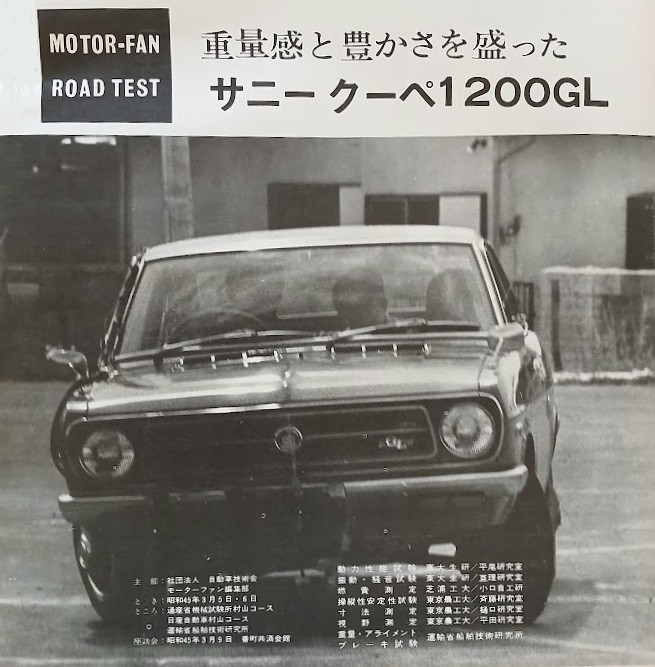
Nissan Sunny Coupe 1200GL (1970)
Publication: Motor Fan
Format: Road Test
Date: July 1970
Authors (Roundtable): Hiroshi Takahashi, Osamu Hirao, Hiroshi Okazaki, Zenzo Sonoda, Kenji Higuchi, Motoo Harada, Akio Miyamoto, Kunitaka Furutani, Yasuhei Oguchi, Taizo Tateishi, Masahide Sano, Kenzaburo Ishikawa, Zo Doi, Kenichi Otani, Minoru Onda
Aiming a Little Higher
Magazine: We’ve introduced the new Sunny 1200 series previously in these pages. This road test focuses on the GL coupe, but first, could you tell us about the aims of development for the series as a whole?
Takahashi: First, let me briefly outline the intentions behind the full model change. After releasing the previous Sunny, we conducted various surveys within Japan. As a popular car, the question was how we might increase volume further. What we found was that we needed to penetrate a broader segment of the market.
For example, in terms of demographics, the previous Sunny tended to lean somewhat toward younger buyers. While continuing to attract that group, we felt it was necessary to expand its appeal to include more of the middle-aged segment as well. Another finding, and this is not only limited to mass-market cars, but across all categories there has been a tendency for higher-grade models to sell better. For example, while “Deluxe” models have typified this trend up until now, it has shifted recently toward greater demand for even higher-grade models like the GL and SSS. Taking these points into consideration, we decided to go a little more upscale with the model change.
Another point is exports. We have been shipping an average of around 2,000 units per month, but the Sunny originally began as a model focused on the domestic market, with exports considered somewhat secondary. This time, however, we intend to expand exports in earnest. Our thinking is to create a car that can appeal in all regions, anywhere in the world. In that sense, the development goals for domestic growth I just mentioned seemed to apply equally to overseas markets, so we approached the design and layout accordingly.
To be a bit more specific, in terms of layout, we made the car slightly larger. Japanese cars, as a rule, tend to be somewhat narrow. Originally, Japanese cars were designed to fit domestic road conditions and small-car regulations; in other words, proportions have favored length over width. With this Sunny, however, we have increased the width without extending the overall length very much, improving interior accommodation. We also aimed to give the interior a somewhat more luxurious appearance.
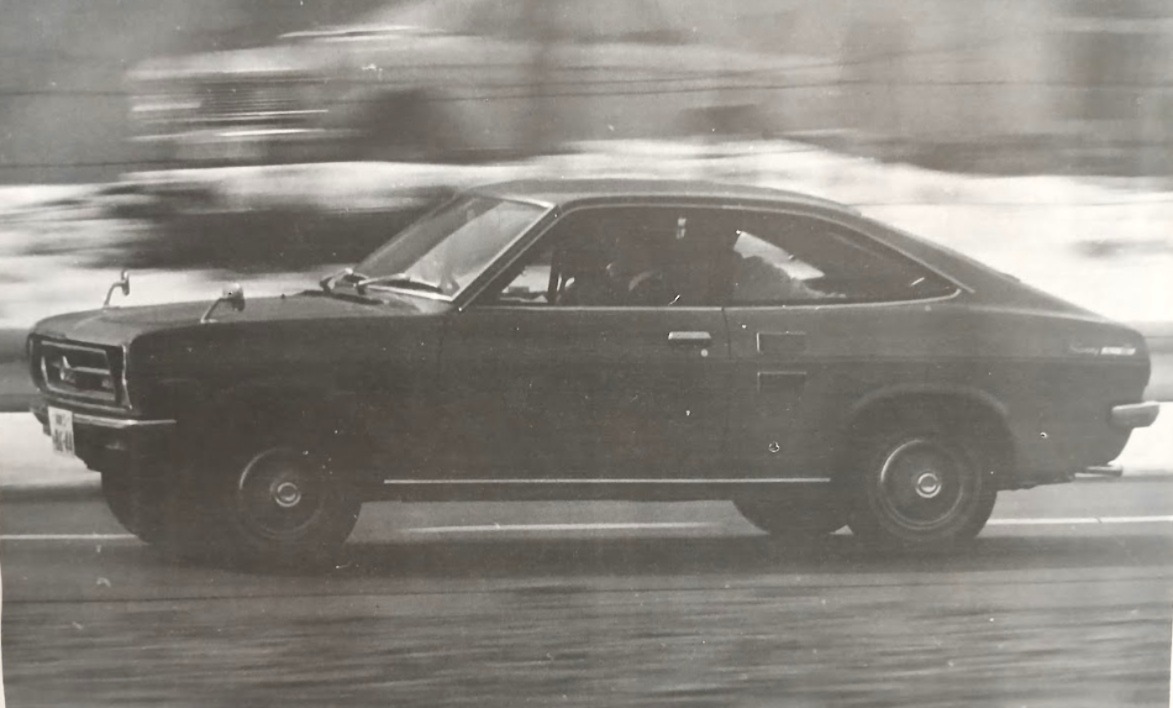
As for styling, the Sunny has always had a style based on straight lines, and has been well-regarded for having a light, nimble character. At the same time, that approach could be seen as somewhat youthful. To appeal across a broader age range, we introduced more curved surfaces to create a greater sense of volume, a sense of mass and composure. In our advertising, we describe it as having “a sense of richness,” and that is what we’re aiming for. As for the coupe, the 1000’s fastback shape has been very well-received, so we thought we should continue that concept and made the coupe a fastback.
In terms of performance, weight has increased by around 30kg, which would not have created any particular deficiency, but we chose to improve performance further by increasing engine capacity to 1200cc. These were the primary development aims and changes, but in addition, with higher speeds becoming more common, we have also given due consideration to high-speed capability and the safety issues that are increasingly being discussed.
A Car With Spaciousness
Magazine: We’d like to ask about the specifics one by one, but overall, it seems that the new model has significantly changed the impression many people previously had of the Sunny. So first, we’d like to hear your initial impressions of the car itself. Professor Hirao, what did you think after driving it?
Hirao: I think that the policies that were just described are very clearly showing up. In fact, during the test of the Laurel, during my half-day trip to Hakone and back, I made a bet with someone from Nissan about how many Nissan cars we would see with female drivers behind the wheel. (Laughs) I said that there might be two or three, but Nissan insisted there would be more than ten. In the end, I won and got the chocolates. (Laughs) So, I think that unless a car is one that many women will want to drive, it will be difficult to broaden the sales base, but Takahashi has just explained that they are aiming for a wider range of people this time. After driving it in various situations, I feel that it certainly has more room, as well as a sense of playfulness.
Up to now, Nissan’s cars up have tended to be designed in a rigid, logical way, and their form has been determined strictly by the way they will be used and driven. When I look at the original Sunny, I feel that it’s a form that pursues functionality to the limit, and there’s no dream, no mood. It gives off a feeling of tension. I think that the policy in this regard has changed dramatically. This time, I think we may see many young housewives driving it. (Laughs). Now, however, the Bluebird next to it looks small, which is a little worrisome. (Laughs)
Takahashi: In fact, the Bluebird is a size larger, with engines ranging from 1300cc to 1600cc. There was quite a gap between the Bluebird and Sunny before, but now they’ve become a little closer.
Hirao: How much is the price difference between them?
Takahashi: It’s about 100,000 yen.
Hirao: Ultimately, it would be ideal if people could tell just by looking at the cars that they were priced 100,000 yen apart. If the perceived difference is small, it could make things tough for the one that is higher-priced.
Okazaki: Just as Professor Hirao says, when following a Bluebird from behind, you might think the Sunny is about the same size, and it does seem to have grown by at least one class size. Another thing is that it is often said that Nissans appeal to people who are particular about cars, and who are knowledgeable about them. It seems there have been fewer people who drove one primarily for the atmosphere or mood. I have a strong impression that this has changed quite a bit.
I don’t know much about design in technical terms, but it does seem like this car’s image is quite different from the one I’ve had of the Sunny up until now. I was surprised to see how much the impression could change simply by altering the character of the lines. Or maybe I’ve gotten caught up in the advertising, but either way, I would be interested to hear more about how a simple change in the way lines are used can make such a difference.
Sonoda: I think the difference in width appears more pronounced due to the wider spacing of the front and rear lamps, combined with the more rounded styling. The curved side glass is also used effectively, and I think this is another reason why it appears larger.
Retaining Functional Sharpness
Higuchi: Actually, when I first saw the new car, I must admit I was concerned. As Professor Hirao mentioned earlier, Nissan cars have traditionally been well-designed from a functional perspective, and I personally prefer driving them for this reason. But when I saw this new model, my first impression was that it had become like any other car. In other words, since being functionally sharp alone doesn’t sell cars, the styling had become more mood-oriented. If it were only the styling that had changed, this would be tolerable. But if the driving feel had also become more mood-oriented, it would be a problem. That’s what I was worried about. However, when I drove it, I was relieved. The way it drives is very much like the previous Sunny 1000, or the Bluebird 310.
Earlier it was mentioned that Nissan cars tend to be driven by enthusiasts. I believe there will be more and more such drivers in the future. As people move on to their second or third car, more of them will naturally graduate from choosing a car purely on appearance or mood. Ultimately, their interest in the functional aspects will begin to matter more. From that standpoint, I was relieved to find that Nissan can update the aesthetics while retaining the driving functionality of earlier Nissan models. The mood has certainly changed dramatically, but the mechanical characteristics remain the same as before. That is an encouraging sign.
Oguchi: Not only in the front seats, but when sitting in the back seat as well, you get the feeling that it’s spacious–enough so that even on longer trips, rear passengers would not get tired easily. Of course, more space would be welcome, but there are always dimensional limits within a given size class. Considering those constraints, my impression was that, at least in terms of feeling, the interior space is quite generous.
Magazine: We’ve heard that the styling emphasizes size and spaciousness, which must have required considerable effort to achieve. The engine also appears to have a higher compression ratio and increased output, which must have made it a fairly demanding design for a mass-market car. Could you outline its main features?
Harada: I’ll give a brief explanation of the engine. The previous 1000cc unit had a bore of 73mm and a stroke of 59mm. For this 1200cc engine, we increased the stroke by 11mm, resulting in a bore and stroke of 73 x 70mm. From a production standpoint, the manufacturing line was designed with the idea of sharing as much as possible with the previous 1000cc line. As an engine designed to be suitable for large production volumes and aimed at a broad customer base, the main goal was to achieve a balance that would make both high-speed and low-speed performance easy to use.
At the same time, since this is a mass-market car, we aimed to retain the economy of the previous 1000cc engine. As for pollution control measures, the previous model was already equipped with a blow-by device, but we have now adopted a system that actively ventilates blow-by gases into the intake manifold.
Quietness is also important in relation to the development of highways and high-speed travel, so we aimed for that and used five bearings. Also, increasing the stroke can lead to the risk of excess oil consumption due to increased piston travel, so we have adopted a combined ring to completely eliminate this.
As for exhaust emissions, we have worked to improve them as much as possible. Carbon monoxide levels are now in the range of just over 1%, so even for export to North America, it is not necessary to fit any major additional equipment. We have taken great care to ensure that even the strictest regulations are met.
0-400m in 18.0 Seconds
Magazine: With the considerably longer stroke, the engine is not as strongly oversquare as before. Has this made much of a difference in its character? When you actually drive the car, do you feel that it is more flexible than before?
Harada: That was one of the things we paid the most attention to during development. In order to improve throttle response from low speeds, we worked on various manifold designs and carburetor sizes. In particular, we spent a lot of time improving the intake manifold, ensuring good mixture distribution and using relatively narrow runners.
Miyamoto: I drove the 1000cc and the 1200cc one after the other, and as you said, the longer-stroke engine feels much more tenacious. Acceleration response for overtaking is greatly improved, so passing has become much easier. I was wondering how it would turn out, since moving from 1000cc to 1200cc comes with a slight increase in road tax, but I would say the improvement is more than worth it. Of course, standing-start acceleration has improved as well. Although oversquare engines have seemed to be more popular lately, the fact that various manufacturers are also lengthening stroke seems to be a positive trend.
Magazine: At this point, let’s take a look at the measured data. What about the figures from the Hirao Laboratory?
Furutani: We tested both the Coupe GL and the four-door GL. Starting with the Coupe GL, acceleration from a standing start was 4.8 seconds to 50m, 7.7 seconds to 100m, 11.3 seconds to 200m, and 18.0 seconds to 400m.
The four-door GL accelerated from a standing start in 4.7 seconds to 50m, 7.2 seconds to 100m, 11.4 seconds to 200m, and 18.1 seconds to 400m.
Third-gear overtaking acceleration from 30km/h was almost the same for both the coupe and sedan: 40km/h in 4.1 seconds, 60km/h in 7.5 seconds, 80km/h in 11.1 seconds, and 100km/h in 15.4 seconds.
Magazine: How do these figures compare to the feeling when you actually drove the car?
Hirao: With numbers like these, differences of 0.1 second really don’t matter. In that sense, I think the acceleration is good. More important are the finer details–for example, whether the engine wakes up well on starting. On a cold morning, can you set off immediately without any jerking or hesitation? When you let it warm up at idle, can you start the engine and go back inside to finish breakfast, or do you have to watch it for 10 or 20 seconds before you can leave it running safely? To my mind, such things are quite important. From testing a lot of different cars, I’ve found that the differences can be quite pronounced in this regard.
Okazaki: As others have said, it is an engine with a very wide usable range, and it’s much smoother than the previous 1000cc. It’s also much quieter. What I appreciated most about it was that while maintaining the low-speed ease of use, it still has the high-speed character that Nissan fans will appreciate. I think that flavor will be very appealing to those of us with slight engineering-enthusiast leanings. In that sense, I felt that it was an engine that was both very easy to use and enjoyable.
1200cc Margin
Oguchi: In simple terms, my impression is that it has “gained a certain margin.” In terms of numbers, the acceleration is not that different from the 1000cc, but there is a sense of reserve that isn’t captured by the figures alone. For example, it can reach 100km/h in 13.4 seconds–as Professor Hirao said earlier, the exact number does not need to be debated in detail, because with performance at that level, one can drive very comfortably.
As for cold starts on winter mornings, I don’t know for sure, but it did feel like there might be a slight tendency toward over-cooling. It might be related to the operation of the thermostat…
Hirao: Are the engine’s cold-start manners generally good?
Oguchi: It starts quickly, but it tends to be a little slow to warm up. So if you try to push it right away, it has a bit of that “gaku-gaku” shuddering.
Magazine: Could you please present the data measured at the Watari Laboratory?
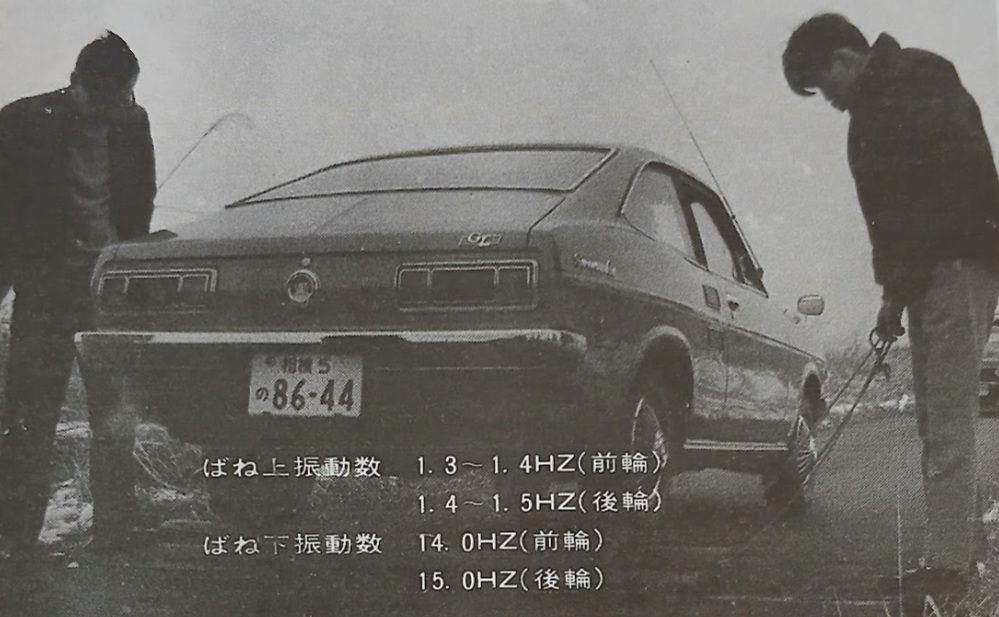
Tateishi: For the Coupe GL, when we measured the natural sprung frequency, it was 1.3-1.4Hz for the front wheels, and 1.4-1.5Hz for the rear wheels. The unsprung frequency was 14.0Hz for the front wheels and 15.0Hz for the rear wheels.
The noise level was 65 hones at 40km/h, 68 hones at 60km/h, 73 hones at 80km/h, 77 hones at 100km/h, and 81 hones at 120km/h. External noise was 71.5 hones during steady driving and 79.5 hones during acceleration.
For the four-door sedan, the vibration frequency was 1.4Hz for both the front and rear wheels. The unsprung vibration frequency was 15.0Hz, also for both the front and rear wheels.
The interior noise was 64 hones at 40km/h, 67 hones at 60km/h, 71 hones at 80km/h, 74 hones at 100km/h and 80 hones at 120km/h. External noise was 70.5 hones in steady-speed driving and 78.5 hones during acceleration.
In terms of vibration, a bouncing frequency of 1.3-1.4Hz is typical for a car of this class and suggests that the ride is relatively comfortable. The noise figures are also good, but the coupe feels subjectively a little louder than the sedan. The exterior noise of both cars is under 80 hones under acceleration, and from the perspective of traffic noise pollution, anything under 80 is considered acceptable. Overall, the results are very good in terms of noise, vibration, and ride comfort.
Better Fuel Efficiency Than the Catalog Values
Magazine: Next, let’s please have the fuel economy figures from Oguchi Laboratory.
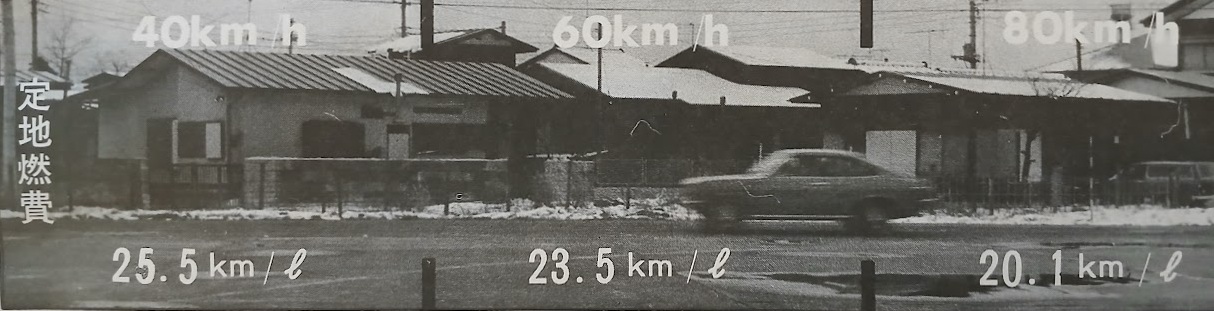
Sano: In terms of steady-state fuel economy, for the Coupe GL, the results were 25.5km/l at 40km/h, 23.5km/l at 60km/h, 20.1km/l at 80km/h, and 15.2km/l at 100km/h. The catalog fuel economy is listed as 22.5km/l, so our result of 23.5km/l actually exceeds the published value. This was with three people and test equipment on board.
The model operating fuel efficiency was 14.2km/l when driving in a simulated 40km/h speed zone, with an average speed of 21.0km/h, which is almost 56% of the value at 40km/h when driving at a steady speed. In a simulated 60km/h speed zone, the result was 11.8km/l with an average speed of 24.5km/h, which is roughly 50% of the value in steady-speed driving.
Magazine: How does this compare to the previous Sunny?
Oguchi: It’s difficult to compare the fuel economy, since we did not take measurements on the earlier model. But I would say that a constant-speed fuel economy of 23.5km/l at 60km/h is quite good, considering the weight of the test load. In longer-distance running using only rough measurements, we also recorded approximately 14.0km/l in actual driving.
Magazine: It’s been common knowledge for some time that the Sunny has very good fuel economy. Now, let’s move on to the data on braking and control operating force measured by the Ship Research Institute.
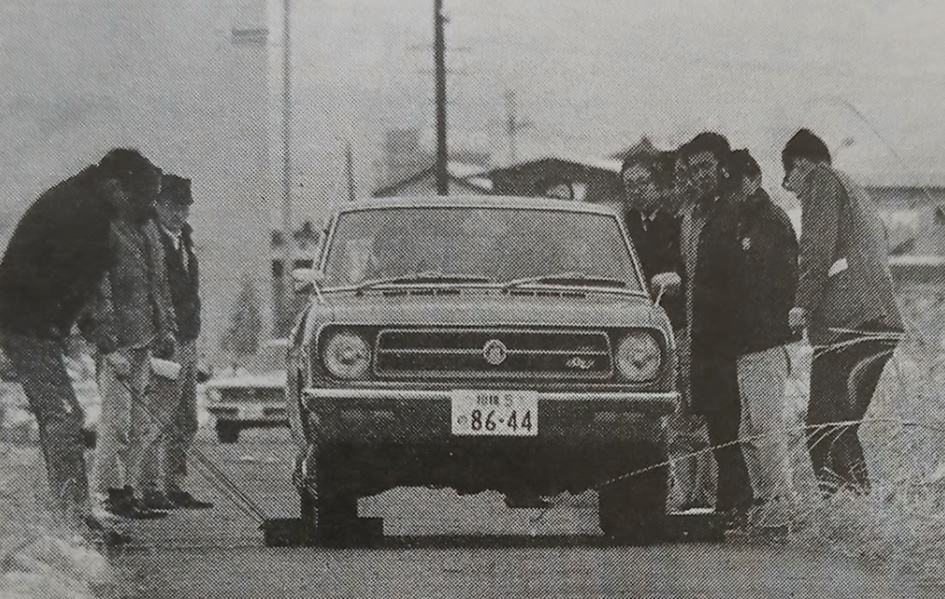
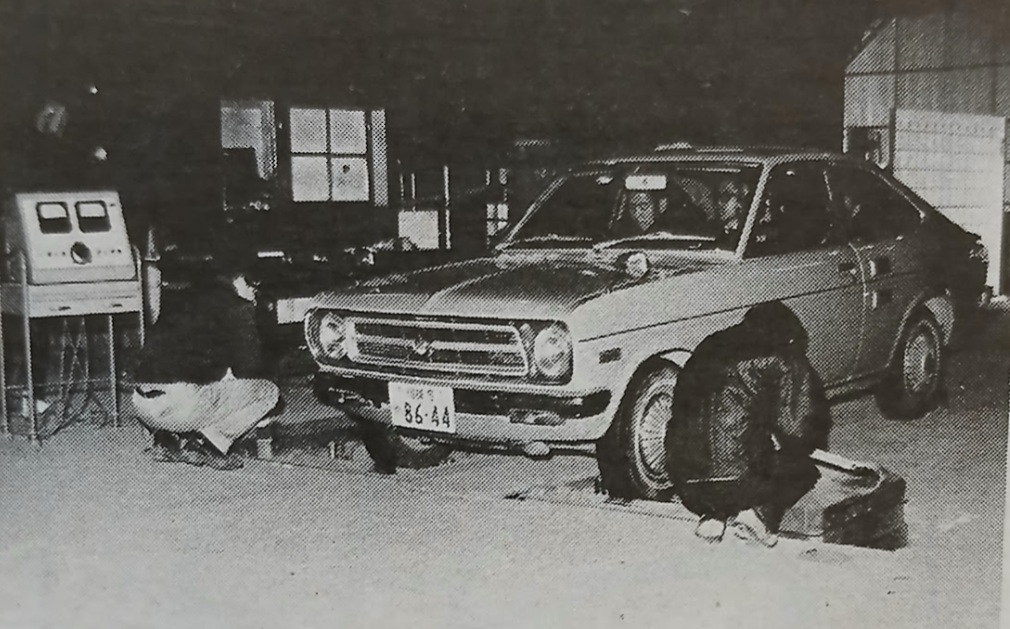
Ishikawa: The measured weights were 178kg at the front left, 204kg at the front right, 175kg at the rear left, and 160kg at the rear right. What stands out is that the weight at the right front wheel is 25kg heavier than the left front wheel. The front-to-rear weight distribution is 53:47 with one person on board. With two people on board, the weight distribution is almost unchanged.
Regarding wheel alignment, with one person on board, there is slightly large toe-in and a medium amount of camber. The rear also has a slight reverse camber, resulting in almost zero side slip.
The brakes are discs in front and leading-trailing drums in the rear, typical of this class of car. I should mention that the car we measured was the GL Coupe; the sedan was not tested. For a disc system, the brakes are fairly effective, with a pedal effort of 23kg for 0.6g deceleration. The left-to-right balance of the brakes is also very good. The front-to-rear brake force distribution is roughly 7:3.
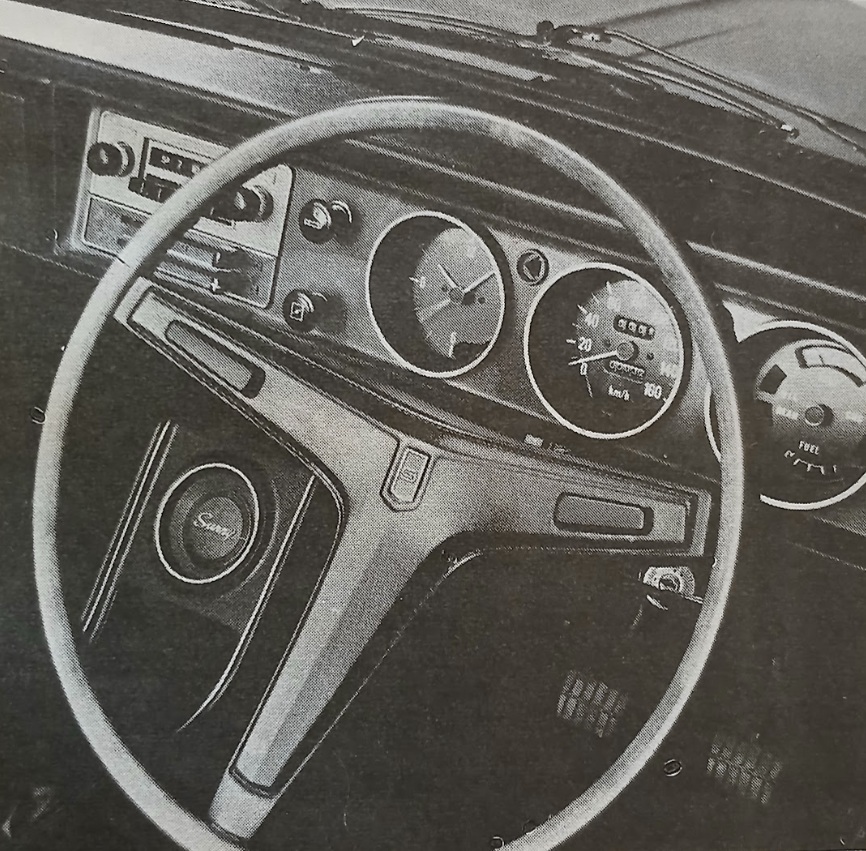
In terms of control efforts, the gear lever is a floor-mounted 4-speed change, and is extremely light in operation–almost too light–at about 2kg. Actually, the figures are 3kg going into reverse, and 1kg otherwise. The accelerator pedal effort is 1.5kg when maintaining a steady 50km/h, and 2kg when accelerating hard, which are also quite low values. The window cranks, doors, and other controls also generally require around 2kg, making everything extremely light to operate.
Magazine: We’ve heard that the various controls, including the brakes, are very light. What were your impressions, Mr. Okazaki?
Okazaki: I got the same impression as what was just described. The steering is also very light. I personally liked the steering feel of the previous Sunny, but perhaps because this model aims at a wider demographic, the sharpness is somewhat diminished. Still, the response is good enough to satisfy even young people, and I think that generally speaking, it still retains enough elements to be described as a sporty car.
Oguchi: I thought that the car’s performance is appropriate for the GL name. There’s no imbalance–such as, for example, a very light clutch paired with a heavy brake pedal. It’s a car that makes it easy to simply get in and drive immediately, with a well-rounded, easy-to-use feel. That impression extends to the coupe as well.
Hirao: Over-lightness can be a concern, but I thought the throttle pedal effort was just right.
Slightly Strong Understeer
Magazine: Professor Hirata is not here today as he is on a tour of his laboratory’s facilities, so Professor Yamamoto will be providing us with the data on visual field measurements, while also commenting on the general characteristics of the cars.
Yamamoto: For the Coupe GL, from the driver’s perspective, the distance to the windshield is 52cm with the seat in the center of its sliding range, which is a relatively good value compared to other cars in this class. In the event of a collision, it is better for this distance to be as far as possible, but if it is too far, the field of view will be poor. When comparing the visible range through the windshield with other cars, I would say it is among the better examples.
The wipers’ cleared range is also relatively good. Executive Director Takahashi mentioned earlier that they paid particular attention to visibility, and while the car still has triangular vent windows, the pillars have been made very thin. Without the triangular windows, the figures would probably improve by two or three percent.
Magazine: Thank you. In the coupe, the rear window area is quite large, but with large expanses of glass, the image often becomes distorted and makes visibility quite difficult, even though there is no problem with the field of view itself.
Yamamoto: Yes, it worsens because the angle of the glass is so horizontal.
Higuchi: I noticed this as well, although the amount of distortion was not excessive.
Magazine: Next, the Saito lab will present the data on maneuverability and stability.
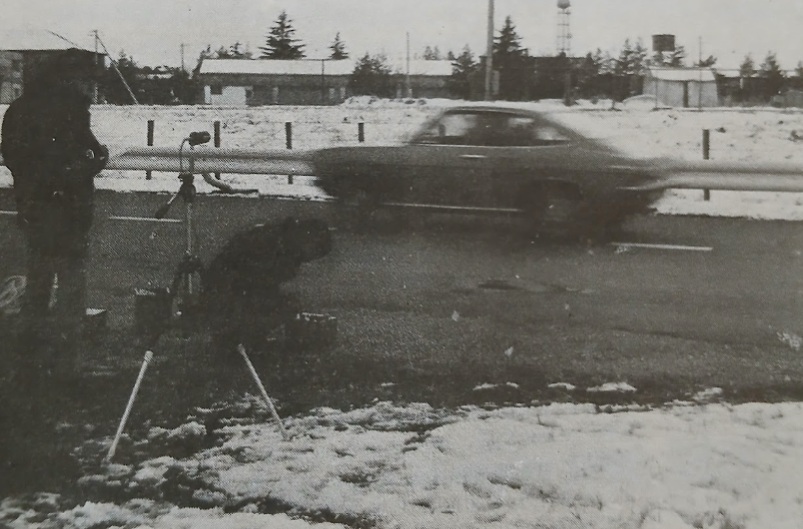
Doi: The test vehicle was the Coupe GL. There was still some snow left on parts of the test course, which was a concern, but the skid pad was completely dry. First, the minimum practical turning radius was 4.55m on the outside and 2.09m on the inside. This is noticeably smaller than other cars in the class.
Regarding the understeer and oversteer characteristics, at V²=100 the R/Ro ratio was 1.54, which indicates somewhat strong understeer. We accelerated up to 40km/h, but were unable to find a point where it reversed into oversteer. The steering effort in this test was 3.1kg to hold 0.5g, which seems to be a roughly average level of steering force. The roll rate was 4.5°, which is on the firm side for a sedan, but can be considered standard for a sporty type.
When the car is stationary, the steering force to turn the wheel to the left was 8.5kg at 90°, 12.0kg at 180°, 13.8kg at 270°, and 14.0kg at 360°, with a maximum of 14kg. Turning to the right, the steering force was 6.5kg at 90°, 12.0kg at 180°, 15.0kg at 270°, and 14.0kg at 360°, with a maximum of 15kg. This is slightly heavier than comparable cars in the class.
To measure steering force at higher speeds, we performed a slalom test with the cones spaced 70m apart, and at 0.25g lateral acceleration, steering effort was 2.6kg when turning right and 2.3kg when turning left. Compared with other cars in the class, these figures are about average.
In the free-release directional stability test at 100km/h, the damping ratio, our standard comparative measure, was about 0.2. The frequency was 0.8Hz, corresponding to a period of about 1.25 seconds, and the waveform shows very good damping and excellent stability.
A Delightful Manual
Okazaki: I personally didn’t feel that there was such pronounced understeer. I thought it was very nimble and easy to drive. The only thing that concerned me a little was that the so-called bouncing motion of the body seemed a little on the large side.
Takahashi: I would question whether it should be described as strongly understeering.
Doi: Compared with most of the cars we test, it did not feel especially strong. However, compared with the earlier Sunny, the R value has increased slightly to 1.57.
Hirao: I think I understand why numerically, the understeer figure is quite strong in terms of numbers, but doesn’t feel that way to the driver. I think it’s because the steering is light. It’s especially light at high speeds. As a result, one tends to apply more steering input than expected. In terms of feel, that works to offset the understeer. You don’t think you’re turning it that much, but you’re actually correcting the car’s line without realizing that it’s washing out. And by the time you realize it, you’ve already compensated for it properly. I suspect that may be what is happening.
Otani: Cars with extremely strong understeer like in the old days are no longer viable.
Magazine: Now we’d like to ask for the data on dimensions and safety from the Higuchi laboratory.
Onda: Measurements were taken on both the GL Coupe and the GL four-door sedan, but I will mainly focus on the GL Coupe. As mentioned, the most significant change is the increased width of the body. Accordingly, the front and rear treads have also become slightly wider. The overall length has not increased as much as the width.
As for the interior, the basic layout remains the same as the previous coupe, and the folding rear seats and the integrated trunk space have been retained. In terms of dimensions, the interior is about 50mm wider than the previous model. Another difference is that the handbrake is now a floor lever type instead of the umbrella-handle type of the previous model.
Higuchi: I’ll continue with safety and maintenance. To give you the conclusion first, the safety rating was 83 out of 100. Up until now, it’s been normal for a car to score below 80, so in that sense, this car’s safety equipment is very good. Keep in mind, this is just a visual assessment of safety features.
Next, regarding maintenance, when I read the manual, I found many things that were very encouraging. For example, it clearly states that even if the rubber hoses for the brake and fuel systems look safe to the naked eye, they should still be replaced at certain intervals. This has long been a common practice for airplanes and trains, but this was the first time I’d seen such guidance printed in an owner’s manual for a car. It states plainly in bold type that “When the tire tread begins to fade, replace the tires” and “Use regular fuel.” This was the first time I’ve come across such a helpful manual.
Hirao: The gas station guys may not be pleased. (Laughs)
Higuchi: I want to thank them for providing an owner’s manual that includes so much useful information for the owner. In terms of the maintenance itself, it specifies that you should change the engine oil every 5,000km, and lubricate various parts every 10,000km. It also says that you should have a minor tune-up about every 20,000km, and a major tune-up every 40,000km. So, I think the average user won’t need to do much before the first vehicle inspection.
Magazine: Now that we’ve covered most of the topics, We understand that the previous model will continue in production alongside this one. Could you explain the production targets, including the ratio between the coupe and sedan?
Takahashi: In February, production of the 1200 was 13,000 units, and the 1000 was 3,300 units, for a combined total of 16,000. This is a personal opinion, but I was wondering if, at 13,000 units, we might have planned too few. I had expected the ratio of GL four-doors and coupes to be roughly equal, but in fact demand for the GL four-door is higher. There has also been particularly strong demand for the Sunflower Gold color, and at times we have been unable to fill all the orders.
Magazine: We’ve heard that the sales ratio of coupes to sedans is 4:6.
Takahashi: I think coupe production is still lacking a bit. Looking ahead somewhat, we’re aiming for domestic series production of approximately 28,000 units, and around 35,000 units including exports.
Magazine: Thank you all very much.
Postscript: Story Photos