Nissan Sunny Coupe 1200GL (1970)
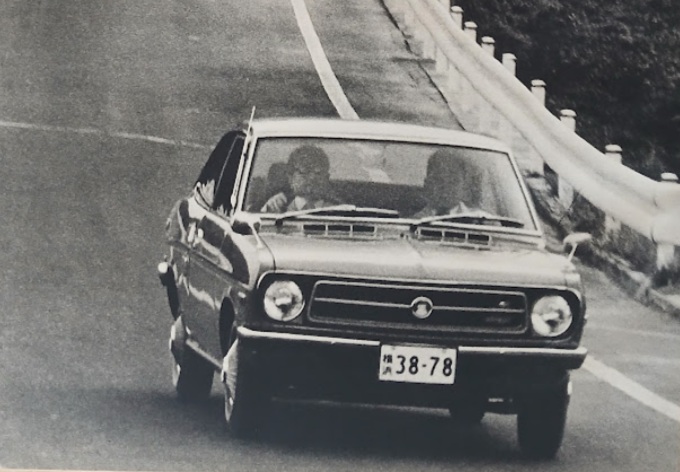
Publication: Motor Fan
Format: “Bubble Index” Road Test
Date: March 1970
Author: Atsuro Sasaki, Kazuhiko Sanbon, Yasuhei Oguchi, Masahide Sano, Atsuhiko Okubo
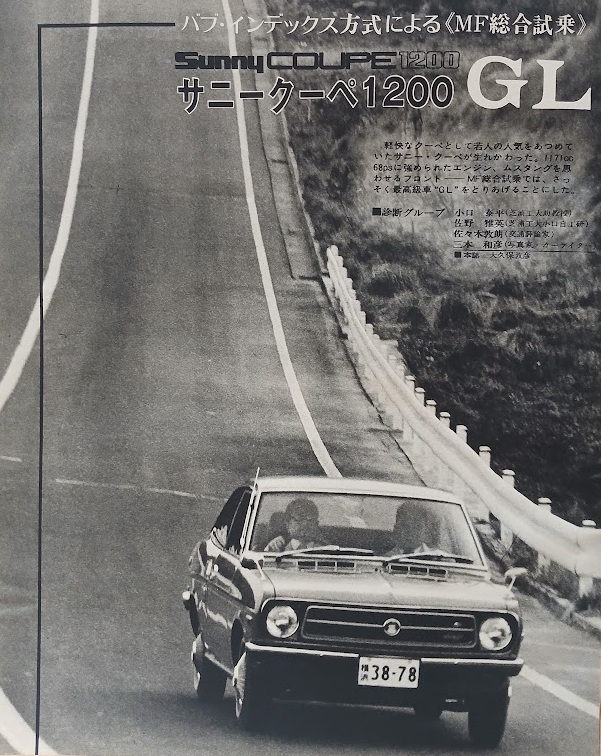
The Sunny Coupe–long popular among younger drivers as a light, lively coupe–has now been reborn. Its 1171cc engine has been strengthened to produce 68ps, and the front styling carries a hint of Mustang influence. For the MF Comprehensive Road Test, we have chosen to examine the top-of-the-line model, the “GL…”
The date was January 6. Appearing at the very beginning of the New Year–when the traditional pine decorations had just scarcely been taken down–the Sunny 1200 made its debut with timing best described as “unorthodox.”
Rumors had been circulating since the previous spring: would this be a full model change, or merely a power increase? In the end, the matter was provisionally settled with the announcement that a 1200 series would be added to the Sunny line.
Yet this may be only the opening move. If the Sunny has fired the first shot, its rival Toyota will surely have something in store for the Corolla. Depending on how that response shapes up, further developments may well follow. Already, it seems, this year’s “SC battle” has begun in earnest.
It was exactly four years ago, in January, that the Sunny first appeared amid great fanfare. At the time, it seemed as though Nissan Motor might lead the coming age of the 1000cc family car, and the launch began with remarkable momentum. Yet some six months later, in the autumn, its rival–the Corolla–entered the fray with an 1100cc engine and seized the upper hand.
The Sunny itself has always possessed a unique character and style, making it a distinctive presence on the market. Nevertheless, it continually found itself facing a competitor that emphasized its extra 100cc in advertising, offered products keenly attuned to user tastes, and backed them with formidable sales power. As a result, the Sunny remained in the position of having to relinquish first place. And that situation proved both deep-rooted and long-lasting.
For that reason, the Sunny 1200 may be said to have been designed with its rival Corolla directly in its sights—calculated and engineered from every angle with that competitor in mind. From the moment we first saw it at the new-model announcement, that sense was unmistakable.
This intention is easily read from the principal points Nissan itself emphasized:
- a spacious, dynamic style expressing a sense of richness;
- the widest and most luxurious interior in this class;
- a top speed of 150km/h and a 0–400m acceleration time of 18.6 seconds;
- comfortable ride and high-speed stability achieved through a distinctive suspension system.
Overtake–overtake–and press even beyond the boundaries of this class… otherwise, “you’ll be overtaken again.”
The engine tells the same story. Where the previous 1000cc model produced 56ps at 6000rpm (60ps in the coupe version), the new 1200 raises the output of both versions to 68ps at 6000rpm.
Some Reservations About the Styling
The Bubble Index comprehensive road test group turned its attention to the new Sunny 1200 without delay. For the test car, we chose the 1200 Coupe–the version expected to attract the most interest in this class. To provide a point of comparison, we chose a 1200 four-door with full automatic transmission to serve as the accompanying car. An automatic in the 1200 class, and a three-speed at that–this naturally stirred our curiosity. Both cars were in the top-grade GL specification.
As usual, Sanbon took the wheel of the coupe, with Oguchi and Sano manning the test instruments. In the accompanying full-automatic sedan were Sasaki (your author) and Okubo. We set off from the Tomei Expressway at Seta. Since the new model had only just been officially announced, the two machines–both painted a shade of golden-brown–attracted considerable attention even before we reached the tollgate. (This color is likely to become a trend; in Europe it is already fashionable as a sporty hue, and at last autumn’s Tokyo Motor Show several manufacturers displayed cars in similar tones.) In the Sunny 1200 lineup, this color is called Sunflower Gold. Its hue leans slightly more reddish than the similar shade used on the Bluebird, which is called Safari Brown. The distinction is presumably a marketing tactic, but a rather confusing one.
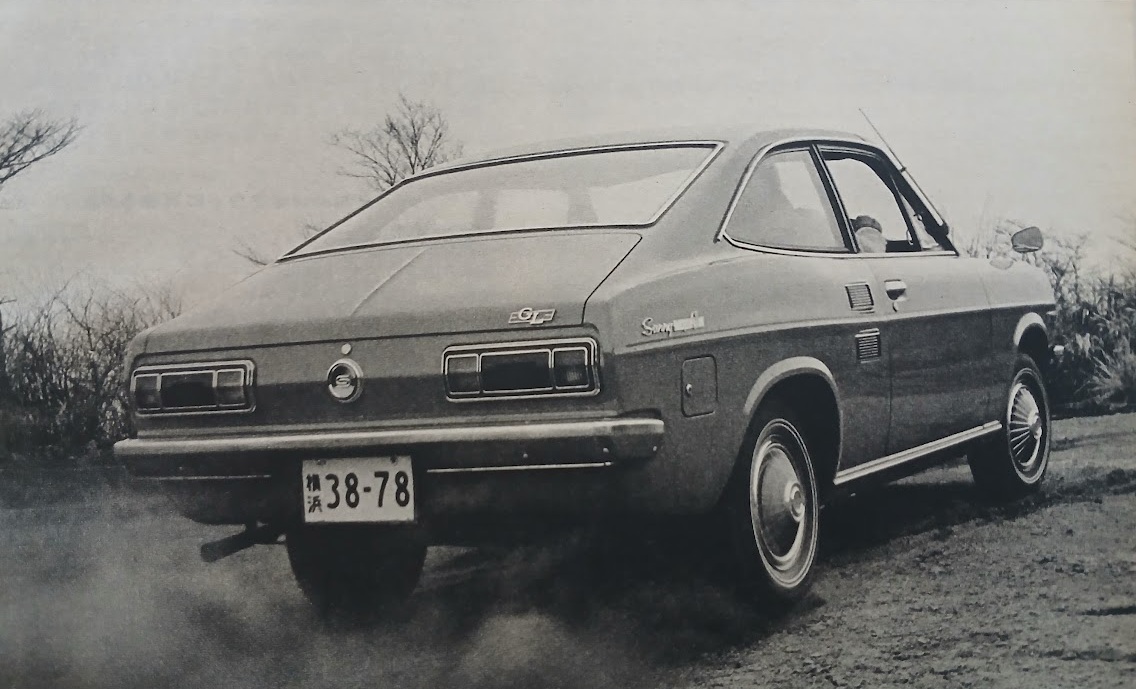
Viewed running on the main lane of the Tomei Expressway, the Sunny certainly appears to have grown larger. Not only the coupe, but the entire 1200 series shows that, where the Sunny 1000’s design relied heavily on straight lines, the new model’s body is clearly treated with softer curves. When our accompanying car pulls out to pass and we glimpse its front from the coupe’s rear window, the impression of size is unmistakable.
“You can clearly see that the width has increased, and it does seem bigger overall. But the treatment of the radiator grille is a bit overdone–that’s a mistake. It’s molded in plastic as a single unit, but was that central section really necessary? It comes across as a fussy bit of decoration,” one of the group commented.
We stopped at the Ebina Service Area, gathering around the cars for a closer look. Opinions varied considerably, making a consensus difficult.
“Personally, I preferred the straighter lines of the 1000. By adding curves and borrowing cues from the Corolla and Subaru, it seems to have lost some of its individual character.”
“No, at least with the coupe, the Sunny 1000 was almost aggressively sporty. It seemed to be aimed at young drivers–or perhaps even children. This new model has a more substantial, larger-car atmosphere. Judging from how it feels to drive at speed, you can trust it on the highway, and the usable interior space is not just a marketing claim,” another voice observed.
Yet other complaints were heard as well—
“Why is it that Japanese cars lack the boldness to commit to a design? Shape it decisively–cut the form cleanly, then bring it together as a whole. That kind of clarity is missing. Instead, it feels as though bits of clay have been added little by little and then shaved down with a spatula, the shape emerging piece by piece. It’s all too fussy,” remarked Oguchi and Sasaki.
“And then there’s the tailgate. If they were going to do it at all, why not make it a swing-up type like the Fairlady’s? It would have given the car an entirely fresh image. In the coupe the rear seatback folds down, creating a flat load surface. If the tailgate opened fully, a stylish shopkeeper might buy one just to recruit employees,” Sanbon added with a laugh.
Indeed, among European cars in this class, designs with a large upward-opening tailgate have been appearing more frequently. The suggestion met with approval from the entire group.
When it came to the exterior, every member of the staff had his own opinions, and the discussion showed no sign of ending. Meanwhile, at the Ebina Service Area a small crowd had gathered around the cars. Even the restaurant staff came outside to take a look. We had not come to stage a new-model exhibition… Barely finishing our coffee, we set off again.
For this round of testing we made a slight change to our usual route. Continuing straight along the Tomei Expressway, we headed for Gotemba. From there the course would take us along the Otome Road to Sengokuhara and Moto-Hakone, then on from Taikanzan to the Hakone Turnpike, before retracing the same route back.
The revised course offered a longer measured section, and with greater distance it becomes possible to repeat measurements and improve their accuracy. The same applies to fuel-consumption testing: the longer the distance, the closer the results come to real-world driving conditions.
Strikingly Powerful Performance
When it came to running performance, the main focus of interest during the Sunny 1200 test drive was its lively 68ps output. The Sunny 1000 had also been regarded as a car that “ran well”–a nimble, responsive machine, if not a powerful one. The 1000cc Coupe GL weighed 675kg, but the 1200 Coupe GL adds only 25kg, bringing the total to exactly 700kg. The question, then, was what kind of performance its 68ps and 700kg would deliver.
At 100km/h on the main expressway lane, the car ran with remarkable ease–so much so that the engine’s smoothness could almost be described as silky.
“It feels quite powerful,” one member observed. “And yet it doesn’t feel as though it’s being limited by the gearing. Perhaps it would be going too far to say there’s lots of power in reserve, but its response certainly doesn’t give the impression of being thin or merely superficial.”
“No, it’s clearly the real thing,” another replied. “It isn’t just quick on its feet–it runs strongly and has real stamina. You could almost say it already feels like a more mature car than others in this class.”
“Running like this, even with three people aboard, even though it’s only a 1200–in this sense, it surpasses the old Bluebird 1200 (310 series), or even the 1300 (410 series). Not just in the way it runs, but in its overall character as well.”
There was, however, one point worth noting about the test car: the clutch seemed to have a slight delay in its return action. In effect, its feel has been made rather soft.
“Until now the Sunny’s clutch engagement has always felt quite sharp, hasn’t it? If you let it out too quickly the car would either hop forward like a startled rabbit or stall altogether. Now it engages more softly, which makes it better suited to beginners. Even someone with little experience can get in and drive it without anxiety. But that also means the old fun of keeping its youthful, mischievous nature in check has disappeared,” remarked Sanbon.
“There may be cost-reduction considerations involved,” added Oguchi, “but I’d like to see them spend a little more on the clutch. Increase the pressure on the plate, for example, or make the engagement more definite. Considering the amount of power available, the response off the line feels somewhat weak.”
Standing-start acceleration from 0-100km/h was measured at 16.2 seconds. For comparison, the accompanying full-automatic car required 27.4 seconds to reach 100km/h in “D.”
In the standing 0-400m–the so-called “zero-yon”–the coupe recorded 17.9 seconds with two passengers aboard, slightly better than the figure announced at the model’s debut (which had been measured with a full passenger load).
For brief moments both the coupe and the full-automatic car were able to push the speedometer needle past the limit without difficulty. Even at those speeds the acceleration felt entirely natural, and there was no sign of disturbance in the engine’s revving.
Next came acceleration onto the expressway from the entrance ramp. Starting at 40km/h and using full throttle in third gear, the Sunny accelerated to 100km/h in 13.9 seconds. The distance required was 270m–slightly longer than the length of the acceleration lane–but by about 220 meters it had already reached main-lane speed. In practical terms, there should be little cause for anxiety when merging.
Overtaking acceleration also proved quite respectable. Starting from 30m behind the accompanying car, with both cars holding a steady 60km/h, we downshifted into third and applied full throttle. From that point it took 7.2 seconds to complete the pass, gain a 30m lead, and return to the main lane. The distance required was 179m, and by the end of the run the speed had reached 92km/h.
Next, we repeated the test with a truck traveling at 80km/h. Starting from 60m behind, we again applied full throttle in third. It took 10.6 seconds and 353m of road to complete the pass, gain a 60m lead, and return to the main lane, with a final speed of 120km/h. During this run there was neither surging nor any sense of the torque falling away; the engine simply revved freely and easily. In that sense, the car gave an impression of underlying strength.
For comparison, readers may wish to refer to the figures recorded by the Skyline 2000GT in the same tests in last month’s issue. Under the same conditions, the latter car’s results were 6.8 seconds over 173m, and 10.3 seconds over 348m. The 2000GT, of course, is a 2000cc, 120ps “highway hero.” Yet the Sunny’s small engine produced figures approaching those of the far more powerful machine.
In our judgment, such abilities on the highway contribute directly to safety. There is no doubt that this performance influenced the uniformly high scores the Sunny received in the “running performance” category during the final evaluation.
As for hill-climbing ability, we carried out the test on the same section of the Hakone Turnpike as before: a demanding course consisting of a 550m 8% downhill followed by a 600m uphill stretch of 10% and 3% gradients. The route twists through sweeping curves of 200R, 3000R, and 700R, making it a fairly severe test.
The Sunny covered the section in 48.4 seconds, with an average speed of 85.5km/h. The overall impression was that it dispatched the climb with relative ease. On the day of the test, the conditions were less than ideal–a fairly strong westerly wind sent occasional flurries of light snow blowing across the road.
Concern About the Pedal Layout
Moving on to handling and stability, the 1200’s steering feels only slightly heavier than that of the 1000–“perhaps a little more weight has been added,” observed Sanbon, who has used a Sunny 1000 for quite some time. “It has that dry, positive steering feel that could almost be called a Nissan hallmark,” remarked Oguchi and Sanbon. “You turn it and it responds in exact proportion as the tires bite into the road. Very easy to use.”
The coupe’s steering wheel is molded from a light-brown synthetic resin in the same color as the instrument panel. The rim is modestly thick, and it features a T-shaped (three-spoke) design. A wood-rimmed wheel is available as an option, but the standard rim is also comfortable to hold. It did not feel slippery even when gripped with bare hands. One minor point, however, was that the molding on the underside of the spokes felt somewhat uneven, as though the finishing burrs had not been completely removed.
In terms of directional stability, the car settled quickly in the free-release test–about one oscillation at 60km/h and two cycles at 100km/h before returning to stability.
One further note: the speedometer in both test cars exhibited some error. Measurements were taken twice using a stopwatch and a tachymeter-equipped watch against the kilometer posts on the Tomei Expressway. A speedometer reading of 100km/h corresponded to a road speed of 88km/h in the coupe, and 91km/h in the four-door. Although this degree of error falls within allowable tolerances, users should keep it in mind when reading the indicated speed.
In terms of ride and comfort, the pedal layout presents a problem. There’s far too much space to the right of the accelerator, and conversely, no room beside the clutch. “You end up having to bring your left foot in under the pedal,” said Sano and Oguchi. In practical terms, there is hardly any need for space to rest one’s foot to the right of the accelerator. Perhaps it was arranged this way to allow for a more relaxed driving posture, but before long one begins to feel awkwardness in the position of their left foot.
Those who had been driving the full-automatic car tried it out: “Ah… I see.” Everyone agreed that this is something that should be corrected.
Pedal effort itself is average, and perfectly acceptable.
Both cars were GL models, so the raised sections on either side of the backrest were upholstered in vinyl leather, with the center portion finished in black nylon tricot. The material has a pleasant feel to the touch.
“Women would probably like this. I imagine it will be well received by women drivers.” “I don’t know… it feels a bit like sitting on women’s undergarments.” Laughter followed…
“Leaving the fabric aside, the raised sides of the seatback are rather high,” said Oguchi. “For someone like me, with a tall torso and a thicker build, it feels as though my shoulders are being pinched, and it’s hard to get comfortable.”
“I didn’t feel that way. Among Nissan cars, where the seatbacks tend to be low, I think it’s rather good. Perhaps the shoulders lift off them a bit while driving,” said Sanbon and Sasaki.
“The seat height isn’t bad, and there’s no undue pressure on the thighs, so you don’t feel fatigued easily,” offered Sano.
And what of the coupe’s rear seat, which sits 35mm higher than in the 1000? Even the tallest members of the group, Sanbon and Okubo, found that their heads did not touch the roof, and legroom was plentiful. It’s fair to say that this is a significant difference from the Sunny 1000.
The “auto ventilation” system has become a selling point. The heater fan blows warm air to the footwell, while opening the central vent on the driver’s side allows cool air to flow in. The vent is angled to direct air to the center of the front seats–and even the driver’s face. This is especially pleasant when driving on the expressway. With vent outlets at both ends of the instrument panel, drivers accustomed to having their right hand in the breeze find the direction of the airflow quite welcome.
We then entered the old Hakone road, a route with a much rougher surface. Voices noted, “Ah, this–no, this stretch sets up such a racket,” but then: “Compared with the old Sunny, it’s softer. The suspension is much better than the old one.” “Exactly, it wasn’t like this before.”
The road clearance is 170mm, about 1cm higher than before. That alone allows the car to handle the rough surface with ease.
The improvement in road holding and ride comfort is not due to the suspension alone. The tires have also been changed to a 6.00-12-4PR low-profile type. With this change, they are now roughly on par with those fitted to the Corolla, Subaru, and Familia. “Until now it was 5.50,” someone recalled. As with other Nissan models, these tires are also tubeless.
Interior noise became a point of discussion. In the coupe, the readings were 65 phons at 60km/h, 72 phons at 80km/h, and 73 phons at 100km/h, with the 80 and 100km/h figures being quite close together. In the full-automatic car, the readings were 68 phons at 60km/h, 69 phons at 80km/h, and 75 phons at 100km/h, with the 60 and 80km/h figures closest together. This left the group somewhat puzzled.
Readers should bear in mind that these were indicated speeds, so the speedometer error mentioned earlier applies here as well.
Aside from this, gear noise is fairly noticeable at low speeds, but during high-speed running in top gear it rarely becomes bothersome. A certain amount of muffled rattling could be heard from the interior trim. On rough roads, the cover over the coupe’s cargo area bounced up with a bang and a clatter, which startled us more than once. “I kept looking back to see what had happened.”
“And when the fuel in the tank gets low, you hear it sloshing around–splash, splash. That’s the sound that bothered me most.” “A fuel-shortage warning device?” Laughter again.
A Respectable Passing Mark For a Popular Car
Economy has always been one of the Sunny’s chief virtues, and it is something most Sunny owners take pride in. According to its catalog figures, the 1000 returned 23km/l. With the new 1200, the manufacturer has claimed that despite the increase in power, fuel consumption has not worsened. The question was how this would turn out in practice.
Fuel consumption measurements were carried out somewhat differently this time. Starting from the Tomei Expressway entrance at Seta in Tokyo, we drove straight through to Gotemba, where we made the first refueling stop. From Gotemba we circled through Hakone, conducting rough-road driving, hill-climbing measurements, and other tests before returning to Gotemba for a second refueling. In this way, fuel consumption was measured twice.
On the expressway section, we covered 88.8km and used 6.15 liters of fuel, for a fuel consumption figure of 14.4km/l. This corresponds to about 65% of the catalog value. Three people were aboard, and in addition to repeated performance measurements there were periods of low-speed running while checking instrument error. Had the car been driven continuously at highway speeds, the figure might well have been higher. This point was emphasized by Sanbon, a longtime Sunny 1000 user, and by Sasaki, known among us as an advocate of “economical driving.”
Compared with the coupe, the full-automatic car inevitably returned lower figures. On the Tokyo-Gotemba run it recorded 13.8km/l, and on the Gotemba test loop the result was 9.3km/l.
The engine durability index, as shown in the accompanying graph, was calculated at 7.11 × 10⁵. In terms of durability as well, it may be said that Nissan’s traditional reputation for robust engines has been carried forward.
Turning to safety, the GL model is equipped with disc brakes as standard. This drew unanimous praise.
“I think the braking feel matches the car’s high-speed performance quite well. At first the stopping distances may seem a little long, perhaps, but the brakes are doing their job properly. Compared with the previous Sunny, which used drum brakes, this is a considerable improvement. The pedal stroke and effort are both quite acceptable,” said Oguchi and Sanbon.
A single bead line has been added along the sides of the body. The manufacturer says that this emphasizes a sense of speed and stability when the car is viewed in profile. In fact, the pressing is drawn quite deeply, representing a clear difference from the Sunny 1000.
“In terms of rigidity, it has roughly the same effect as attaching an additional strip of steel plate across this section.”
Manufacturers who are aiming at exporting to the United States appear to be using American safety standards as one of their benchmarks. Nissan is no exception in this regard. The company states that the car has been brought “close to complete compliance,” and the GL model tested here was equipped as standard not only with the aforementioned disc brakes, but also with a collapsible steering column and dual-circuit headlamps. Other features now regarded as common-sense safety design are also present: a full crash pad across the instrument panel, recessed door handles, and a flexible rear-view mirror mount. Judged on a visual basis, the car’s safety provisions appear to be fairly satisfactory.
The Enjoyment of Mastering an Unpretentious Character
As for product appeal–we will let this subject stand as our conclusion.
The Sunny 1200 has consistently kept the Corolla 1200 as its target. In terms of product appeal, it represents a considerable leap forward compared with previous Sunnys. This applies not only to the Sunny Coupe, but also to the four-door and two-door sedans, which have improved in their own ways. If earlier Sunnys were sold largely on the pride that “form followed function,” then this new model may be seen as a candid acknowledgment of the limits of that approach, with Nissan now adopting a measure of Toyota’s well-known skill in merchandising.
All 4-speed floor-shift models are equipped with round gauges, set into a plastic panel with a crystalline metallic pattern. Of the three circular dials, the one on the left can be fitted either with a tachometer or a clock. On the GL model a console is also standard, and the clock is relocated there when a tachometer takes its place in the gauge cluster. This arrangement smoothly accommodates the wishes of buyers seeking a sportier atmosphere.
The automatic version likewise adopts a sporty T-bar-type gear selector, the first time such a device has been used by Nissan. Incidentally, the selector lever shifts with light effort, and at night the illumination is bright enough that the labels for its positions can be read at a glance.
Nor is the attention limited to the interior. The wheel covers are designed with a somewhat delicate sporting look. For female buyers seeking a luxurious atmosphere, the tricot seat upholstery is the same type used in the President. For those with an eye for accessories, the GL model also comes with a steering lock, and even the cigarette lighter is illuminated.
One senses Nissan’s determination: this is the comeback–let’s go out and sell in volume.
Fans of the Sunny 1000–who valued its straightforward character and the enjoyment of making the most of its modest virtues–may well find themselves exhaling sighs of resignation. Yet how many buyers in this segment do such purists really represent? It seems Nissan has at last come to understand that point. That, in the end, is our conclusion on this newly “grown” Sunny 1200.
Its performance is higher. It has clearly taken a step up in class. But what of the price? It may still be too early to render a final judgment.
Among our diagnostic group, the evaluations of its product appeal came out at 7.5, 7.0, 7.5, 8.0, and 6.5–an average of 7.3–revealing opinions that were at once rather radical and yet subtly varied.
Postscript: Story Photos