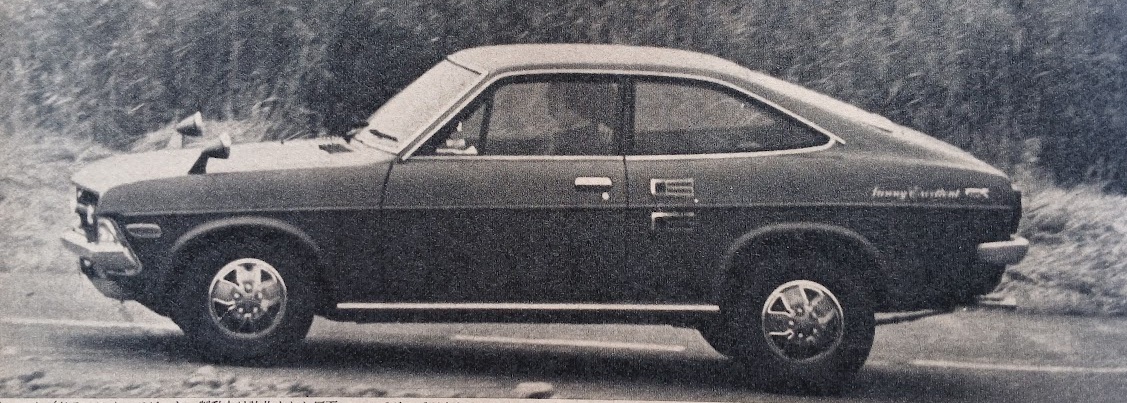
Nissan Sunny Excellent Coupe 1400GX (1971)
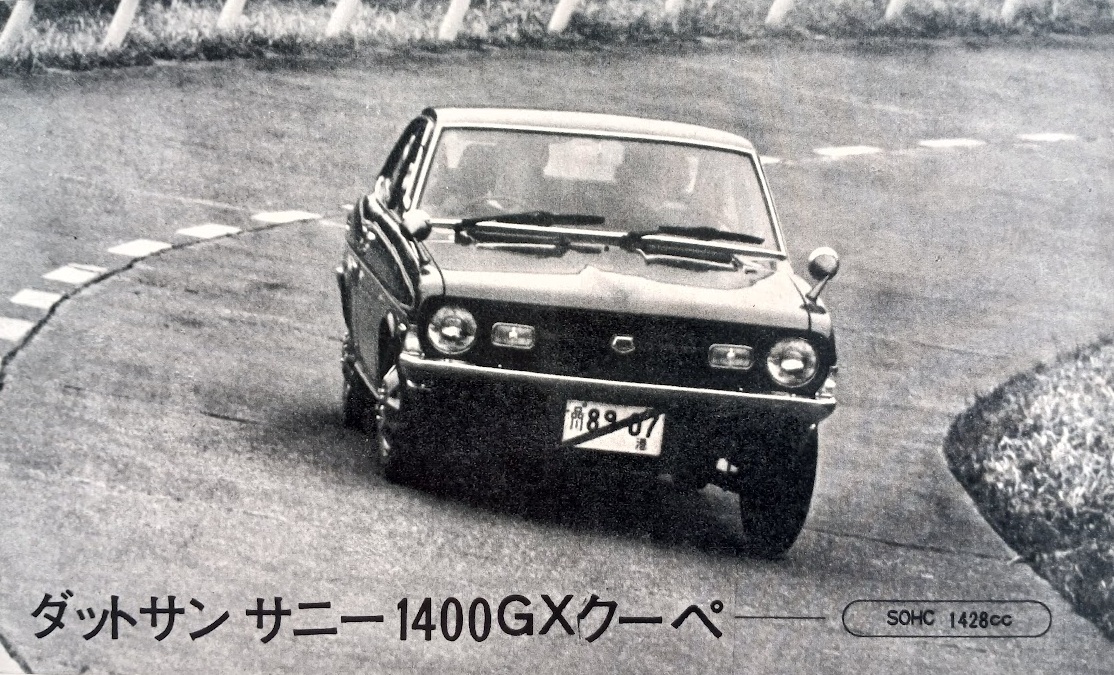
Publication: Car Graphic
Format: Road Impression
Date: July 1971
Author: Shotaro Kobayashi
Road testing the Nissan Sunny Excellent Coupe 1400GX
Our honest opinion, after testing the 1400GX, is that we find it hard to understand why the big, heavy engine from the Bluebird 1400 had to be installed in the Sunny. Certainly, straight-line performance has improved slightly, but it must also be said that the Sunny’s greatest virtues, its excellent handling and well-judged balance, have been considerably spoiled.
Let’s begin by comparing the specs of the two cars. The 1400GX’s engine is a SOHC 1428cc unit, compared to the 1200GX’s OHV 1171cc. Their respective outputs are 95ps/6400rpm and 83ps/6400rpm, with 12.2kgm/4000rpm and 10.0kgm/4400rpm of torque. Vehicle weight is 820kg for the 1400GX and 705kg for the 1200GX, giving them respective power-to-weight ratios of 8.63kg/ps and 8.49kg/ps.
The first thing that stands out is the 1400GX’s weight, which has increased by no less than 115kg. The second is that, despite the 12ps increase in output, its power-to-weight ratio is actually slightly worse.
The overall gear ratio is practically the same for both cars. Consequently, the road speed per 1000rpm in top gear is 26.4km/h for the 1200GX and 26.6km/h for the 1400GX. Along with the engine swap, the Bluebird’s 4-speed gearbox has also been retained (which results in a large floor hump and a cramped left footwell). When the engine is revved up to 6800rpm, where the redline begins, the maximum speeds in each gear are the same as the 1200GX: 49km/h in first, 82km/h in second, and 128km/h in third. However, the larger absolute torque does give the 1400GX a slight advantage in acceleration, with a 0-400m time of 17.4 seconds (compared to 17.8 seconds for the 1200GX, as recorded in C/G issue 112).
Regardless of the figures, it must be said that the overall engine performance of the 1200GX is far superior. Despite being an OHV, the 1200GX engine revs up to nearly 8000rpm with ease, whereas the SOHC 1400GX engine becomes noisy above 4000rpm, making the driver psychologically resistant to revving it over 5000rpm. The beginning of the redline at 6800rpm coincides with the onset of valve float, making it practically impossible to rev it any higher. As mentioned above, due to the identical overall gearing, the maximum speeds in each gear are the same; but in reality, one hesitates to push it past 5500rpm, mainly due to the noise and vibration, with the result that effective performance is no better than that of the 1200GX.
Another point became clear when measuring acceleration times: the rear axle would shake violently in reaction to the torque during sudden starts, making it extremely difficult to leave the line smoothly (this did not occur with the 1200GX). It seems likely that some countermeasure, such as adding a torque rod, would be necessary for the chassis to cope with the increased torque. What has improved with the 1400GX is low-speed flexibility. First gear is used almost exclusively for moving away from a stop, while second gear allows for smooth acceleration even from engine speeds below 1000rpm, barely a walking pace. However, the 1200GX is also adequate in this respect; in terms of the overall balance between engine and chassis, it is in fact fair to say that the 1400GX suffers from an excess of torque.
The impact of the 1400 engine conversion is more noticeable in handling than in power performance, and unfortunately, the effect is almost entirely negative. From the moment we pulled away and turned the first street corner, it was immediately apparent that the steering was much heavier than in the Sunny tested previously. This is partly due to the wider 6.15-13 tires (the test car was fitted with Toyo E31s), but the crucial factor is that the front wheel load has increased significantly as a result of the heavier engine (approximately +30kg). Regrettably, this has significantly spoiled the handling of the Sunny, in that the steering response has become markedly duller, and understeer has become unduly pronounced.
In the Sunny 1200GX, the car’s moderate understeer could be balanced by applying power to the rear wheels, allowing stable high-speed cornering in an attitude close to a four-wheel drift (even lifting the inside front wheel off the pavement at the limit). However, the 1400GX’s understeer is excessive from the outset, and adding power causes the inside rear wheel to lift, resulting in intermittent loss of grip and making it impossible to corner smoothly. The degree of understeer was evident when lifting off the throttle mid-corner, as the nose of the car would cut sharply inward, just like a front-wheel-drive car, causing an abrupt change in the car’s trajectory.
Rear-wheel grip on uneven surfaces was never a strong point in the 1200GX, but this tendency is even more pronounced in the 1400GX, with its reinforced and heavier rear axle (the differential carrier is borrowed from the Skyline), which hops around and makes it easy for the car to lose the driver’s chosen line. In addition, the 1400’s longer wheelbase (extended ahead of the windshield to accommodate the larger engine) and overall length increase its turning radius from 4.1m to 4.7m (5.1m curb-to-curb), and it must be said that the exceptional maneuverability of the Sunny 1200, particularly in tight spaces, has been largely sacrificed.
Fuel economy has also generally worsened. In suburban high-speed driving, including testing at the Murayama course, the recorded result was 8.47km/l, falling well short of the 1200GX’s figure of 9.94km/l under similar conditions. Regular fuel was used for the test, and there was no trace of knocking even when accelerating from low speeds, so there were no problems at all in this respect.
The ride feels much softer than the previous model. Small, continuous surface irregularities are absorbed well by the suspension, but it is weak over single bumps, resulting in violent up-and-down jolts, felt especially in the rear seats. On the rough-road test section at the Murayama Proving Grounds (a surface resembling a series of evenly spaced concrete bars about 7-8cm high), the vibrations were unbearable below 50km/h, but at around 70km/h, the car’s motions settled down and we were able to pass through the section without difficulty. The softer front suspension has also resulted in conspicuously more pronounced nose dive during braking. The disc/drum brakes are now equipped with a master back servo, so it can be said that braking power has at last caught up with the car’s speed.
Speaking frankly, these brakes constitute the only major improvement over the 1200GX. In all other respects, the 1400GX cannot be recommended.
Postscript: Story Photos