Nissan Skyline 2000GT-X Hardtop (1972)
Publication: Motor Fan
Format: Test Drive Report
Date: November 1972
Author: Hiroshi Okazaki
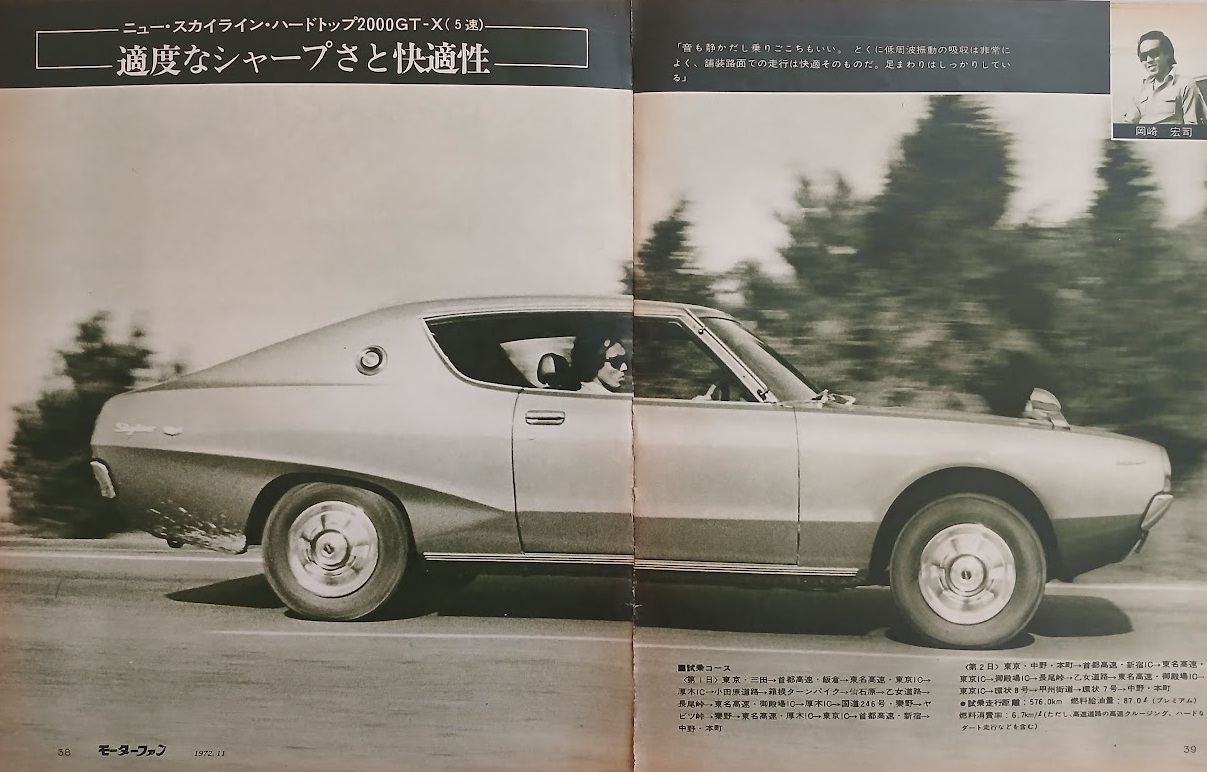
A Well-Judged Balance of Sharpness and Comfort
“The engine is quiet and the ride is excellent. In particular, low-frequency vibrations are absorbed remarkably well, making travel on paved roads exceptionally comfortable. The suspension feels thoroughly well sorted."
Improved Refinement and Reduced Noise
The Skyline GT’s selection as Car of the Year for 1970 was, as I recall, due above all to its achievement of what was described as “a harmonious relationship between man and machine.”
That was precisely what I hoped to find taken a step further in the new Skyline GT.
The model I drove was the Hardtop 2000GT-X, and I am pleased to report that it met expectations.
In both performance and feeling, it remains fundamentally close to the character of the previous “Ska-G.” Yet everything has been further refined, further developed, and brought into greater harmony with the driver.
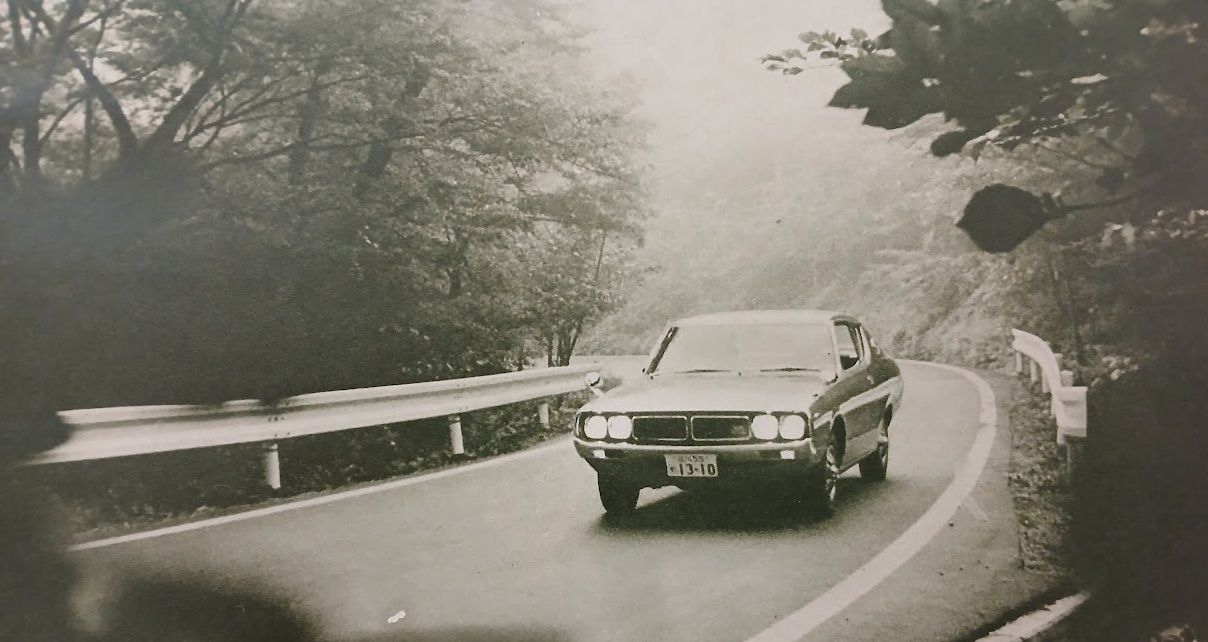
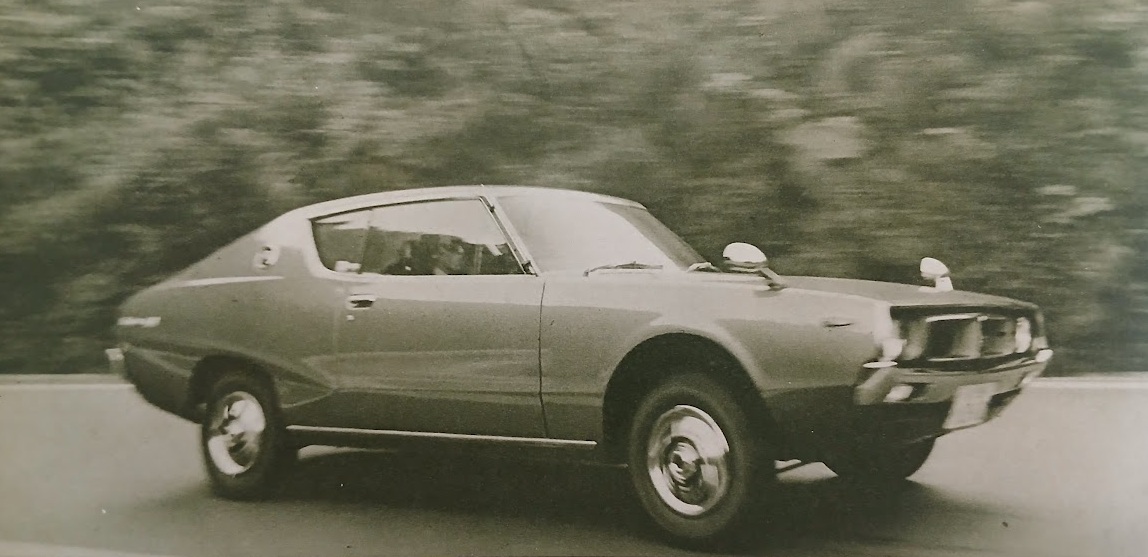
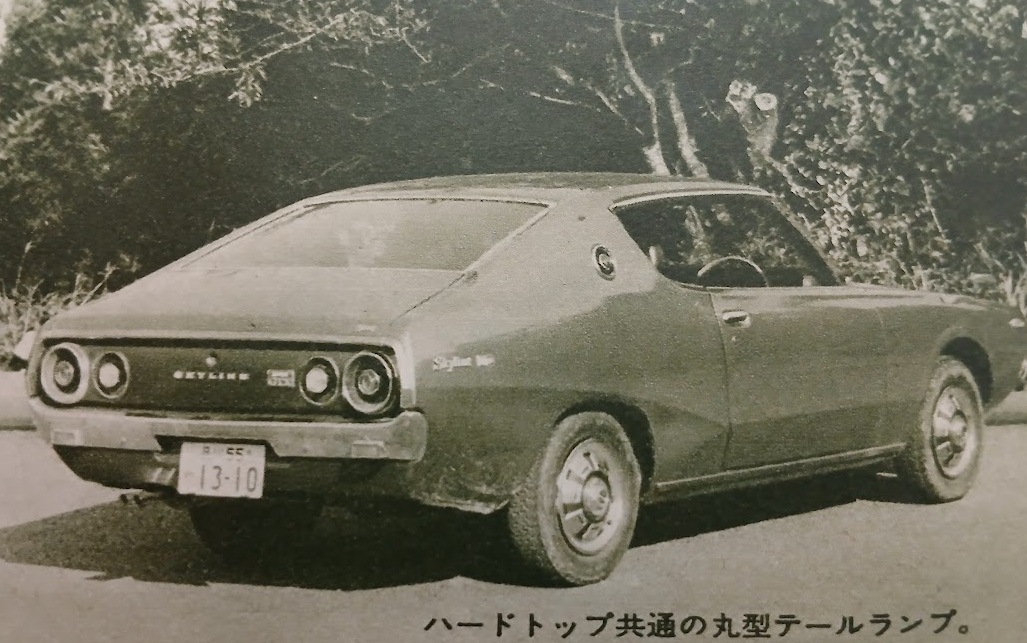
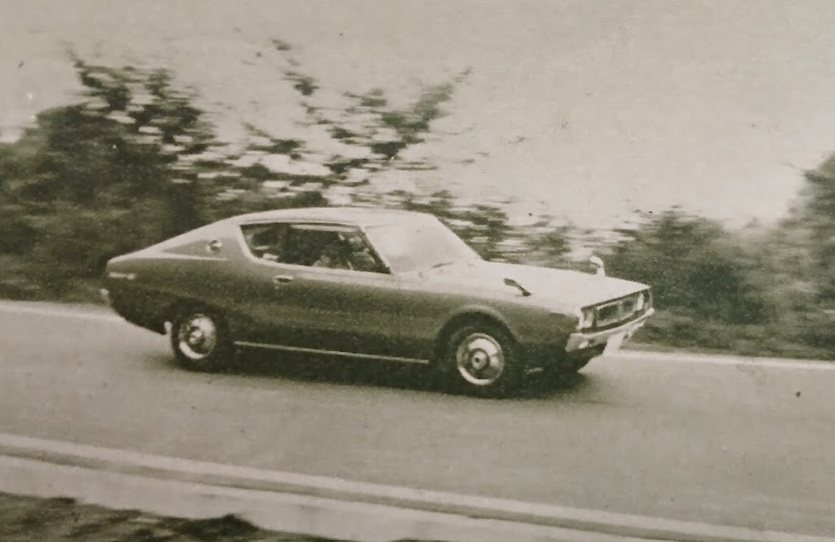
As for the styling, it has moved closer to what one might call “modern fashion.” The distinctive character of the previous model has largely disappeared, and the car’s appearance has taken on a softer, more rounded personality. As a result, those who favored the old Skyline’s individuality may find themselves growing even more attached to it. For the majority of buyers, however, the new model will almost certainly prove even more appealing.
I’ve already hinted at my conclusions, but let us turn to the details of the driving experience.
The first thing that became apparent after setting off was the car’s impressive quietness.
One immediately senses that considerable effort has been devoted to the suppression of vibration and noise.
Both vibration and noise from the powertrain are very well controlled, and equal attention has clearly been paid to noise reduction throughout the body structure.
Most impressive of all is the way high-frequency sounds–the sort that tend to irritate the human ear–have been almost completely eliminated.
Wind noise is also kept to a very low level. Up to about 130km/h, the car’s aerodynamic noise suppression can hardly be faulted.
Beyond that speed, however, the pillarless side windows begin to flutter slightly, and wind noise rises accordingly. A higher threshold would naturally be welcome, but from a practical standpoint, a 30km/h margin can hardly be considered inadequate.
Ride quality is equally impressive. In particular, the suspension does an excellent job of absorbing low-frequency vibrations, making travel on paved roads exceptionally comfortable.
Overall, the ride has moved in a softer direction compared with the previous model. Yet it is not soft in the unpleasant sense of feeling loose or underdamped. Much of this comfort must also be credited to the seats themselves. Upholstered in tricot cloth, they are excellent in shape, size, shock absorption, and tactile quality.
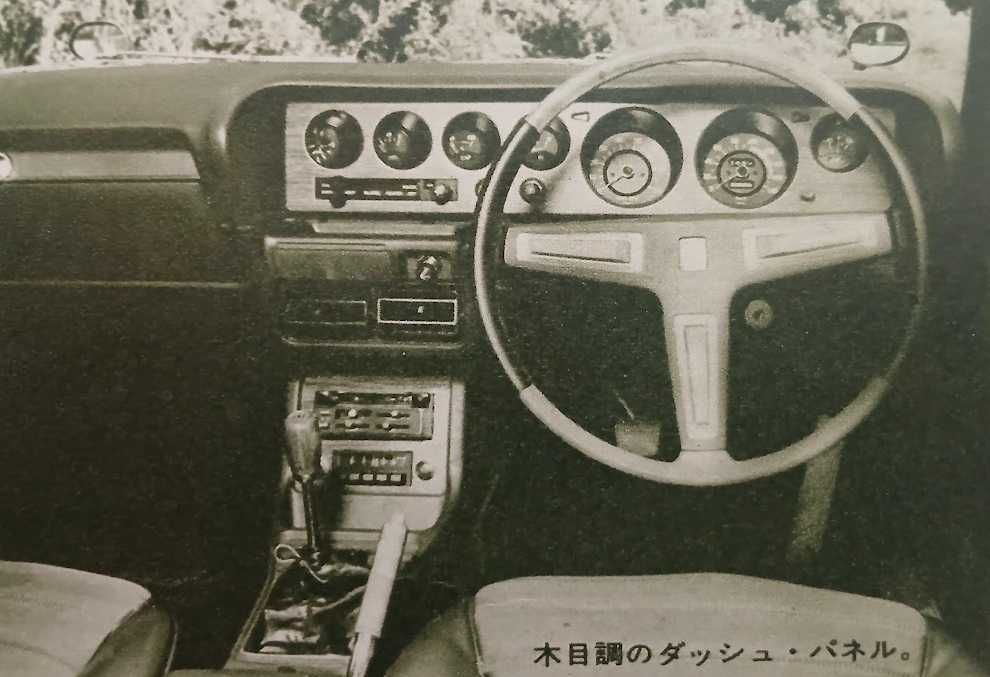
The driving position presents no significant complaints either.
For a car of this type, the combination of a relatively low seating position and excellent forward visibility deserves particular praise. Many recent cars place the upper edge of the instrument panel unnecessarily high, seriously compromising the driver’s view ahead. The designers of the new Skyline have chosen practical safety over the illusion of luxury, and this is commendable.
There is, however, one disappointment.
The adoption of fastback styling has come at the expense of rear three-quarter visibility, which has been significantly reduced. The previous Skyline GT was one of the few coupes to offer genuinely good rearward visibility, and it is regrettable to see such a virtue sacrificed–even if one understands that styling has become one of the car’s strongest selling points (perhaps the strongest…).
A More “Rounded” Character in Handling
The GT-X’s engine is fundamentally unchanged from that of the previous GT-X. Peak output and torque figures remain exactly the same.
The test car, however, was equipped with the 5-speed gearbox, and this transmission is an entirely new design.
The ratios are 3.321, 2.077, 1.308, 1.000, and 0.864, with a 4.111 final drive. These figures closely follow the gearing philosophy of the previous GT-X.
The new GT-X’s transmission strikes a good compromise between practicality and sporting character.
It is well-suited to spirited driving–although, in terms of pure enjoyment, I would still give the edge to the old GT-R’s gearing. For everyday touring, however, the new setup is considerably easier to use and ultimately allows the car to cover ground more quickly.
The synchronizers for first through fourth gears are of the Warner type, while fifth gear alone uses a Porsche-type synchronizer.
Porsche-type synchronizers often suffer from vague engagement feel and relatively heavy operating effort, characteristics that can easily disrupt the driver’s rhythm. This new gearbox avoids such shortcomings by employing Warner-type synchronizers for the lower four gears.
Certainly, I would say the shift quality is superior to that of the previous GT-X’s 5-speed.
One weakness remains: shifts between second and third gear feel somewhat awkward, hindering truly smooth up- and downshifting.
Clutch effort also appears to have been reduced considerably.
It is now light enough that many women drivers should have no difficulty operating it.
The accelerator and brake pedals likewise present no problems.
Whether one chooses to describe it as pedal feel or pedal effort, the calibration has been handled with considerable skill.
The controls are not merely light. The efforts required by each pedal are well-balanced, and the resistance they provide inspires confidence.
The handling itself has not changed dramatically, aside from taking on a somewhat more “rounded” character… if that is the word for it.
Steering response strikes a reasonable balance, offering an appropriate degree of sharpness. At this level, whether the driver prefers quicker steering or slower steering, they are unlikely to find much to criticize.
That said, when directional changes become especially rapid, there is a slight delay in the car’s response.
The test car was fitted with the optional 165SR-14 Dunlop SP3 tires, inflated to 1.8kg/cm² front and rear.
Drivers seeking a “dry” handling character with crisper, quicker response should find that, for normal road use, the desired result can be achieved simply through attention to the tires and wheels.
One detail does deserve criticism, however. The full wheel covers appear to provide insufficient clearance for the balance weights attached to the wheels. As a result, the covers protrude wherever a weight has been fitted.
This is unquestionably an area that should be reconsidered.
The steering characteristics remain mildly understeering, as one would expect, but the tendency feels less pronounced than in the previous model.
The new “Ska G”–putting aside one’s personal preferences, it surpasses its predecessor in many respects. Above all, in the pursuit of “harmony between man and machine…”
Postscript: Story Photos