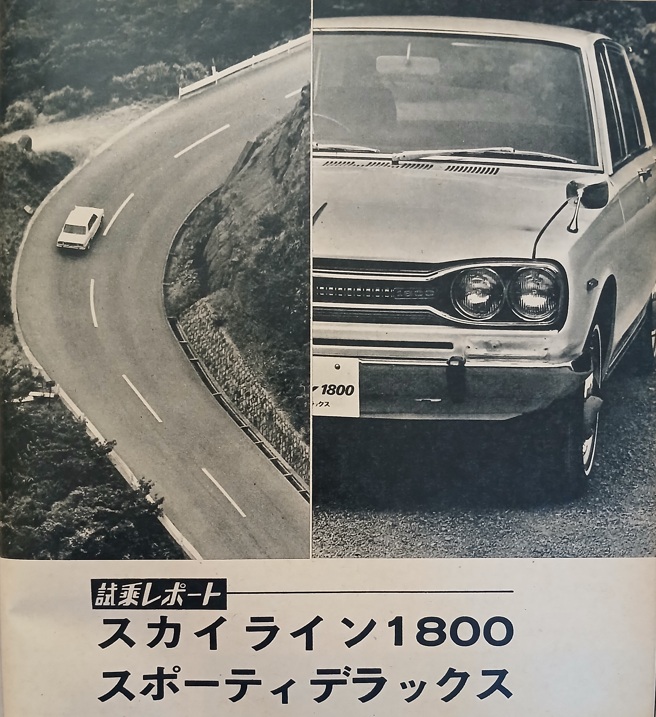
Nissan Skyline 1800 Sporty Deluxe (1970)
Publication: Motor Fan
Format: Test Drive Report
Date: October 1969
Author: Hiroshi Okazaki
Equipped with the Laurel Engine
It could be said that the Skyline 1800 is a car that was bound to appear sooner or later. Its engine is the same unit used in the Laurel, but the Laurel engine itself was originally based on that of the Skyline 1500. At the planning stage, therefore, Nissan must naturally have anticipated market trends and foreseen eventually scaling it up to 1800cc for installation in the Skyline.
In that sense, one might even say that this 1.8-liter four-cylinder OHC engine belongs more naturally in the Skyline than in the Laurel.
There is consequently no problem at all with the balance between engine and chassis; indeed, it almost seems as though the car had been designed from the outset to achieve its best balance with the 1.8-liter engine installed.
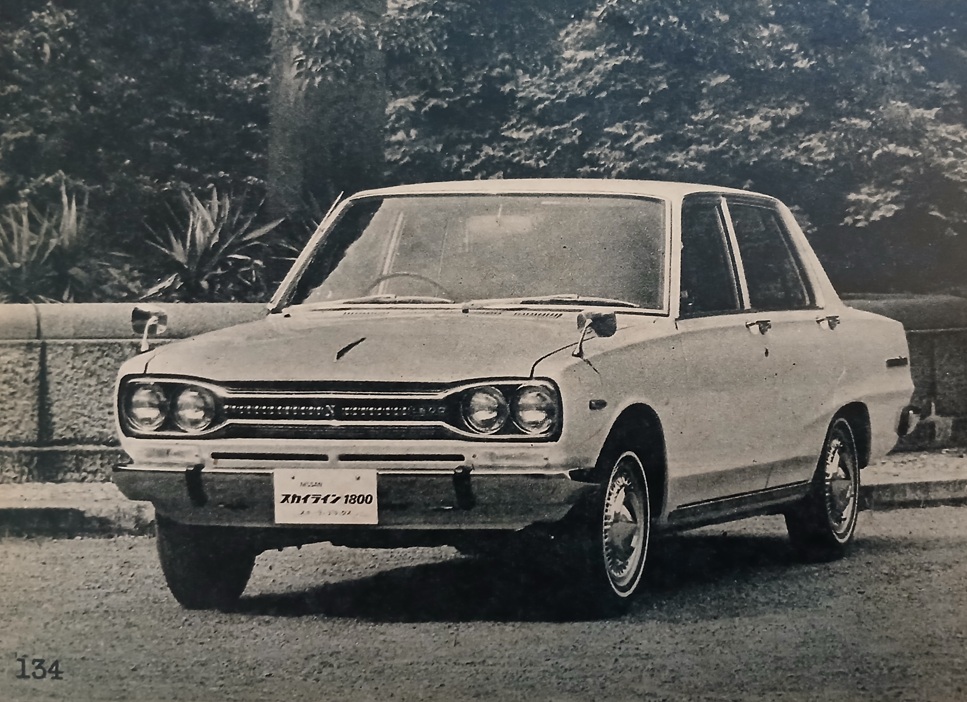
The body shell of the Skyline 1800 is completely unchanged from that of the 1500 series. The only changes are a more luxurious treatment of the front grille and rear-end finish.
The basic interior design also follows that of the 1500 series, with changes limited to a wood-grain finish for the switch panel on the dashboard and completely revised, more luxurious door trim.
The car I drove was the Sporty Deluxe, but despite the name, the only difference from the standard Deluxe model is its 4-speed floor-shift transmission.
This follows the same approach as the 1500 series, but if a car is to bear the name “Sporty,” I would have liked to see some of that character reflected in the interior as well.
Of course, in a car like this, where the price must be kept as low as possible, one cannot expect the comprehensive treatment given to the Skyline GT. But I would at least have liked an instrument panel that satisfied the “image and function of a sporty car.”
In terms of its performance on the road, this car is certainly “sporty,” and in that respect there is no cause for complaint. But along with these unseen qualities, those which can actually be seen are also an important consideration for the buyer when choosing a model.
Leaving aside this question of whether it is “sporty,” however, the dashboard design itself is excellent, both functionally and visually. Skillful interior design, particularly around the dashboard, was one of the distinguishing features of the old Prince cars, and that tradition can be said to live on in the Prince-derived models even now, after the merger with Nissan.
Spacious Interior With Plenty of Room
The front seats are separate seats with full-reclining backrests, and are very well designed.
They are particularly good from an ergonomic standpoint. The way they support the body from the waist to the back cannot be faulted, while the support around the tailbone is also better than most. If one were determined to find a fault with these seats, it would be that the cushions are slightly short. Even this is less a complaint than a small wish that, if possible, they might have been a little longer….
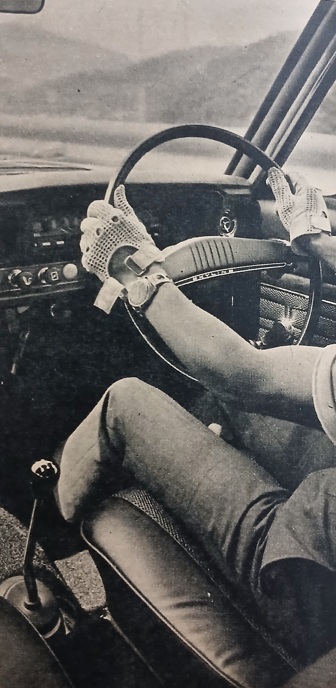
Nor could I find anything to criticize in the driving position.
The slightly low seating position for this type of car is also pleasing.
The ergonomically well-designed seats and completely natural driving position meant that during some 300km and ten hours of testing, I never once found myself shifting position in the seat, nor did I feel fatigued.
The rear seat is somewhat intruded upon by the wheel housings, but there is plenty of hip room, and even three adults can sit across without difficulty. Shoulder room, of course, is more than sufficient.
There is also plenty of foot room. The front seats provide 160mm of fore-and-aft adjustment, but even with them moved fully back, there is still space between the rear passengers’ knees and the seatbacks.
Although the rear seat thus provides plenty of space, its cushion is unfortunately somewhat short, while the seatback is also a little too upright. This is a tendency found in many Japanese cars, but hardly a welcome one.
Since there is already plenty of room available, I would like to see a rear seat arrangement that allows a more relaxed seating position.
The Skyline uses a flow-through ventilation system. The secondary vents at either end of the dashboard allow both the direction and volume of airflow to be freely adjusted, while the outside air entering the cabin through them is discharged through outlets in the rear pillars. Both the intakes and outlets have generous capacity, and even with the windows fully closed, the cabin is adequately ventilated as long as the car is traveling at a reasonable speed.
Its Character Emerges at High Revs
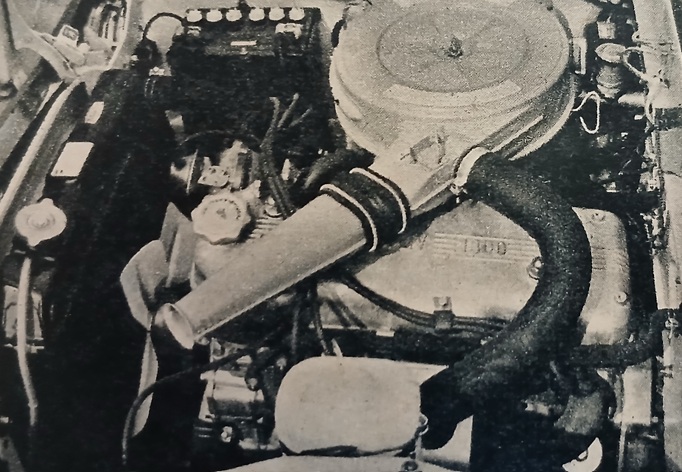
The SOHC four-cylinder engine, known as the G18, is a scaled-up version of the G15 used in the Skyline 1500. With its V-shaped valve layout, polyspherical combustion chambers, aluminum-alloy cylinder head and five-bearing crankshaft, it is an engine of quite advanced design.
The engine is installed at a 12° angle to the left. This seems to have been done less to lower the hood line than to allow a longer intake manifold and thereby improve intake efficiency.
Bore and stroke are 85 × 80mm, making it a short-stroke design of 1815cc. With a compression ratio of 8.5, it develops a maximum output of 100ps/5600rpm and maximum torque of 15kgm/3600rpm.
On first acquaintance, what stands out about this engine is its high degree of smoothness for a four-cylinder. In terms of flexibility, however, I would not say that it is anything particularly special.
Consequently, at low engine speeds—below 2000rpm—its response is not especially lively. Its smoothness, however, means that there is little to criticize in terms of ease of use. Even so, quite a few drivers will probably find it somewhat lacking in strength.
While the engine may not satisfy everyone at low revs, I doubt that anyone will find fault with it in the medium- and high-speed ranges. Its smooth, sharp response at medium and high revs is outstanding among engines in this class.
The catalog gives a 0-400m acceleration time of 18.0 seconds with a full load of passengers, which from my impressions seems entirely achievable. With the driver alone, a time of under 17.5 seconds would not appear difficult either.
I was not able to attempt the claimed maximum speed of 165km/h, either, but it should be well within the car’s capabilities.
The engine gives its best response between roughly 2000-5000rpm, and acceleration up to around 110km/h in third and 140km/h in top is excellent.
165km/h at 6000rpm
The transmission is a fully synchronized 4-speed. As mentioned earlier, its sporting, close-ratio gearing—3.382 in first, 2.013 in second, 1.312 in third and 1.000 in fourth—is the same as that of the Laurel, and these ratios are also shared with the Fairlady 1600.
The overall ratio in top gear is numerically the largest among cars in this class, but in the other three gears—first, second and third—the Skyline conversely has the smallest overall ratios apart from the Laurel. (Second is almost the same as that of the Corona Mark II 1900.) First in particular is tall, at 13.16 compared with 13.83 for the Luce and 13.58 for the Corona.
In other words, the Skyline’s ratios are spaced considerably closer together than those of the Corona or Luce.
Taking the engine to 5600rpm, where maximum power is developed, gives about 45km/h in first, 78km/h in second and 118km/h in third. If it is revved further to 6000rpm—a speed that seems perfectly safe to use frequently—the corresponding figures become 48, 85 and 126km/h. The maximum speed of 165km/h is also reached at about 6000rpm.
The shift lever, mounted on the center floor, has appropriate travel both fore-and-aft and laterally, and its engagements are precise.
The synchromesh is also quite powerful, allowing quick gear changes under all conditions.
Effective Tension Leaves
The suspension is basically the same in layout as that of the 1500 series, with independent strut-type suspension at the front and a rigid rear axle carried on semi-elliptic leaf springs.
The springs and shock absorbers are also the same as on the 1500 series, as is the use of tension leaves on the rear leaf springs.
These tension leaves appear to be notably effective in controlling bump and rebound. For example, when encountering an obstruction at high speed, they absorb the resulting movement almost immediately, while also reducing wind-up motion under sudden acceleration and allowing the car to accelerate smoothly.
This should naturally have a beneficial effect on handling and maneuverability as well.
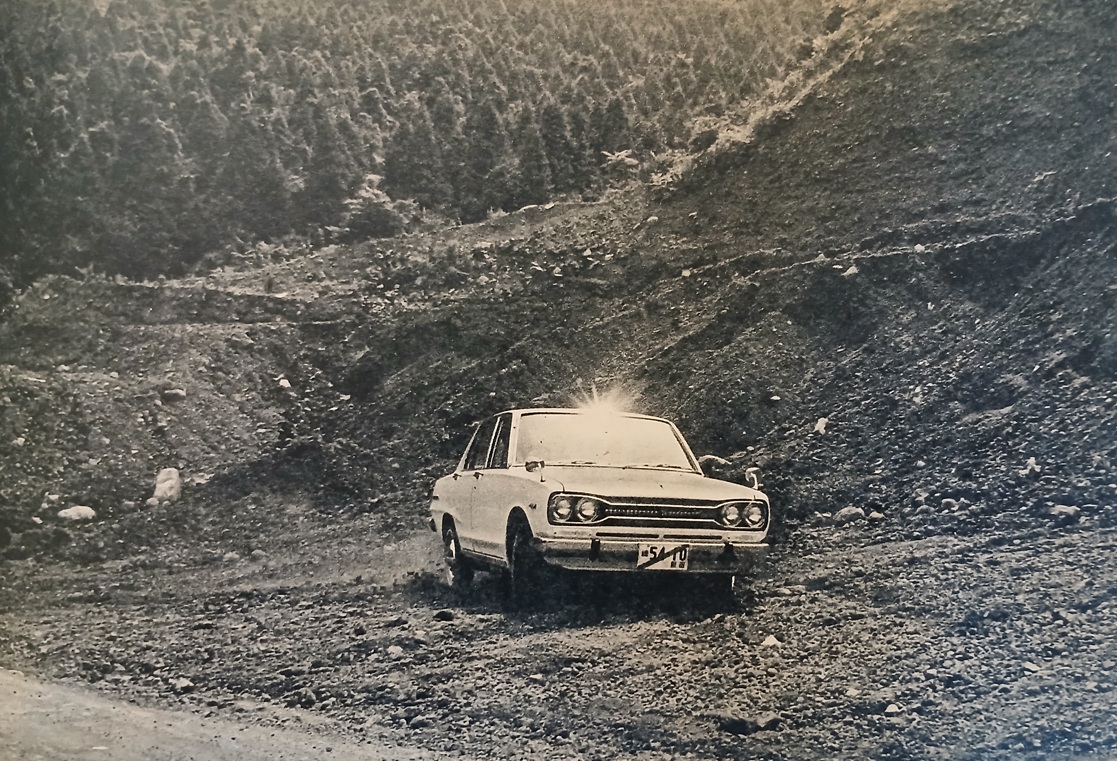
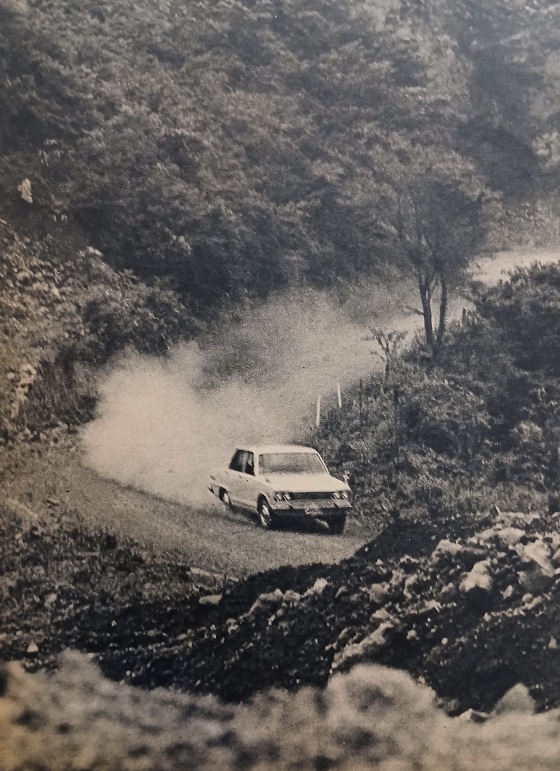
On the other hand, when traveling at high speed over an irregular surface such as a gravel road, the tension leaves seem to work to some disadvantage, tending to reduce tire adhesion. As a result, on gravel, raising the speed even a little caused the tail to move from side to side, considerably reducing the sense of stability.
To reduce this instability on irregular surfaces, I tried lowering the tire pressures, and this proved quite effective.
Strictly speaking, with any car it is best to adjust the tire pressures appropriately for paved roads or irregular surfaces such as gravel. In practice, however, no one goes to such trouble, nor are there very many cars that make it necessary.
With the Skyline 1800’s suspension, however, driving hard over both paved and irregular surfaces at the same tire pressures is something one might think twice about. This applies, of course, only to the minority of drivers who enjoy sporting driving. It is of no concern to the great majority who slow down appropriately when entering a gravel road and pick their way carefully over the surface.
Now that most major roads are paved, it may well be better to produce a car with greater advantages on paved roads, even if this means accepting some slight disadvantage in its characteristics on unpaved surfaces.
Tubeless Tires Do Not Match the Car
The steering characteristics show relatively mild understeer for a car of this type, giving it what can generally be considered very easy handling.
The transition to final oversteer is also smooth, and even when the tail begins to slide there is plenty of time to correct it. The standard 6.15-14-4PR tubeless low-profile tires, however, are not really adequate for the car’s excellent capabilities. Anyone who wishes to make use of the car’s full potential should naturally specify the 165SR-14 radials available as a factory option.
With the standard tires, the capabilities of the Skyline 1800’s suspension and the power of its engine cannot be fully exploited.
For less-than-serious sporting driving, of course, the standard tires can be considered adequate….
The Skyline 1800 also appears to have good stability. By stability I mean the ability of a car, when disturbed by an external force, to return naturally to its original steady state. The importance of this becomes apparent in situations such as being suddenly pushed sideways by a crosswind at high speed, or having to make a sudden steering maneuver while traveling at speed.
Handling, stability and ride comfort are to some extent conflicting requirements, and as a result, it is necessary to find a compromise between them. How high a level a manufacturer can achieve in making that compromise is where its skill comes into play.
In the case of the Skyline 1800, on paved roads at least, it seems to achieve a relatively high level of compromise for a Japanese car with a rigid rear axle.
The brakes are servo-assisted discs at the front and leading-trailing drums at the rear, with a tandem master cylinder as standard. Pedal effort is naturally not heavy, but the overly sensitive response that can make brakes feel obviously servo-assisted has been deliberately suppressed. The result is a feel that should seem entirely natural even to someone who has never used servo-assisted brakes before. This is a commendable approach.
Braking power is also at a generally satisfactory level. Under hard braking, however, the rear wheels tend to lock somewhat early.
Postscript: Story Photos