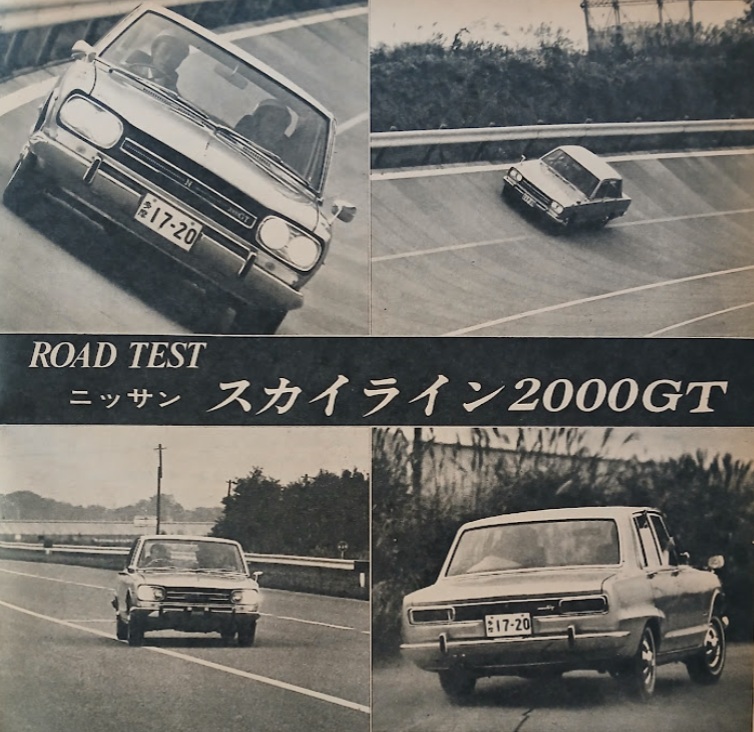
Nissan Skyline 2000GT (1969)
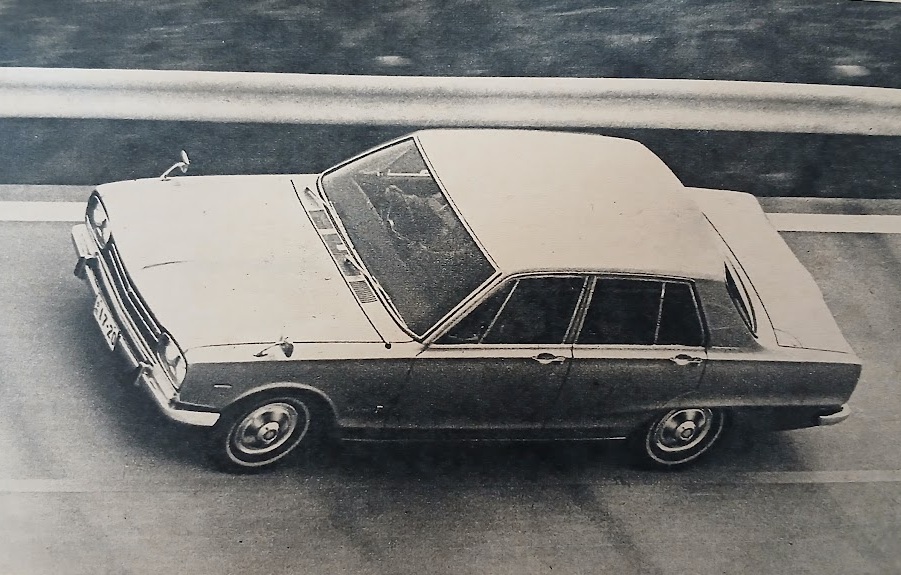
Publication: Motor Fan
Format: Road Test
Date: January 1969
Authors (Roundtable): Jiro Tanaka, Shinichiro Sakurai, Hiroshi Hoshijima, Kenji Higuchi, Masashi Kondo, Nobuo Shibata, Yasuhei Oguchi, Kenichi Goto, Kenzaburo Ishikawa, Kazuo Kumabe, Yasunobu Tomizuka, Taizo Tateishi, Osamu Hirao, Akio Miyamoto, Minoru Onda, Toshihide Hirata, Motor Fan Editorial Staff (uncredited)
Aiming for a True “GT Car”
Magazine: To begin, could you tell us about the development process behind the new Skyline 2000GT?
Tanaka: This Skyline 2000GT was announced on September 18 and went on sale from October 9. The 2000GT name itself was already used on the previous Skyline for the more sporting version, and while the basic philosophy has been carried over, the intended user base and overall positioning are somewhat different this time.
With the earlier 2000GT, there was a strong emphasis on sportiness, partly due to its involvement in competition. There were two versions: the A-type, which was suitable for road use, and the B-type, which was aimed more directly at racing. With this new model, we’ve tried to define the character of those two approaches more clearly.
The car tested here corresponds to what was previously the A-type. We’ve set out to establish it firmly as a grand touring machine for road use. In other words, it’s intended to be a car that can fully make use of expressways such as the Tomei and Meishin—what you might call a true GT car in the proper sense.
To achieve that, we’ve adopted a six-cylinder engine, independent rear suspension, and disc brakes with a master-back servo, among other features. In that respect, the mechanical specification differs considerably from the standard Skyline sedan.
Another point is that the previous 2000GT was based on the standard sedan, with an emphasis on keeping weight as low as possible. In contrast, this new 2000GT is based on the Deluxe version. The interior has been given a more refined treatment, with a center console, and incorporating items such as a radio, clock, and carpeting to create a more luxurious atmosphere.
In terms of safety equipment as well, we’ve taken a step further beyond the Skyline sedan. For example, a collapsible steering column is available as an option, seat belts are of the three-point type, and headrests are fitted for both front-seat occupants.
As for the competition-oriented model, we displayed a reference exhibit at this year’s Tokyo Motor Show—a Skyline 2000GT fitted with a detuned version of the Nissan R380 engine. This corresponds to the former B-type, and in that version, the pursuit of speed has been taken as far as possible.
Differences from the Sedan Model
Magazine: In terms of differences from the sedan model, the exterior shows a longer wheelbase and extended front hood, giving it well-balanced long-hood, short-deck proportions. But how much has changed underneath, particularly in the suspension?
Sakurai: For the suspension, the front uses a strut-type setup, and its basic geometry is largely unchanged from the Skyline sedan. However, because this is a GT car intended for sustained high-speed touring, we’ve reinforced components such as the spindle, and increased the bending rigidity of the struts themselves.
At the rear, the Skyline sedan uses leaf springs, but for the 2000GT we’ve adopted an independent suspension with a semi-trailing arm layout. This is the same basic type already used in the Bluebird and Laurel, chosen for its ability to follow the road during high-speed cornering.
From our perspective, a car of this character really requires independent rear suspension, so we implemented this semi-trailing arm system in the 2000GT. While the basic layout is shared with the Bluebird and Laurel, the way the car will be driven is quite different, so in reality there are very few shared components.
Engine: OHC Inline-Six, 1998cc
Magazine: The engine is the L20-type six-cylinder OHC with a single carburetor, as used in the Cedric. Could you tell us a bit more about it?
Sakurai: It’s essentially derived from the L20 used in the Cedric with twin SU carburetors, but converted to a single-carb setup. It’s an OHC inline-six displacing 1998cc, with a short-stroke design–78mm bore by 69.7mm stroke–and a compression ratio of 9.0. Output is rated at 105ps at 5200rpm.
There’s been some comment that this figure might be a bit conservative… but that’s the official number.
Compared to the Cedric engine, we’ve raised the compression ratio from 8.5 to 9.0, adopted a cam profile better suited to higher speeds, adjusted ignition timing accordingly, and changed the exhaust from a dual to a single type. In short, we’ve tuned it as a high-speed-oriented engine with a single carburetor.
The idea is to achieve good tractability at low speeds, while also ensuring stable performance at higher speeds.
As for why we didn’t use the G7 engine (the 2-liter OHC six from the Gloria), the L20 has a shorter stroke, and it’s also a newer design. We felt it offered more room for future development.
Magazine: What about the transmission?
Sakurai: It’s what we call the Type 71–a 4-speed, fully synchronized manual gearbox. It’s already in use in models like the Gloria, Cedric, and Fairlady. We’ve made some minor refinements, but fundamentally it’s a shared unit.
Aiming Between a Sports Car and a Sedan
Magazine: You’ve said this car is aimed at being a “true grand touring car,” but in reality, the GT label sometimes feels like just a name–more an image of being the top-grade model in the Skyline lineup. What’s your view on that?
Tanaka: That’s fair. Rather than being a purely hard-edged sports car, the idea was also to incorporate more deluxe elements and make it usable by a wider range of people.
Magazine: So in that sense, you’re interpreting “grand touring” in a broader way.
Hoshijima: I think so. Of course, the GT name itself has appeal, but rather than getting too hung up on it, it might be better to think of this simply as Nissan introducing another new 2000cc passenger car… (laughs)
Tanaka: In a way, sports cars and sedans are gradually converging, and this car sits somewhere in between.
Hoshijima: Exactly. Typically, 2000cc passenger cars don’t attract much interest from younger drivers. But this one is different. In that sense, I think it’s a 2000cc car that younger people can really get into. Personally, I’d love to drive one around myself–with air conditioning, even. (laughs)
Tanaka: Interestingly enough, the American Ford “Delta” subcompact that’s been getting attention lately is about the same size as this car. In the U.S., they say it’s meant to hold back the advance of Japanese cars, but if you look at the specifications, it’s actually quite similar to this.
Higuchi: As we get older, doing long drives–300-500km in a day–becomes more of an effort. So a car like this, with a larger engine, a more deluxe body, a longer wheelbase, and good ride comfort, is very appealing. For a two- or three-day trip, something like this feels just about right.
Magazine: Let’s talk about the styling. At a glance, it looks much the same as a standard Skyline. Was that a deliberate decision, to not differentiate it more?
Tanaka: There are two reasons for that. Looking at the track record of the previous Skyline 2000GT, its buyers weren’t just young people. As a four-door, it appealed to quite a broad audience. It could be used a bit for pleasure, but also for everyday tasks. That versatility is one reason it sold so well.
With the new 2000GT, we’ve carried over that strength. The other reason is cost. We wanted to keep it as affordable as possible and make it accessible to a large number of people, so we’ve used as many shared body pressings with the standard Skyline as we could.
Designed for a Broad Range of Users
Magazine: Looking at it more closely, the proportions seem better than the standard Skyline.
Higuchi: The front hood is longer, and the overall balance has improved. It gives the car a stronger presence as well.
Sakurai: From early in the development process, it was decided that both the Skyline and the Skyline 2000GT would be produced together, so the styling was considered from the outset with that in mind. We made sure neither would look out of place. The standard Skyline has a slightly shorter nose, while the GT’s is longer.
Kondo: A long nose looks good, of course, but if it’s too long, it can become a concern when turning on narrow roads or pulling out onto wider ones. This car strikes a good balance–it doesn’t feel excessive.
Tanaka: The previous Skyline 2000GT was about 200mm longer than the standard body, but this new one is only 150mm longer.
Higuchi: On American cars, you often see automatic transmissions that can also be shifted manually–a more sporting type of torque converter gearbox. For a car with this kind of character, something like that might be quite suitable… Are there any plans along those lines?
Tanaka: If I had to say, I think things will gradually move in that direction. As for whether there are concrete plans… that’s a difficult question to answer. (laughs)
Higuchi: Compared to the previous 2000GT, this car feels much more restrained, and designed to appeal to a wider audience. Of course, it still incorporates GT-like performance and ride comfort, but…
Sakurai: If anything, I think the term “sports deluxe sedan” suits this car best. It’s the most upscale model in the Skyline range, with a clear sporting character, and in a sense it brings together quite different types of users.
Because of that, it wasn’t like designing a car with a single, sharply defined focus. We ran into a number of challenges trying to reconcile those different requirements.
0-400m in 16.8 Seconds: Outstanding Performance
Magazine: Could you present the results of the power performance tests conducted by the Hirao Laboratory?
Shibata: This test was carried out at Nissan’s Murayama plant test course. Conditions were excellent, and we were able to gather very solid data. Starting with standing-start acceleration, the time-to-distance figures were: 0-50m in 4.4 seconds, 0-100m in 6.8 seconds, 0-200m in 10.7 seconds, and 0-400m in 16.8 seconds.
Looking at it in terms of speed versus time, it reaches 60km/h in 4.2 seconds, 80km/h in 6.7 seconds, 100km/h in 9.8 seconds, and 110km/h in 11.5 seconds.
Next, for overtaking acceleration, we measured two cases: starting from 30km/h in third gear, and from 40km/h in top gear. From 30km/h in third, it takes 2.0 seconds to reach 40km/h, 5.4 seconds to 60km/h, 9.1 seconds to 80km/h, and 12.6 seconds to 100km/h. From 40km/h in top gear, it takes 5.2 seconds to reach 60km/h, 10.3 seconds to 80km/h, and 15.7 seconds to 100km/h.
These tests were conducted with three occupants plus test equipment onboard, totaling 201kg, for a total test weight of 1,291kg.
Magazine: A 0–400m time of 16.8 seconds is quite impressive.
Oguchi: In all the Motor Fan tests so far, I don’t recall any car breaking the 17-second barrier over 400m. Earlier, it was described more as a grand touring car than a pure sports car, but judging from these numbers, the performance is certainly in sports car territory.
In particular, the 0–50m time of 4.4 seconds means there’s a real sense of ease in city driving. And on the expressway as well, it has the kind of performance margin you’d expect from a grand tourer.
Magazine: The Skyline 1500 we tested recently did 0–400m in 18.1 seconds, so this is more than a full second quicker.
Tanaka: If I remember correctly, the Porsche 911 recorded around 17.1 seconds in the Motor Fan test.
Oguchi: The catalog mentions aerodynamic styling, but at first glance the car looks a bit chunky, and not especially aerodynamic. However, when we actually measured it, the drag coefficient came out at around 0.023, which puts it solidly among the lower values.
Goto: According to our in-house data, compared to the previous Skyline we tested, aerodynamic drag has improved by about 5%. It’s not just that the nose is longer–the overall shape may look similar, but the curvature is different. The standard Skyline, on the other hand, has almost the same amount of drag as the previous 2000GT.
Impression of the Top Model Skyline
Tanaka: The overall shape of the hood and the curve near the top of the front glass make a difference in air resistance. Whether the airflow separates there or not seems to make quite a difference.
Goto: On the sides, the airflow mostly separates anyway, so it doesn’t have much effect.
Kondo: How about the underside of the body, underneath the car? Has any attention been given to that area?
Sakurai: We’ve fitted an under-cover in front of the front axle to keep mud from splashing up, which also smooths the airflow. Further back under the body, things get more complicated. We’ve tried to keep the layout as flat as possible to minimize airflow disruption, but with exhaust pipes and other components in place, it’s impossible to make it perfectly flat. We have made efforts, though.
Magazine: How does it feel when driving? There are cars where the speedometer seems to climb rapidly even though they don’t feel particularly fast.
Oguchi: That’s right. Even from a standing start, the initial surge is not dramatic. So it’s surprising that the 0–400m time comes out in the 16-second range. At the same time, when you watch the speedometer, the car picks up speed very quickly. I think this also relates to the overall character of the car–it has quite a soft, gentle feeling. The previous 2000GT leaned closer to a sports car in character, but this is notably different.
Ishikawa: I felt the same. Rather than a sports car, it gives the impression of the top-grade Skyline. The interior is deluxe, and acceleration is excellent, yet it never feels overly sporty.
Higuchi: I also thought the relationship between the clutch and accelerator, and the spacing of the pedals, seems designed to create a soft, relaxed driving mood. Previous sports cars or GT models have often used an intentionally sharp clutch and accelerator to heighten the sensation of sportiness, but this car is the opposite–it’s soft, and driving it feels relaxed.
Magazine: Professor Kumabe, what’s your impression? Any thoughts?
Kumabe: Compared with the earliest Skylines, it’s like a world apart. Even the old Skylines were intricate in structure, but as a car, the current model is far more cohesive. The new standard Skyline is fine, but this 2000GT adds an extra measure of appeal. How much does it cost?
Tomizuka: It’s 860,000 yen for delivery in Tokyo.
Extremely Quiet Even at High Speed
Magazine: Next, please give us the vibration and noise data handled by the Watari lab.
Tateishi: This test was conducted on the same day as the Hirao laboratory’s tests, at Nissan’s Murayama factory test course. Starting with suspension vibration frequencies: the natural sprung frequency is 1.3cps for both front and rear wheels, about 78 cycles per minute. The unsprung frequency is 15.0cps at the front and 13.0cps at the rear.
We measured noise levels both inside and outside the car. However, the Nissan test course is in much better condition than the course at the Motor Fan testing lab, so the noise readings are 2-3 phons lower than usual. Please keep that in mind when comparing with data from other tests. Inside the car, the results were: 59 phons at 40km/h, 63 at 60km/h, 67 at 80km/h, 72 at 100km/h, and 75 at 120km/h.
Next, for outside noise, we took measurements according to JIS standards. Since it’s a 4-speed gearbox, we conducted two tests: noise level at a constant 50km/h in second gear, and during hard acceleration from 50km/h in second gear. The constant-speed figure was 71 phons; under hard acceleration, it was 79 phons.
Magazine: How do these numbers compare with the standard for a 2000cc class car?
Tateishi: This is a Grand Touring car, but in terms of suspension vibration frequency, it’s not much different from a normal sedan. At the same time, the cabin environment–the feel–is very deluxe, and the noise level is exceptionally low. For this class, it’s outstanding.
Especially at high speed, you can have a conversation in a normal voice without difficulty. The quietness at high speed really stood out.
Magazine: Compared with the Skyline 1500 we tested earlier, it’s actually about 1 phon quieter at lower speeds.
Tateishi: Yes. With GT cars, some users consciously want the sound to be more pronounced or powerful, but in this car, the emphasis seems to be on quietness rather than noise.
Attention to Soundproofing and Vibration Control
Sakurai: We’ve put a lot of effort into keeping the car as quiet as possible. That said, given the kind of car it is, we also looked carefully at the tone of the sound. We try to avoid creating that flashy, attention-grabbing noise you sometimes hear on the streets.
Magazine: When quieting the car, did you focus more on treating the source of the sound, or on soundproofing?
Sakurai: We worked on both–soundproofing and vibration control. That meant experimenting with the composition and shape of the rubber materials, adjusting damping levels, and so on. The final-drive mounts, in particular, were redone many times. The exhaust mounts were also tricky because they have a large effect on the sound.
Miyamoto: Even for sports cars, the Ministry of Transport has been pressing JAF to guide manufacturers to reduce noise levels. There’s no rule that says a sports car must be loud, so a quiet ride seems better. Running silently and smoothly–that’s the appeal of a high-end car. Even for a sports car, I think it’s preferable.
Tateishi: Once the Tomei Expressway is fully open, there will be more long-distance, high-speed driving. Under those conditions, loud noise just creates fatigue, so it’s always better to keep it as quiet as possible.
Oguchi: This car is quiet, and the tone is very nice, too. High-speed or low-speed… the sound is well balanced. And speaking of tone, every manufacturer seems to have its own signature.
Tanaka: That’s because the approaches to soundproofing are different.
Tateishi: In ordinary cars, the peak noise usually appears around 120-130 km/h. In this car, the peak shows up around 60-70 km/h, so the pattern is a little different from normal cars. Even the character of the sound is a bit different.
Tanaka: High-frequency sounds are mostly blocked by soundproofing, but controlling the low-frequency sounds is the real challenge.
Tateishi: Overall, the sound dampening is very strong, which is commendable.
Efforts to Reduce Wind Noise at High Speeds
Magazine: How about wind noise at high speeds?
Sakurai: Actually, the previous Skyline had quite a bit of wind noise, so we put a lot of effort into this when developing the new Skyline. Wind noise has two main causes: one is the whistling effect, and the other comes from protrusions in the airflow that themselves create noise. The question was how to eliminate both. Our basic approach was to avoid changing the body style itself and instead tackle the problem with fine adjustments.
For example, removing sharp edges was effective. The door sealing also has a big impact, so we used double sealing and improved the precision of its fit considerably. With these measures, wind noise in the new Skyline is much reduced.
Ishikawa: Is there ever a point where a car can be too quiet…? (laughs) Certainly, quietness at high speed is no problem, but if the engine is so quiet you can’t even tell it’s running, you might turn the key again by mistake… (laughs)
Goto: At low speed, the quietest car is the Nissan Royal, for official use. You can’t tell whether the engine is running at all.
Hirao: From the passengers’ perspective, though, the quieter the better.
Hoshijima: This car is indeed quiet. With the old 2000GT, you had to brace yourself for the noise when you wanted to pick up speed. The new GT removes that aspect entirely–you can accelerate naturally. You don’t really notice the speed, yet the car does exactly what you want. That combination makes it very appealing. The feeling of “not going fast” also ties into the vibration and sound characteristics.
Higuchi: Ideally, you’d want two cars. For a multi-day trip far away, you’d take a car like this. For half-day drives, something wilder, more spirited. Going forward, people will likely have two cars and use them with this kind of clear distinction. Up to now, both roles were being served by a single car.
Maintaining Understeer to the End
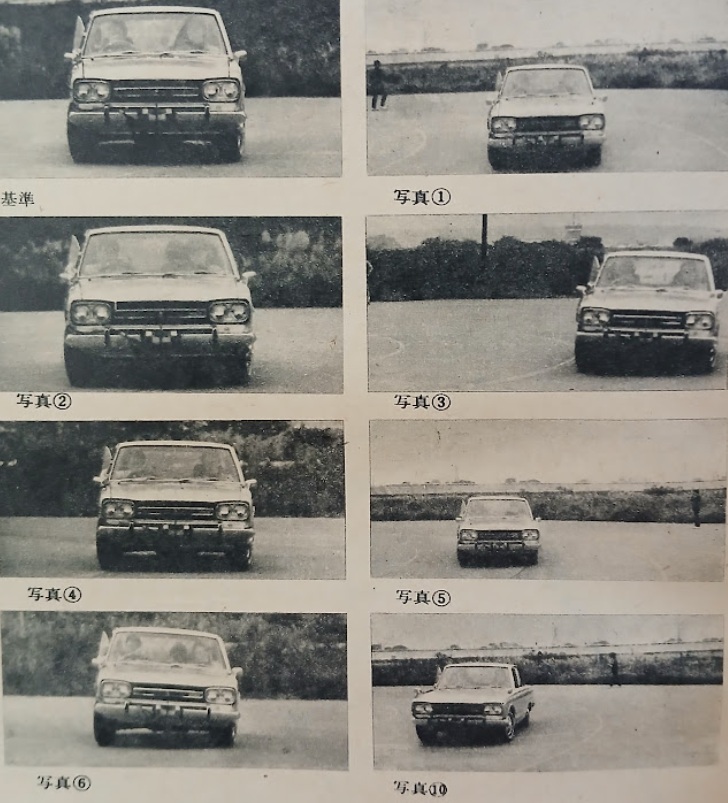
Magazine: Please share the handling and stability test results from the Kondo lab.
Kondo: To summarize the results briefly, this car falls between a sports car and a sedan, according to the standard Motor Fan test data. In steady-state circular tests for oversteer and understeer, the car maintained understeer throughout, up to a lateral acceleration of 0.6g.
It’s likely that even if acceleration continued further, it wouldn’t suddenly oversteer. The steering effort is a bit on the heavy side, but still under 5kg, which seems reasonable. The roll angle at 0.5g lateral acceleration is about 4.1°. The catalog lists 4.3°, probably due to differences in passenger load.
With the car stationary, steering effort when turning the steering wheel 360° to the left was 12kg; to the right, it was 15kg. In the low-speed figure-eight test, steering effort when entering the curves at 0.25g lateral acceleration was 7-8 kg, a comfortable value. High-speed steering effort was measured in a slalom test: at 0.25g lateral acceleration, it was about 2.2kg; slightly heavier would be better.
Finally, in the hands-off stability test, we took measurements at speeds to 160km/h. This is the first time Motor Fan has obtained data at such speeds. At these high speeds, the self-recording accelerometer usually shows significant swinging before converging to a straight line, but in this car, it was minimal.
In acceleration tests from a standstill, the slight jerkiness after clutch engagement observed in most test cars was almost absent in the low range, producing results similar to a torque-converter automatic car. Overall, the measured data was extremely smooth.
Tanaka: The rear suspension bushings are relatively soft, and combined with the clutch characteristics, I think this contributes to that smooth tendency.
Hirao: What’s the lock-to-lock figure for the steering?
Onda: 3.5 turns.
Tanaka: Stationary steering effort depends not just on the steering system, but also on the road friction coefficient. Our test course produces higher values than the usual lab course.
Hirao: So the surface is rough. You could reduce steering effort with power steering, but that’s costly. Recently, we have also begun seeing more variable-ratio steering systems.
Brake Force Front-to-Rear Distribution: 7:3
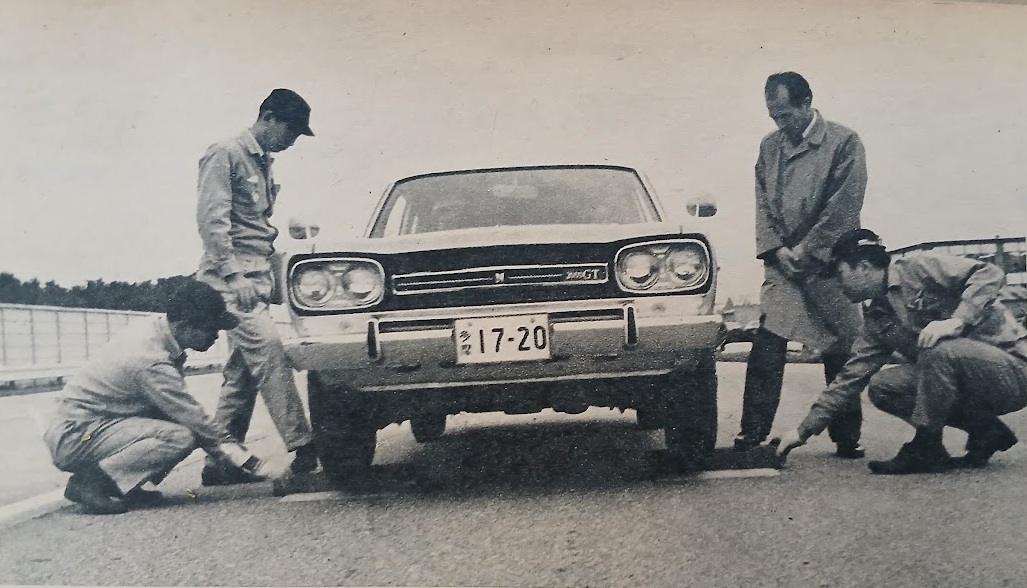
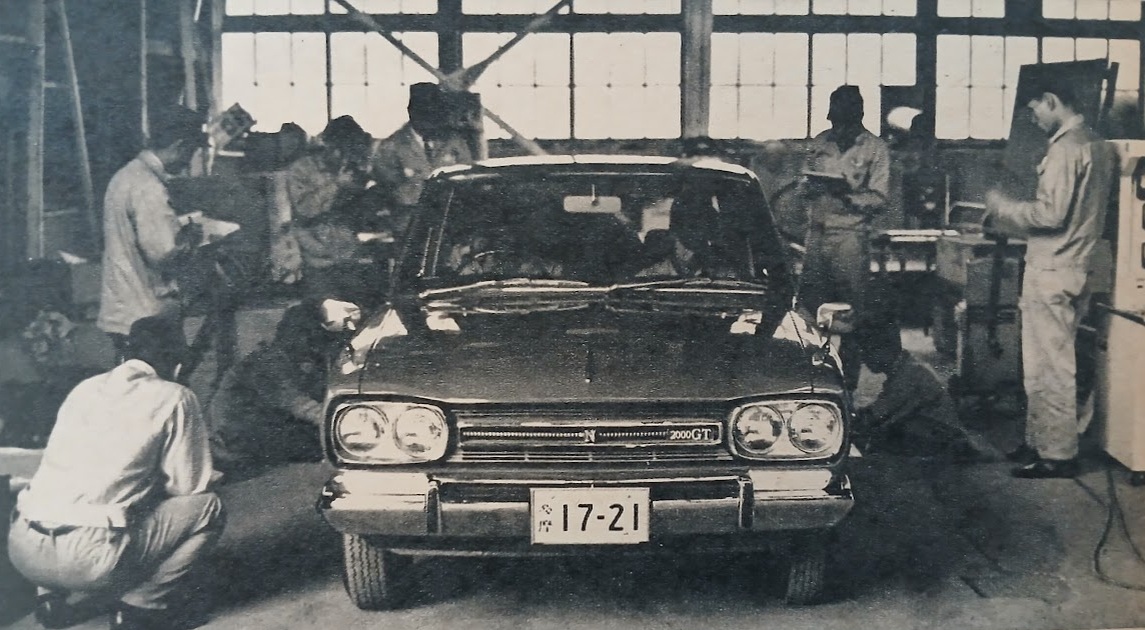
Magazine: Next, please give us the data on weight, alignment, and brakes measured at the Ship Research Institute.
Ishikawa: First, weight. With the spare tire, tools, and a full tank of fuel, the car weighed 1123kg. The nominal weight is 1090kg, so the tire, tools and fuel adds about 33kg. This is 35kg heavier than the old 2000GT, likely due to the deluxe equipment.
When the car is empty, the front-wheel load is heavier on the right side by 32kg. With the driver on board, the difference grows to about 43kg. Front-to-rear weight distribution is roughly 53:47 empty, 49:51 with five passengers. Weight per unit area is 154kg/m², 12kg lighter than the previous 2000GT. The power-to-weight ratio is 77ps/ton, which isn’t particularly high for this class of GT car.
Wheel alignment, with only the driver aboard, shows slightly large camber and toe-in. Left-to-right balance is good, with zero side slip. The front wheels show little difference in alignment between a one- and five-passenger load. Rear wheels have near-zero camber and toe with only the driver; with five on board, camber tilts slightly negative.
Magazine: And the brakes?
Ishikawa: The braking system uses front discs and rear leading-trailing drums, with a tandem master cylinder for safety and a vacuum servo (master back) to reduce pedal effort. At 0.6g deceleration, pedal effort is about 23kg, relatively easy to use. The front-to-rear distribution favors the front, at 7:3. Left-right balance is good at the front; slight differences appear in the rear. These are the results from the bench tests. On the road, decelerating at 0.6g from about 50km/h, pedal effort drops to roughly 18kg, slightly lighter than in bench testing, likely due to the vacuum level or lining condition.
Magazine: And the parking brake?
Ishikawa: It’s a floor-lever mechanical type, operating on the rear two wheels. To achieve 0.2g deceleration, the required force is 18kg–very light and effective. However, the ratchet teeth are a bit coarse, so to provide braking equivalent to 20% of total vehicle weight requires roughly 30kg of effort.
Light Control Efforts Overall
Magazine: How was the feel of the car’s controls?
Ishikawa: The weight of the gear lever is normal, around 2-4kg for each gear. The clutch pedal takes 6.5kg to engage and 11kg to release, which is also within the typical range. The accelerator pedal is very light–it requires just 0.5kg at a steady 50km/h, and about 1kg under acceleration. That puts it among the lighter values we’ve measured.
Hirao: Have you considered making the parking brake act on all four wheels? That would improve safety and convenience in various situations. Why is it that parking brakes are always applied only to the rear wheels? Though I suppose with this car, the front discs might make that tricky…
Tanaka: If you want a purely mechanical system to work on all four wheels, the equalization has to be engineered very carefully.
Miyamoto: If you were stopped at an intersection and got rear-ended, having all four wheels braked would make quite a difference in the impact.
Hirao: It would be safer when jacking up the car, too.
Ishikawa: In the future, it might end up that way.
Hirao: In any case, it’s worth thinking about.
Sakurai: In practice, incorporating the front is complicated by the steering mechanism, and, of course, there’s the cost issue.
Hirao: The discs were Arnett type on the standard Skyline, but on this 2000GT, that’s been changed, right?
Sakurai: Yes. We’re using the S16 type developed by Girling and manufactured by Sumitomo Electric.
Hirao: Is that considered better than the Arnett type?
Sakurai: Not necessarily. Performance has improved, so we opted for a design with pistons on both sides. Generally, the Arnett type is used only on cars up to around 1500cc.
Hirao: Just to be sure–how much stress can these brakes handle? For example, when descending Otome Pass without engine braking, repeatedly accelerating and then braking, will they hold up? Will they resist glazing or fade?
Tanaka: They should be fine.
Hirao: That’s impressive.
Goto: We’ve also conducted tests descending all the slopes in Hakone without using engine braking at all.
Hoshijima: Old brake fluid is a problem, isn’t it? It tends to cause vapor lock more easily.
Tanaka: It’s true that brake fluid absorbs moisture quickly.
Sakurai: For the most extreme racing use, like with the R380 or R381, we never use fluid left over from humid days. We wait for a very dry day, drain all the old fluid, and refill it with high-boiling-point fluid rather than the ordinary type. That’s the level of attention we give it.
Wipers That Sweep Clean to the Very Edge
Magazine: Could you tell us about the field-of-view measurements conducted by the Hirata Laboratory?
Hirata: As usual, we set up a wide fisheye lens at the driver’s eye position and took photographs at various angles, facing front and rear. The eye height from the ground measured 121.5cm with the seat slide all the way forward, and 118.5cm with the seat back. The horizontal distance from the front windshield to the lens cap was 49cm with the seat forward, and 53.5cm with the seat back.
From these measurements, depending on the seat position, the visible range through the front windshield spans 75.5-84.5° left to right, and 31-27° top to bottom. The rear window offers a 48-52° range laterally, and 11.5-13.5° vertically. The wiper sweep covers 88.5-76.5°. The blind spots on the horizontal plane, including the driver’s viewpoint, range from 90.5-66.0° overall; looking forward alone, the blind area is 49-20°.
One point that stood out was the wipers themselves–they sweep all the way to the edges of the windshield, leaving it completely clear. Expressed in solid angles, the view forward through the windshield measures 0.718-0.549 steradians, with the wipers clearing roughly 71% of that area.
Magazine: How about the vehicle dimensions? In particular, how do they compare with the standard Skyline?
Onda: As noted earlier, overall vehicle length has increased by 195mm, with a 150mm longer wheelbase, so the hood is noticeably longer. Otherwise, externally, there is little difference from the sedan. Inside, however, the GT shows considerable changes.
First, the steering wheel is set at about four degrees of rake. This shifts the relative position of the front seats slightly forward, which also lengthens rear-seat legroom. The front seats’ integrated headrests are very sleek, though raising or lowering them requires a little effort.
The most significant interior change is the addition of a luxurious center console. Along with the shift lever, several switches and meters–such as the ammeter and fuel gauge–have been moved here. This improves the reach to the controls there, though the driver needs to move their gaze considerably to read the gauges.
Regarding the gauges themselves, all are round and highly legible. They harmonize well with the black dashboard and contribute to the GT car atmosphere. The shift lever stroke, which was somewhat problematic in the previously tested Skyline Sporty Deluxe, is now well calibrated in the 2000GT, and no issues were observed.
We’d Like Air Conditioning as Standard
Hirao: Where does the red zone on the tachometer begin?
Sakurai: It’s from 6400-8000rpm.
Magazine: Dr. Higuchi, could you share any observations regarding safety?
Higuchi: Our safety checklist at the Higuchi Laboratory is due for an update, but in the meantime, we conducted a visual evaluation across five major categories–30 items in total–using a five-point scale. This car scored 126 points out of 150. Converted to a 100-point scale, that comes to 84 points. Anything above 75 points indicates no serious safety issues, and in this class of car, scores have traditionally been around 80 at best. So in terms of safety, this is a notably excellent car.
In particular, the body has been designed on the basis of various tests, including crash tests, and with the adoption of features such as a tandem-type brake master cylinder, a brake failure warning lamp, and standard three-point seat belts (for the front seats), it appears that considerable attention has been given to improving safety.
At this point, the next step I’d like to see is further consideration of safety from the outset–things like how the seat belts are stored when unused, and avoiding “add-on” safety accessories. I hope future models will integrate safety more thoroughly in the original design.
Magazine: How about maintenance?
Higuchi: Prince led the industry in promoting maintenance-free operation under the catchphrase “sealed engine." With this car, the suspension is said to require no attention for 100,000km, and the wheel-related maintenance is only needed at 40,000km intervals. The typical user nowadays drives around 12,000km per year, so essentially, once you buy this car, the only regular maintenance is engine oil changes–3,000km for the first change, then every 5,000km after. In that sense, it’s remarkably low-maintenance.
Magazine: Even though this is a GT car, its character is quite different from the old Skyline 2000GT. The ride is more deluxe, appealing to a broader range of users, and making it well suited for ordinary touring. The appearance of a car with this kind of character is certainly welcome from the user’s point of view.
Hirao: One other wish: I’d like to see air conditioning be made standard equipment. It’s currently a manufacturer option. From here on, I think air conditioning will be indispensible. It would also solve ventilation issues on rainy days and prevent the windows from fogging.
The High-Performance 2000GT-B
Magazine: Compared with the previous Skyline 2000GT, this car seems to have been made somewhat more restrained in character. We assume this is because another model—the 2000GT-B—is being developed as a purely competition-oriented version. Could you tell us a little about this high-performance GT-B?
It was also exhibited at the recent motor show under the name “Skyline 2000GT (R380 engine-equipped),” wasn’t it? How much has the R380 engine been detuned?
Sakurai: The R380 engine is a 2-liter, six-cylinder DOHC unit, designed purely for racing. As such, it is not well suited to mass production.
To install it in a production model, we needed to improve manufacturability. And in terms of its performance characteristics, it would be difficult to use as-is for ordinary city driving. For that reason, we have “detuned” it, so to speak, making it usable across a wider range of conditions.
Hirao: By detuning, you mean mainly changes to the compression ratio and valve timing?
Tanaka: That’s right. We also added a cooling fan and switched the carburetors to Solex units.
Hirao: Is the basic design identical to the R380?
Tanaka: We haven’t altered the bore or stroke ratio.
Magazine: Output is said to be over 160ps, but if one were to actually enter this car in a race, could it be tuned up to something approaching R380 levels?
Sakurai: With the right methods, absolutely. I believe it’s possible to reach that level without infringing on homologation rules. But tuning isn’t just a matter of simply altering a few specific parts; it requires quite a high level of detailed technique, so it’s by no means simple.
Magazine: In the previous Skyline roundtable, we heard that overall production targets were 7,000 units per month by the end of 1968, and 10,000 units annually in 1969. What’s the expected figure for the 2000GT?
Tanaka: I think roughly 1,000 units per month. We’ll watch demand carefully and adjust accordingly.
Magazine: Thank you very much for your time.
Postscript: Story Photos