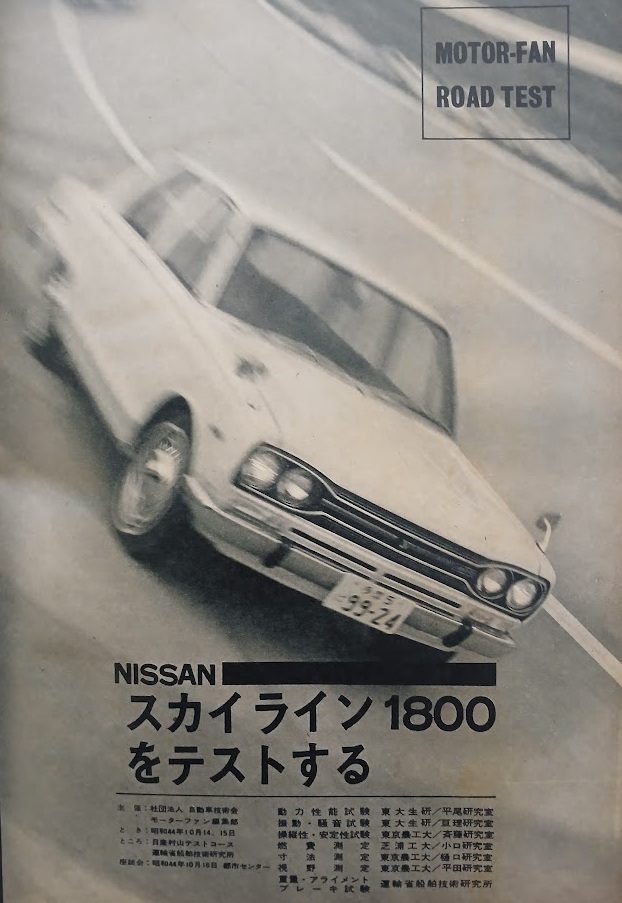
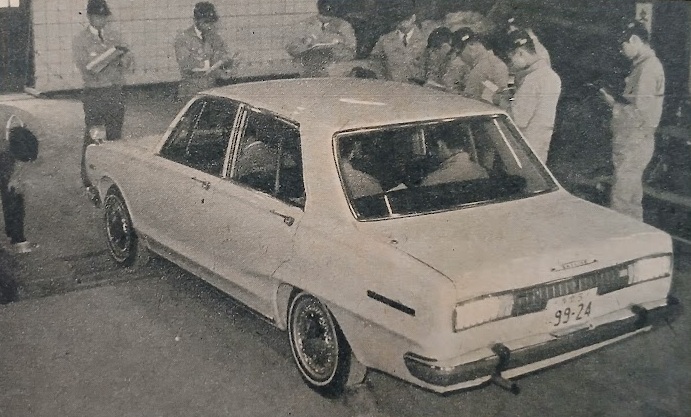
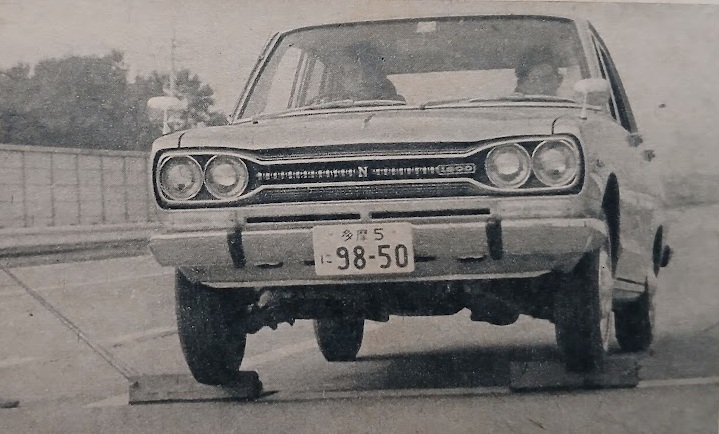
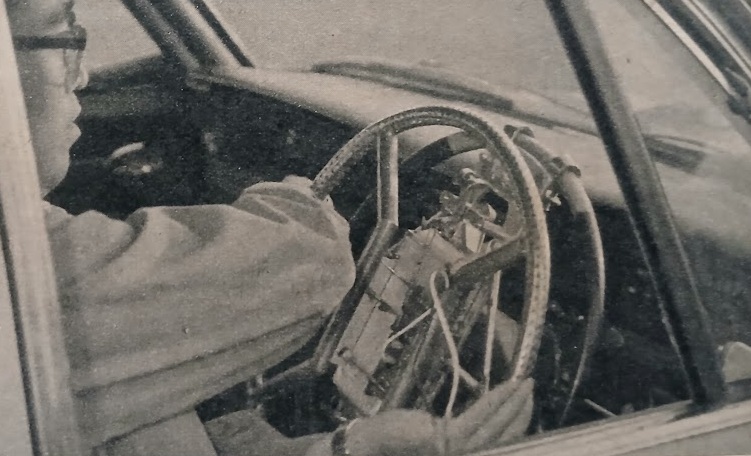
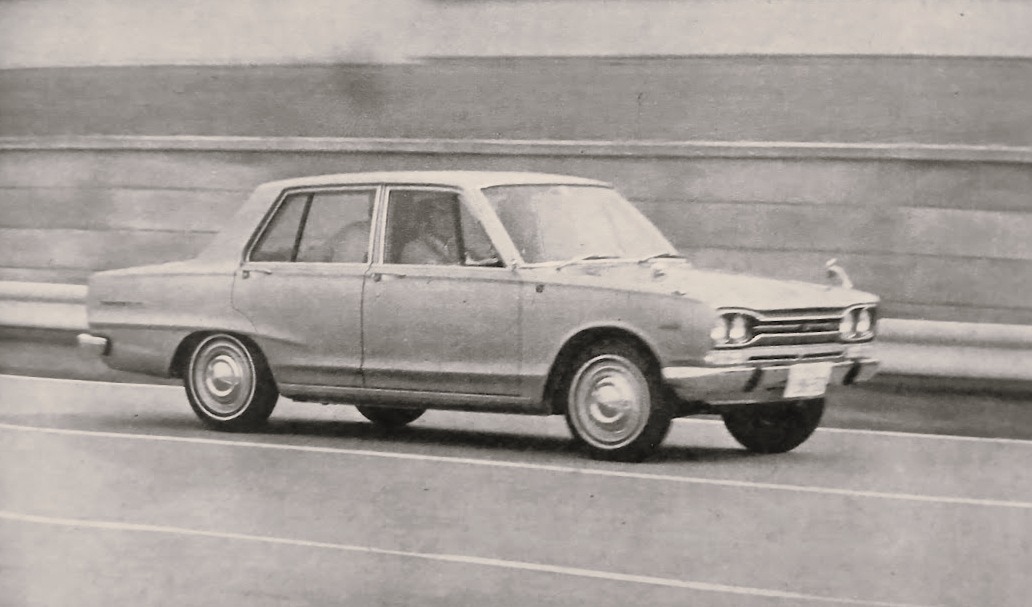
Nissan Skyline 1800 (1970)
Publication: Motor Fan
Format: Road Test
Date: December 1969
Authors (Roundtable): Jiro Tanaka, Takashi Ushijima, Osamu Hirao, Kenichi Goto, Tadashi Terashima, Kunitaka Furutani, Hiroshi Okazaki, Kenji Higuchi, Shinichiro Sakurai, Taizo Tateishi, Masahide Sano, Akio Miyamoto, Zo Doi, Mineo Yamamoto, Kenzaburo Ishikawa, Minoru Onda, Motor Fan Editorial Staff (uncredited)
Responding to the Need for a Wider Model Range
Magazine: First, we’d like to ask Mr. Tanaka, how was this 1800cc model conceived and brought to market? Please tell us about it, starting from the planning stage.
Tanaka: Basically, we decided to develop the 1800cc model in order to diversify our model lineup in anticipation of increased production. As you know, with the expansion of the expressway network, demand for 1800cc-class cars has grown considerably, and we decided this model was necessary to meet the needs of our customers.
Magazine: What is the current production ratio between the 1500cc and 1800cc models?
Tanaka: The 1800cc accounts for 40%, and the 1500cc is 60%. However, the reality is that production cannot keep up with demand, and demand for the 1800cc is stronger. To coincide with the new model year, we’ve updated the exterior for both the 1500cc and 1800cc versions. The front and rear grilles are new, and there are some minor changes to the interior as well. For the domestic market, the Skyline series now consists of 16 variants, including the Touring Deluxe and Sporty Deluxe.
Magazine: What can you tell us about the engine?
Ushijima: The 1500cc G15 engine’s bore and stroke have been changed to create the 1800cc version. This engine is actually based on the same one used in the Laurel. Naturally, we revised the equipment and related components to make it suitable for installation in the Skyline 1800.
The design goals are the same as for the Laurel: performance equivalent to a 2000cc-class engine, while achieving the economy and fuel efficiency of a 1500cc.
Magazine: What are the specific changes?
Ushijima: Compared with the 1500cc engine, the cylinder block bore has been bored out from 82mm on the 1500cc to 85mm, while the stroke has been increased from 70.2mm on the 1500cc to 80mm.
For the cylinder head, the diameter of both the intake and exhaust valves has been enlarged. And since the stroke is longer, the overall height of the cylinder block is greater. Naturally, the piston rings have also been revised to match the increased bore. Those are the main changes, but on a more detailed level, the carburetor specifications have also been changed.
Magazine: What percentage of the parts do they have in common?
Ushijima: About 80% of the parts are shared.
Magazine: Is this engine exactly the same as the Laurel’s?
Ushijima: I think it’s fair to say that, again, about 80% of the components are shared, but the surrounding equipment required for installation in each vehicle differs. For example, the oil sump in the oil pan on the Laurel bulges out at the rear of the engine, whereas on the Skyline it bulges out at the front, so you could call it a mix of the 1500cc and 1800cc layouts.
Magazine: So, between the Skyline’s 1500cc engine and the Laurel’s 1800cc engine, which one came first?
Ushijima: The 1800cc engine came first. However, its basic origin was the engine of the previous Skyline. That car’s 1500cc engine with 88ps was the very first in the lineage.
Magazine: Our impression was that low-speed performance seems to be a little better than the Laurel’s.
Ushijima: I think that has to do with the final drive ratio. The engine’s characteristics are fundamentally the same, only the carburetor manufacturer is different.
Hirao: How does the gear ratio differ from the Laurel?
Goto: The Laurel uses a 3.70 final drive. The Skyline (1800cc) uses a 3.90.
Hirao: Why is that?
Goto: On the Laurel, the 4-speed transmission uses a 3.70, while the 3-speed transmission uses a 3.90. In reality, most customers choose the 4-speed…
Ushijima: During development, each engineer has their own ideas. For the Laurel, they decided to use different final drive ratios for the 3-speed and 4-speed, but for the Skyline, we concluded it would be fine to keep it the same, so it ended up being standardized.
Magazine: But isn’t it odd that the heavier Laurel has a taller final gear?
Terashima: That’s probably because they wanted it to cruise quietly at high speed.
Hirao: Anyway, when I see them out on the Tomei Expressway, the Skyline is usually going faster than the Laurel.
Higuchi: Isn’t it just that Laurel owners are more refined than Skyline owners? (laughs)
Tanaka: Well, it’s true that the Skyline is designed to appeal more to younger buyers.
Magazine: We couldn’t test it this time, but there’s also the automatic version. It seems to be very well matched to the car.
Terashima: From 0–400 meters, it’s only about one second slower.
Tanaka: The automatic we’re using now is really quite good. It’s much better than the Borg-Warner.
Excellent Standing-Start Acceleration
Magazine: Now, please announce the results from the performance tests conducted at the Hirao Laboratory.
Furutani: For these tests, we estimated the vehicle weight to be 1,154kg with three occupants and measuring equipment aboard.
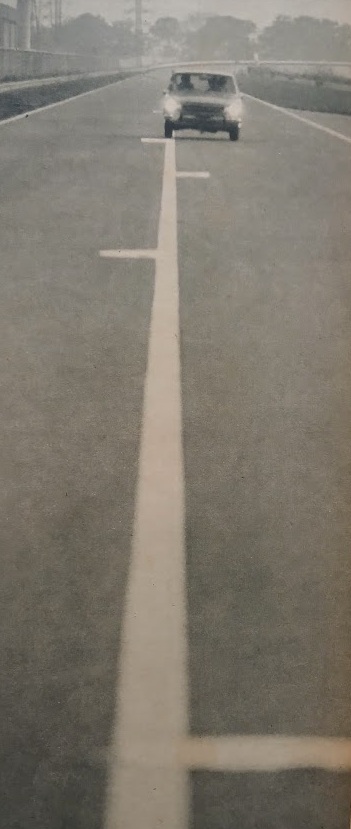
First, in terms of time to distance, the standing-start acceleration results were 0-50m in 4.4 seconds, 0-100m in 7.0 seconds, 0-200m in 11.0 seconds, and 0-400m in 17.6 seconds. In terms of time to speed, the results were 0-40km/h in 3.0 seconds, 0-60km/h in 5.2 seconds, 0-80km/h in 7.7 seconds, and 0-100km/h in 11.5 seconds.
The overtaking acceleration times, starting from 30km/h in third gear, were 2.0 seconds to 40km/h, 5.6 seconds to 60km/h, 9.1 seconds to 80km/h, and 13.0 seconds to 100km/h. When we started from 40km/h in top gear, the time to those speeds was 2.8 seconds to 50km/h, 5.1 seconds to 60km/h, 9.8 seconds to 80km/h, and 14.9 seconds to 100km/h.
This car is said to be a sporty type, but even so, the 0–50m time of 4.4 seconds was surprisingly good. It may have been partly due to the road-surface conditions, but this performance is comparable to the Skyline 2000GT.
Compared with the Corona Mark II 1900SL, the 0-400m time is the same at 17.6 seconds, but the Corona Mark II is slower off the line, while picking up speed in the latter half.
Magazine: Mr. Okazaki, what do you think?
Okazaki: I’m quite satisfied with it. I took it for a spin and drove it fairly briskly, and for a four-cylinder it felt extremely smooth. I think the gearing and general balance are much improved over the 1500cc. It’s not just that displacement and power were increased, but that everything is well balanced now, and I’d say it has become a genuinely good car.
Hirao: What is the weight-to-power ratio?
Tanaka: It’s 9.56kg/ps.
Higuchi: So, wouldn’t that give it about the same performance as the small GTs from Europe or the UK?
Okazaki: That’s right.
Higuchi: It’s very impressive for that level of performance to come from a normal sedan.
Okazaki: That’s why there are problems with the tires not being able to keep up.
Magazine: The tires are the same as the 1500cc model, correct? Why is that?
Sakurai: When we decide on tire specifications, we do so based on test results. The 6.15–14 tires we’ve been using up to now actually felt somewhat extravagant for the 1500cc model, and it also proved perfectly suitable for the 1800cc, so we didn’t change the tires.
Hirao: We’ve heard earlier that it feels very smooth and well balanced, and there really is that sense. So naturally, it’s going to be fast on the Tomei Expressway and similar highways.
Tanaka: Yes, it can maintain high speeds easily.
Hirao: When I drove at an actual speed of 100km/h, I ended up passing most other cars.
Sakurai: Regarding acceleration, compared with the 1500cc model, we did not simply take advantage of the increase in engine size for the floor-shift models. Instead, we tried to improve acceleration while also making good use of the increased torque, aiming for a balanced approach.
Hirao: Well, generally speaking, a car that can maintain high speeds easily is a good car, I think. How about wind noise?
Tanaka: We paid considerable attention to wind noise on this car. A major source of wind noise is when air leaks in and out around the rubber door seals, so we’ve taken great care to eliminate even the slightest noise from this area.
Magazine: We took it up to 160km/h on the test course, and the wind noise was certainly low. However, the engine sound changed once it went past 5000rpm…
Okazaki: Yes, the sound does change, but it’s a good kind of sound.
Ushijima: We haven’t particularly noticed any resonance above 5000rpm…
Hirao: I don’t know if it’s related, but I noticed you’ve done quite a bit of work to the air cleaner.
Ushijima: The air cleaner body has holes drilled in it, and those holes were added to balance sound and performance. There’s also a valve in the intake duct, the part that looks like an elephant’s trunk, and from there, there’s a bypass passage that leads to warm air near the exhaust manifold. That passage is intended to draw in warm air to prevent carburetor icing during winter, especially when humidity is high due to melting snow and the temperatures are low. So the idea is for the valve to switch between summer and winter conditions, drawing in warmer air in winter.
Lower Ride Frequency Than the 2000GT
Magazine: Next, Mr. Tateishi will discuss the noise and ride vibration test results.
Tateishi: The sprung vibration frequency is 1.35cps at the front, and 1.55cps at the rear, and the unsprung vibration frequency is 14.0cps for both the front and rear.
As for noise levels, the road surface conditions of the test course were extremely good, so the values are quite favorable: 59 phons at 40km/h, 62 phons at 50km/h, 64 phons at 60km/h, 67 phons at 70km/h, 69 phons at 80km/h, 70 phons at 90km/h, 73 phons at 100km/h, 74 phons at 110km/h, and 75 phons at 120km/h.
For exterior noise, we performed our usual two tests: steady driving at 50km/h in second gear, and accelerating from 50km/h in second gear, with the results being 70.5 phons for the steady-speed pass, and 80.5 phons for the acceleration pass.
As for ride vibration, I think the suspension frequency is slightly lower than the Skyline 2000GT we tested previously. The ride also felt very comfortable. However, around 90km/h, there is a slight increase in vibration, which seems to be due to a resonance in the rear suspension.
Comparing the noise levels with other cars using our usual reference point, the 1800, the 2000GT, and the 1500cc models all produced very respectable values, right at the lower edge of the Motor Fan evaluation zone.
Magazine: Thank you very much. What does the manufacturer think?
Goto: In our internal data, there’s a slight dip in the noise level at around 120km/h, creating a sort of valley in the curve. Because of that, 110km/h can actually feel a bit louder.
Tanaka: Overall, I believe the noise level is still quite low…
Tateishi: Yes, I would agree.
Better Fuel Economy Than Expected
Magazine: Let’s move on to the fuel-consumption test results.
Sano: For steady-speed fuel economy when driving in top gear, we measured 21.4km/l at a steady 30km/h, 22.6km/l at 40km/h, 19.8km/l at 60km/h, 17.0km/l at 80km/h, 14.0km/l at 100km/h, 10.6km/l at 120km/h, and 7.0km/l at 140km/h.
For practical fuel economy in a normal driving cycle, we measured 13.9km/l in a simulated 40km/h speed zone, driving at an average of 21.8km/h, and 11.0km/l in a simulated 60km/h speed zone, with an average speed of 24.5km/h.
For an 1800cc engine, these results were considerably better than I had originally expected.
Magazine: Aren’t they a little too good? (laughs)
Terashima: I think the fact that there was almost no wind during the test helped produce such favorable numbers.
Magazine: Good performance, quiet running, and good fuel economy to boot. That’s remarkably impressive.
Hirao: Given the favorable conditions, I think it would be worth re-testing just to be sure.
Furutani: It’s even extremely smooth at idle.
Magazine: Does the long intake manifold have anything to do with it?
Ushijima: As far as fuel economy goes, I don’t think it has any direct effect.
Miyamoto: Comparing it to the 1500cc model, there’s no difference between the mechanical and electric type fuel pumps, is there?
Ushijima: Not really. Structurally, the 1500cc and 1800cc engines are the same.
Magazine: How does fuel economy compare with the 1500cc?
Ushijima: There’s no noticeable difference in fuel economy on the road.
Tonoi: From actual vehicle test data, the 1800cc seems to be slightly better than the 1500cc at medium and high speeds. It’s probably because of the taller gearing and the surplus torque, so the matching works out well in that range.
Goto: The difference is about 0.2–0.3 km per liter.
Higuchi: In that case, no one will want to buy the 1500cc anymore.
Goto: Not necessarily. The taxes are different.
Sakurai: Yes, there are the taxes, and the price of the car itself is also different. Depending on how and where the car is used, the 1500cc can actually be the better choice.
Light Steering Effort When Stationary
Magazine: Now let’s review the handling and stability test results conducted at the Saito Laboratory.
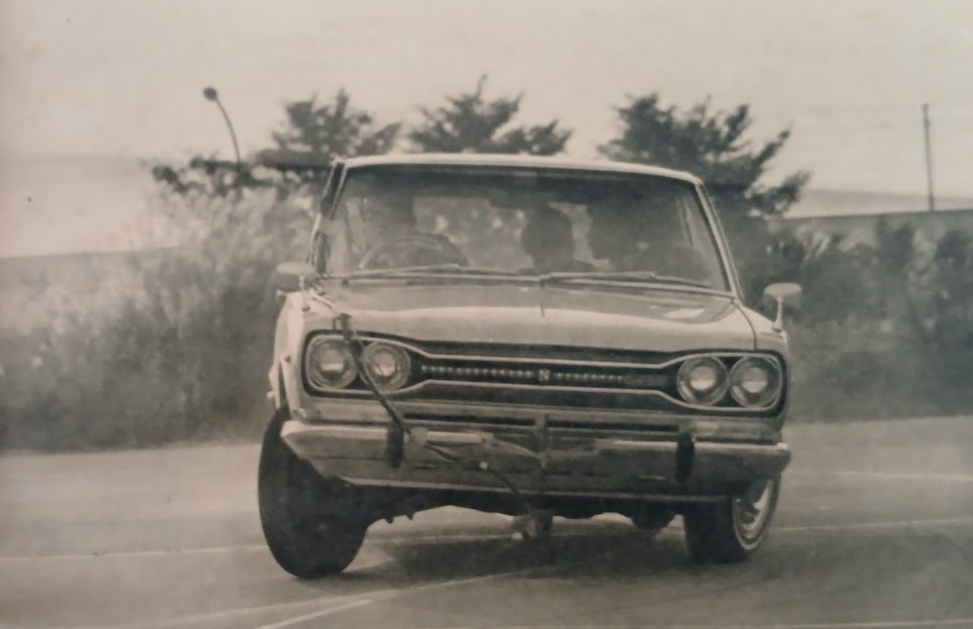
Doi: First of all, the practical minimum turning radius was 5.50m when measured at the outer radius, and 3.05m at the inner radius.
Next, in the understeer/oversteer test on our 15m test circle, at V100 the R/R value is 1.55, with a vehicle speed of 39km/h at that time.
During that test, the maximum force required to maintain the steering angle was 3.5kg, and at 0.5g lateral acceleration, it was 2.8kg. The Corona Mark II’s maximum was 3.3kg, so it’s a little heavier in this car.
At that time, the roll angle was 5.17°. This was with three occupants plus instruments, and the catalog lists 4.8°, so our measurement came out slightly higher.
Next, for steering effort when the car is stationary, we measured 8kg for a 90° turn to the left, 11kg for 180°, 12kg for 270°, and 12kg for 360°, with a maximum effort of 14kg. When turning right, we measured 6kg for a 90° turn, 10kg for 180°, 11kg for 270°, 11kg for 360°, and a maximum of 13kg. These values indicate that the stationary steering effort is fairly light.
Next, regarding steering effort at low speeds, when cornering at a lateral acceleration of 0.25g, entering a curve requires 5.5kg, and exiting requires 2.0kg, which can also be said to be on the light side.
In high-speed turns, again at 0.25g lateral acceleration, steering effort is 2.8kg to the right and 2.8kg to the left. Steering effort when accelerating is somewhat heavier compared with other cars.
To test hands-off directional stability, we conducted the free-release test up to 160km/h. It felt very stable, and when converted to a frequency, it converged at about 1cps.
Magazine: On paved roads, it’s becoming increasingly difficult to say which is better, independent suspension or a rigid axle, don’t you think?
Okazaki: I’m not really that fond of independent rear suspension. The reason is that they’re usually more difficult to control at the point of breakaway in cornering. Rigid-axle cars are generally easier to control even if you steer more sharply, and if a suspension can provide a certain level of handling stability, I think it actually contributes to the sense of ride comfort as well.
Sakurai: When we talk about expressways like the Tomei or Meishin, it’s true that at extremely high speeds, you have to give careful consideration to the suspension geometry to ensure stability in fast corners. With a rigid axle, you could say that the range for fine tuning is much narrower. However, at speeds like those of the Tomei or Meishin, there’s almost no practical difference between independent and rigid-axle suspension.
Hirao: Regarding shock absorber characteristics, they don’t seem to be as effective at the bottom of their travel as the De Carbon type.
Magazine: What did you think about the maneuverability and stability, Mr. Okazaki?
Okazaki: I can’t help feeling that the tires can’t quite keep up with the car’s performance. I never felt any instability, not even on mountain roads or winding roads, but I still felt a little worried about the tires.
Also, when I drove fast over roads with a series of bumps, rather than gravel, the rear wheels lost contact with the road a little. I managed to settle it down by adjusting the tire pressure, but I think the rear wheels’ grip on dirt or rough surfaces is weaker than usual for a touring sedan. On paved roads, however, it’s quite good.
In terms of the design, a small leaf spring has been added to the rear differential to prevent axle wind-up and to absorb noise. I wondered if this might somehow have a negative effect when driving over rough roads with a series of bumps.
Sakurai: Compared with other cars of this type, I don’t think the rear wheels have particularly poor road contact or roadholding.
The goal wasn’t to make the car excel on rough terrain, but rather to enhance safety at high speeds on expressways. Accidents at high speed are very dangerous, so the focus was on high-speed safety.
Regarding the differential tension spring, I don’t think it has any adverse effect on roadholding. We took this into consideration, along with ride comfort, suspension effectiveness, and stability, before setting it up in this way. We did it mainly for noise reasons, but we didn’t neglect to check those other factors.
Magazine: Regarding the steering, the data shows that it’s light at low speeds and heavier at high speeds. What do you think about that?
Tanaka: That’s a good trend, isn’t it?
Yamamoto: The original Gloria and Skyline also handled very well, but recently, I feel both have become a bit softer…
Sakurai: Up until now, Skylines have tended toward sharper handling, even in terms of wheel alignment. For this new model, we wanted to bring out a softer feel, for example, by reducing the noise as much as possible, so that it can be popular with a wider range of customers. There were also concerns that the Skyline’s sporty feel might be too strong, so in this regard, we have deliberately made it softer from the planning stage. In terms of feeling, compared with the previous model, it is either softer in a good sense, if you look at it in a positive way, or in a negative way, it is less responsive.
Hirao: Does it let you relax when driving on the Tomei Expressway?
Sakurai: I often drive back and forth to Gotemba, and even if I rest my hands on the bottom of the steering wheel, I can drive at high speed without exerting any bodily tension.
Hirao: I’m against driving with your hands under the steering wheel. If you had a tire blow out, you’d go right off the road. You have to keep a firm grip on the wheel. Rather, there are some cars that let you feel relaxed, while others don’t.
Sakurai: Certainly, there are cars that make you tense up while driving, but this car is not one of them.
Hirao: In that case, that’s excellent.
Sakurai: We did practical driving tests with this car and a variety of others on the Tomei and Meishin Expressways, and it didn’t seem to cause fatigue.
Magazine: How does it do in crosswinds?
Terashima: We’ve also compared it with other cars in this regard, and I think it performs well.
Good Brake Balance
Magazine: Now, please share the results measured at the Funaken Ship Research Institute.
Ishikawa: First, regarding weight: the car weighs 965kg, which is 5kg heavier than previous Skylines. With spare tire, tools, and a full tank of fuel (50kg of gasoline), the total comes to 986kg.
The weight distribution per wheel is 249kg for the front left, 289kg for the front right, 227kg for the rear left, and 221kg for the rear right. As a percentage, the fore-and-aft weight distribution is 54.6% front, 45.4% rear. Even with one or two passengers in the front seats, the distribution remains essentially the same.
With a full load of five passengers, the distribution is about 49% front, 51% rear, nearly half-and-half. One notable observation: with the car empty, the front right (driver’s side) is about 40kg heavier than the left.
Next, regarding wheel alignment: the recent trend is toward smaller front camber and toe-in angles, but this car has strong front camber and toe-in. The rear is nearly vertical and horizontal, with almost no camber or toe-in.
With five passengers, the front camber and toe-in increase slightly, while the rear changes very little.
Magazine: How about the brakes?
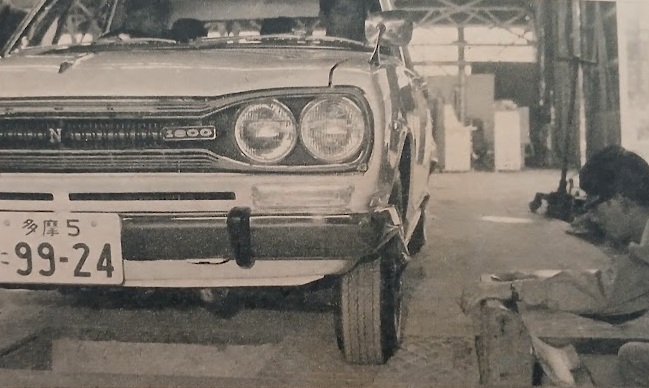
Ishikawa: Regarding the brakes, at first I thought that only the engine had changed in this car, and that the brakes and other components were completely the same. However, the front brake disc diameter and the wheel cylinder size have also been changed, and a brake servo has been added.
Looking at pedal travel, the front brakes engage first, at a pedal force of about 1.5kg, while the rear brakes begin to engage at 4.5kg. Pedal force reaches its maximum at about 30kg and does not increase any further.
Regarding the balance of braking force between left and right wheels: the front uses disc brakes and is very well balanced. The rear brakes are also roughly even, though the test results show that the right rear is slightly weaker than the left.
Comparing front-to-rear brake force distribution across models, the 2000GT was about 70/30, and the 1500cc Skyline was about 65/35. Compared to those, the front braking force on this model is relatively smaller.
The parking brake is mechanical, acting on the rear two wheels, with a walking-stick type lever. Using it with an operating force of roughly 30kg provides about 20% of the vehicle’s weight in braking force. The holding power is very good; it’s not a rachet system, but rather a unique Nissan mechanism. Operating force is less than 35 kg, providing more than 20% of the vehicle’s braking force.
One thing that concerned me was that in forward driving, the parking brake’s power increases proportionally to lever effort across a wide range, but when I gradually increased the lever effort in reverse, the braking power increased so sharply that the wheels almost locked. This is something I’d like to understand better, and I’d like to hear if you have any insight.
Magazine: How about the clutch?
Ishikawa: The clutch pedal force is 9.5 to 10.5kg, close to the 11kg of the 2000GT, with disengagement requiring about 6 kg.
The accelerator is very light. To maintain a constant 50km/h, the pedal force is about1 kg, and when accelerating rapidly in second gear, it was about 1.2kg. When pressed down to the floor, the force reaches roughly 4 kg, which are all light values.
Magazine: Regarding brake distribution, does the fact that it’s slightly strong at the rear mean that it’s easier to provoke rear wheel lock?
Okazaki: From my experience driving it, that did seem to happen a little early.
Ishikawa: Why was the front disc diameter reduced compared to before?
Sakurai: This was done because we wanted to ensure ample availability of service parts, and also because standardizing parts with the Laurel and Bluebird would make it easier within the company’s production system. During earlier development of this model, we couldn’t make this change because the parts weren’t standardized yet, but this time we took the opportunity to implement it.
Ishikawa: Are the cylinder diameters the same as the Laurel?
Sakurai: No, the calipers are different, so the overall design is completely different. The other cars use the SC type, but this car uses the Arnett type.
Hirao: And the rear is leading-trailing, correct?
Sakurai: Yes.
Hirao: So why does the parking brake perform poorly?
Ishikawa: The parking brake tends to bind and lock up. Perhaps some component is defective.
Terashima: Compared to internal company data, the parking brake was slightly weaker in this test. In the company tests, the braking did not show these effects.
Hirao: The brake balance definitely shows a smaller-than-usual difference between the front and rear. The rear brakes are a bit too strong.
Sakurai: The standard assumption for this car is that it will be carrying four passengers. If you check the balance with only the front seat occupied, this tendency will show up unless an anti-skid device is used.
Magazine: Regarding the parking brake, the mechanism itself seems very good, but it’s not used on other cars. How do users react to it?
Hirao: As long as it doesn’t loosen or spring back when used, it’s excellent.
Sakurai: If there were any issues in that area, we’d get a lot of complaints, but for the handbrake, there hasn’t been a single complaint so far.
Hirao: That’s why it’s being praised.
Visibility Is the Same as the Previous Skyline
Magazine: Next, let’s go over the visibility data.
Watanabe: The forward visible range is 31° to the right, 61° to the left, for a total of 93°. Vertically, the range is 10° up, 15° down, for a total of 25°. The rear visible range is 12° right, 38° left, for a total of 50°. Vertically rearward, it is 5° up, 8° down, total 13°.
Next, the wiper sweep range is 29° on the right, 48° on the left, for a total of 77°. Including the driver’s viewpoint, the dead angles in the horizontal plane are 8° in the left front blind spot, 15° in the right front blind spot. The total forward blind spot is 23°, and 69° overall.
The solid angle of the visible range is 1.3 steradians in the front, the visible range of the windshield is 0.55 steridians, and the visible range of the area swept by the wipers is 0.391 sterirdians.
Magazine: It’s almost the same as the 1500cc, isn’t it?
Terashima: I think it’s almost unchanged, though there may be slight differences due to the reclining mechanism and its fixed angles.
Low Seats Are a Notable Feature
Magazine: Next, let’s hear the data on body dimensions and design from the Higuchi Lab.
Onda: There haven’t been any major design changes directly affecting the dimensions of this car. The overall body size is a bit small for this class, but the interior dimensions have been kept within the standard range thanks to careful framing of the styling and other aspects.
In terms of minor details, the antenna has been changed to the same type as the Laurel, and the rear door glass, which previously didn’t go down very far, has now been improved, which makes a better impression.
Additionally, required equipment such as parking lights, emergency flashers, and a hazard switch have been added.
Magazine: The handbrake angle has also been slightly altered according to the manual. Why is that?
Sakurai: It was changed to avoid contact with the center console.
Onda: One special feature of this car is the low seat height. Compared to other cars in the same class, the low driving position is a very distinctive characteristic.
Magazine: Mr. Okazaki, how does the low seat feel when you drive it?
Okazaki: I can’t comment on exact dimensions, but as soon as I got in the car, I definitely felt that you sit low. It felt like I fit perfectly in the seat, and it gives a good sense of control.
Higuchi: In our previous studies, we found that domestic cars generally have seats that are too high for comfort in spirited driving. So I think this low seating will be a hit with drivers who prefer a sporty driving position.
Magazine: Was there a particular reason for making the seats lower?
Sakurai: It wasn’t something we did deliberately. We had various people within the company test it out, and made adjustments before deciding. It may be that the seats seem low compared to other cars because they were also somewhat low in previous models, and many drivers were accustomed to that seating position, so we continued with what people liked.
Miyamoto: For highway driving, a lower seat is better. But for parking or garage maneuvers, it’s better to have a higher seat that allows good forward and rear visibility. For drivers who drive with their chin up, we tell them, “relax your shoulders.” So the ideal design would be one where, if you move the seat forward, it becomes higher, and if you slide it backward, it becomes lower. That way, both conditions can be accommodated.
Magazine: Dr. Higuchi, please comment on safety.
Higuchi: When we last tested the Skyline, we gave it 86 out of 100 points. For this model, it came out as 89 points, showing improvement. The main reason for the higher score is the addition of hazard lamps and emergency flashers, which contribute significantly. The seats are also better, which increases the safety margin.
Looking more closely at reach and ergonomics, there’s a slight improvement in how far controls and buttons are from the driver, so it is improved in this regard. In terms of the subjective impression, the difference is only about one point, but the measurable difference in quality is two points, bringing the total to 89 points.
Also, this is a good opportunity to make a suggestion: instead of just checking safety visually as we have been doing for these tests, it would be better to review companies’ internal data from actually crashing or damaging cars in controlled testing. If this could be done, it would enable a much more realistic safety evaluation.
It might soon be the right time to share internal company data publicly. Manufacturers conduct extensive research and experiments, and letting the public know about it could also help boost future exports.
Magazine: How about maintenance?
Higuchi: The Skyline was the first car in Japan to be intentionally designed to be very low-maintenance, and has a tradition of “sealed” engines and “thousands of kilometers without lubrication." So, just like the anti-reflective gauge lenses, it goes without saying that you just need to change oil every 5,000km and check the engine; after that, you can basically leave it until the next vehicle inspection. So, there are no maintenance issues.
Hirao: What type of windshield glass are you using?
Sakurai: It’s fully tempered glass.
Hirao: This has been a topic of some discussion, but I think fully tempered glass is better. Some say that with fully tempered glass, you can lose visibility when it cracks, but our research shows that there have been very few cases where this has led to a serious accident. Even if the glass does crack, you can quickly restore visibility by breaking it by hand.
Overall, I think glass that is less likely to shatter is safer, and an argument can be made that it is far more dangerous for the glass to break open and allow large objects to enter the car.
Magazine: Could there be a case where visibility suddenly disappears and the driver slams on the brakes?
Hirao: Psychologically, the driver’s response shouldn’t be to slam on the brakes. They should be instructed to clear a hole by hand and come to a stop gradually.
Ishikawa: In terms of safety, the biggest issue in crash tests is how the seats are installed. With sliding seats, they’re usually only secured on one side. So when a dummy is placed in the car, it typically flies forward in a crash. How are you addressing this?
Tanaka: The installation of the seat is regulated by MVSS (US Federal Motor Vehicle Safety Standards), and we follow that standard.
Goto: What we are currently doing is MVSS-compliant, and while this is done mainly for export to the US., the fundamental safety approach is applied to all vehicles, whether they are exported or sold domestically.
Hirao: I think we need to examine MVSS itself more critically. In particular, taking the seatbelt from a mounting point on the floor is questionable. Ideally, the belt should go to the occupant from the seat, not from the floor. At first, the three-point belt might fit the body securely, but the seat can be moved, which creates a mismatch. So, fundamentally, the current system has its limitations.
Higuchi: Even with seat sliding, I don’t think most people use the full hundred or so mm of travel that is usually provided. I think it would be fine for seats to have two sliding positions, forward and back. and just lock into each one. For long trips, use the rear position; in the city, move it forward. That’s sufficient.
Hirao: I wonder if, in car interiors of the future, the front seat area might be left completely open, with all the instruments mounted behind it, viewed through the rearview mirror. And when necessary, the steering wheel could move away in an instant, replaced by something soft that pops out instead. This might be the direction of future interior design, don’t you think? (laughs)
Magazine: On the subject of production mentioned earlier, what are the production plans for the Skyline series?
Tanaka: For the series, roughly 10,000 units are planned within this year. Exports are not going to the US; the main markets are Southeast Asia and the Middle East. Currently, we are not considering the US market.
Magazine: Something like the 2000GT would go over well there, wouldn’t it?
Tanaka: In today’s American market, it’s not a time to increase sales by adding more models. In fact, there is a shortage in the supply of cars, so rather than adding more types, it’s better to increase production of the models currently available.
Hirao: What are your thoughts on the sculpted design on the 2000GT’s body sides?
Tanaka: Lately, it’s actually been very well received.
Hirao: Personally, I’m not very fond of it… (laughs) So I wondered how that would turn out, and I guess I’m just behind the trend after all.
Magazine: It seems to be popular among young people.
Tanaka: After all, when it comes to trends, almost anything can be seen as good once it becomes popular.
Okazaki: The earlier Prince-era cars were very good when they first came out, but over time, people got tired of them. By contrast, when this new model came out, it wasn’t so good at first. But it’s gotten better and better, and now, I think it’s become a really good car.
Magazine: We’d like to conclude this roundtable with Mr. Okazaki’s words of praise. Thank you very much.
Postscript: Story Photos