Nissan Skyline 2000GT (1970)
Publication: Motor Fan
Format: “Bubble Index” Road Test
Date: February 1970
Authors: Yasuhei Oguchi, Masahide Sano, Atsuro Sasaki, Kazuhiko Sanbon, Atsuhiko Okubo
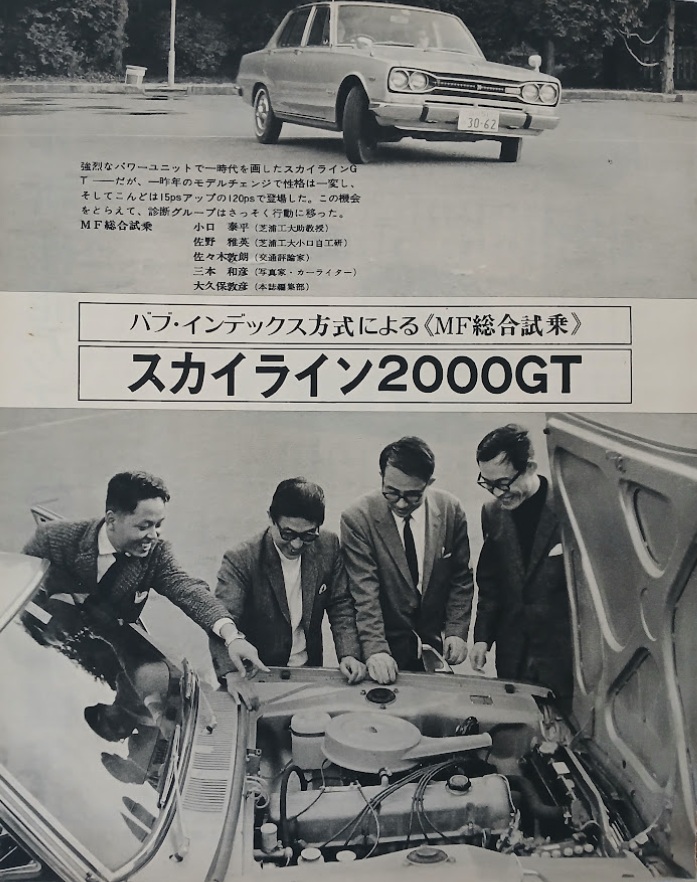
The first Skyline GT defined an era with its powerful performance, but its character transformed dramatically with the model change two years ago. Now, a minor change has been released with an additional 15ps, bringing total output to 120ps. Seizing this opportunity, our team immediately sprung into action.
Skyline 2000GT: Comprehensive Bubble Index Test Drive
The subject of the second installment of our comprehensive test drive series is the Nissan Skyline 2000GT.
This car is so well-known that it goes by the nickname “Ska G” among young sports-car enthusiasts, many of whom are rendered breathless at the mere mention of the letters “GT.”
In 1964, when Prince was still independent from Nissan, the company took the chassis of its Skyline 1500, extended the nose, and fitted it with the Gloria’s six-cylinder OHC engine uprated with triple Weber carburetors, creating the original Skyline 2000GT.
Such an endeavor was unprecedented in Japan at the time, and its appearance was hailed as a public sensation. What quickly elevated the Skyline GT’s status to something approaching a legend, however, was that it went on to achieve near-total dominance on the circuit, winning race after race in the domestic motorsports scene.
In response to the popularity of the “Ska G” as an idol for young motorsports fans, a more mildly tuned A-type was introduced (curiously, the heavily tuned B-type came first, with the A-type appearing later, a reversal of the usual order). At the same time, the manufacturer energetically promoted its image as a high-speed touring car with a strong sporty character.
The expression “wolf in sheep’s clothing,” which would later be used in advertisements for similar models from other manufacturers, was, at that time, widely regarded as a reference to the Skyline 2000GT itself.
Prince later merged with Nissan, and the car became known as the Nissan Skyline 2000GT. There were minor changes along the way, but in the fall of 1968, in conjunction with the model change of the Skyline 1500, it too adopted the current body style.
However, the GT model retained its “traditional” design features of a six-cylinder, 2000cc engine and long-nose proportions.
Tracing the development story of the 2000GT is quite complicated, and since most readers are already aware of it, we will refrain from going into the details.
What did attract attention at the time of the model change, however, was the new car’s specification of 105ps, a single carburetor, and a 4-speed transmission. The reasoning behind this was later explained by the appearance of the GT-R with the R380 engine, but at the time of the 2000GT’s announcement, it left many people scratching their heads.
The commonly asked question was, “It’s still wearing sheep’s clothing, but where is the wolf?”
Last fall, with the introduction of the Skyline 1800, the Skyline 2000GT received a 15ps increase, bringing output to 120ps. The question is, what will the reaction be this time?
A Subtle 15ps Power Increase
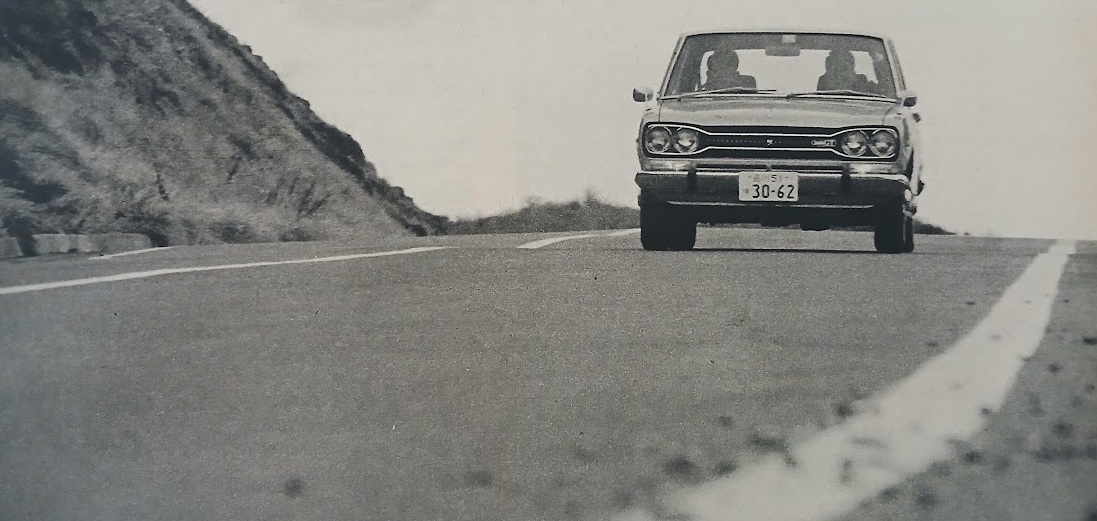
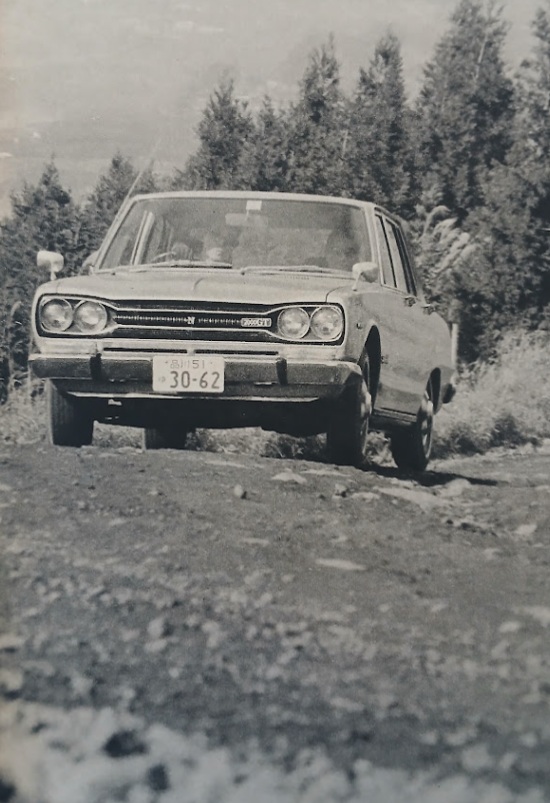
The route for our test was almost the same as in the first installment, from Tokyo (Tomei Expressway) to Atsugi (Atsugi-Odawara Road) to Odawara (Hakone Turnpike) to Moto-Hakone, then from Hakone through to Gotemba, and then back on the Tomei Expressway for the return to Tokyo. However, this time, taking rough-road driving in Hakone into account, we turned off at Sengokuhara just before the Otome Road and took the old road over Nagao Pass (National Route 136).
This time, a Skyline 1800 Sporty Deluxe was chosen as the accompanying car to allow us to compare the two models. As usual, Sanbon, Oguchi, and Sano were in the main car, while Sasaki and Okubo were in the accompanying car.
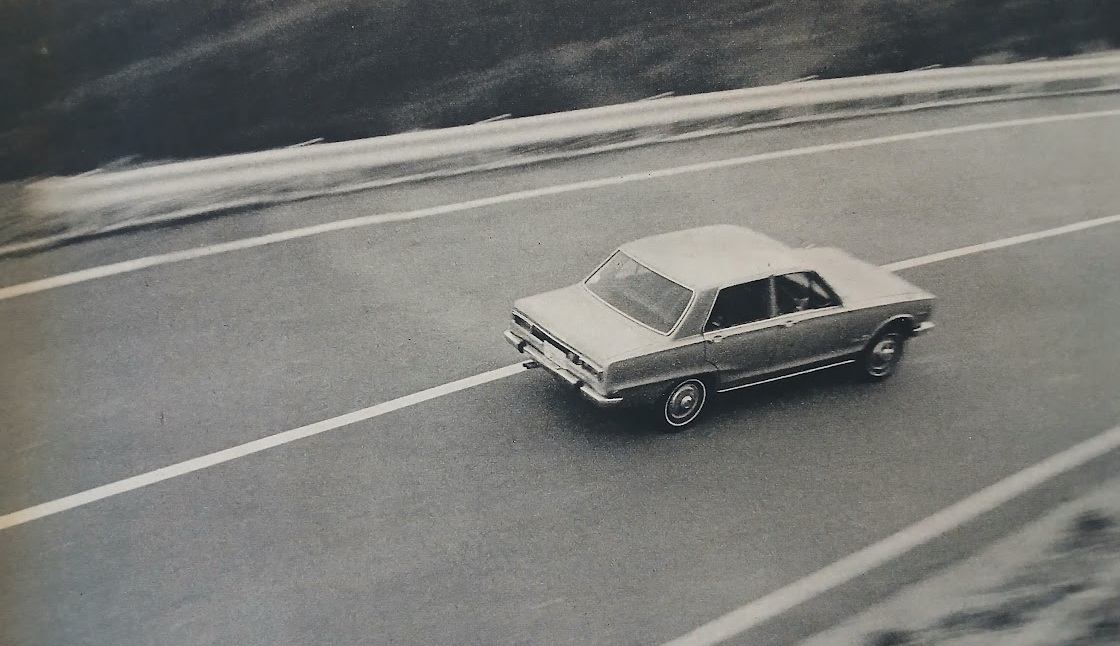
After refueling at a gas station on the Tomei Expressway at Seta, the silver metallic Skyline 2000GT and the crimson 1800 set off one after the other. As soon as we passed the Tokyo toll gate on the Tomei Expressway, the 2000GT began to pull away from the 1800 with ease. “As expected, its swiftness makes it seem that it hasn’t disappeared that far into the sheep suit…”
“Just as you’d expect. It has the kind of response that makes it seem to vanish smoothly.”
“And without feeling like you’re really pushing it, either.”
There were sighs mixed in with the voices from the accompanying car. And laughter–it’s better not to be lovestruck too quickly, you know.
Prior to this, various opinions were heard on the reason behind the power increase to 120ps.
“The subsequent models of each car on the market have become more powerful. While it still had enough in reserve for high-speed driving, 105ps was not enough to maintain the 2000GT’s outsized ‘displacement’ on the market,” was one view.
Another view pointed to “internal circumstances." “With the addition of the 100ps Skyline 1800 to the series, it would be awkward to have the GT, with its 2000cc displacement, only 5ps ahead. They had to strengthen it to further separate the two.”
“A shock treatment brought it back to life,” someone joked, drawing laughter. Still, it is fair to say that the motivation for the 15ps increase was to match the sporty mood and make the car more relaxed in high-speed driving.
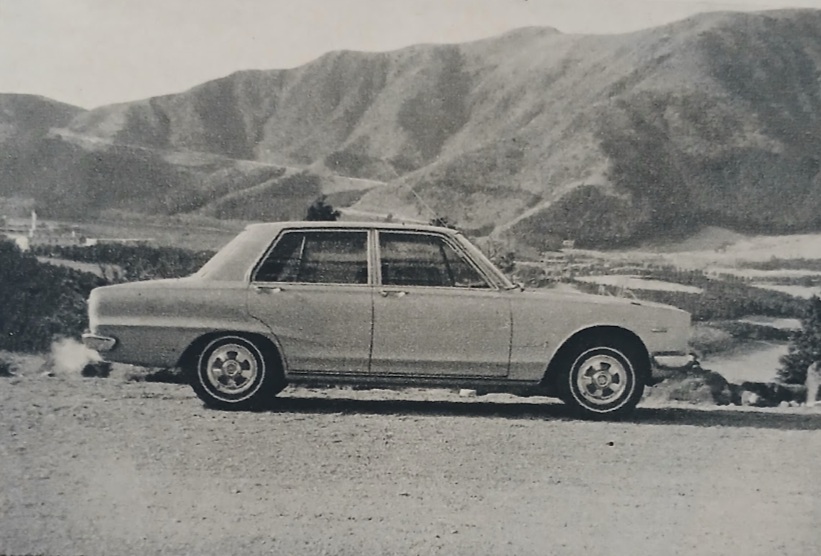
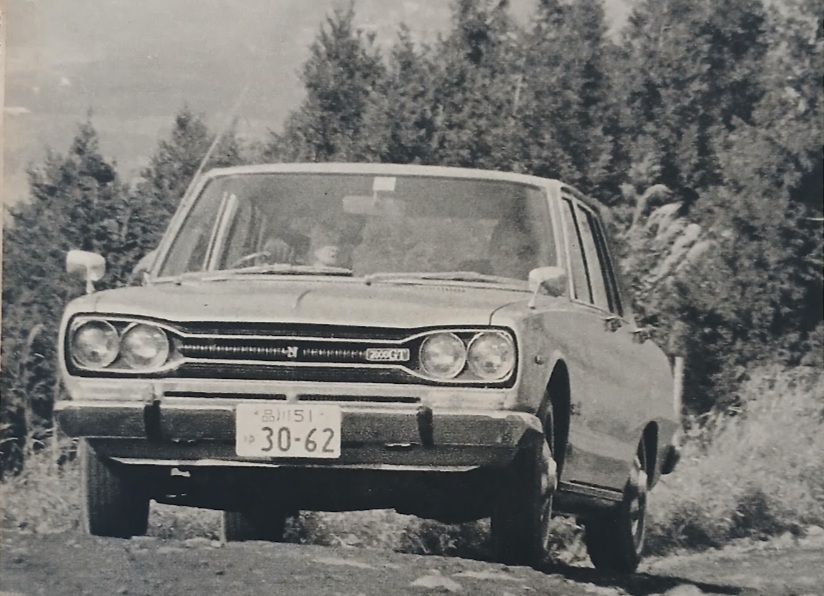
As for the styling, it has been over a year since the new body style appeared, so there is no need to dwell on it here. The front grille has undergone a minor change, matching that of the Skyline 1500. However, the taillights remain the same as last year’s model, recessed deeply within their outer guards. This is a design touch we applaud. The deep placement makes them less likely to be damaged in a rear-end collision, and it also makes the brake lights easier to see in daylight. There’s no need to make changes for the sake of change with each minor update. If a feature has presence and character, there is no reason not to retain it with confidence.
By this point, we had already begun various tests while driving on the Tomei Expressway. What were the results?
A Gentlemanly GT With Underlying Strength
As for driving performance and acceleration, everyone in our group was familiar with the original “wolf,” and some already have experience driving the GT-R, which has cast off its sheep’s clothing entirely, so the reaction was a rather mundane, “I guess it’s about what you’d expect.”
“Maybe the GT name raises expectations too high. Somehow it feels a little lacking. Speaking purely for myself, I think it’s best to view it as a high-speed family sedan.”
However, there were also voices like this:
“With a vehicle weight of 1095kg, it feels very substantial. Yet compared with other 2000cc cars, it is genuinely agile. You can normally drive it as a well-mannered sedan, yet it still has enough performance in reserve to turn wolfish when the need arises."
As an ideal use case, imagine a business trip from Tokyo to Osaka. On the expressway, you can accelerate up to 100km/h with little effort, using a light throttle foot. In fourth gear, you can drive casually at an easy 100km/h, with the engine turning around 3800rpm. The reserve acceleration when driving on the highway driving translates directly to safety. You finish your business in Osaka, then take the Tomei again all the way back. That’s how this car is meant to be driven. And what’s more, you can drive it in your normal town clothes, not dressed up in a turtleneck and racing suit. As one of us put it, “It’s a gentleman’s car. And the car itself is also gentlemanly.”
Acceleration from 0-80km/h takes 10.3 seconds, and it takes 13.4 seconds to reach 100km/h. The latter time, under 15 seconds, is quick enough to indicate that it has plenty of potential as a sporty car.
Taking a look at overtaking acceleration, it takes 173m and 6.8 seconds to overtake a car traveling at 60km/h, with a final speed of 92km/h. And if you try to overtake a car going 80km/h? The distance doubles to 348m, but the time is still a short 10.3 seconds, and the final speed is 122km/h.
Oguchi said, “We call it gentlemanly, but I can really sense its underlying strength… it’s a powerful car.”
We continued the in-gear performance tests. When accelerating to merge on an on-ramp, an important factor on expressways, it took 251m and 12.9 seconds to go from 40km/h to 100km/h. With the Tomei Expressway’s acceleration lanes being 250m long, there is no need to worry about entering the flow of main lane traffic.
For climbing ability, we used the same 1,150m section of the Hakone Turnpike that we used last time. It’s an up-and-down course with a maximum uphill grade of 10%. The time required was 43.6 seconds.
In addition to this hill-climbing test, we also conducted a comparative test. Climbing the same section, the 1800 Sporty Deluxe was able to maintain 65km/h in third gear, but the 2000GT managed to reach 80km/h. In top gear, the 1800 could only just manage the climb at around 50km/h, while the 2000GT climbed comfortably at 60km/h. This was measured on the steepest section where the indicated gradient was 10%, and our method was to observe the drop in speed as we gradually pressed the cars’ accelerators to the floor. It may be somewhat unfair to the 1800 to directly compare it to the 2000GT like this, but it does show how big the difference is for reference.
Turning next to handling stability, the first point we considered was straight-line stability with one’s hands off the steering wheel. When we twitched and released the wheel, the convergence took just over one cycle. Seen from the accompanying car, the 2000GT appeared to settle quickly and smoothly. The apparent movement was small. However, the testers inside the car gave it a poor rating. The instrument readings show that it settles well, but to the human senses, the way it settles feels drawn-out and leaves a sense of unease.
“It probably comes from a variety of factors, such as the lateral rigidity of the tires, the suspension, weight, the position of the roll center, and the aerodynamic center, but ultimately, whether it settles well or not is determined by our human senses. It can be said that the high-speed damping effect is insufficient. I think it’s probably the jerk acceleration (the rate of change of lateral acceleration) that causes the discomfort. All humans have the ability to detect this, but it doesn’t register on instruments, at least not with the current measurement methods. That may be why it simply feels uncomfortable,” said Oguchi.
This has yet to be clearly explained theoretically. In terms of the measured lateral acceleration data, the numbers are not bad. However, the driver is left with a lingering, unsteady feeling. This is not unique to the Skyline 2000GT, but it is regrettable that, despite having excellent power performance and acceleration, this aspect is still lagging behind. If this problem could be corrected and resolved, it could become a truly superb GT. We would like to see this become a major goal for Japan’s automotive industry in the future.
As for steering, the car was equipped with the optional wood-rimmed steering wheel. In terms of feeling, it has the same crisp feel common to Nissan cars. This trait is often described as a “dry” (as opposed to “wet”) steering feel. This is a matter of personal preference, so it’s hard to judge absolutely, but for a sporty car, we would definitely recommend this dry type. All of the testers responded positively to this steering feel.
Of the transmission, the group said, “It’s a good transmission that matches the car perfectly.” Also: “It fully brings out the virtues of the Warner-type unit. The gear ratios, shift feel, stroke, and weight of the lever are all perfect.” Some even went so far as to ask why the shift feel is so different in the Fairlady Z, since both are Nissans.
We found the crisp, precise engagements perfectly suited to the task of managing this powerful car. The gear ratios of 3.549 in first gear, 2.197 in second, 1.420 in third, and 1.000 in fourth are unchanged from the 105ps model. Even so, the solid, satisfying shift feel drew praise from everyone.
“Nissan’s transmissions are widely recognized for their quality. You often hear acclaim for their clean, decisive shifting,” someone remarked, offering a bit of insider perspective.
“On the other hand, I wish they would do something about the low-frequency gear noise.”
As for the clutch, we weren’t as enthusiastic. “The first thing I noticed when I got in was the weight of the clutch. I don’t like it,” said Oguchi and Sanbon.
“When I drove the 1800, I felt its clutch was easier than the one in the car I usually drive (a Bluebird SSS), but the 2000GT was a different story. However, I may have simply been getting tired from using it repeatedly around town,” said both Sasaki and Okubo.
The pedals give a strong sense of responsiveness to initial pressure, then seem to give way slightly as you depress them further. The difference in pedal force between the brake and accelerator can increase fatigue. Oguchi emphasized that this point isn’t limited to pedal force, and that more serious attention should be paid to control harmony in general. This includes inputs to secondary controls such as switches and knobs.
Regarding the controls, opinions included: “They’re scattered, and searching for them disrupts your concentration” (Sanbon). “The console-mounted light and wiper switches are easy to find by feel and pose no problems in use” (Sano). “The fuel and voltage gauges on the console would have been better positioned up near the radio and heater” (Sasaki). The small size of the ashtray came in for harsh criticism as equipment on a long-distance, high-speed touring car: “It looks like a chest of drawers for hina dolls…”
Problems With Wind Noise and Seats
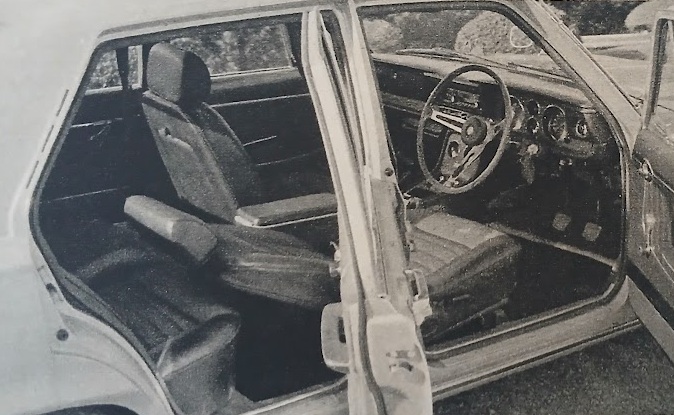
In terms of comfort, we found some issues with the seat. “The bottom cushion pinches too tightly at the sides, and you feel like you sink into the middle. But the balance between the cushion and the backrest is off, so your back isn’t supported at the sides when cornering,” said Sano and Sanbon.
“I think it would be better to have more support for the lower back,” said Oguchi. “The bottom cushion grips the hips a bit too much, but it’s good that its front edge doesn’t press up against the thighs. Overall, the seating retains the typical characteristics of Japanese cars, which tend to have high seats."
By comparison, the Fairlady’s seat cushion has a 1.5cm height adjustment, allowing it to be tailored to the driver’s body. For a car in this class, at least that level of consideration would have been welcome.
On the other hand, the rear seats are near-perfect. Legroom is generous and the seats themselves are comfortable. However, some commented: “The backrest angle is a bit too reclined. I suppose it depends on personal preference…”
As for interior noise, at 60km/h we measured 67 phons, at 80km/h around 72 phons, and at 100km/h only 75 phons. This last figure was particularly noteworthy. It is natural that noise increases as the speed increases, but in this case, the curve becomes gentler as speed increases. Especially considering that there will likely be more opportunities for continuous high-speed driving in the future, 75 phons at 100km/h is a significant and commendable result.
However, wind noise is relatively loud. After trying various things, it appears that the cause is the antenna mounted on the right windshield pillar. The antenna sits about 1cm above the surface of the pillar, being fixed at the upper and lower ends. As air passes through the small gap, it seems to create friction noise and turbulence, resulting in a fairly pronounced wind noise.
Regarding ride comfort, the Skyline series uses a typical strut-type suspension for the front wheels, while at the rear, it employs the same semi-trailing arm independent suspension as the Bluebird and Laurel. The tires are 6.45-14-4PR bias-ply.
The resulting ride leaves little to criticize. Comments such as, “You don’t feel the sense of speed,” and “It feels stable, so you can drive for long distances” were in the majority.
However, one tester observed, “The ride definitely reflects the car’s price,” but “I don’t know if it’s suitable for the image of a GT car…” On that point, we’ll let the product be judged on its own merits.
Looking at safety, the comments were mostly positive. “I tried the three-point seat belt, and the shoulder belt that hangs from the ceiling supports your shoulder properly, without rubbing against your neck. That’s good,” said one driver. “The outer panels are 6mm thick, so the body feels very rigid,” said another. “The disc brakes use double calipers, which is also good, and they feel strong and stable.” On these points, all the testers were in agreement.
The interior is finished entirely in black. From the seats to the headliner, everything is black, except for the woodgrain on the dash panel (which feels cheap, being nothing more than a printed pattern on a metal plate). This is probably a matter of personal taste, but we found the black interior quite soothing.
That said, the steering wheel spokes are not anti-glare treated, and bright trim is used on the interior frames for the front and rear triangular windows. Why they would do this, especially when the exterior surfaces are finished with an anti-glare coating, is hard to understand. It may seem like a small thing, but shiny chrome trim is also scattered around the instrument panel. Despite the increased power and performance, there have been no improvements in this area; it is unchanged from before.
We mentioned earlier that the wood-rimmed steering wheel was optional, but the latest catalog appears to list it as standard equipment. In any case, even if the wheel rim is molded synthetic resin, the spokes likely remain glaringly bright. It would be better if the kind of anti-glare treatment used on the Nissan Bluebird SSS were used instead.
As for the sound of the horn, it sounds quiet when heard from inside while driving, but heard from the outside, its tone is clear and high-pitched. Among Nissan horns, it is probably the best, and is possibly one of the best fitted to any domestic car.
Another point concerns the headrests, which are standard equipment to protect the head and neck in a rear-end collision. Normally, these are mounted using two metal posts inserted into the seatback, but in the case of the Skyline, the headrest is supported by a single, fairly thick steel plate. To adjust it, you loosen screws on the back of the backrest and move the headrest into position. If you do not fit the screw properly into the next adjustment hole, it will not lock into place. If you notice this while driving, you will have to stop the car and move to the rear seat to adjust the height. It’s impossible to adjust it by reaching back and moving it while sitting at an intersection.
The cushion feels soft when your head contacts it, and one wonders if it could sink in deeply, then rebound and throw the head forward in a rear impact. It may have been better to make it a little firmer.
High-Quality, Substantial High-Speed Car
In conclusion, we have raised various criticisms, but when we scored the Skyline 2000GT in terms of overall product value, it returned high averages, as you can see from the hexagonal scoring chart. It could be said that this type of car tends to appeal to the preferences of enthusiasts like ourselves, but that wasn’t necessarily the case when we were driving and testing the 2000GT. Instead, what it delivers is a fairly high overall standard. In terms of acceleration, ride comfort, and handling, it offered satisfactory responses to our critical eye. If anything, it could be said that we were the ones holding high expectations for it as a car of this type and class, and were watching coldly to see whether it could live up to them.
As for fuel economy, we initially recorded an astonishing figure of 13.5km/l between the Tokyo Interchange and Ebina Service Area. From Ebina onward, we ran various tests and took measurements, followed by repeated runs up and down the Hakone Turnpike at high rpm. During the demanding hill-climb test, we must have gone up and down the course more than a dozen times. After that, we drove along the winding Hakone mountain route, covering a total distance of 135km. Under these hard driving conditions, fuel consumption was 6.5km/l. One is tempted to add the words, “even so” to this. The next day, after driving at full speed from Gotemba, we covered 99.4km on the Tomei Expressway from the Tokyo Interchange to Shinagawa, navigating the city rush hour traffic, using 10.8l of fuel. Our overall fuel economy for the the trip was 9.2km/l. Despite our driving style being harsher than that of the average driver, the car still managed to deliver fairly economical results both on the highway and in the city.
The price is also low for a six-cylinder, 2000cc class GT car. It fully conveys the feel of a high-grade sports sedan. While there are some issues in areas such as the interior, it would not be an exaggeration to describe it as a uniquely accomplished product for a domestically produced car in this class.
When we posed the question, “Who would buy this car, and for what purpose?”, the answers that emerged were: “A capable gentleman who likes sporty cars.” “An active young enthusiast with ambition, good sense, and skill.” Even, “A woman, if she’s not interested in showing off, but has real driving ability.”
There was one last thing that everyone in the group agreed on: one more letter should be added to the car’s name.
“In Japan, the term ‘GT’ is associated with sportiness or aggressive driving. But the nature of this car is closer to the true meaning, Gran Turismo. Although it appears mild-mannered at first, it hides an inner strength that borders on extravagance. For a car with such a character, the simplicity of the GT badge and its connotations may be doing it a disservice. Now that the GTR has been released, it might be better to give it a more evocative name, like GTL, for example. Couldn’t this be a car capable of opening up a new customer base?"
How to Read the Bubble Index
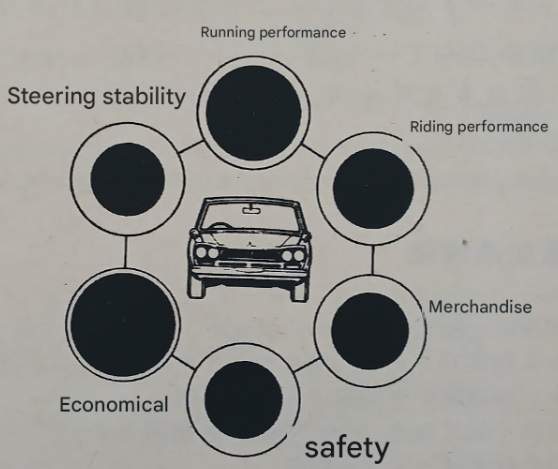
Every car has what might be called character. It can be said that this character emerges from a combination of factors such as performance and functionality, intended use, vehicle class, and design philosophy. However, not all aspects of the car’s character are clearly revealed to the user. The purpose of this series is to unravel the character of a car by evaluating six important aspects of its performance.
The size of the circle at each vertex of the index represents a rating of the attribute indicated there, and by comparing the six circles, one can also get a sense of the balance among them. In the case of the Skyline 2000GT, it received a particularly high rating for economy, but this is because it is a 2000cc class car priced at 860,000 yen, making it exceptionally economical within the context of its class. Otherwise, apart from some issues with handling stability, the six performance areas all received good scores and were well-aligned, making it a well-balanced model overall.
We have explained our methodology for this test series, but our hope is that, using these tests as reference material, the final judgment will be made by the readers themselves.
Postscript: Story Photos