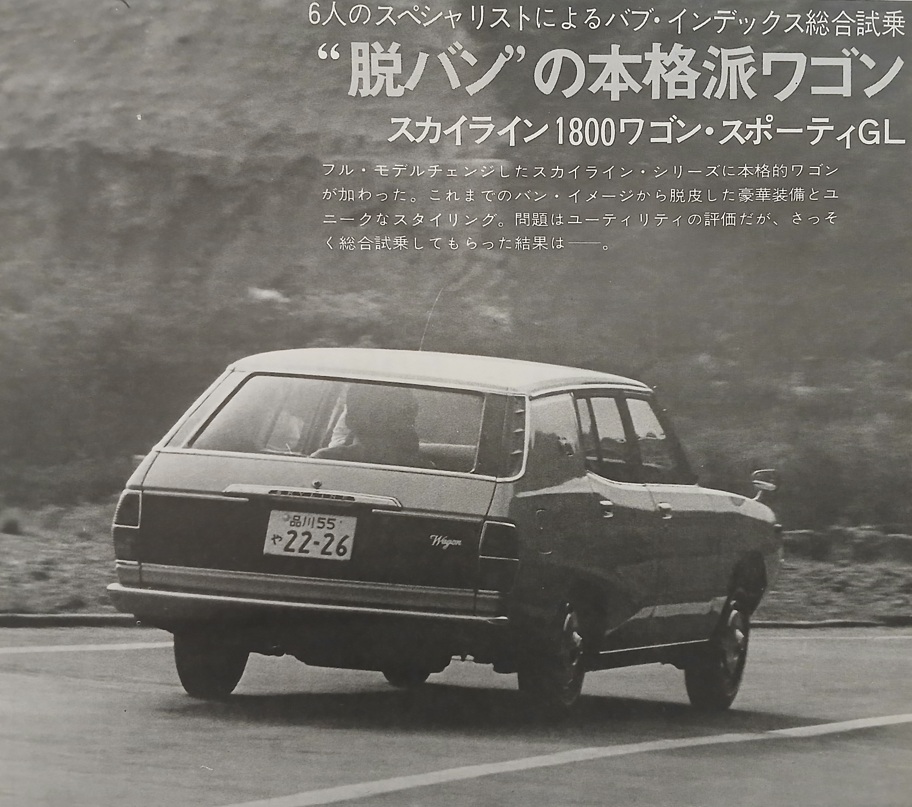
Nissan Skyline 1800 Wagon Sporty GL (1972)
Publication: Motor Fan
Format: “Bubble Index” Road Test
Date: December 1972
Authors: Osamu Mochizuki, Katsuzo Kageyama, Tadao Suzuki, Yasuhei Oguchi, Reiko Ikuuchi, Kensuke Ishizu
A True Wagon, Free of Its Van Origins
The fully redesigned Skyline series has been joined by a true station wagon. With luxurious equipment and distinctive styling, it has shed the commercial-van image of its predecessors. The question is how its utility measures up. We wasted no time in putting it through our comprehensive road test—and here is what our panel found…
What Exactly Is a Wagon?
This is the first wagon to appear in our Bubble Index comprehensive road test. Mention a wagon, and the image that immediately springs to mind is a delivery van, commonly known simply as a “van.” But a wagon is not a van. What, then, is it? Somehow, it is not particularly easy to define in words.
For reference, a look in Kojien (edited by Shinmura Izuru) gives the following definition:
“Wagon: A four-wheeled vehicle. A cart. A handcart.”
That doesn’t tell us all that much.
What, then, do our six specialists think a wagon should be? Their Bubble Session discussion around the table would come after the road test; first, we asked them to “get cooking” on the new Skyline 1800 Wagon Sporty GL.
As usual, test-driver Mochizuki was the first to take the wheel, with Assistant Professor Oguchi in the front passenger seat and Lecturer Sano, manning the test equipment, in the rear. From the Tokyo Interchange of the Tomei Expressway to the Nakai Service Area, the three traveled together while comprehensive measurements were taken for overtaking acceleration, handling and stability, interior noise, and other aspects of the car.
…Clear skies. A light breeze. A beautiful autumn day.
One of the attractions of a wagon is its usefulness for leisure, and the luxuriously equipped Wagon Sporty GL makes you want to drive on and on, heading somewhere far away.
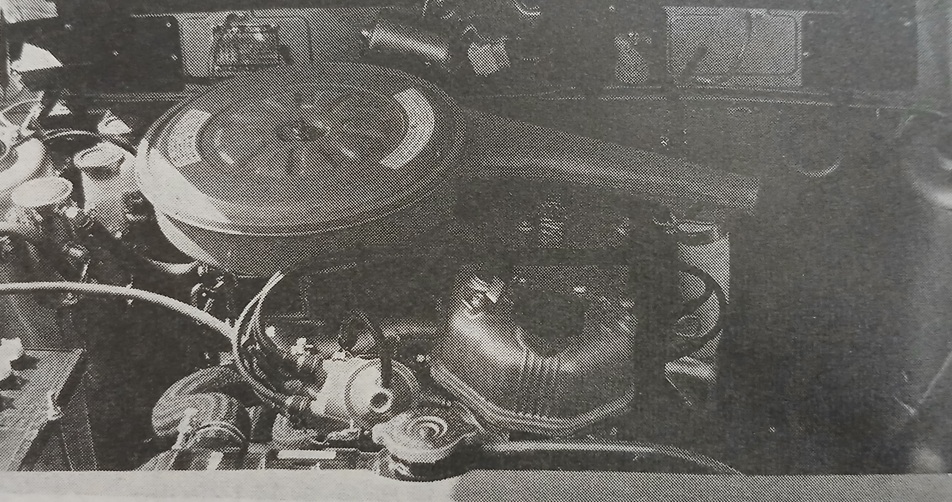
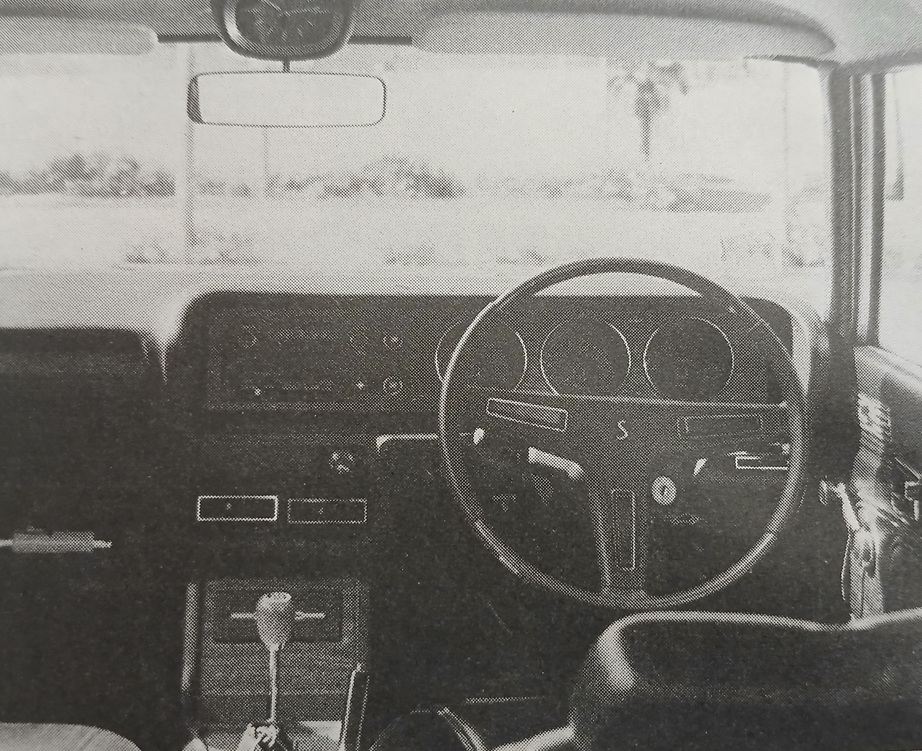
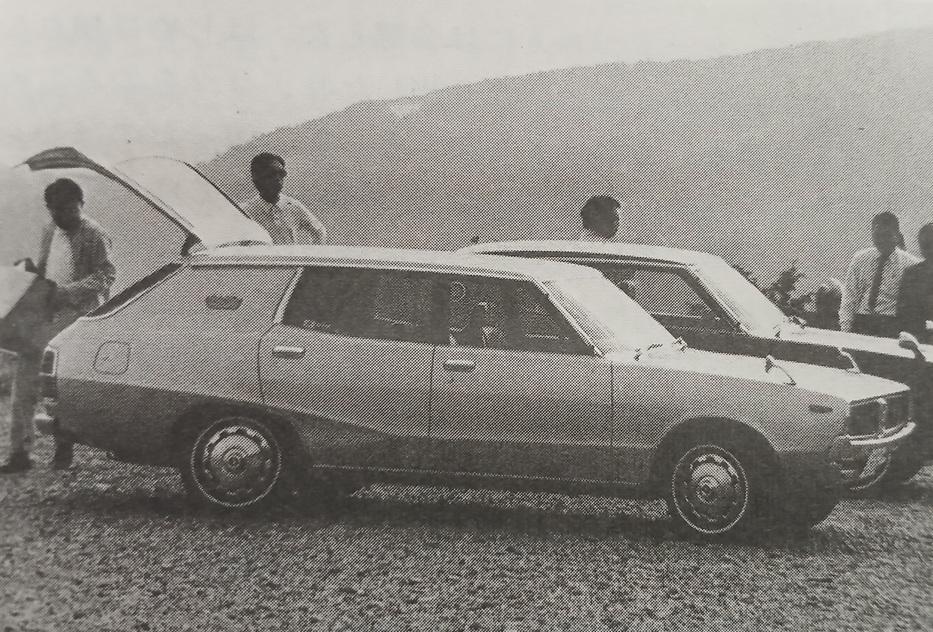
The engine is the G18, an OHC four-cylinder unchanged from the previous Skyline. It develops 105ps/5600rpm and 15.3kgm/3600rpm, and is well-known for being a willing revver. We used a Skyline 1800 Hardtop Sporty GL as our accompanying car. The instrument panel has three round gauges set in a woodgrain fascia and includes a tachometer; in other words, the wagon has been given the same equipment as the top model in the 1800cc series.
At the Nakai Service Area on the Tomei Expressway, Mochizuki handed over the wheel to Professor Kageyama. As the specialist responsible for Handling and Stability, he repeatedly tried hands-off running and lane-change maneuvers. There is a slight tendency for the tail to wander, he reports, but nothing that presents a problem in normal use.
The steering wheel tilts through a range of approximately 40mm, while the finely adjustable seat makes it easy to find an ideal driving position.
Assistant Professor Oguchi, responsible for Safety, also seemed pleased that the effort to give this design “a warm, human touch” has been carried over to the Wagon as well. As he put it, “An extraordinary amount of attention has been devoted to both the styling and the car’s functional qualities in motion, including the ease with which the driver can operate it.”
Ordinarily it would be racing driver Asaoka who charges over the Otome Pass, but once again he was off overseas. His Interior & Comfort assignment was therefore taken over by Motor Fan’s own Suzuki. On the subject of the wagon’s luxury and sporting character, he commented: “From the standpoint of utility, is there really anything to distinguish the wagon from the van? I can’t help feeling that there is a little too much emphasis on the idea that ‘van + luxury equipment = wagon.’"
Given Japan’s particular circumstances and social environment, in which this type of car has developed under the legal classification of a “passenger/cargo vehicle,” it seems likely to be many years yet before the usefulness and applications of the wagon are as widely understood and accepted as they are in Europe and America. This point also came up for considerable discussion during the Bubble Session following the road test. The reports that follow cover that subject along with the driving impressions of the car itself, and we invite you to read on.
Incidentally, Nissan also offers wagon versions of the Bluebird U and Cedric. In passenger-car sales from January through August of this year, 873 wagons were sold out of 82,325 Bluebird Us, representing 2.3%, while Cedric wagon sales amounted to 1,185 out of 39,324, or 3.1%. Planned production of the Skyline 1800 Wagon, we are told, amounts to less than 1%.
What exactly is a wagon? For the moment, these percentages themselves seem to tell us much of the answer to that question.
Performance: Passenger-Car Levels of Cruising Comfort (Osamu Mochizuki)
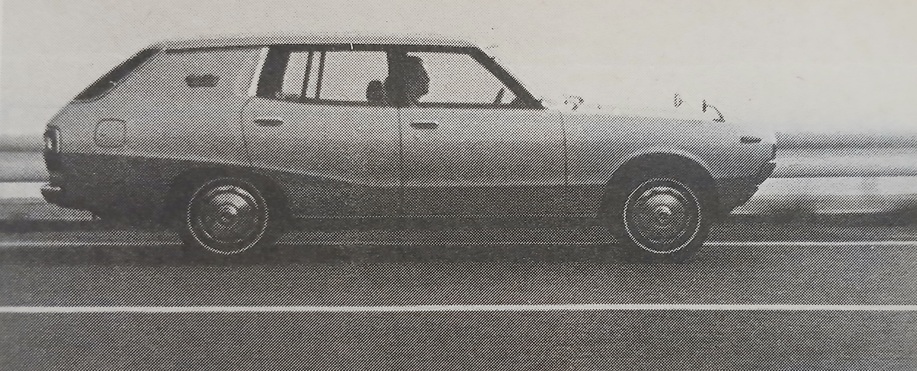
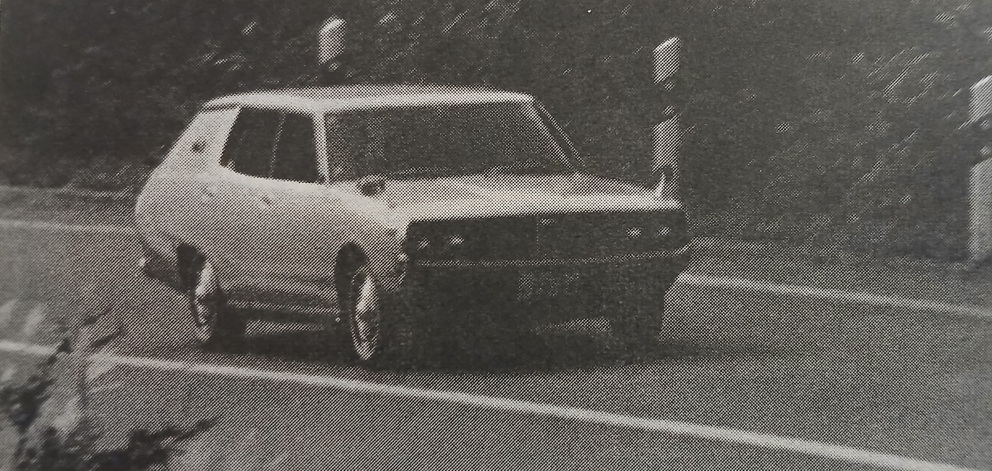
Making full use of the new Skyline’s body silhouette, the wagon has smart styling that makes it every inch a sporting wagon. Its performance is correspondingly strong.
Curb weight is 1045kg, and with five occupants on board the gross vehicle weight is 1320kg. Looking at the specifications for the van, its maximum cargo capacity with five occupants is 250kg. If we assume the wagon has the same carrying capacity, its gross weight at maximum load would be 1570kg.
With an output of 105ps, this gives a power-to-weight ratio of 15kg/ps, which is a reasonable enough figure.
Referring to the performance curves, on a 5% gradient in top gear at 60km/h there is approximately 70kg of driving force in reserve. Since this figure remains virtually constant from around 40 to 80km/h, it is fair to say that the car has plenty of hill-climbing ability even when fully loaded.
The transmission ratios are exactly the same as those of the 1800 Hardtop, and the 3.889 final-drive ratio is unchanged as well. Consequently, the wagon also has good speed potential. At 100km/h the engine is turning 3600rpm in top gear, allowing comfortable cruising on a par with a passenger car.
Up to a certain speed, wagon-type cars tend to generate less lift than notchback or coupe types, and in this respect the Skyline also has good straight-line stability. Once past 140km/h, however, lift inevitably becomes more noticeable, and the car also becomes more susceptible to crosswinds.
The G18 engine fitted to this car is a well-proven unit, with more than four years of service in the Skyline and Laurel.
Its specifications—85 × 80mm bore and stroke, 1815cc, SOHC, 105ps/5600rpm and 13.5kgm/3600rpm—have remained unchanged for many years. Mean piston speed is held to a relatively low 14.9m/sec, and the engine is also well balanced, so cylinder wear is minimal and the block does without cylinder liners.
A hemispherical combustion chamber, a relatively low compression ratio of 8.3:1, and its oversquare proportions all combine to make this an exceptionally smooth engine at low speeds.
Response is somewhat leisurely, but this is an engine that continues to accelerate strongly and consistently. The wagon weighs 1045kg against the Hardtop’s 1015kg, putting it at a 30kg disadvantage, yet up through the middle-speed range there is little to separate them. Indeed, partly because the wagon produces less running noise than the Hardtop, it actually gives the impression of being the smoother-running car.
All models in the Skyline series apart from the Standard and Van are equipped with disc brakes. Since the Wagon’s equipment specification follows that of the 1600 Sedan Sporty GL, it naturally has disc brakes as well. We are told that a 4.5-inch Master-Vac servo is used, but the pedal feel leaves something to be desired. Pedal effort is light and easy to manage up to the servo’s reaction point, but quite a lot of pedal travel is required before the brakes begin to take firm effect.
Although this car has appeared as a full-fledged sporting wagon, viewed in overall terms I think it is fair to conclude that its performance has reached a level appropriate to its class and character.
“The engine is every bit as good as its reputation suggests.” — Oguchi
“The brakes feel weak even with only one person aboard. With every seat occupied and a heavy load in the cargo compartment, I imagine they would be less effective still.” — Ikuuchi
“All the power it needs, and easy to handle as well.” — Suzuki
Handling & Stability: Steering Too Light to Be Reassuring (Katsuzo Kageyama)
I was impressed by the care that has gone into the positioning of the various controls around the driver. The steering wheel is adjustable for tilt, and besides such basic items as the seat, pedals and parking-brake lever, careful thought has clearly been given to making the various switches easy to operate. I was particularly impressed that, even with the seat belt fastened, someone with a short reach like myself can operate everything without difficulty.
The design of the instrument panel may be a matter of personal taste, but no one could deny that the gauges themselves are easy to read. Their illumination, and that of the instrument panel as a whole, is particularly good when entering a tunnel or driving at night. Whether it is the headlamp switch, the parking-brake lever, or any of the other controls immediately around the driver, one senses an effort to preserve the good traditions established with the earliest Skylines.
Since I seem to have done nothing but praise the car so far, if I had to find fault with something, I would say that the shift lever seems a little too far away. That may simply be because my arms are short, but with everything else so exceptionally well positioned, this one point was a bit unsatisfying.
On the road there is nothing particularly remarkable about the handling and stability, but the steering felt light and not very reassuring. Perhaps as a result, I found it difficult to get a clear sense of the straight-ahead position, which was somewhat disconcerting. At high speeds, I would prefer steering with a heavier, more substantial feel.
There were frequent opportunities to change lanes on the expressway, and when I made a sudden steering input at high speed, I thought I could feel the tail wander, which surprised me. I tried it repeatedly, and it was no illusion: the tail definitely has a tendency to wander. In normal lane changes on an expressway, however, lateral acceleration is not particularly high, so this is not enough to present a practical problem. But if the steering is deliberately worked from side to side to unsettle the car, a slow, lingering swaying motion can be felt.
In fact, this tendency is more noticeable on ordinary roads than on the expressway. On a twisting road such as those around Hakone, the residual swaying is quite apparent both as the car enters a bend and as it returns to the straight.
In general, vans and wagons tend to exhibit this sort of behavior because of the greater weight toward the rear, and it becomes even more pronounced when they are carrying a load. Our test was conducted with two people in the front and one in the rear, but with a full load of passengers plus 250kg of luggage, I have little doubt that the tendency would become considerably worse. Since the steering is rather light to begin with, I find this a bit concerning.
In every other respect, there was nothing particularly memorable to report. And if there is nothing to report, I suppose that means there is little to complain about.
“The steering is still somewhat heavy in low-speed cornering.” — Oguchi
“The steering is too light at high speeds.” — Mochizuki
“It goes where you point it, but I’d like a little more sharpness.” — Suzuki
Interior & Comfort: Emphasis on Passenger-Car Character (Tadao Suzuki)
In Japan, there has been a strong tendency to demand cars that look good and offer levels of performance that can hardly be exploited on public roads, rather than placing much emphasis on utility or practicality. Recently, however, alongside a growing demand for utility, the wagon has begun to attract attention in another sense—as an upmarket van, a commercial vehicle with passenger-car qualities.
The Skyline 1800 Wagon shares its body shell with the Van, but has been given equipment equivalent to the GL, the highest-grade passenger-car specification. From behind the wheel, there was nothing at all to remind me that I was driving a wagon.
Three round instruments are set into the woodgrain instrument panel, and there is even a tachometer. The three-spoke steering wheel has a partial leather covering and a tilt mechanism, while the seats are luxuriously trimmed in tricot cloth. This is very much a wagon emphasizing luxury and sporting character. But when it comes to utility, is there really anything to distinguish the Wagon from the Van? I cannot help feeling that there is rather too much emphasis on the idea that “Van + luxury equipment = Wagon.”
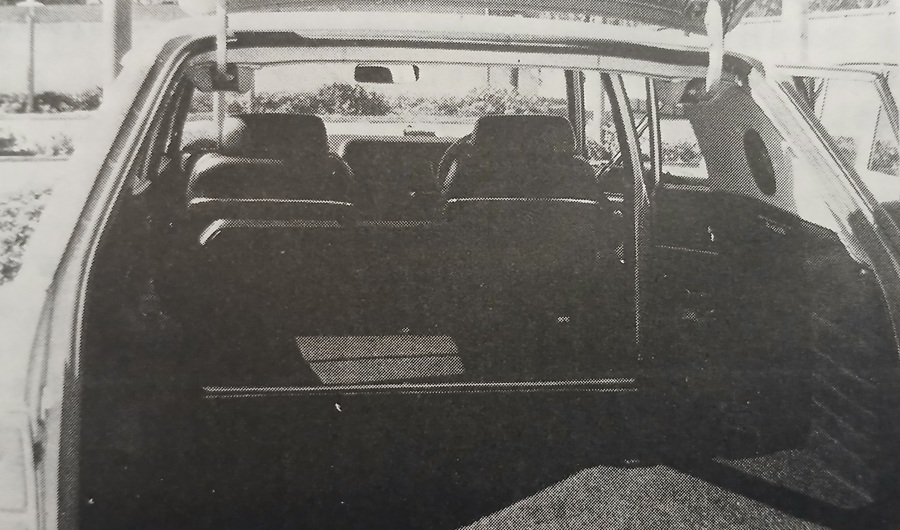
If the aim is to create an atmosphere lacking in the Van and give the Wagon more of a passenger-car character, I would prefer to see details such as gas struts like those used on the Cherry Coupe adopted for the rear gate, and the jack, which is stored completely exposed below the rear seat, stowed away more neatly.
Although the rear seat’s partial tricot upholstery looks appealing, its actual comfort is the same as that of the Van and falls far short of the relaxed seating expected of a passenger car. The Hardtop provides better accommodations even though there is less space. I would very much like to see improvements to the seat cushion and its angle so that occupants can settle themselves more comfortably and securely.
The luggage compartment—the very reason for having a wagon—is carpeted, and folding the rear seat provides a great deal of space. The drawback is that once the rear seat is folded, the reclining range of the front seats is restricted. Along with the shortcomings in rear passenger accommodation, this strikes me as one of the Wagon’s weak points.
For the way a wagon is likely to be used, the 105ps 1800cc engine should be fully adequate, whether by Japanese or European and American standards. By making good use of the willing G18 engine and the fairly close-ratio 4-speed transmission, the car can be driven at quite a quick pace. At medium and high speeds, however, engine noise and high-frequency vibration permeate the entire body, and I suspect that prolonged high-speed cruising could become tiring.
Ride comfort is very much that of a passenger car. There is none of the rear-wheel hopping when lightly loaded that is so common in vans. Conversely, when fully loaded, the rear end is likely to settle quite a lot, placing considerable demands on the rear wheels and, I suspect, affecting the steering characteristics as well.
“The clock in the overhead console is an interesting idea, but it isn’t very easy for the driver to see.” — Kageyama
“The instrument-panel design is good, and the gauges are easy to read.” — Mochizuki
“The seat material feels pleasant against the skin and breathes well.” — Oguchi
“The tricot seat fabric has a very nice feel.” — Ikuuchi
Safety: A Functional Driving Environment (Yasuhei Oguchi)
Until now, Japanese wagons have strongly reflected their origins as dual-purpose vans designed primarily to carry cargo. Somehow, they have never quite been able to shake the feeling of being cargo vehicles—or rather, commercial vehicles. In this respect, the car tested here establishes a much clearer image of a sporting wagon for both passengers and luggage, with its sights set on the leisure-vehicle role.
Among compact sporting wagons, I suppose the outstanding example must be the Volvo 1800ES. The Skyline does not pursue the sporting theme to the same extent, but an extraordinary amount of attention has been devoted to both its styling and its functional qualities in motion, including ease of driving.
If I could make one request, it would be for greater consideration of those riding in the rear seat. The seatback, for example, is rather low. Related to this is the fact that, although “safety pillow” headrests are available as an option, it would be much more convenient if they were a built-in type that could be brought into position with a single action rather than having to be adjusted each time. On a long drive, having nowhere to rest one’s head can be surprisingly tiring, all the more so when the seatback itself is low.
People are generally quite adaptable, so unless something is seriously amiss they will become accustomed to almost any control layout. Even so, when one considers the need to act instinctively in an emergency, ambiguity and awkwardness of operation should be avoided wherever possible. The controls, instruments and everything affecting visibility make up the points of contact between driver and car, making them fundamental to comfortable and safe operation.
In this respect the test car is exceptionally well thought out. All of the controls are easy to operate even with the seat belt fastened. The combination light-switch lever is easy and natural to reach, and so are the wiper switch and cigarette lighter.
The gear lever gives the odd impression that it has to be operated with the body turned slightly sideways, but this trait has been carried over so faithfully from the previous Skyline that one might regard it as a sort of tradition. Since the lever requires an appropriate amount of effort and engages each gear with a positive action, it is not particularly objectionable. If that were not the case, though, I suspect its position would be a matter of debate.
As for the seat belt, it left me rather perplexed. At first, being unfamiliar with it, I found myself pulling the belt in and out repeatedly, but with practice I could fasten it correctly on the first try. Besides that, what bothered me was the feeling that the belt gradually tightened as I moved in the seat. Perhaps it is not well suited to a driver with poor posture…
At this point there is little need to dwell on the car’s safety features; it can be considered fully equipped. The one particularly novel feature is the tilt steering wheel, which can be adjusted through a vertical range of 40mm.
“It’s good that the seat-belt retractor is built into the interior trim. But there’s nowhere to stow the inner belt, so it ends up getting ‘lost.’” — Ikuuchi
“The brakes left me lacking confidence.” — Suzuki
Economy: Only 10,000 Yen More Than the Sedan—and Good Value (Reiko Ikuuchi)
Forgive me for beginning with a slight digression, but I was curious to see how much the wagon versions of other models cost, so I looked through this magazine’s new-car price guide. To my surprise, wagon prices are not listed.
We may understand that “a wagon is a passenger car, while a van is a commercial vehicle,” but perhaps we are still not accustomed to thinking of the wagon as a passenger car. For that matter, even the manufacturers themselves, who are presumably eager to promote wagons as leisure cars for a new era, still publish brochures grouping the “Wagon and Van” together. Thinking about this, my first impression was that the average buyer, if they are going to spend more than 800,000 yen anyway, may decide that they might as well buy a passenger car after all.
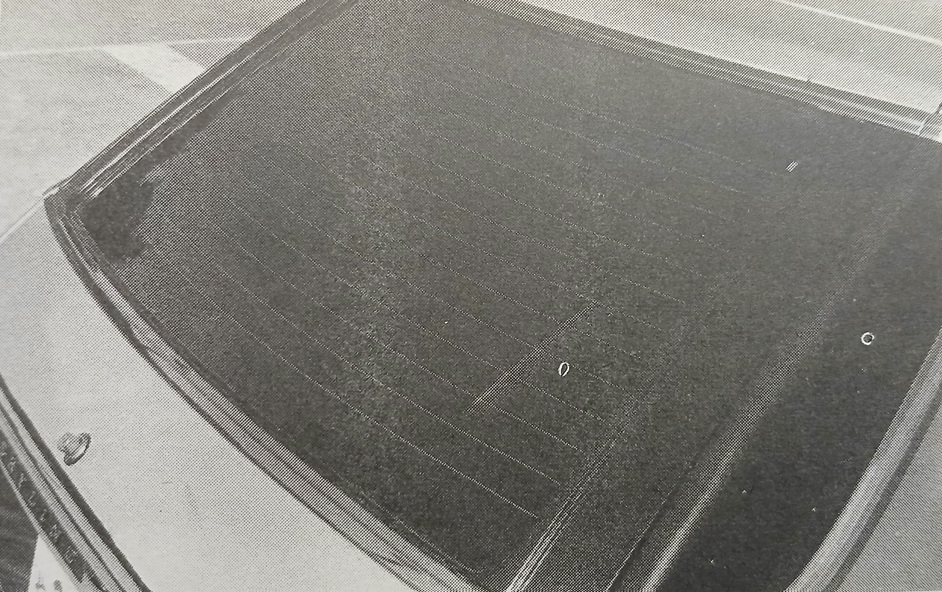
Now, the standard cash price in the Tokyo area for the 1800 Wagon Sporty GL tested here is 807,000 yen. Equipment includes front disc brakes, tilt steering, a collapsible steering column, rear defogger, console box and overhead clock. Its equipment is equivalent to that of the 1800 Sporty GL sedan, which costs 797,000 yen, making the Wagon only 10,000 yen more expensive. That 10,000 yen difference is surprisingly small. Where a sedan and wagon are otherwise built to the same specification, it seems more common for the wagon to cost several tens of thousands of yen more. With the Mark II, for example, the 1700 DX sedan with 3-speed column shift costs 707,000 yen, while the equivalent 1700 DX wagon costs 768,000 yen. The Savanna RX sedan costs 670,000 yen and the GR 700,000 yen, compared with 730,000 yen for the Sport Wagon.
Demand for wagons in Japan, however, is still low. Even within the Skyline range, planned wagon production amounts to less than 1% of the total.
In America, on the other hand, wagons are said to account for 10.8% of all passenger cars, according to 1971 statistics for the Big Three. In the roughly $3,000 class—more precisely, models priced between $3,101-$3,750—the proportion rises to 24.7%.
In Japan as well, people recognize that a wagon is well suited to leisure activities such as fishing, camping and skiing. Few, however, can afford the luxury of buying a wagon in addition to a passenger car simply for recreation, and there is still some resistance to using a wagon for the everyday purposes normally served by a passenger car. What, then, are the economics for someone who currently uses a van and considers replacing it with a Wagon Sporty GL?
To begin with, the Van, as a commercial vehicle, is exempt from commodity tax, whereas the Wagon is subject to a 15% tax, and this naturally affects its purchase price. Taking the Skyline 1800 as an example, annual automobile tax is 24,000 yen for the Wagon and 15,000 yen for the Van. On the other hand, the Wagon requires an inspection only every two years, while the Van requires one annually, and compulsory liability insurance is also slightly more expensive for the Van.
Officially, the Wagon has no rated cargo capacity, but in the case of the Skyline, the cargo-area dimensions and the width of the opening are the same, so it can accommodate objects of the same size as the Van. The suspension and other specifications differ, however, so the Wagon is not suited to carrying particularly heavy loads.
“The days when merely owning a car was a status symbol are over. Cars are no longer something people drive just for show. Once you simply decide, ‘What’s wrong with a wagon?’…” — Ishizu
Product Appeal: High Marks for Thinking “Half a Step Ahead” (Kensuke Ishizu)
I think Japanese people are quite concerned with appearances. Owner-drivers, in particular, tend to be very conscious of what others think. Perhaps that is why the image of “wagon = van” remains so strong, and why wagons have achieved nothing like the popularity here that they have in Europe and America.
Foreigners, on the other hand, seem less concerned with appearances. As the ways in which they use cars have become more varied, demand for wagons as family cars and utility vehicles has grown.
I can see evidence of this even in the apartment building where I live. It is an expensive building, with rents ranging from 200,000-400,000 yen a month, and many of the residents are foreigners. Yet only two of them drive what we would call “foreign cars.” The rest all drive Japanese cars, and half of those drive wagons or vans. Among the Japanese residents, by contrast, not a single one drives a wagon or van.
One of the foreign residents told me, “I’d like to have a second car, but garage space is just too expensive. If I can only have one car, it has to be a wagon.” Watching them, one sees that on weekends they load up their families and go off to enjoy their leisure time—sometimes taking tables and chairs along with them. They use their wagons simply as one of the practical necessities of everyday life, almost as if such considerations as the particular “flavor” of driving a car, or keeping up appearances, were completely beside the point.
I doubt that Japanese people could carry this attitude quite so far. Perhaps there is something in our national character that makes us less adept at knowing how to enjoy our leisure. But the greatest reason wagons have failed to make much headway in Japan is surely that there are simply too many vans. And because wagons have looked so much like those vans… well, perhaps it is only natural that buyers should feel some resistance.
The full official name of the test car is “Skyline 1800 Wagon Sporty GL,” and I think the addition of “Sporty GL” is a good one. Even the name seems to emphasize: “This is in a different class from a van.” And in fact, in high-speed cruising the car lives up to its Sporty GL designation. I think one can also sense the manufacturer’s intent in the decision to offer the wagon only as a GL, the highest grade in the 1800cc series.
The other specialists have already discussed its strong performance and luxurious equipment in detail, so I will not repeat those points. But in terms of the wagon as a product concept, I think that, at least for now, it can be regarded as Japan’s representative example of the type. I only hope that the manufacturer’s engineers and designers will have the breadth of perspective and enthusiasm to take a look into the garages of apartment buildings like mine—and allow themselves a little “play,” in the best sense of the word—as they determine what direction the Japanese wagon should take from here.
Judged strictly in terms of its market appeal, there are any number of points I could criticize. But in the thinking behind its development and the aims of its design, I sense an ability to anticipate the user’s desire by “half a step.” That makes me more inclined to applaud than complain, and for my part I gave it the highest score I have ever awarded.
“That large overhead clock was certainly a surprise.” — Oguchi
“The styling around the rear quarters is excellent.” — Mochizuki
“The combination of passenger-car atmosphere and carrying convenience is appealing, but still, in Japan…” — Suzuki
“I think it was a good decision to offer the Wagon only as a GL, making the distinction from the Van quite clear.” — Ikuuchi
How to Read the Bubble Index
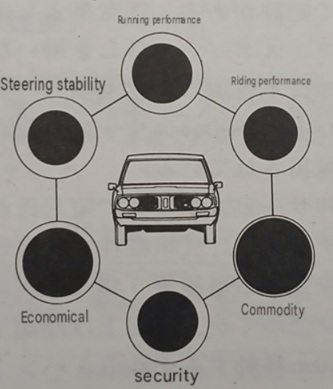
Every car has what might be called character. It can be said that this character emerges from a combination of factors such as performance and functionality, intended use, vehicle class, and design philosophy. However, not all aspects of the car’s character are clearly revealed to the user. The purpose of this series is to unravel the character of a car by evaluating six important aspects of its performance.
The size of the circle at each vertex of the index represents a rating of the attribute indicated there, and by comparing the six circles, one can also get a sense of the balance among them. In the case of the Skyline 2000GT, it received a particularly high rating for economy, but this is because it is a 2000cc class car priced at 860,000 yen, making it exceptionally economical within the context of its class. Otherwise, apart from some issues with handling stability, the six performance areas all received good scores and were well-aligned, making it a well-balanced model overall.
We have explained our methodology for this test series, but our hope is that, using these tests as reference material, the final judgment will be made by the readers themselves.
Postscript: Story Photos