Nissan Skyline 2000GT-R Hardtop (1971)
Publication: Car Graphic
Format: Road Test
Date: January 1971
Author: “C/G Test Group” (Shotaro Kobayashi, uncredited)
Summary: A semi-racing hardtop with a six-cylinder twin-cam 24-valve engine. Runs without knocking even on regular fuel, relatively flexible, only slight effect on performance. Exceptionally good handling despite cross-ply tires, enjoyable on the circuit. Outstanding steering response, but lots of kickback. Rear-seat accommodation rivals that of the sedan. Controls are heavy, near the limit of practicality. Expensive.
Road testing the Skyline 2000GT-R Hardtop
As we wrote in last month’s issue, we recently covered some 900km in the new 2000GT-R and 2000GT Hardtops, running together through the mountains and countryside around Tokyo, and came away especially impressed by the GT-R’s tremendous performance and its outstanding handling for a practical road car. So, this month, we brought out the GT-R Hardtop again, with a plan to record precise performance figures at Yatabe, including maximum speed, and then fully explore its handling limits at FISCO.
Looking back, it must be said that we have not had very good luck as far as the GT-R is concerned. Immediately after the GT-R sedan debuted in the spring of 1969, we took one to Yatabe (see C/G, May 1969), only to find that its engine was not in a proper state of tune—to the extent that the car was actually faster in fourth gear than in fifth—and clutch slip forced us to abandon the acceleration tests. After the GT-R was repaired and we borrowed it again several days later, Tokyo was struck by, of all things, the heaviest March snowfall since the weather bureau began keeping records, leaving the GT-R buried under 30cm of snow for two days.
By contrast, the GT-R Hardtop we tested last month was in exceptionally good condition. But we had serious doubts as to whether it would stay that way for the month leading up to this test. After all, we knew that Nissan’s public-relations department had only one GT-R available for testing, and that it was subjected to hard use day after day at the hands of testers from one magazine or another, hardly leaving time even for maintenance. There is nothing more disappointing than going all the way to Yatabe only to find that the condition of the car prevents a complete test.
We therefore explained the situation to Shinichiro Sakurai of Nissan’s No. 4 Vehicle Design Department, the father of the GT-R, and he kindly offered to provide a car used by the No. 9 Vehicle Experimental Department at Murayama for spot-check testing of cars taken from the production line. As soon as we had finished writing the copy for the special Tokyo Motor Show issue, we hurried to Murayama and took delivery of a bright-red GT-R from Nobuyuki Tonoi of the Experimental Department (a test driver who made a name for himself in racing during the GTB era).
This car was an even earlier production example (chassis No. 000012) than the orange car tested the previous month (No. 000021), and was fitted with the 155ps regular-fuel engine. It had covered about 5,100km and, although carefully run in, remained 100% stock, so we were told that it should be producing its intended design output. The Experimental Department normally ran it on regular gasoline, and we likewise used low-lead fuel (around 92 octane) for our test.
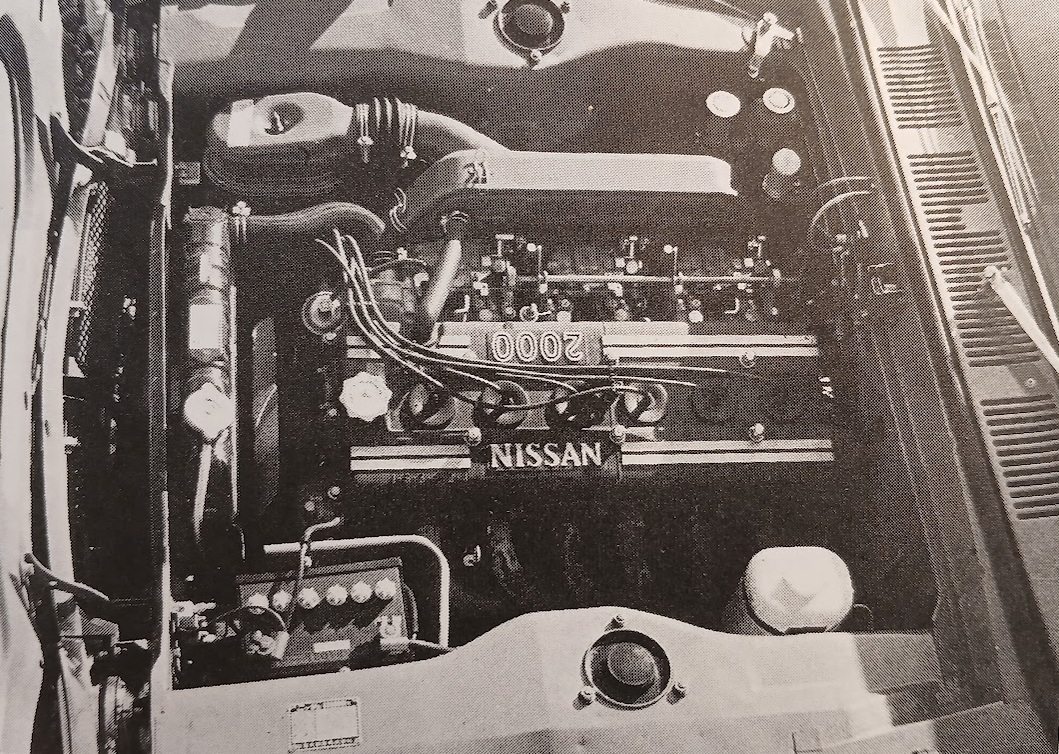
It may be hard to believe, but this semi-racing engine runs perfectly well on regular gasoline, and testing at Yatabe showed that the effect on performance is very slight. On the regular-fuel engine, material is machined away around the piston crown to increase combustion-chamber volume, reducing the compression ratio from 9.5:1 to 9.0:1. At the same time, ignition timing is retarded from 15° BTDC at 1000rpm to 10°, and the distributor’s advance characteristics are also changed. As a result, output and torque are reduced from the high-octane version’s 160ps/7000rpm and 18.0kgm/5600rpm to 155ps/7000rpm and 17.6kgm/5600rpm, respectively.
In last month’s issue, we noted that the test car’s engine was much more flexible than that of the 160ps GT-R sedan we tested previously, but this red Hardtop was even more tractable at low speeds. No sooner had we left the Murayama factory than we became stuck in rush-hour traffic, and the trip of barely 16km dragged on for an hour and a half. It was a great help that the car would creep along in first gear at its 1000rpm idle with one’s foot completely off the throttle. Throughout our test of approximately 1,200km, and under every kind of condition, the engine’s behavior remained entirely unchanged and remarkably stable. Even in a long traffic jam such as this, for example, the water temperature (this particular car ran a bit cold, normally indicating midway between 50-80°C) would rise only to 80°C. And on the rare occasions when we found a gap in the line of cars and could accelerate hard, the revs flared as “explosively” as ever when we stepped on the throttle.
As mentioned above, when we previously took the GT-R sedan to Yatabe, its engine had not been adequately prepared and lacked the expected power at high speeds, so the maximum speed was only 179.55km/h. Ever since, confirming the GT-R’s true capabilities has been a promise we have owed to C/G readers. For this editor, it had become something of an obsession.
This time, the tests at Yatabe could be conducted under nearly perfect circumstances.
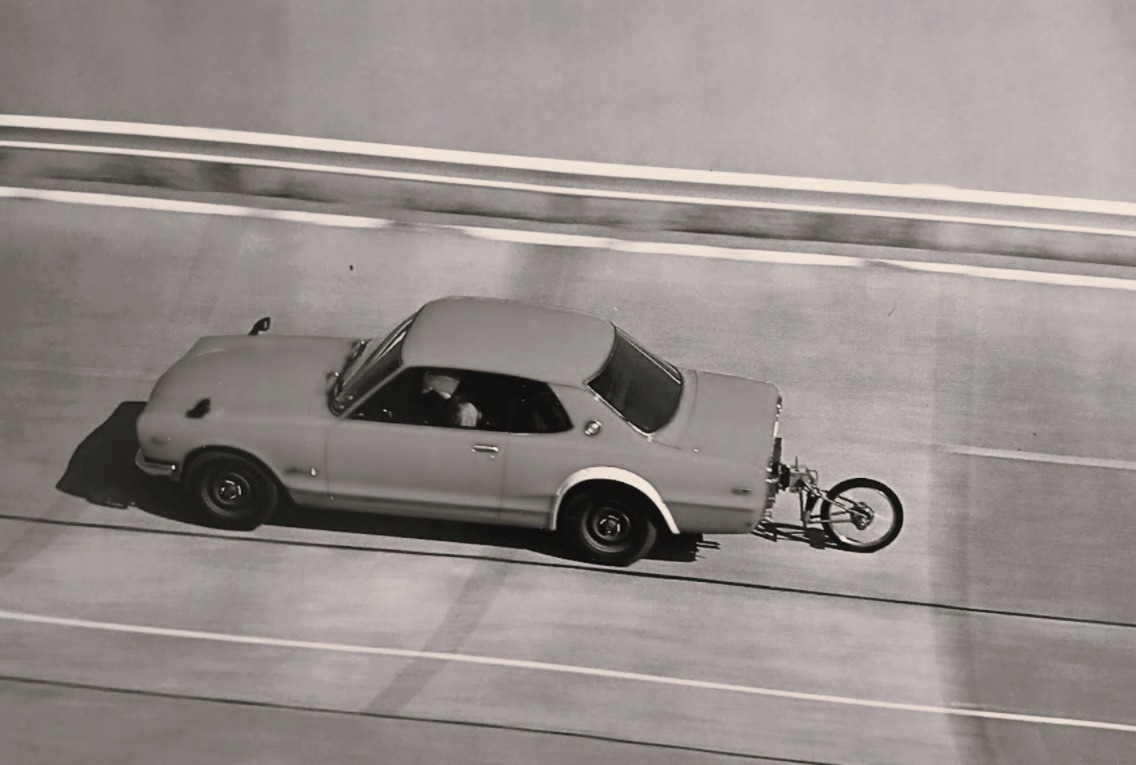
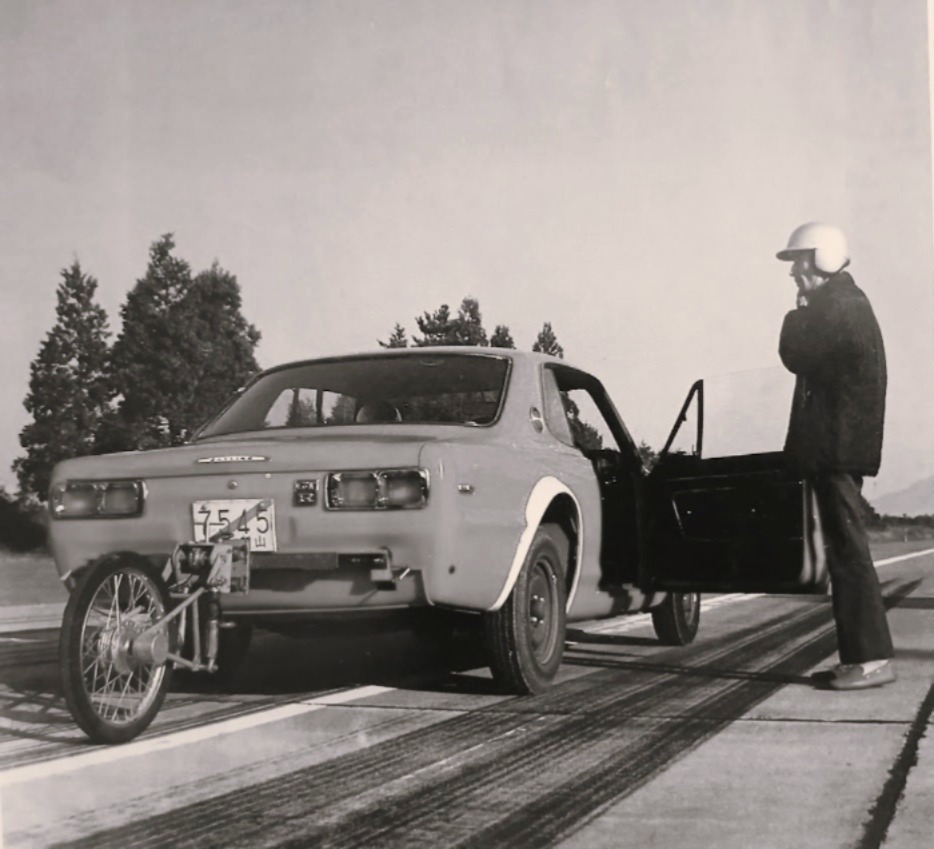
The car was in excellent condition, and the weather was equally favorable: clear skies, virtually no wind, low temperature and high humidity. After thoroughly warming the car and bringing the six liters of engine oil up to temperature, we attached the fifth wheel and set out onto the course. We spent a few laps warming up the transmission, then began the high-speed runs in earnest.
C/G’s testing procedure is extremely rigorous. Times are taken over a precisely measured 2km straight and around the 5.5km circuit, and the average speed is calculated for each. In maximum-speed testing, the fifth-wheel electric speedometer is used only for reference purposes. (In practice it is remarkably accurate: with no wind, its indicated speed and the calculated average speed agree exactly.)
In the end, the average speed over the flying 1km was 185.56km/h, while the average for the 5.5km lap, somewhat affected by the wind, was 184.01km/h. For the reasons explained above, we consider these figures to be representative of the regular-fuel GT-R’s true capability, though in all honesty they were somewhat lower than we expected. Nevertheless, we believe that with the optional tail spoiler fitted to reduce aerodynamic drag (it is said to become quite effective above 120km/h), a maximum speed of around 190km/h should be possible, even if the catalog figure of 195km/h is out of reach.
The gearing seems a little too high for the car’s weight and power. Maximum speed is the same in either fifth or fourth gear, at which point the engine speed is only about 6000 or 7000rpm, respectively (7000–7500rpm is the yellow zone). Although the engine is described as flexible, 4000-7000rpm is still the usual range when really driving fast. The standard final-drive ratio is 4.444, but if this editor were to use a GT-R as an everyday car, I would fit the optional 4.875 ratio without hesitation. Maximum speed would increase, of course, but this is of no practical importance; the real purpose would be to improve acceleration and flexibility at low and medium speeds. Judging from the test car, the engine will rev easily to 8000rpm, so with the lower final drive it should be possible to make more effective use of the upper speed ranges in third, fourth and fifth, making the car easier to use as well.
Of course, even as it is, the GT-R’s acceleration is impressive for a heavyweight 2-liter car. It covers 0-400m in 16.6 seconds and 0-1km in 31.1 seconds, by which point its speed is exactly 160km/h. Compared with the GT-R sedan (160ps) we tested previously, however, it is 0.2 second slower from 0–400m and also 0.2 second slower from 0–100km/h. It would seem that the loss of output due to the use of low-lead gasoline slightly outweighs the Hardtop’s advantages over the sedan in aerodynamic drag and reduced weight.
While taking the acceleration times, one thing that became apparent is that making a clean racing start in the GT-R demands fairly delicate judgment and footwork. To begin with, the car is simply heavy (1277.5kg with two occupants and test equipment), low-speed torque is weak, the gearing is relatively high, and it is equipped with a limited-slip differential. As a result, even if the engine is brought up to 6000rpm and the clutch let in gradually, the revs fall below 4000rpm and acceleration bogs down momentarily. The 16.6-second time was achieved with an ideal start with just a trace of wheelspin; without any wheelspin, the time was about 0.2 second slower.
The ratios of the 5-speed gearbox are extremely well chosen for practical use. Third, fourth and fifth in particular are closely spaced, making them ideal for maintaining a high average speed with frequent gear changes. For example, comparing the 60–100km/h overtaking acceleration times—a range often used on expressways—in the upper three gears, fifth requires 12.6 seconds, fourth 9.5 seconds, and third takes only 6.6 seconds. From 80-120km/h, the corresponding figures are 13.3, 10.0 and 8.5 seconds. Third has the widest useful range of all: it will accelerate from 40km/h in town (about 2000rpm) without even knocking, yet its upper limit extends to more than 150km/h. Even the overdrive fifth can be used from a surprisingly low 60km/h, and there is enough power to maintain 100km/h while climbing uphill grades like those encountered on the Tomei Expressway.
As described above, the lower compression ratio (from 9.5 to 9.0) and use of low-lead gasoline have only a slight effect on performance, and with the improved flexibility at low engine speeds, it could even be said that the car has become more practical. If there is a disadvantage in everyday use, it is probably the increased fuel consumption. Comparing the constant-speed fuel consumption (measured by C/G over a 1km section with an electromagnetic fuel-flow meter) with that of the 160ps GT-R sedan tested previously (which also weighed 1320kg during testing, 44.5kg more than the Hardtop) the figures are as follows (with those for the sedan in parentheses). All were measured in fourth gear: 11.4km/l (11.9km/l) at 60km/h, 8.6km/l (9.4km/l) at 100km/h, and 5.9km/l (6.4km/l) at 140km/h.
Suspecting that this was due to an overly rich mixture, we put the car on a CO tester, but surprisingly it returned 4.0% and passed with flying colors. (Idle limiters are fitted to the three Solex carburetors on production cars.) The overall average for our test distance of approximately 1,200km was only 5.58km/l (corrected for the odometer, which read 0.3% high), but this was because, as usual, we drove as fast as conditions permitted whenever possible. The best result came during a 399km high-speed touring run accompanying our test of the Galant GTO MII, in which we returned to Tokyo via the Tomei Expressway, Omote-Fuji, Lake Kawaguchi and the Chuo Expressway, recording 6.65km/l. We also asked the owner of a GT-R (160ps sedan) who frequently travels to and from Suzuka using the Tomei, and he reported an expressway average of around 7.5–8km/l. The fuel tank, incidentally, holds 100 liters.
The GT-R has a powerful electric fuel pump in the trunk, which makes a constant clicking sound. When caught in a traffic jam, the loud sound of fuel being pumped is heard continuously, even when the car is stopped, and this naturally thrifty C/G editor (born in the early Showa years) could hardly keep from wincing (?) at the sound.
The GT-R’s handling is second only to the Fairlady Z’s among Japanese production cars. The first thing one notices on the road is that the steering response is extraordinarily sharp for a car of this weight and size. At the cornering speeds that can be explored on public roads, understeer is very slight, roll is minimal, and steering effort is within reasonable limits except when parking.
The Bridgestone Super Speed 2 cross-ply tires contribute greatly to the handling, though at the expense of ride comfort. Even at pressures of 2.0/2.0kg/cm², they feel extremely hard on the road, and kickback through the steering is very strong. They are sensitive to road camber and longitudinal ridges, which disturb straight-line stability in much the same way as racing tires. On anything less than a smooth surface like that of the Tomei Expressway, the steering must be held firmly and the driver must concentrate. (In compensation, on a good surface the straight-line stability is so good that one can take one’s hands off the wheel even at maximum speed, and the car is virtually unaffected by crosswinds.) With the introduction of the Hardtop, the previous wood-rimmed steering wheel has been replaced by a leather-covered one, but gloves remain practically a necessity.
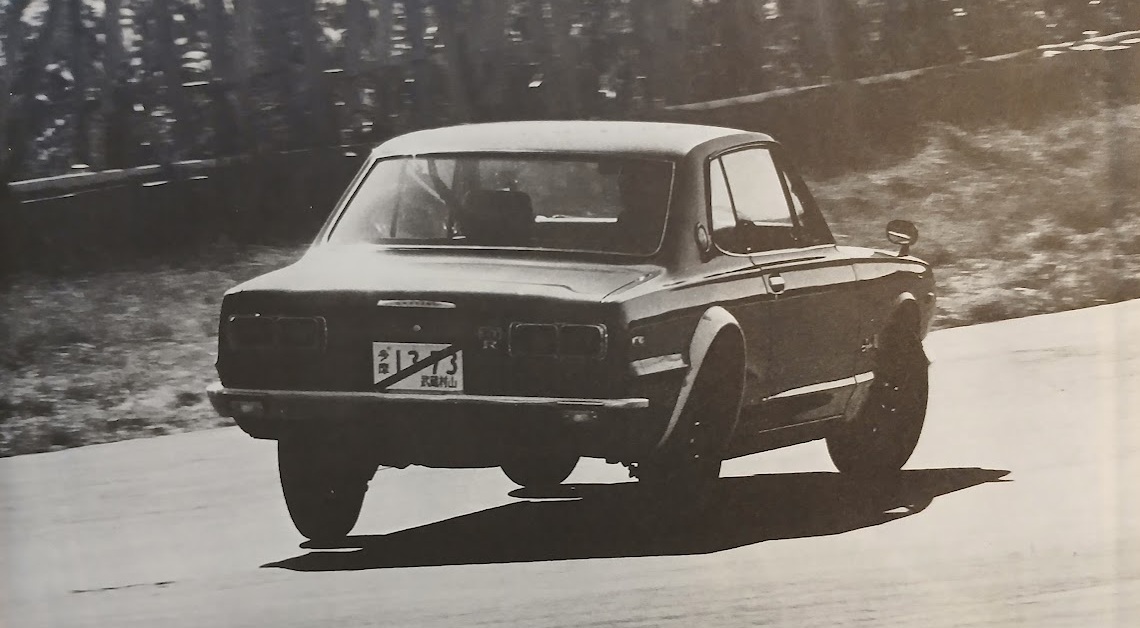
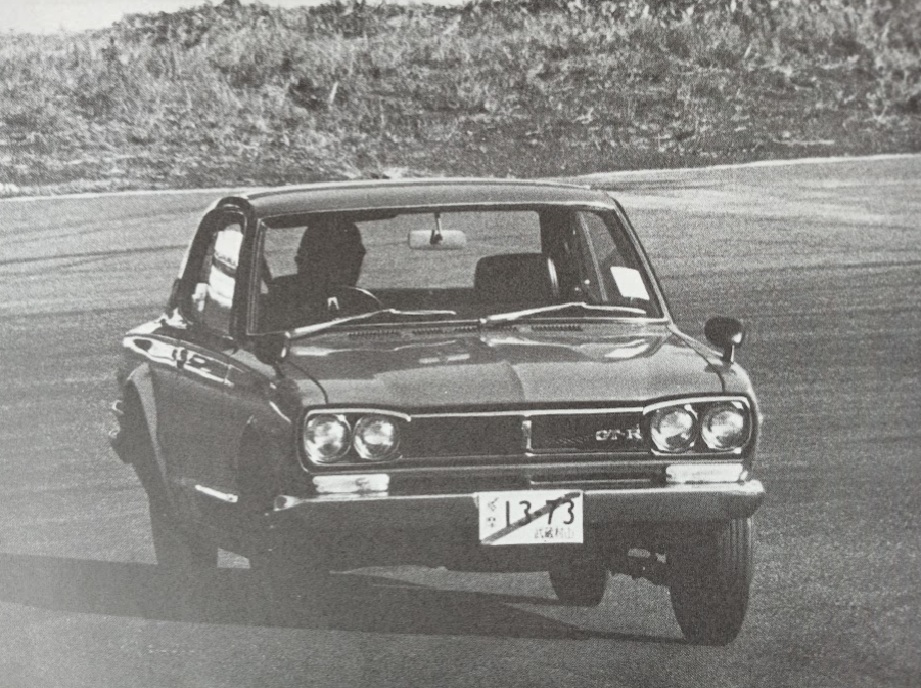
On dry roads, at least, the grip of these tires is of a high order, and it takes a lot to make them squeal. The only safe (and legal) way to test the GT-R’s cornering behavior at the limit is to take it to a circuit. At FISCO, we were able to enjoy its high-speed cornering thoroughly. Through the first corner of the 4.3km course, the series of fast left-handers that follows, and the 100R after the hairpin, it became clear that even on the standard tires, the GT-R can be taken through cleanly in an attitude approaching a drift, balancing the cornering power of the front and rear tires with steering and throttle.
The suspension, which seemed to allow hardly any roll in ordinary road driving, rolls quite a bit under the high lateral g that can be generated on a circuit, and because of the available power, there is always the possibility of the car developing roll oversteer. However, the transition occurs gradually, so it is relatively easy to catch with the sharp steering and the throttle.
By contrast, in a slow corner such as the hairpin (where the surface is also extremely slippery), the GT-R’s “touring-car” character becomes a significant disadvantage. Understeer becomes strong, the car rolls considerably, and the rear wheels break loose easily when full power is applied in second gear. While the steering usually feels quite quick, a higher ratio would be preferable for making corrections in such situations.
We ran with the tire pressures raised to 2.3/2.3kg/cm², but even immediately after nearly an hour on the circuit the tires were only slightly warm, and wear at the edges was minimal. However, the 4.5J rims seem somewhat inadequate for a car of this weight. The 5.5J rims and 6.95H-14 tires from the Fairlady Z432 should fit without modification, and we believe that installing them would improve the handling even further.
The GT-R is equipped with unassisted disc/drum brakes, since racing drivers dislike even the slight time lag introduced by a servo. Pedal effort is therefore generally high, and even a gentle stop at a traffic light (around 0.3g) requires a substantial 20kg of pressure. Braking action is progressive in proportion to pedal effort, and the way the car remains stable while decelerating powerfully, even under hard braking from high speed, is especially commendable.
FISCO places relatively little demand on the brakes, and we had no problems there. Previously, however, when we spent about an hour driving the winding roads of Shiga Kogen together with the 2000GT, pedal effort gradually increased and we began to feel a slight vibration through the pedal. At Yatabe we conducted what we call the C/G-style 0–100–0 fade test. This consists of accelerating to 100km/h, stopping at a deceleration of approximately 0.5g, immediately accelerating again, and repeating the sequence ten times in a row. In this test, the faster the car, the more frequently its brakes must be used, but since a high-speed car demands greater reliability from its brakes, we consider the method a reasonable one.
The results showed that the GT-R is not fade-free after all. Pedal effort began at 22kg, then increased sharply from the seventh stop to 36kg, eventually reaching 42kg—almost twice the initial figure. For a practical road car, we feel that pads with a lower coefficient of friction but greater resistance to fade, combined with a servo, would be preferable. As it is, especially with a full load, there can be anxious moments in city traffic when the car ahead brakes suddenly.
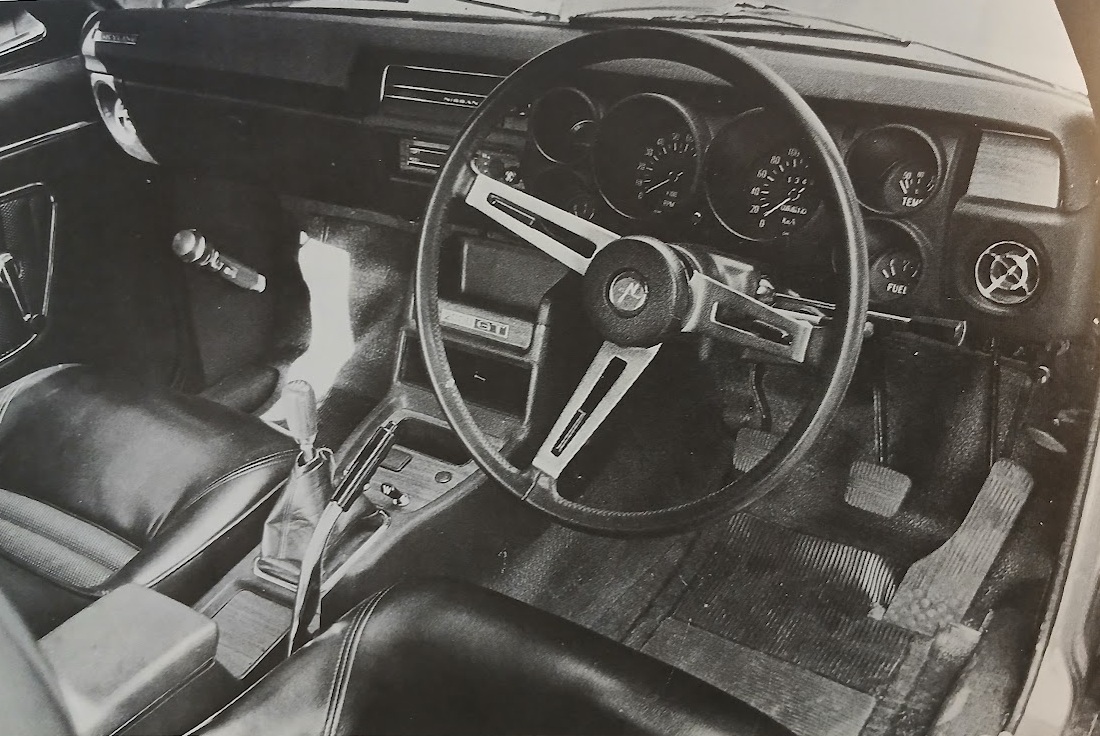
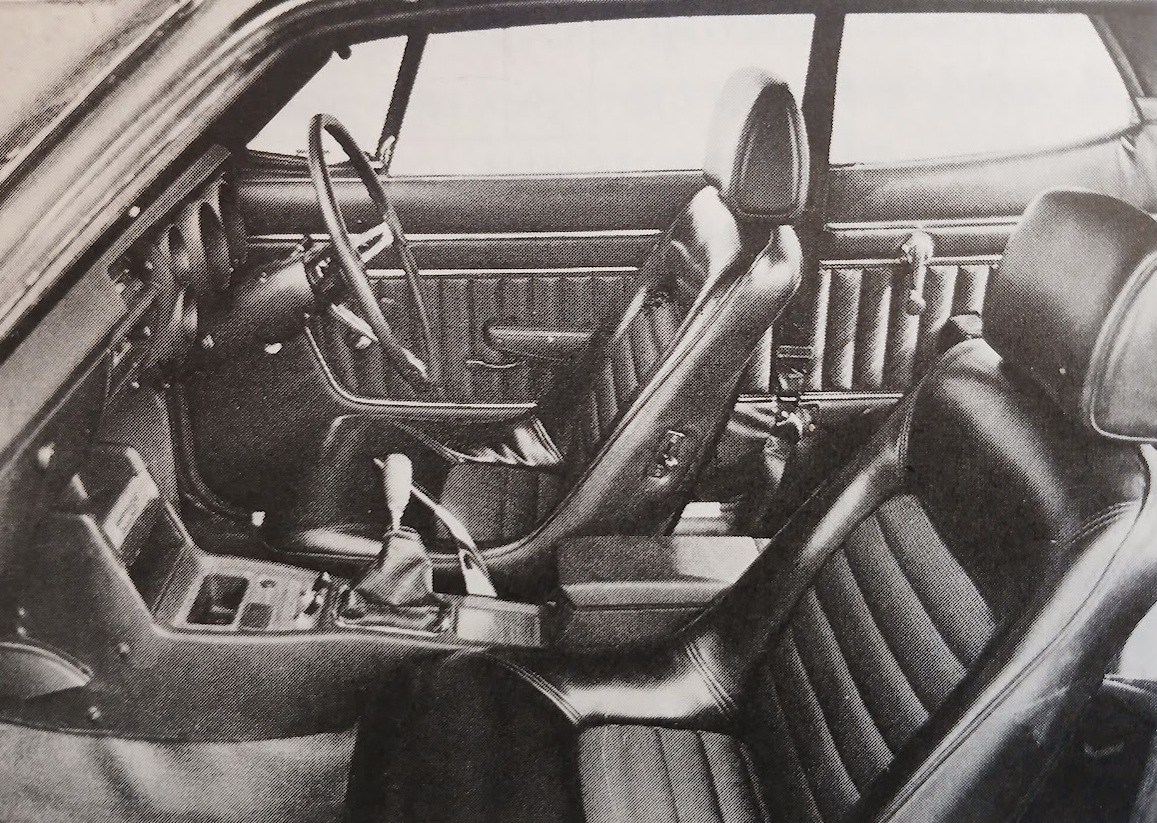
We have devoted so much space to the GT-R’s handling and performance that there is little room left to discuss accommodation. To briefly describe our observations, the shape of the bucket seats is generally good (though this editor would prefer the backrest reclined a little farther), and they do not cause undue fatigue even on long drives. Rear-seat accommodation is almost comparable to that of the sedan. One improvement introduced with the Hardtop is the light switch: in a return to the old Prince arrangement, flashing and beam switching can now all be controlled by a lever on the right side of the steering column. Neither a heater, defroster nor radio is fitted as standard, but perhaps the GT-R’s designers are heavy smokers, as it does at least include a cigarette lighter. Also, the stroke of both the clutch and brake pedals is too long.
Now then, if this editor were buying a GT-R for practical use, I would specify it as follows: a 4.875 final drive; the Z432’s 5.5J wheels with Bridgestone Super Speed-2 6.95H-14 tires; racing brake pads along with a servo; quicker 15.2:1 steering; and iodine headlights. I would also want to reduce exhaust noise enough that warming up the car in a residential neighborhood early in the morning would not invite disapproval. The result would be a serious grand tourer for the driver who enjoys its handling.
Postscript: Story Photos