Nissan Skyline 2000GT-R Hardtop (1973)
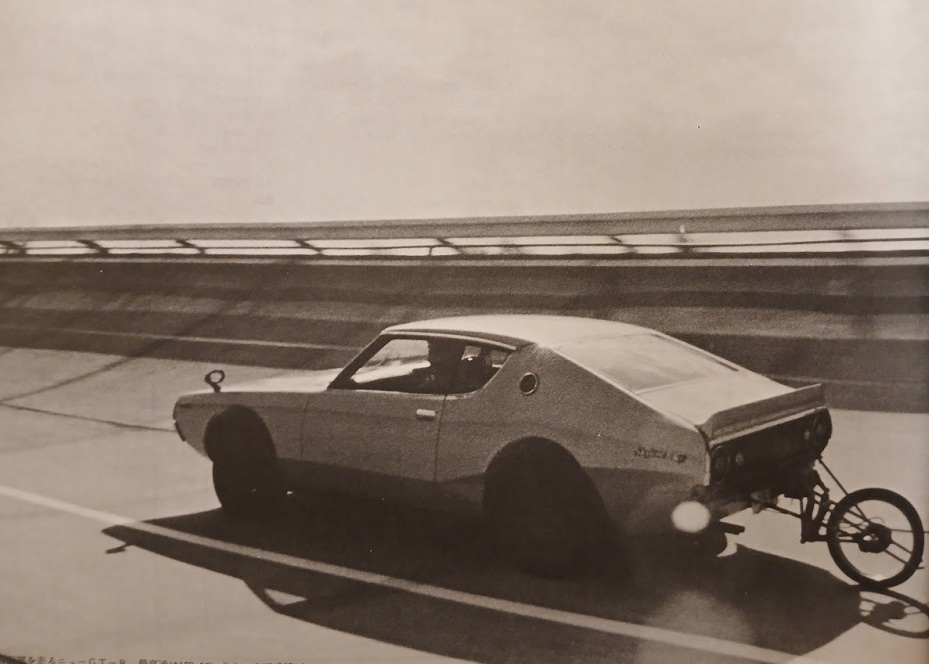
Publication: Car Graphic
Format: Road Test
Date: May 1973
Author: “C/G Test Group” (uncredited)
Summary: The “Ska G-R” returns with a completely redesigned body. It retains the semi-racing engine inherited from the previous model. Despite its enticing specifications, the stock car’s performance leaves much to be desired. The controls are heavy, and while its handling lacks subtlety, it nevertheless achieves a high standard of overall balance. The ride is solid and composed. The four-wheel servo-assisted disc brakes require heavy pedal effort, fuel economy is poor, the car is generally noisy, and it is high-priced, aimed at wealthy enthusiasts.
Road testing the Skyline 2000GT-R Hardtop
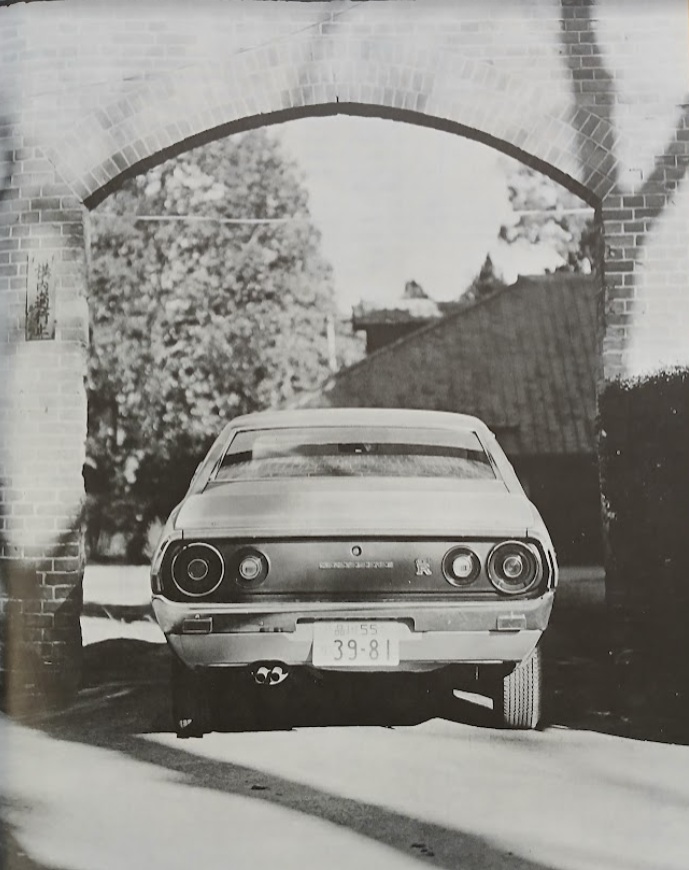
The Skyline GT—better known simply as the “Ska-G”—appears to occupy a place among the dream cars of the average Japanese motorist.
Beyond its large, imposing body and an abundance of equipment befitting a personal car, there is little about it that obviously sets it apart from its rivals. In many respects it is simply a typical Japanese passenger car. Yet the Skyline enjoys extraordinary popularity. In the sales race it has consistently maintained an overwhelming lead over other cars in the same class, including Nissan’s own Laurel and Toyota’s Corona Mark II, which are broadly comparable in styling, equipment, performance, and price.
Indeed, in some regions it has even outsold the perennial best-seller, the Toyota Corolla.
The numbers tell the story. During January of this year, new registrations totaled 4,835 for the Laurel and 6,744 for the Corona Mark II, while the Skyline recorded 9,543. Admittedly these figures cover the entire Skyline range, so it is impossible to say how many of these were GTs. Even so, we are told that since the full model change introduced last September, the best-selling version of the entire Skyline series has been the Hardtop 2000GT-X equipped with the 5-speed gearbox—a remarkably expensive car at 1,025,000 yen delivered in Tokyo. (Ivory, incidentally, is said to be the most popular body color.)
Why, then, has the “Ska-G” proved so outstandingly successful?
The answer cannot be separated from its achievements in Japanese touring-car racing.
From its first appearance as a support event entry at the JAF Grand Prix held at Fuji Speedway in May 1969 until its defeat at the hands of the rapidly improving rotary-powered Savanna at the same circuit in May 1972, the Murayama-prepared Skyline compiled an extraordinary record of some fifty victories over a period of three years.
Those racing Skylines were based on the GT-R. Or, more accurately, the GT-R was created by taking a highly developed racing version and placing it on sale to qualify as a “production car” for homologation purposes. It therefore differs fundamentally in character from the ordinary Skyline GT.
Little further introduction is needed at this point. Revived in January of this year as the highest-performance model in the Skyline range, the new GT-R combines the fully redesigned body introduced last year with mechanicals substantially unchanged from the previous GT-R—the same car that achieved those celebrated “fifty consecutive victories.”
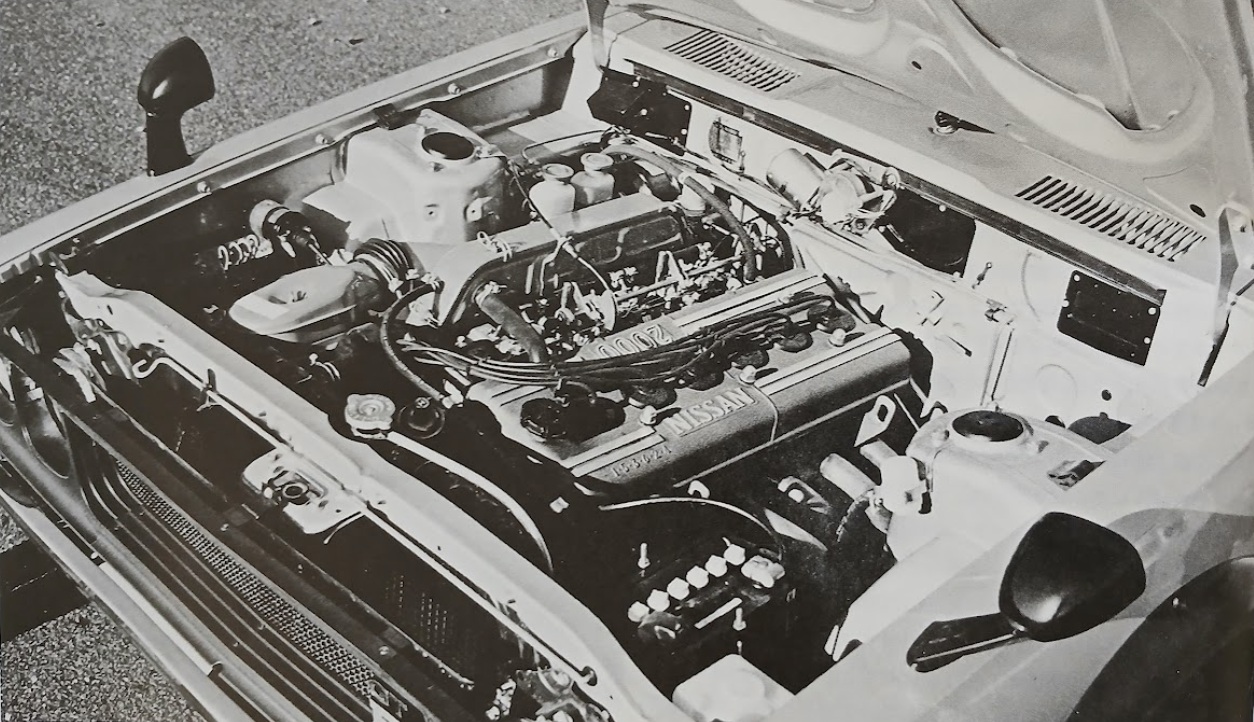
In place of the standard GT’s SOHC inline-six, it is powered by the semi-racing S20 DOHC 24-valve inline-six, a descendant of the engine developed for the Prince R380. Drive is transmitted to the rear wheels through a 5-speed Porsche-type fully synchronized gearbox and a limited-slip differential.
Every unnecessary luxury, inside and out, has been discarded. Even the heater and radio have been thrown out, while the suspension is strengthened extensively.
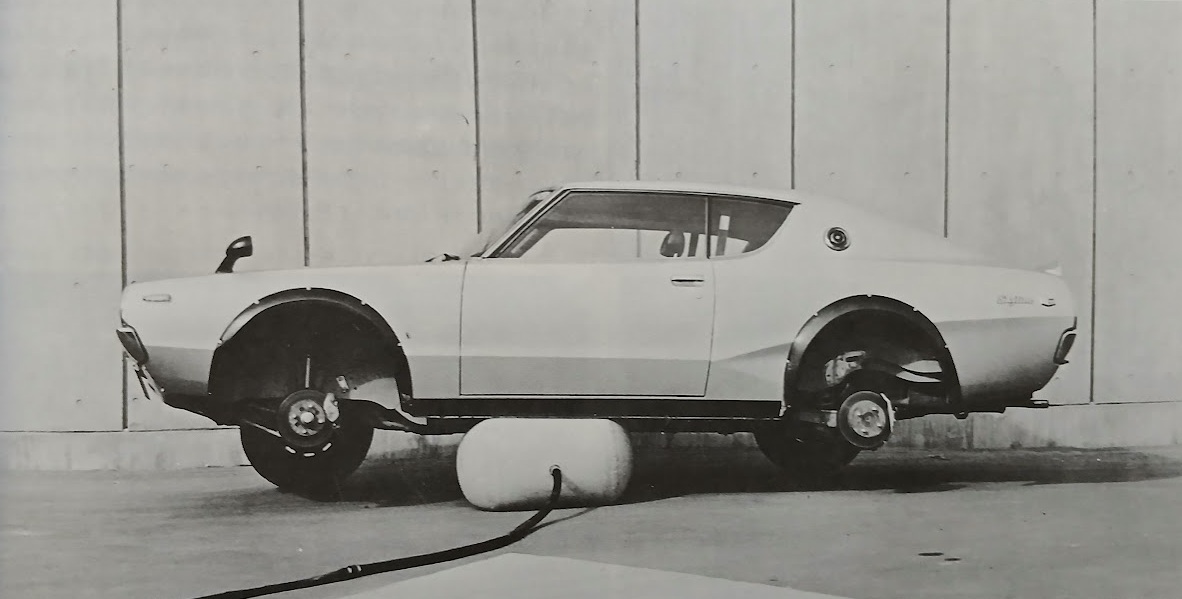
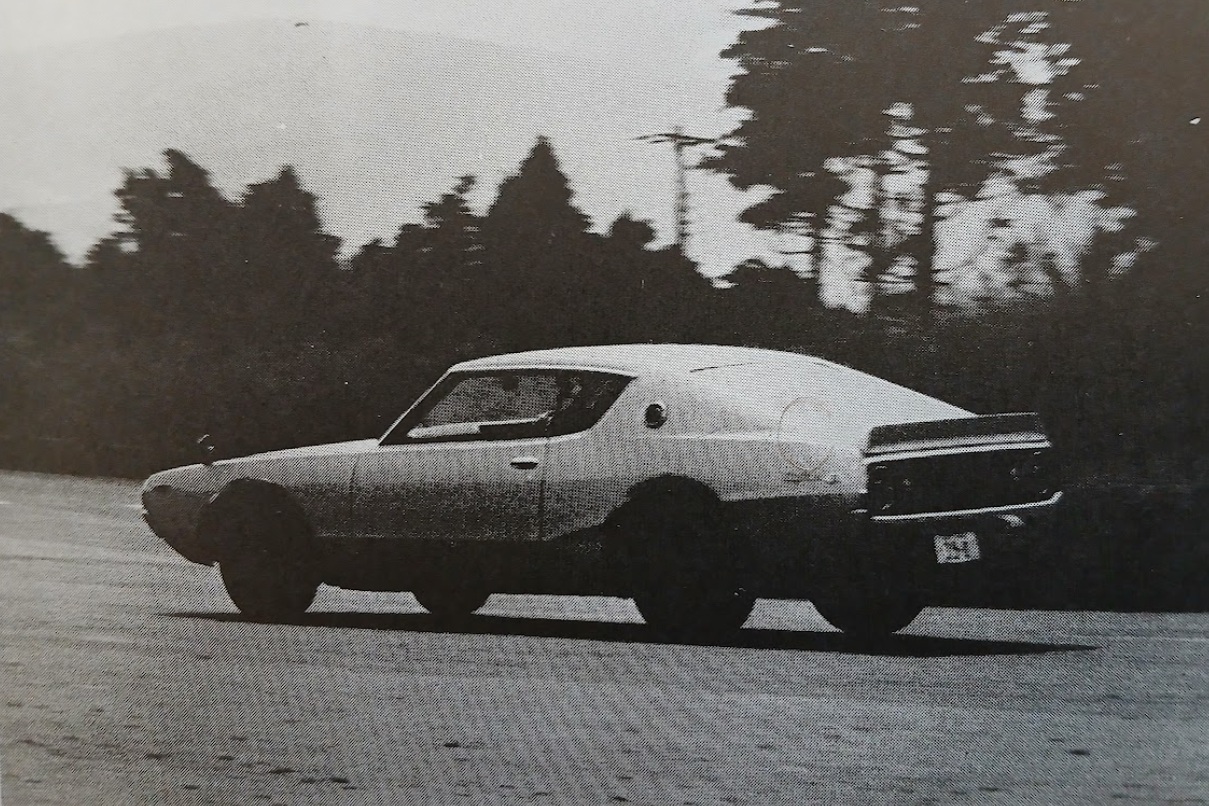
Unlike its predecessor, the new GT-R is equipped as standard with disc brakes at all four wheels assisted by a vacuum servo. Another new feature is the addition of a rear stabilizer bar. The front and rear wheel openings have been enlarged to accommodate plastic overfenders, covering 5J×14 wheels half an inch wider than those of the standard model and fitted with 175HR-14 radial tires. A rear spoiler is another distinctive external feature.
Including the detailed measurements carried out at Yatabe, we put approximately 800km on the new Skyline GT-R during this test. Unfortunately, where outright performance was concerned—one of our main points of interest—the luckless Car Graphic test team was once again disappointed.
We simply seem destined to have bad luck with this racing-derived S20 engine.
We have now taken three different S20-powered models to Yatabe’s high-speed circuit: the original GT-R sedan, the subsequent hardtop GT-R, and the Fairlady Z432. It cannot fairly be said that any of them has lived up to expectations. (Nor, for that matter, were any of the examples we have driven on other occasions in truly perfect tune.)
This time was no exception. In maximum-speed testing, for example, the car fell well short of its catalog figure of 200km/h, recording an average of only 178.66km/h over the 1km section. During these runs, the tachometer needle stubbornly refused to climb past 5900rpm in fifth gear.
The previous hardtop GT-R, carefully prepared at Nissan’s Murayama works (albeit the regular 155ps version), recorded 185.56km/h in Car Graphic’s flying-kilometer test at Yatabe. Admittedly, the new model is 45kg heavier at 1,145kg and presents a somewhat larger frontal area. Even so, it is clear that this test car again failed to display the performance it ought to have.
In the lower three gears, the engine’s 7500rpm limit (the yellow zone begins at 7000rpm) corresponded to 68km/h in first, 102km/h in second, and 149km/h in third. In direct fourth gear, however, the engine could not exceed 6700rpm, producing a speed of 172km/h.
Acceleration figures were equally unexceptional: 0-400m in 17.3 seconds, 0-1000m in 32.3 seconds, and 0-100km/h in 11.2 seconds. None surpassed the standards expected of a sporting 2-liter car, and all fell well behind those recorded by the Galant GTO 2000GSR tested alongside it.
Yet while it must be an exceedingly difficult task to keep the three Solex 40PHH carburetors of this semi-racing engine in perfect adjustment—and to maintain the correct clearances on all twenty-four valves—the disappointing performance just described was not accompanied by the temperamental low-speed behavior one might have expected. Indeed, the engine displayed remarkably few bad manners at lower engine speeds.
Except on especially cold mornings, there was hardly any need to touch the choke knob. Two or three pumps of the large organ-type accelerator pedal were sufficient to wake up the twin-cam engine with its characteristic high-pitched metallic bark. Without any load being applied, it would maintain 2000rpm for approximately two minutes, by which time the coolant temperature had reached 50°C and the car was ready to drive away.
For a high-performance 2-liter engine lacking a fluid coupling for its cooling fan, this rapid warm-up is quite exceptional. Yet neither prolonged high-speed running nor crawling through city traffic ever pushed the water-temperature gauge above 80°C.
The engine also offers more than enough flexibility. In extreme cases it will continue to pull smoothly in fifth gear at just 1100rpm—equivalent to only 30km/h—without bucking or jerking. If acceleration is unhurried, the practical lower limits are approximately 20km/h in third gear, 30km/h in fourth, and 40km/h in fifth.
This, however, serves only to demonstrate what is possible. Driven as this car is intended to be—with the throttle wide open—even third gear becomes distinctly unhappy below about 40km/h, the engine clearly laboring under the load.
Even when subjected to this sort of treatment, however, the engine seldom became noticeably temperamental, perhaps thanks to its fully transistorized ignition system. If it began showing signs of fouling, holding engine speed above about 2500rpm for a short while was enough to clear it, after which it would once again pull cleanly and smoothly all the way to the 7500rpm limit. Our test car exhibited a slight flat spot at around 6000rpm, but it was so minor as to be hardly worth mentioning.
What left the strongest impression, however, was the sound.
Under hard acceleration, the previously mentioned metallic roar is joined by the induction noise from the large air cleaner and the high-pitched, dry note of the exhaust, all of which envelop the driver as they reverberate inside the cabin. Much of this is attributable to the substantial reduction in sound-deadening material compared with the standard GT, though the powertrain itself is clearly noisy as well.
At lower engine speeds, the dominant sounds are the engine’s mechanical noises, accompanied by the high-pitched clicking of the electrically operated fuel pump mounted behind the rear bulkhead, rhythmically tapping away like a woodpecker behind the driver’s head.
The floor-mounted 5-speed gearbox is carried over from the previous model, retaining its Porsche-type servo synchromesh. Its ratios—2.906, 1.902, 1.308, 1.000, and 0.864—are well chosen for road use. Like all gearboxes of this type, however, it suffers from excessively long shift travel, requiring rather exaggerated movements for rapid gear changes.
On our test car, which had already covered some 6,000km and had almost certainly seen hard use, the synchromesh could no longer be described as especially robust. Engaging first gear from neutral invariably produced gear clash, while hurried shifts during acceleration testing overwhelmed the synchronizers without much difficulty. Gear noise, too, was clearly audible.
The clutch, requiring no less than 18kg of pedal effort, nevertheless maintained positive engagement throughout repeated standing-start acceleration tests. Perhaps in combination with the limited-slip differential, it produced an interesting effect. If the clutch was engaged too quickly during an acceleration run, engine speed dropped sharply and the engine fell out of its power band. On the other hand, even if one was reckless enough to abuse the clutch—holding the throttle open at 6000rpm while slipping the clutch excessively on take-off—the resulting acceleration times proved almost no different.
Even so, the clutch pedal is simply too heavy.
Its travel is almost identical to that of the standard GT, making it difficult to understand why such excessive pedal effort is necessary. It can fairly be said to exceed the limits of everyday practicality. After spending some time negotiating congested city traffic, with its constant clutch operation, the left knee begins to protest.
The other major point of interest, of course, is the GT-R’s handling. (For this type of car, there are really only two things that matter: performance and handling.)
The handling of the standard Skyline GT on which it is based is, on the whole, safe enough but thoroughly uninvolving. In short, it does little to rise above the ordinary standards of the average domestic passenger car. The new GT-R, however, is in an altogether different league. With spring rates increased by more than 30 percent—to 2.48kg/mm at the front and 2.62kg/mm at the rear, while retaining the standard GT’s damper settings—it achieves a much higher standard of handling than the base model. Moreover, its chassis displays a degree of refinement beyond that of the previous GT-R.
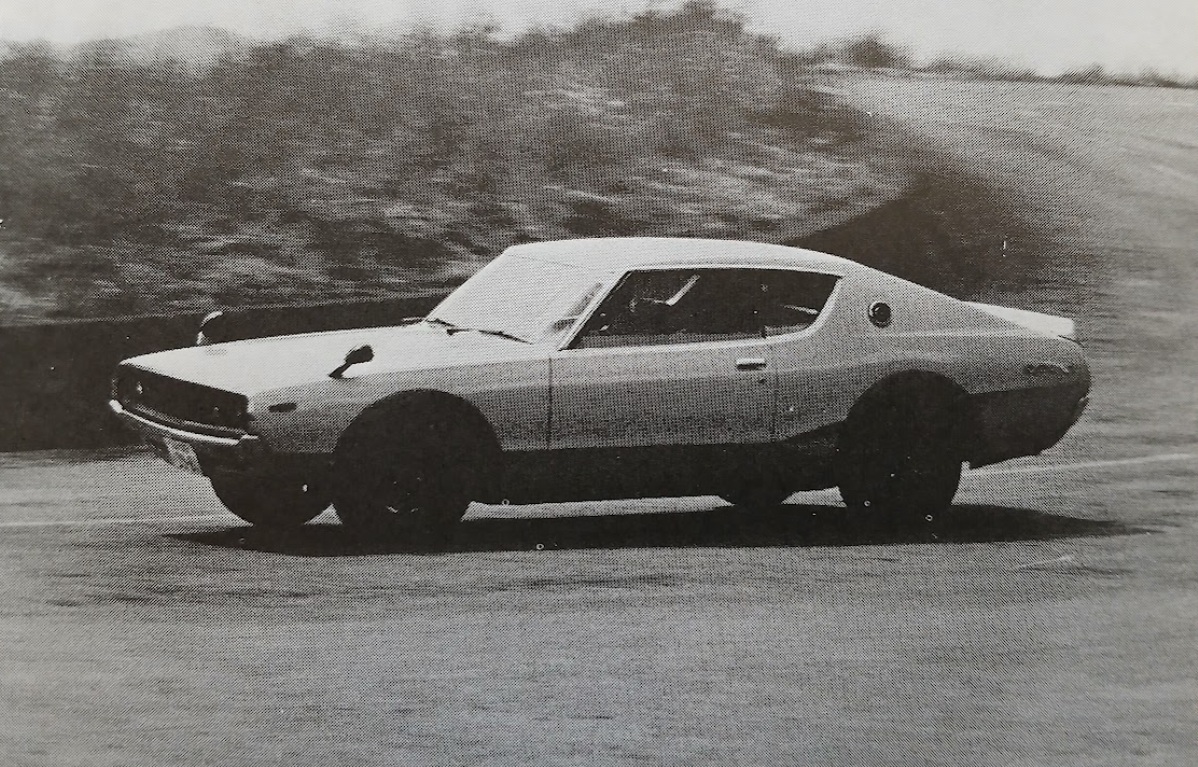
Equipped with anti-roll bars front and rear, riding on 5J×14 wheels shod with 175HR-14 radial tires, the GT-R maintains a consistently stable attitude and predictable behavior regardless of cornering speed.
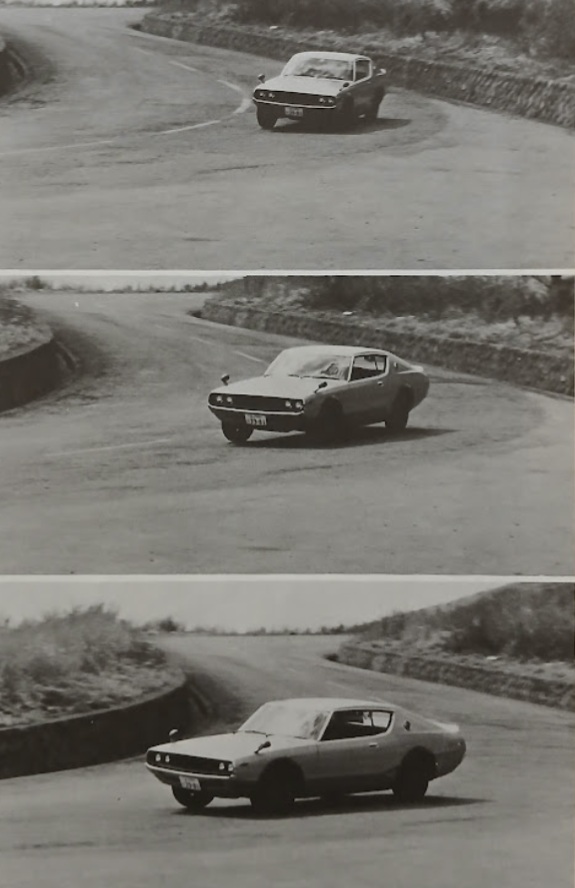
Its handling is characterized throughout by fairly pronounced understeer. Steering effort is only slightly heavier than that of the standard GT, but holding the required steering lock throughout the corner demands rather more work. Body roll is well controlled, however, and the car passes through bends impressively smoothly.
Despite appearing rather narrow beneath the prominent overfenders, the 175-section tires generate a high level of absolute grip, allowing all four wheels to trace the intended line faithfully even at considerable speeds.
The recirculating-ball steering is less impressive. Around the straight-ahead position it feels distinctly vague because of the usual elastic free play inherent in the mechanism. Even when the wheel is swung vigorously some 45 degrees side to side while traveling at high speed in a straight line, the car’s long nose seems to barely respond.
Once past this dead zone, however, the steering becomes reasonably accurate and inspires satisfactory confidence.
Even when subjected to a demanding slalom, the GT-R remains unexpectedly agile for a car of its size. Simply by working the steering wheel quickly from lock to lock, the driver can thread through the course without the oscillations building excessively.
Ultimate breakaway arrives with a gradual slide from the rear wheels, yet considering the high cornering speeds involved, recovery is remarkably easy.
While hardly changing the throttle opening, one need only unwind the steering slightly to regain control almost immediately.
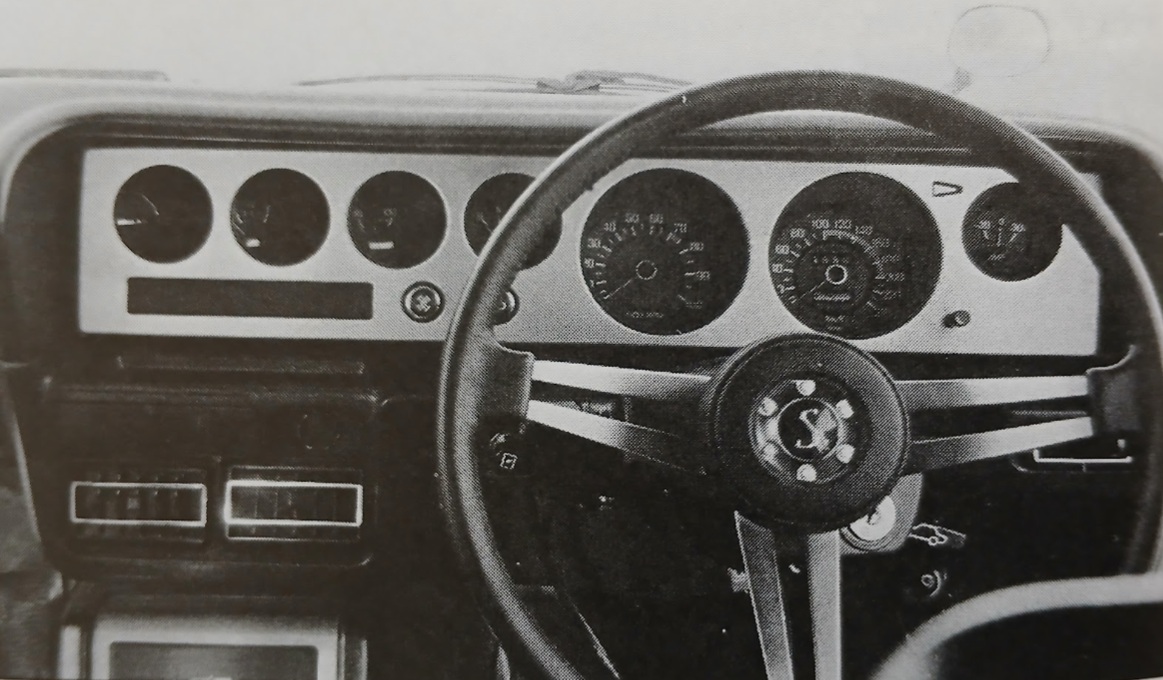
Unlike the previous model, however, the GT-R now retains the standard Skyline’s steering ratio of four turns from lock to lock, together with its large 40cm steering wheel. As a result, if excessive power is applied in a tight second-gear corner, the driver’s hands become extremely busy.
In downhill corners, the rear no longer develops the light feeling familiar from the standard GT, an improvement that can be credited to the new rear anti-roll bar. Perhaps for this reason, the rear tires seem to offer markedly greater grip than in the previous GT-R.
Even so, the handling never becomes burdened by excessive understeer.
From the foregoing, one might imagine the GT-R to be a delightfully nimble companion on a winding road. In reality, the situation is rather different.
The car itself has an agility quite out of keeping with its substantial size. The driver, however, must wrestle a large steering wheel from side to side like a truck driver, repeatedly depressing a clutch with excessive travel and exceptionally heavy pedal effort, while grasping the long-throw gear lever in a full-handed grip for one shift after another. It is, quite literally, a workout.
There is certainly no shortage of excitement. One is constantly aware of driving the car hard. Yet it remains a far cry from the delicacy that is one of the great pleasures of true sporting driving.
I do not believe Nissan’s engineers themselves lack sensitivity. At the very least, however, little evidence of it can be found in their products. (The Cherry is an exception.) This is no doubt a reflection of the company’s product philosophy when designing cars for a broad mass of buyers.
That said, it is equally true that many sporting drivers find exactly this kind of brutishness appealing.
The change from rear drum brakes to discs is significant mainly on paper—or perhaps with racing preparation in mind. In ordinary driving, the difference is hardly noticeable. The newly adopted 6-inch vacuum servo may account for the fact that pedal effort has been reduced very little compared with the previous GT-R.
Braking performance itself is entirely adequate for the car’s weight and performance, at least at the speeds likely to be encountered on public roads. Changes in attitude during heavy braking are modest, allowing the driver to stamp confidently on the large brake pedal.
One particular strength is that the rear of the car hardly lifts under braking. As a result, braking can safely be delayed until almost the very moment of turn-in without upsetting the car’s stability.
However, the brakes are not as fade-resistant as their heavy pedal effort might suggest. In the severe “0-100-0” fade test used by Car Graphic, pedal effort rose from an initial 15kg to no less than 46kg by the conclusion of the test—among the poorest results we have recorded in our road tests to date. There was no smoke or other dramatic effect, but the increase was unmistakable evidence of serious brake fade.
We did not confirm the grade of brake pad fitted to the test car, but preventing this would presumably require a pad material with a lower coefficient of friction. For a car as heavy as this, brake reliability is far too important to neglect. The inevitable consequence, however, would be an even greater increase in normal pedal effort. That, in turn, would almost certainly necessitate a larger vacuum servo—perhaps one 8 or 9 inches in diameter.
As noted earlier, every one of this car’s controls is simply heavier than it needs to be, even for a model intended for a small audience of dedicated sporting enthusiasts.
Contrary to what its specifications might suggest, accommodation—particularly ride comfort—is remarkably good.
The chassis is naturally on the firm side, being tuned for high-speed driving. Yet thanks to its substantial body and long wheelbase, the GT-R always conveys a reassuring sense of solidity. Even when crossing raised pavement markers, no harsh jolts or abrupt kicks are transmitted through the chassis.
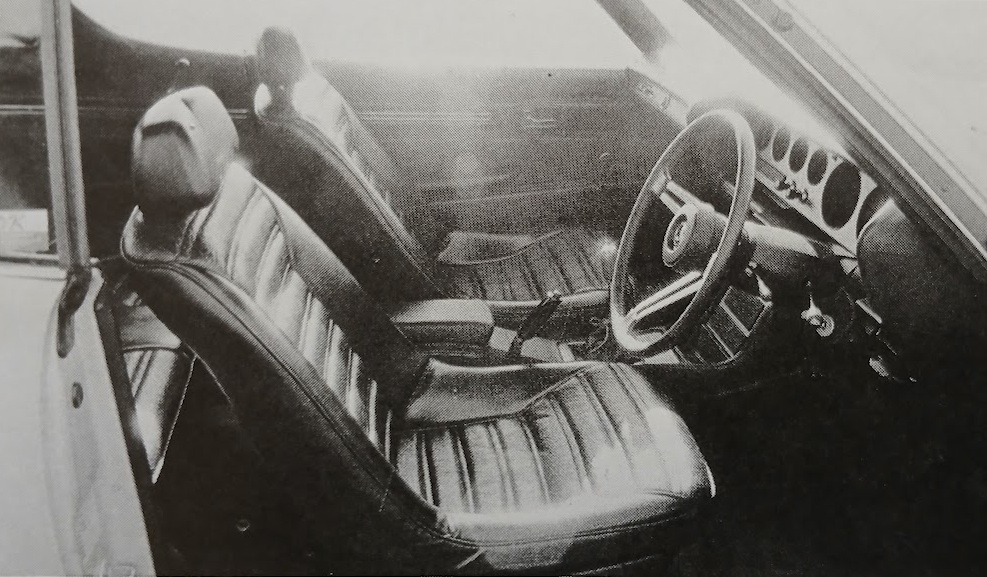
The fixed-back full bucket seats, with their integrated headrests, wrap completely around the driver. When pressing on along a winding road, they provide such effective lateral support that the seatbelt is hardly needed to keep the body in place. Their virtues extend beyond support alone, however; they also absorb road shocks exceptionally well.
The favorable impression of the car’s accommodation owes much to the rigidity of the body itself. The previous GT-R rode only slightly more firmly than this new model, yet there was always a sense that its body lacked stiffness, with squeaks and creaks constantly making themselves heard over uneven roads. The present model represents a substantial improvement in this respect. Apart from the inevitable increase in mechanical noise resulting from the omission of sound insulation, the body itself remains commendably free of rattles and creaks.
The omission of various accessories is understandable, given this car’s purpose. Eliminating even the heater and defroster, however—items essential to everyday use—is more difficult to justify, even if the object was to save weight for racing homologation.
During our test, the absence of a heater proved troublesome in more ways than one. Not only was the cabin simply cold, but on early mornings the film of ice on the windshield took ages to clear. Even after that, the inside of the glass frequently fogged, causing no end of inconvenience.
Anyone prepared to spend a considerable sum on this car would be well advised not to indulge in false stoicism. The heater and defroster should certainly be specified, even at the additional cost of 19,000 yen. (One cannot drive quickly while bundled in heavy clothing.)
Other equipment fitted to the standard model but omitted from the GT-R includes the radio, rear-window defroster, clock, tilting steering column, and anti-glare rear-view mirror.
Fuel consumption proved consistently poor, in keeping with the car’s specifications and performance. It deteriorated particularly badly when the engine was used as intended in the upper reaches of the rev range.
A full day’s hard driving through the mountains of Izu and Hakone returned an average of only 4.47km/l, using premium gasoline. The Yatabe test session, including maximum-speed testing, averaged 4.92km/l, again reflecting sustained operation at high engine speeds. Likewise, heavy city traffic—particularly under the congested conditions encountered during this test—produced just 3.64km/l, as the low gears had to be used almost continuously.
On the other hand, when cruising on the highway at around 100km/h, fuel consumption improved to a much more respectable 9.28km/l.
To be perfectly honest, we find it difficult to understand why Nissan chose to develop such a specialized machine at a time when concerns over safety and pollution have become increasingly pressing. Granted, the Skyline once dominated touring-car racing, and that success undoubtedly contributed to its remarkable sales. Even so, the reasoning behind creating a car like this today is less than convincing.
Unlike the standard GT, the GT-R is hardly a car for practical driving at all. It is certainly “fun to drive,” but its character is altogether too lacking in subtlety.
Perhaps that is perfectly acceptable. Yet if the intended customers are those fortunate enough to own a second car solely for pleasure, why cling so stubbornly to the limits of the 5-number class? Why not follow the example of the Fairlady 240Z and install the SOHC 2.4-liter engine instead?
Its exhaust note could never equal the atmosphere of the DOHC unit, but it would be far easier to maintain and inherently more reliable. At the same time, it would offer greater smoothness and refinement. Indeed, based on our experience with the various Fairlady models, its greater displacement would almost certainly make it the faster engine in actual driving—both on the road and on the circuit.
Then, if all of the controls were made just a little lighter, and a few of the accessories genuinely necessary for road use were reinstalled, the result would surely be a far more complete Gran Turismo—one that would be more than merely “another GT-R.”
In years past, almost every genuinely fast car was inevitably a rough-edged one as well. When engineering had not yet reached today’s level, achieving high performance meant sacrificing something else.
Today, however, it is by no means impossible to build a car that is smooth, quiet, and effortlessly fast.
As the flagship of the Skyline fleet—a model that has already secured its place in the history of the Japanese automobile—it may now be time to take up that new challenge.
Postscript: Story Photos