Nissan Skyline 2000GT-R (1969)
Publication: Car Graphic
Format: Road Test
Date: May 1969
Author: “C/G Test Group” (uncredited)
Summary: A hot sports sedan with a 160ps six-cylinder twin-cam 24-valve engine. The engine revs easily to 8000rpm, yet is relatively smooth even at low speeds, with consistently stable performance. Excellent 5-speed gearbox. Bucket seats provide good support. Suspension is hard, but ride quality is good. Handling greatly improved over the 2000GT. Controls somewhat heavy, making the car difficult to use around town.
Road testing the Skyline 2000GT-R
A Group 6 prototype DOHC four-valve racing engine, slightly detuned and installed in a seemingly ordinary four-door sedan, ambles innocently through city streets. A fast-looking two-seat GT comes bearing down from behind. Let it draw close enough to fill the rear-view mirror, then quietly, deeply press the throttle down. In an instant, the sheep turns into a wolf, quickly leaving the startled GT driver behind. Surely, everyone has indulged in such a childish fantasy at least once. With the recently released Skyline 2000GT-R, however, this exact dream can become reality—if you are prepared to spend 1.5 million yen.
The GT-R combines the body of the existing 2000GT with a DOHC engine producing 160ps/7000rpm in place of the 105ps SOHC unit, a 5-speed gearbox, and a firmer suspension. This engine, designated S20, is based on the GR8 unit of the Nissan R380, which won fame in the Japanese Grand Prix and in setting international Class E records. In S20 form, it has been detuned to make it practical for use on the street, and some compromises have been made to allow for ease of production. The compression ratio has been reduced from 11.0:1 to 9.5:1, the camshafts revised for more practical valve timing and profiles (reducing valve duration from 310° to 250°), and three twin-choke Solex carburetors are used instead of the Lucas fuel-injection system. These and other changes reduce output from the GR8’s estimated 230ps/8500rpm to 160ps/7000rpm. Even so, it remains a highly tuned unit, producing 80.4ps/liter.
The character of the 2000GT-R can perhaps be best understood by comparing it with its sister model, the 2000GT, and the former GTB.
| 2000GT-R (PGC10) | 2000GT (GC10) | 2000GTB (S54B) | |
|---|---|---|---|
| Valvetrain | DOHC | SOHC | SOHC |
| Output | 160ps/7000rpm | 105ps/5200rpm | 125ps/5600rpm |
| Torque | 18.0kgm/5600rpm | 16.0kgm/3600rpm | 17.0kgm/4400rpm |
| Output/liter | 80.4ps/l | 52.6ps/l | 62.9ps/l |
| Weight | 1120kg | 1090kg | 1095kg |
| Weight/output | 7.0kg/ps | 10.4kg/ps | 8.8kg/ps |
As these figures show, the GT-R’s power-to-weight ratio of 7.0kg/ps is far better than that of the former GTB, and even better than that of pure GT cars like the Toyota 2000GT (7.5kg/ps). Among Japanese cars, only the Fairlady 2000 (6.4kg/ps) surpasses the GT-R in this respect.
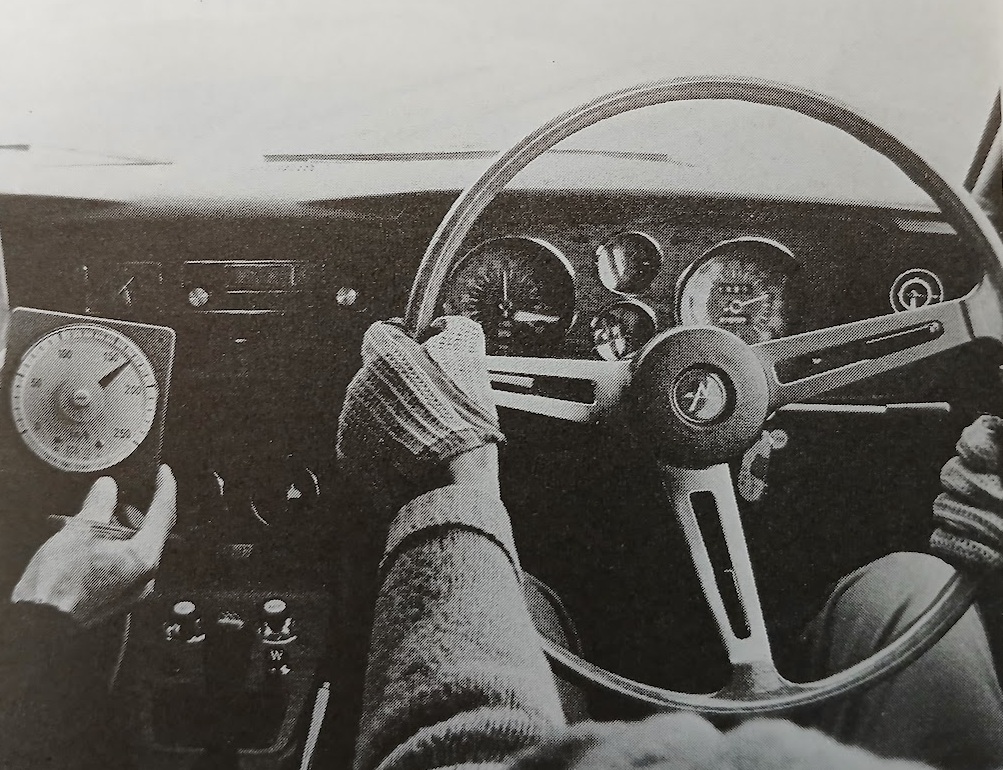
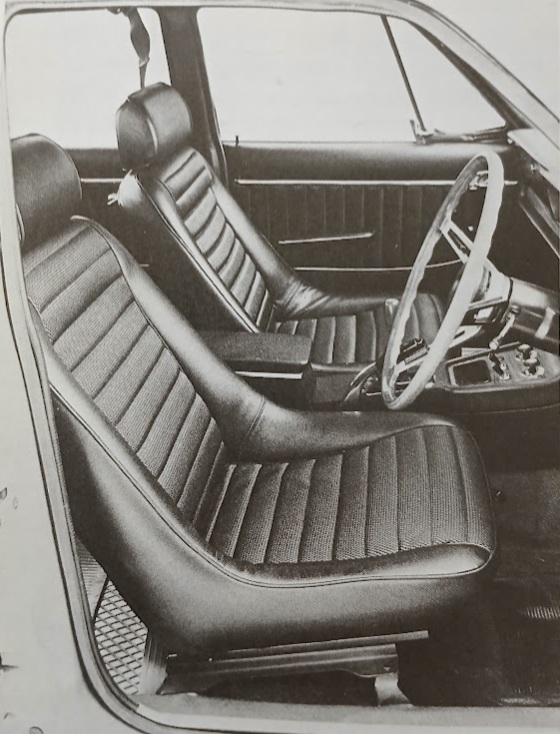
At first glance, the interior differs little from that of the 2000GT (GC10), showing that the car has been designed with practical road use very much in mind. Almost the only major difference from the GC10 is the seats. These are genuine bucket seats, with fixed backrests, but both their shape and angle are close to ideal. The driver’s seat alone is equipped with a headrest and 3-point seat belt as standard. Apart from a steering wheel rim and 5-speed gear lever knob made of wood (genuine wood), and a rev counter scaled up to 10,000rpm, there is little to distinguish it from the GC10.
From the instant the engine starts, however, one senses with the whole body that this is no ordinary car. Switch on the ignition and the first sound is the busy clatter of the electromagnetic pump in the trunk, feeding high-octane fuel from the 100-liter tank to the three Mikuni-Solex N40PHH carburetors. As might be expected of a semi-racing engine with considerable valve overlap, it does not start at the first touch of the starter, though neither is it temperamental. The moment it does catch is quite literally explosive. Many readers will have seen an F1 or prototype engine being started in a racing paddock, and the feeling is much the same. The starter churns away—kuu, kuu, kuu—for what seems like a long time, and just when one thinks it may not start, the engine erupts into life with a roar. It requires that characteristic pause. The mixture is set fairly rich, and even on a cold early morning there is no need for the choke; two or three blips of the throttle is enough.
Surprisingly, immediately after a cold start the engine idles at a steady 800–900rpm, and once under way it pulls without the slightest hesitation. Anyone prepared to buy a GT-R, however, would surely never set off without giving the engine at least five minutes to warm up, bringing the six liters of oil in the crankcase fully up to temperature. Even at idle there is a constant light whine, apparently from the timing chain, but press the throttle and the revs flare instantly, the magnificent mechanical and exhaust noise reverberating all around. On a quiet morning in a residential neighborhood, it seems likely that a prolonged warming-up period will draw complaints.
It would be untrue to say that the GT-R is easy to drive around town. To begin with, all the pedals are heavy. The throttle pedal must work against the return springs of three Solex carburetors, and as an example, it feels much heavier than even the clutch in a Subaru 1000 (which is unusually light). However, throttle response is so sensitive that, for an ordinary driver using the car in town, this amount of pedal weight may actually be safer. The clutch, too, is extremely heavy, making frequent use in city traffic rather burdensome.
The character of the engine can be summed up simply as “Jekyll and Hyde.” Up to about 4000rpm, it behaves much like a normal passenger-car engine, but beyond 5000rpm it suddenly turns ferocious, and its eagerness to keep climbing even beyond the 7000rpm redline is that of a true racing engine.
The torque characteristics are, of course, entirely biased toward high engine speeds. Below 1500rpm, there is hardly any torque to speak of, but power starts to come in sharply from around 3500rpm, with 3500–6500rpm being the most useful range. Consequently, driving through city streets at 60km/h or below is no fun at all.
As already mentioned, the GT-R is equipped with the same Porsche-type servo-synchromesh 5-speed gearbox as the Fairlady (though the gearbox casing differs because of the different engine). The final drive ratio is 4.44, shorter than the 2000GT’s 3.90. The gear ratios are as follows (figures in parentheses are the overall ratios including the final drive): 2.957 (13.12), 1.858 (8.24), 1.311 (5.82), 1.00 (4.44), 0.852 (3.78).
As we described in last month’s Fairlady test report, this gearbox earns very high marks. Its action is smooth and light, the throws are suitably short, and the synchromesh is extremely powerful. The 13.12 overall ratio in first, however, is slightly too tall for this high-speed, high-revving engine. Moreover, with the strong grip of the Dunlop GS1 tires and a limited-slip differential fitted as standard, quick launches require a little practice. Unless the engine is held at 4000rpm or more and the clutch engaged skillfully, the instant the left foot comes up, the revs fall below 2000rpm, and the car bogs down off the line. A furious start that leaves black tire marks behind is simply out of the question, and for the first 10 meters or so, even a lightweight 1-liter car will take the lead.
Although the torque curve is peaky, the absolute amount of torque is high, so the GT-R will run smoothly enough at 50km/h in fourth or 60km/h in fifth (about 2000rpm). Needless to say, however, accelerating from these speeds, while not impossible, asks too much of the engine. In city driving, therefore, only the first three gears are of any practical use.
When we received our test car, its odometer showed barely 1,500km, making it virtually a new car. We were reluctant to conduct high-speed tests on a car that had not been fully run in, but time constraints left us no choice but to take it to Yatabe in this condition.
As we had feared, the engine was still tight, and its maximum speed fell well short of the catalog figure. The GT-R’s claimed maximum speed is 200km/h, but no matter how we coaxed our test car, it could not reach more than 180km/h.
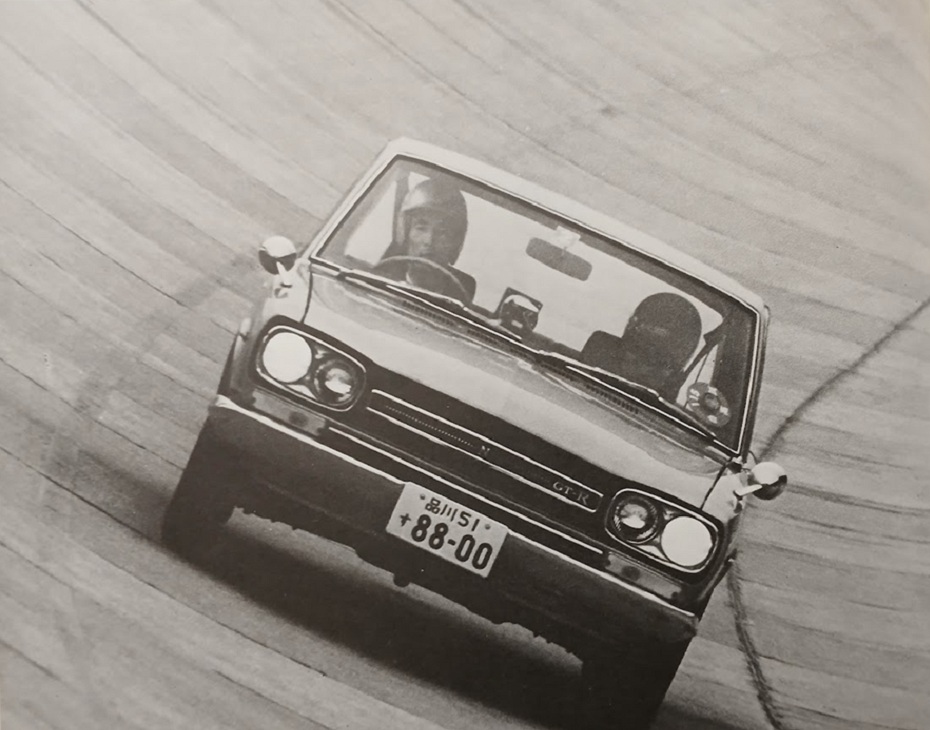
The C/G test group’s method of measuring maximum speed provides a reliable double check, using both the fifth-wheel electric speedometer and the elapsed times over an accurately measured 1km section and the 5.5km circuit. Before testing, we first check the accuracy of the fifth wheel over the 1km section at 60km/h and 120km/h; the error was less than 1% in both cases. Our GT-R only managed an average of 179.55km/h over the 1km section and 173.15km/h for a lap of the 5.5km circuit. The result was the same whether in fifth gear (5600rpm) or fourth (6500rpm).
In our experience, engines like this do not fully loosen up until around 5,000km, at which point the car suddenly seems to become lighter. Therefore, we would like to emphasize that these figures do not, of course, represent the GT-R’s true potential. We very much wanted to make another maximum-speed attempt with a GT-R that had been fully run in, but due to time and location constraints—Yatabe cannot be reserved at short notice—we had to abandon the idea this time. Incidentally, the speedometer on our test car was exceptionally inaccurate, indicating 195km/h at a true 180km/h.
The rev counter is marked with a red zone above 7500rpm. Perhaps because our test car was still new, the engine began to feel somewhat strained from around 7500rpm, while torque fell off sharply beyond 6500rpm, making use of the red zone pointless. The effective power band is therefore a relatively narrow 3500–6500rpm. As a result, to make the GT-R go quickly, it is necessary to shift frequently between second, third and fourth. If taken to 7500rpm, these gears give the extraordinary speeds of 105, 150 and 180km/h respectively.
Overdrive fifth is purely a high-speed cruising gear, intended to reduce engine speed—and consequently fuel consumption and noise—rather than increase maximum speed (which, as already noted, is the same as in fourth). It is particularly useful when cruising at 100km/h on the Tomei Expressway. In fourth, 100km/h corresponds theoretically to about 4000rpm; selecting fifth reduces this to approximately 3430rpm.
Noise levels are generally high. The engine is accompanied at all times by the whine of its timing gears, while beyond 4000rpm a metallic, high-pitched exhaust note quickly rises in intensity. It is not particularly apparent from inside the car, but when one watches a GT-R running flat out from trackside, it sends out the same high, metallic exhaust note as the R380. There is no mistaking the bloodline.
Acceleration is, quite simply, outstanding for a practical 2-liter car. The standing-start 0–400m was covered in 16.4 seconds. Unfortunately, partway through the acceleration testing the clutch began to slip badly, making it impossible to record overtaking-acceleration figures at higher speeds. There was no problem when transmitting high torque through the lower gears, as in a standing start, but sudden acceleration in a high gear—for example, from 40km/h in fifth—caused severe clutch slip. It is particularly regrettable that, because of the condition of the test car, we were unable to adequately conduct testing in the high-speed range where this car should be at its best, either for maximum speed or overtaking acceleration, and we must apologize for this to our readers. (The standing-start acceleration test was conducted before the clutch began to slip, so we believe this figure to be close to the true capability of a practically-new test car.) In fairness to the GT-R, we should add that about two weeks after the Yatabe tests, we drove the same car again for two days on the street, after its clutch had been replaced. The clutch, of course, then operated perfectly, but since the driving was on public roads, we could not take any measurements.
The way it builds speed in the higher ranges is, as one would expect, superb. In third gear, for example, the regular GT’s acceleration begins to fall away quickly once over 100km/h; the GT-R, by contrast, really begins to pull strongly from around 80km/h, and does not lose its edge until it reaches 140km/h. The difference is that great. If the law allowed it, 150km/h would be an entirely natural cruising speed. At this speed the engine is turning only 5000rpm in overdrive, a full 2500rpm below the red zone. Engine noise is considerable even at this speed, but vibration is very slight.
Throughout five days spread over two test periods, totaling approximately 800km, the twin-cam 24-valve semi-racing engine remained in excellent condition and gave no trouble whatsoever. Whether crawling through Tokyo traffic or running continuously for 30 minutes around the Yatabe circuit at more than 170km/h, the coolant temperature always remained within the normal range, oil pressure hardly varied, and idle quality remained unchanged.
Fuel consumption is not especially important in a car with the GT-R’s character, but it will still be of great interest to anyone thinking of buying one. Over our total test distance of 820km, the overall average was 4.97km/l. This included about 250km of performance testing at Yatabe, with the rest divided almost equally between expressway and city driving. Economy runs are, of course, hardly our specialty, but then no one who drives a GT-R is likely to take it slow. At a steady 100km/h in fifth, as much as 8km/l can be reached under favorable conditions. The fuel tank holds no less than 100 liters, certainly enough for a nonstop journey from Tokyo to Nagoya.
Oil consumption is normal for a semi-racing engine. The piston clearances appear to be fairly generous, and particularly after a cold start, until the engine is fully warmed up, hard acceleration leaves a trail of blue smoke. We were unable to measure the consumption accurately, but estimate it at roughly 400–500km/l. In any case, this can hardly be considered excessive. NGK B-7ES spark plugs were used under all conditions, with no trouble from either fouling or overheating. Looking back, however, we cannot help wondering whether the car might have gone a little faster in the maximum-speed test if we had fitted colder plugs. Once maximum speed had been reached, there was some suggestion that pressing the throttle further caused the spark to break up. Incidentally, the GT-R is the first Japanese production car to employ a fully transistorized, breakerless ignition system.
The brakes are the same as those on the 2000GT, with 10-inch Dunlop-Sumitomo S16 opposed-piston discs at the front and 9-inch leading-trailing drums at the rear. The difference is that the GT-R has no vacuum servo (the same 4.5-inch Mastervac unit as on the 2000GT is available as an option). At first this may seem rather strange, but it is because racing drivers dislike even the momentary time lag introduced by a servo. Pedal effort is therefore generally higher than on the 2000GT; even a gentle stop at a traffic light (about 0.3g) requires a heavy 20kg effort, nearly twice that of the 2000GT. The braking action is commendably progressive in proportion to pedal effort. At high speeds in particular, braking is exceptionally stable and inspires confidence. On the other hand, stop-and-go driving around town can be a little tiring.
To test brake fade, the C/G test group has “invented” what we call the 0–100–0 test. It is a severe procedure: accelerate from rest to 100km/h, brake at 0.5g to a stop, then immediately accelerate again to 100km/h and brake again, repeating the cycle ten times. In the GT-R, the pedal effort of 32kg on the first stop increased only to 34kg on the tenth stop, virtually no change at all. Its resistance to fade therefore leaves nothing to be desired. The handbrake is located just to the left and slightly forward of the gear lever and, in an emergency, can by itself produce approximately 0.3g of braking force.
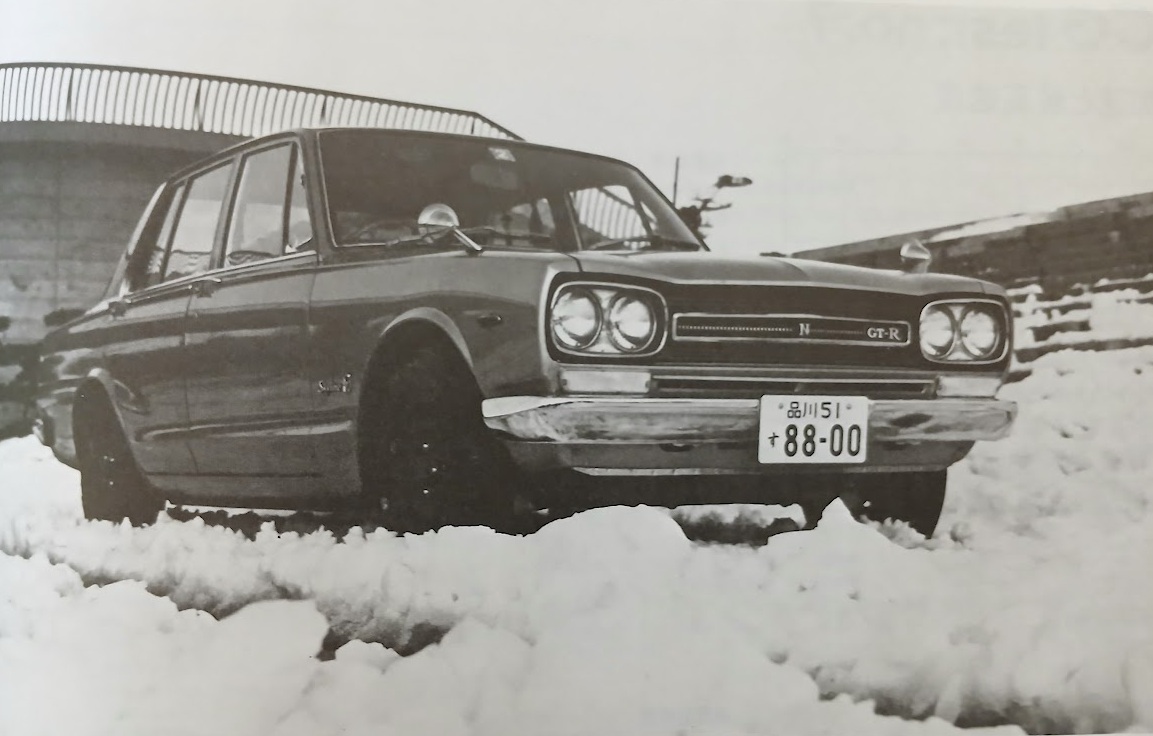
The only safe (and legal) way to fully test the handling of a car like the GT-R is to take it to a closed circuit. We had planned to go to Fuji Speedway, and had even arranged a set of racing tires for the occasion. By extraordinary bad luck, however, the day brought 30cm of snow—the heaviest March snowfall since the weather bureau began keeping records—and we were forced to suspend testing for two days.
As a result, we were unable to test the handling to our satisfaction, and will refrain from making any definitive statements about it. Even from our limited experience, however, we can say with certainty that the handling is much improved over that of the GT. Spring rates are approximately 30% higher at the front and 10% at the rear, while the front and rear tracks are 44mm wider. The steering is also higher-geared, with a ratio of 18.5 (3.3 turns lock to lock) compared with 19.8 (3.5 turns). The tires are Dunlop GS1 6.45H-14-4PR tubeless, with an H rating (capable of continuous running at 205km/h). We normally ran them at pressures of 2kg/cm² front and rear, increasing them to 2.3kg/cm² at Yatabe.
Steering effort is considerably heavier than in the GT, and requires considerable arm strength, especially when parking. This is in marked contrast to the GT, where the steering is light at any speed. Straight-line stability on a good surface is outstanding; even at 160km/h one can take one’s hands off the wheel without anxiety. On the other hand, steering response around the straight-ahead position is unexpectedly sluggish, and steering effort is also high. From this, one would naturally expect severe understeer. The initial steering response is indeed sluggish and heavy, but once the steering begins to take effect, the car turns surprisingly naturally. Roll is very slight, but the geometry seems to be arranged so that even a small amount of roll reduces the understeer. Thanks to the limited-slip differential, there is almost no wheelspin even when full power is applied in second gear through a tight corner. In snow, however, it proved unexpectedly poor, spinning easily and becoming difficult to drive.
The ride feels considerably harder than that of the GT. Thanks to the long wheelbase, however, there is no pitching, and on a good surface the ride is extremely smooth. Its ability over poor roads is also impressive, and the suspension never bottoms, although the occupants are shaken up and down quite severely. Under these conditions the forward part of the body shows some flexing, and the vibration of the steering column in particular is unpleasant. Although the Dunlop GS1 is a cross-ply tire, its tread is stiff, and even at 2kg/cm² a considerable amount of kickback is transmitted to the driver’s hands.
Aside from the excellent bucket seats, the interior is exactly the same as that of the 2000GT, so there is no need to describe it again here (see the test of the 2000GT in the January 1969 issue). One thing we noticed about the driving position this time is that both the clutch and brake pedals extend too far toward the driver from the floor, making them tiring to operate frequently. They could also stand to have shorter travel. This is particularly noticeable because of the heavy pedal effort.
The frequently used light switch is located far away on the center console, and is difficult to reach without leaning forward from the straight-arm driving position that drivers of this kind of car will naturally adopt. As we have said many times, we would very much like to see the convenient column-mounted light switch, a traditional feature of the Skyline, brought back as soon as possible. New additions to the GT-R include the four-way hazard warning flashers that will become mandatory on new cars from April 1 (the switch is under the dashboard), and a flashlight with both red and white beams (mounted next to the passenger seat).
In conclusion, contrary to our expectations (or perhaps our hopes?), the GT-R proved to be a high-performance sedan detuned sufficiently to be entirely practical even around town. However, because the engine is based on that of the R380, restoring it to a fully tuned 220ps specification is relatively easy. Engine and suspension tuning parts are already listed in the catalog, providing everything necessary to modify the car for its intended purpose, whether rallying or racing. This must be greatly reassuring to drivers planning to enter the GT-R in competition.
As we have explained, we were unable to test the GT-R’s outstanding high-speed performance fully because the test car was not running properly. We intend to find an opportunity to confirm its true capabilities in the near future.
Postscript: Story Photos