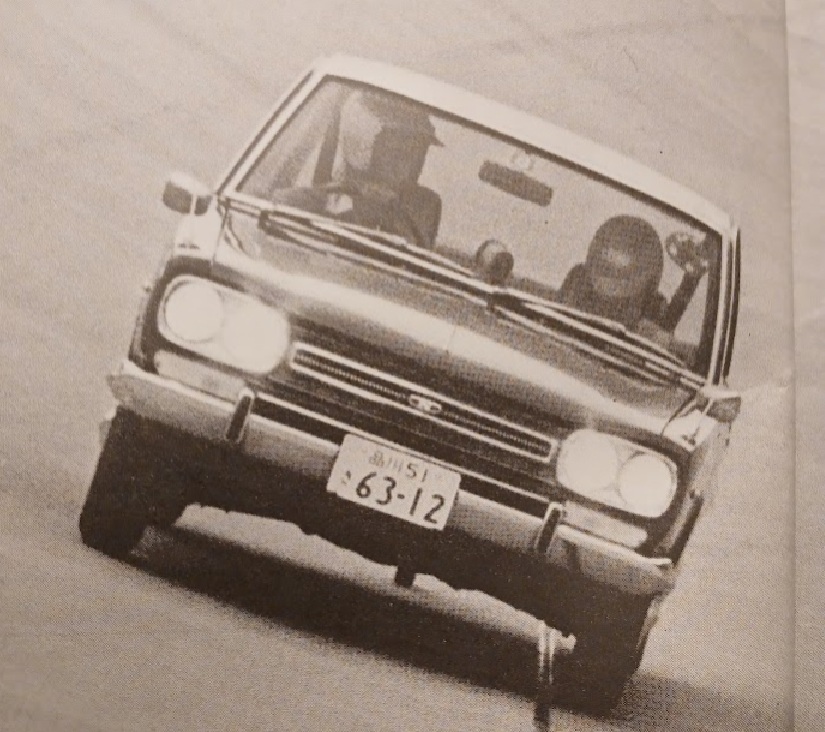
Nissan Skyline 1500 Sporty Deluxe (1968)
Publication: Car Graphic
Format: Road Test
Date: October 1968
Author: “C/G Test Group” (uncredited)
Summary: A refined five-passenger sedan with markedly improved accommodation over the previous model. Exceptionally comfortable front seats, satisfying 4-speed floor shift, outstanding fuel economy. The disc/drum brakes deliver insufficient stopping power, though fade resistance is excellent.
Road testing the Skyline 1500 Sporty Deluxe
Following the merger of Nissan and Prince, there was considerable concern regarding the fate of the Skyline, a comparatively low-volume model. The announcement of the fully redesigned Nissan Skyline–there is no trace of the Prince emblem anywhere on the car–has at least gone some way toward reassuring the marque’s enthusiasts. For the time being, however, only the 1500cc Skyline has been released, while the much-discussed (?) 2000GT, according to those connected with the project, is not expected to appear until sometime this autumn.
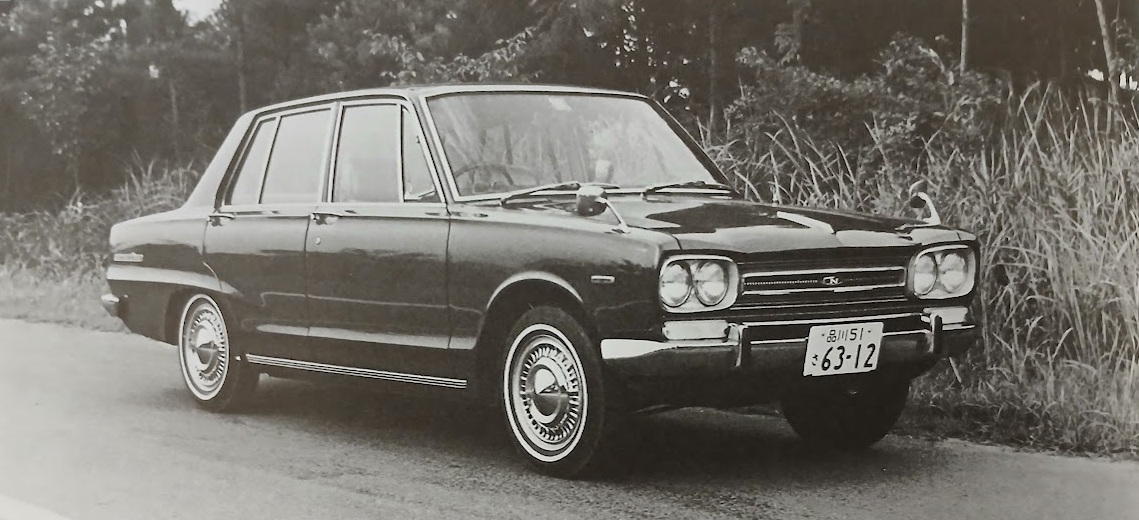
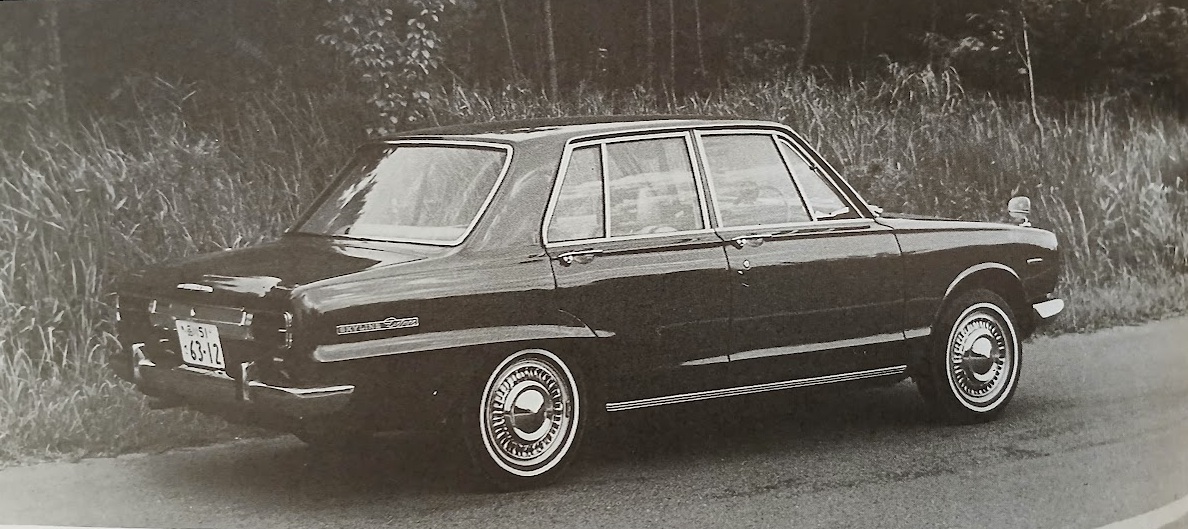
The car tested over a distance of 750km was the newly added Sporting Deluxe model (694,000 yen), one of four sedan variants now included in the Skyline range. In truth, though, the “sporting” designation is little more than a matter of atmosphere, for there are no changes to either engine or chassis. The model merely adds a 4-speed floor-shift gearbox, separate front seats, front disc brakes, and 4.5J rims fitted with 6.15-14 low-profile tires as standard equipment.
Dimensionally, the new Skyline is appreciably larger than the previous model. Wheelbase has increased by 100mm, overall length by 135mm, and width by no less than 100mm, while overall height has conversely been reduced by 20mm. Visually, the car appears distinctly larger in scale.
Mechanically, the principal change is the adoption of a MacPherson strut front suspension in place of the previous double-wishbone arrangement, bringing the Skyline in line with the Bluebird and Laurel. In addition, as already noted, disc brakes are now fitted to the front wheels of the Deluxe models.
At the rear, however, Nissan has elected to retain the good old-fashioned (?) live axle and leaf springs, in contrast to the company’s more recent policy of advocating four-wheel independent suspension.
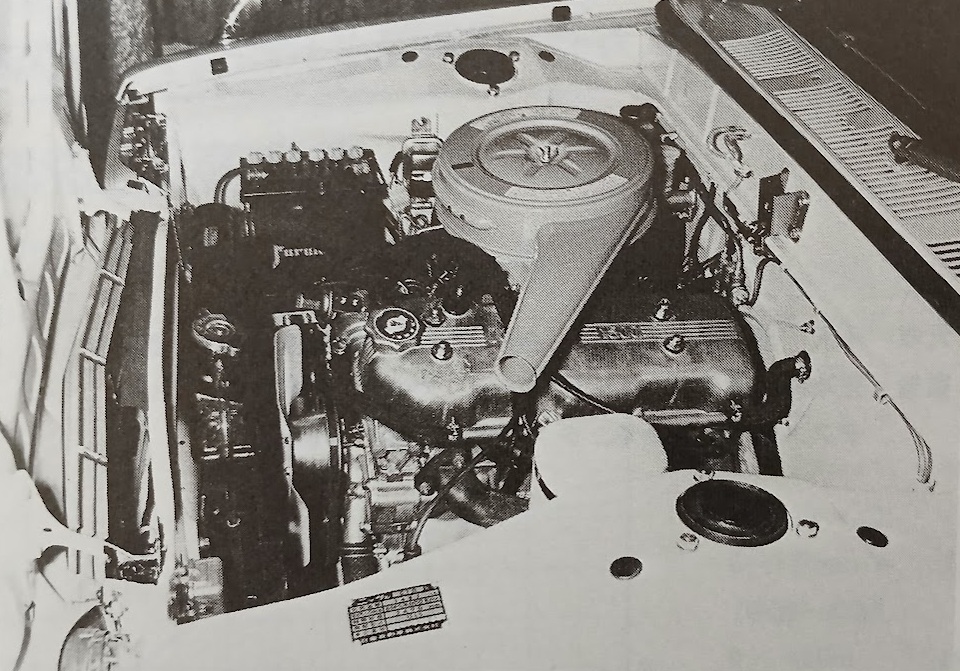
The engine remains the G15-type 1483cc five-main-bearing unit with crossflow aluminum cylinder head introduced during last August’s minor change, producing 88ps/6000rpm, though revised in minor details for its new application. The most significant alteration is that the block has been inclined 12 degrees to the left, a measure adopted in order to share the basic block structure with the Laurel’s 1.8-liter engine. (The Laurel’s G18 engine was originally a Prince design, itself based upon this G15 unit.)
The first impression unanimously expressed by the C/G test staff was the remarkable quietness and smoothness of both engine and driveline even at high speeds, and this impression remained unchanged throughout the test. The SOHC engine gives the impression of exceptionally efficient breathing, and in first and second gear it will rev freely beyond 7000rpm. Even at such engine speeds the valve gear shows no trace of float.
In actual driving, of course, there is little occasion or reason to use such high revolutions, but if one were to extend the engine to 6500rpm, the car would reach 46km/h in first, 70km/h in second, and 120km/h in third.
As a family car, the engine is tuned somewhat on the high-speed side. Below 2000rpm torque is not especially abundant, but from around 2500-3000rpm the engine suddenly begins to pull strongly. It would be unfair to describe the car as lacking in flexibility, yet below 50km/h in top gear–corresponding to slightly under 1900rpm–it feels rather lifeless.
Accordingly, third gear tends to be used almost as frequently as top gear in city driving. It is often tempting to shift unnecessarily, simply because the gearbox itself is such a pleasure to use. Although the ratios are not quite as closely spaced as those of the Laurel, they are very well matched to the engine’s characteristics, with exceptionally smooth progression from one gear to the next during acceleration.
The gear lever is positioned closer to hand than in the Laurel, stands nearly vertical, and operates with comparatively short, positive movements. The synchromesh is powerful enough that even rapid shifts during acceleration testing produce no gear clash whatsoever. Gear noise is almost entirely absent, and it is particularly noteworthy that third gear is nearly as quiet as direct top.
Indeed, this gearbox must be counted among the Skyline’s best features.
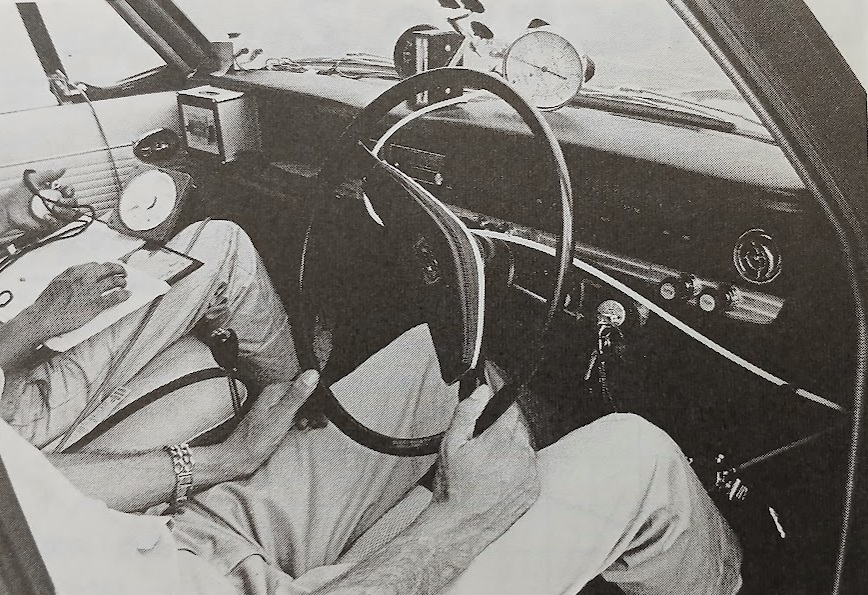
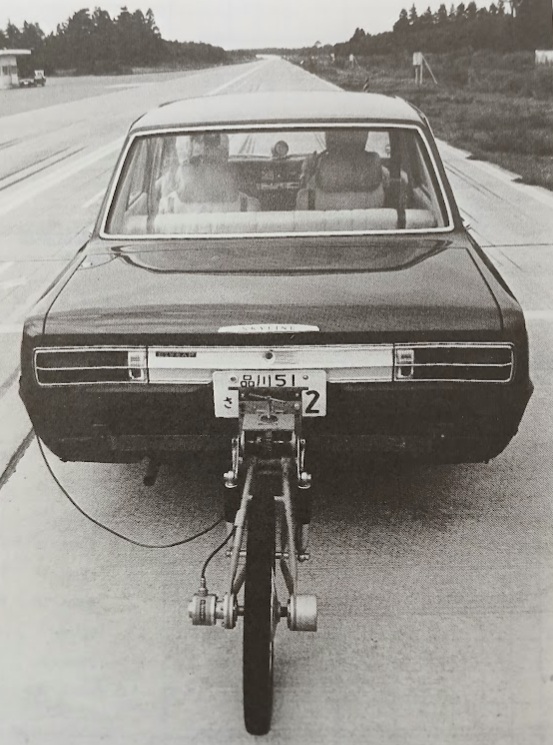
In terms of performance, the Skyline is entirely satisfactory by the standards of modern five-passenger family sedans. As described in detail in last month’s issue, the C/G test group now carries out full-scale proving-ground testing at the Yatabe High-Speed Test Course’s 5.5km circular track, using a variety of precise measuring instruments. Maximum speed and acceleration figures are measured with great accuracy through the combined use of an electric fifth-wheel speedometer and photoelectric timing equipment.
The Skyline recorded an instantaneous best speed of 152.0km/h as measured by the fifth wheel, while the photoelectric equipment measured an average of 150.38km/h over the 400m section. Average speed over the 5.5km circuit was 148.66km/h.
At 150km/h, engine speed is approximately 5700rpm, leaving a useful margin below the 6000rpm power peak. Driveline vibration and noise are both very low, while directional stability is so good that even hands-off driving is possible. Consequently, the tension ordinarily associated with high-speed travel is almost entirely absent.
Vehicle weight during testing, including two occupants, measuring equipment, and approximately half a tank of fuel, was 1210kg.
In a family car of this kind, 0-400m acceleration figures are largely academic, but the Skyline recorded 19.4 seconds averaged over two runs in opposite directions. Clutch pedal effort, at 10kg, is entirely normal, while pedal travel is by no means excessive. Engagement is exceptionally smooth and should present no difficulty even for inexperienced drivers.
Moreover, repeated racing starts produced no sign whatsoever of excessive clutch slip or overheating.
Now that expressway networks are steadily being completed throughout Japan, a car lacking the ability to cruise comfortably and safely at 100km/h can hardly be considered acceptable in modern life, even in the case of an affordable family car. In this respect as well, the Skyline deserves a rating comfortably above average.
At 100km/h the engine is turning approximately 3900rpm, yet engine noise remains subdued enough not to become objectionable. Directional stability is exceptionally good, while wind noise–provided the windows are fully closed, a point we will return to later–is extremely low. Acceleration in top gear naturally begins to weaken somewhat beyond 100km/h, yet the engine still responds clearly when the throttle is opened further.
Exhaust noise, already low by the generally quiet standards of Japanese cars, is especially subdued in the Skyline. Particularly commendable is the complete absence of the booming resonance from the exhaust system noticeable in the Laurel. Engine mounting, too, is superior to that of the Laurel, and the intrusion of vibration and noise into the cabin is kept to an exceptionally low level.
As traffic grows faster and more congested, both in city driving and on the highway, brisk acceleration increasingly becomes an important element of active safety. In this regard, the Skyline’s third gear displays particularly sharp acceleration across a remarkably wide speed range, and the figures clearly indicate that third deserves frequent use.
For example, in the 50-70km/h acceleration test representative of overtaking in city traffic, the Skyline required 7.8 seconds in top gear but only 4.8 seconds in third. Similarly, for the 80-100km/h acceleration commonly encountered on expressways, third gear recorded an exceptionally brisk 5.8 seconds compared with 9.8 seconds in top.
At the same time, third gear also performs well at lower speeds, covering 20-40km/h in 5.4 seconds. These figures demonstrate that the Skyline’s engine characteristics and gearing are very well balanced overall.
It should also be noted that the Skyline’s speedometer is unusually accurate.
One of the most pleasant surprises during our Skyline test was its exceptionally good fuel economy.
The C/G test group measures fuel consumption using a highly accurate British fuel-flow meter, conducting steady-speed consumption testing over a measured 1km section at Yatabe in both directions, while also collecting real-world consumption data on public roads using the same equipment.
On ordinary roads, the best figure was obtained while cruising the Tokaido route to Fujisawa at 60-80km/h, where the Skyline returned 13.13km/l. On the Daisan Keihin Expressway, maintaining an average of 80-90km/h produced 11.51km/l.
More surprising still was the fact that even in slow-moving Tokyo city traffic with frequent traffic lights, fuel consumption only worsened to 8.14km/l.
The overall average across the 741km test distance–including approximately 220km of severe proving-ground testing at Yatabe–was 9.50km/l.
The fuel tank is officially rated at 50 liters, though when we accidentally ran the car dry at Yatabe and subsequently filled the tank completely to the filler neck, it accepted 52.3 liters.
With its 8.5 compression ratio and aluminum cylinder head, regular-grade gasoline is entirely sufficient.
Part of the reason for the exceptionally good fuel economy was probably that the test car’s air-fuel mixture appeared slightly lean. Evidence for this lay in the fact that, despite the warm weather, the engine would not accelerate entirely smoothly for roughly the first kilometer after a cold start unless some choke was applied. The tailpipe also appeared dry and whitish, and when the car passed by there was almost no detectable exhaust odor left behind.
Unfortunately, the Skyline’s braking performance was, in our view, unsatisfactory.
The front brakes use 265mm discs, while 228.6mm (9-inch) leading-trailing drums are used at the rear. (The previous model had used duo-servo drums front and rear.) Vacuum servo assistance is optional, and was not fitted to the test car.
The consistency of braking effect is unquestionably a major improvement over the earlier duo-servo drums, which were prone to unevenness. For some reason, however, absolute stopping power is simply insufficient.
Pedal effort is normal for an unassisted disc/drum arrangement, and pedal travel is also moderate. Under ordinary city driving conditions there is little cause for complaint, but during full braking tests from 50km/h in neutral, no amount of variation in pedal technique could produce more than 0.78g on the decelerometer. (Measurements were taken using both a British Mintex U-tube decelerometer and a Mintex-Churchill brake tester.)
Increasing pedal effort merely caused the rear wheels to lock earlier, which actually resulted in longer braking distances.
Whether this stemmed from fundamentally poor front-to-rear brake balance or simply incorrect adjustment on the test car could not be conclusively determined, though we hope it proves to be the latter. At high speeds, pedal effort was judged somewhat excessive, and buyers would probably not regret specifying the optional vacuum servo (Mastervac).
Beginning last month, we introduced a fade test into our test program. From 100km/h, the car is braked at approximately 0.5g, immediately accelerated once again to 100km/h, and then braked once more. This sequence is repeated ten times at intervals of 1km. If brake fade occurs, pedal effort increases markedly and becomes immediately apparent.
In the Skyline’s case, the results showed only a very slight increase in pedal effort during the final two runs, accompanied by a faint odor of overheated brake pads. It may therefore be said to possess satisfactory resistance to fade. It should also be noted that these disc brakes are almost entirely free from squeal.
As for handling, it can only be described as appropriate for a conservative family car. With an unloaded weight distribution of 55.7/44.3, the car is considerably nose-heavy, and as one would expect, understeer is fairly pronounced.
The recirculating-ball steering requires 3.8 turns from lock to lock, yet because there is exceptionally little free play by Japanese standards, response is not nearly as dull as this figure might suggest. Steering effort is generally on the heavy side. In particular, parking effort will likely feel rather substantial to modern drivers accustomed to the extraordinarily light steering common among Japanese cars.
At higher speeds, however, this moderate heaviness proves distinctly reassuring, especially for inexperienced drivers. Combined with the car’s nose-heavy balance, it contributes to excellent directional stability at speed, the Skyline being barely affected even by crosswinds.
Ride comfort is somewhat difficult to describe. The suspension itself cannot be considered especially outstanding. On smooth roads such as expressways the ride is commendably flat, yet over repeated small irregularities the suspension tends to resonate at certain speeds, producing a fairly pronounced vertical hopping motion.
What the suspension fails to absorb, however, is often taken up by the seats themselves, with the result that passengers may receive a surprisingly favorable impression of overall comfort. The Skyline seems to represent a typical example of this phenomenon.
Its separate front seats are exceptionally good by Japanese standards. Their shape is excellent, while the cushions combine appropriate firmness with sufficient resilience, compensating very effectively for the shortcomings of the suspension.
Overall body rigidity is quite high, and even when driven rapidly over rough roads the car retains a solid, well-constructed feel. Road noise is also very effectively suppressed. Steering kickback, however, is rather strong.
Turning next to the interior, we have already mentioned the excellence of the seats, but equally commendable is the relationship between seat, steering wheel, pedals, and gear lever. Drivers ranging in height from 150cm to 180cm can all obtain an almost ideal driving position. Visibility in every direction is likewise very good.
Nearly everyone who drove the car remarked upon how easy it was to drive, and how quickly one became accustomed to it. Much of this must be credited to an intelligently designed interior layout that permits an exceptionally natural driving posture.
The benefits of the 100mm-longer wheelbase are felt even more clearly in the rear seat. Space is generous, intrusion from the wheel arches is minimal, and the center cushion is sufficiently thick that three passengers can be accommodated without undue discomfort. In the previous Skyline there had been a marked difference in comfort between the front and rear seats, but in the new model the disparity has been largely eliminated.
There is, however, one aspect of the minor controls that greatly disappointed us.
Since the original 1957 Skyline, the convenient multifunction lever mounted on the right side of the steering column–combining headlight flashing, beam selection, and turn-signal operation–had been a distinctive feature of the car. In this new Skyline, it has disappeared entirely. Drivers long familiar with the Skyline (as well as the 2000GT and Gloria) will no doubt lament its loss.
Worse still, the replacement lever is actually less convenient even than those fitted to Nissan’s other models such as the Bluebird and Laurel, being limited merely to turn-signal and headlight-dipping functions.
(On the Bluebird and Laurel, if the main lighting switch on the dashboard is pulled to the first position, the column-mounted lever allows switching between parking lamps and dipped headlights directly from the column itself, eliminating the need in city driving to reach across to the dashboard and switch the lights off each time one stops at an intersection. It is a genuinely useful arrangement.)
There are, on the other hand, many areas in which the Skyline has improved over its predecessor. One such example is the adoption of a parallel-action two-speed windshield wiper system, which no longer leaves the triangular unwiped area at the center of the windshield that plagued the earlier design. (The Bluebird and Laurel, incidentally, still retain the old arrangement.)
Considerable attention also appears to have been paid to interior safety. Thick padding has been fitted to the backs of the front seats so that rear passengers are better protected if they are thrown forward in an accident.
The front seats are equipped as standard with two-point seatbelts, while fixed, non-adjustable headrests are available as an option. The true effectiveness of the headrests can hardly be judged short of experiencing an actual rear-end collision, but at the very least, they allow passengers to recline the seat, fasten the belt, and travel in remarkable comfort while resting or sleeping.
There is, however, a drawback: once the headrests are fitted, it becomes very difficult for front-seat occupants to reach the rear doors or operate the rear side windows.
In general, the workmanship and finish of the interior gave the impression of being slightly superior even to that of the Bluebird and Laurel.
Naturally, the Skyline is equipped with a fresh-air ventilation system. Air enters through outlets at both ends of the dashboard and into the footwells by ram effect while driving, though the system is not as powerful as that of the Bluebird.
Even in city driving it is often necessary to supplement airflow with the two-speed blower, operated by a small pushbutton switch which rather unfortunately feels liable to break at any moment.
On expressways as well, airflow is initially quite strong, but as cabin pressure builds up, the flow of fresh air diminishes considerably. It therefore becomes necessary to crack open the rear windows slightly in order to vent the air, which naturally increases wind noise as a result.
Apparently, no car yet exists with a ventilation system sufficiently effective to permit fully closed-window high-speed driving on a hot day.
Taken as a whole, however, the new Skyline represents a substantial improvement over its predecessor in nearly every respect. For those who find the Bluebird 1300 somewhat inadequate, yet have no need for a car as large as the Laurel, it should prove a very appealing five-passenger family sedan.
Postscript: Story Photos