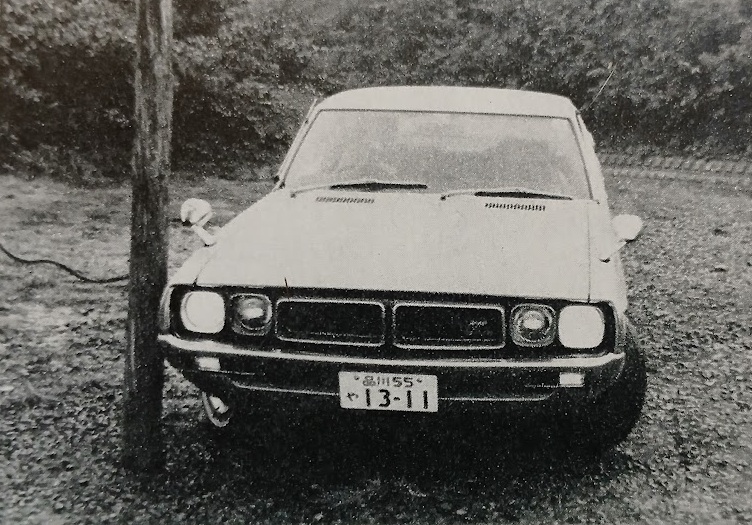
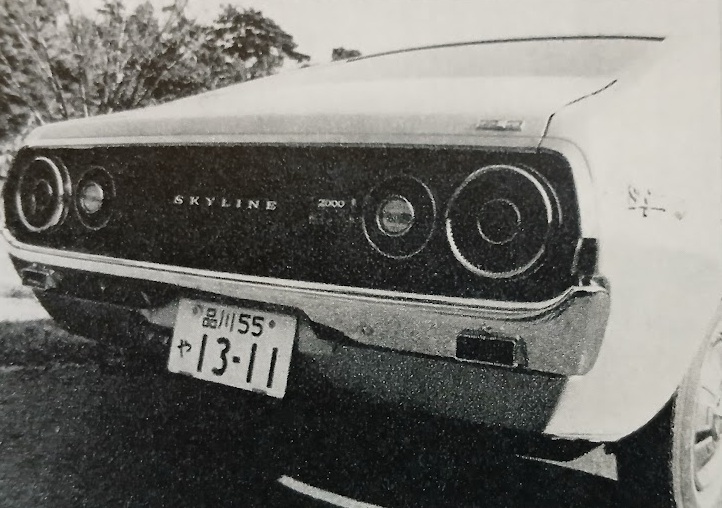
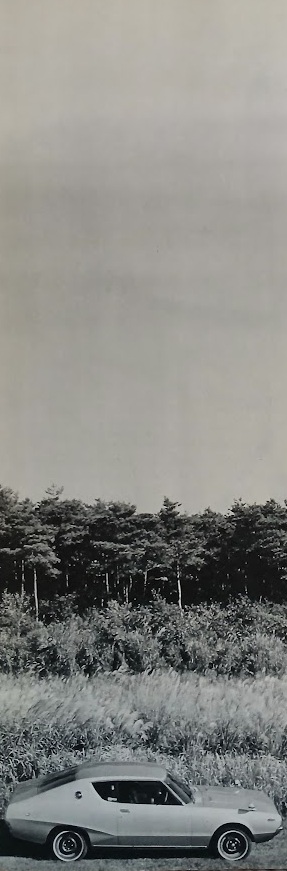
Nissan Skyline 2000GT-X Hardtop (1973)
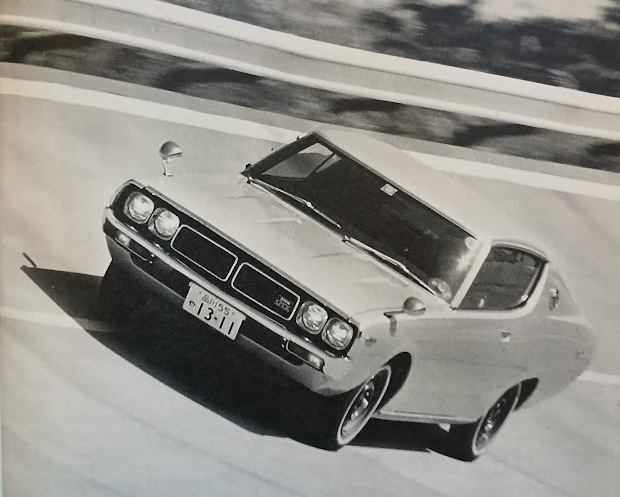
Publication: Car Graphic
Format: Road Impressions
Date: January 1973
Author: “C/G Test Group” (uncredited)
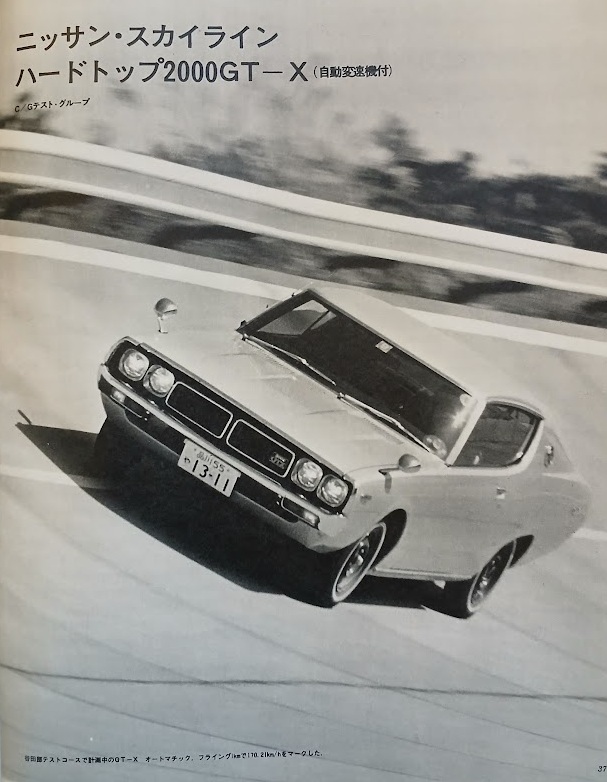
Road testing the Skyline 2000GT-X Hardtop
Nissan’s flagship Skyline series underwent a full model change last September to arrive at its present form. This time, from among its many variations, we chose the Hardtop 2000GT-X with automatic transmission and tested it over approximately 600km. The so-called “Ska-G” is said to be a favorite among many affluent domestic-car buyers, and within the new series, the most popular seems to be the Hardtop 2000GT-X with 5-speed gearbox, the hottest version—at least on paper.
Yet as its large and somewhat heavy body, comfortable interior, rather “sleepy” 6-cylinder engine, long 2610mm wheelbase, and four-wheel independent suspension suggest, this car is fundamentally a cruiser intended for comfortable long-distance touring. For such a purpose, an automatic transmission should have significant advantages. Our test car was luxuriously equipped, with the 130ps twin-SU engine and the “X” specification—including cloth-covered seats, cassette stereo, power windows, and overhead console—as well as a JATCO 3-speed automatic transmission and optional air conditioning. Its Tokyo price is said to be 1.21 million yen.
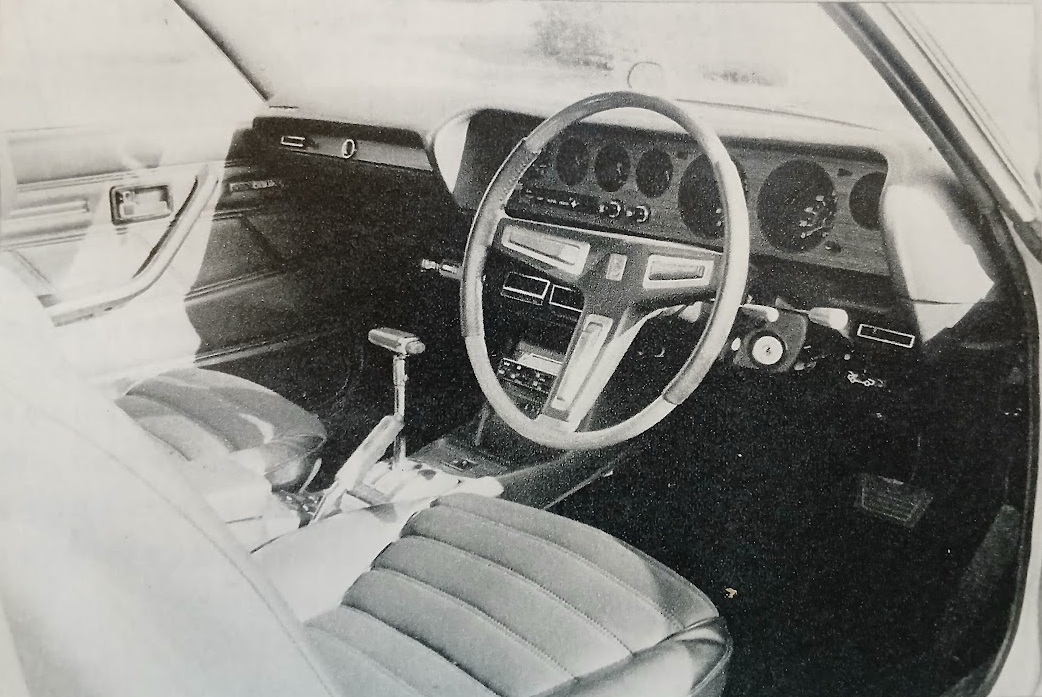
The floor-mounted selector, with its six positions of P-R-N-D-2-1, operates lightly and positively. The engine idles at about 900rpm in neutral, dropping to 700rpm when a gear is engaged. Idle creep is strong, making it necessary to keep firm pressure on the brake pedal.
For ordinary driving, the “D” range is all that is required (starts are always made in first), and the shift points vary considerably according to how far the throttle is pressed. With an extremely gentle start, for example, and the accelerator held at only a small opening, the 1-2 and 2-D shifts occur at just over 10km/h and just over 20km/h, respectively, with the engine barely reaching around 1800rpm. Even in actual city conditions, driving just briskly enough to lead the flow of traffic, the transmission shifts up at 2500rpm in crowded areas (at 25km/h and 40km/h, respectively), while on a somewhat clearer road, pressing harder raises the shift points to 3500rpm (35km/h and 60km/h).
With each shift, the needle of the rev counter (which reads to 8000rpm, with the yellow zone beginning at 6000 and the red at 6300) drops abruptly and the engine note changes. There is also a distinct shift shock that can be felt through the body, but fortunately it is not severe enough to be unpleasant.
When given full throttle with the selector left in D, the kickdown switch responds quite readily. The shift point then jumps to 4900rpm, allowing 55km/h in first and 100km/h in second. In standing-start acceleration tests at the Yatabe test course, using D range and kickdown, the car covered 0-400m in 19.67 seconds and 0-1000m in 36.30 seconds.
If more acceleration is desired, first and second must be held manually. In this case, taking the engine to 6300rpm, where the red zone begins, gives just over 80km/h in first and 135km/h in second. In particular, since kickdown from D to second stops operating above 95km/h, manually selecting second from such speeds should make better use of the advantages offered by the automatic transmission.
For fast overtaking at around 100km/h on the expressway, it is necessary to make use of the 2 range. As expressways become more crowded, like the Tomei is today, situations like this will occur more often, so it would be better if the 2-D shift point were set higher.
Cruising at 100km/h (although when the speedometer indicates 100km/h, the actual speed is only 93.31km/h, making it quite optimistic) corresponds to about 3400rpm, while 120km/h corresponds to about 4000rpm. At either speed, touring is very quiet and comfortable. The bulky L20 SOHC 6-cylinder unit has become markedly quieter and smoother within this sort of practical operating range compared with the early versions. Still, as we have repeatedly pointed out, once it passes around 5000rpm, noise and vibration increase rapidly and the engine also begins to lose its punch.
In this respect, setting the redline at 6300rpm seems rather optimistic. In practical terms, 5000rpm is about all that one can stand; in this car, that corresponds to an indicated 148km/h. This is about the limit for comfortable high-speed cruising. Beyond that, in addition to the engine noise (the exhaust is surprisingly loud and tends to boom inside the car from around 5000rpm), the whistling from the side windows becomes louder, to the point that even people seated next to each other have to raise their voices to carry on a conversation. Even then, the loudest offender is the speed-warning buzzer, which starts to sound at 110km/h.
On winding roads, the 2 range is useful: press the accelerator and the car accelerates about as well as one with a conventional manual gearbox in third; release it and there is dependable engine braking. In this range, however, no matter how hard the throttle is pressed, there is no kickdown to first—it is a true second-gear hold. As a result, if the car loses speed coming out of a tight corner, first must be selected, but the transmission responds extremely slowly to this operation and in practice will not shift down until speed falls below 30km/h.
One useful expedient, then, is to select 2 and immediately move the lever down to 1, while continuing to drive with the transmission actually still in second. With the lever already in 1, when speed falls, one needs only to press the throttle hard for the transmission to shift into first, giving strong acceleration. There is quite a large shock when it does so, but this simply has to be accepted as one of the measures necessary for sporting driving with an automatic transmission.
The four-wheel independent suspension, with MacPherson struts and coil springs at the front and semi-trailing arms and coil springs at the rear, is carried over from the previous model, and its characteristics are also very similar. In general, the car can be said to have extremely stable and safe handling.
With the new model, the recirculating-ball steering has been changed to a variable ratio of 19.0–22.5. Although it still has a rather dull feel, there is very little of the elastic play around the straight-ahead position, and the steering responds reasonably faithfully to the amount of lock applied. Perhaps because of the heavy engine over the front wheels, understeer is still stronger than average, and on entering a corner the steering wheel has to be turned through quite large angles and held firmly against the heavy effort required to maintain that lock. (The GT-X’s peculiar partial-leather steering wheel varies in feel depending on where it is grasped, which is unpleasant until one gets used to it.)
In normal driving, the car retains these basic characteristics up to quite high speeds. Unfortunately, this time we were unable to establish its behavior when pressed further, to the limit. The day we went to Hakone in search of winding roads was spoiled by rain, and the standard 6.45S-14-4PR cross-ply tires (the test car was fitted with Dunlop GS1s) simply could not find enough grip on the wet surface.
These tires, which cannot be said to offer especially high adhesion even in the dry, were thoroughly miserable in the rain. Even with the gentle application of power through the torque converter, the tail would frequently step out in corners. Even in a straight line, simply running onto the painted road markings was enough for them to relinquish their grip. If this is the case even with an automatic transmission, a driver who intends to drive enthusiastically with a manual gearbox should probably move up one class in tire grade and size. With a curb weight of 1170kg and an output of 130ps, something equivalent to a 6.95 tire would seem only natural, and a good-quality radial would also be worthwhile.
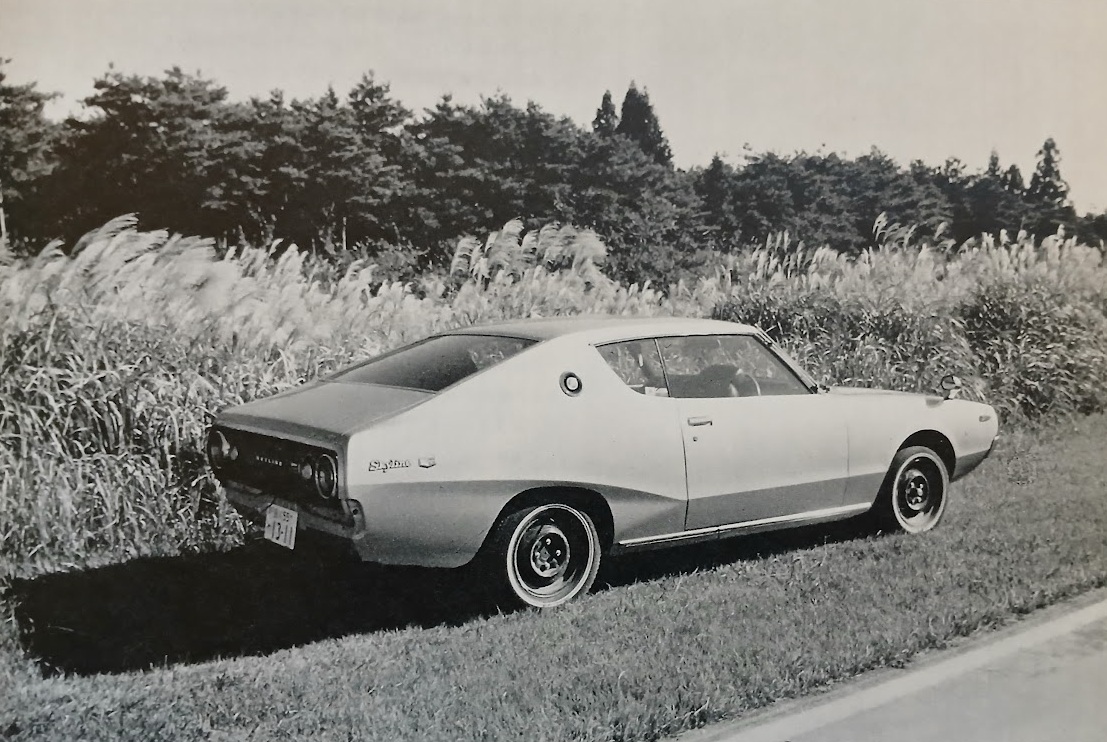
The increase in body size over the previous model—130mm in overall length and 30mm in width—is readily apparent from the driver’s seat. From the relatively low seating position, the hood seen beyond the high cowl is broad and flat, and as in the Laurel and Corona Mark II, it is difficult to see the road immediately in front of the car. As a result, when driving quickly on a winding road, one inevitably has to adopt a more upright posture.
At such times the tilt steering wheel, with 40mm of vertical adjustment, is useful, but in its highest position it is a rather difficult reach away. For a Japanese driver of average build, in fact, the lowest position is about right at all times. The seats, upholstered in soft tricot across their center sections, are generously dimensioned and quite soft overall, yet provide firm support where it is needed; even when the car rolls to large angles in hard cornering, there is no struggle to maintain one’s position.
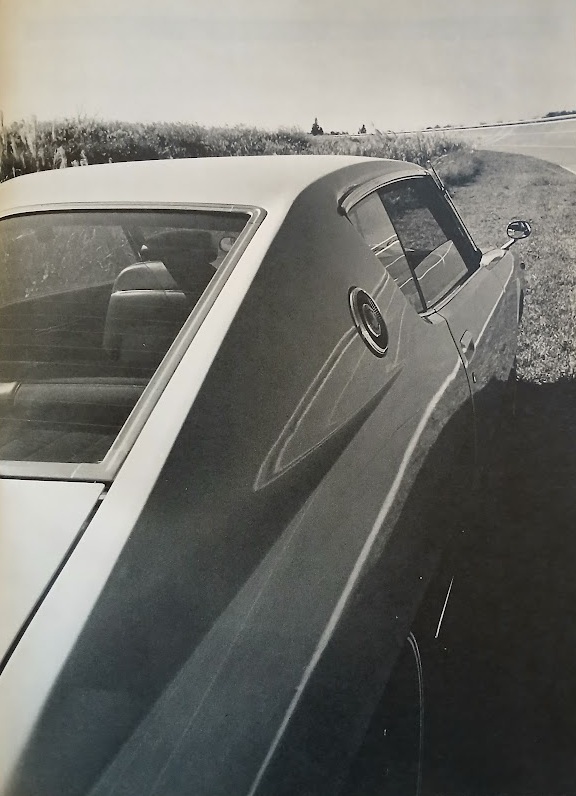
Thanks to the relatively high waistline, the interior forms a comfortable private space, but the other side of this is poor rearward visibility, making it difficult to back up in tight places such as gas stations. Moreover, the rear window glass is raked so steeply that even when the car is moving slowly, raindrops tend to collect on it.
There is very little bright trim on the instrument panel, and the scales on the gauges themselves are suitably uncluttered, making them extremely easy to read both day and night. One drawback, however, is that because of the high cowl, checking them while driving requires an excessive amount of up-and-down eye movement. The group of smaller gauges angled toward the driver also seems to have been positioned a little too far forward.
Among the interior equipment, a small bulb that illuminates the ignition keyhole when the parking lights are on, and the layout of the power-window switches—four of them grouped on the center console, with the driver’s switch made longer than the others—can be cited as “thoughtful little touches.” A lever at the lower right of the driver’s seat opens the trunk using a long cable, and is convenient in that luggage can be loaded or unloaded while the engine is running. But if that is the object, it would be far more practical simply to have a completely separate key lock for the trunk, as on earlier Japanese cars and the great majority of current imports.
As on the Laurel, the newly fitted four-mode wiper switch on the left side of the steering column is another major virtue. (Its three-click positions provide intermittent, low-speed, and high-speed operation respectively, while pressing the knob operates the windshield washer and automatically gives two sweeps of the wipers.) The wipers themselves also remained firmly on the glass at 140km/h, reliably covering a wide swept area.
With its large body fitted with an assortment of appealing personal-car features and its ability to provide quiet, safe long-distance travel, the Skyline GT-X is probably one of the better buys among Japanese cars in this class. In particular, if one is to specify the car in keeping with its design intentions, the automatic transmission is, after all, the better choice by far.
One drawback is that it has to be fed expensive premium gasoline, but even with this heavy body, over the course of our test we managed a reasonably good average of 7.20km/l (corrected for odometer error). As might be expected, during the session that included maximum-speed testing at Yatabe, the figure fell to 6.55km/l; conversely, on the day we enjoyed comfortable touring through Izu and Hakone, it returned as much as 7.85km/l.
If one can enjoy foolproof motoring, complete with stereo and air conditioning (which we did not test, this being the cold season), while attracting envious glances—“Ah, a Ska-G!”—from those around us… well, perhaps the gasoline bill is something one can live with, don’t you think?
Postscript: Story Photos