Nissan Skyline 2000GT-X Hardtop (1972)
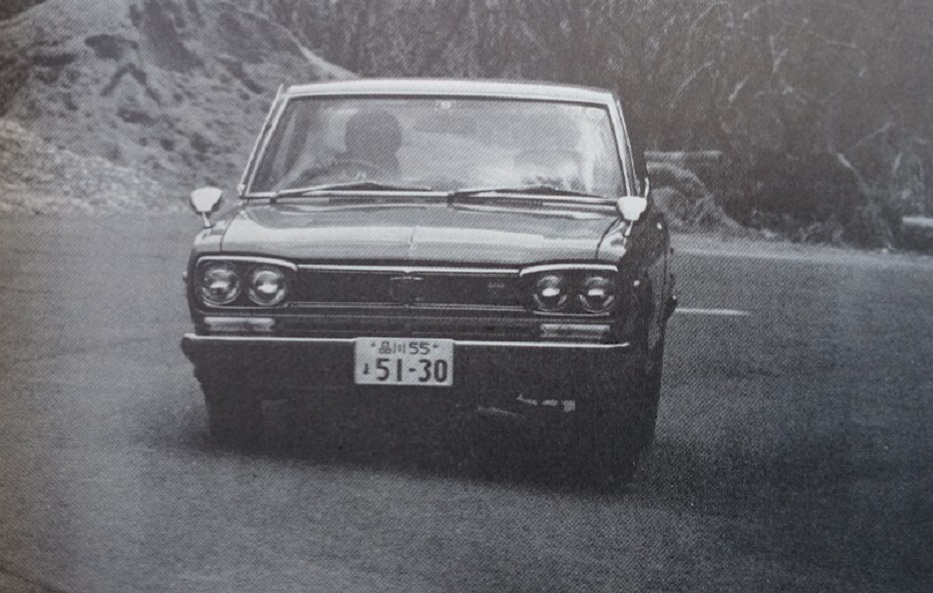
Publication: Car Graphic
Format: Road Impressions
Date: June 1972
Author: “C/G Test Group” (uncredited)
Road testing the Skyline 2000GT-X Hardtop
The flagship of Nissan’s money-making Skyline range—aside from the GT-R, which has an altogether different character—is now the Hardtop 2000GT-X, introduced to the lineup in the autumn of 1971. More recently, a GT-X version of the 2000GT sedan has also been added to the lineup.
The GT-X uses a lightly tuned version of the 1998cc six-cylinder engine, retaining the same compression ratio but adding twin SU carburetors. It also comes standard with a car stereo and seats trimmed partly in tricot fabric. For the first time in the Skyline series, buyers can also specify a 5-speed gearbox with Porsche-type synchromesh (a 40,000 yen option). Tokyo prices are 993,000 yen for the Hardtop and 935,000 yen for the sedan—98,000 and 75,000 yen more, respectively, than the standard GT. A 3-speed automatic transmission is also available as a 55,000 yen option.
The engine is shared with the Cedric GX and Fairlady Z. In premium-fuel specification it produces 130ps/6000rpm and 17.5kgm/4400rpm, while the regular-fuel version develops 125ps/6000rpm and 17.0kgm/4400rpm. Compared with the single-carburetor engine, these are increases of only 10ps and 0.5kgm respectively.
The optional 5-speed gearbox is based on that of the GT-R, with only the first- and second-gear ratios made substantially lower. Fifth gear is, of course, an overdrive ratio. Since the final-drive ratio remains unchanged at 3.90, the overall gearing is considerably taller than before. The gear ratios are as follows:
GT-X 5-speed: 3.321 – 2.077 – 1.308 – 1.000 – 0.864
GT 4-speed: 3.592 – 2.246 – 1.415 – 1.000
Having missed the opportunity to drive the Hardtop 2000GT-X when it was first introduced, we took this opportunity to evaluate the combination of the twin-SU engine and the new 5-speed gearbox.
We requested a GT-X sedan from Nissan without delay. However, the company’s public relations department had only a Hardtop 2000GT-X available, so, accepting that our test would be somewhat out of season, we set off for Hakone in the hardtop instead. The test car had covered approximately 13,000km and was equipped with the premium-fuel engine. Fortunately, it was also fitted with the optional 5-speed gearbox, as well as the optional Bridgestone radial tires (165SR-14).
When we previously tested the Skyline Hardtop 2000GT, we noted that its single-carburetor engine revved freely beyond 7000rpm, offered good flexibility at low speeds, and was remarkably quiet. All of those qualities have carried over unchanged to the GT-X. In city driving, despite the taller overall gearing, the engine pulls well at low speeds. Fifth gear is asking a bit too much, but in fourth it will accelerate well enough to keep pace with traffic from just under 40km/h, or around 1000rpm. For those who prefer a sportier driving style, only first and second gear are needed around town—the latter pulling cleanly beyond 80km/h—and the GT-X can indeed become a wolf in sheep’s clothing.
While the engine seemed entirely satisfactory in city driving, it proved somewhat disappointing once we reached the expressway and settled into high-speed cruising. At a steady cruising speed there is little to criticize, but when overtaking from around 100km/h the engine simply lacks punch. At that speed, the engine is turning only 2800rpm in fifth and 3200rpm in fourth, so leisurely acceleration is only to be expected. But even in third gear, where acceleration begins from 4200rpm—just below the power peak—the feeling is much the same. The response is simply rather sluggish.
At first we wondered whether the closely spaced third-, fourth-, and fifth-gear ratios were responsible, but it gradually became clear that the engine itself was not producing its catalog output. It required more than five minutes to warm up before it would accelerate smoothly, and despite the twin carburetors, power fell away noticeably beyond about 5500rpm. The most likely explanation appears to be that the carburetors have been set as lean as possible to satisfy the new exhaust-emissions regulations. Our honest impression was that the engine was making no more than about 100ps.
Setting that aside, however, it is fair to say that the GT-X is a comfortable highway cruiser. Its straight-line stability remains excellent up to and beyond 160km/h, and even when driving in fourth and fifth—and occasionally third—gear, the noise level remains far below the standard of most domestic cars. It also offers good resistance to crosswinds. At legal cruising speeds, one can drive with complete peace of mind. Even the speedometer seems relaxed, indicating 100km/h when the true speed is 95.5km/h.
On the mountain roads of Hakone, however, the tall gearing and disappointing power conspired to make the car feel even more sluggish. Especially in second and third—the gears used most frequently on these roads—it lacked punch for overtaking (a feeling reinforced by the fact that this engine simply lacks the crisp, free-revving nature one expects from twin carburetors). As a result, it was often necessary to use one gear lower than usual. A 5-speed gearbox consisting of the standard 4-speed plus an overdrive top gear would probably have been better suited to the car (and its available power).
Ironically, the fact that the car has become relatively underpowered has allowed the chassis to catch up, and the result is handling of a remarkably high standard. The steering has about 100mm of free play in the straight-ahead position, requiring a rather exaggerated motion at turn-in, but once committed to a corner the front wheels respond faithfully. The steering wheel is somewhat too large, which keeps the driver’s hands rather busy, but it remains consistently light. In short, it is neither sluggish nor overly sensitive, making it well suited to the average driver.
The same is true of the car’s cornering characteristics. It maintains a stable understeer, and because the degree of understeer increases only slightly as speed rises, the car remains easy to control. With insufficient power to break the rear wheels loose, and with mid-corner inputs such as braking having little effect on the car’s attitude, it can be described as exceptionally safe. However, caution is required over mid-corner bumps, as the car has a tendency to bounce rather noticeably.
The optional Bridgestone Radial 11 tires fitted to the test car, though offering rather poor grip, are well matched to both the handling and the available power. Even when set to the recommended high-speed tire pressures (2.0kg/cm² front, 2.1kg/cm² rear), they squealed continuously at modest cornering speeds. Even so, they are easier to control than tires that grip strongly before breaking away suddenly.
The front-disc, rear-drum brakes are another of the car’s strong points. The discs squealed noticeably at low speeds, but the pedal remained consistently light, and the brakes delivered stable, confidence-inspiring stopping power from any speed.
Ride comfort is excellent regardless of road surface or speed, thanks to the long wheelbase, appropriately firm suspension, and excellent seats. Rear-seat passengers, however, must accept 70mm less legroom than in the sedan, along with somewhat more pronounced upward jolts.
Finally, a word on fuel consumption. Over our 350km test, which included a round trip to Hakone on the Tomei Expressway as well as city driving, the GT-X returned 7.9km/l, the best result of any Skyline 2000GT tested by C/G. Part of this improvement is undoubtedly due to the overdrive gear, which was used about equally with fourth during expressway cruising, though the very lean carburetor setting likely had a greater effect. Even so, the 50-liter fuel tank shared with the 1500 and 1800 models is too small for a car intended as a long-distance tourer. Oil consumption during the test was nil.
In conclusion, we must say that the 10ps increase over the standard 2000GT (120ps) is effectively offset by the taller overall gearing, with the result that acceleration actually feels slightly inferior. The GT-X is well suited to drivers who value quiet, refined high-speed cruising. Those seeking a sportier style of driving will find the standard 4-speed gearbox a better choice.