Nissan Skyline 2000GT-R Hardtop (1973)
Publication: Auto Sport
Format: Road Impression
Date: March 1973
Author: Motoo Kitano, Masahiro Hasemi, Hiroshi Okazaki
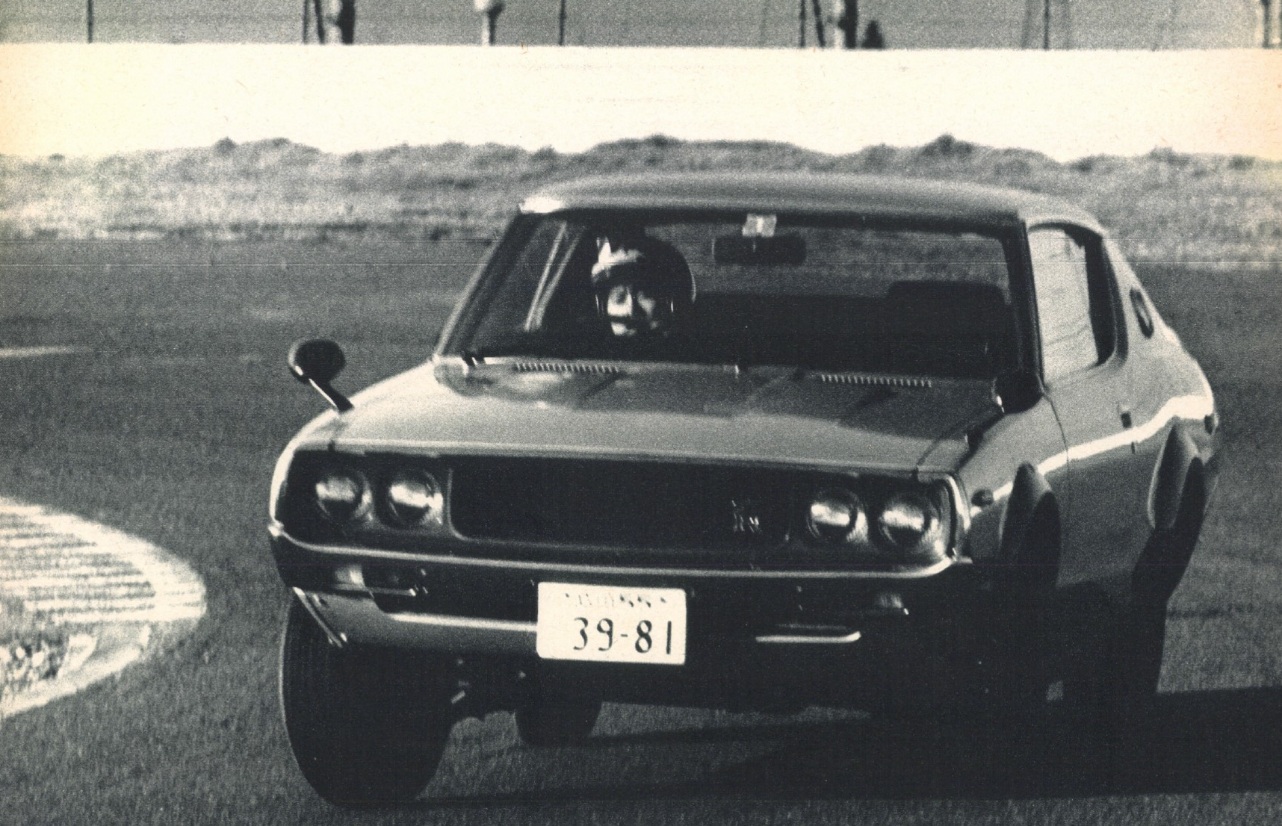
The much-anticipated reborn Skyline GT-R has finally arrived. This model is based on the new Skyline GT hardtop body and is equipped with the legendary S20 power unit that has set numerous brilliant records in domestic races. We wasted no time in bringing this new GT-R to the Tsukuba Circuit. The test drivers were Nissan works’ Motoi Kitano and Masahiro Hasemi.
Four-Wheel Discs With Excellent Fade Resistance
As the starter key was turned, the sound of the electromagnetic fuel pump working filled my ears. Sitting next to me in the GT-R’s cockpit was Kitano.
“Whiiirrrrn”… With the metallic sound unique to the S20, the 24-valve, DOHC straight-six engine came to life.
“The sound is great. I think anyone who loves cars will be thrilled by the sound of the S20. No matter how many times I listen to it, I’m always in awe,” Hasemi murmured.
He’s exactly right. When you’re driving in the city or on the highway, the sound of this car passing by clearly conveys the power and strength and makes you want to give way. The exhaust note of the S20… even if it’s at a loud volume, it’s not an unpleasant noise for enthusiasts, but a beautiful “sound.”
Kitano completed laps in the 2 minute 19 second range. In the tight corners, he let the tail hang out a little just before entering and took advantage of the limited slip differential to exit cleanly. After seven or eight laps we came back to the pits.
“It feels like it’s become more mature in many ways than the previous GT-R. In other words, I feel like the old GT-R is better in terms of rawness, but in return it’s more well-rounded and easier to handle. It has a more refined feeling.
“The steering is lighter and the clutch is smoother, but that doesn’t mean it’s any less sporty, and cornering ability remains at a high level.
“In the old GT-R, you could feel the center of gravity shift to the rear when cornering, but this feels more like a racing car, with the center of gravity toward the front. If the center of gravity is shifted to the rear and the car starts to slide, the front becomes less effective, making it harder to control, so in that sense, the new GT-R has better maneuverability.
“Also, compared to the previous GT-R, the front end lifts up less when accelerating from a standstill, and as the speed increases the steering feels more stable, which is a step in the right direction.”
Kitano continues, choosing his words carefully.
“However, for those who want to use the full power of the S20, the standard tires are a little weak. Also, a steering wheel with a smaller diameter would be better. With this combination of steering gear ratio and steering wheel diameter, the steering tends to feel a little delayed when cornering aggressively. This is based on my own personal preferences, but if I were to buy a GT-R, I would switch to higher-grade tires and change the steering wheel to one with a smaller diameter.
“Of course, if you’re just driving briskly on regular roads, there’s nothing wrong with leaving it at the standard setting…
“The brakes are really good. With the old GT-R, which had drums on the rear, braking was good up to a certain point, but if you went any further than that, they would lock up and lose stability. In this new model with four-wheel discs, you can rest assured that it will keep that steady, strong braking action, pulling you down firmly but progressively, all the way to the limit.
“The brakes are so fade-resistant that they can even be used on a circuit as-is. This is one of the major attractions of the new GT-R. However, if you use them hard, the tires still tend to give out. If we put on better tires, I’m sure the brakes will be even more powerful.”
Footwork Suited to Grip Running Style
It was Hasemi’s turn at the wheel. After completing about 10 laps, he came back into the pits.
“Overall, it’s more well-rounded than the old GT-R. The engine…the high rev range especially, seems smoother, and the suspension settings, if anything, feel more refined as a street version.
“The same goes for the clutch. I remember the old GT-R’s clutch being quite hard to engage, but with this one, you don’t have to worry about the engagement at all when starting off.”
In other words, the first things Hasemi said after getting out of the car showed that he had a similar impression to Kitano.
I also got behind the wheel after Hasemi, and I had the same overall impression.
Driving the old GT-R in crowded city streets was quite hard work, but with the new GT-R, this has been significantly reduced.
Steering effort is much lighter. This is likely due in large part to the steering gear ratio being relaxed from 18.5:1 to 19.0-22.5:1, but the alignment and tuning also appears to be a factor.
The change in steering gear ratio has also increased the lock-to-lock ratio from 3.3 turns to 4.0 turns. Four turns is a little too much for this type of car, but the initial response is good, so it’s not so noticeable during normal driving, and you won’t break a sweat when parking, so it’s a great choice for the street version.
In this sense, I think things are actually moving in a positive direction.
However, as Kitano said, when it comes to “hot” driving on winding mountain roads, there tends to be a delay in steering response, so in some cases it may be necessary to change to a smaller diameter wheel.
“As for the steering characteristics, if you are driving in the speed range you could cover on general roads, you can drive with a slight understeer. However, if you’re driving aggressively on a circuit, the understeer will come out more strongly.
“In the case of a front-heavy car, this understeer characteristic is somewhat unavoidable, but it should be possible to improve it by tuning the tires and wheels.
“For a car like this, I’d like the wheels to be magnesium if possible. A size of about 6 inches would be good. I feel that 5.5 inch steel wheels are a bit lonely in the wheel wells of this car.
“If we added higher-grade tires on 6-inch mag wheels, it would look a lot more impressive, and in terms of performance, I think it would be more than enough for a street sports car,” says Hasemi.
The new GT-R’s suspension is basically not much different from that of the previous GT-R, but an anti-roll bar has been added to the rear.
The settings seem to be a little softer than the old GT-R. With the old GT-R, it was relatively easy to try out drifting techniques if you wanted to, but the new GT-R is set up in such a way that grip driving is basically the best fit.
“Yes, the setting is definitely suitable for grip driving. In the past, a lot of racing cars also had stiffer settings that made it easier to slide and drift, but most of the more recent settings are now suited to grip running,” said Kitano.
As Hasemi said, the steering characteristics usually maintain a slight understeer, but when driving in a way that involves aggressively attacking corners, the understeer becomes fairly strong.
The old GT-R also had a tendency to understeer when high g forces were applied, but as mentioned above, drifting was relatively easy, which made it possible to cover up the understeer to some extent. In the case of the new GT-R, in order to suppress the understeer, it is basically necessary to recover the cornering force of the front tires by controlling the power. This change in trajectory due to power off–in other words, the so-called “tuck-in” phenomenon–is quite evident.
However, these phenomena only become evident at fairly high speed ranges, and as I have already said, they do not become evident when driving at high speeds on public roads.
Driving in the City, Even 60km/h in Fifth Gear is Possible
“The differential is a limited-slip, but it’s so smooth you never know when it’s starting to work, and yet it works powerfully. It’s really easy to use,” said Hasemi.
“That’s right. With such smooth handling, even if a beginner drives in the rain or on low-traction surfaces like dirt roads, they won’t be surprised. It’s really easy to drive,” Kitano agreed.
The limited slip differential’s effectiveness is most evident when exiting a corner. Acceleration is quick and the car can accelerate forcefully even when the driver’s line is off.
“With the limited-slip, it’s relatively easy to slide the tail, so many people like to try that kind of driving style, but basically, I recommend slowing down enough before entering a corner and through the apex. Try not to slide as much as possible, and then use the full power of the limited-slip when you exit. This is the most orthodox, safest, and fastest way to run. Especially on slippery surfaces, if you slide recklessly and lose your balance, it will take time to regain your balance, and even though your intent is to run fast, it will actually kill your speed. Please keep this in mind and use the power of the limited-slip to its full potential,” advises Kitano.
“The brakes are outstanding. As expected, the power of four-wheel discs is very strong. Tsukuba is a tough course for brakes, where even racing brakes start to lose effectiveness after about three laps, and the pressure applied to them changes after about five laps. But with this, the braking effect doesn’t drop that drastically even after ten laps. Of course, the speed is also lower than with the racing version, so you can’t simply compare the number of laps… But even when you press hard, the stability is good, and the front and rear balance is good. As Kitano said, this is one of the great attractions of the new GT-R.” Hasemi seemed to really like these brakes.
The new GT-R’s front brakes are the same S16 type discs as the Skyline 2000GT, while the rear brakes are newly developed Arnett type disc brakes with parking mechanism.
The master back servo has been changed from the GT’s 4.5 inch to a 6 inch, and the master cylinder has also been increased in size. Needless to say, the rear wheels are also fitted with a proportioning control valve to prevent rear wheel locking.
As mentioned above, the brakes on the old GT-R were disc/drum brakes with no servo. Therefore, the pedal force was quite large, and continuous use, especially in typical deceleration situations in the city, put a lot of strain on the driver’s right foot.
However, the new GT-R’s pedal pressure is just right for city driving, and it’s not difficult to control when driving at a hotter speed. As Hasemi said, it also has excellent fade resistance.
The five-speed gearbox is also inherited from the previous GT-R, but its gear ratio settings are entirely appropriate for sports use.
When pushed to 7000rpm, the maximum speeds in each gear are 67km/h in first gear, 100km/h in second gear, 140km/h in third gear, 182km/h in fourth gear, and 200km/h in fifth gear.
The gears are well coordinated and matched with the characteristics of the engine, making it possible to extract full, forceful power under all conditions.
Although the S20 engine has a high power output of 160ps, its flexibility is not significantly compromised.
Third gear is sufficient for driving at 40 to 50km/h in urban areas, and the overdrive fifth gear can be used from around 60km/h.
However, there isn’t much torque until the rotation exceeds 3000rpm, so although you can drive smoothly at low speeds, when it comes to acceleration, you’ll want to stay above 3500rpm.
Also, the combination of modest low-speed torque, a high first gear ratio, and a limited-slip differential requires a launch technique that is different from that of an ordinary car. With a normal sedan-like combination of accelerator and clutch work, the start will be very jerky, the revs will drop, and you will fall behind significantly. To get a clean start in the GT-R, use half-clutch at the moment of engagement, increase the rotation speed a little, and then gradually engage the clutch the rest of the way.
In other words, the technique is “little by little…”
However, as Hasemi said in his impressions, the strictness of footwork at the start has been greatly reduced compared to the old GT-R. Any enthusiast who wants to get behind the wheel of a GT-R will be able to get the hang of a clean start after just a few tries.
Is the L24 the Favorite for the Race Version?
Well, let’s summarize here.
“The rawness that was present in the previous GT-R has been toned down a little, but as a street sports car, it feels more refined and complete. Also, even though a milder feeling has been added overall, as a serious sports car, it is hot where it should be hot, sharp where it should be sharp…it is sharp in all the key areas,” is Kitano’s overall assessment.
“It certainly feels like it has a stronger sense of suitability as a street sports car than the old GT-R. But even though it’s milder, it doesn’t go in a direction that spoils the sportiness of the GT-R in any way. The old model’s Spartan feeling, which required a certain amount of physical strength, has faded, but it’s still as sharp and powerful as ever. After that, you can choose the tires and wheels to suit your individual preferences, and if you want even quicker steering, you could change the steering wheel to one with a smaller diameter. As a street version, this level of simple tuning should be enough to provide a more than satisfactory feeling,” says Hasemi.
I think you now have a general idea of what the new GT-R is, but when it comes to the GT-R, what people are most interested in is its racing activities.
I asked them a few questions about this, and no clear answers were given as to the possibility of racing or other activities, other than a comment from Hasemi that “The body shape is good, and the engine and suspension have great potential performance, as has already been demonstrated. However, when it comes to racing, the absolute body size and vehicle weight will be an issue.”
Rumor has it that a racing version of the new Skyline is definitely in the works, whether it will be raced or not, but the power unit in question remains a mystery.
However, if we summarize the speculations of people involved in the race, the consensus is that there is almost no chance the car will be equipped with the S20 type engine. That would mean the L24 or L26 could be used instead, but the current favorite is probably the L24.
The L24 type is already installed in the export model “Skyline 240K,” and there are no installation problems at all. The engine weight is also much lighter than that of the S20.
It’s not impossible to imagine the L26 being used, but I don’t think it’s likely to happen anytime soon. If the L26 is ever used, it will likely be installed in the Fairlady first.
This is because, from Nissan’s perspective, the Fairlady Z must naturally be considered a higher class sports car than the Skyline, and it would seem politically impossible to turn the Skyline into a machine that is faster than the Z.
The weight of the L26 is about 13kg lighter than the S20. There seems to be almost no problem with mounting it. Therefore, it is conceivable that it will eventually be installed in the Fairlady Z and the Skyline, but for now I think the Skyline 240 is the most likely favorite.
However, as mentioned above, if the Fairlady 260Z is released, the Skyline will undoubtedly follow suit and be equipped with an L26 engine.
Either way, it won’t be long before the new Skyline makes its vaunted return to the circuit.