Nissan Skyline 2000GT-R (1969)
Publication: Auto Sport
Format: Road Impression
Date: April 1969
Author: Seiichi Suzuki, Tatsuro Sasaki, Toshikazu Inoue
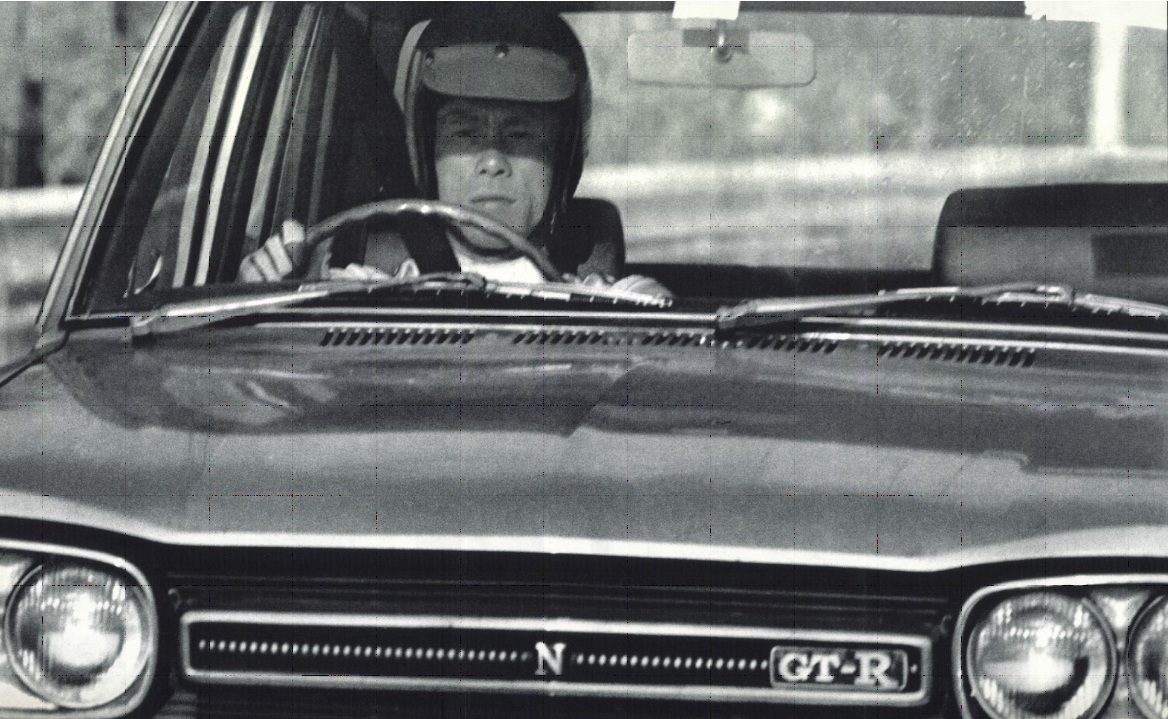
The hot-model “GT-R” version of the Skyline 2000GT has gone on sale. The driver Auto Sport called upon was Seiichi Suzuki, freshly back from Daytona. The GT-R charged through the rain on the Tomei Expressway, then shattered the early-morning silence of Suzuka Circuit with the shriek of its tires.
A Sound That Stirs Excitement
The hot GT car eagerly awaited by sporting enthusiasts finally went on sale on February 21. Its name—the Skyline 2000GT-R.
The GT-R’s engine is based on the inline six-cylinder, DOHC, four-valve-per-cylinder unit developed for the Nissan R380 racing prototype. First appearing in 1965, during the former Prince era, the R380 has since achieved numerous successes in domestic racing while making great strides in both performance and body design.
The hard-edged character of the original Skyline GT helped awaken Japanese motor sport from its slumber. What effect, then, will the “New Skyline” GT-R have on today’s motor sport world? To find out, Auto Sport asked SCCN driver Seiichi Suzuki, just back from competing in the Citrus 250-mile race at Daytona, to put the car through a full performance test.
The plan consisted of a 570km long-distance tour from Tokyo to Suzuka, heading west along the Tomei Expressway and National Route 1, followed by a demanding sports driving session at Suzuka Circuit.
At 1:00pm on March 7, we met at the entrance to the Kawasaki interchange of the Tomei Expressway. Suzuki, his face still bearing a “Daytona tan,” broke into a smile and promptly slipped into the bucket-type driver’s seat…
The seat holds the driver snugly in place. Apart from the rich wood-grain finish of the instrument panel and console box, the interior is entirely black.
The instrument panel groups together a speedometer reading to 240km/h on the right, a tachometer with its red zone from 7500-10000rpm on the left, a water-temperature gauge at the upper center, and an oil-pressure gauge below–all the gauges for monitoring the engine’s vital functions.
On the center console, the ammeter and fuel gauge are mounted side by side facing the driver. At the forward end, within easy reach of the left hand, are the cigarette lighter and washer switch, with the light and wiper control knobs just behind them. Farther back still, beside the seat, is the wood-grain gearshift knob. Slim in shape and marked with the five-speed and reverse shift pattern, it is well matched to the length of the lever and fits comfortably in the hand.
Seiichi Suzuki turned the starter. The engine cranked with a brief kuu-kuu-kuu, then started immediately. Equipped with three twin-choke Solex carburetors, the “six” settled to an idle of around 1000rpm. Along with the dry sound of air being drawn into the carburetors came the deep, heavy beat of its six cylinders firing.
Suzuki fastened the three-point seat belt and shifted into first gear. Without the slightest hesitation, the GT-R climbed the interchange ramp onto the Tomei Expressway. The moment we joined the main lanes, Suzuki pressed the accelerator down decisively. With an exhaust note that instinctively stirs a man’s excitement, the tachometer needle leapt upward.
The acceleration was tremendous. Third gear, then fourth—and with the engine not yet even at 4000rpm, the speedometer was already approaching 100km/h. Yet the stability was outstanding. It was already becoming clear that, on public roads, there was simply no way to bring out the wolf lurking beneath the GT-R’s unassuming exterior.
Onto the Suzuka Circuit!
Seiichi Suzuki put on his helmet and racing suit. It was early morning at Suzuka Circuit, and the enthusiasts who had come to the course began gathering around.
“So this is the hot version of the ‘New Ska-G.’”
Fresh off the production line, the GT-R stood proudly in the paddock.
“I wonder if it can really handle the circuit just as it is.”
With everyone watching, Suzuki settled into the cockpit.
“This bucket seat—I thought a reclining back might have been nice around town, but once you’re on the circuit, it feels just right.”
With that, Suzuki pressed the accelerator two or three times and turned the starter, without using the choke. The 1989cc, four-valve, DOHC S20 inline six immediately came to life.
Being equipped with three Mikuni Solex 40PHH carburetors, this power unit requires a certain knack when starting. As is generally true of twin-choke carburetors, if the accelerator is pressed two or three times before operating the starter, bringing the accelerator pumps into action, the engine will start without the choke. This, however, is how the engine should be started when cold.
When the engine is warm, the accelerator should be pressed down slightly and held in that position while the starter is operated. Provided there is no mechanical trouble, the engine should start within five or six seconds at most. If the starter is released after only two or three seconds simply because the engine has not fired, getting it started on the next attempt becomes more difficult, since the plugs will become fouled. The hotter the engine, the farther the accelerator should be pressed.
The principle is the same as restarting a racing engine after a pit stop, or after a spin has stalled it during a race. In other words, the GT-R is started in much the same way as a racing car.
The tire pressures were set at 2.6kg/cm². Suzuki took the GT-R out onto the course.
Leaving behind the dry note of its exhaust, the Skyline 2000GT-R began its laps. One, two, three, four…. It was like a fish in water.
The GT-R came down the straight in front of the grandstand at 190km/h in fifth, braking about 150m before the first corner as Suzuki shifted down to fourth. Before the clipping point, he dropped another gear to third. The second and third compound corners and the S-bends were all taken in third. Speed through the S-bends was approximately 120km/h.
Emerging from the S-bends, Suzuki shifted up to fourth just past the Dunlop Bridge, then back down to third before the Degner Curve (80R). Immediately after clearing Degner, he shifted up to fourth again and headed for the Hairpin (20R).
For the Hairpin, he shifted from third down to second and took it at 70km/h. Accelerating out, he went from second through third to fourth. The next difficult section, the Spoon Curve, was taken at 100km/h in third. Immediately afterward he shifted up to fourth and headed over the grade-separated crossing toward the final corner. Over the crossing, the speed was approximately 180km/h.
Compared with Fuji Speedway, Suzuka has many more demanding corners, requiring an almost dizzying succession of gear changes.
The gearbox is basically unchanged from that of the Fairlady 2000, and the ratios are exactly the same.
“You can feel that distinctive Porsche-type character through your wrist. The stroke length is just right, too. It’s a perfect gearbox for circuit driving,” Suzuki commented.
—How about the clutch?
“It’s a little heavy, but with 160 horsepower to handle, it naturally has to be this strong.”
—And the accelerator?
“It’s somewhat heavy because of the three carburetors. But considering the character of the GT-R, that’s only to be expected as well.”
—The brakes?
“They require quite a lot of pedal pressure. Anyone approaching this car with the idea that it’s an ordinary sporting car might find them a little disconcerting at first. But that’s the way racing cars are. For use away from the circuit, you can fit the optional Mastervac brake booster.”
The Bluebird SSS, for example, takes exactly the opposite approach from the GT-R, with a brake booster fitted as standard. When the car is entered in a race, however, it is removed. Without it, heel-and-toe operation is easier, and there is also a savings in weight. This point alone makes it quite clear that the GT-R was designed with racing foremost in mind.
Now, let us turn our attention once again to the GT-R as driven by Seiichi Suzuki.
Through the corners, the GT-R behaves almost like a racing car. With scarcely any body roll, it sweeps cleanly through each turn.
“The tires are standard—6.45H-14, 4PR high-speed tires front and rear—so I held back a little. As for the handling, unless you provoke it into a power slide, it tends slightly toward understeer. In any case, even through the Hairpin there’s absolutely nothing to make you uneasy. It’s a good car.”
After completing four laps of the 6.004km course, Suzuki continued for another half-lap before taking the shortcut back into the pits. And remarkably, in completely standard form, his lap times were around three minutes. With nothing more than a change to racing tires, it should easily break the 2 minute 50 second mark. If it were then fully equipped with the available racing options and tuned to the limit permitted under Group 5 regulations for Special Touring Cars, there can be no doubt that it would become a formidable machine.
The following day, the All-Japan Suzuka Automobile Race Meeting was held at Suzuka Circuit. In official qualifying, a 2000cc-class Fairlady (driven by Takatoshi Teranishi) recorded a best lap of 2 minutes 34.5 seconds, while a Bluebird SSS modified for the 1600cc Group 5 class (driven by Motoharu Kurosawa) recorded 2 minutes 40.1 seconds. The Skyline 2000GT-R will surely go on to surpass these times one after another. That was our conclusion from the circuit test.
Fuel consumption during the circuit session was 4.38km/l.
An All-Purpose High-Speed Machine
For the tour to Suzuka, we deliberately chose the route over Hakone rather than taking National Route 246. From Odawara, the GT-R powered its way up the Hakone Bypass, with snow still lying along the roadside, before beginning the descent on National Route 1 amid heavy truck and passenger-car traffic.
Seiichi Suzuki drove the GT-R at quite a pace.
Hard into the corners. With ordinary driving, relying only on the brakes and steering, the car would tend toward understeer. Instead, Suzuki used heel-and-toe technique at every corner to keep power going to the driven wheels. Driven this way, the understeer changes to neutral steer, allowing the car to descend at high speed while carving smoothly through the corners.
Particularly noteworthy here was the versatile spring-rate setting. Despite the hard cornering, there was almost none of the body roll that might cause discomfort, while irregularities in the road surface were hardly noticeable.
“The springing surely has something to do with it, but I think the low-profile tires are also contributing a great deal,” Suzuki observed.
For more than 10km between Numazu and the Fuji interchange of the Tomei Expressway, we encountered the area’s chronic heavy traffic. Despite crawling along throughout that stretch, there was not the slightest sign of plug fouling or an irregular idle. And when we entered the Tomei and opened the throttle fully, the ignition remained perfectly clean.
As already mentioned, however, because the front disc brakes are not fitted with a brake booster, considerable pedal pressure is required when braking in traffic.
“A brake booster would make the car easier to drive around town, but when a car is homologated, it helps to keep the certified weight as low as possible so that there is less weight to remove when preparing it for racing. So I agree with the idea of making the deluxe equipment optional,” Suzuki said.
On the Tomei Expressway, we also measured passing acceleration.
From 70-100km/h, the GT-R required 4.0-4.2 seconds in third gear.
In fourth, the time was 5.6-5.8 seconds.
From 80-100km/h, the times were 2.9-3.0 seconds in third and 3.4-3.6 seconds in fourth.
For comparison, we took the Fairlady 2000 passing-acceleration figures from Motor Fan Road Test Digest.
From 70-100km/h, the Fairlady required 4.8 seconds in third and 7.9 seconds in fourth.
From 80-100km/h, the corresponding times were 3.2 seconds and 5.4 seconds.
In every case, the GT-R showed quicker passing acceleration than the Fairlady sports car. The cars we overtook became mere specks in the rear-view mirror almost before we knew it.
Before long, the sun went down and the headlights were switched on. On the expressway, the high beams provided plenty of illumination, giving no cause for uneasiness even at high speed. The instruments were also easy to read, with no troublesome reflections.
Beyond Nagoya, we encountered rain after dark. The wipers use high-speed blades designed to relieve aerodynamic pressure, and their movement never slowed; they worked perfectly.
The road surface was wet enough that a normal passenger car could have managed only 70-80km/h, yet the GT-R continued at 100km/h without the slightest concern. The tires maintained a firm grip on the road, with no indication that they were about to slide, and even the sharp curves beyond Sekigahara required no slowing down. Much of this, of course, was due to the skill of the accomplished Seiichi Suzuki. Even so, “an all-purpose machine”—that was our overall verdict on the Skyline 2000GT-R.
Supplement: Profile of the Skyline 2000GT-R
The Skyline GT-R, recently placed on sale, is the racing version of the new Skyline GT. It corresponds to the B-type version of the former Skyline GT, but the designation “R” was adopted to show that the car has, quite literally, the capabilities of a racing sedan and can be entered in competition almost exactly as it is.
The outstanding feature of the Skyline GT-R is, above all, its formidable power unit. The six-cylinder, DOHC, 1989cc, four-valve engine of the Nissan R380 prototype—which holds seven international records and has enjoyed a brilliant competition record—has been modified for use in normal driving and installed in the GT-R.
In appearance, it is almost identical to the 2000GT already on sale. It can be distinguished, however, by the shape of the pressed line around the rear fenders, its capless wheels and wide black high-speed tires, and the “GT-R” emblems.
For the moment, its competition debut looks likely to come in the Special Touring Car race at the JAF Grand Prix on May 3. The manufacturer has also announced that it will produce the 1,000 cars required for Group 2 homologation by then.
A wide range of optional parts is available, allowing the GT-R to be made into an even more fearsome machine. Conversely, it can also be equipped as a car to enjoy around town. Price: 1,500,000 yen, delivered at dealers in the Tokaido region.