Nissan Skyline 2000GT-R (1969)
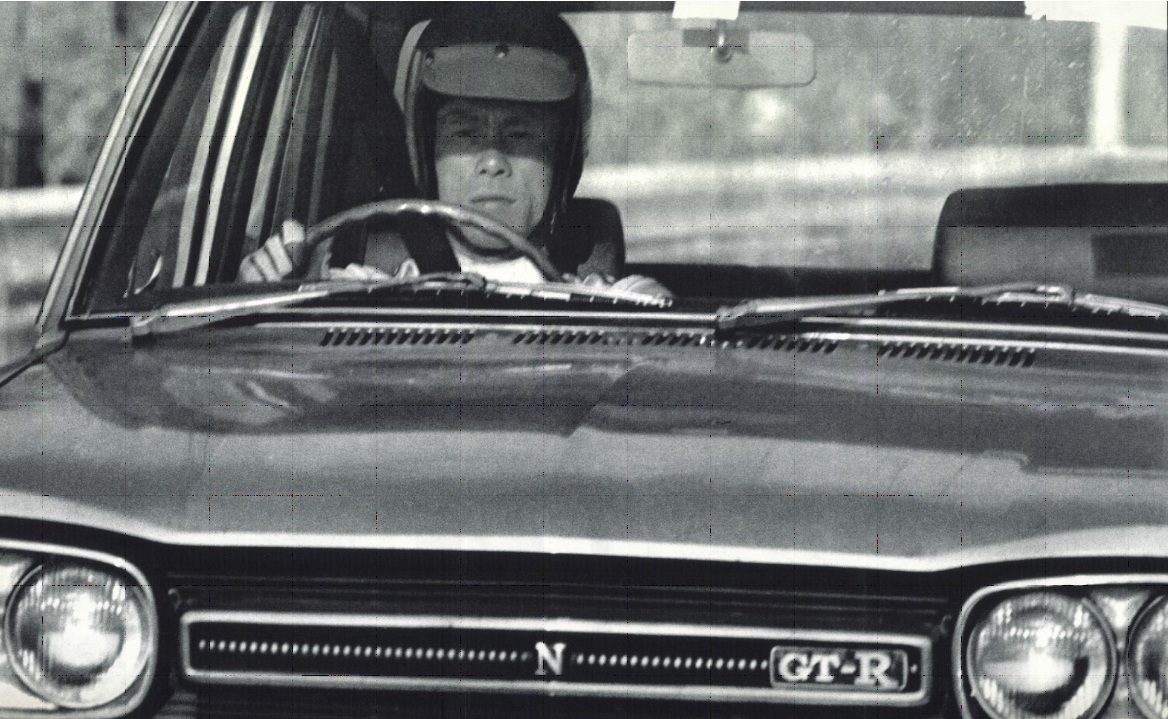
Publication: Auto Sport
Format: Road Impression
Date: April 1969
Author: Seiichi Suzuki, Tatsuro Sasaki, Toshikazu Inoue
The hot model of the Skyline 2000GT, the GT-R, has been released onto the market. The driver we commissioned to test it was Seiichi Suzuki, who had just returned from Daytona Speedway in the US. On the day of the test, the GT-R hurtled down the rainy Tomei Expressway, cutting through the morning silence on its way to the Suzuka Circuit.
Exciting Sounds
The Skyline 2000GT-R, a hot GT car eagerly awaited by sports car enthusiasts, was finally released on February 21st.
The engine of the GT-R is based on the inline six-cylinder, DOHC, 4-valve per cylinder engine of the racing prototype Nissan R380 that debuted in 1965, during the days of the old Prince Motor Company, and went on to achieve numerous victories in domestic races, while making great strides in both performance and body design.
The toughness of the first-generation Skyline GT awakened the dormant motorsports spirit of Japan. And what kind of impact will the reborn New Skyline GT-R have on the current motorsports world? We asked Seiichi Suzuki (SCCN), who had just returned from competing in the Daytona Citrus 250 Mile Race, to test the car to its limits and comment on its performance.
We planned a 570km long tour from Tokyo to Suzuka, heading west on the Tomei Expressway and National Route 1, and, of course, some tough circuit driving at Suzuka Circuit.
At 1:00 p.m. on March 7th, we met Suzuki at the entrance to the service station at the Kawasaki Interchange on the Tomei Expressway. We immediately changed seats and he slid into the driver’s seat.
The GT-R’s bucket front seats hold your body snugly in place. Apart from the solid wood grain pattern on the instrument panel and console box, the interior is entirely finished in black.
The instrument panel contains a speedometer up to 240km/h on the right, a tachometer with a red zone from 7500rpm to 10000rpm on the left, a water temperature gauge at the top center, and an oil pressure gauge at the bottom–all of the core instruments for monitoring the engine.
The center console has an ammeter and a fuel gauge lined up in front, a cigarette lighter and washer switch at the very front within reach of the left hand, and the light and wiper switch knobs in front of them. In front of that, next to the seat, is a wooden shift knob. The shift knob, which controls a 5-speed gearbox with a conventional shift pattern, is slim and matches the length of the lever well, making it easy to grip.
Suzuki turned the key. The engine started up immediately with a roar. The engine, which is equipped with three twin-choke Solex carburetors, idled at about 1000 rpm. Along with the dry sound of air being sucked into the intake, the heavy combustion sounds of the six-cylinder engine resonated off the surrounding walls.
We put on the three-point seat belts as the GT-R climbed out of the interchange onto the Tomei Expressway in first gear, then second, without any hesitation. As soon as we entered the main line, Suzuki stepped hard on the accelerator. The needle on the tachometer jumped up along with the exhaust note.
Amazing acceleration. Into third gear, then to fourth. Even before it reached 4000rpm, the speed was already exceeding 100km/h. And it was incredibly stable. It was clear that it would be impossible for this docile-looking GT-R to reveal its true wolf-like nature on public roads.
Run at Suzuka Circuit!
Seiichi Suzuki put on his helmet and racing suit. It was still early morning, but we had already arrived at Suzuka Circuit. Enthusiasts who had come to the course had gathered around the GT-R.
“Oh, so this is the hot type of ‘New Ska G’?”, was the most common remark. Otherwise, everything was quiet.
“I wonder if I can really drive it on the circuit in its stock condition?” Suzuki mused as he sat in the cockpit, all eyes on him.
“I’m starting to like this bucket seat. I felt like it would be better if it could recline in the city, but it feels just right when I’m on the circuit,” Suzuki said, depressing the accelerator pedal two or three times before turning the starter. He didn’t pull the choke. The 1989cc 4-valve inline six-cylinder DOHC S20 engine started up immediately.
This power unit, which is equipped with three Mikuni Solex (40PHH) carburetors, requires a little trick when starting. As is the case with all twin choke carburetors, if you press the accelerator pedal two or three times before turning the starter to activate the accelerator pump, it will start without pulling the choke. However, this only applies when the engine is cold.
When the engine is warm, the best technique is to depress the accelerator pedal slightly and hold it in that position while you turn the starter. If there are no mechanical problems, it should start in five to six seconds at the longest. If you stop the starter after two or three seconds because the engine hasn’t started, it will be difficult to start again because the spark plug will foul. The hotter the engine is, the deeper you should depress the pedal. This is the same principle as when you start an engine during a pit stop during a race, or when it has spun out and stalled. In other words, it’s the same technique you’d use to start a racing car.
The tire pressure was set to 2.6kg/cm² all around, and Suzuki pulled the GT-R out onto the course.
Leaving a dry exhaust note behind, the Skyline 2000GT-R began its run. One lap, two laps, three laps, four laps… the GT-R was like a fish in water on the track.
The GT-R raced down the straight in front of the grandstand at 190km/h in fifth gear, then downshifted to fourth while braking about 150m before the first corner. It then dropped to third gear just before the clipping point. It remained in third gear for the second and third compound corners and the S-bend. The speed at the S-bend was about 120km/h.
After passing through the S-curve, the GT-R shifted up to fourth gear just past Dunlop Bridge, then down to third gear just before Degner Curve (80R). Immediately after passing Degner, it was up to fourth gear again as it headed for the hairpin (20R).
At the hairpin corner, Suzuki dropped from third to second gear and rounded it at 70km/h, then shifted back up through the gears to fourth. At the next difficult section, Spoon Carve, he went through it in third gear at 100km/h. After this, he immediately shifted up to fourth, crossed the intersection and sailed through the final corner. The speed at the finish line was about 180km/h.
Suzuka has many tougher corners than Fuji Speedway, requiring rapid gear changes. The gearbox is basically the same as that of the Fairlady 2000, and the gear ratios are exactly the same.
“You can feel that unique Porsche-type feeling in your wrist when you shift. The stroke is just right, so it’s a perfect gearbox for circuit driving,” said Suzuki.
We asked him, what about the clutch?
“It’s a little heavy, but with 160 horsepower, it naturally needs to be strong enough.”
And the accelerator?
“It’s a little heavy because it has to open three carburetors, but that’s to be expected when you consider the character of the GT-R.”
How about the brakes?
“They require a lot of pedal force. If you get into this car thinking it’s a normal sports car, you might be surprised. But all racing cars are like this. For use off the circuit, you can just install the optional master back (power booster). For example, unlike the GT-R, the Bluebird SSS comes standard with a master back. But when you’re racing, you remove it. This makes heel-and-toeing easier and also reduces weight.”
From this point of view, it is clear that the GT-R is a car that can be driven on the street, but is primarily intended for racing.
Watching from the stands, the GT-R’s cornering was certainly reminiscent of a race car, with almost no roll and smooth exits from the corners. We asked Suzuki, did it feel that way from the driver’s seat?
“These are the standard tires (6.45H-14, 4PR, high-speed rating), so I adjusted the pressures to be a little higher. As for maneuverability, unless you do a power slide intentionally, it tends to understeer a little. In any case, I don’t feel uneasy at all even in hairpin turns. It’s a good car.”
Suzuki completed four more laps of the 6.0km course, then took another half lap and returned to the pits via the shortcut. The lap time was around 3 minutes with the standard tires. If the tires were changed to racing tires, it would easily achieve 2 minutes, 50 seconds. So, if the car is fully equipped with racing options and tuned to the limit allowed for Group 5 (special touring cars), it will definitely be a fearsome car in competition.
The day after the test run, the All-Japan Suzuka Motor Race was held at Suzuka Circuit with great fanfare. In the official qualifying for this race, the best lap times were recorded by a 2000cc Fairlady (Teranishi Takatoshi) with a time of 2 minutes 34.5 seconds, and a 1600cc Group 5 modified Bluebird SSS (Kurosawa Motoharu) with a time of 2 minutes 40.1 seconds. The Skyline 2000GT-R will no doubt beat these times one after the other. This was the conclusion of the circuit run.
The fuel consumption rate when driving on the circuit was 4.38km/l.
An All-Purpose High-Speed Machine
For the tour to Suzuka, we deliberately chose to go over Hakone instead of taking Route 246. From Odawara, we climbed powerfully through the Hakone Bypass, with snow still remaining on the side of the road, and started to descend Route 1, where there was a lot of truck and passenger car traffic.
Here, Seiichi Suzuki pushed the GT-R at a pretty fast pace.
We found that, in hard cornering with the GT-R, if you just rely on the brakes and steering, you’ll end up with understeer. But by using heel-and-toe for each corner and keeping the power down at the drive wheels, the understeer turns into neutral steering, allowing you to smoothly turn the corner and exit at high speed.
What was particularly noteworthy here was the versatility of the spring rate settings. Even though we were cornering quite hard, there was almost no unpleasant body roll, yet I didn’t notice any bumps in the road at all. Seiichi Suzuki says, “This is probably due to the seat spring material as well as the low-profile tires, which are quite effective.”
There was heavy traffic congestion for about 10km from Numazu to Fuji Interchange on the Tomei Expressway. We drove slowly throughout that stretch, but there was no sign of the plugs fouling or engine slowdown, and the spark ignition was fine even when we got on the Tomei Expressway and gave the engine full throttle.
However, as mentioned above, the front disc brakes do not have a vacuum booster, so braking in crowded areas requires a lot of force.
“It’s easier to have a master back when driving around town, but it’s also helpful to reduce the weight when taking part in races if you can reduce the ‘certified weight’ as much as possible when getting the vehicle homologated. Therefore, I agree with the idea of making the booster an option,” said Suzuki.
On the Tomei Expressway, I tried to time the overtaking acceleration.
To go from 70km/h to 100km/h, it took 4.0 to 4.2 seconds in third gear, and 5.6 to 5.8 seconds in fourth gear.
Acceleration times from 80km/h to 100km/h were 2.9 to 3.0 seconds in third gear, and 3.4 to 3.6 seconds in fourth gear.
By the way, for comparison with what is widely recognized as Japan’s fastest sports car, here is a look at the Fairlady 2000’s overtaking acceleration from the Motor Fan Road Test Digest:
From 70km/h to 100km/h, the Fairlady takes 4.8 seconds in third gear and 7.9 seconds in fourth gear.
From 80km/h to 100km/h, it takes 3.2 seconds in 3rd gear and 5.4 seconds in 4th gear.
In other words, the GT-R shows significantly quicker overtaking acceleration than even the Fairlady 2000. The cars that were passed quickly became tiny specks in the rearview mirror.
Soon the sun was setting. We turned on the headlights. We were on the highway, so we used high beams. Their light was bright enough that I didn’t feel anxious when driving at high speeds. The gauges were easy to see, without any glare or reflections.
It was raining at night from Nagoya onwards. The wipers are equipped with high-speed blades and were designed to reduce air resistance, so they worked perfectly, without slowing down.
Also, the road conditions were so wet that most other cars could only travel at 70-80km/h, but the GT-R continued to drive at 100km/h without any worries. The tires gripped the road with confidence, and there were no traces of sliding, so there was no need to slow down even on the sharp curves beyond Sekigahara. This was largely due to Suzuki’s driving technique, but even so, it was clear that this was a true “all-purpose machine.” That was the overall impression we got from the Skyline 2000GT-R.
Afterword: Skyline 2000GT-R profile
The new Skyline GT sports car, which will soon appear in racing, is the Skyline GT-R, which was just recently released. It replaces the GT-B type of the old Skyline GT, but the R name was used to indicate that it literally has the capabilities of a racing sedan and can participate in races almost as-is.
The defining feature of the Skyline GT-R is, above all, its powerful power unit. It is fitted with a 1989cc six-cylinder DOHC 4-valve engine from the Nissan R380, a prototype car with seven international records and a glorious racing history, which has been modified for use in public-road driving.
The exterior is almost identical to the Skyline 2000GT that is already on the market, but it can be distinguished by the shape of the press lines on the rear fenders, the exposed capless wheels and wide blackwall high-speed tires, and the “GT-R” emblem.
For the time being, the car’s competition debut is likely to be in the special touring car race at the JAF Grand Prix on May 3. The manufacturer has announced that it will produce 1,000 units for sale by then, which is necessary for the vehicle to be approved for Group 2 racing.
There are a wide variety of optional parts available, so you can make the car an even more fearsome performer. You can also turn it into an enjoyable touring car. Prices start from 1.5 million yen (ex-store delivery in the Tokaido region).