Nissan Skyline 2000GT-R Hardtop vs Nissan Fairlady Z (1973)
Publication: Auto Sport
Format: Group Test
Date: August 1973
Author: Auto Sport Editorial Staff (uncredited)
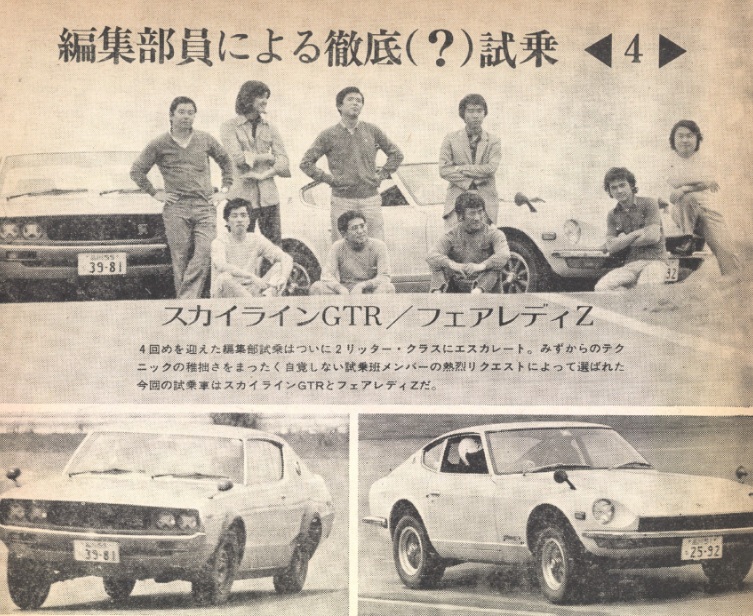
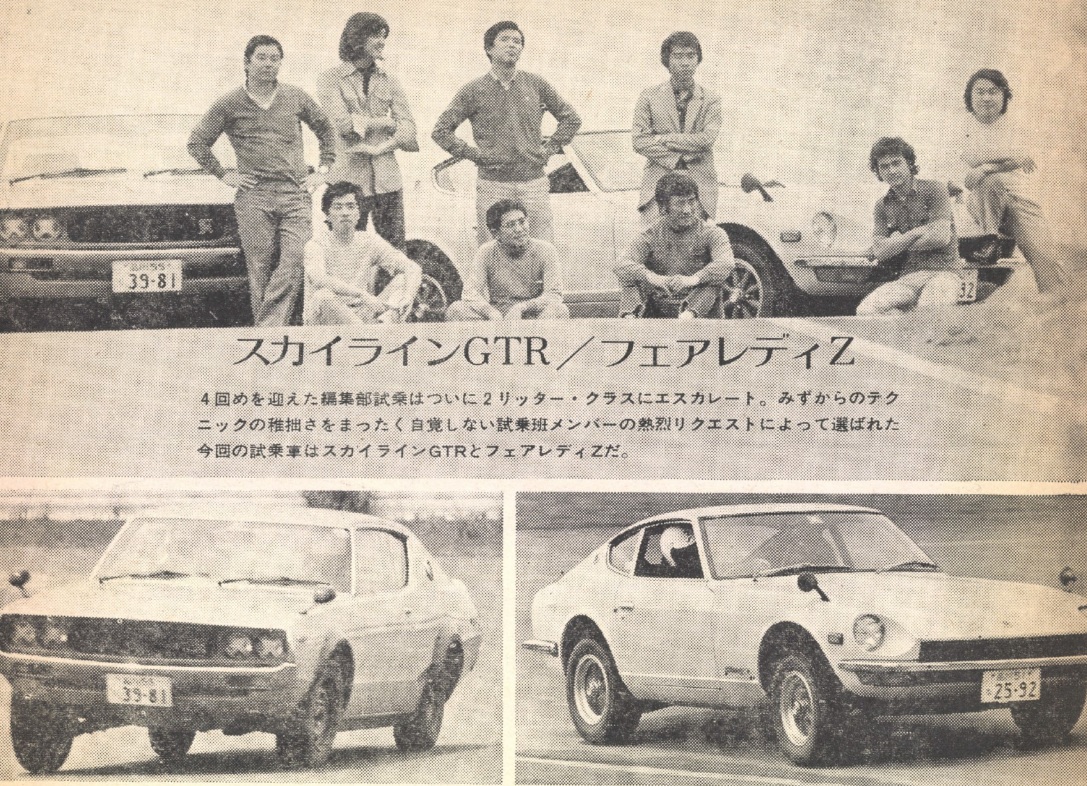
Now in its fourth installment, the editorial test drive series has finally escalated into the 2-liter class. At the enthusiastic request of the test team–apparently still unaware of how unrefined their driving skills actually are–the two cars selected this time are the Skyline GT-R and the Fairlady Z.
Editors’ Comprehensive (?) Test Drive: Skyline GT-R vs. Fairlady Z
Encouraged (!?) by the positive reception to date, our editorial staff’s “thorough” (?) test drive series rolls on, now in its fourth installment. Taking the old adage “learn by doing” to heart, the members of the test team have, by this point, begun to imagine themselves as proper test drivers. The way they take the wheel is starting to look the part as well. Before long, some were even bold enough to declare, “We want to test cars that can truly bring out the full extent of our driving technique.”
And so, for this test, the cars selected were the Skyline GT-R–at the very peak of performance among production models, with no real rival in its class–and the Fairlady Z, a high-performance GT with an established record in both rallying and circuit racing on the international stage.
On one side, Nissan’s ultimate sporting model–the Skyline GT-R–equipped with a semi-racing DOHC 24-valve engine breathing through triple Solex carburetors. On the other, the Fairlady Z, also a six-cylinder machine, but fitted with a mass-market SOHC engine and twin SU carburetors.
Which matters more–the engine, the chassis… or whether we’re even capable of handling cars like these in the first place?
Guest Driver: Masao Nakamura
On the test day in June, with the rainy season already declared across the Kanto region, the sky nevertheless cleared as if in anticipation of our arrival. At Tsukuba Circuit, the Skyline GT-R and Fairlady Z sat in the paddock, waiting to head out onto the course, their bodies gleaming under the early-summer sun.
The track itself was, of course, completely dry. A faint heat haze even shimmered over the first corner as seen from in front of the control tower. With track temperatures expected to rise significantly, we set the test cars’ tires–front and rear–to 2.0kg/cm² pressure as a baseline.
For this session, we were also joined by guest driver Masao Nakamura, currently active in the Belco 72F rotary machine.
Up to now, these editorial test drives have been conducted solely by the magazine’s own staff. While fully aware of our own limited skill level–and accepting the risk that the evaluations might become overly subjective “feel-based” impressions–we continued in this format in order to convey things that only amateurs might notice, fresh impressions that professional drivers tend to overlook. This is precisely why the title includes that hesitant question mark after “thorough test drive.”
However, reaching the fourth installment, we decided it would not be meaningless to have a professional racing driver assess the level our team had reached. For that purpose, Nakamura was invited to join us.
He also has prior experience conducting magazine test drives here at Tsukuba Circuit, and is well versed in how production cars should be driven on a track. As such, we expected that he would also be able to provide a clear and accurate evaluation of our driving.
GT-R: Heavy Understeer
The name Skyline GT-R–etched into the memory of racing fans through a string of unprecedented victories in Japan’s touring car scene–returned once again in February of this year with the new Skyline GT-R, arriving about six months after the full model change of the Skyline series last September.
As readers will recall, shortly after its debut, we conducted a circuit impression test at Nissan’s factory with drivers Kitano and Hasemi in order to explore its potential for racing competition.
However, as of June, four months after its introduction, the new GT-R has yet to make any appearance in actual racing events–contrary to expectations.
One is left to wonder whether Nissan, having realized that even the vaunted S20 engine cannot overcome the burden of a significantly larger and heavier GT-R body–and now facing rotary-powered rivals freed from peripheral port restrictions–has effectively abandoned its return to the racing arena, preserving only its name and legacy.
Nevertheless, the GT-R’s appeal still lies, above all, in its engine. The S20, a semi-racing DOHC unit born from the legendary Nissan R380 that opened a new chapter in domestic motorsport, has lost none of its allure even today.
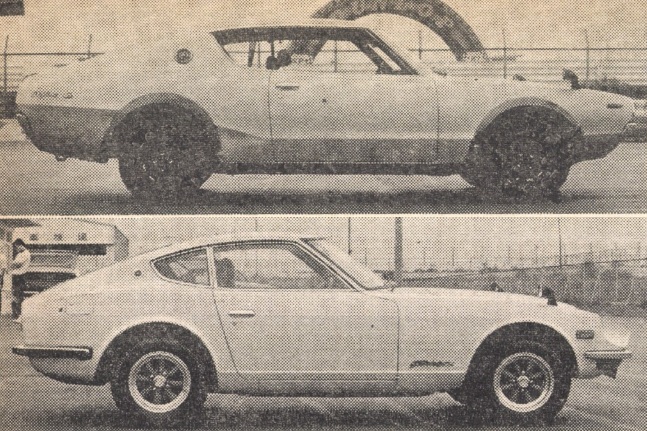
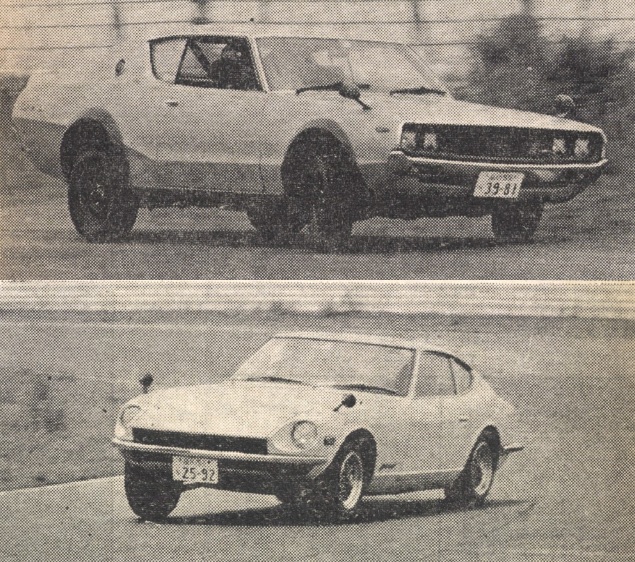
The styling of the GT-R, with this inline-six DOHC engine under the hood, continues the long-nose proportion that has been a tradition since the first Skyline GT. Combined with overfenders covering both front and rear wheel arches and a standard rear spoiler, it has a distinctly purposeful appearance.
At the front, behind a wire-mesh radiator grille, and at the rear garnish panel, an “R” ornament glimmers faintly, proclaiming the presence of its high-performance heart.
As for styling impressions, these are inevitably subjective. But in this author’s personal view, the new GT-R feels somewhat overdone in places–particularly the pronounced overfenders, which seem excessive. In this sense, the original first-generation GT-R sedan (PGC10), which offered no visual indication of its performance nature beyond the rear wheel opening and a simple red “GT” badge, remains the most appealing interpretation.
With that, enough preface–let’s move on to the test itself.
Each driver began with five laps of free runs. Mr. Nakamura took up an instructor’s position at the first corner, closely observing each driver’s cornering technique.
The GT-R’s powerful exhaust note echoed across the otherwise silent circuit. In city driving it is somewhat conspicuous—hardly what one would call quiet—but on a circuit, it becomes simply an engaging mechanical soundtrack.
As expected, the engine revs willingly. The tachometer is marked up to 10000rpm, hinting at its high-performance intent, while the stated 7500rpm rev limit, if anything, appears to be rather conservative.
160ps is not something we, of course, are in any position to fully exploit–but on the other hand, the S20 engine does not feel unruly or difficult to handle. The moment you open the throttle, it responds with a degree of flexibility that is almost hard to believe, the revs rising smoothly and cleanly.
That said, to truly feel its overwhelming acceleration, the tachometer needle needs to be kept above roughly 3500rpm. Beyond that point, whenever you press the throttle, you can be assured of being pressed firmly into the seatback.
Because of the relatively tall gear ratios, standing starts do not feel especially dramatic. However, the acceleration from 100km/h onward is where the GT-R reveals its true character–nothing else truly compares to it.
The high gearing, combined with an engine capable of operating at very high rpm, also means that on the Tsukuba Circuit the car can effectively be driven without using fourth or fifth gear at all. On the back straight, the GT-R reaches 140km/h, its top speed on this circuit, yet even at that point it is only in third gear at 6500rpm, still leaving plenty in reserve.
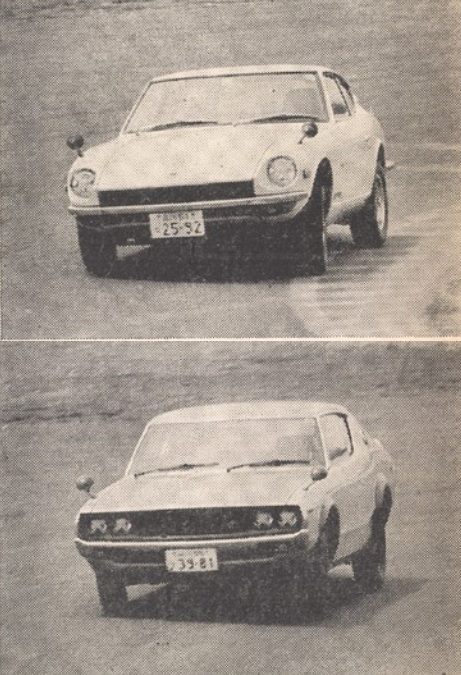
While its straight-line acceleration is outstanding, its behavior in corners is also noteworthy–for a different reason. It is characterized by severe understeer, to a degree not encountered in our previous three test sessions.
This tendency is particularly pronounced at the right-hand 35R under the Dunlop Bridge, taken at full throttle. The cameraman positioned on the outside of the corner reportedly had several moments where he genuinely thought he might be in danger.
After all members of the test team had completed their runs, Nakamura then took the wheel of the GT-R. On his fifth lap after the start, he recorded a time of 1 minute 20.6 seconds before returning to the pits.
Editor: “Isn’t the understeer quite strong?”
Nakamura: “There is certainly that tendency. But it seems to be amplified by several factors–first, the tires are somewhat undersized relative to the vehicle weight, and second, the limited-slip differential is not working very effectively. On top of that, I think your entry speeds are too high, and you are turning in too early. That is what’s making the exits difficult.”
“With this car, if you induce a slight amount of rear sliding on corner entry, the rest becomes much easier. Ultimately, the key to improving lap times is understanding the car’s characteristics and driving accordingly.”
All: “I see.”
Editor: “How about the suspension?”
Nakamura: “Compared to the previous model, the new GT-R is softer all-around. That applies to the suspension setup as well. For a street version, it has probably been taken about as far as it can go, but on the circuit it still feels lacking. There is too much stroke, so body roll is large and it is difficult to induce controlled slides. The brakes, too–perhaps due to poor adjustment on this particular car–did not feel as strong as one would expect from a four-wheel disc system. It took considerable effort just to get them to lock.”
Editor: “I see… Well then, let’s move on from the Skyline to the Fairlady Z.”
We Were Able to Experience Drifting
The Fairlady Z made its debut in 1969, replacing the earlier open-type Fairlady (SR311), and is currently the only two-seat sports car being produced domestically. In racing and rallying, the export-spec 240Z has largely become the dominant model, although both the 2-liter and 2.4-liter versions share the same basic engine architecture.
Ideally, we would have liked to test the Z432 equipped with the same S20 engine as the GT-R. However, production had already been discontinued at the time the 240Z was introduced domestically, making this impossible. As a result, this test was carried out with the far more conventional 2-liter Z, powered by the SOHC L20 engine.
The test car itself is an early example, registered in May the year following its release (1970), and has already covered over 80,000km. As such, the body shows significant signs of wear, and it is hard to imagine that the engine is still delivering all of its original performance. For that reason, we fitted a new set of “shoes” in an attempt to compensate, at least with respect to chassis performance.
In stock form, the car is equipped with 4.5J steel wheels and 6.45H-14 high-speed bias-ply tires. For this test, we replaced them with 185/70HR-14 ultra low-profile radial tires. The wheels are 6J aluminum alloy units, an original product from Speed Shop Lotus, sold under the name “Yarrow.”
The design of these wheels is reminiscent of the magnesium racing wheels used by the Nissan R380 from American Racing Equipment, and they suit the Fairlady Z’s sporting image extremely well.
Since we did not run the car on standard tires, it is difficult to quantify exactly how much difference the wider tires and wheels made. At the very least, it was clear that there was a significant gap in performance compared to the GT-R tested at the same time–even after allowing for the Z’s naturally more composed GT-style handling.
Switching from the GT-R to the Fairlady Z feels almost like descending from the second floor to the first. The Z’s cockpit sits very low, enveloping the driver, and its design philosophy is clearly centered on the driver as the focal point, in true sports car style. The dashboard is a one-piece molded foam resin unit, and all instruments are arranged perpendicular to the driver’s line of sight.
The steering wheel is a thick wood-rimmed design with 2.7 turns lock-to-lock. It uses a rack-and-pinion mechanism with a relatively quick 16.4:1 ratio, giving sharp response, but also transmitting a fairly strong level of kickback from the road surface.
As noted earlier, the power unit is the L20 engine, derived from the Bluebird series. As informed readers will already know, this is a mass-production engine also used in the Cedric and Gloria.
No matter how much it is dressed up in sports car clothes, this engine remains–both for better and worse–a passenger car engine. Its flexibility in the low- and mid-range is impressive to the point of being remarkable, but above 5000rpm the driver doesn’t feel like pushing it any further. Noise and vibration increase significantly, while power delivery begins to taper off.
The Fairlady Z’s outstanding handling is ultimately the result of a well-balanced sports car chassis combined with a finely matched four-wheel-independent suspension. With its fundamentally excellent road-holding, it delivers an unparalleled level of enjoyment even when driven on the circuit.
Its excellent straight-line stability is impressive, but in cornering, the low center of gravity and the fully independent strut-type suspension work together so effectively that body roll is virtually imperceptible. The car maintains an extremely stable attitude, carving the intended line with ease. Compared to the GT-R, its behavior is almost neutral, with a natural, predictable character that offers a wide degree of control freedom. With the help of its sharp steering, it even allowed us to try deliberately provoking a hint of tail slide.
In terms of lap times, however, the edge still went to the GT-R. Even with the Z’s excellent chassis and Mr. Nakamura’s driving skill, the best the production L20 engine could do was 1 minute 21.1 seconds.
Nakamura: “If the brakes on the GT-R had been fully up to standard, it might have been possible to dip under 1 minute 20 seconds. Still, while it may be a bit slower in terms of lap times, in terms of drivability the Z is in a completely different league from the GT-R.”
Editor: “Yes, yes–that’s exactly right.”
Nakamura: “The quality of the suspension is such that even on corner exit, it feels almost as if a limited-slip differential were fitted, so little drive is lost at the inside wheel. This was especially noticeable at the final corner.”
Editor: “Now that you mention it… yes, it does feel that way. It really is an incredibly easy car to drive.”
Nakamura: “I suppose that’s because the overall balance of the car compensates for a driver’s lack of finesse.”
Editor: “Wh–?! …Well then, thank you very much for today.”
Postscript: Story Photos