Nissan Silvia (1965)
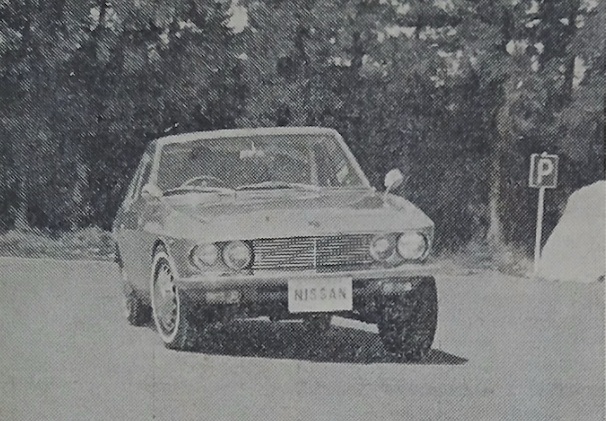
Publication: Motor Magazine
Format: Road Impression
Date: April 1965
Author: Hideo Aoki
“Silvia”—a name belonging to a beautiful woman in Greek mythology, and said to have inspired numerous artistic works, including Schubert’s song “To Sylvia” and Delibes’ “Sylvia” ballet suite. I must admit that it was a name I had never heard before, although its pleasing sound led me to imagine that it must have something to do with beauty.
We tested the Silvia on March 20 at the Yatabe High-Speed Test Course. I should make it clear, however, that this was not a road test in the usual sense. Given the location, it was necessarily more of a high-speed test. I hope to carry out a more detailed road test at a later date.
Development of the Silvia began toward the end of 1962, with the creation of a beautiful body style as its starting point. Naturally, a great deal of attention was paid to the design’s appearance, but repeated wind-tunnel testing was also carried out, and the resulting body is said to be aerodynamically stable.
When I first saw the car exhibited at the 11th Tokyo Motor Show, I thought it beautiful, but assumed it was a “dream car” intended only for display, and paid it no particular attention. Now, however, with sales scheduled to begin on April 1, the sight of the actual production model has made me look at it with fresh admiration. Its beauty is genuinely striking, and I am convinced that the quality and care of its finish are unsurpassed among Japanese cars. This is not the beauty of an ordinary mass-produced car, but that of a custom-built car.
One of its most distinctive features is the way the body is composed of flat surfaces divided by straight lines flowing from front to rear, with few of the curved panels more often seen in conventional streamlined designs. Conversely, the glass surfaces, which are usually flat, are all curved. Overall, the car has something of an arrow-like shape, with its visual weight concentrated toward the rear. It reminds one of a racehorse devoting all its energy to forward motion. Nissan calls this the “Crisp Look.” Although it has nothing to do with cars, one is reminded of expressions such as the “Good Kid Look” or the “007 Style.” Today’s mass media certainly has no shortage of creativity when it comes to inventing catchy phrases that encourage people to buy.
Although the body itself is entirely new, extensive use has been made of the Fairlady chassis in an effort to keep costs down. As I will discuss later, the car’s high price is said to result from the amount of labor required to produce this thoroughbred-like body. Finished in imported paint, the body has no visible seams whatsoever. The front pillars have been made thinner by relieving them of the roof load, giving the car an especially clean appearance, while the weight of the roof is carried at the rear.
The body itself is said to be as rigid as that of a monocoque structure. Combined with the proven Fairlady chassis, one can easily imagine that the resulting structure is exceptionally strong. Even on rough roads or during abrupt steering maneuvers, there is no perceptible twisting or creaking from the body.
As for body design, a subject on which I am usually quite outspoken, I will refrain from offering any further comment this time. Instead, I would encourage readers to see and appreciate the actual car for themselves when it goes on sale on April 1.
In a subsequent conversation with members of Nissan’s engineering department, I was asked to judge the Silvia as a luxury touring car rather than a sports car. But now that I have actually tested it, I would call it a genuine sports car. Admittedly, there were two or three areas in which it was not quite what one would expect of a sports car. Nevertheless, its sporting qualities are more than sufficient to outweigh these shortcomings.
Superb Acceleration
Viewed as a sports car, one’s attention is naturally drawn first to the engine. Equipped with twin SU-type carburetors and a dual exhaust system, it is outwardly a quite conventional four-cylinder OHV unit. In designing this engine, Nissan apparently considered two alternatives: enlarging the bore of the Fairlady engine and tuning it for higher output, or shortening the stroke of the 1900 engine to achieve the desired power. In the end, the latter approach seems to have been taken because of its superior durability under prolonged operation.
The result is an extremely short-stroke engine, with bore and stroke dimensions of 87.2 × 66.8mm. The reduction in piston speed, combined with improvements in bearing materials, appears to have greatly reduced the likelihood of mechanical trouble during prolonged high-speed running. Both the intake and exhaust manifolds have been designed to minimize resistance, resulting in high efficiency. From a displacement of 1595cc and a compression ratio of 9.0:1, Nissan has succeeded in extracting an output of 90ps/6000rpm and maximum torque of 13.5kgm/4000rpm.
Perhaps owing to its extremely short stroke, the engine’s initial acceleration is exceptionally strong, taking the car from 0-50km/h in approximately three seconds. Indeed, acceleration was so quick that we were unable to measure the 0-30 and 0-40km/h results this time, so we have left these out.
The engine is equipped with an alternator rather than a conventional generator, while the cooling system uses a permanent-type coolant with antifreeze and corrosion-inhibiting properties, requiring replacement only once every two years. Modern cars have advanced to the point where little routine maintenance is necessary, making life quite convenient for their owners. Speaking of convenience, the number of lubrication points around the chassis has also been greatly reduced, and it is an excellent development that most modern cars now require virtually no regular chassis lubrication.
Because the Silvia uses the Fairlady chassis, its interior is surprisingly spacious in relation to its compact exterior dimensions. Before its introduction, I had imagined that it might be a 2+2, but it is in fact a two-seater, with plentiful legroom. The curved side windows also provide generous space around the shoulders.
Settling into the leather-upholstered reclining seat, one finds a comfortable driving position with arms and legs naturally outstretched. The pedals include a long, narrow accelerator of a type I have not previously found in a Japanese car, making heel-and-toe exceptionally easy. There is also a somewhat large, Nardi-style steering wheel, with aluminum spokes and a wooden rim.
Ahead of the steering wheel, the instruments are arranged in a clear, legible row of circular dials, with white markings on black faces in proper sports-car fashion. From right to left are the fuel gauge, speedometer, clock, tachometer, and water-temperature gauge. The speedometer is marked to 180km/h, while the tachometer has a yellow zone beginning at 6000rpm and a red zone from 6200rpm, with the scale extending to 7000rpm. Acceleration in first and second gears is so strong that the needle will jump to the red zone almost immediately if one is not careful.
At the engine’s maximum output speed of 6000rpm, the corresponding road speeds are approximately 50km/h in first gear, 80km/h in second, 120km/h in third, and 165km/h in top. Since the engine will readily enter the red zone in the first three gears, it seems likely that somewhat higher speeds could actually be reached. Naturally, operating an engine in the red zone is not good practice, but judging from the sound and general behavior of the engine during my test, I suspect that continuous running at around 6500rpm might be possible. I must add, however, that I cannot accept responsibility for anyone who chooses to put this feeling to the test.
During our test at Yatabe, we found that the engine could reach 6200-6300rpm in top gear, compared with the catalog figure of 165km/h at 6000rpm. We thought the car was probably traveling at somewhere around 170-180km/h, but since we had known from the outset that the speedometer was inaccurate, it was necessary to calculate the speed from the tachometer reading. For reference, the sustained maximum speed calculated from a timed lap of the Yatabe circuit was 168km/h.
Powerful Synchromesh Makes for Smooth Shifting
The standing 0-400m time was 17.4 seconds, which, among the cars I have tested, equaled the Prince 2000GT and was the fastest recorded by a Japanese car. My allotted test period was the first of the morning, from 8:00-10:00am. From past experience, I knew that acceleration times generally improve the longer a car is driven, and sure enough, the next group recorded 17.3 seconds. Later in the afternoon, with only the driver aboard, times of 17.0 and 17.3 seconds were apparently achieved. Since I was not there to witness these runs, I cannot confirm these figures, but the Silvia’s exceptionally high performance was certainly demonstrated.
Ahead of the transmission tunnel is a console of the type becoming increasingly common in modern cars, neatly housing the radio, switches, and various other controls. In terms of ease of use, there is nothing particularly good or bad about the arrangement. Behind this are the gearshift lever, ashtray, and a lockable glove compartment that also serves as an armrest.
The parking-brake lever is positioned to the right of the gearshift. In a GT car with this level of performance, however, I would prefer a fly-off type that can be released simply by pulling upward, rather than requiring a button to be pressed.
The gearshift lever itself is ideally positioned. Even a tall foreign driver with a long reach should be able to change gears comfortably from this location. The lever is short, thick, and nearly vertical, although the rubber damping seems a little excessive, making it feel somewhat reluctant to engage each gear.
Perhaps it is unkind to say so, but I cannot entirely dismiss the impression that this damping has been used to give the synchromesh time to do its work.
According to the technical literature on the Silvia’s transmission, this fully synchronized 4-speed unit not only incorporates synchromesh on first gear but also uses a servo-synchromesh mechanism. The catalog describes servo-synchromesh as a special system adopted by leading racing-car manufacturers such as Porsche and Alfa Romeo, permitting rapid and positive downshifts even during high-speed driving.
In actual use, however, the Silvia’s transmission does not quite have the distinctive feel familiar from Porsches and Alfa Romeos, at least not to the extent suggested by the catalog. Nevertheless, it is an excellent transmission with a character of its own. As advertised, the synchromesh is powerful, and shifts into every gear can be made smoothly.
The clutch accompanying this transmission is also noteworthy. Instead of using several coil springs to provide pressure on the clutch disc, it employs a diaphragm-type pressure spring formed from a single steel plate. Diaphragm clutches are relatively uncommon in Europe, whereas most American cars use this type of pressure spring.
Noise from the transmission, differential, and engine is effectively suppressed by the body’s sound insulation, and is hardly noticeable either at idle or during low-speed driving. Above 120-130km/h, however, wind noise around the upper part of the windshield pillars becomes somewhat pronounced. I understand that this has been improved in the production version.
Speaking of noise, the most conspicuous sound the Silvia produces is undoubtedly its exhaust note. At low speeds, the car is as quiet as a high-class passenger sedan. Once engine speed approaches 5000–6000rpm, however, the exhaust becomes quite loud. The sound of the car approaching from 1-2km away, with its pronounced Doppler effect, is truly impressive and highly pleasing to the ear.
After the test, I spoke with members of Nissan’s engineering staff, and it became clear that considerable research had gone into the exhaust system, from the shape of the manifolds to the design and length of the muffler, with particular attention paid to resonance effects and efficiency. The arrangement of the twin exhaust pipes, which merge into one before dividing again into twin tailpipes, is likewise the result of this painstaking development work.
Dependable Disc Brakes
The Silvia is equipped with front disc brakes that feel somewhat lacking at low speeds, but maintain consistent effectiveness even at high speeds. The main advantage of disc brakes is their excellent cooling ability. For example, even when driving through water during a rally, the discs dry quickly through centrifugal force as soon as they leave the water, allowing braking effectiveness to recover quickly. Since the brakes themselves have no self-servo action, there is no tendency for one side to pull more strongly than the other.
At Yatabe, I tried applying full braking at 160km/h with my hands off the steering wheel, and the car came to a stop in a straight line. There was some wander because of the strong wind, but this was attributable to the crosswind rather than the brakes.
Judging from the shape of the body, one would expect aerodynamic drag to be very low. Nevertheless, at speeds above 150km/h, when the car encountered crosswind gusts of around 12m/sec during our test, there was a fairly pronounced tendency for the nose to swing downwind. This was not a rolling motion, but something that could be corrected through steering. Once used to the car, the driver would not find it particularly dangerous.
I suspect the reason for this tendency lies in the suspension, which is unexpectedly soft and sedan-like for a car that, judging by its appearance, one would naturally think of as a sports car. Personally, I would prefer somewhat firmer suspension, even at the expense of a certain amount of ride comfort. For a touring car intended for fashionable ladies or more mature drivers, however, the current setup would probably be preferable.
Speaking of personal preferences, humans are naturally greedy, and precisely because the Silvia is such an excellent car, I find myself wishing for several further improvements. First, I would like to see it equipped with a 1900cc OHC engine capable of reaching around 7000rpm, producing somewhere around 120-130ps. Next would come a fully synchronized 5-speed transmission, followed by smaller refinements such as an automatic-tuning radio.
There is also something I have wished to see for many years. Imagine taking a charming GT like this, setting its sporting character aside, and installing a large, powerful engine along with a fully automatic transmission. Naturally, it would have air conditioning, electrically operated seats and windows, and so on. How enjoyable it would be to drive such a car! This, too, might be considered one possible direction for a grand touring car intended for everyday use.
This report has necessarily been based solely on high-speed testing at the Yatabe proving ground. Since I was unable to evaluate the Silvia as a car for everyday use, I realize that readers may find certain aspects of the report lacking. I hope, however, to have another opportunity to test the car more freely and report my findings when the time comes.