Nissan Silvia (1965)
Publication: Motor Magazine
Format: Engineering Interview
Date: May 1965
Authors (roundtable): Kazumi Yotsumoto, Hideo Aoki, Hiromichi Nakamura, Tomoharu Izumi, Seijiro Matsumoto, Kenichi Sasaki, Osamu Machida, Motor Magazine editorial staff (uncredited)
Roundtable Discussion: Talking with Nissan About the Silvia
Magazine: When the Silvia prototype was exhibited at last year’s Motor Show, its bold styling and the specifications that were partially disclosed gave us the impression that this would be a sports car with considerably higher performance than we had imagined.
Today, then, we would like to ask you about various aspects of the car, from its styling to its mechanical design.
Yotsumoto: As designers working for a Japanese car manufacturer, we have received our share of criticism from outsiders, telling us that Japanese automotive design is not up to standard and that we ought to study harder. We have felt a certain obligation to respond to such criticism, and for some time had been thinking about how we might improve Japanese automotive styling. Then, as it happened, we were given instructions to undertake a car of this kind.
Fortunately, we already had the Fairlady chassis, with its exceptionally good layout, and I believe that made a car like this possible. From the outset, our aim was to create a car in which styling would take precedence, so we gave considerable thought to the direction automotive design might take in the future.
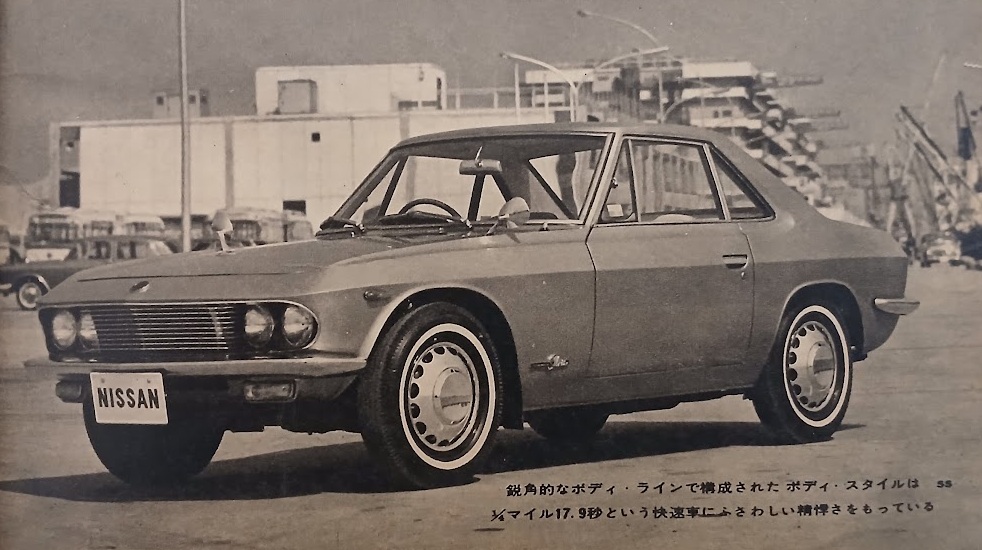
One direction was what we call “crispness”—a sharp, finely-cut appearance. Another major feature concerned the structure itself.
We had long wanted to see whether we could somehow do away with the front pillars, giving the impression that the roof was supported entirely by the rear quarters and the roof structure itself. That was something of a dream of ours, so we tried to come as close to that appearance as possible. I think we have succeeded to a considerable extent, but…
We also set out with other objectives in mind, such as reducing aerodynamic drag.
Aoki: I think the styling is extremely original and very well resolved.
When I drove the car, however, the first thing I noticed was a tendency to wander when traveling in a straight line at high speed. Of course, I imagine there are various factors involved, including the suspension, but I also had the impression that the car was rather susceptible to being buffeted by crosswinds, perhaps because of its aerodynamic characteristics.
So I asked the engineers whether wind-tunnel testing had been carried out in determining the body shape, but…
What I would like to know, then, is whether this tendency to wander is actually a suspension problem, or whether the car is being affected by aerodynamic factors or the shape of the body itself.
Yotsumoto: We did not conduct wind-tunnel tests directly on this car, but before beginning work on it, we had carried out tests on a shape fairly close to that of the present Silvia.
Aoki: I had the impression that perhaps the car had been developed with rather too much emphasis on achieving the desired styling.
On the day of the test, we had a southwesterly wind of about 12m/sec. Of course, in a wind that strong, even an ordinary car will be affected quite a bit.
Nakamura: At what speed were you traveling when the crosswind caught the car and pulled at the steering?
Aoki: I think it was at around 6000rpm, close to maximum speed. Since the tachometer was more accurate than the speedometer, I was watching only the engine speed. In top gear, it was around 6000-6100 or 6200rpm. That would be about 170km/h, I suppose.
Izumi: As you know, normal passenger cars generally have a drag coefficient of around 0.5 to 0.7. We believe the Silvia’s figure of 0.45 is exceptionally low, perhaps almost without precedent.
One reason is that the front of the body tapers inward, reducing the frontal area. Another is the pronounced inclination of both the windshield and rear window. We believe these features contribute considerably to the low drag coefficient.
We also paid quite a lot of attention to stability in crosswinds when the styling was developed. I believe the center of aerodynamic lift is located considerably farther toward the rear than on previous cars. For that reason, we have little concern about the car being pushed off course by a crosswind.
Aoki: Of course, I have had relatively few opportunities to conduct high-speed tests of Japanese cars in this class at such speeds. I may have been expecting too much, since I found myself comparing the Silvia with thoroughbred sports cars such as Jaguars and Lotuses.
Nevertheless, when a car is capable of reaching speeds like this, I think considerable attention ought to be paid to that aspect of its behavior as well.
Izumi: If we had started out to develop a sports car with a coupe body, I imagine it would have been relatively easy to determine the suspension specifications with an emphasis on high-speed stability.
But as Section Chief Yamamoto explained earlier, this was a car intended to realize something of a dream in body design. The main emphasis was on styling and beauty.
We also felt that the accommodation and ride comfort ought to be appropriate to that character. For that reason, rather than aiming for a car that would remain absolutely stable in crosswinds at 160-170km/h, we placed greater emphasis on ride comfort…
Magazine: We would like to hear something about the difficulties you encountered in developing this graceful body style. We would also be interested in hearing about the interior design.
Yotsumoto: I don’t say this simply because we have produced something successful, but I feel that, rather than encountering particular difficulties, there were actually many aspects of the work that were relatively easy.
With an ordinary four- or five-passenger car, there are very strict requirements that must be met. For example, the body width may be restricted because the car must be suitable for use as a taxi, and there are also limitations around ease of entry and exit. These things make the designer’s task extremely difficult.
In this case, however, as mentioned earlier, we already had an excellent base model in the Fairlady, so there was much greater freedom, and the work was relatively straightforward. If there was a difficult aspect, it was deciding how our original idea should actually take shape. To call it a design philosophy might be putting it rather grandly, but we had a definite idea of the kind of car we wanted to create, and the problem was how to express that idea in practice.
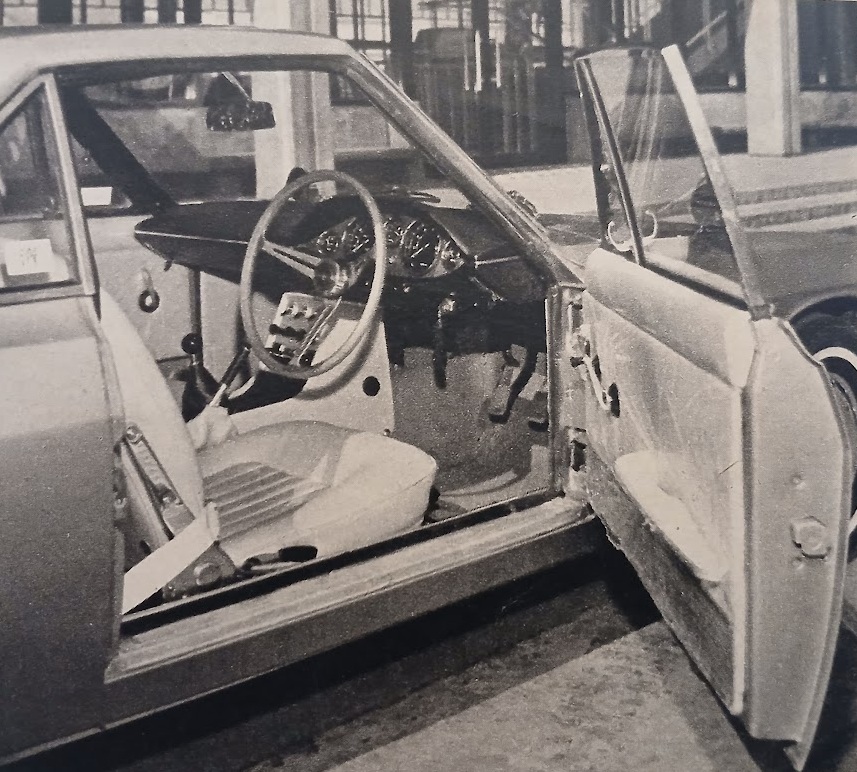
As for the interior design, anyone buying this car would be paying quite a lot of money, so we had to think about what kind of interior would give the owner a corresponding degree of satisfaction. Then, with a car at this level, there is also the question of high-speed driving. Unless considerable attention is paid to ergonomics, an attractive appearance alone is not enough.
For these reasons, we made a mock-up from the beginning and carried out ergonomic checks, including monitoring of heart-wave patterns. We also worked to lower the hood as much as possible to improve visibility. These were some of the areas in which we encountered difficulties.
Aoki: In my opinion, the driving position is probably the best of any Japanese car.
The seats are very comfortable, and even when driving at high speed, one’s shoulders remain firmly supported by the seatback. I found the car exceptionally easy to drive. The only thing was that the rushing wind noise was surprisingly loud.
Nakamura: You mentioned that the noise was loud. Do you mean in comparison with other cars?
Aoki: Yes, that’s right. The car looks so surprisingly good that, to put it simply, its appearance creates certain expectations, and in that sense…
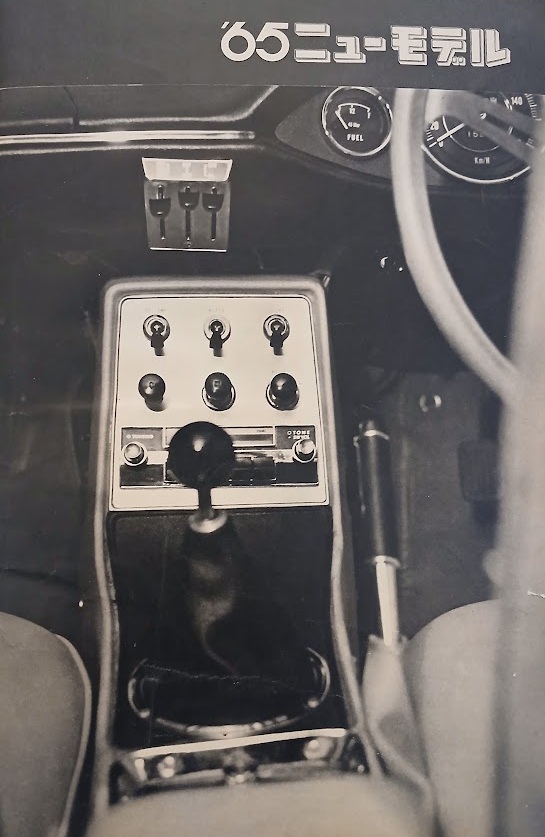
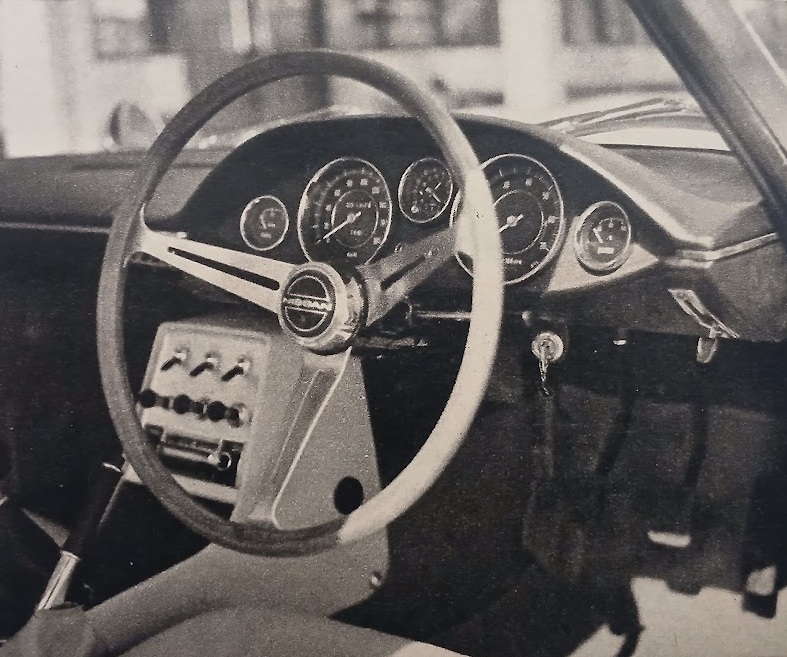
Easy-to-Read Instruments
Magazine: We’d like to ask test-driver Aoki a little more about his impressions. What did you think of the positioning of the controls and pedals?
Aoki: It’s very good indeed. The pedals are probably the best of any Japanese car. The accelerator pedal is unusually long, and, if you’ll excuse me for saying so, I think this suggests that the designers have made some progress in their thinking. (Laughs)
Until now, I don’t think much importance has been attached to the design of accelerator pedals. There also seems to have been a general feeling in Japan that a wide pedal was preferable, since it would be harder for the driver’s foot to slip off. In practice, however, a pedal is easier to operate if it is narrow and long from top to bottom. It is also better to have the pedals fairly close together. Personally, I think the clutch and brake pedals could be a little closer together still.
Magazine: What about the position of the steering wheel in relation to the driver’s knees?
Aoki: I think it’s good. Of course, I’m a little on thin side, so I can’t really speak for everyone…
But by the standards of Japanese cars up to now, I think this is probably the easiest driving position for almost anyone to adapt to.
Magazine: Turning to the area around the driver’s seat, did you find the instruments easy to read and the gearshift lever convenient to operate?
Aoki: The instruments are very easy to read. There is one thing, though, that I always say about sporty cars of the GT type: I would like to see an oil-pressure gauge.
As for the position of the gearshift lever, I think it’s perfectly satisfactory for someone of my build. I imagine this car will probably be exported, and in that case I feel that its current position, or perhaps one a little farther forward, would be about right.
Izumi: We’ve also heard some people say that it’s positioned too far back…
Aoki: I wouldn’t go so far as to say it’s too far back. It’s simply not positioned especially far forward.
There is one thing about the gearshift lever, though. On the car we used for this test, first gear was very difficult to engage. I wondered whether the rubber damper might be having rather too strong an effect. I haven’t looked inside the mechanism, so I don’t know exactly how it’s made, but I had the impression that excessive damping might actually be making the gear more difficult to engage.
As for the lever’s travel, its position, and so forth, I have no complaints for now. I think it’s very easy to use.
Nakamura: We’ve changed the transmission’s synchromesh arrangement from the conventional type to servo-synchromesh. As a result, its feel is somewhat different from that of the previous baulk-ring type, and it may seem a little more difficult to operate at first. In that respect, I think it may partly be a matter of getting used to it.
Aoki: If the difficulty engaging first gear was peculiar to that particular car, then there’s no problem. But if it’s a general characteristic, I think it might be worth making some improvements.
Matsumoto: Was it only first gear?
Aoki: Only first. And I suspect it was limited to that particular car.
Matsumoto: What do you think of fitting a transmission of this kind to a Japanese car?
Aoki: It’s very good. I think it represents a considerable advance.
Performance Exceeding the Catalog Figures
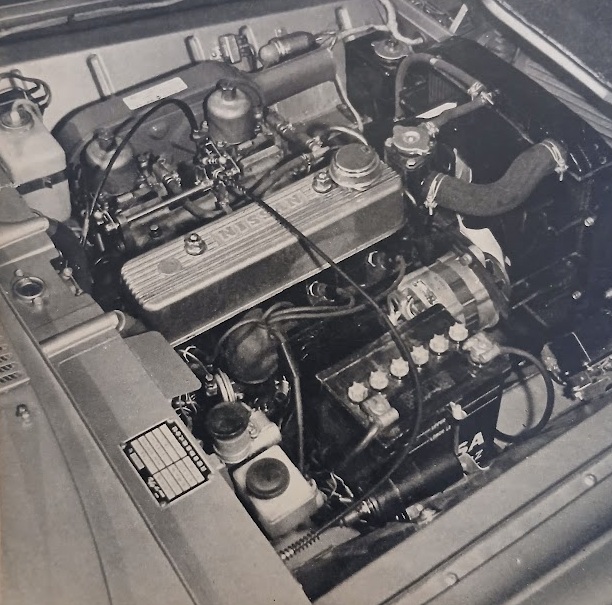
Magazine: Next, we’d like to hear about the newly designed four-cylinder OHV engine. Was this engine developed specifically for the Silvia?
Sasaki: Yes, it was. But before going into that, I’d like to ask Aoki something. When we designed this engine, we had a particular character in mind for it. Did you notice anything that distinguished it from the engines of previous sports cars?
Aoki: Well, generally speaking, a sports-car engine develops a great deal of power at high engine speeds, but has relatively little at low rpm. With this engine, however, I felt that acceleration at low speeds was also exceptionally good, although the weight of the body and other factors undoubtedly have some influence.
Sasaki: The body has a rather “dressy” character, and we designed an entirely new engine to suit it.
Generally speaking, there are two ways of achieving high performance: one is to install a large engine, and the other is to extract a high level of power from a smaller one. In the Silvia’s case, there were certain restrictions imposed by the body design, and we decided that a large engine was unnecessary. As a result, we set out to extract high output from a small engine.
That naturally brings the design fairly close to that of a sports-car engine. In fact, we approached its development essentially as the design of an engine for a sports car.
The engine previously used in the Fairlady displaced 1500cc, whereas the new engine is a 1600cc unit. Among our present four-cylinder engines, we also have the 1900cc unit. We considered two alternatives: shortening the stroke of the 1900 to bring its displacement down to 1600cc, or enlarging the existing 1500 to the same capacity.
In the end, after looking at various examples from other manufacturers, we concluded that the shorter-stroke approach would be more suitable for a sports-car engine, particularly regarding its ability to continue developing power at high engine speeds. We therefore shortened the stroke.
The stroke is 66.8mm, which places it in the category of extremely short-stroke engines.
From our own driving impressions, when driving around town, the engine seems to have about the same amount of torque as previous sports-car engines, or maybe a little more. But its ability to continue pulling at high rpm, and the speed with which it gains rpm, are greatly improved. I think these are characteristics that have emerged as a result of the short-stroke design.
Aoki: So when I said earlier that the engine had plenty of power from low speeds, I was also taking into account how quickly it gains rpm. It’s very good indeed.
Another thing I’ve noticed from testing various cars is that very few will even get close to the red zone in top gear, let alone enter it. They may get there in third, but rarely in top. The Silvia, however, will actually enter the red zone in top gear, and that struck me as evidence of exceptionally high performance.
Sasaki: Because the engine revs so freely, we’ve devoted a great deal of effort to high-speed endurance testing. We’ve reached the point where we can rate it for continuous running at around 6500rpm with virtually complete confidence.
Nakamura: Looking at the performance curves, one almost gets the impression that, with this kind of performance, four gears is enough to cover the entire operating range.
Izumi: At Suzuka, I imagine you’d take it up to around 7000rpm, wouldn’t you?
Sasaki: It will certainly rev that high.
Aoki: Most ordinary drivers tend to think of every gear except top as an acceleration gear. Whether they’re in first, second, or third, they keep their foot on the accelerator, and when they reach the point where they can’t accelerate any further, they change up to the next gear. That seems to be the general approach.
Once a driver becomes more of an enthusiast, however, the approach changes. If he wants to maintain 4000rpm or 5000rpm, he’ll think nothing of driving around town in second gear. He may use third, or top, in much the same way. When the gears are used like that, the value of a 5-speed transmission becomes apparent. But among the drivers I’ve observed, very few make such full use of their cars.
Nakamura: In any case, a fifth gear would probably be an overdrive or overtop ratio, and it would be difficult to make full use of it except on certain kinds of roads.
Matsumoto: I should make one thing clear: the Silvia was not originally intended to be marketed as a sports car. We already have the Fairlady to fill that role.
Aoki: Judged as a very sporty, attractive passenger car for ordinary motorists, I think the Silvia is a very well-rounded design.
My one reservation is that the price of 1.2 million yen seems a little high. Personally, I would have liked to see it kept somewhere around the one-million-yen mark.
Izumi: The custom-style finish does seem to have made the car rather expensive to produce.
The body, for example, has no visible seams at all, so a great deal of labor goes into its construction.
Aoki: The finish is exceptionally good, too.
Magazine: So rather than a mass-produced sports car, it’s more of a custom car…
Aoki: That’s right.
Matsumoto: Our management’s view was that we should create a beautiful car and give it performance to match. That was the idea behind the character we sought to establish for this car.
Aoki: I tried stopping the car from maximum speed two or three times. Compared with cars of the past, the brakes are vastly superior. But ordinary drivers cannot apply the brakes with such force, particularly when traveling at high speeds. With that in mind, I think it might be better to fit power-assisted brakes, so that the car can be brought to a stop as quickly as possible.
Magazine: We weren’t able to conduct braking tests at the test site this time. What sort of stopping distances have you recorded?
Izumi: They are better than those of the Fairlady. However, stopping distance is not determined by the brake mechanism itself, but by the coefficient of friction between the tires and the road surface.
Regarding the earlier suggestion that the brakes might be a little more effective, Nakamura will probably explain this in greater detail later, but the main advantage of disc brakes is that they do not suffer fade—that is, a loss of braking effectiveness—at high speeds.
Generally speaking, above about 50-60km/h, disc brakes require less pedal effort than drum brakes to produce the same braking force. On the other hand, in city driving, where one is always starting and stopping repeatedly, drum brakes may feel slightly lighter to operate…
Nakamura: As for the stopping distance we were discussing, that is determined by the limit of tire adhesion. It varies considerably according to the road surface.
The deceleration at the point where the tires reach their limit of adhesion is generally said to be around 0.6g. In the Silvia, we reached 0.6g with a pedal effort of 26kg. I don’t think 26kg is an especially heavy pedal effort, although fitting a servo would of course make it lighter.
Aoki: As I mentioned, I think the brakes are quite adequate as they are.
Matsumoto: Mr. Aoki, your figures for the standing quarter-mile were 17.4 seconds, with a top speed of 168km/h. With a little more running, I imagine it would do better still.
Aoki: I expect it would. When I was testing it, there was a southwesterly wind of 12m/sec, so the conditions were about as unfavorable as they could be.
Matsumoto: Later on, someone—I forget who—managed to reach 175km/h. That’s 10km/h above the catalog figure…
Nakamura: Even looking at the performance curves, you can see that the engine has plenty of power in reserve at 165km/h.
Aoki: With Japanese cars, it’s often difficult to achieve even the performance quoted in the catalog. Looking at it that way, and forgive me for putting it like this, I suppose you could say you’ve produced a car that actually lives up to its catalog figures, without any exaggeration. (Laughs)
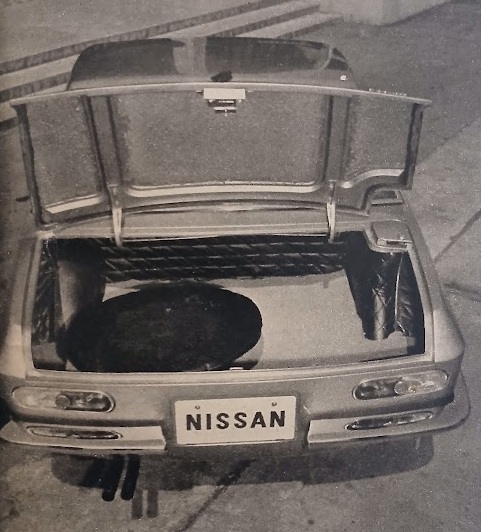
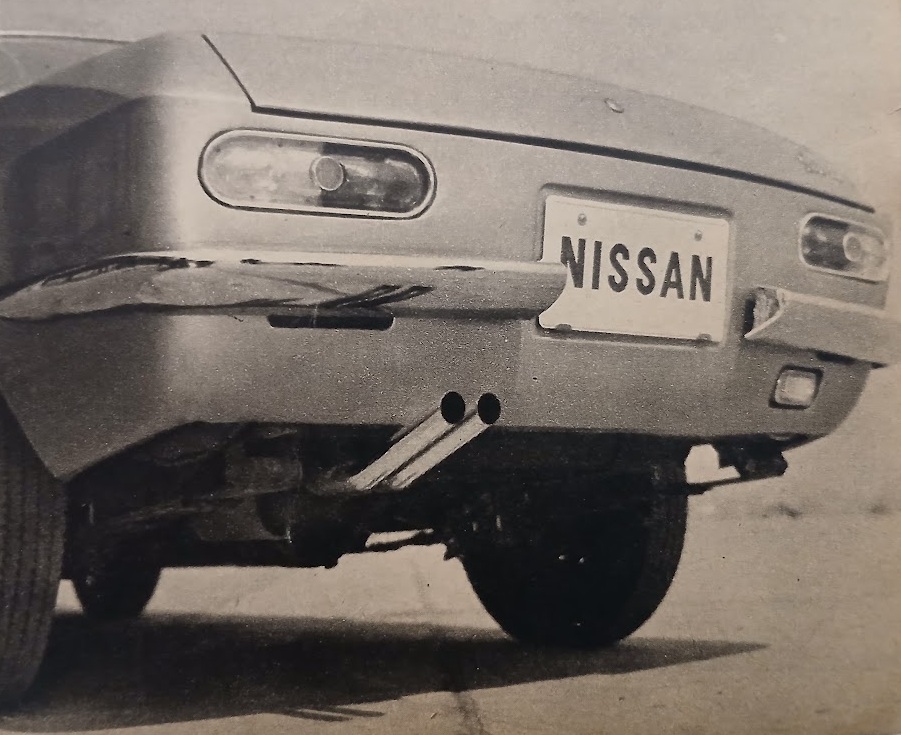
Magazine: To return to something we skipped over earlier, the exhaust pipes are brought together into one and then divided into two again at the rear, aren’t they?
Sasaki: That’s right. The exhaust is collected into a single pipe and then appears to divide into two again at the rear. We conducted every test we could imagine to extract even a little more horsepower, and adopted every measure we could.
Izumi: As we’ve been saying, beneath its outward appearance, this car is really a high-performance sports car. In terms of its engine and chassis, we’ve gone to great lengths comparable to many pure sports cars. At the same time, however, we’ve aimed for accommodation comparable to that of a luxury passenger car, paying particular attention to noise, vibration, and other aspects of refinement.
Machida: Bringing the exhaust gases together into a single pipe partway along the system produces reflected pressure waves. These reflected waves help draw the exhaust gases out of the other cylinders, thereby improving power output.
The final section has two pipes. That arrangement was chosen partly for styling reasons and partly for the exhaust sound.
Aoki: And the exhaust note itself is part of the car’s appeal to the customer, isn’t it?
Magazine: With that, it seems we’ve reached the end of our allotted time, so we’ll bring our discussion to a close here.
Postscript: Story Photos