Nissan Silvia (1965)
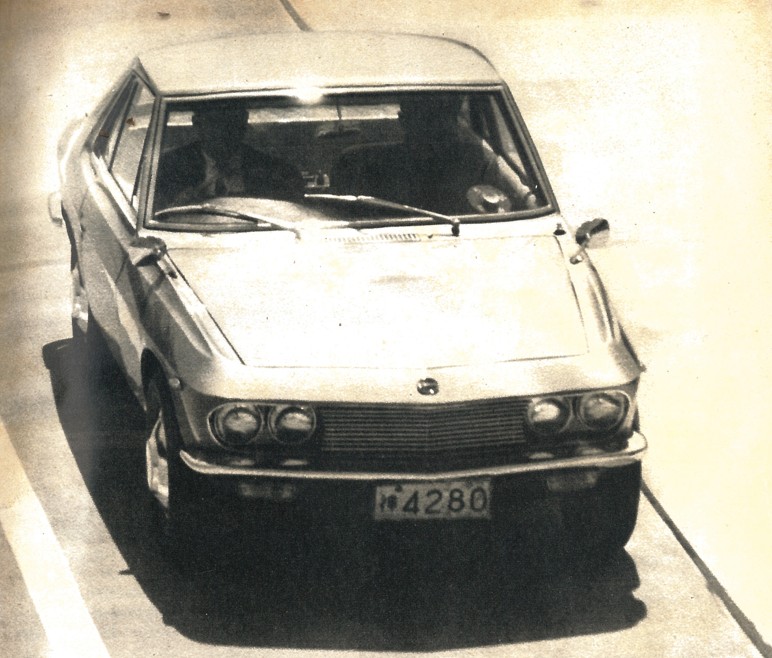
Publication: Motor Fan
Format: Road Test
Date: July 1965
Authors (Roundtable): Teiichi Hara, Motoo Harada, Osamu Hirao, Hiromichi Nakamura, Kenzaburo Ishikawa, Kazuo Kumabe, Masaichi Kondo, Kazumi Yotsumoto, Mineo Yamamoto, Yasuhei Oguchi, Atsushi Watari, Naoyuki Yamada, Taizo Tateishi, Akio Miyamoto, Kenji Higuchi
A High-Performance Car to Match the Styling
Magazine: Since last year’s Tokyo Motor Show, the Silvia has generated quite a bit of attention, and now it has finally gone on sale. It seems to differ considerably from the prototype that was exhibited at the show, so let’s begin with an explanation of the development aims from Nissan.
Hara: We’ve long had a desire to build a beautiful car. That was really the starting point behind the Silvia. When it came to deciding what to base it on, given the range of models we had available, we settled on something not too large, but also not cheap-feeling—something of an appropriate size and character.
In the end, we chose the Fairlady as the base, kept it a two-seater so as not to be overly ambitious, and went with a coupe body, which lends itself well to achieving a clean, attractive layout.
Up to that point—that is, until the stage when we displayed it at last year’s show—that was essentially the direction we had taken. But when it came time to bring it to market, we felt that having only the shape, with nothing underneath to match it, would be unsatisfactory. So we set out to give it performance worthy of its appearance, and developed a high-performance 1600cc engine, resulting in the car now on sale.
In terms of its content, I’ll start with the styling. As something we’ve worked on ourselves, we feel it’s something we can be proud of. Of course, being a car, there were various discussions about functional beauty—streamlining and so on—but from our standpoint, we focused on things like weight balance and visual balance.
And if I may add a more technical consideration, we are always mindful of crosswind stability, so we specified a shape in which the center of aerodynamic force is not too far forward. With those requirements in place, we then allowed the stylists a fair degree of freedom.
As for the engine, we made use of as much existing equipment as possible from the units used in the Cedric and the Fairlady, modifying them to create a more high-speed-oriented engine. As a result, it became a fairly short-stroke 1600cc unit.
Compared with the Fairlady engine, the bore has been increased by 7.2mm, while the stroke has been reduced by 7.2mm, giving an overall increase in displacement of 100cc.
The bore-to-stroke ratio comes out to about 0.76, which makes it quite a short-stroke design. Internationally, there are even shorter-stroke examples–particularly among Ford engines.
As for the character of the engine, we did not develop it with only racing use in mind. We aimed instead for good usability. Maximum output is 90ps at 6000rpm, and peak torque is 13.5kgm at 4000rpm. It is more high-revving than an ordinary engine, but it is not difficult to handle in the way a racing engine might be.
The clutch has also been reinforced, with a stronger spring setup, to withstand overrunning conditions up to around 8000rpm–for example, when driving downhill or when pulling hard in third gear.
Porsche-Type Synchromesh Mechanism
Magazine: You’ve been promoting the synchromesh as something developed in technical cooperation with Porsche, haven’t you?
Hara: Yes, that’s right. This is the first time Nissan has adopted a Porsche-type system in one of its cars. You could say that this particular synchromesh is the car’s most distinctive feature–something unique to it.
Fundamentally, we took considerable inspiration from their design, but the unit itself was developed by Nissan. So rather than a direct transfer from Porsche, it would be more accurate to say it was a collaboration.
In the end, we felt that for normal use, four forward gears would be sufficient, so we settled on a fully synchronized 4-speed transmission. Taking Porsche’s input into account, we were advised that if the gearbox shaft became too long–even with four speeds–it could lead to undesirable flex.
So we arranged all four forward gears within the main gear cluster, and placed reverse behind that. Normally, everything might be housed within a single section, but that would have made the unit too long. By placing the reverse gear section behind the gearbox, we were able to keep the overall length more compact.
Hirao: When you say “Porsche-type synchromesh,” what exactly does that mean in practical terms?
Hara: It’s not something that’s widely used, but Porsche themselves use it, and Alfa Romeo has been using it for quite some time as well.
To give you a bit of background–when we visited Alfa Romeo, we asked whether there was a synchromesh system that would engage reliably at any speed. After considering the requirements, they told us, “In that case, you should use the Porsche system.”
Structurally, speaking in simple terms, it incorporates something like a leading brake shoe within a conventional synchronizer. This produces a servo effect, allowing for reliable downshifts even from very high engine speeds.
The synchronizer itself is quite strong, but by adding this servo action, it ensures that speeds are matched and downshifts occur positively. For that reason, this type is often referred to as a servo-synchro mechanism.
Even Porsche themselves, I understand, took quite some time to refine and bring this system together. The version we first saw and the one we eventually collaborated on differ considerably.
Effective Even Over Long-Term Use
Harada: Recently, this type of system has started to be used even in more practical, everyday cars. Models like the Simca in France and the Fiat 850–fairly popular cars–have adopted it. At first, it was mainly used in sportier vehicles, but…
Nakamura: Because it has a servo mechanism, when you first apply pressure to the ring, an initial force comes into play. So the effort sort of rises sharply at first, then levels off, and finally slips smoothly into gear–that’s the feel.
Hara: Another feature of this synchromesh is that there’s no real wear at the contact points. With conventional synchronizers, after tens of thousands of kilometers, you inevitably start to get that notchy, “gritty” feel. But with this one, even after long use, it continues to perform effectively.
Harada: At the engagement surfaces, what you might call the clutching areas, those slightly uneven portions are coated with molybdenum.
Hara: Dimensionally, it’s also been made a little smaller than the previous Warner-type units.
Ishikawa: We recently tested a Porsche 911, and compared with that, the shift effort here is noticeably higher.
On the Porsche, it was around 2-3kg, but here first gear is about 6kg, second around 4-5kg, and even top gear is about 4kg–so it’s a bit on the heavy side.
Hara: So in that respect, the teacher is better after all? (laughs)
Hirao: When we tested it at Yatabe, the synchromesh engaged very well indeed.
The Benefits of a Short-Stroke Engine
Hara: As for the other features, we’ve adopted Dunlop-type disc brakes on the front wheels. In normal driving, the weight distribution is about 54% on the front, but under braking this shifts to roughly a 2:1 ratio. That means the rear wheels can remain conventional drum brakes without much concern about fade.
Because we adopted disc brakes, we increased the wheel size from 13 inches to 14 inches, which means the shape of the fender cutouts differs slightly from those of the show car.
Looking at the finished product as a whole, I think it’s fair to say we started with the goal of creating a beautiful car, and then pushed ourselves to give it performance worthy of that appearance.
The catalog top speed is 165km/h, although in our internal testing it has exceeded that figure.
However, because it is a low-volume production car, the price is relatively high at 1.2 million yen. To justify that, we’ve placed emphasis on a certain level of customization and luxury, paying careful attention to interior appointments and overall refinement.
As for sound, there was some discussion about giving it a more overtly “sports car” character. But we also wanted a car that wouldn’t feel out of place pulling up to a hotel entrance, so we aimed for a more refined tone–something closer to a sedan in that respect.
In terms of driving stability, since the car is based on the Fairlady, it inherits much of that character.
Hirao: The engine has a very short stroke. Does that configuration work well in practice?
Harada: In increasing the engine displacement to 1.6 liters, we explored about three different approaches–extending the stroke, enlarging the bore, and so on.
With a short-stroke design, we did expect some loss in low-speed performance. However, with a twin-carburetor setup, the overall balance improves even with a short stroke, so we chose that route.
The final dimensions–87.2mm bore × 66.8mm stroke–may seem a bit of an in-between solution. That’s because, starting from the Fairlady engine, we needed to retain space for the water jacket, which limited how much we could increase the bore. So in the end, it was a compromise.
Hirao: So if those constraints weren’t there, would it have been preferable to bring the bore-stroke ratio closer to one?
Harada: We didn’t go as far as testing that specifically, but in general, as you move toward a shorter stroke, within limits, you tend to gain more high-speed performance.
Hirao: Based on the results, I had thought that with a cylinder size in that range, it might be better to bring the bore–stroke ratio closer to equal. If that’s not the case, then I may need to revise my thinking.
Harada: I’m not sure it can be generalized that far…
Plenty of Scope for Tuning
Hirao: Earlier, you mentioned that engines with a short-stroke layout like the Silvia’s are mostly found in Ford designs–but I imagine the displacement per cylinder in those engines is larger than in this case.
Harada: When I referred to Ford, I meant the British Fords–engines like those in the Anglia, for example, which I believe have a stroke in the 40mm range.
That series uses a common manufacturing process to produce a variety of engine types, covering up to around 1.5 liters in that lineup.
That said, in terms of absolute stroke length, for a cylinder of this size, something around 70mm would normally be appropriate. In this case, however, because we’re using twin carburetors, low-speed performance didn’t suffer as much as expected, so we adopted the short-stroke design. It’s not that a short stroke is inherently superior in all cases.
Hirao: When you try to raise the compression ratio, doesn’t that become more difficult?
Harada: Yes, there is that tendency, since the combustion chamber becomes somewhat flatter in shape.
Kumabe: Are the carburetors the same as before?
Harada: Yes. We did compare them with a larger size, but the performance curves cross at around 4,500 rpm, and below that the larger unit falls off significantly. From a practical standpoint, we felt the smaller one was the better choice.
Kumabe: If you fit larger carburetors, they might be less effective at low speeds, but you’d get more power at higher speeds, wouldn’t you?
Harada: Yes, you would at high speeds. However, our primary aim was usability.
In the end, we focused on three elements–camshaft, compression ratio, and carburetors–and built about three different engine specifications. We ultimately chose the one with the lowest peak output, as it provided the best low-speed characteristics.
Kumabe: In that case, for something like racing use, would it be enough to change the camshaft and carburetors?
Harada: Exactly. There’s a considerable margin there for that kind of tuning.
Hirao: You mentioned earlier that the car’s driving stability is broadly similar to the Fairlady’s, since it shares that foundation. But the steering feel seems softer than in the Fairlady, doesn’t it?
Hara: We didn’t intentionally change it. I think it’s simply the result of slight differences in weight and weight distribution.
If anything, we feel it gives a somewhat milder impression than the Fairlady.
Hirao: And the steering wheel angle and mounting, are those the same?
Hara: Fundamentally, yes. The only change is in the section with the universal joint–specifically, the angle of the steering column post has been altered there.
Aiming for “Rich,” “Spirited,” and “Sporty”
Magazine: What led you to settle on a 1600cc engine?
Hara: From a facilities standpoint, something like 1900cc would have been possible. However, we were able to make use of the existing 1500cc production equipment, and we felt that this displacement was appropriate for the car.
Once you move into the 2000cc class, the level of competition changes entirely.
Kondo: You mentioned earlier that the project began with the aim of creating a beautiful car, and the styling is certainly very attractive, at least in a commercial, visual sense.
But you also said that function was taken into account. From that perspective, I do have some doubts–particularly when it comes to aerodynamic design. How do you see the relationship between styling and aerodynamics here?
Hara: To be completely honest, we didn’t pursue aerodynamics in a particularly detailed or rigorous way.
Our general feeling was that if something is considered beautiful, it probably won’t be too bad aerodynamically either. So in practice, we left much of that to the styling team.
Hirao: Recently, manufacturers have been introducing more and more high-speed sports models–take the Toyota Sports 800, for example. In many ways, this car feels like its opposite.
That car is smooth and rounded, whereas this one–what was it called, “crystal-cut”?–has very sharply defined lines. And while Toyota seems to be aiming for an inexpensive sports car, this one is targeting a relatively higher class.
It’s interesting–the lower-priced car is rounded, while the more upscale one is more angular. Is there some connection there?
Hara: There wasn’t any particularly deep reasoning behind it.
In internal discussions with the head of styling, the starting point was simply: “Let’s create a showpiece for the Motor Show.” From there, it just happened that our approach leaned toward something more upscale.
Yotsumoto: As for the “crystal-cut” theme, there wasn’t any especially deep theory behind it either.
The idea was to create something crisp and clean in execution, what you might call a “rich look.” Something visually attractive, with a sense of substance, spirit, and sportiness–without feeling cheap. That’s what we aimed to bring together in the design.
More specifically, I’d long wanted to give a car’s roof a kind of cantilevered feel–almost as if it were projecting forward from the rear quarter panels, like an overhanging eave. That was something I wanted to try.
Ideally, I would have eliminated the front pillars altogether, but after discussions with the body engineers, we instead made them as thin as possible.
As for the body sides, they have a relatively flat, planar quality, but another factor there was the idea of combining that cantilever concept with the possibility of using sliding doors. That’s part of what led to that flat surface treatment.
So overall, those were the main design intentions, and I think we were able to express what we set out to achieve.
The Coupe Advantage–Especially in Structural Rigidity
Yamamoto: The use of flat surfaces and sharp character lines, almost like diamond cutting, is very striking. But beyond styling, wasn’t there also an advantage in terms of suitability for mass production?
Hara: In our experience, mass-produced bodies tend to benefit from having more curvature. So in this case, the design was decided purely from a styling standpoint.
Yamamoto: If that’s the case, might it not have been possible to reduce weight–and improve performance further–by making greater use of light alloys?
Hara: If we were designing with racing in mind, then of course we would have had to consider that.
But given how the project began, we didn’t pursue those kinds of measures. If we were targeting racing, we’d probably want to reduce the weight by another 100kg.
That said, when you consider practical use, it’s not necessarily true that lighter is always better. For things like ride comfort and vibration, having a certain amount of weight can actually be advantageous.
Of course, some might say that after going to the trouble of developing such a high-performance engine, not taking racing into account shows a lack of ambition–but those are issues we can leave for the future.
Yamamoto: So the decision to make it a coupe, besides making it easier to achieve a cohesive shape, also offered advantages in terms of structural rigidity?
Hara: Yes, overall rigidity is much easier to achieve that way.
We felt it would be somewhat pointless to make it an open car and then have to increase weight just to compensate for the loss of stiffness. We’ve already had that experience with the Fairlady–without a roof, you have to add quite a lot of reinforcement underneath.
Yamamoto: The frame is based on the Fairlady, then?
Hara: That’s right. Although the length has been shortened slightly.
A Shape That Keeps Running Resistance Low
Magazine: Now then, let’s take a look at the performance test results…
Oguchi: In standing-start acceleration, we recorded 0-200m in 11.0 seconds, and 0-400m in 17.4 seconds. Nissan’s internal figure for 0-400m is said to be 17.9 seconds, so the Motor Fan test produced slightly better results.
Kondo: I understand there was quite a strong wind during testing?
Oguchi: By the time of the test, the wind had died down somewhat, but there was still a crosswind of about 5-7m/s.
Hirao: So the conditions weren’t especially favorable.
Oguchi: In overtaking acceleration as well, this was the first time we were able to measure all the way from 40km/h in top gear up to around 140km/h.
Part of that may be due to using Yatabe rather than Murayama as the test location, but in any case, I think the data clearly demonstrates the car’s strong acceleration performance.
Magazine: It seems fuel economy wasn’t measured in this test, so we’ll refer to Nissan’s data. But you did conduct a high-speed coasting test, correct?
Oguchi: We haven’t fully compiled the data yet, but we can report the rolling resistance and aerodynamic drag coefficients.
The rolling resistance coefficient is about 0.015, which is relatively low–most ordinary cars are around 0.018. The aerodynamic drag component is also small, at roughly 0.002.
Kondo: I would have expected the rolling resistance to be closer to 0.012 or 0.013…
Hirao: With larger cars, you tend to see lower figures. Since this is a small car, internal friction effects probably play a bigger role.
Yamada: For this Silvia, the overall drag coefficient comes out to about 0.5. That’s roughly on par with a typical sedan, and actually on the higher side for a sports-type car.
Kondo: From a purely aerodynamic standpoint, I would have expected it to generate more wind noise, but a figure of 0.5 isn’t bad.
Hirao: Most ordinary sedans are around 0.6. Cars like Porsche or Volkswagen are probably just a bit above 0.5.
Yotsumoto: If it had headlamp covers like a Volkswagen, the figure could be improved further, but regulations no longer allow that.
Hirao: As Professor Kondo suggested, 0.5 does seem a bit low for this kind of styling. However, I suspect the use of racing tires–and particularly the high tire pressures–had a significant influence on the results.
Nakamura: The low running resistance likely plays a role as well, but fuel economy is actually quite good for a twin-carburetor setup.
On a run between Odawara and Yokohama, the average fuel consumption came out to 16.5km/l, with an average speed of 49.3km/h over a distance of 103.4km.
Sedan-like Soft Sound Quality
Magazine: How about the noise and vibration data?
Watari: Since this is a sports-type car, it may not be necessary to go into too much detail on this aspect, but we will present the data for the record.
Tateishi: In the suspension vibration tests, using the usual bump course, we obtained sprung-mass vibration frequencies of 1.5cps at the front and 1.6cps at the rear. Unsprung mass vibration was in the 20-23cps range, and the damping characteristics appear to be fairly strong.
Watari: In other words, bouncing is around 90 cycles per minute, and pitching about 95 cycles per minute, which are typical values for GT cars and other sports cars.
However, when actually driving it, it seemed quite good in those aspects, but I did feel that elastic vibrations in the structure were somewhat noticeable.
On the test day, there was a strong wind of about 20m/s blowing at roughly 45° to the straight course, and combined with the high-speed driving, the upper edge of the door felt a little flimsy.
Tateishi: For the noise measurements, because of the strong wind, the background noise reached as high as 65 phons on the A-weighted scale. So for the 40-60km/h range, background correction was applied. The readings were 65 phons at 40km/h and 72 phons at 60km/h. We also measured up to the top speed of 160km/h, where the reading was 91 phons.
Watari: This is the first time we’ve measured in-car noise up to 160km/h under such strong wind conditions. If we convert the wind speed conditions, it’s equivalent to running at nearly 190km/h. When compared with other GT cars, these values fall into the lower (quieter) group.
Nakamura: Compared with our internal data, the high-speed noise seems slightly higher. For reference, at 160km/h we recorded 86 phons, so this is about 5-6 phons higher.
Hirao: That’s probably because of the wind. Even though background noise has been corrected, at high speeds the relative airflow over the car increases significantly, so noise generated independently of background conditions also rises. It probably increases with roughly the square of the relative wind speed.
Hara: Also, when the wind comes in at a slight angle, noise tends to increase. Professor Watari also pointed out the door fit, and it’s true that in those areas the noise can rise quite sharply.
Tateishi: During the test, we experienced the worst of the wind conditions of the day. According to radio reports, the maximum instantaneous wind speed in that area was about 25m/s. We did not measure exterior noise, but from listening to the car, as described, the sound is more like a sedan–lighter in character than a typical sports car.
Nakamura: In deciding the overall sound character, we examined it in various ways, but in the end we settled on a touring sports car classification, and gave it a sedan-like quality.
Steering Characteristics: Tending Toward Understeer
Magazine: How were the results of the handling and stability tests?
Kondo: First we measured the minimum turning radius. As shown in the accompanying chart, the outermost path of the car was 5.25m, and the innermost was 3.01m.
In the understeer/oversteer test, the car remained in a state of understeer throughout. Maximum steering effort was 2.8kg, which I think is light for a car of this type.
The degree of understeer is evaluated from the R/R₀ ~ V² curve. It continues rising up to about 120 m²/s², which is a good result. However, since the rate of increase is rather strong, I did wonder whether the understeer might be a little on the heavy side.
For reference, the Porsche 911–well known for good handling stability–also showed understeer values up to around this same 120 m²/s² range in our tests.
The roll angle in cornering, derived from the straight-line relationship, also matches the measured values quite well. The points fall cleanly on the estimated line, giving a roll rate of 3.90, which I think is quite acceptable.
The steering effort when stationary is 16kg at 180° to the left, and 16kg at 270° to the right. These are fairly high values. Most domestic sports cars in recent years tend to show relatively heavy steering at standstill–maybe on the assumption that they will be driven by energetic young drivers.
One point that stood out is that the left and right steering efforts are not symmetrical.
In the low-speed steering tests–that is, the figure-eight course tests–the steering effort on entering a turn was about 6kg at 0.25g lateral acceleration, which I would consider to be in the favorable range.
The high-speed slalom tests, meanwhile, show that to the left the steering effort is about 2.5-3kg at a lateral acceleration of 0.25g, which is quite good. However, to the right it is not symmetrical with the left, dropping to about 1.5kg at 0.25g, and the effort curve itself also becomes more relaxed.
This seems related to the asymmetry already seen in the stationary steering effort test. It may be due to some unevenness in setup or alignment, and I would like to discuss it later with the company engineers.
Hirao: I wonder how the alignment was set up…
Ishikawa: We measured it with a side-slip tester. The front wheels had a moderate amount of camber and toe-in. With either one passenger or two, both camber and toe-in shift slightly toward the smaller side. The rear wheels have almost no camber or toe-in at all.
Kondo: As for straight-line stability with hands off the wheel, we tested this up to 120km/h, and there is nothing unusual to report.
Hirao: Perhaps because of the strong wind, it felt as though the steering was being pulled around quite a bit. I happened to be driving a Mercedes 300SL at the time, and it didn’t behave that way. I suppose that’s because it’s larger and heavier.
Kondo: This is probably something for future research in Japan.
Kumabe: In those wind conditions, I think anyone driving it for the first time would feel that way.
Ishikawa: Up to about 120km/h there’s no real wandering. But at 140 or 160km/h, the wind effect on the steering becomes quite noticeable.
Brakes That Work Well at High Speed
Hirao: I wonder if the steering rigidity is a little low. I can’t quite get a quick, precise sense of how much correction is needed–in other words, it feels like it doesn’t settle properly. The Fairlady didn’t have that feeling, though there was a difference in test speeds.
Hara: That may be true. Another weak point of understeering cars is that they tend to be sensitive to wind.
Kondo: That may be part of it, but looking at recent sports cars, all of them have light steering. Since these are sports cars, perhaps the gear ratio could be made a little smaller and the effort increased slightly.
Hara: The question of how to make steering heavier at high speeds–that’s a difficult one. We’ll continue to study it.
Magazine: How about the results of the Ship Research Institute tests?
Ishikawa: Total weight with spare tire and tools is 993kg. Axle load is 531kg front, 462kg rear, giving a 53.5:46.5 distribution. With two passengers, the rear load increases slightly.
The brakes are Dunlop-type discs at the front and leading-trailing drums at the rear. Because discs are used at the front, pedal effort for 0.6g braking is about 37kg, somewhat on the heavy side. Brake force distribution is 6:4.
Left-right balance is generally good, though on the test car the left front brake was slightly weaker than the right.
The parking brake requires 29kg effort for the equivalent of 0.2g braking–this figure is somewhat higher than the internal data. It is a floor-mounted lever type acting on both rear wheels, positioned for easy reach and smooth in operation.
In road testing, unlike previous cars where pedal effort increased with speed, this car shows slightly lighter pedal effort at higher speeds, likely due to aerodynamic effects and related factors. However, at 120km/h, braking at 0.6g causes noticeable fade and the pedal becomes heavier. That said, recovery is quick, so repeated tests do not show a significant rise in pedal effort.
Among other controls, the shift lever is somewhat stiff and requires relatively high effort. The clutch, on the other hand, is lighter than that of the Fairlady.
Watari: The shift lever feel was quite good. But I can’t say the brakes had particularly good “feel.”
Kumabe: This may be a very basic question, but when braking from very high speeds–say, 160-170km/h–what is the proper sequence?
Hirao: What I do is first apply the brakes to reduce speed, then drop into third and use engine braking, then brake again and shift into second. That’s the method I use–what do you think?
Hara: I think it probably depends on driving habits by country. In Europe, engine braking is widely used, but in Japan, not as much.
Kumabe: With ordinary drum brakes, how many repeated stops are they expected to withstand from something like 170 or 180km/h?
Hara: We test on the basis of about 20 consecutive applications. With older brake systems, repeated use was generally limited up to around 100km/h. As speed increases, braking load may rise more than proportional to the square of speed, but we believe 20 cycles is still safe.
Harada: To be honest, at 160km/h, unless you apply quite serious force, it becomes difficult.
Ishikawa: With these disc brakes, we tested stopping from 140km/h, and it came to a very clean stop.
Hirao: In that sense, these brakes are reassuring. And with engine braking as well, thanks to the Porsche-type synchronizer, you can downshift cleanly at almost any speed.
Miyamoto: From experience, disc brakes, even if you step on them hard enough to lock on paved roads, tend to bite down smoothly, whereas drums are no longer safe in that situation—the steering starts to get pulled…
Higuchi: In racing, we were taught to keep full pressure on the brakes, and if it starts to skid, ease off and reapply. With that technique, even drum brakes can still be used safely for deceleration.
Magazine: Now, let’s move on to the visibility measurements…
Yamamoto: The seat has 130mm of fore-and-aft adjustment. We measured forward visibility and the solid angle of the visible field with the seat both fully forward and fully rearward. The data is shown in the appendix, but overall, for a coupe-type car, visibility falls into the better category.
Excellent Interior and Exterior Finish
Magazine: How about interior dimensions and related measurements?
Higuchi: In terms of body dimensions, since this is a pure two-seat coupe, compared with 2+2 or four-seaters in the same class, overall length is shorter, width is mid-range, and overall height is among the lowest. Because both length and height have been pushed down to the limit, the reduction effect on frontal projected area is quite significant.
There is one minor point: compared with the width of the front bumper and the front half of the body, the protrusion of the wheel covers is somewhat pronounced.
As for interior dimensions, since it is a two-seater, there is sufficient space. In particular, the rear luggage area, together with the curved door glass, forms a fairly generous storage space. The seats are set low and deep, which secures ample head clearance.
However, I did feel that rather than making it strictly a two-seat coupe, if it were certified as a four-seater under regulations, it could also be used more easily for family purposes.
The driving position is set in a typical sports-car posture: the seat front is low, the steering wheel is positioned close to the seat cushion, while the backrest is set farther away.
The steering wheel and stick-type gear lever are also very much in the sports-car style, and the pedal layout has been designed to allow heel-and-toe operation.
Switches and control levers are arranged more cleanly than in previous examples. Items that feel slightly far away are those used less frequently while driving—such as the seat slide lock, trip meter reset, cowl ventilator, ignition key, and bonnet lock. Everything else is placed appropriately and is quite satisfactory.
The interior and exterior specification is quite luxurious and, among domestic cars, appears to fall into the top-class category. The gauges are also well executed–the curved instrument panel arrangement is particularly impressive.
Retractable seat belts and adjust straps are properly fitted, and together with the soft interior trim, safety considerations are well taken care of.
Magazine: Thank you all very much.