Nissan Silvia (1965)
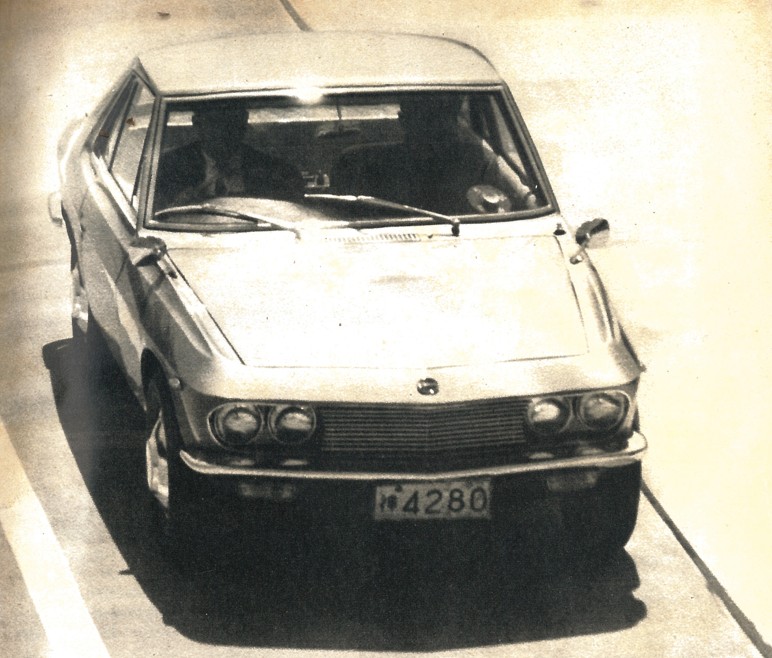
Publication: Motor Fan
Format: Road Test
Date: July 1965
Authors (Roundtable): Motoo Harada, Osamu Hirao, Hiromichi Nakamura, Kenzaburo Ishikawa, Kazuo Kumabe, Masahi Kondo, Kazumi Yotsumoto, Mineo Yamamoto, Yasuhei Oguchi, Atsushi Watari, Taizo Tateishi, Akio Miyamoto, Kenji Higuchi
A High-Performance Car With Style
Magazine: The Silvia, which has been much talked about since last year’s Tokyo Motor Show, has finally been released. It seems to have changed quite a bit from the prototype exhibited at the show, so let’s start by asking Nissan to explain the development goals of this model.
Harada: From the beginning, our desire was to make a beautiful car. This was the starting point for the Silvia, and when it came to deciding what to base it on, we settled on something that was neither too big nor too lightweight, and was adaptable to the concept, based on the cars we had on hand.
In the end, we decided to base it on the Fairlady, keep the seating capacity modest with accommodations for two, and to go for a coupe type that would make it easier to create a beautiful layout.
This was the stage we had gotten up to when we exhibited it at the show last year, but when it came to actually putting it on the market, we didn’t want it to be just a beautiful shape with nothing inside. So, to give it performance that matched its appearance, we developed a high-performance 1600cc engine, which resulted in the car we are selling now.
To explain the content, of course, the highlight of the car is its style. As a design, I think that it is something we can be proud to have worked on. Of course, since it is a car, we had to consider both beauty and functionality, and there were many discussions about making it streamlined, but we were mostly focused on the visual balance and the weight balance… Then, if I had to name a scientific consideration, we wanted the center of wind force not to be too far forward, due to the issue of crosswind stability, which we are always careful about… We made requests about those things, and then we let the stylist do the rest freely.
For the engine, we used as much of the equipment as possible that we use for the Cedric and Fairlady, and modified it to create a high-speed engine, so it has a fairly short stroke for a 1600cc engine.
Compared to the Fairlady engine, the bore is 7.2mm larger and the stroke is 7.2mm smaller, resulting in an engine volume 100cc larger. This bore-stroke ratio is about 0.76, which can be said to be a fairly short stroke. Looking around the world, only certain example of Ford engines have strokes shorter than this.
The engine’s characteristics were not specifically designed for racing, so we tried to make it very easy to use. Maximum output is 90hp at 6000rpm, and maximum torque is 13.5kgm at 4000rpm. It’s a higher-speed type than a normal passenger car’s engine, but it’s not difficult to use like a racing car.
The clutch has a stronger spring type to accommodate overrun up to about 8000rpm, such as when driving downhill or downshifting to third gear.
Porsche-Type Synchronization
Magazine: Nissan is promoting the fact that the synchromesh was designed in a technical partnership with Porsche.
Harada: That’s right. This car is the first Nissan car to use a Porsche-type synchro. You could say that this synchromesh is the most distinctive technical feature of this car. We basically took a lot of inspiration from their designs, but the actual unit was developed by Nissan in collaboration with Porsche.
In the end, we decided that four speeds would be sufficient for normal use, so we went with a 4-speed forward fully synchronized transmission. We listened to Porsche’s opinion, and they advised that even with a 4-speed, if the driveshaft was too long, it would not be very good due to excessive bending, so we put all the forward 4-speed parts inside the gearbox, and put the reverse gear behind it to make the shaft shorter.
Hirao: What exactly is a Porsche-type synchro?
Harada: This is not a mechanism that is widespread all over the world, but Porsche itself uses it, and Alfa Romeo has been using it for quite some time now. To give you an anecdote, when we visited Alfa Romeo and asked if there was a syncromesh that would work reliably at any speed, they looked at the data and decided that we should use the Porsche type.
To briefly explain, the internal structure is that of a normal synchronizer, plus a device just like a brake’s leading shoe which acts as a servo, so you can downshift reliably from any rpm, even high engine speeds. The synchronizer itself is powerful, but because it has a servo action that reliably downshifts in line with the rpm, this type is called a servo synchronizer system.
It took Porsche a long time to develop this. The design is very different now than when we first saw it when we partnered with them.
Effective Even For Long-Term Use
Harada: Recently, it has started to be used in practical vehicles as well. It has been adopted in certain popular cars such as the French Simca and the Fiat 850. At first, it was only used in sporty cars, but…
Nakamura: Because there is a servo mechanism, when you first press the ring, an initial force is applied, so at first the resistance rises sharply, and then it slowly goes flat. It just slides right in.
Harada: Another feature of this synchro is that the gear teeth do not wear out. Conventional synchro rings would get rough after tens of thousands of kilometers of use, but this one will still function perfectly even after a very long time of use.
Harada: In the area where the clutch meshes, where the surface is irregular, it uses a coating of molybdenum. In terms of dimensions, the unit is a little smaller than the Warner type we used previously.
Ishikawa: We recently tested a Porsche 911, and compared to that, the effort of the gearchange in this car is significantly greater. The Porsche’s shifter was around 2-3kg, but this one required 6kg for first gear and 4-5kg for second, and shifting into top is also around 4kg.
Harada: I guess the teacher is better after all (laughs).
Hirao: Still, when we tested it at Yatabe, the synchronization was very good.
The Benefits of Short-Stroke
Harada: Another feature of this car is the use of Dunlop disc brakes on the front wheels. In terms of weight distribution, I think that when driving normally, the load is on the front wheels about 54%, but when braking, the ratio is about 2:1, so even though the rear wheels are normal drum type, there is almost no risk of fade. Because of the use of disc brakes, the tires have been increased from 13 inches to 14 inches, so the cutouts of the wheel arches are a little different from when the car was exhibited at the show.
In the end, the final result was a beautiful car. We started with the idea of what we wanted, and we developed performance that could match it. The maximum speed is quoted as 165km/h in the catalog, but in our internal tests we have seen speeds even faster than that.
However, because it is produced in small quantities, the price is a steep 1.2 million yen, so we have taken into consideration the customizability and deluxe atmosphere that goes with that price, and have also given careful attention to the cabin furnishings.
Regarding the issue of sound, there was some discussion about whether it should be something more like a sports car, but we wanted a car that would not be embarrassing to park next to a hotel, not just for racing, so we went for something a little more refined. I think it’s roughly comparable to a sedan. As for driving stability, since it is based on the Fairlady, it has inherited many of that car’s characteristics.
Hirao: The engine has a very short stroke. Is that better?
Harada: We experimented with three different types of engines, including extending the stroke, widening the bore, and a combination of the two. We had expected that the short-stroke type would be weak at low speeds, but assuming a twin-carb specification, the all-round performance would be good even with a short stroke, so that was the one we went with.
The dimensions are an odd 87.2mm bore and 66.8mm stroke, but this is because it is a Fairlady engine, and we were forced to compromise by the fact that there is a water jacket in between the cylinders, and we could not expand the bore any further.
Hirao: So if the design had allowed it, it would have been better to make the bore-stroke ratio a little smaller?
Harada: We haven’t testedit that far, but I think that with a shorter stroke, although there is a limit, the high-speed effect would be increased.
Hirao: Judging by the size of an individual cylinder, with an engine displacement like that, I had thought that it would have been more appropriate to have a bore-stroke ratio closer to 1, but if those are your results, I may have to revise my thinking.
Harada: I don’t know if this can be said as a general rule…
Plenty of Room For Tuning Up
Hiaro: Earlier, you mentioned that short-stroke engines like the Silvia’s are found in some Ford models, but volume of each cylinder is larger in those engines, isn’t it?
Harada: When I say Ford, I mean the British Ford, and the Anglia, for example, has a stroke of 40-something mm. That engine produces a variety of engines in one manufacturing process, and that series covers up to the 1.5 liter Consul.
Certainly, in terms of absolute stroke value, I think that for a cylinder volume of this size, about 70mm would normally be considered ideal, but in this case, since we used a twin carburetor, it doesn’t become weak at low speeds either. This doesn’t mean that a short stroke is necessarily better, but it works well in this particular case.
Hirao: Doesn’t it become difficult when you try to increase the compression ratio?
Harada: The combustion chamber becomes a bit flatter, so yes, that does tend to make it harder.
Kumabe: Are the carburetors the same size as before?
Harada: Yes, they are. We tried using one size larger and compared them, and found that the performance curve crosses over at about 4500rpm, but is significantly lower below that, so we think the smaller size is better for practical driving. If you use a larger carb, it will not perform well at low speeds.
Kumabe: However, it wll probably have more power at higher speeds.
Harada: Yes, it does at high speeds. However, our aim is to make it easy to use, so… In terms of performance, we built three engine types, varying the camshaft, the compression ratio, and the carburetor. In the end, we chose the low-speed type that produces the least horsepower.
Kumabe: So, if you were to enter a race, you could just replace the camshaft and carburetor, right?
Harada: Yes. And I think there’s a fair amount of margin built in for that.
Hirao: The driving stability is roughly similar to the Fairlady, but the steering seems to feel softer than the Fairlady.
Harada: It wasn’t something we made a conscious effort to change. We think it was just due to the slight difference in weight and its distribution. We also think it feels more like a civilized Fairlady.
Hirao: Are the steering wheel angles and mounting methods the same?
Harada: Basically, yes. However, halfway through the steering column, at the universal joint, the angle of the post has changed.
The Aim is to Be Rich, Spirited, and Sporty
Magazine: Why did you decide on a 1600cc engine?
Harada: From the equipment standpoint, we could have gone up to 1900cc, but we were able to use the production facilities for a 1500cc, and we decided that this size was appropriate. When you move up to the 2000cc class, the level of your rivals changes drastically.
Kondo: You mentioned that it all started with the idea of making a beautiful car. I understand that the design was created with a focus on aerodynamics, and I think that the style is certainly beautiful, in terms of commercial beauty. However, you also mentioned that functionality was taken into consideration. In that case, I have some doubts about the aerodynamic design… How did you think about the shape and aerodynamic design?
Harada: To be honest, we didn’t give much thought to the aerodynamic design. In general, we just left it up to the stylists, assuming that things that are considered beautiful probably aren’t too bad in terms of wind resistance.
Hirao: Recently, various manufacturers have been releasing high-speed sports cars, such as the Toyota Sports 800. This car contrasts with that one in many ways. That car’s shape is smooth and rounded. This car has crisp, or should I say, crystal cut lines. Also, Toyota is aiming for a more affordable sports car, while this car is relatively high-class. It seems that cheaper cars are more rounded, while the higher-end ones are sharper and more angular, is there some kind of relationship there?
Harada: I don’t really have any deep thoughts about it. I had a private discussion with the head of the design department, and we simply decided to create something that would be the highlight of the Motor Show, and the result ended up being something that was aimed at a relatively high-end market.
Yotsumoto: There was no particular thought put into the “crystal cut.” It was very crisp, had a high-class look, and was visually beautiful… somehow rich-feeling and spirited, and sporty without looking cheap, so we decided to go with it. Specifically, I wanted to give the roof of the car a cantilevered look from the front. I wanted to use the rear quarter panel to create a cantilever roof that extends forward like an overhang. I actually wanted to remove the front pillars as well, but after discussing it with the body engineer, we decided to just make them as thin as possible.
The body sides have a relatively flat feel, and another reason for this is that, in addition to the cantilever roof, I also wanted to make the doors sliding doors that disappeared into the body. That’s basically what I was aiming for with the design. And I think that shows what we wanted to do from the beginning.
Coupe Type Has Advantages in Terms of Rigidity
Yamamoto: The flat surfaces and ridges reminiscent of diamond cuts have been used to great effect. Apart from being a stylistic consideration, this must have also had the added benefit of making it suitable for mass production.
Harada: Actually, in our experience, the more mass-produced the body is, the more rounded it is, so we decided on that style just for aesthetic reasons.
Yamamoto: If that is the case, wouldn’t it have been possible to use a little more light alloy to reduce the weight and improve performance?
Harada: If you think about racing, of course you have to take that into account, but since this car was all about our original aesthetic idea, we put it together without thinking about such things. If we were thinking about racing, I would want it to be 100kg lighter. But when it comes to practicality, I don’t think being slightly heavier is necessarily bad. For example, when it comes to issues like ride comfort and vibration, a certain amount of weight is an advantage. Well, some might say we’re being too selfish for developing such a high-performance engine and not thinking about racing, but we’ll carry that over as something to address in the future. At least, I’d certainly like to.
Yamamoto: I imagine the reason for making it a coupe, instead of an open car, was probably because it was easier to create the shape, and also because it had an advantage in terms of rigidity.
Harada: After all, it does give the car a lot of rigidity. I thought it would be foolish to make it an open type and increase the weight while reducing rigidity. We’ve done roofless cars before with the Fairlady, but you have to reinforce the bottom quite a bit.
Yamamoto: The frame is from the Fairlady, right?
Harada: Yes, but the length is a little shorter.
A Style With Low Rolling Resistance
Magazine: Now, here are the results of the power performance tests…
Oguchi: In terms of standing-start acceleration, the 0-200m time was 11.0 seconds, and the 0-400m time was 17.4 seconds. The in-house data showed 0-400m in 17.9 seconds, so we actually got better figures in the Motor Fan test.
Kondo: It seems the wind was quite strong…
Oguchi: It was, but during our test, the wind had died down considerably and the crosswind was around 5 to 7m/s.
Hirao: So the conditions weren’t particularly favorable.
Oguchi: That’s right. Also, this was the first time that we have been able to measure the top-gear overtaking acceleration time from 40km/h to 140 km/h. This was because the test location was Yatabe and not Murayama this time. In any case, I think this data proves the good acceleration of the car.
Magazine: We weren’t able to measure the fuel economy ourselves this time, so we will refer to Nissan’s data, but it seems we did did conduct coasting performance tests at highway speeds.
Oguchi: I haven’t been able to organize the data yet, so I’ll publish the rolling resistance coefficient. The rolling resistance coefficient is about 0.015, which is on the low side. For a normal car, it’s about 0.018. The air resistance is also about 0.002, so I think it’s also small.
Kondo: I thought the typical rolling resistance was around 0.013 or 0.012…
Hirao: With a larger car, the number would be smaller, but since this is a small car, things like internal friction come into play.
Yamada: The drag coefficient for the new Silvia will be about 0.5, which is about the same as a normal sedan, and on the high side for a sports car.
Kondo: Aerodynamically speaking, people say the Silvia has a lot of wind noise, but 0.5 isn’t so bad.
Hirao: A normal sedan is around 0.6. I think Porsche and Volkswagen have just been getting a little under 0.5.
Yotsumoto: It would be better if we put headlamp covers on it like Volkswagen does. However, this is no longer allowed due to regulations.
Hirao: As Professor Kondo said, 0.5 is a little low considering the styling, but I think the fact that it was running on racing tires with high pressures probably had a big impact as well.
Nakamura: I think the low rolling resistance is a factor in this as well, but the fuel economy is quite good for a twin-carb engine. The average fuel economy between Odawara and Yokohama was 16.5km/l. The average speed was 49.3 km/h, and the distance traveled was 103.4 km.
Soft, Sedan-Like Sound Quality
Magazine: What about our noise and vibration data?
Watari: Since it’s a sports car, I don’t know if I should go into too much detail about this aspect, but I’ll announce the specifications anyway.
Tateishi: In the suspension vibration test, the vehicle was driven over the usual bumps. The sprung vibration frequency at the front is 1.5c/s, the rear is 1.6c/s, and the unsprung vibration is 20-23 c/s, so the damping is quite strong.
Watari: In other words, the bouncing rate is about 90 times per minute and the pitching rate is about 95 times per minute, which is the same as that of conventional GT cars and other sports cars.
However, when I actually rode in the car, although it was quite good in many respects, I felt that the elastic vibration through the chassis was a little large. On the test day, there was a strong wind of about 20m/s blowing at a 45-degree angle to the straight course, and when we were driving at high speed, the upper edge of the door felt a little lacking in rigidity.
Tateishi: As for the noise data, due to the strong winds, the background noise was 65 phons on the A scale, so we corrected for ambient noise in the measurement range of 40 to 60 km/h. At 40 km/h, it was 65 phons, and at 60 km/h, it was 72 phons. We also measured interior noise at 160 km/h, and the figure was 91 phons.
Watari: This was the first time that we measured noise inside the car in strong winds at 160 km/h, and if you convert the wind speed, it corresponds to running at close to 190 km/h. When comparing these measurements with other GT cars, the noise level is on the low side.
Nakamura: Comprared to our in-house data, the sound seems to be higher at high speeds. For reference, at 160 km/h, we measured the sound level at 86 phons, which is about 5 to 6 phons lower.
Hirao: It must be because of the wind. The background noise is corrected for, but at high speeds, the wind speed against the vehicle increases, so the noise generated apart from the background noise also increases. It probably rises at roughly the square of the wind speed against the vehicle.
Harada: Also, if the wind hits it from a slightly diagonal direction, the sound gets louder. Professor Watari pointed out the fit of the door, and in areas like that, the sound can get louder suddenly from gusts.
Tateishi: The wind was at its worst during the sound testing, with a maximum instantaneous wind speed was 25 m/s. I did not measure the noise outside the car, but when I listened to the sound of the car, as others mentioned, it more like the light sound of a sedan than a sports car.
Nakamura: We considered various options when deciding on the exhaust sound quality but in the end, since this is a touring sports car, we intentionally went for something more sedan-like.
Basic Steering Characteristic is Understeer
Magazine: How about the results of the maneuverability and stability tests?
Kondo: First, we measured the minimum turning radius. The results are 5.29m for the outermost part of the car, and the innermost part is 3.01m.
The understeer, oversteer, and steering force test shows that the car maintained understeer until the end. The maximum steering forc during the test was 2.8kg, which I think is light for this type of car. The degree of understeer was judged from the R/R.~V². (R is the radius of curvature at time t=0, R=14.0m) curve, and it continued to increase up to 120m²/s², which I think is quite good. However, since the rate of increase was so strong, I wondered if the degree of understeer was too strong. For comparison, the Porsche 911, which has good handling and stability, also exhibited understeer up to about 120m²/s² like this Silvia.
The roll angle during turns is obtained by comparing an actual straight line overlaid with the measured values, which results in a calculated roll rate of 3.90, which I think is appropriate.
The steering force for turning the wheel while stationary is 16kg for a left turn at a steering angle of 180° and 16kg for a right turn at 270°, which are quite large values. It seems that the steering force while stationary is high for all domestic sports cars these days, maybe on the assumption that they are driven by energetic young people. What bothers me more was the asymmetry in effort between left and right turns.
In the low-speed steering force test, i.e. the figure-8 course driving test, the steering force when entering a curve was 6kg at a centripetal acceleration of 0.25g, which I think is in the optimum range. In the high-speed steering force test (slalom test), turning side-to-side with a maximum lateral acceleration of 0.25g, turning left resulted in a maximum effort of 2.5 to 3kg, but the right turn effort was asymmetrical with the left, being much lighter at 1.5kg. This is related to the asymmetry in steering force when the car is stationary, and I would like to discuss this with the company’s engineers later whether it was just a maintenance issue.
Hirao: I wonder what the alignment was like…
Ishikawa: When measured with a side slip tester, the front wheels had medium camber and toe-in. When there was one person in the car and when there were two people in the car, the camber and toe-in were slightly smaller. The rear wheels had almost no camber or toe-in.
Kondo: We also performed hands-off directional stability tests at speeds up to 120km/h, but there was nothing unusual to report.
Hirao: Perhaps because the wind was strong, I felt like the steering was light and easily deflected. I happened to be driving a Mercedes-Benz 300SL the same day, but that car didn’t seem to be affected. I suppose it’s because that’s a bigger car with heavier steering.
Kondo: For Japan, this is a topic for research in the future.
Kumabe: I think everyone who drives in gusty crosswinds for the first time has the same feeling.
Ishikawa: Up to about 120 km/h, there wasn’t much wobbling. But at 140 or 160km/h, the wind had a big effect on the steering.
Effective High-Speed Braking
Hirao: I wonder if the stiffness of the steering column is a little low. I couldn’t instantly make the right corrections, which was a little unnerving. I didn’t notice this in the Fairlady, although there was some difference in the test speeds.
Harada: Yes, this happens. Understeering cars have the disadvantage of being weak against the wind.
Kondo: That may be true, but if you look at the sports cars that have come out recently, they all seem to have light steering at high speeds. Since they are sports cars, surely it would be okay to make the gear ratio smaller and the steering a little heavier?
Harada: It’s quite difficult to make the steering appropriately heavy at high speeds. We will continue to research this.
Magazine: What about our tests at the Ship Research Institute?
Ishikawa: The weight is 993kg including the spare tire and tools, with 531kg on the front wheels and 462kg on the rear wheels, for a weight distribution of 53.5:46.5. With two people on board, the rear load becomes a little heavier.
The brakes are Dunlop type discs on the front wheels and leading-trailing drum brakes on the rear wheels. Because discs are used on the front wheels, the pedal force required for 0.6g deceleration is a little heavy (37kg), and the distribution of the braking force is 6:4. The balance between the left and right wheels is quite good, but on the test car the left front wheel brake was a little weaker than the right.
The parking brake has a 0.2g operating force of 29kg, which is greater than the in-house data, but the floor-lever type rear two-wheel brakes are located in an easy-to-reach position and operate smoothly.
In earlier road tests, cars have tended to require greater pedal force as speeds increased, but in the Silvia, due to air resistance and other factors, the pedal force actually becomes lighter at higher speeds. However, at 129km/h, 0.6g braking causes considerable brake fade and the pedal becomes heavier. However, because recovery is quick, no significant increase in pedal force is observed in repeated tests.
The shift lever is a little rough and difficult to operate. Effort seems to be heavier than in the Fairlady. The clutch, on the other hand, seems lighter than the Fairlady’s.
Watari: I thought the feel of the shift lever was pretty good, but the brake feel wasn’t so impressive.
How to Brake From High Speed
Kumabe: This is a very basic question, but what is the proper technique for decelerating from high speeds, like 160 or 170km/h?
Hirao: I usually apply the brakes first to slow down, then downshift to third gear and let engine braking slow the car, then apply the brakes again and throw the car into second. What do you think?
Harada: I think customs differ depending on the country. In Europe they make heavy use of engine braking, but this isn’t so common in Japan.
Kumabe: With normal drum brakes, how many times can you be guaranteed to stop from high speeds of 180 or 170kmh?
Harada: We test systems so that they can be guaranteed to work for about 20 consecutive stops, but in those tests, the continuous speed before stopping is 100km/h. At higher speeds, the load increases by more than a factor of two, but I think they will still be fine for about 20 stops.
Harada: But to be honest, when it comes to speeds like 160km/h, it becomes almost impossible unless you exert an incredible amount of force.
Ishikawa: With these disc brakes, I tried braking hard from 140km/h, and it stopped perfectly.
Hirao: These brakes are very reassuring. And as for engine braking, thanks to the Porsche-type synchro, you can downshift smoothly at any speed.
Miyamoto: From my experience, even if you use disc brakes hard enough to approach wheel lock on a paved road, they will still work, but with drum brakes, it’s no good. The steering wheel gets yanked right out of your hands…
Higuchi: In races, I was taught to press the the brakes as hard as I could, then ease off when it skidded, and then brake again. This way, even with drum brakes, you can slow down safely.
Magazine: Now, here are the results of the visibility test…
Yamamoto: The seat slide travel is 130mm, and we measured the solid angle of forward visibility and the visible range with the seat in its fully forward and rearward positions. Looking at the data, I think that overall visibility in this car is good for a coupe.
Exterior and Interior Finish
Magazine: What about the interior dimensions?
Higuchi: In terms of body dimensions, since it is a full two-seat coupe, compared to a 2+2 or four-seat cars in the same class, it is short in length, medium in width, and the lowest in height. The reduced length and height have a large effect on reducing the frontal area. However, although it is a small thing, the protrusion of the wheel caps was noticeable compared to the width of the front bumper and the width of the front half of the body.
The interior dimensions are fully adequate for a two-seater. The luggage area at the rear is particularly spacious, with the curved doors and glass. The seats are low and deep, ensuring ample head clearance. However, I wonder if it could have legally been classified as a four-seater, so it could be used for family use, rather than limiting it to a two-seat capacity.
The driving position is typical of a sports car, with the front end of the seat low, the steeply inclined steering wheel close to the seat cushion, and far away from the backrest. The steering wheel and stick-type gear shift lever also add to the sports-car feel, and the pedals are arranged to allow for heel-and-toe positioning.
The reach to the switches and levers is also better than in any previous domestic car. The only controls that feel a little far away are the seat slide lock, trip meter reset, cowl ventilator, ignition key, bonnet lock, etc., which are rarely used while driving. The rest are all located in convenient places and leave nothing to be desired.
The interior and exterior finish are luxurious, and must be considered among the best of any domestic car. The gauges are impressive, and the way they are arranged across the curved instrument panel is very nice. The car is also equipped with a roll-up safety belt with adjustable straps, and the soft interior lining assures that safety measures are sufficient.
Magazine: Thank you all very much for your support.