Nissan Silvia (1965)
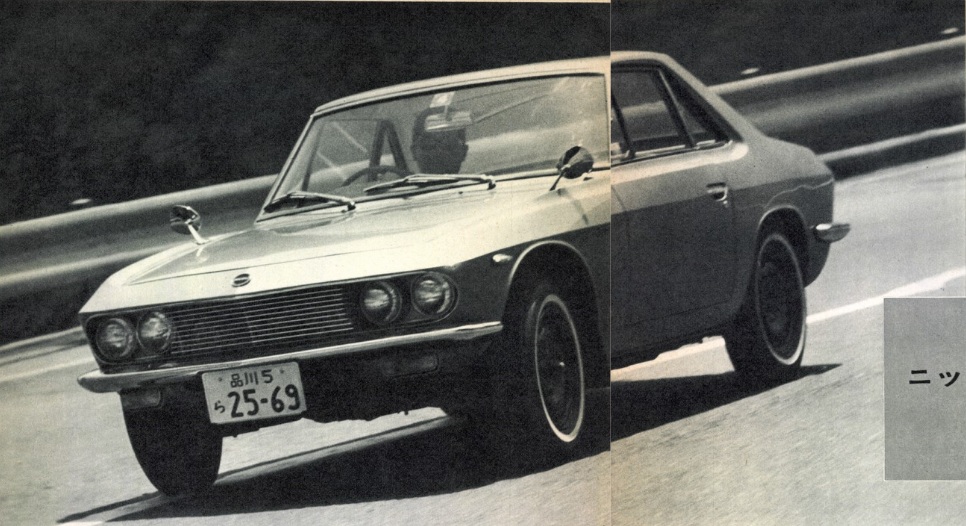
Publication: Auto Sport
Format: Road Test Report
Date: Summer 1965
Author: Hiroshi Hoshijima
Silvia’s Aim is to Be a “Beautiful Car”
I had the opportunity to drive a Silvia for five laps around the Yatabe high-speed test course, followed by touring from Tokyo to Kyoto and back. This is the first time that a license-plated Silvia has been driven such long distances.
Just as Nissan took the model name “Cedric” from the protagonist of “The Little Prince,” “Sylvia” is the name of a beautiful woman from Greek mythology. Schubert wrote a song called “To Sylvia,” and in Italy, this is a popular first name for girls.
The Silvia made its debut at the Tokyo Motor Show last fall as a two-seater coupe body mounted on a Fairlady chassis, upgraded with a 1600cc engine.
The production model was released in April with improvements to the clutch, transmission, brakes, and other components. The price is 1.2 million yen.
The aim of the design was to create a “beautiful car.” Essentially, the Fairlady’s structure was reused to create a two-seater coupe of reasonable dimensions. Since style without substance would be meaningless, the interior has been upgraded to a standard that will not embarrass the driver at the price. Likewise, if performance had been the only priority, the styling should have been designed for less air resistance, but since it is meant to be a luxurious personal car, it seems that visual balance and an intuitive aerodynamic style took priority. Of course, as a “100 mph” car, the issue of crosswind stability was also taken into consideration, and basic aerodynamic characteristics were thoroughly considered, such as not placing the wind force’s center point too far forward.
The angle of the windshield is considerably steeper than that of the Fairlady, which is to be expected since it was clearly meant to seat two people from the beginning, whereas the Fairlady was originally planned as a three-seater.
Super Short-Stroke Engine
The Silvia’s engine is a modified G-type engine used in the Fairlady and Cedric 1500. The bore has been enlarged by 7.2mm and the stroke has been shortened by 7.2mm to make it an ultra-short stroke engine with an 0.76 ratio. Some have reported that the 1500cc capacity has been increased only by enlarging the bore, but this is a mistake. As a result, the capacity has increased by 100cc. It seems that the aim is not to increase the piston speed even when the engine rotation speed is increased, and at the same time not to lose torque even at low rotations.
Carburetion is the same as the Fairlady, using twin side-mounted Hitachi variable-venturi type carburetors with a valve diameter of 38mm. Using a slightly larger one would be advantageous in terms of power, but this likely would have impaired low-speed performance.
The compression ratio is 9.0. The compression pressure is 12.7kg/cm² at 320rpm, and the maximum combustion pressure is 50kg/cm² at 4000rpm, the same as the Fairlady.
Output has increased to 90ps/6000rpm, and the maximum torque to 13.5kgm/4000rpm. The valve timing is the same as the Fairlady, but the ignition timing is slightly earlier at 16°/600rpm. The standard spark plug is B6E. The engine oil capacity has been increased by one liter to 4.1 liters.
The radiator has a larger frontal area to accommodate the increased power, and uses a 0.9kg/cm² high-pressure cooling system. It holds 8 liters, including a 1 liter auxiliary tank, allowing long periods without refilling. The boiling point has also been raised to 124°C by adding a high-pressure cap.
Porsche-Type Fully Synchronized Transmission
The clutch has been changed from the Fairlady’s coil spring type to a dish-shaped diaphragm spring. When the rotation speed increases, the coil spring type causes the clutch to float due to the centrifugal force, and its clamping force weakens, but the diaphragm type prevents this. It also has the advantage of making pedal operation easier and reducing wear imbalance, whereas with a coil spring the pedal forces increases in proportion to the amount of pressure applied. The surface area has also increased from 312cm² to 364cm².
The transmission is a 4-speed fully synchronized transmission. It uses technology borrowed from Porsche, specifically, a Volklink servo synchronizer system. The gear ratios are closer to the top in line with the increased engine capacity, at 3.382 (first) / 2.013 (second) / 1.312 (third) / 1.000 (fourth). The final gear ratio is 4.11, which is higher than the Fairlady’s 3.89, so acceleration performance is naturally better. A 3.89 differential is also available as an option.
Due to space limitations, we will not go into detail about this full synchro device here, but we will introduce its structure and operation in detail at a later date. Unlike the conventional cone clutch principle, the servo system uses an automatically controlled brake to synchronize the rotation of the coupling sleeve and the gear clutch. The gear teeth are subjected to less wear, and even if you push the shift lever hard from fairly high rpm, you can shift with an easy feeling, which is an attractive feature. This will be advantageous when competing in races where the slight difference in the time it takes to change gears can determine the outcome, or when tackling acceleration runs. The transmission is a 4-speed for now, but we can probably expect a 5-speed full synchro like Porsche fits to its own cars in the future. The durability of the differential has also been improved.
Excellent Ride Comfort
The front suspension is independent with coil springs, a stabilizer bar and double-acting shock absorbers. The rear suspension is a rigid axle with long-span leaf springs and double-acting shock absorbers, same as the Fairlady. In other words, it is a completely ordinary layout. But the Silvia seemed softer than the Fairlady when I drove it. When we returned to Tokyo, I inquired with the manufacturer about this, but they said there should be no difference. Comparing it to the Fairlady that accompanied us on the drive, I found that the Silvia did roll more in the same corners (which is natural due to the higher center of gravity), and that the springs felt softer. Generally, the Fairlady is too rough on the unpaved tracks in Shimizu and Toyohashi, so that I don’t feel like driving for long stretches, but in the Silvia it’s easy. If there really is no difference in the suspension, perhaps the seat cushioning is exceptionally good.
The seats are certainly excellent. Both the backrest and the cushion are thick and moderately soft, so I didn’t feel any discomfort even after driving for 10 hours a day. The interior is spacious, which is hard to imagine from such a low body, and the feeling of relaxation and the unexpectedly generous head clearance are also remarkable. The fore-and-aft travel of the seat adjustment measures 160mm. It is suitable for both long-legged people and people with short legs, like me. If you fix the seat according to the position of the pedals, you can change the angle of the backrest to stretch your arms out and hold the steering wheel like Stirling Moss, or drive sitting upright. The reclining mechanism has seven steps, and if you tilt it all the way back, you can stretch out and sleep. It is suitable for long-distance touring with a lot of freedom of choice. The angle can be adjusted freely by pulling the lever next to the seat, but if you need to raise it from a lower position suddenly, due to a deterioration in road conditions, for example, you can simply pull the backrest and it will return to your preferred position.
There is also a safety belt. However, the automatic retraction is a little inconvenient. If the belt retracts too far back, you have to open the door to get to it next time, so it would be better if it stopped right at the door.
There is a luggage shelf behind the seat, and it looks like you could fit another person back there in an emergency if they crouched. It makes you think that if the Silvia had been made into a full fastback style, it could have been a 2+2. In reality, however, it is not so easy to solve the problem of how to deal with the rear window, the need for more power to carry four people, the weight distribution, and so on.
Over 6000rpm is OK
The gauge cluster has a clock in its center. On the left is a speedometer reading up to 180km/h, with an odometer and trip counter. On the right is a tachometer reading up to 7000rpm; both it and the speedometer are large. Below the clock are the turn signal indicators. On the left end is the fuel gauge, and on the right is the water temperature. The whole cluster is covered by a deep hood, and the gauges are nicely arranged on the sophisticated black leather background. The fuel tank holds 43 liters, the same as the Fairlady. The optimum water temperature is 80-90°C, but during this drive it was often below 80°C, and it only showed the optimum temperature on Mt. Hiei. At any rate, there was no overheating even in the summer heat. It is a shame that an oil pressure gauge was not added, even though a warning light comes on if the oil pressure is too low or there is insufficient oil.
The tachometer has a yellow zone between 6000 and 6250rpm, and a red zone between 6250 and 7000rpm. The yellow zone means that while it’s OK to use the engine in this range, it’s not recommended to use it for too long, and the red zone shouldn’t be used at all except for momentary increases in rpm or in emergency situations. This display is very helpful. Of course, I didn’t use this end of the tachometer much, but it does seem that there is a high-frequency noise from the engine that sounds a bit like valve surge once it goes over 6300rpm. If I can be greedy, I think it would be even better if there were also markings at the lower end of the tachometer to tell me at what rpm I should downshift.
The chrome trim surrounding the gauges is a bit distracting. The tachometer is marked in 100rpm increments, and the speedometer in 2km/h increments, which is a bit too busy. Put another way, the glare from the chrome surround gets in the way when you try to read the finer details. Speaking of chrome, the panel in front of the passenger seat also has a horizontal chrome trim molding, which is unnecessary. A crash pad alone would be much better.
The wipers, lights, interior and map lights, windshield washer, cigarette lighter, and choke are all located on the center console panel. Below them is the radio. It’s well placed, but the design of the radio is not what you’d expect in an interior with such a high-end atmosphere. Instead, it honestly feels like whatever was available was just stuck into place. Sorry to nit-pick, but I also don’t like the lack of a power antenna and auto-tuner in such a luxurious car.
Wood-Rim Steering Wheel
There is a floor shift lever for the 4-speed transmission at the base of the console panel. I remember that the prototype had a wooden knob, but it seems that it was not adopted for the production car. The spherical knob is a bit too large to make a comfortable hand-hold. I think it would be better if it was more a cone shape, but it depends on your preference. The handbrake is well positioned.
The steering wheel is a Nardi type with a wooden rim and a horn button in the center. The cam and lever steering mechanism and gear ratio (14.8:1) are the same as the Fairlady, except for the post angle above the joint in the steering column. The steering feels softer than in the Fairlady, and the degree of understeer in turns is reduced. Impacts felt through the Silvia’s wheel seem less intense, which may be due to the difference in weight and its distribution.
The lever on the steering wheel’s right side operates the turn signals in the up-and-down direction, and the headlights forward-and-back. When the console light switch is raised to its first position, pushing this lever forward dims the headlights, and pulling it backwards turns on the parking lights. When the console switch is in the second position, pushing forward turns on the main beams, and pulling it backwards dims the headlights. If used properly, it can be effective as a flashing signal. The tumbler switch for the lights has a good action and feel.
The pedal layout is close to perfect. All three pedals are suspended, and the long accelerator pedal is what is called a heel-and-toe type. It requires skill to use this technique when braking for fast turns, and these pedals seem to be very well-suited to it. If I were to be greedy, I would like to see a foot rest for the left foot. When driving for a long time, it can be surprisingly tiring to have your left foot stretched out in a flat position and supporting it only with your heel.
The ashtray is behind the shift lever. Further behind is a raised console box. The lid doubles as the center armrest. However, if a passenger rests their arm on it, it seems like it might interfere with shifting. There is also a glove box in the panel in front of the passenger’s seat, but the lid is difficult to open because there is no finger-grip.
Ventilation and Rear Quarters
The wide front and rear windows and the curved glass on both sides provide excellent visibility, but ventilation is an issue.
The air that enters through the slits in the cowl top goes into a box under the dash and is led into the cabin through valves on the left and right sides below, but regardless of the mechanism, I would have liked the rear quarter glass to be able to be pushed open backwards. I think this would be much more effective than adjusting the side windows or the front triangular windows. It may be fine in the spring and fall, but it will be hot in the summer. Then again, people who buy cars like this probably aren’t burdened by the cost of installing an aftermarket air conditioner…
Due to the season, there was no chance to use the heater, but the defroster worked perfectly. The interior lamp turns on automatically when the door is opened, but can also be turned on with a switch on the console. Its lens can be turned in all directions so it doesn’t get in the way of the driver’s vision and is a useful map lamp for the navigator. It’s also very bright.
Acceleration That Won’t Be Threatened By the Fairlady
The best acceleration runs came from raising the engine to 3500-4000rpm and engaging the clutch, then shifting into second at 6000-6500pm, then third, and then top gear. Acceleration is excellent. No worries here about being outrun by the Fairlady.
The figures were 0-50m in 4.6 seconds, 0-100m in 7 seconds, 0-200m in 11 seconds, and 0-400m in 17.4 seconds. It took only 10.8 seconds to reach 100km/h. The speeds at 6000rpm in each gear were about 50, 80, 125, and 165km/h, respectively. I was able to reach 6200rpm in top gear. If I were driving alone, the 0-400m time could probably be reduced to 16.7 or 16.8 seconds. There was surprisingly little knock at slow speeds, and in top gear, the engine just managed to maintain 30km/h at about 1100rpm, and could maintain 40km/h without difficulty. On the Meishin Expressway, it took 6 seconds to go from 80km/h to 100km/h, 13 seconds to 120km/h, and 21 seconds to 140km/h. Acceleration is sufficient for overtaking. It feels like it has more than 90ps.
Great Road Grip
The Meishin Expressway has some steep uphill sections, but at 3600-3700rpm in top gear, which corresponds to a steady 100km/h, the engine is generating a torque of over 13kgm, so it’s very easy to maintain speed, and if you dip into the throttle, the car accelerates steadily. The most difficult curving stretch, the 260R stretch between Sekigahara and the Sekigahara tunnel, also showed unshakable roadholding at 120-130km/h. The accelerator pedal has little friction loss, and even when you use all of its travel, the operating force hardly increases, and it responds well.
On Mt. Hiei, with its succession of sharp turns, the full-synchro gear shift and responsive acceleration made the drive a pleasure.
Dunlop-Type Disc Brakes
The brakes are Dunlop-type discs up front and leading/trailing shoe drums at the rear. Recently, disc brakes have become widely adopted in domestic sports cars with engines of 1000cc or more. As we move into the age of high-speed driving, and the demands placed on brakes for sports driving become more severe, it is only natural that they are promoted as a selling point, but here I would like to explain why disc brakes are better than drum brakes.
With drum brakes, the force applied to the tip of the wheel by the wheel cylinder is increased by friction with the drum at the end, which increases the braking force–a self-servo effect, allowing a large braking effect to be obtained with a small pedal force. This is the greatest advantage, but on the other hand, the lining, which is made of organic material, is easily affected by heat. Moreover, it is not good at dissipating heat. In the end, the more frequently the brakes are used and the higher the temperature becomes, the greater the change in the coefficient of friction becomes, making the braking force unstable, and the phenomenon of fade more likely to occur.
In this respect, disc brakes have good heat dissipation and little fade because the discs rotate in contact with the air. At the same time, because they have no self-servo action, there is little difference in friction between the left and right wheels, and there is little risk of imbalance. However, the lack of self-servo action does have the disadvantage that the pedal force required to press the pads onto the discs is high, especially in larger cars, unless a power assist device is installed. Taking all of the above into consideration, the decision is often made to use discs on the front wheels, which have a higher brake distribution (typically 6:4), and drums on the rear wheels.
The Silvia’s brake pads are by Mintex and are about 10mm thick. The material is a resin mold of brass powder. As long as the car is not used in extreme conditions, these pads should last for 30,000 to 40,000km. There is no need for any fussy adjustments, so even a novice can replace the pads.
When the car was jacked up at the Nissan Tourist Service Center at Hakone Touge and the wheels were removed to examine the brakes, it was found that the rear drums were indeed too hot to touch with one’s hand, while the front discs were only slightly warmer than normal. After 20 minutes, the rear drums were still about 40°C, but the front discs were already cold.
To tell the truth, the reason we jacked the car up was because there was an unpleasant rumble under the floor, but it turned out that this was the sound of the exhaust pipe hitting the frame. There is a hole drilled in the X-member in the Silvia’s frame to allow the exhaust pipe to pass through it, but in the test car, the hole was too small. They filled it with asbestos to eliminate the sound. It was unclear whether this was just a problem with this individual car, or a design defect.
Gentle Exhaust Sound
I noticed that the interior noise level was rather loud when driving on the Yatabe test course, but less so on the Meishin Expressway. Looking back, I think it was because we were using BS racing tires at Yatabe. It was probably tread pattern noise unique to the racing tires.
When the windows are opened only a little, or even if they are completely closed, there is a fair bit of wind noise right by your ears, and the exhaust note is of course louder than that of a sedan, but it’s still pretty tame by sports car standards.
When I finished the touring test and was unloading my luggage, I noticed that the trunk lid opened by itself just by inserting the key and turning it 90 degrees, and I was surprised to see that the inside of the trunk was covered in the same quilted vinyl leather as the interior. This was an unexpected luxury. On the other hand, unloading a trunk filled with a lot of luggage can be troublesome. Is it a bit too much to ask that a trunk lamp be provided?
Refueling is done by opening the filler lid with a key. But, speaking of luxuries, if the lid could be opened from inside the car with a lever, like the engine hood, it would save having to hand the key over to the gas station attendant every time.
Fun Sports Touring
The course for the touring part of this test was from Tokyo, to Nagoya, Gifu Ogaki, Meishin Otsu, Mt. Hiei, Miya, Hamamatsu, and finally back to Tokyo. The total distance was 1,082km, with a total driving time of 19hrs 30min, at an average speed of 56km/h. We used high-octane gasoline, and the total consumption was 120 liters for the Silvia and 105 for the accompanying Fairlady. Average fuel consumption was 7.6km/l for the Silvia and 8.7km/l for the Fairlady.
If we limit this to the Meishin Expressway and Mt. Hiei hillclimb (excluding the Ogaki to Yoro route due to refueling, but including Miya to Nagoya), the total distance traveled was 265km. fuel economy on these stretches was 6.3km/l for the Silvia and 7.8km/l for the Fairlady, with an average speed of 72km/h. The catalog fuel economy is 15.5km/l, so on average on the Tokaido, the average distance traveled on one liter is about half the catalog value, and on the sports tour, it is only about 40%. On the other hand, if you can afford to spend this much on gasoline, you can have a very enjoyable drive.
As a car, the Silvia suits the high-class personal life of its intended audience of freelancers, entertainers, young executives, and so on. It’s also suitable as a car for participating in motorsports. And it is also a perfect car for enjoying sporty touring on your holidays.
One final point: Nissan’s pure sports car, the Fairlady, is also popular, especially overseas. I cannot help but think about how the Fairlady’s performance has suddenly lost its luster with the emergence of the Silvia. Even though it is 100cc smaller and significantly cheaper, it is not as interesting as a car that is 1.5 seconds slower to 400m and over 10km/h slower in top speed than its newer, fancier sibling. I would like to end this report by expressing my hope that the Silvia engine and transmission will be installed in the Fairlady as soon as possible.