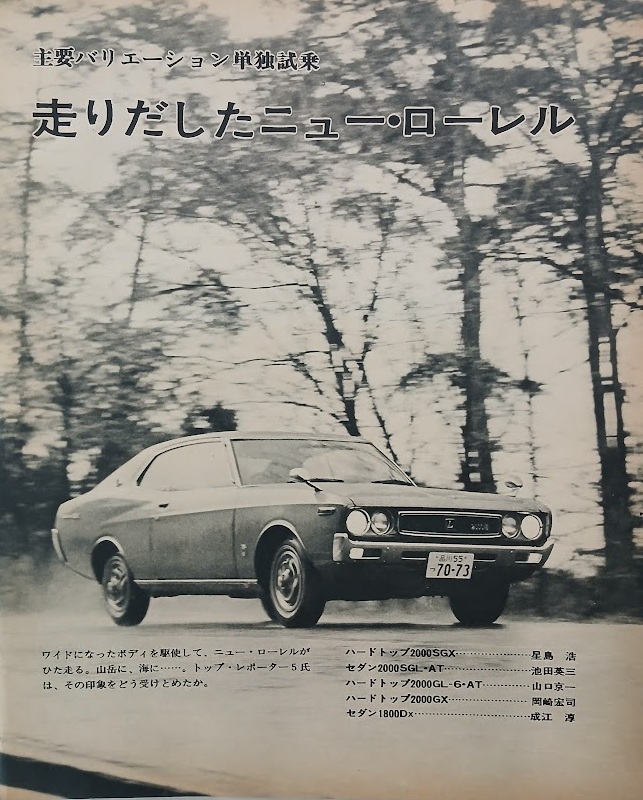
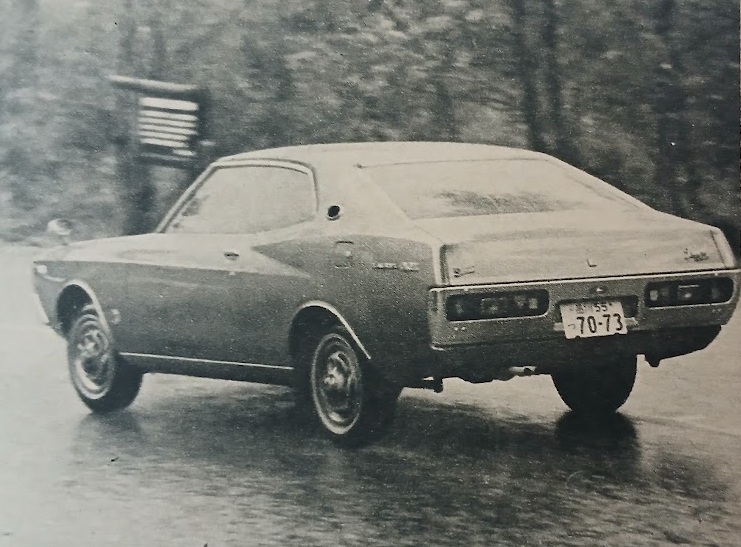
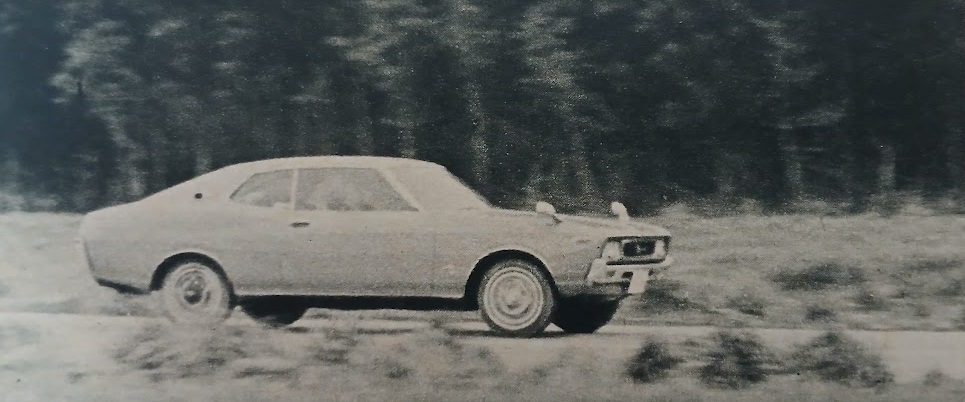
Nissan Laurel Hardtop 2000SGX (1972)
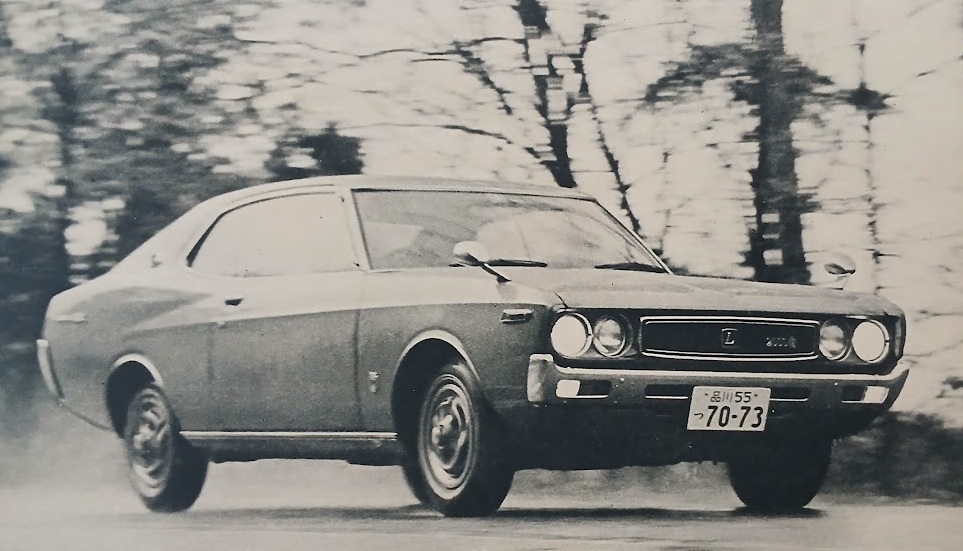
Publication: Motor Fan
Format: Test Drive Report
Date: June 1972
Author: Hiroshi Hoshijima
Not Quite the Car I Expected
Length, 4500mm (4420mm); width, 1680mm (1625mm); height, 1405mm (1390mm); wheelbase, 2670mm (2585mm); front/rear tread, 1350/1330mm (1360/1345mm).
These are the main dimensions of the new Laurel Hardtop SGX and one of its strongest rivals, the Toyota Mark II Hardtop L. (Figures in parentheses are for the Mark II.)
With the exception of tread width, the Laurel is larger in every dimension. The SGX I tested was equipped with Nissan’s six-cylinder L20 engine, but even the four-cylinder 1800cc Laurel Hardtop shares the same body and dimensions, differing only slightly in overall width at 1670mm. In general, the Laurel has become noticeably larger than the Mark II.
Judging by the numbers alone, it is even a size larger than the Skyline 2000GT sedan, despite using the same L20 engine.
Weight has increased accordingly. The SGX tips the scales at 1205kg unloaded, with 660kg on the front axle and 545kg on the rear. The Mark II Hardtop L, by comparison, weighs 1120kg, with 640kg on the front axle and 480kg on the rear. The new Laurel is more than 100kg heavier than the Skyline Hardtop 2000GT-X.
In other words, the new Laurel series has moved much closer to the Cedric and Gloria in both size and market position.
One suspects that Nissan intends for the Laurel to become its standard-bearer in the 2-liter class, while the Cedric and Gloria will eventually move further upmarket as 2600cc or even 3-liter cars once the expected changes to Japan’s tax structure come into effect.
The original Laurel was conceived before the Nissan-Prince merger was completed, and was developed as a senior brother to the upcoming-generation Bluebird, reaching production ahead of the Bluebird itself.
After the merger brought the Skyline series into the Nissan family, however, the Laurel was hastily fitted with Prince-derived G18 and G20 engines. The result was a car that found itself caught somewhere between the Bluebird and the Skyline, and never quite established a clear identity of its own.
What will happen when the Skyline undergoes its next model change remains to be seen. For the moment, however, the new Laurel’s place in the Nissan lineup has been clearly defined: a step above the Skyline, but below the Cedric and Gloria.
If I were responsible for Nissan’s product planning, however, I suspect I would be rather troubled by the question of what to do with the next Skyline series.
After all, Nissan’s lineup already stretches from the Cherry, Sunny, Bluebird, and Bluebird U through to the Cedric, Gloria, and President. Trying to position the Skyline somewhere within that range, using already-available components, would almost inevitably bring one right back to where the new Laurel stands now.
For that reason alone, the much-rumored new Skyline said to be arriving this autumn should prove extremely interesting.
To tell the truth, I was more than a little disappointed when I first saw the new Laurel.
As I have already suggested, given the need to define the next Skyline series, I had expected the Laurel to evolve into something very different–perhaps a true specialty car in the manner of the Celica, with styling bold enough to set it completely apart.
I imagined something aimed at buyers a little older than the Celica’s audience, yet still young at heart. A car available with either four- or six-cylinder 2-liter engines, perhaps even offering the powerplant from the 240Z. A genuinely sporting coupe, in a 2+2 or even a 2+3 configuration.
Indeed, I was so taken with the idea that I might well have bought such a car myself.
The reality was not what I had hoped for.
Questions About the Seat Belts
The engine is the familiar L20 unit–whether one chooses to describe it as the engine from the Skyline 2000GT-X or from the Gloria Hardtop GX is a matter of perspective.
The cylinder head is shared with the Gloria GX, while the cylinder block is from the Skyline 2000GT-X. In the end, components from both were combined, with only the oil pan being unique to the Laurel in order to suit its installation requirements.
Output is rated at 130ps/6000rpm, with maximum torque of 17.5kgm/4400rpm, on the required premium fuel. Carburetion is by twin Hitachi-built SU units.
The organ-type accelerator pedal feels somewhat heavy. Not only is pedal effort greater than expected, but the throttle response itself is surprisingly subdued.
The engine climbs smoothly to its torque peak at 4400rpm, but beyond that point it suddenly begins to feel lethargic. Past 5000rpm, mechanical noise–apparently from the valvetrain–begins to intrude.
Admittedly, the test car was still in new condition, and one hesitates to subject such a car to undue abuse. Even so, I never felt inclined to pull the engine all the way to its 6000rpm power peak.
In fact, I tried it only once.
When the Skyline 2000GT equipped with the L20 engine first appeared, I remember being genuinely impressed. Here, I thought, was an affordable sports sedan. Even with its single-carburetor 105ps specification, it was an exciting car.
Despite being very much a street version, that Skyline 2000GT would dispatch 0-400m in comfortably under 17 seconds, and run from 0-100km/h in well under 10 seconds. At the time, it left a tremendous impression on me.
A full four years have passed since then.
In that time, it seems we have become extremely demanding. The fact that a 130ps twin-carburetor OHC engine no longer excites us–or even fully satisfies us–says much about how our expectations have changed.
The test car was finished in a bright metallic green known as Laurel Green, with an olive-green interior.
At the launch presentation, I had already singled out this combination as the color scheme best suited to the Laurel Hardtop, so in that respect I was quite pleased. Another attractive choice is the gold metallic finish, while the light brown interior trim is also very appealing.
It is difficult to imagine any of these color combinations suiting the current Skyline Hardtop.
Whether one regards that as a virtue or a fault, does it not reveal something fundamental about the character of the new Laurel Hardtop? It is an interesting question.
The front seats incorporate integrated headrests. The lower portion of the seatback and the rear half of the cushion are trimmed in a stylish tricot cloth. Both width and length have been increased.
I would not go quite so far as agreeing with the catalog’s claims regarding lateral support, but the shape and firmness of the seats are fully satisfactory. The SGX also features an armrest cleverly integrated into the door panel, while map pockets are fitted to the backs of the front seats.
Rear-seat accommodation is generous as well. In particular, there is ample fore-and-aft room, allowing rear passengers to sit without worrying about their knees contacting the front seatbacks.
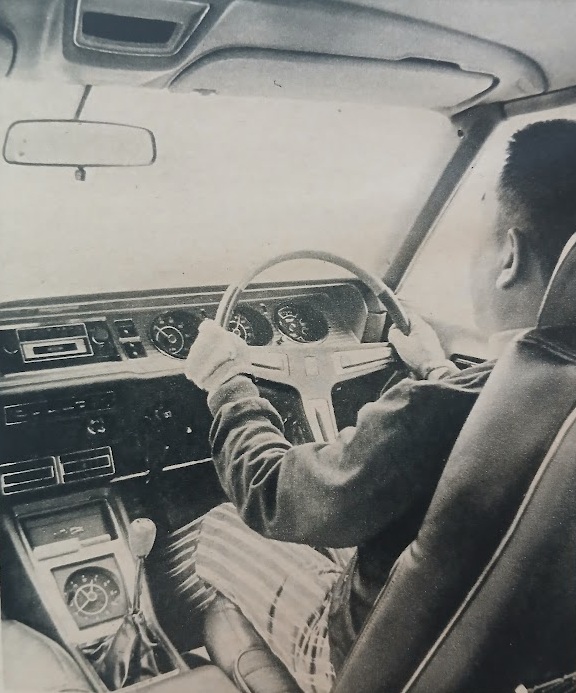
At first, I found the instrument panel’s angled layout somewhat unusual, but legibility is actually quite good.
The one exception is the clock after dark. Its illumination is dim, and the numerals, markings, and hands are all difficult to read. If an instrument cannot be checked with a quick glance, it becomes a safety issue.
After all, one well-known author is said to have been involved in an accident because his attention was diverted by the controls of an air conditioner.
The under-dash handbrake lever is less satisfactory. It uses a roller-lock, continuously adjustable mechanism, but the lever is so far away that operating it requires the driver to shift position awkwardly in the seat. Even releasing it fully requires a surprising amount of effort before the warning lamp goes out.
The truly serious flaw, however, is the seat belt.
The long protective boot covering the seat belt is a sensible idea, helping to keep the belt clean, and the automatic retractor and locking mechanism are not bad concepts in themselves.
The problem is that, while driving, the belt continually reels itself in. Each time it does so, it locks tighter, eventually becoming uncomfortably restrictive. Drawing the belt out from its boot requires sensitivity as well—unless it is pulled very gently, the mechanism locks immediately. Stop the motion halfway and it locks there too.
This is an area that clearly requires further development.
Visibility, ventilation, and heater performance all earn passing marks. The bi-level heating system, which promises the ideal combination of a cool head and warm feet, is less effective than I had expected.
On the SGX, all four side windows are power-operated. I found myself momentarily confused each time I used the switches, perhaps because their operation seemed contrary to instinct, but this is undoubtedly the sort of thing one quickly becomes accustomed to.
The clutch pedal is on the light side. Its travel is fairly long, and depressing it fully requires a conscious follow-through with the heel, but there is nothing particularly awkward about it.
Like the Skyline 2000GT-X, the SGX offers a 5-speed transmission as an optional extra.
So equipped, at an additional cost of 20,000 yen, the test car carried a rather substantial Tokyo showroom price of 1.05 million yen.
The gearbox uses Nissan’s familiar servo-type synchronizers, a design that has by now become something of a Nissan trademark. Considering the rotational inertia involved, the synchronizing action is remarkably effective.
Impressive Brakes
The gear ratios are: 3.321 (first) / 2.077 (second) / 1.308 (third) / 1.000 (fourth) / 0.864 (fifth), with a final-drive ratio of 4.111.
The Skyline 2000GT-X uses the same transmission, but with a 3.900 final drive. On the new Laurel, the 4-speed transmission is paired with a 3.900 final drive, while the five-speed receives the 4.111 unit.
As a result, the overall reduction ratios are 3.900 in fourth gear for the 4-speed; and 4.111 in fourth gear, or 3.555 in fifth, for the 5-speed.
In the GT-X, the corresponding figures are 3.900 and 3.370.
The problem is that the ratios of fourth and fifth are simply too close together.
Within the normal cruising range of 60-100km/h, engine speed does not drop very much when shifting into fifth. Conversely, shifting down does not provide a particularly meaningful increase in driving force either. At the rear wheels, the difference amounts to perhaps an additional 30kgf.
In practical terms, this means the 5-speed contributes little to fuel economy. While engine speed falls slightly and the engine becomes marginally quieter, the increase in gear noise largely offsets the benefit. The result is only a modest improvement in cruising refinement.
Nor does the gearbox offer much advantage for engine braking. If strong engine braking is required while cruising in fifth, one is likely to skip fourth altogether and shift directly into third.
Considering all of this, the 5-speed is not nearly as compelling an option as enthusiasts might initially imagine.
The steering has abandoned the rack-and-pinion system of the previous Laurel in favor of a recirculating ball-and-nut design.
With it has gone one of the old Laurel’s defining characteristics: the unusually light steering effort when maneuvering at low speeds. If the previous Laurel required no more effort than a Sunny, the new Laurel is much closer to the Skyline 2000GT. I would not say steering effort has doubled, but it has certainly increased by roughly half again. From lock to lock, the wheel takes exactly four turns. Compared with the Mark II’s heavier steering and 4.5 turns lock-to-lock, however, it is both lighter and easier to operate.
The wood-rim steering wheel with its partial leather covering is undeniably attractive.
The day of the test brought poor weather and wet roads, so comparing the new Laurel directly with other cars under such conditions may be somewhat unfair. Even so, on winding roads around Narita and Mount Tsukuba, the limitations of the tires were impossible to ignore.
The speeds involved were hardly outrageous, yet the front tires would begin to scrub and slide almost immediately upon entering a corner. Apply power and the rear tires would break away with surprising ease–enough to make one sit up suddenly. I could not believe my driving skills had deteriorated so dramatically overnight…
The car simply deserves better tires.
Even if that were to make the steering somewhat heavier, it would be a price worth paying. Considering the vehicle’s weight and the amount of driving force delivered to the rear wheels, the standard 6.45S-14 tires are simply out of their depth.
What impressed me, on the other hand, was the effectiveness of the brakes and the car’s ability over rough roads.
The Skyline 2000GT has excellent brakes already, and the new Laurel is every bit its equal. They inspire confidence from the first application and can be relied upon completely.
I have a particular rough-road test route where I habitually evaluate different cars. Most recently, I had driven the Mark II GSS, the Capella GS II, and now the new Laurel over the same section.
At 40km/h, 60km/h, and then 80km/h, the comparison became revealing. To be perfectly honest, the Laurel Hardtop SGX was the only one of the three that could exceed 80km/h without all four tires losing their grip on the surface.
One can say without hesitation that the suspension layout–and, more importantly, the tuning of the springs and dampers–is exceptionally well judged.
It is neither too stiff nor too soft. The balance is remarkably well chosen.
Setting aside the smaller details, I later found myself thinking that this would be a truly excellent car if only given tires with greater stiffness. As I mentally sorted through the points that had disappointed me, a television commercial happened to come on.
It was that familiar slogan:
“Let’s drive slowly. Let’s live slowly."
The timing was so ironic that all I could do was smile.
Postscript: Story Photos