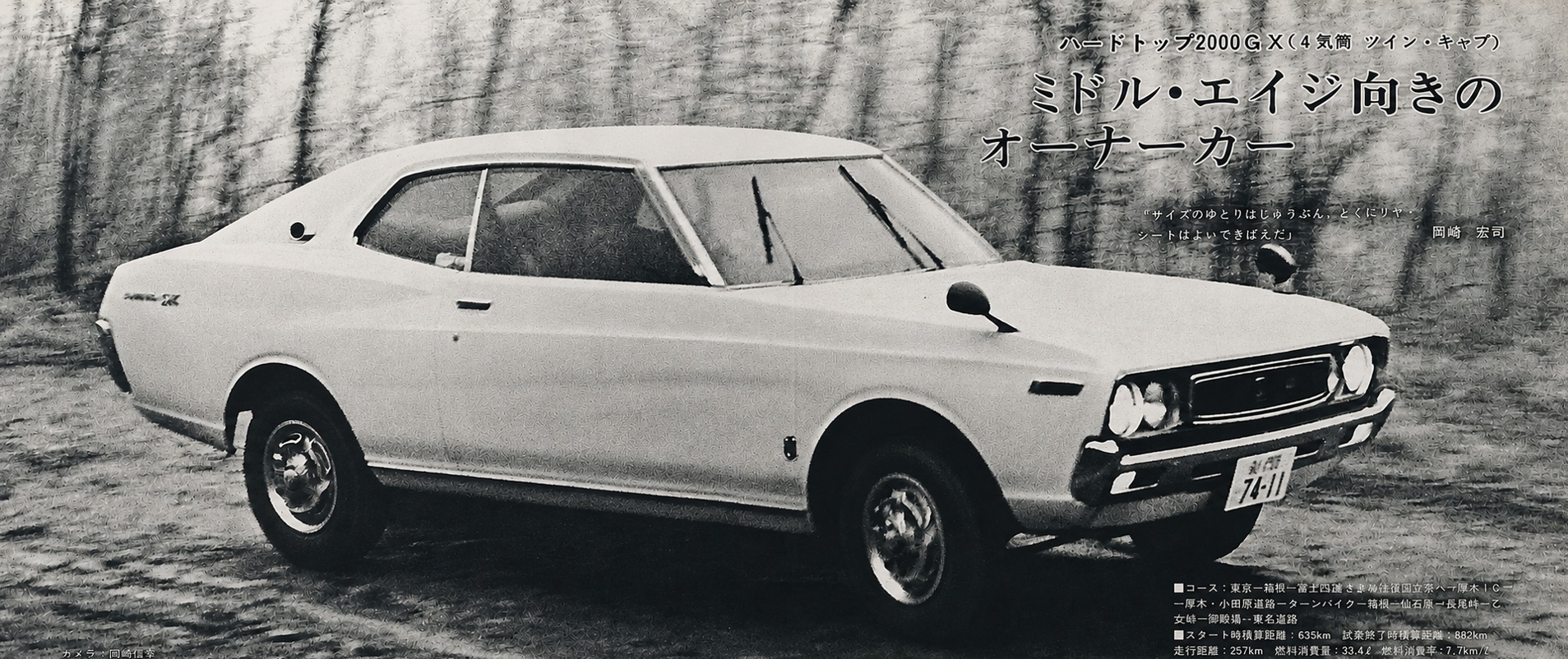
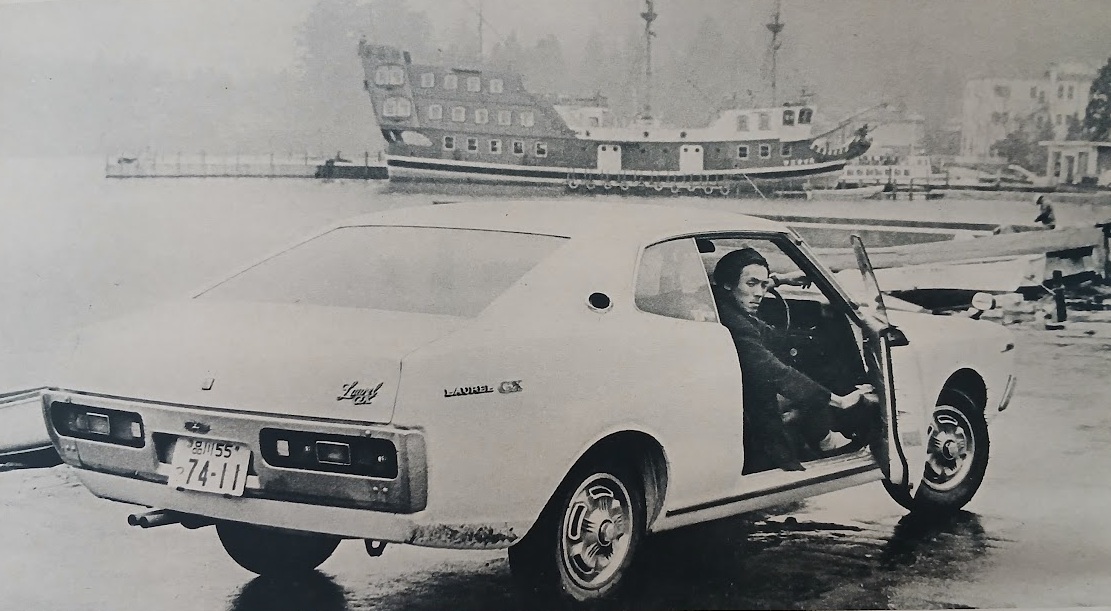
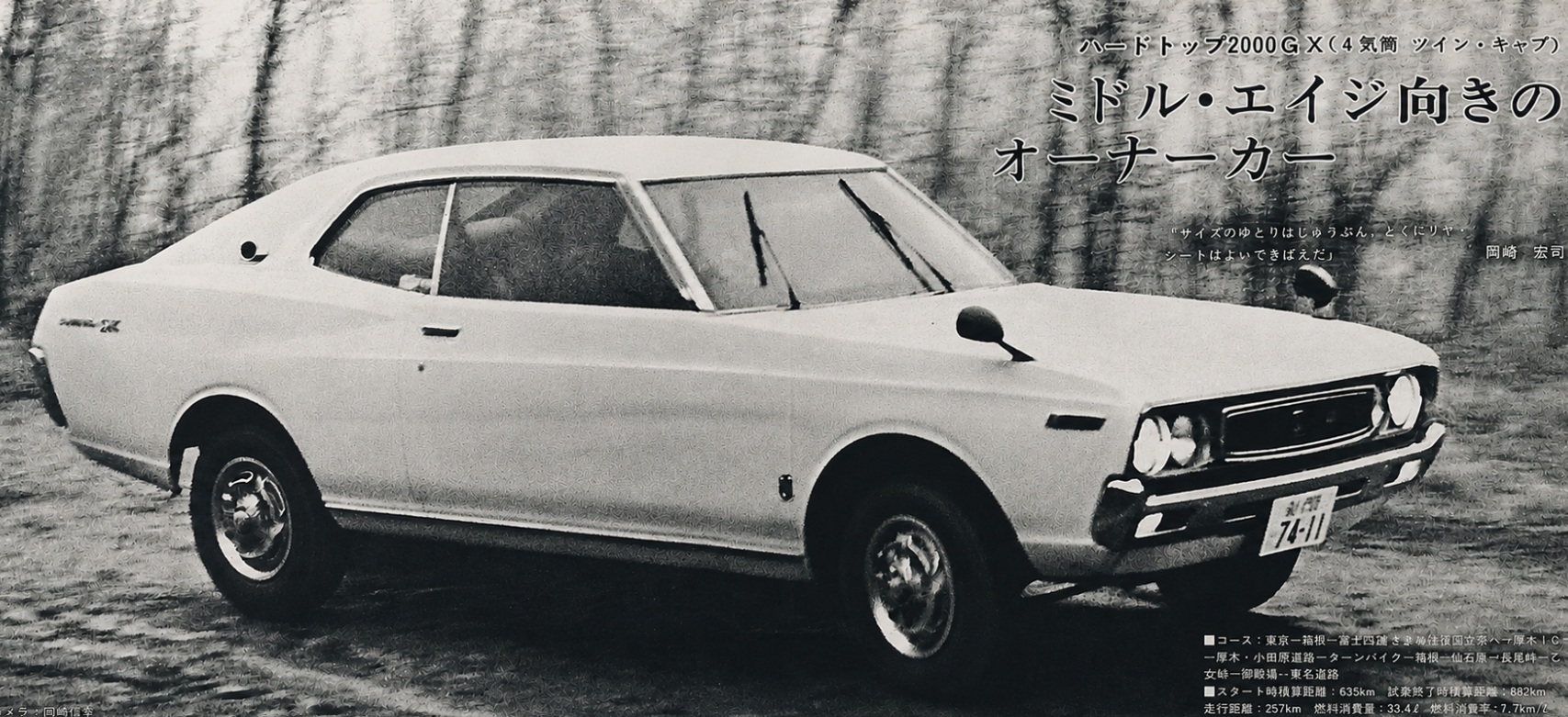
Nissan Laurel Hardtop 2000GX (1972)
Publication: Motor Fan
Format: Test Drive Report
Date: June 1972
Author: Hiroshi Okazaki
An Owner’s Car for the Middle Aged
This is a big car. Compared with the previous Laurel, overall length has increased by 170mm, width by 65mm, and height by 25mm. Even alongside cars in the Cedric class, it gives away very little in terms of size.
Naturally, the interior benefits as well.
Spacious accommodation had always been one of the Laurel Hardtop’s defining virtues, and the new model takes this even further.
The 170mm increase in overall length has been largely consumed by the installation of Nissan’s six-cylinder L-series engine, which is approximately 220mm longer than the four-cylinder G-series unit. As a result, interior length has increased only slightly compared with the previous model. Interior width, however, is another matter. Roughly 70% of the added 65mm of body width translates into additional cabin width, giving the interior a noticeably greater sense of space.
Width has a tremendous influence on comfort. In particular, it contributes greatly to the subjective feeling of spaciousness.
Even those accustomed to cars in the Cedric class should find the Laurel’s interior entirely satisfactory, both in measurable terms and in the overall sense of roominess it conveys.
The front and rear seats are well executed, as well. They are not especially soft, but are well matched to the suspension and provide a comfortable seating position.
They are also generously proportioned, as one would expect in a high-grade owner’s car. The rear seat, in particular, is exceptionally well done.
Its “high-back” seatback extends well above shoulder height and is reclined at a comfortable angle. One can rest one’s head against it and relax completely.
Even with three adults aboard, neither hip room nor shoulder room feels inadequate. That said, while the rear seat is nominally designed for three passengers, its shape clearly favors the two outboard occupants, so the person in the center does not enjoy the same level of comfort or support.
Headroom is generous as well. Indeed, rear-seat accommodation differs little from that of a sedan.
Access to the rear seat presents no difficulty for passengers of average build, and the lever mounted on the side of the passenger-seat backrest to fold the seat forward is a thoughtful touch.
A walk-in mechanism would make it better still, however…
Functional Instrumentation
The only aspect of the rear cabin that did not impress me was the rather flimsy armrest. Had more attention been paid to its design and functionality, the rear seat could have been made even more comfortable.
The driving position is not what one would call sporting, but it suits the Laurel’s basic character as a car intended for middle-aged owners perfectly. It also fits neatly with the car’s advertising slogan: “Let’s drive slowly.”
Drivers who prefer a steeply reclined seatback and a long-legged, arms-outstretched driving position may find the relationship between the seat, pedals, and steering wheel somewhat unsatisfactory. Those who prefer to sit closer to the wheel with the seatback only moderately reclined–a position that probably represents the average driver–should have no difficulty finding a comfortable driving position.
This does not mean the Laurel is unsuited to fast driving on winding roads. The seat offers ample adjustment through its finely graduated slide and recline mechanisms, and with a little experimentation it is possible to find a position suitable for fairly spirited driving as well.
The placement and operation of the controls leave little to criticize. The wiper/washer and lighting controls grouped around the steering column are particularly easy to use.
The wipers are of the intermittent type and offer four operating modes. The first intermittent setting produces a sweep approximately every eight seconds, while the second reduces the interval to roughly three seconds.
In light rain or on damp roads after a shower, this intermittent operation proves genuinely useful. The rigidity of the wiper arms and the fit of the blades are both excellent, allowing them to operate quietly and smoothly. Good wiper performance may seem like a small thing, but it can make driving in bad weather considerably less fatiguing. They remain effective even at high speeds.
As for the instrument panel design, judgments are inevitably influenced by personal taste, so I will limit myself to saying that, in my view, the Laurel’s panel is both functionally well organized and sufficiently luxurious in appearance.
One detail did bother me, however: the red indicator lamp for the rear-window defogger is rather distracting.
The Hardtop 2000GX is equipped as standard with three-point front seat belts with automatic retractors. As a result, the belt stores neatly on the door side, but no provision has been made for stowing the lower portion of the belt.
The retractor itself uses a ratchet mechanism. To pull the belt out successfully, it must be drawn in one smooth motion. If it is allowed to retract even slightly partway through, the mechanism locks and the belt must be fully returned before it can be pulled out again.
There is also a tendency for the belt to ride across the abdomen rather than the hips.
There is no question that seat belts are valuable safety devices, but unless they are easy to fasten and comfortable to wear, few drivers will make a habit of using them.
Manufacturers often complain that, “Even when seat belts are fitted, owners don’t use them.” But the first priority should be providing belts that can be fastened quickly and comfortably in a single movement.
In that respect, most domestic seat belts now on the market must be judged a failure.
Rather than complaining that drivers “won’t use them,” I would prefer to see manufacturers devote more effort toward creating belts that people want to use.
The engine is fundamentally the same as that used in the previous GX, though a number of detail changes have been made to improve packaging, address emissions requirements, and increase parts commonality with the G18 engine.
Lower Gearing Brings a More Powerful Feel
Displacement remains 1990cc. Equipped with twin SU carburetors, the engine produces 125ps/5800rpm and a maximum torque of 17.5kgm/3600rpm in high-octane specification.
This is a highly flexible engine, capable of delivering useful torque across a broad operating range. From the standpoint of everyday usability, there is very little to criticize.
Compared with the previous version, the camshaft timing has been revised slightly, with a wider operating angle and increased valve overlap (shared with the G18 engine). Even so, I found no evidence that low-speed tractability had suffered as a result–though the revised gearing may also play a part in that impression.
At the same time, the engine seems to have gained a touch more sharpness at higher speeds.
I drove two different examples of the 2000GX, and the engines left quite different impressions. The first felt rather coarse in the upper rev range, with noticeably high levels of vibration and noise. It hardly encouraged one to extend it beyond 5000rpm. The second car, however, pulled relatively smoothly all the way to the beginning of the yellow zone at 5800rpm.
The most likely explanation is that the first car was simply out of tune.
Even so, smoothness above 5000rpm is not exceptional by any standard, and noise increases considerably as the revs climb.
In terms of performance, however, the car provides all one could reasonably ask of a sporting model.
Although the new Hardtop 2000GX weighs roughly 120kg more than its predecessor, the lower gearing gives it a distinctly more powerful character in everyday driving.
The previous Laurel employed unusually tall gearing by Japanese standards. While that appealed to a certain type of enthusiast, many drivers felt that the car responded sluggishly to the throttle and seemed somewhat lacking in power.
The new Laurel, by contrast, uses gear ratios much closer to the domestic norm, with the result that virtually any driver can appreciate the full effect of its 125ps.
In the previous model, the maximum speeds attainable in first, second, and third gear were approximately 60km/h, 90km/h, and 130km/h respectively. In the new GX, those figures are roughly 45km/h, 78km/h, and 117km/h.
Naturally, the sensation of acceleration is improved, and practical performance benefits as well.
These ratios–including the final drive–are identical to those of the Skyline GT. Given Japanese road conditions, the experience level of the average driver, and the character of the Laurel itself, I would say they represent a clear improvement over the gearing used in the previous model.
A Need to Reconsider Straight-Line Stability
The suspension is independent at all four wheels, consisting of MacPherson struts at the front and semi-trailing arms at the rear. Combined with the long 2670mm wheelbase–comparable to that of cars in the Cedric class–the result is an exceptionally comfortable ride.
I conducted the test with the tires inflated to the recommended high-speed pressures of 1.9kg/cm² front and 2.0kg/cm² rear, and the ride was nothing short of excellent.
The car’s ability to cope with rough roads is impressive. The generous suspension travel smooths out broken surfaces with ease. The balance between the front and rear suspension settings also appears to be very well judged. Even when speed is increased over poor roads, there is remarkably little of the unpleasant pitching or heaving that often accompanies such conditions.
Road noise, too, has been very effectively suppressed.
The steering has changed from the previous rack-and-pinion type to a recirculating-ball system. The ratio is 19.8:1, and the wheel requires four turns from lock to lock. Although that sounds rather slow, the initial response is reasonably good, so in ordinary driving it rarely becomes a concern.
When driving briskly on winding roads filled with successive hairpins, however, the steering inevitably begins to feel rather busy.
Steering effort from low to medium speeds is appropriately weighted, inspiring confidence even during abrupt inputs. At higher speeds, however, a little more steering weight would be preferable.
With only two occupants in the front seats, the handling balance can best be described as showing a moderate degree of understeer. My impression, however, is that the understeer is less pronounced than it was in the previous Laurel.
Once four people are aboard and additional weight is placed over the rear wheels, the understeer diminishes further.
That, in itself, is not a bad thing. The problem is that straight-line stability deteriorates at the same time.
This is one of the characteristics often associated with semi-trailing-arm rear suspension, and in the Laurel the effect is quite pronounced. Even the slightest steering input produces a subtle change in direction. In other words, the steering becomes almost too responsive.
As an experiment, I asked a young woman with two years of driving experience—who happened to own a Skyline GT—to drive the car. She too found it difficult to maintain a steady course. The car tended to wander.
She also drove it on the expressway. Conditions were somewhat windy, but her reaction was immediate: “It wanders around and makes me nervous. My shoulders are getting tired.” Before long she was eager to relinquish the wheel.
With only the front seats occupied, straight-line stability is reasonably good. Once additional load is placed over the rear axle, however, it becomes noticeably worse.
Because straight-line stability is one of the aspects of handling most directly related to safety, I would very much like to see this area reconsidered.
Another point worth mentioning is the lingering body-roll motion that becomes apparent during slalom driving.
That said, the Laurel still scores highly overall. Changes in steering behavior under power-on and power-off conditions are minimal, and its breakaway characteristics are not the type that are likely to catch a driver out unexpectedly.
The brakes are a servo-assisted disc-and-drum system. Pedal effort is light enough to be comfortable yet firm enough to permit easy modulation. The pedal feel is somewhat spongy, but under normal driving conditions braking performance is entirely adequate.
Even so, I would welcome a little more stopping power, and when the car is driven hard, its fade resistance leaves something to be desired.
Fundamentally, the Laurel is a car aimed at middle-aged owners. At the same time, its breadth of character is sufficient to satisfy younger drivers looking for something more enjoyable.
Among the Laurel range, the 2000GX may well be the model with the most youthful personality of all.
Postscript: Story Photos