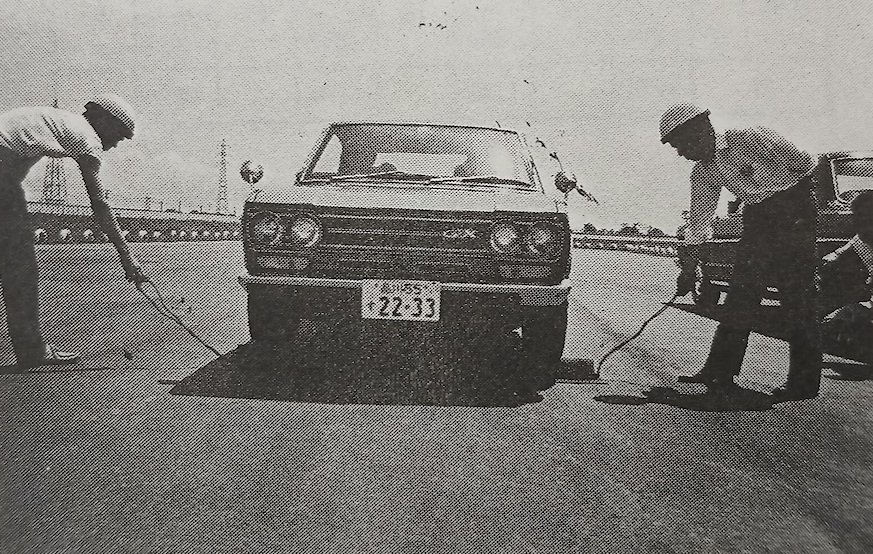
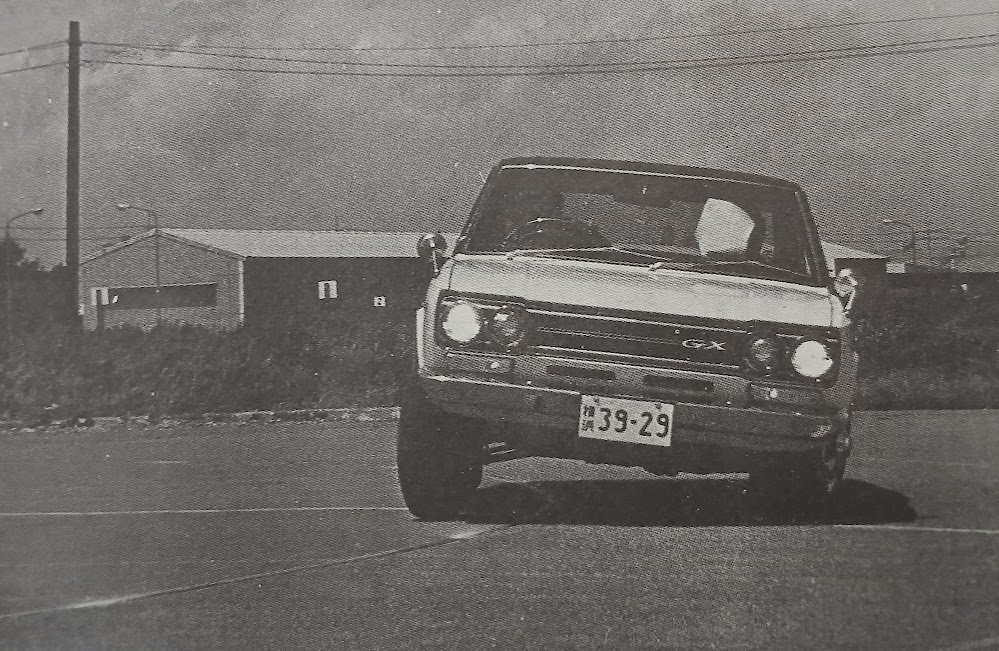
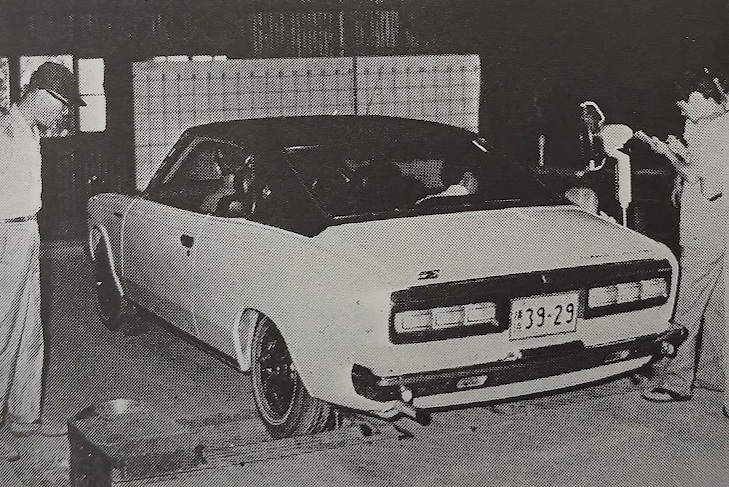
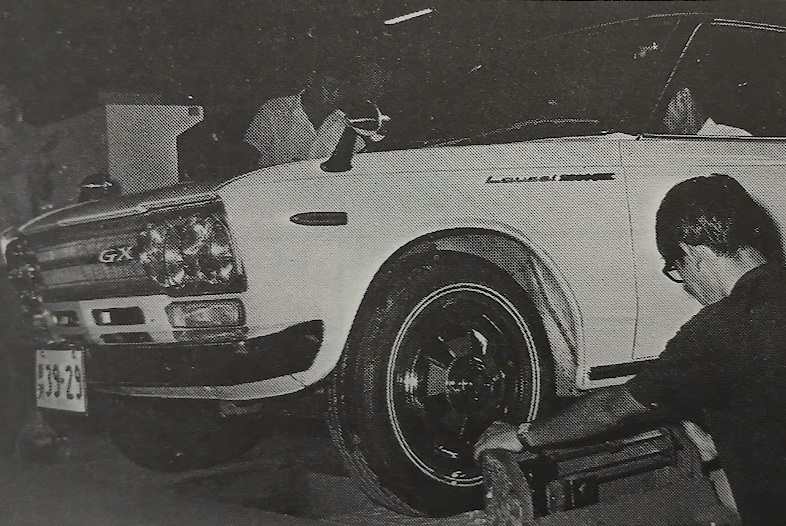
Nissan Laurel Hardtop 2000GX (1971)
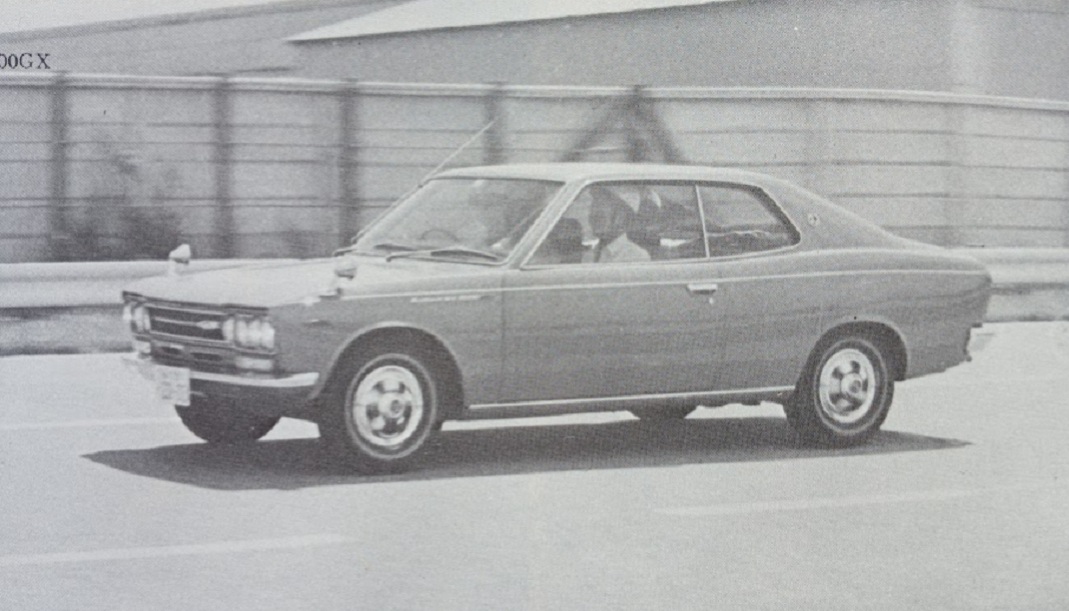
Publication: Motor Fan
Format: Road Test Summary
Date: 1971 (Motor Fan Road Test Digest Annual)
Author: Motor Fan Editorial Staff (uncredited)
Nissan Laurel Hardtop 2000GX Model Overview
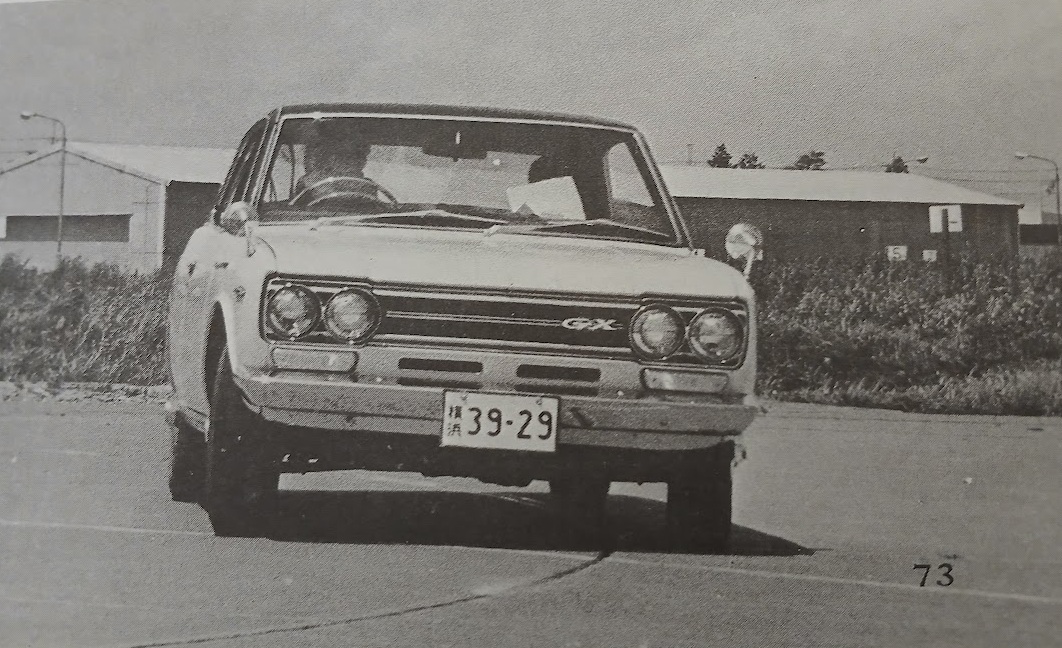
The Laurel sedan was released with styling based on straight lines and flat surfaces, reminiscent of the Bluebird, but it has since been upgraded with a hardtop body style that could be said to have pioneered the specialty-car genre in Japan.
The rear window is steeply raked, descending horizontally from top to bottom and cut at an acute angle where it meets the roof. Combined with the slightly higher waistline at the rear, the overall shape is reminiscent of a triangle sloping downwards at the front, giving the hardtop a sharp image of speed.
It is said to be aimed at high-class private owners, which can be interpreted to mean that it is designed to be enjoyed by middle-aged gentlemen in both formal and casual driving situations. However, the powerful 2000cc engine will make it attractive to sporty young people as well. It seems to be a car that attempts to appeal to everyone.
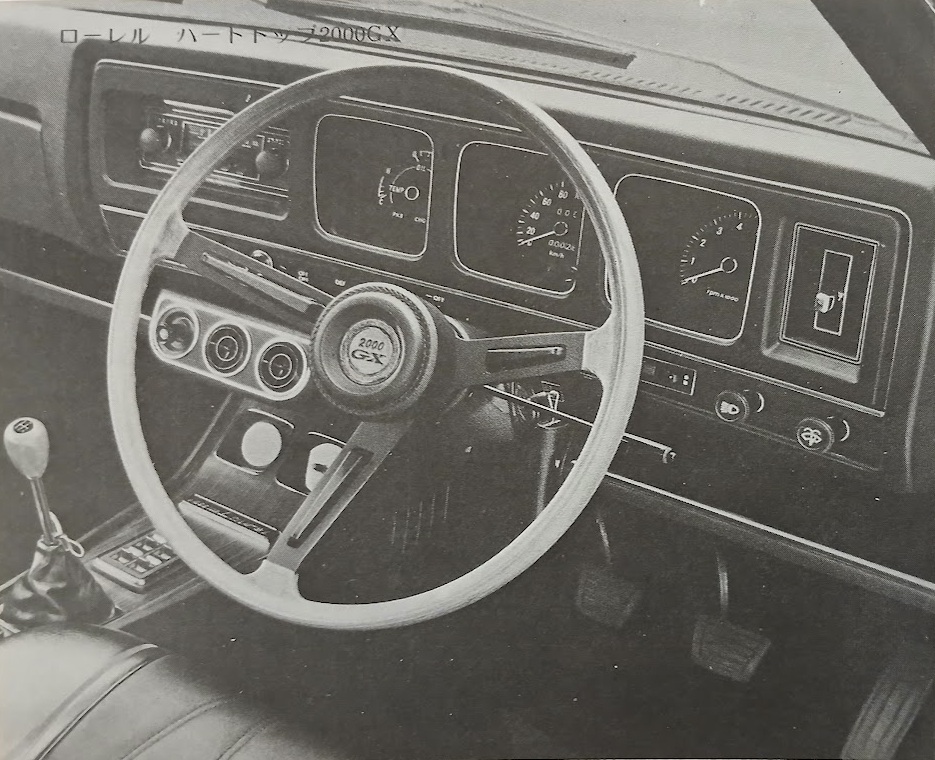
The instrument panel is gently angled around the driver, focusing the gauges and warning lamps towards the driver’s viewpoint, and together with the non-reflective lenses, this reduces driver fatigue. The switches and knobs are also labeled with pictograms, and at night the labels are highlighted in light green using a fiberscope to prevent erroneous operation. The steering wheel is a deep dish, three-spoke sporty type with a crash pad in the center.
The seats are thick, soft, and comfortable, but the driver’s seat is mounted somewhat high, and some people find its position relative to the pedals unsatisfactory (this height is fine for the front passenger and the rear seats). The suspended accelerator pedal is wide, long, and easy to press, just like an organ-type pedal.
In addition, while two-door cars often make it difficult to get in and out of the back seat, the Laurel’s doors have been made as large as possible, and there is no center pillar, making ingress and egress very easy.
The engine is a SOHC cross-flow engine originally based on the 1500cc unit in the Skyline, which was first scaled up to 1800cc, and then bored out further to 2000cc. The twin SU-type carburetors, hemispherical combustion chamber with V-shaped valve arrangement, narrow-angle camshaft, and large flywheel mass all contribute to flat torque characteristics and a maximum torque of 17.5kgm/3600rpm, while at the same time achieving a maximum output of 125ps/5800rpm. The weight of the engine is light at 146kg, almost the same as that of a 1500cc class engine, due to the aluminum head, thin-walled cast block, and the fact that the base engine was in fact 1500cc.
The suspension is a four-wheel independent layout that has been proven on Nissan’s pride and joy, the Bluebird and Skyline GT series. The MacPherson strut system at the front has high roll rigidity and good road contact, and since the support points on the body are widely distributed, alignment problems are unlikely to occur. In addition, the system itself has high rigidity because the loads in the vertical, horizontal, and longitudinal directions are supported by separate arms and struts. This type has become more common in recent times because it is easy to package and uses a smaller number of parts.
The rear suspension is a semi-trailing arm type that is functionally somewhere between a swing axle and a trailing arm layout, minimizing the jacking phenomenon and camber change, and improving road contact. The driveshaft mechanism uses ball splines rather than conventional splines, allowing it to operate more smoothly when drive force is applied.
The steering is a rack-and-pinion type, a first for Nissan, but it doesn’t seem to be very sharp.
The body structure is a unit body, and since the hardtop has no center pillar, the front pillars and roof steel are made thicker to create a rigid cabin structure, while the rigidity of the engine bay and trunk are intentionally reduced to create energy-absorbing crumple zones in the event of a collision.
The brakes are Arnett-type discs at the front and leading-trailing drums at the rear.
Manufacturer’s Development Intention
“This new model was developed in response to the growing demand for hardtops, and with the aim of expanding the Laurel’s market share. There are four areas that made up the key focus points when developing this car.
The first is related to the appealing style and usability of the hardtop, such as the large doors and the lack of triangular vent windows.
Secondly, because it is a specialty car, the equipment was enhanced. The engine, which had previously been 1800cc, has been enlarged to 2000cc, and the interior has been given a luxurious atmosphere with a console, power windows, etc.
The third is the issue of body strength, which applies to any hardtop with no center pillar. The strength of the greenhouse section from the front pillar through the roof to the rear quarter pillar was almost doubled, and the door hinge attachment points were also strengthened to make them more secure.
Finally, fourth, as much attention as possible was given to safety, including the fitment of front disc brakes, a collapsible steering column, and pollution control measures.”
Nissan Laurel Hardtop 2000GX Test Drive
This hardtop was developed based on the “high-end private owner’s car,” the Laurel 1800 sedan, but the only part of the exterior that retains the sedan’s image is the front end. Elsewhere, it has been given a sleek and elegant styling treatment that completely overturns the plain image of the sedan.
However, while it is sleek, it does not come off as too flashy, which shows that, like the sedan, it is meant to appeal to middle-aged and older people more than younger people.
The interior is also luxuriously finished, and the design gives a strong impression of emphasizing calm. Once inside the car, you can sense a feeling of comfort and serenity, even with the novelty of the pillar-free hardtop and resulting wide visibility.
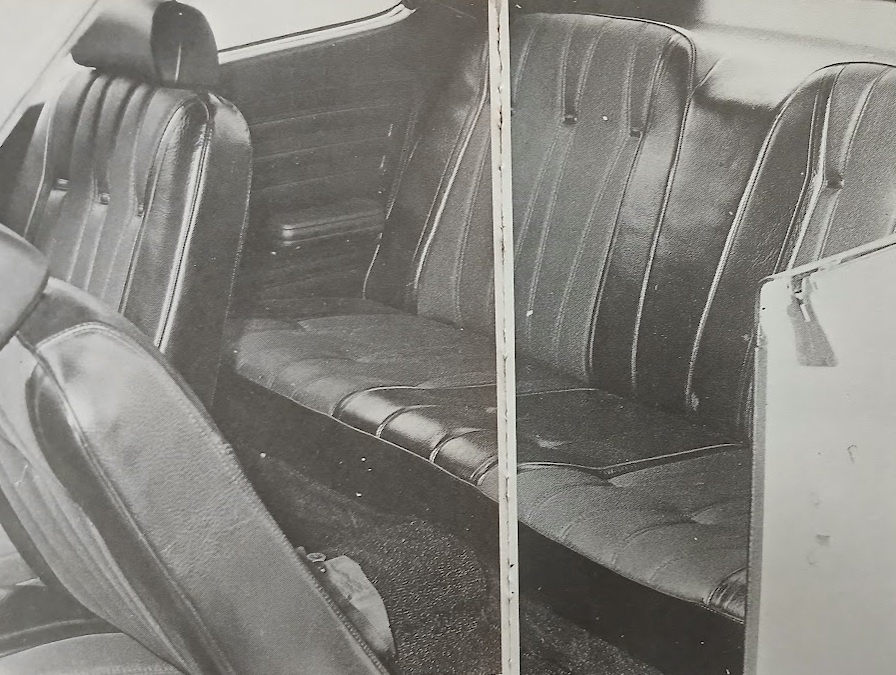
The door openings are so wide that if you adjust the front seats for a driver of average height, you can step into the back seats without even folding the front seatbacks forward. Of course, that’s only if you’re very slim.
There are no major problems with the driving position, but the steering wheel is too high and the wheel diameter is too large, which seems to spoil the sporty feeling.
A common concern with hardtops is whether there will be enough space in the back seat, but in the Laurel’s case, there’s nothing to complain about. There are no protruding wheel wells, and there is plenty of foot space. In fact, except for the absence of rear doors, there is almost no difference in practicality compared to the sedan. The seat itself has tall backrests that come up to shoulder height, which allow you to relax comfortably.
The trunk is also very spacious, undoubtedly one of the largest in the class. However, it is unfortunate that the opening is rather small and that its lower edge is high, making it difficult to load and unload luggage, particularly if the items are bulky or heavy.
The GX’s engine is a powerful 1990cc OHC inline-Four with a maximum output of 125ps/5800rpm and a maximum torque of 17.5kgm/3600rpm. This output is comparable to that of the six-cylinder Cedric GX and Crown SL, but as you might expect, because it is a four-cylinder engine, it is inferior to those two cars in terms of smoothness and quietness.
Generally speaking, engines with SU twin-carburetor setups are associated with the image of making peak power at high speeds, but the engine of this GX is tuned to emphasize low and medium-speed operation. Although the response at high rpm is a little lacking in sharpness, that doesn’t mean that it lacks the ability to run at high speeds. The Laurel GX has enough power to run at any pace the driver desires, whether in the city or on the highway.
However, the gear ratios of this car are generally quite tall compared to the gear ratios of the typical domestically-produced car, so in order to make the most of the 125ps output, it is necessary to push the revs quite high in each gear before upshifting.
If a driver starts off and quickly puts the car in top gear, and then, once in top, tries to avoid downshifting as much as possible, they will surely get the impression that the car lacks power.
Acceleration in top gear improves from around 50km/h, and in third gear from around 40km/h, so the best way to make use of the Laurel GX’s capabilities is to use third gear mainly when driving in urban areas, and to shift down to second when overtaking.
On the other hand, the tall gear ratios are perfect for cruising and overtaking on the highway. Cruising at 100km/h on the highway corresponds to about 3300rpm, and it feels relaxed at this speed and remains quiet. In third gear, the car can reach a maximum speed of around 130km/h, making overtaking on the highway a breeze.
As such, the Laurel’s gear ratios are on par with those of a sports or GT car, and while young people and enthusiasts will no doubt be pleased by the extension in each gear, one gets the impression that this does not match the car’s character, being more aimed at middle-aged and older people.
As for the ride, it is soft and comfortable even on rough roads.
The steering characteristics are dominated by quite strong understeer, and the steering response is also surprisingly sluggish. Since this is the GX model, even though the Laurel itself may be aimed at middle-aged and older people, there are surely some people, even within these demographics, who will want to drive it in a sporty way. Wouldn’t it be better if it had a more crisp handling feel? As it is, the combination of gearing suited for high speeds and this sluggish handling seems mismatched.
Directional stability is good, and the car settles very well when its line is disturbed while driving at high speeds.
The brakes are servo-assisted front discs and rear drums, and a proportioning valve helps prevent premature locking of the rear wheels. The servo works well and provides strong braking force, but the pedal effort required becomes quite high during sudden braking from high speed. This seems to be due to pronounced fade. We also got the impression that fade occurred rather early when descending a mountain road at high speeds.
The gearbox has a Porsche-type servo synchronizer, but the feel of this mechanism seems to be something that people either love or hate. Those who love it compare the feeling to “cutting hot butter with a knife,” while those who don’t say it “doesn’t have a crisp, definite edge” to its engagements. Either way, the synchronization effect itself is so powerful that it is beyond criticism. More generally, we feel that the shift stroke could be a little shorter.
Speaking of control feel, the brake and clutch pedal stroke are also large, and together with the aforementioned shift stroke, this results in more movement of the driver’s arms and legs than is really necessary.
In terms of mechanical layout, the Laurel Hardtop is a car that uses a mix of components from the Bluebird and Skyline, but in terms of its feel and character, it has more in common with the Bluebird.
Postscript: Story Photos