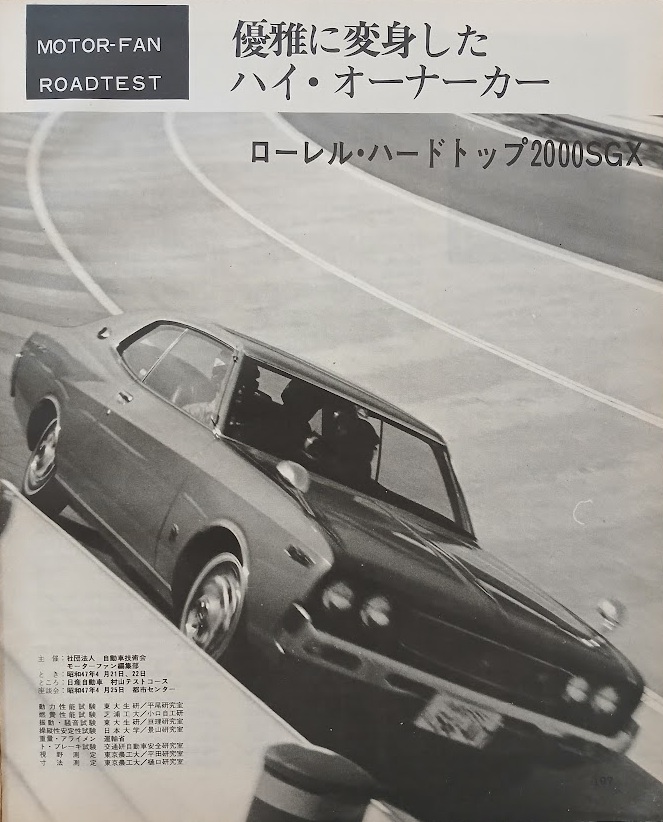
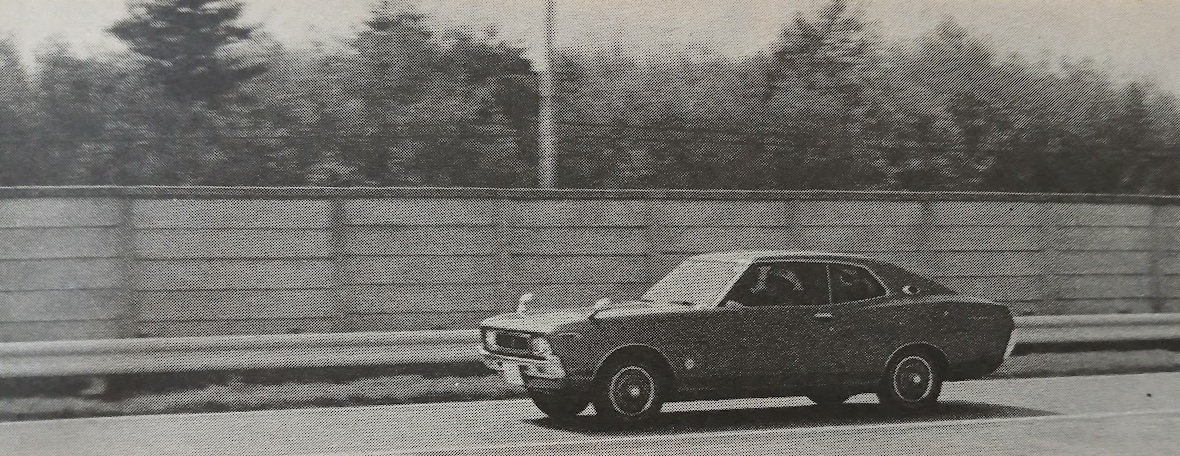
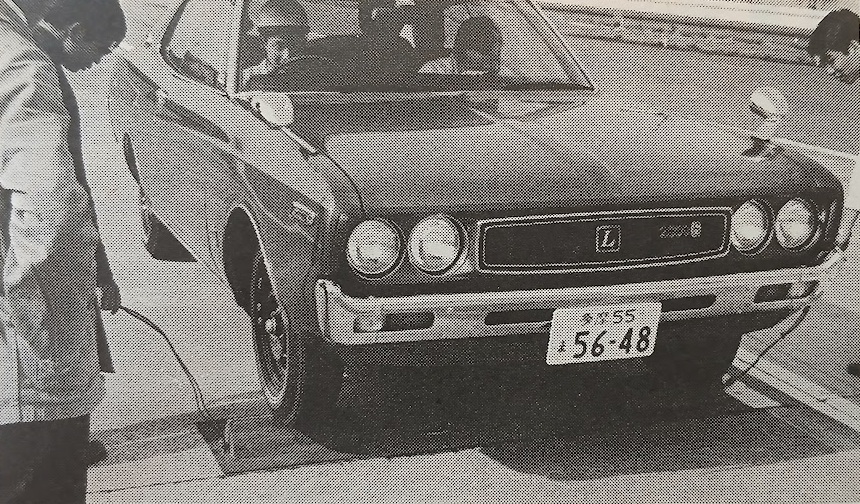
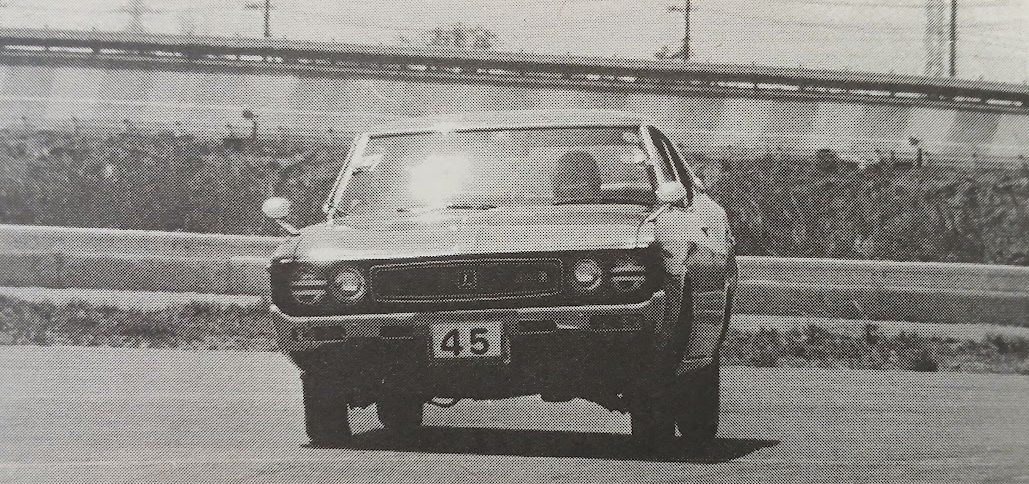
Nissan Laurel Hardtop 2000SGX (1972)
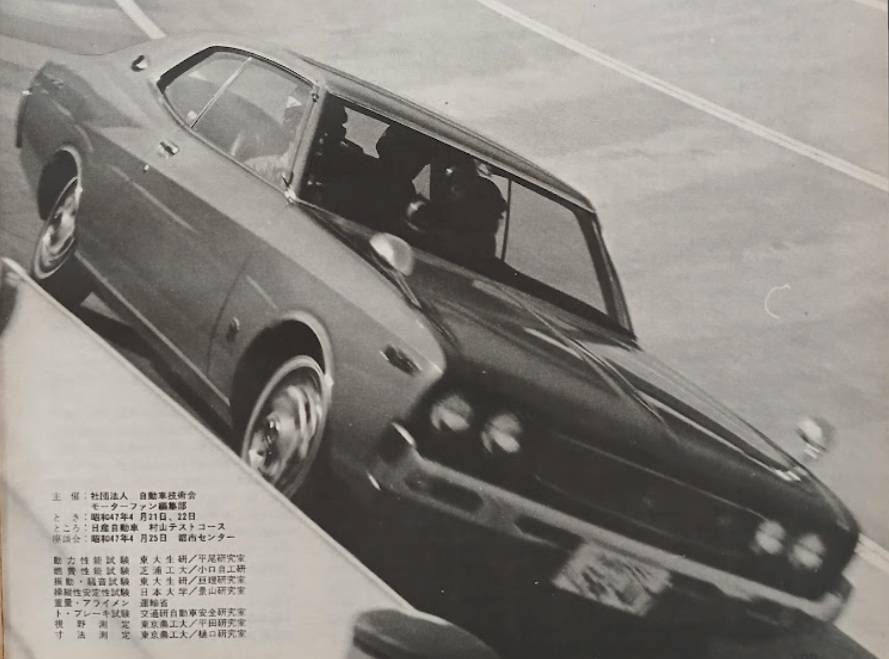
Publication: Motor Fan
Format: Road Test
Date: July 1972
Authors (Roundtable): Jiro Tanaka, Kenichi Goto, Toshio Omura, Hiroshi Okazaki, Yasuhei Oguchi, Kyoichi Yamaguchi, Hiroshi Hoshijima, Osamu Hirao, Yoshi Terashima, Jun Narue, Eizo Ikeda, Atsushi Watari, Kunitaka Furutani, Taizo Tateishi, Masahide Sano, Katsuzo Kageyama, Kenzaburo Ishikawa, Toshihide Hirata, Minoru Onda, Motor Fan Editorial Staff (uncredited)
The Ultimate Owner-Driver’s Car
Magazine: First, could you give us an overview of the new Laurel?
Tanaka: Naturally, a carmaker’s products have to match their brand image. For example, we design the Skyline around a sporting image, while the Cherry is aimed at a somewhat younger market.
In the Laurel’s case, the previous model was similar to the Bluebird in both size and styling, and in that sense its identity as a Laurel was somewhat indistinct. We have marketed it as a high-grade owner-driver’s car, but some time has passed since its introduction, and the number of competitors in the class has increased. This time, we wanted to define that character much more clearly, so we’ve made some fairly extensive changes.
Specifically, overall length has increased by 195mm and width by 65mm. In terms of size, it now sits between the Skyline and Bluebird U on one side and the Cedric/Gloria on the other. It’s a size that doesn’t really exist elsewhere in the current Japanese market, and we wanted to express the idea of the ultimate owner-driver’s car through its dimensions.
As for the engine, we chose what we consider the best powerplant available under the current regulations: a 2-liter six-cylinder. Alongside that, the lineup also includes the existing 1.8-liter and 2-liter four-cylinder engines, a total of three engine choices.
Given the character of the car, the styling has been made rather elegant–perhaps even a little opulent–instead of projecting an overtly sporting image.
And because this is an owner-driver’s car, we wanted the interior to be as impressive as possible. We’ve devoted a great deal of effort and expense to the cabin, particularly the seats and interior trim.
Those four areas are the key elements behind the new Laurel’s upgraded image.
Magazine: As the car grows larger, how does it relate to the Cedric/Gloria range, particularly the hardtop models?
Goto: The width is relatively close, but in terms of length it falls midway between the Cedric and the Bluebird U. The character of the car is different as well. The Cedric is a more formal car, with significant emphasis on corporate and business use. The Laurel is aimed primarily at private owners, and there’s also a considerable difference in price, so we don’t believe it will compete directly with the Cedric.
Magazine: You mentioned that the interior has been made more luxurious. Is there a tendency for buyers in this class to be especially attracted to that? Looking at the market research…
Omura: That tendency seems to be growing stronger recently. With this Laurel in particular, we wanted an interior worthy of a luxury car, both in name and in practice. To achieve that, we tried a number of new approaches aimed at combining safety with a sense of luxury.
For example, the door trim panels are molded as single pieces, there’s an overhead console with the sun visors integrated into it, and the seats feature built-in headrests. The steering wheel is made from genuine wood.
We also based the equipment specification on market research. Higher-grade models come standard with features such as power windows and a stereo system.
A Style That Looks Larger Than It Is
Magazine: How do you feel about the styling?
Okazaki: It certainly does look large. But from the rear, the tires seem a little undersized.
Oguchi: Less from a performance standpoint than from one of stability, the tires do seem rather narrow.
Okazaki: It also feels a bit high-waisted.
Tanaka: The styling has a slight wedge shape to it, so the front is lower and the rear is higher…
Magazine: Wouldn’t something like a 175-section tire be more appropriate?
Yamaguchi: More like a 185/70-14. (laughs)
Omura: 165 is as far as we can go, considering tire chains.
Magazine: What about the rear “cut-out” section?
Omura: As a premium car, we deliberately gave the ends of the rear fenders a sharper finish and added a certain amount of surface depth. The idea was to create a sense of dignity appropriate to a higher-grade vehicle.
If you simply round it off, it becomes much easier from a stamping standpoint, but that’s precisely where the difference between an ordinary car and a luxury car shows up.
Yamaguchi: But I think the most distinctive feature of any domestic car is the rear bumper. One advantage here is that the trunk opening is lower–about 7-8cm lower than the Bluebird U. That makes loading luggage much easier.
However, since the lamps are integrated into the bumper, I do wonder if they might get dirty more easily when driving in the rain.
Hoshijima: They definitely did get quite dirty.
Also, in terms of styling, I feel it might be a little too restrained. It could have been a bit more expressive. I was expecting something closer to a specialty car–perhaps one step above a Celica in terms of personality. I thought that might be what would really differentiate it from the Skyline.
Tanaka: That was, in fact, part of the intent. But in a sense, it is also meant to be a more subdued car–something for middle-aged buyers, if you will. It is not intended to be “hot” or especially sporty.
Hoshijima: I understand that, but even the Celica doesn’t feel like it’s only for young buyers anymore.
Hirao: Still, a style like the Celica probably wouldn’t sell in large numbers.
Omura: Since launch, we’ve received various opinions. Some middle-aged users, and even existing Laurel owners, have said it feels a bit more youth-oriented than before.
Our design goal was to combine a sense of novelty and slightly younger appeal with a certain mature dignity. In other words, we were aiming for both dynamism and a sense of adult refinement. Naturally, that required a great deal of effort from the styling team.
As a result, we’ve ended up hearing both kinds of opinions. We take that as confirmation that we were aiming for exactly that kind of middle ground.
Somewhat Dull Response
Magazine: Let’s move on to the engine. The test car was fitted with the six-cylinder unit with SU twin carburetors. This is essentially the same as the Skyline 2000GT-X, isn’t it? Aside from things like the oil pan shape…
Omura: There are some installation-related changes, and for the G-series we’ve also made a number of small refinements–such as improving heater performance and adding intake air heating.
Magazine: The carburetor is different as well, correct?
Omura: The G-series twin-carb setup was said to be somewhat difficult to handle, so this time we’ve added a dedicated idle circuit to the carburetors. That makes idle more stable and adjustment easier, and it also improves the engine’s exhaust characteristics.
Tanaka: We also believe this is the first car to feature evaporative emission countermeasures.
Yamaguchi: Is the camshaft the same as the Skyline GT-X?
Omura: The camshaft is different. The single-carb version uses the same cam as the Cedric, while the twin-carb version uses the same cam as the Cedric L26. It is not the same as the Skyline GT-X.
Yamaguchi: I can’t help feeling the engine response is a bit sluggish.
Hirao: In other words, the response isn’t very sharp?
Oguchi: Do you mean the rate at which revs build when you press the accelerator?
Hoshijima: It’s not so much initial pickup–it feels more like it reaches its limit fairly early in the upper range.
Hirao: So it’s a “let’s live slowly” kind of engine. (laughs)
Terashima: Compared with the Skyline GT in the same class, this car is slightly heavier, and the sound has also been tuned to be quieter. I think those factors are affecting the subjective feel. In terms of raw data, they are almost identical.
Narue: The exhaust note has certainly been toned down. That was done deliberately.
Terashima: The SGX, as the top-grade hardtop, was intended to be more about quiet, refined cruising than outright sportiness.
Ikeda: The G20 engine in the G-series feels more responsive, while the L20 feels a bit more subdued.
The four-cylinder is also quieter in terms of sound, while the six-cylinder has slightly more mechanical noise at first impression.
Goto: But in absolute terms, the six-cylinder is still the quieter engine. That is reflected in the data.
Watari: Are the suspension setups the same for the four- and six-cylinder versions?
Omura: No. Because the front axle load differs, the spring rates and damper characteristics are different.
Hirao: I think this connects to what we were saying earlier about throttle response. For example, on a slight incline at around 50km/h in top gear, you floor the accelerator to try to overtake another car–but it doesn’t really surge forward.
Then, if you ease off slightly after a moment, it actually starts to pick up better. That makes you wonder whether there’s a point where torque hits a “flat spot” when the throttle is fully open.
In other words, instead of torque increasing proportionally with throttle input, there seems to be a point where it levels off a bit at full opening.
Tanaka: Did you stamp on the accelerator abruptly?
Hirao: Yes–but when I eased off slightly, it actually accelerated better.
Tanaka: That kind of behavior does exist.
Hirao: That may be related to the impression that the engine response is a bit dull.
Tanaka: With modern engines in particular, because of emissions control measures, the idle and low-load mixtures tend to be set slightly leaner. That can make transitions less immediate, which may be contributing to that feeling.
0–400m Standing Start: 17.3 Seconds
Magazine: Next, please give us the power performance results.
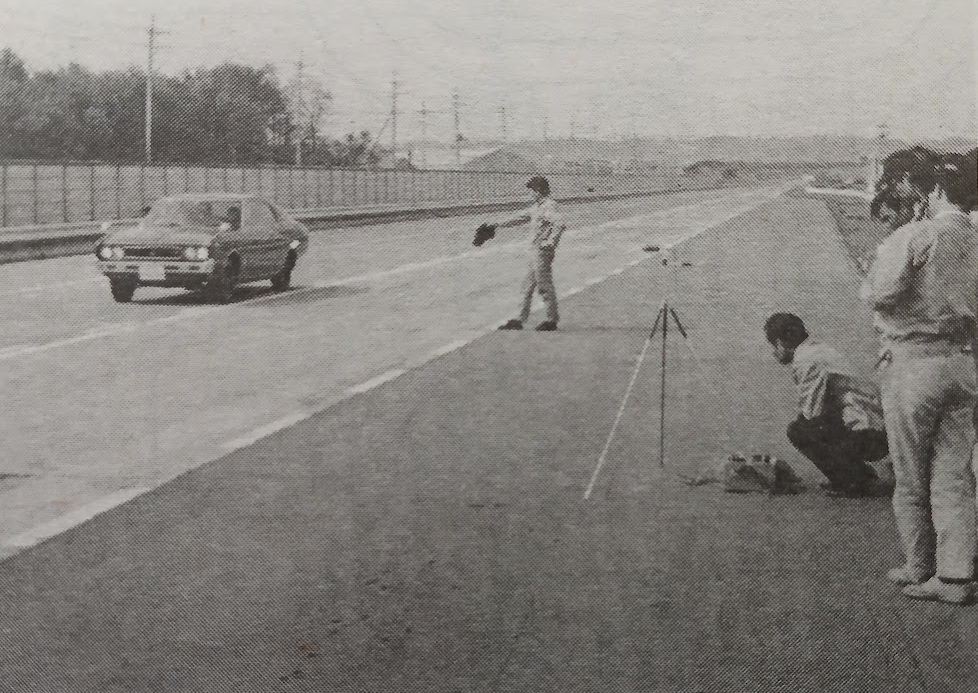
Furutani: The standing-start acceleration times were 0-50m in 4.4 seconds, 0-100m in 6.9 seconds, 0-200m in 11.0 seconds, and 0-400m in 17.3 seconds.
Compared with the previous Laurel, the overall gear ratios are slightly shorter. That improves initial response somewhat, but on the high-speed end it doesn’t seem to extend as well. The engine’s peak torque comes in at 4400rpm, so it is more of a high-speed type engine… but even so…
Magazine: The 5-speed transmission has a final gear ratio of 4.111.
Hirao: Everyone says having a 5-speed is “cool”, but wouldn’t a 6-speed be even cooler, then? (laughs)
Hoshijima: The 5-speed in this car isn’t really what you’d call “cool.” There’s no real reason to put it in fifth, and no real reason to drop back to fourth either. (laughs)
Omura: Even among 5-speed gearboxes, there are different types–some where top gear is 1:1 and it’s a close-ratio setup, and others like this where top gear is an overdrive. The character varies quite a bit.
Narue: This one is clearly meant for quiet overdrive cruising–but in practice you still get some gear noise…
Hirao: So there’s no 3-speed version?
Omura: The column shift is 3-speed.
Magazine: That’s only on the 1800 economy model.
Hirao: Really, it ought to be the other way around. The 2000 is the one that should be fine with only three speeds, and the 1800 is the one that ought to have five.
Tanaka: From the standpoint of performance, yes, that would be true. From a driver standpoint…
Oguchi: Looking at the acceleration data, 0-50m in 4.4 seconds is very quick. There’s certainly nothing “dull” about the response.
Hirao: That’s not the same thing as response—that’s just a quick time. (laughs)
Okazaki: Compared with the four-cylinder GX, which one accelerates better? Subjectively, the four-cylinder feels like it pulls more strongly.
Terashima: We don’t have direct comparative data, but in terms of vehicle weight and initial response, the four-cylinder does seem quicker.
Omura: In that sense, the four-cylinder GX has somewhat more of a “hot” character overall.
Quiet Cabin, Comfortable Ride
Magazine: Next, please present the vibration and noise results.
Tateishi: Suspension vibration measurements show a natural sprung-mass frequency of 1.4Hz at both front and rear seats. Unsprung mass frequencies are 14.5Hz at the front and 14.0Hz at the rear.
Interior noise levels were 60 phons at 40km/h, 63.5 at 60km/h, 68 at 80km/h, 71 at 100km/h, and 73 at 120km/h.
Exterior noise was recorded in second gear at 50km/h, measuring 70 phons at a steady speed and 76 phons under acceleration.
Watari: Interior noise figures are certainly on the quiet side. This uses a MacPherson strut and semi-trailing arm independent suspension, but the sedan uses leaf springs at the rear. Which is quieter?
Omura: In the six-cylinder cars there’s essentially no difference. At high speeds, however, from around 120km/h upward, the sedan tends to be quieter.
Hirao: That’s because there’s a center support bearing in the middle of the propeller shaft…
Goto: In the past, quite a bit of noise used to come in through the center bearing mount, but these days that’s been improved. In fact, at high speed it works better.
Watari: With hardtops, as they get older, they almost always start to creak at the point where the door glass meets. This car feels like it has that potential as well.
The ride quality itself is quite good, but depending on what the target is, 1.4Hz feels like a bit of an in-between tuning. If it’s meant as a “driver’s car,” it should be higher; if it’s for middle-aged buyers, it might be better to lower it. As it is, 1.4Hz feels like a compromise.
Magazine: Why was a rigid rear axle chosen for the sedan?
Goto: The car has been made larger, with a longer wheelbase and wider track. At the same time, road conditions are improving. So while independent suspension is better in terms of handling stability—especially on rough roads—this is not a very sporty sedan. In such cases, a rigid axle is sufficient.
Magazine: There’s a general impression among users that a rigid axle means “cheaper.”
Watari: It is cheaper, of course, but I don’t think a rigid rear is necessarily a bad thing. It does have disadvantages on rough roads, but those kinds of roads are becoming less common. For sedans, this layout is actually quite rational, and it reduces the burden on the engineers.
Magazine: Earlier there was a comment that in overdrive the car doesn’t become very quiet, and there’s some gear noise…
Omura: Top gear (fourth) is a direct drive. In overdrive, another gear stage is engaged, so you do get a slightly higher-pitched, “hyunn”-type gear sound. It’s not something we expect to be particularly noticeable.
Watari: How much of a difference does it make compared with top gear?
Omura: Engine rpm drops by about 15%, so there is a corresponding reduction in noise.
Magazine: How was the wind noise?
Okazaki: The car I drove had rather poor window sealing and fit. There was a noticeable whistling noise.
Hirao: In the end, if the door seals are too soft, that sort of thing tends to happen.
Omura: On the hardtop, there’s no upper glass guide, so at high speed the glass tends to be pulled outward by air pressure and can separate slightly from the weatherstrip. On this new Laurel we increased the rigidity of the glass guide, and also tried various weatherstrip cross-sections–solid types, sponge types, and so on–before settling on the final specification. As a result, wind noise is significantly improved compared with earlier models.
Yamaguchi: The dampers are different on the hardtop and the sedan, aren’t they? The hardtop uses a conventional type, while the sedan uses De Carbon units.
Omura: Through testing during development, we selected them based on overall vehicle matching.
Yamaguchi: You mean in terms of ride comfort?
Omura: Ride comfort, noise, and also stability on rough roads and the like… all of those were taken into account.
Ikeda: So the leaf springs are being supplemented by De Carbon dampers? In that case, would it be fair to say that fitting them to the hardtop would improve things further?
Omura: If the matching is done properly, I think it could improve things… but…
Watari: That’s a point where opinions tend to split. The main reason for using De Carbon units is probably shock “noise.” On the sedan, it’s mainly for acoustic reasons.
From a performance standpoint, it’s a bit of a halfway measure.
Tanaka: You can’t really say De Carbon is a universal solution. It depends on the desired ride quality.
Watari: In fact, with ride comfort, De Carbon can sometimes make things worse.
Ikeda: So is cost the main factor?
Omura: No, the cost difference is not that large.
Watari: It should be cheaper in principle, but it doesn’t really turn out that way.
Goto: Ideally, we would like to use something other than De Carbon on the sedan as well. But with the shift toward a rigid rear suspension—where independent suspension would previously have been used—we cannot afford to let things deteriorate. So even if ride comfort becomes slightly worse, we have placed greater weight on handling stability and adopted the De Carbon units.
Easy Steering Operation
Magazine: Now, please give us the fuel economy results.
Sano: Constant-speed testing was carried out in fifth gear. The results were 18.8km/l at 30km/h, 19.0km/l at 40km/h, 16.8km/l at 60km/h, 14.5km/l at 80km/h, 12.6km/l at 100km/h, 10.8km/l at 120km/h, and 9.6km/l at 140km/h.
In the model driving cycle, fuel economy came out at 8.5km/l with a 40km/h target speed, and 7.5km/l with a 60km/h target speed.
Magazine: That’s roughly in line with expectations.
Watari: What is the fuel tank capacity?
Goto: 60 liters.
Watari: On a full tank, what kind of range would you get on the Tomei Expressway?
Goto: In my case, I saw about 10km/l.
Magazine: Let’s move on to handling and stability.
Kageyama: First, the minimum turning radius is 5.69m on the outside, 2.99m on the inside. Compared with the previous Laurel, both wheelbase and overall width have increased, and the front overhang is also considerably longer, so the overall increase is about 30cm. Even compared with the Mark II, the figures are slightly larger.
The overall steering gear ratio is 21.4, which is somewhat large. The Mark II is 20.7, so this is higher.
Stationary steering effort is 12.5kg, which is quite light. For the class, it is a remarkably light figure. This may be due to the larger gear ratio and the use of a recirculating ball mechanism.
Roll angle measured 5°. This is slightly more than the previous Laurel, but less than the Cedric.
The specified tire pressure is also low at 1.6kg/cm², which may be another contributing factor.
As for understeer/oversteer characteristics, at around 0.5g lateral acceleration the R/R value is about 1.75, almost the same as the Mark II.
A notable characteristic is that as lateral acceleration increases, the response is very smooth. There is no sudden step-up in understeer; instead, it increases uniformly.
Steering effort peaks at around 0.4g, at about 3.7kg, which is a fairly normal value. Beyond 0.4g, steering effort clearly begins to drop. In other words, during more aggressive cornering, the steering suddenly lightens partway through, acting as a kind of warning.
In slalom conditions, steering effort tends to feel heavy right from the start, even at relatively low lateral acceleration. It increases in a fairly linear fashion overall.
Directional stability data from the free-release test has not yet been fully compiled, but the general tendency is that damping is rather poor. At around 100-120km/h, we noted a fairly continuous series of oscillations.
Watari: I personally would have preferred power steering. For torque converter-equipped versions, for example, are you considering power steering at all?
Tanaka: In the case of the six-cylinder, it is just at the borderline where power steering is not strictly necessary… We did reduce friction in the steering system and revised the gear ratio in order to make steering effort lighter.
Watari: That aspect feels much better than before.
Tanaka: On the other hand, I think it has moved away from a “sporty” steering feel.
Okazaki: Regarding the four-cylinder GX, I think it’s understandable that there will be some difference in straight-line stability depending on whether there are two people in the front seats or four passengers in the car–but in this case the difference felt quite pronounced. When I drove it, there was a fair amount of wind, and the car tended to wander. It would get pushed slightly by gusts.
When you try to correct it, it tends to over-correct, and it doesn’t really settle in one movement. Especially if you put an inexperienced driver in it, once it starts to be disturbed, it’s very hard to bring it back into a straight line. I really felt that straight-line stability is extremely important for ordinary users.
Hirao: I also drove the sedan on a windy day, and it tended to be pushed more from the rear, which made it feel harder to settle. In particular, when you applied throttle, the rear-end movement became more pronounced. If it were a case of the front being disturbed instead, I think it would settle more quickly. Whether that comes from suspension characteristics, body aerodynamics, or steering system friction, I’m not sure–but this car did feel slightly heavy in terms of steering friction, and it made it difficult to hold a straight line. The other test cars didn’t have that frictional feeling.
Watari: Changing the rear tire pressure might improve it quite a bit.
Omura: It’s possible the tire pressure was slightly low.
Terashima: On expressways with crosswinds, the six-cylinder model, with its higher front axle load, seems to perform better.
Okazaki: In terms of handling feel, the four-cylinder model turns into corners more easily than the previous Laurel, and understeer is reduced. It’s very easy to drive. On roads like the Hakone Turnpike, it feels almost completely controllable, and the tires feel well matched to the engine output.
Hoshijima: I still felt the tires were a bit weak for the car.
Okazaki: In terms of ride comfort, the suspension still feels quite well controlled. I expected it might feel soft and vague, but it’s actually surprisingly composed. In that sense, I quite liked it.
Omura: The suspension shares a great deal with the well-received Skyline setup.
Easy-to-Use Brakes with Broad Appeal
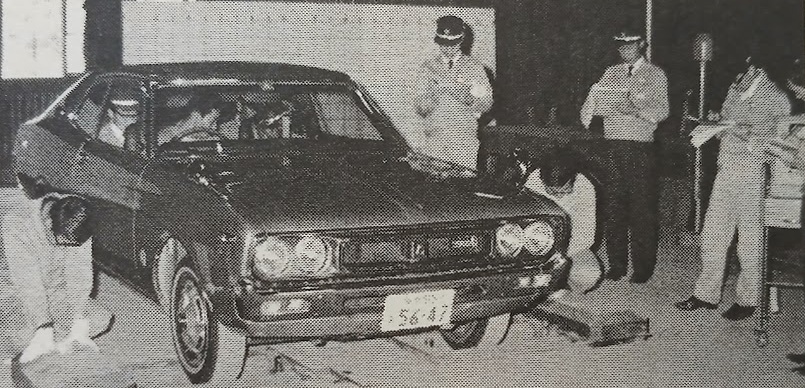
Magazine: Could you present the results from the Traffic Research Institute?
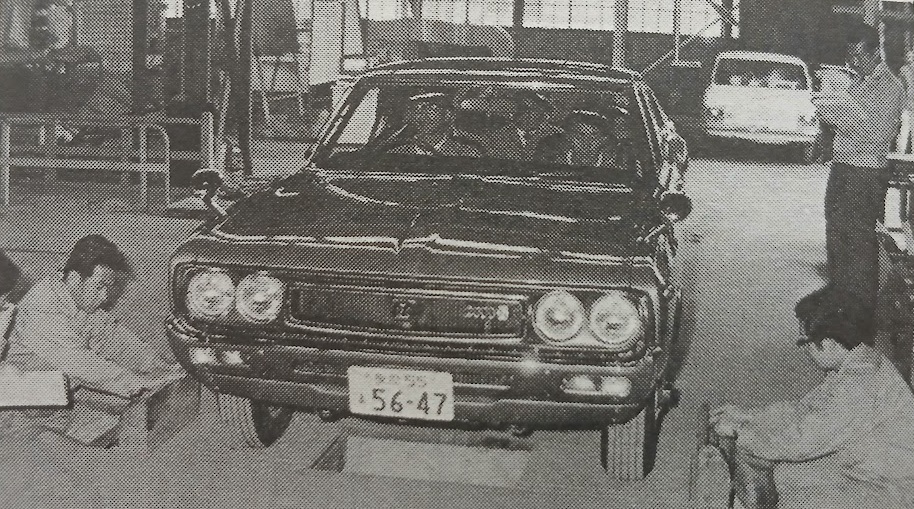
Ishikawa: Vehicle weight was 1229kg, with a distribution of 54:46 front to rear. With one or two occupants in the front seats, the front-to-rear balance hardly changes. With five occupants, it becomes slightly rear-heavy, shifting to about 49:51.
As for alignment, with a light load there is a fairly strong amount of camber and toe-in at the front, and that is its settled geometry. The front changes very little with load. At the rear, in the single-occupant condition both camber and toe-in are fairly pronounced, but with five occupants the camber reverses and the setup shifts to toe-out.
Left-to-right brake balance is quite good. The servo reaches its rest point around a pedal effort of roughly 20kg. The operating point of the NP valve is also thought to be close to the servo rest point.
On the test bench, braking equivalent to 0.6g deceleration requires about 20-21kg of pedal effort, with a brake force distribution of roughly 65:35. In the road test, starting from 50km/h, 0.6g braking requires about 16kg, a better result than the bench figures. At 100km/h it improves further, with 14-15kg needed for 0.6g. However, at 130km/h there is a fair amount of fade, and the pedal effort required for 0.6g varies widely–from about 16kg up to 35kg depending on whether it is at the start of braking or just before coming to a stop.
The fade test consists of repeated 0.5g decelerations from 100km/h at 35-second intervals.
Up to about the fourth run, there was no change in behavior, with pedal effort holding steady at 13-14kg. From the fifth run onward fade appeared, and 20-30kg was required. By the seventh and eighth runs, pedal effort rose to around 30kg.
The effort for initial brake application–what we perceive as “bite”–is about 2.5kg at the front wheels and 4kg at the rear. From that initial bite up to the 0.6g level at around 20kg, the build-up of pedal effort feels relatively soft, at roughly 0.7kg/mm.
The parking brake produces about 20% of total braking force, requiring roughly 30kg of operating effort.
As for other control efforts, the clutch pedal requires about 8kg to disengage and 6kg to engage, both quite light. The accelerator is slightly heavier: effort is about 3kg at a steady 50km/h, and about 5kg under acceleration.
Tanaka: The NP valve is a pressure control valve. In the event of front brake failure, it increases rear brake pressure.
Goto: When both front and rear are operating normally, it keeps pressure low. If the front line fails, it allows the rear brakes to take over more strongly.
Hirao: In that case, wouldn’t that mean it could suddenly spin? With the weight transfer, wouldn’t the rear lock up? You’d only have about 0.3g or 0.4g at most.
Tanaka: We took the load transfer characteristics into account from the beginning.
Magazine: The fade test is, in practice, something people wouldn’t normally encounter in everyday use…
Okazaki: Wouldn’t they, though?
Yamaguchi: I tried repeating this at around 80km/h with the automatic-transmission car. By about the sixth or seventh run, smoke started to appear, and by the tenth run the front brakes were effectively gone. The rear began to lock and the tail started to slew sideways. Are the pads the same type?
Tanaka: There are all sorts of pad materials, of course, but this one is more the type that gives a stronger initial bite. In a sense, its characteristics are almost the opposite of a fade-resistant pad. You might say it’s a somewhat softer compound.
Hirao: Well, since they’re power-assisted anyway, you might as well choose a pad that doesn’t fade, so that even light pedal pressure produces good stopping force…
Tanaka: Ideally you would add only the anti-fade capability, but depending on the pad you also get increased wear, or squeal, and so on. There are various trade-offs.
Okazaki: On roads with long straights and gentle bends, if an average driver is just driving in a sporty way, it will more or less hold up. But if you come down something like the old Hakone road at speed, it gives up very quickly.
Watari: Squeal is really the most troublesome thing.
Tanaka: Pads that resist fade will almost always squeal.
Okazaki: Other cars manage to avoid fade, though, so you start to wonder whether this is below the current standard…
Ikeda: Comparatively speaking, yes, I think that’s fair. Though personally I don’t usually push a car that hard.
Narue: For the target owner of this car, I think brake noise is probably a bigger concern.
Ikeda: The braking feel itself is not spongy, but rather slightly firm. It feels like the servo assistance is being put to use properly, so even an inexperienced driver is unlikely to make a mistake…
Narue: I think it’s a fairly good compromise point.
Highly Practical Wipers and Fender Mirrors
Magazine: Next, could you present the results of the visibility measurements?
Hirata: The total visible range of the front windshield is 91.5° left-to-right, and 23° vertically. The rear window totals 30°, with 18.5° vertically. The wiper sweep covers 82.5° left-to-right, which amounts to about 78% of the front glass area.
The total dead angle on the horizontal plane from the driver’s eye point is 60.5°, of which 14.5° is toward the front.
The interior mirror provides a visible range of 30° left-to-right, covering about 69% of the rear window area.
The total visible field of the vehicle is 2.5 steradians, which sits right around the middle of all the vehicles we have measured so far. Of this, the front window accounts for 0.54 steradians; the average is 0.6, so it is slightly smaller than average. The rear window is also slightly below average. In other words, the visibility to the sides contributes more to the numerical result.
The interior mirror’s field of view is just within the lower end of the desirable range; it would be better if it were a little larger.
The average wiper sweep area is about 0.4 steradians; this car is above that, so it can be considered sufficient. In particular, there are no un-wiped areas on the right side, which is a positive point.
Oguchi: The fender mirror is slightly set outward, which actually makes it very easy to see. In addition, the wipers clear all the way up to the right A-pillar, so the mirror is never obscured.
Kageyama: Wiper performance was very good, with the four-step intermittent setting.
Ikeda: Having four steps is excellent, but even on setting 4, when the rain is hitting hard on the expressway, it still feels a little too slow.
Goto: It was originally faster, but we dialed it back slightly.
Ikeda: It feels like an “extra-fast” setting would still be useful.
Magazine: Why did you choose to partially conceal the wiper mechanism?
Tanaka: Fully hidden systems are covered by patents held by Mercedes-Benz and GM. Also, in our testing, snow tended to get into that enclosed space. So instead, we’ve added something like a grille–our intention is to let snow slide off rather than accumulate inside.
Magazine: Can we have the results of the dimensional measurements?
Onda: The basic body dimensions have increased significantly, and as stated at the beginning, the car now sits at a size midway between the Cedric and the Bluebird U. The only element that remains unchanged from the previous Laurel is the tire size. For the SGX, body width measures 10mm wider than the other models.
The fuel tank has been moved behind the rear seat. This is something we are seeing in recent cars in general, and it seems to be becoming a standard trend. Naturally, this reduces the length of the trunk somewhat, since the tank intrudes into that space, so the figure there is smaller. However, in terms of height, the size is appropriate.
Inside, the seat has a very generous range of fore-and-aft sliding adjustment. As we’ve heard, a lot of effort has gone into making the trim and fittings more luxurious, so some of this may just be a matter of usability, or perhaps of getting used to it–but two or three points did stand out. First, the passing light and turn signal are combined into a single lever. Recently, many drivers have tended to flash the headlights unintentionally when signaling. It happens unconsciously, but it can be a bit startling for oncoming traffic. Since there is also another lever for the headlights, one wonders whether this creates opportunities for confusion from a usability standpoint.
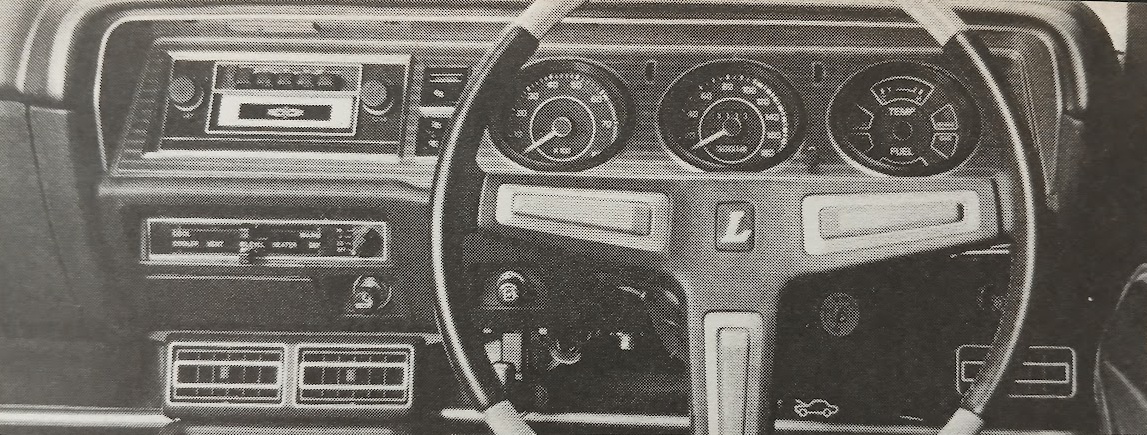
Also, the side vent outlets protrude from below the instrument panel. It gives the impression that they may have been added on afterwards. In practice, this compromises the usability of the under-tray storage area.
I do have some concern about the usability of the overhead console, which has the sun visors integrated into it. This may be slightly inconvenient, though it is likely also a matter of getting used to it.
This overhead console also incorporates a fuel warning lamp and seatbelt warning lamp, both of which activate by flashing.
The gauges are arranged in a straight line and angled to reduce reflections.
Hoshijima: Regarding the seat belt, that was quite difficult. It tended to dig in uncomfortably.
Kawamoto: While driving?
Ikeda: When you move your body, it tightens and digs in.
Okazaki: When pulling it out, you have to extend it in one precise motion. If you pause halfway thinking “that’s enough,” you have to start over from the beginning.
Hoshijima: And once it’s on, even small movements of the body cause it to tighten and cut in further. In the end I gave up and drove without using it. That’s a real problem. The fact that there are no complaints probably just means most people aren’t actually using it.
Magazine: The usage rate is around 10%.
Hirao: So no matter what you do with seat belts, you won’t really get complaints. (laughs)
Watari: Well, people just don’t use them.
Magazine: Right, well then, let’s move on to production plans.
Tanaka: At present, we are planning to produce 6,000 units monthly. Of these, around 500 will be exported. The main export destination is Europe.
Yamaguchi: Is that under the Datsun 2000 name?
Goto: Yes, only the four-cylinder version, and it will be called the 200L.
Hirao: What proportion of total production are automatic-transmission cars?
Tanaka: Around 20 percent, we think.
Magazine: That’s all for now…
Postscript: Story Photos