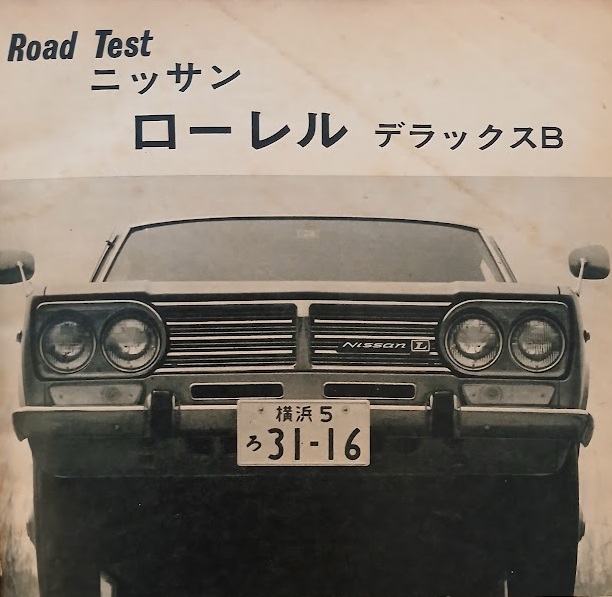
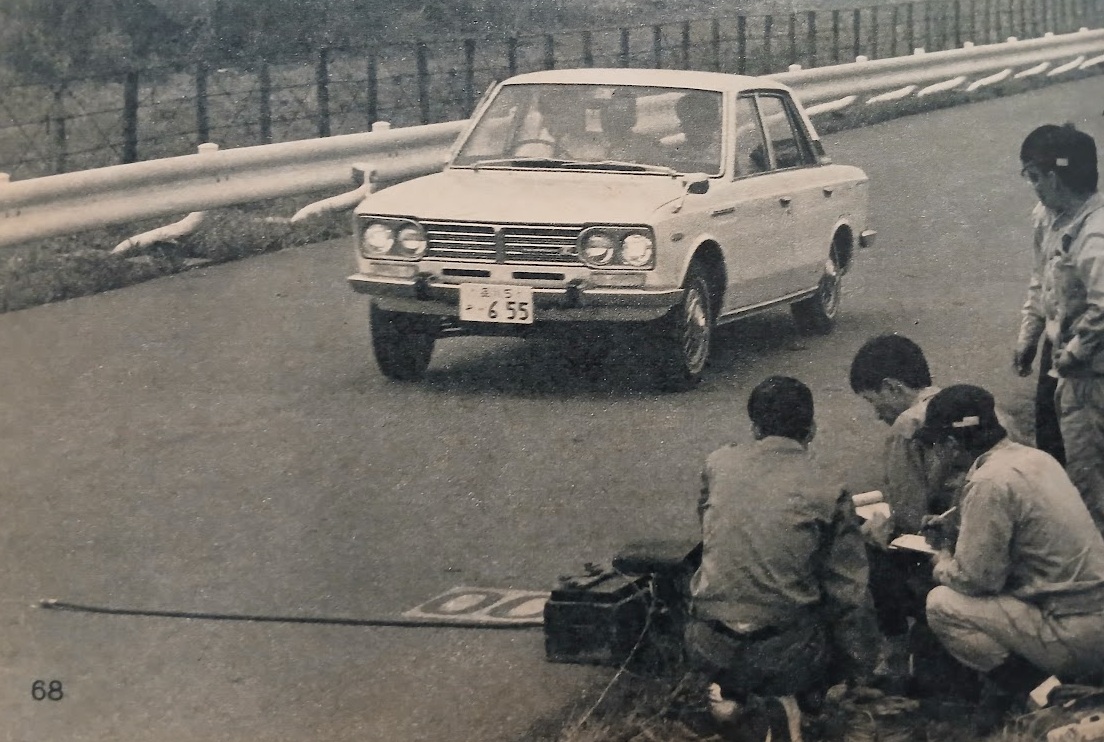
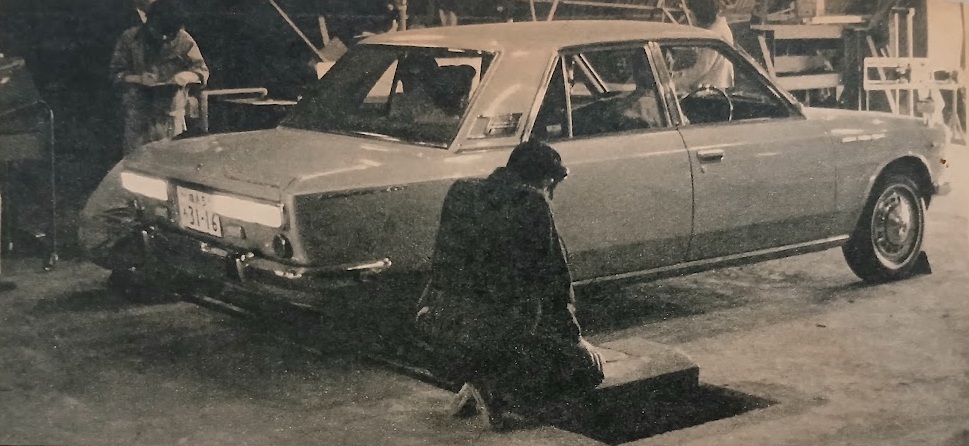
Nissan Laurel Deluxe B (1968)
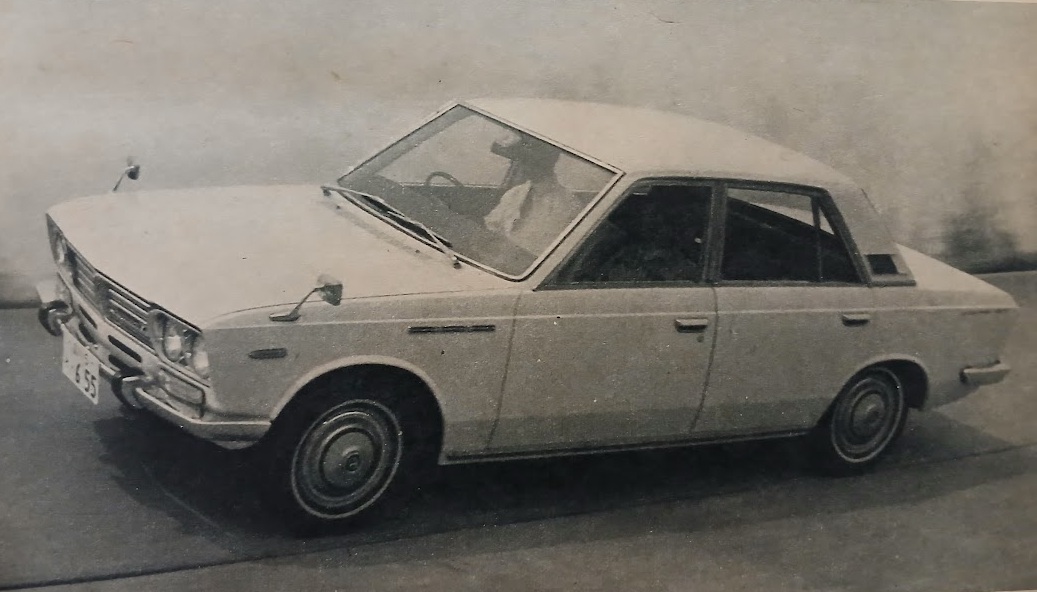
Publication: Motor Fan
Format: Road Test
Date: July 1968
Authors (Roundtable): Teiichi Hara, Mineo Yamamoto, Osamu Hirao, Kazuo Kumabe, Atsushi Watari, Kenzaburo Ishikawa, Hiroshi Hoshijima, Shozo Sato, Kenji Higuchi, Hiromichi Nakamura, Toshihide Hirata, Minoru Onda, Akio Miyamoto, Motor Fan Editorial Staff (uncredited)
The Image and Intent of the Laurel
Magazine: To begin with, could you tell us about the background that led to the development and release of the Laurel, as well as its intended aims?
Hara: The origins of the Laurel project go back to a fairly simple line of thinking. As we were exporting the Datsun Bluebird to the United States, there was an underlying sense in the market that it was somewhat too small. When we looked more closely at what it was being compared with, it turned out to be European cars–roughly equivalent in size to the Austin-class cars that used to be produced domestically.
In Japan, on the other hand, the compact-car regulations allowed somewhat larger dimensions, and there was also considerable demand for commercial use. As a result, this intermediate class had more or less faded away, while cars the size of the Nissan Cedric occupied the upper end of the compact category. In other words, there was effectively no car occupying the space between the two.
Around the summer of 1963, discussions gradually began to emerge about creating such a car.
The next question, of course, was what kind of character it should have. Rather than attempting something overly ambitious—such as a novel six-passenger layout—we decided it would be better to produce a high-quality five-passenger car. Dimensionally, this placed it between the Cedric and the Bluebird, and it seemed reasonable to target it squarely at private owners.
At the same time, we felt that if we were going to introduce such a car, it would need to have a clearly distinctive appeal. There was considerable debate as to how best to achieve that, but in the end, we concluded that for an owner-driven car, it would be preferable to avoid anything too unconventional. Instead, we aimed for a sense of refinement. The design image we had in mind was a car that would look entirely appropriate wherever it arrived–for example, pulling up to a high-class restaurant. In short, the intention was to create a car with a certain dignity.
In terms of performance as well, since this car would be released well after the planning stage, it would need to surpass prevailing standards by a meaningful margin. For that reason, we considered an engine of around 1.7 to 1.8 liters to be appropriate.
More specifically, we already had the 2-liter OHC engine from the Fairlady development program, and by reducing its displacement slightly, it could be brought to around 1.8 liters. That was a very capable engine, and it was the one we initially intended to use.
However, in May 1965, the policy of merging with Prince Motor Company was announced. It took about a year and three months before the merger was completed, and during that time, the respective engineering departments exchanged views quite openly–not only regarding future plans, but also on projects already under development.
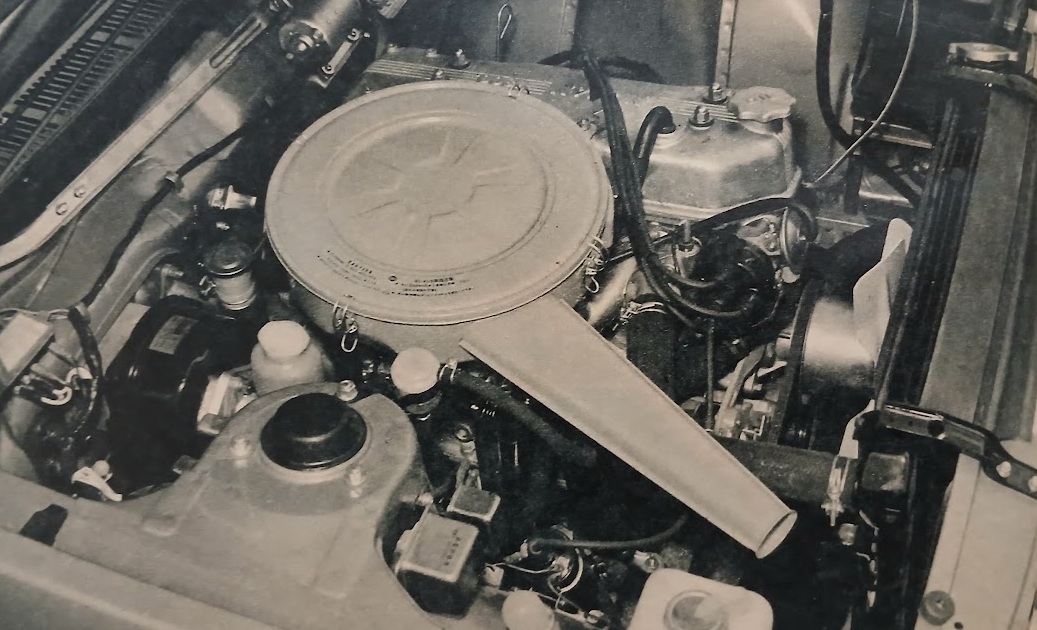
As a result of those discussions, we learned that Prince had been planning a new OHC engine series based on the 1.5-liter unit from the Prince Skyline 1500. When we examined how far that engine could be enlarged, it appeared that 1.8 liters was feasible. Given that, rather than developing an entirely new engine family, we decided it would be more practical to make use of the same production facilities as the Skyline and develop a new engine of broadly similar design.
Yielding Priority to the Bluebird
Magazine: And in terms of other mechanical aspects…?
Hara: Since this was an entirely new car, we naturally felt the urge to be a bit adventurous–to go all the way and aim for what we considered the ideal configuration at the time. From the outset, we decided on a strut-type front suspension and an independent semi-trailing arm setup at the rear.
The first prototypes were completed around May of 1965, and testing continued steadily from there. However, by the autumn of that same year, plans for a model change of the Bluebird began to take shape. It was decided that the Bluebird should take priority over this new car, so development resources were directed accordingly.
We had already intended to adopt these same mechanical features for the Bluebird as well, so in the end, most of the new mechanisms were introduced there first. As a result, the Bluebird was launched ahead of the Laurel, in August of the following year.
Because of that sequence, the Laurel benefited from a longer testing period, and we were also able to incorporate feedback from both our experience with the Bluebird and responses from customers. In that sense, you could say the Laurel was released in a more thoroughly developed state.
In the end, it emerged as something like an “older sister” to the Bluebird, though there are differences in detail.
In terms of suspension, many components are shared between the two. One might argue that this makes the Bluebird somewhat over-engineered, but there is significant demand for it as a taxi and it is often subjected to rather severe use. Given that, the shared specification is by no means excessive.
One key difference lies in the steering system. For the first time in one of our cars, we adopted a rack-and-pinion setup. To be honest, we had considerable concerns about this. There were worries that it might transmit too much shock through the steering wheel, or be prone to shimmy. However, thanks to the extended development time, we were able to refine it to an acceptable level.
Another point is the adoption of independent rear suspension, which allowed greater freedom in packaging components such as the spare tire, fuel tank, and muffler. Initially, both the Bluebird and Laurel were designed to house all of these under the floor. However, for the Bluebird, emerging American safety proposals at the time suggested that, in the event of a rear-end collision, it would be safer to position the fuel tank behind the rear seat. This led to a reduction in trunk space.
With the Laurel, we had more time to study the issue, and through extensive testing we were able to retain the original underfloor layout. As a result, we were able to take fuller advantage of the independent suspension and achieve a larger luggage compartment than in the Bluebird.
The similarity in styling between the two has also been noted, but in fact, the Laurel’s design was completed first. It was the Bluebird that was subsequently revised with reference to the Laurel…
Another difference in performance-related equipment is that disc brakes have been adopted across all Laurel models. For a car of this size, capable of a top speed of around 165km/h, there is no strict rule dictating at what speed discs become necessary. However, we believe that any “100 mile” car should employ disc brakes in the interest of safety.
From the beginning of development around 1965, a total of approximately 60 prototype vehicles were built. This is considerably more than in the past, largely because around 27 of those were used for safety testing, including crash tests and similar evaluations.
As for production, the original plan was to build the car at the Oppama plant. However, when we added up the production volumes for all models, it became clear that Oppama would be operating beyond capacity. Since the engines are produced at Murayama, where there was some available capacity, we shifted the production plan there, and the Laurel is currently built at Murayama.
As for components, suspension parts are manufactured at the Yokohama plant, while transmissions and steering systems are produced at the Yoshihara plant.
Initial production estimates were around 4,000 units per month. However, as this is a new model, even the sales side could not predict demand with certainty, so there was discussion of starting at around 3,000 units. Just before launch, though, there was a sense that the car would sell well, and talk arose of preparing for as many as 10,000 units.
For the time being, we plan to begin at around 3,500 units per month, increasing to 4,000 by the end of the year, and around 5,000 by the following spring. If demand proves strong, we are prepared to increase production further.
The Intent Behind a 1.8-Liter Class Car
Yamamoto: In Japan, there’s really no such thing as an 1800cc class, but in Europe it’s quite common, isn’t it?
Hara: From the standpoint of vehicle size, there wasn’t any particularly firm basis for it. It simply seemed that around 1.8 liters would be about right. It’s not that 2.0 liters would have been unacceptable, of course…
Hirao: I suppose the thinking was that you’d want around 100 horsepower, is that right?
Hara: Yes, that’s roughly the idea. That said, cars in this class in Europe tend to start at around 1.5 liters and then grow to that level. Whether that’s truly necessary, or simply the result of competition, is open to interpretation.
Hirao: In that sense, the physical size of the car isn’t all that different from a 1.5-liter class vehicle. So having around 100 horsepower becomes a key part of its appeal–wouldn’t you agree?
Hara: Generally speaking, European cars tend to have relatively large bodies for their engine size. Japanese cars are the opposite.
Hirao: Looking at the Laurel, its size isn’t dramatically different from the Bluebird. That may actually make it easier for customers to accept. If it were noticeably larger, it could create inconveniences in terms of parking or storage.
Hara: As I mentioned earlier, we originally positioned it dimensionally between the previous Bluebird and the Cedric. However, since the Bluebird itself has grown somewhat in size since then, the gap between the two has become smaller.
Kumabe: The question of why you built an 1800cc car–that would ultimately come down to business considerations, wouldn’t it?
Hara: If it were purely a business decision, the sales side would not readily approve something this untested. Rather, there was a kind of underlying sense that “this is something we’d like to have.” It’s difficult to predict exactly how that will turn out in the future, but that feeling was certainly there. From the engineering side as well, there was a desire to take the opportunity to create something new.
Yamamoto: A production plan of 10,000 units is quite ambitious.
Hara: Well, there is a general way of thinking that 10,000 units represents a meaningful scale for mass production. But more than that, we felt–based on what we saw ourselves–that the car had genuine appeal, and that ordinary customers would likely find it attractive as well. From that expectation of demand came the figure of 10,000 units. On the other hand, from the factory side, there were concerns–it’s not so easy to suddenly be told to produce 10,000 units.
Watari: There is the Bluebird 1600 SSS, but that isn’t exactly aimed at the general market. And while there’s also the Skyline 1500, it has a rather different character.
At present, in the 1600cc class, there are essentially just the Corona and the Florian. Meanwhile, the Bluebird has grown larger, both in engine size and in overall dimensions. So perhaps this car is aimed precisely at that situation.
Hirao: Up to 1600cc, engines tend to increase in steps of 100 or 200cc. But beyond 1600cc, it suddenly jumps straight to 2000cc. So in that sense… there was a space to be filled.
Kumabe: Since it has been developed to this extent as an owner-driven car, let’s take a look at the performance figures as well.
With the rear axle carrying 511kg, the overall weight distribution comes out to 51:49–almost an even split between front and rear.
With one or two passengers on board, that balance remains essentially unchanged. With five occupants, however, it shifts to 47:53, with a noticeably greater proportion at the rear. If you divide the nominal vehicle weight by its footprint, the figure comes out to about 141, which I would say is typical for this class.
As for wheel alignment, the front wheels have almost no camber, but a fairly pronounced toe-in. The rear wheels show a slight negative camber, which becomes considerably more pronounced with a full five-passenger load. At the front, with five aboard, both toe-in and camber approach zero, so the toe setting changes with load.
The brakes are discs at the front and leading-trailing drums at the rear. Balance at the front is excellent, and the rear shows only minor imbalance. 0.6g deceleration is achieved with roughly 15kg of pedal effort, and at that point the brake force distribution is 56:44 front to rear. By current standards, that represents a relatively low front bias–typically one expects over 60%, and recent designs are closer to 70%.
As for pedal feel, the data indicates a relatively soft feel, at about 0.5kg/mm per millimeter of travel. In actual use, it does indeed feel somewhat soft. The servo’s rest point appears to be around 25kg of pedal effort.
On the road, braking from 50km/h shows a very consistent relationship between pedal effort and deceleration, closely matching the results measured on the brake tester. A deceleration rate of 0.6g is achieved with 15kg of pedal effort.
The parking brake is a lever type acting on the rear wheels. Its effectiveness is quite good–under load, about 20kg of force is sufficient to generate braking equivalent to 20% of the vehicle’s weight. However, there is a noticeable left-right imbalance. In reverse, both sides are equally effective up to around 10kg of operating force, but beyond that point the right side increases sharply.
The ratchet mechanism of the parking brake, when operated at around 17kg, produces braking force exceeding 0.3g. However, in reverse, it requires about 30kg of force to achieve a similar effect.
Control efforts throughout the car are generally light. The test vehicle was equipped with a 4-speed floor shift, and the lever required 1.5-3kg for each gear, including reverse. The clutch requires about 10kg to disengage and 8.5kg to engage. The accelerator requires roughly 1kg to maintain a constant speed, and about 1.5kg under acceleration–quite light, overall.
Other controls are similarly light: the door lock release requires about 2kg, window operation about 1.5kg, and both the reclining seat lock and seat slide release fall in the 2-3kg range.
Typically, there is a somewhat greater difference between the effort required to engage and disengage the clutch, but in this case they are quite close. That isn’t necessarily good or bad–it’s simply a characteristic of the design.
In general terms, a pedal effort of around 10kg feels reasonable. Once it exceeds that, it begins to feel rather heavy.
The Question of Standardizing Brake Feel
Hirao: The fact that there’s hardly any difference in pedal effort probably comes from the diaphragm clutch, wouldn’t you say?
Ishikawa: Yes, that’s likely the reason. As for the brakes, the numerical data itself is very good, but in actual use there’s quite a difference in pedal weight between the accelerator and brake, which feels somewhat unnatural.
Hoshijima: I didn’t think there was anything wrong with the pedal layout itself. I only felt it would have been better if the accelerator pedal were positioned a little further inboard.
As for the brakes, I actually thought they were quite good overall…
However, you mentioned earlier that the front brake force distribution is a little low. Perhaps because of that, I remember that on the day of the Laurel’s launch, the weather wasn’t very good, and when I drove it, I had the impression that the rear wheels locked up first when braking…
Sato: From a design standpoint, the front bias is set at about 62%, and in actual road conditions we believe that is sufficient.
Since it uses front discs and rear drums, and considering fade characteristics, we felt this level was appropriate.
Hirao: If the design value is 62%, then I suppose what was just mentioned could occur as part of normal build variation.
Personally, I think somewhere around 65% front bias might be a better balance.
Watari: With these brakes, didn’t you find speed control a bit difficult? Or rather, the braking force comes in quite abruptly–it grabs quickly.
So I think it might be better if the initial response curve were a little more gradual.
Hoshijima: Still, for a car with this level of performance, you really do need this amount of braking power. I thought the brakes were very good.
Hirao: In terms of speed control, I wonder if the relationship between the brake and accelerator pedal positions is the problem. With this layout, you end up lifting your heel to brake, and because the brake is so light…
Higuchi: Exactly. Normally you control speed by resting the weight of your foot on the brake pedal. If it’s lighter than that, you actually have to suspend your foot rather than simply rest it. If anything, being too light can be a disadvantage.
Watari: I think it’s less about heaviness or lightness and more about how it responds. It feels like the stroke is a bit short, so it comes in too quickly…
Nakamura: When you switch from a car without a brake booster to this one, it’s initially quite surprising. But after about two hours of driving, you get used to it.
Watari: Yes, you do get used to it.
Nakamura: Conversely, when I go back from the Laurel to my own older Bluebird, I’m shocked by how little braking force there is. (laughs)
Hirao: So, the way people evaluate the brakes really depends a great deal on what they were driving before.
Hara: From a safety standpoint, ideally the braking characteristics of cars around the world should be standardized.
Hirao: I agree with that. But American cars already tend to have this kind of feel, don’t they?
Hoshijima: Another thing is that the light accelerator pedal really helps the overall feel. It makes the engine response feel especially lively.
And I also drove a version with a torque converter. In a light, powerful car like this, pairing it with a three-speed torque converter gives very impressive results.
Visibility with a Steeply Raked Windshield
Magazine: Next, please present the results of the visibility measurements.
Hirata: As usual, we used a fisheye lens for the measurements. With the seat slid fully rearward, the eyepoint height from the ground was 115.1cm. With the seat fully forward in its 160mm sliding range, it was 118.3cm. At that position, the distance from the lens cap to the windshield was 41cm with the seat forward, and 56cm with the seat rearward.
In terms of the visible range through the forward windows in the horizontal plane, the total left-right angle is 90° with the seat rearward, and 108° with it forward. The rear window visibility ranges from 46-52.5°. The wiper sweep angle is between 76-90°. Vertically, the field of view ranges from 27.5-37.5°, with the upper portion accounting for a relatively large share at 18-28°.
The total blind angle within the horizontal plane through the eyepoint is approximately 57-59°, of which the forward blind spots account for 13.5-18.5°.
Expressed in solid angles, the forward field of view is 1.51-1.69 steradians. Of this, the windshield accounts for 1.044 steradians, and the wiper sweep covers 0.418 steradians–equivalent to about 40-47% of the windshield area. This relatively low coverage is due to the steep rake of the windshield, which limits how far the wipers can reach upward.
The rear window visible area measures 0.177-0.222 steradians.
The interior rearview mirror covers 36-38°, corresponding to 0.140-0.141 steradians. Its coverage of the rear window amounts to approximately 63-80%.
Yamamoto: In general, cars in the 1500-2000cc class tend to have good visibility, but one of the reasons the forward field is relatively strong here is the use of triangular quarter windows.
That said, the steep windshield angle does work somewhat against overall visibility. Also, I feel the 63-80% rear-window coverage is an area that could still be improved.
Hirata: Another point is that the unwiped area of the windshield seems rather large.
Yamamoto: What is the windshield angle?
Hirata: 37°. The Bluebird is 38.5°.
Yamamoto: That difference should have a fairly significant effect on aerodynamics, I think.
Safety Standards Are at a High Level
Magazine: Next, please report the results from Professor Higuchi’s laboratory.
Onda: As mentioned earlier, one of the major external differences is the wheelbase, which is 200mm longer than that of the Bluebird. Dimensionally, it falls into a class above the 1500cc segment. In particular, the interior package has changed slightly because the fuel tank has been moved under the floor. However, the actual interior length is almost the same as the Bluebird. Even so, because of the more steeply angled glass, the total window area is larger across the body.
As for the front seat, there is 160mm of slide travel, plus full reclining adjustment for the seatback. However, since the seating position itself is set somewhat forward, most drivers end up sliding the seat all the way back. That raised a slight concern as to whether this range is sufficient for all users. Apart from differences in seat-to-pedal geometry, most other interior dimensions are broadly similar to the Bluebird.
The cabin width, on the other hand, feels more generous in proportion to the increase in size. And of course, being a five-seater, it feels spacious. However, the shape of the front seats, with a concave center and raised sides, means that if you lean on the armrest while driving, the way your hips settle feels a little awkward. That may just be my personal impression…
Reach to the controls presents no particular problem; nothing feels like a stretch.
In terms of pedals, the height difference between the accelerator and brake is 75mm, which is about 30mm greater than the Bluebird. This likely explains some of the differences in feel mentioned earlier. Also, because the standard seat position is set forward, the relationship between the accelerator and seat is relatively close.
All the gauges are round. Perhaps because there is no tachometer, there is a rather spacious layout for the fuel and temperature gauges.
Magazine: Now then, on to safety…
Higuchi: The test vehicle we evaluated was not fitted with seat belts, but assuming belts are installed, it scores 83 out of 100. Generally speaking, a score of around 80 points is sufficient to pass American safety standards, so this exceeds that level.
At present, all manufacturers are working quite hard on safety. Test methods are also shifting away from purely visual inspection of “apparent safety,” toward the idea that safety must be verified through actual testing in a variety of conditions. In that sense, development efforts are becoming increasingly thorough.
There is, however, one issue with this car: the protruding metal window regulator handle. It would be better if this were made of plastic so that it would break under excessive force, or alternatively, the grip could be made of a softer material that deforms rather than remaining rigid.
As for maintenance, engine oil changes are required every 1,000km, while oil filter, distributor, and idle adjustment are due at 10,000km. Beyond that, there is virtually nothing required up to 40,000km. In other words, the owner needs to pay almost no attention to maintenance. It’s reached the point where even these maintenance checks feel almost unnecessary–that’s the impression.
Treating US Exports on Par with Domestic Demand
Hirao: The discussion never really came up about rack-and-pinion, but I imagine that must have been quite a challenge.
Hara: Yes, the engineer in charge had a fair amount of difficulty. Sure enough, there was more road shock than we had anticipated. For that reason, a fairly large rubber joint was used, with the aim of reducing stiffness in the steering shaft.
It was also the first time we had handled this in production, so that aspect caused additional trouble. The biggest issue in manufacturing was distortion during heat treatment of the rack.
Hirao: Even so, when your hands are actually on the wheel, it feels quite smooth. If you weren’t told, you might not even realize it’s rack-and-pinion.
Hara: Under normal driving conditions, you don’t really notice it.
Hirao: Is that type actually cheaper to produce?
Hara: We believed it should be cheaper, and developed it on that assumption.
Magazine: When is export to the United States planned?
Hara: We very much want to sell this car in America, so preparations are underway in various areas. As part of that, emission control compliance was approved last December after a 50,000-mile test.
It also fully satisfies all American safety standards.
Right after the March 11 announcement, we shipped three cars to the United States, sent five engineers over, and are currently conducting real-world tests there.
In principle, we could rush it to market there, but at the moment we are fully occupied with the Bluebird. So instead, we have decided to take our time and finish it properly, aiming for release in the autumn.
As things stand, we expect US exports to begin this autumn.
Ideally, we would like to sell in America at the same level as domestic demand, but of course pricing will ultimately determine how that works out. In terms of performance, there should be no real difficulty.
Magazine: Will it also be sold in the United States under the Laurel name?
Hara: Probably not. We are already marketing using the Datsun name there.
The Sunny is sold as the Datsun 1000, the Bluebird as the Datsun 1600, and the Cedric as the Datsun 2000.
Miyamoto: This is somewhat unrelated, but what has been the reception to the Bluebird without quarter windows? I think it’s an improvement.
Hara: On balance, the positive opinions outnumber the negative ones.
Magazine: Thank you all very much.
Postscript: Story Photos