Nissan Laurel 2000GL vs. BMW 2002 TI (1971)
Publication: Motor Fan
Format: Group Test
Date: October 1971
Author: Joji Obara
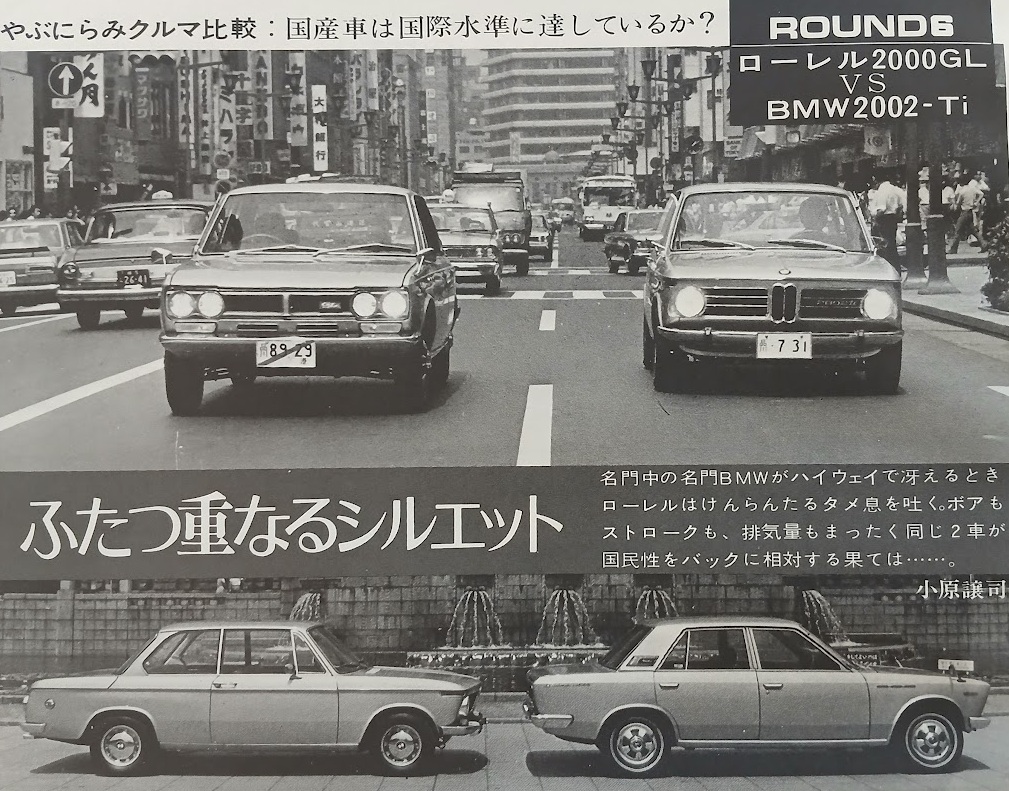
Have Domestic Cars Reached International Standards? Round 6: Two Overlapping Silhouettes
When the thoroughbred BMW comes alive on the highway, the Laurel can only respond with a dramatic, almost theatrical sigh. In bore, stroke and displacement, these two cars are identical. But being imbued with entirely different national characters, what outcome unfolds when they face off against one another…?
Prologue: Once dismissed, scorned, and ridiculed as “ugly,” domestic cars have now grown into beauties envied even on the international stage. More than that–they now dare to challenge beauty in its most exquisite, aristocratic forms…
There is an old expression: “to imitate the furrowed brow.” It’s read hisomi ni narau, and as you might expect, it originates from China. But its meaning carries a sting that still lands a bit too close to home in Japan.
Long ago, in the state of Qin, there lived a woman named Xi Shi, famed for her peerless beauty. One day, suffering from a flash of pain, she instinctively pressed a hand to her chest and furrowed her brow. Yet that strained expression–her knitted brow, her weakened gaze–only heightened her beauty, revealing a kind of fragile femininity.
In the same village lived another woman–also, one might say, “peerless”… though in quite the opposite sense. Hearing of Xi Shi’s charm, she tried to imitate her: hand to chest, face contorted, wandering about the village in mimicry.
The reaction was immediate. “Ugh!” people cried, recoiling in horror. Panic spread. One by one, villagers fled into their homes, slamming their gates shut. Those too poor to even have gates ran from the village altogether.
To ignore one’s own shortcomings and mimic another in the hope of appearing beautiful–that is what it means to “imitate the furrowed brow.” It’s a phrase that feels uncomfortably apt when applied to our own long-standing habit of imitation.
Since the end of the Second World War–or rather, since as far back as the Meiji era–Japan has shown remarkable skill in assimilating Western technology and culture. In particular, we have excelled at imitating Germany; in fields like cameras and automobiles, replication was once the rule rather than the exception.
In those early days, the results were often exactly what you’d expect: products that mimicked the outward form, but whose quality made one wince. They drew contempt from Europeans, and even bargain-hunting Americans began to use the term “Made in Japan” derisively.
And yet, lately, these creations have grown so beautiful they might startle even Xi Shi herself. Not through cosmetic trickery, but through the steady development of our own industrial strength, a uniquely Japanese kind of beauty has begun to emerge from within. It’s no wonder that even Nixon might find this unsettling.
So then–when set against a peerless beauty like BMW, how will the villagers respond to the Laurel?
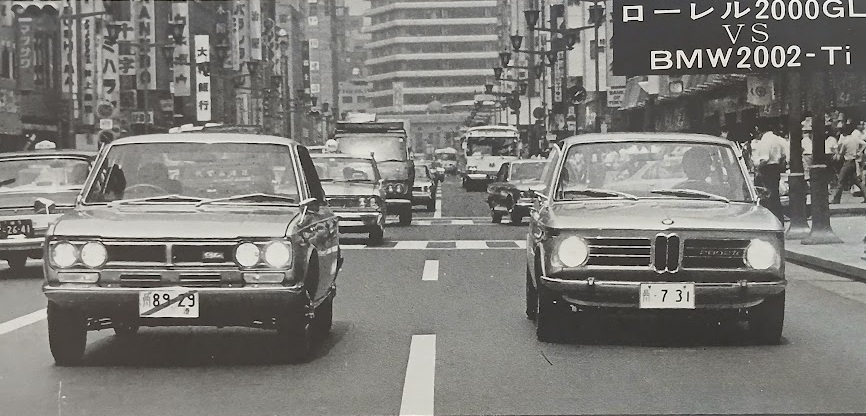
Styling: The well-groomed refinement of the BMW sets it apart, as expected, and its proportions are full of youthful vitality. By comparison, the Laurel finds itself at a slight disadvantage…
Bayerische Motoren Werke–commonly known simply as BMW–has been renowned since before the war as a maker of high-grade automobiles and aircraft engines. Its achievements in motorsport are equally well known, with class victories at Le Mans and an overall win in the shortened 1940 Mille Miglia, among many others.
Even today, with its continued involvement in Formula racing and the supply of competition engines, it should be clear–even to younger enthusiasts–that BMW is no ordinary carmaker. Beyond that, the beautifully styled and finely finished 2000 CS is surely one of those cars anyone would dream of owning at least once.
That model is unfortunately no longer in production, but in its place comes the 2002 TI–a car that preserves BMW’s finest qualities at a relatively (?) accessible price. Based on the well-regarded BMW 1600, the 2002 TI features a more powerful engine, while retaining BMW’s signature flat-deck sedan styling.
The traditional twin kidney grille, with long, rounded openings at the center, and the circular blue-and-white quartered emblem are unmistakable BMW symbols. They represent beauty, speed, stability, comfort, and outstanding driving dynamics–in short, the badge of a true thoroughbred marque.
Remove those two identifying features, though, and this two-door sedan is, in truth, rather unremarkable in appearance.
Still, the large window area and the slim pillars forming the upper body suggest a bright, airy cabin and excellent visibility, and in practice, that impression proves entirely accurate. The front seats, positioned near the midpoint of the wheelbase, contribute to a comfortable ride, and the balance of front and rear overhangs gives the car an elegant, well-proportioned stance.
The dual headlamps are simple in layout, but their bright lenses and platinum-like reflectors give them a jewel-like brilliance. At the rear, the circular tail lamps divided into sections recall those of older Ford Cortinas or Prince Skyline, though here they are arranged in a slightly different two-part configuration.
It’s not a new design, but the rear treatment carries a clean, distinctly European simplicity that feels refreshingly uncluttered.
As for the Laurel 2000GL, it may not necessarily fall short of the BMW in terms of outright beauty. Its long-nose, short-deck proportions follow current trends and give it a broadly appealing, inoffensive style.
What it lacks, however, is the lightness of the BMW. Instead, it carries a somewhat heavier, more mature character, perhaps better suited to middle-aged tastes. The front grille is pleasant enough–certainly nothing that would make one recoil–but it sits slightly too high, and compared to the BMW, this makes the car appear unnecessarily tall.
Another drawback is the extreme rake of the windshield. From a styling standpoint, it may be effective, but it severely compromises visibility and creates a sense of tightness around the driver’s head, making the cabin feel more confined than it actually is. Combined with the deeply cushioned, soft seats, the driver sinks down, bringing the line of sight close to the top of the instrument panel, almost like sitting in a racing car.
Even the design of the wheel covers does little to impress.
In overall proportion, the Laurel is by no means lacking. Yet in these smaller details, it loses ground. Individually, many of its components are just as luxurious as those of the BMW, some even more so. But when it comes to overall finish, it simply cannot match BMW’s meticulous craftsmanship.
It’s a reminder–one that extends beyond automobiles, to all manufactured goods–of just how essential true craftsmanship is. In that regard, BMW’s level of finish is nothing short of superb.
Interior: The Laurel aims to win over Japan’s middle-aged buyers with “European equipment and an American mood;” the BMW counters with a greenhouse-like brightness and a finely honed delicacy.
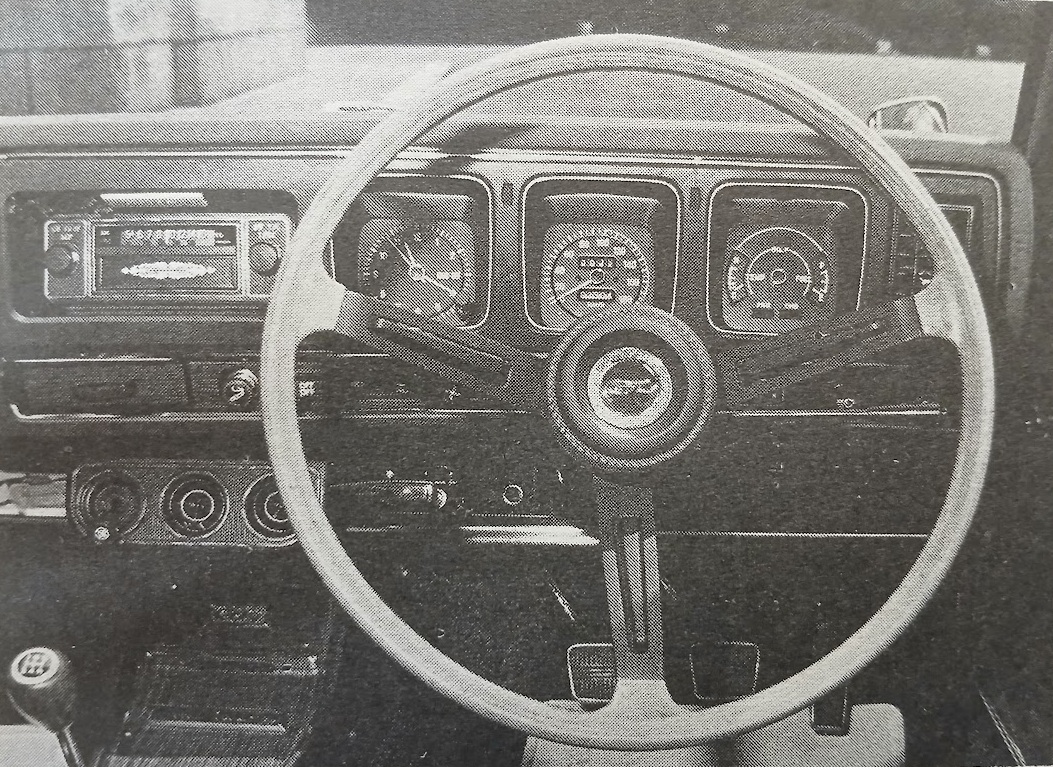
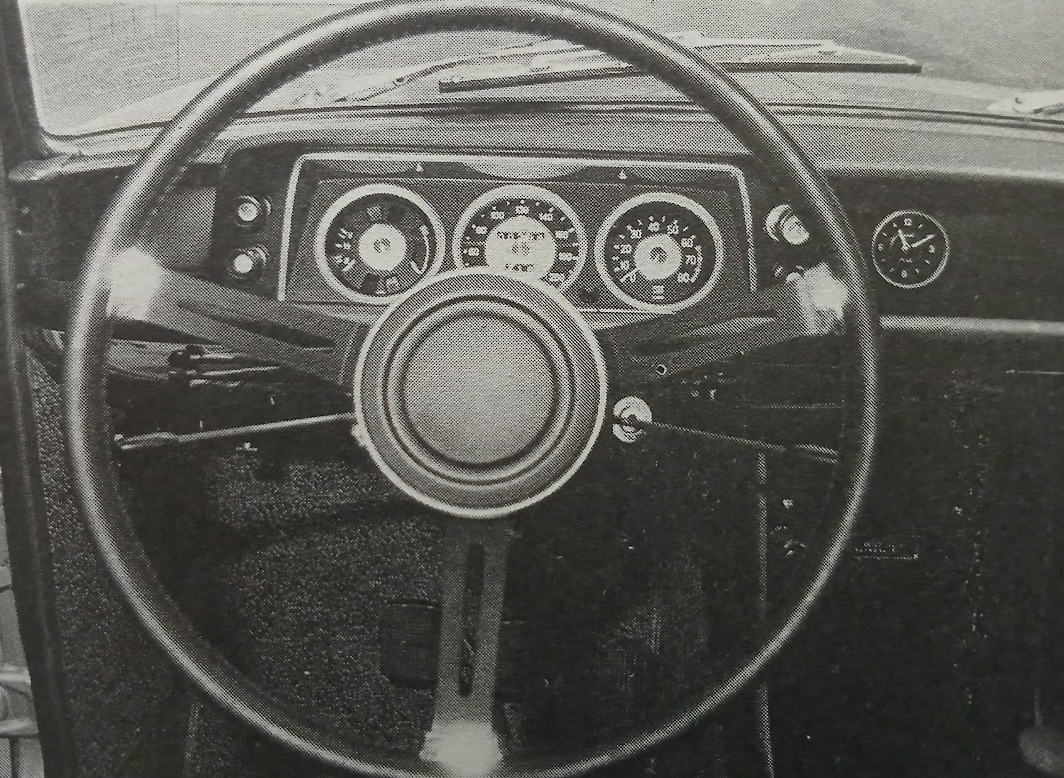
The BMW’s dashboard is simplicity itself, whereas the Laurel’s is dripping with luxury. True to its “GL” designation, the Laurel comes loaded with equipment: a stereo radio, an electric clock with a second hand that displays both day and date, even an aircraft-inspired overhead console. There are flashing warning lights to remind occupants to fasten their seat belts, as well as an indicator light for low fuel. Gauges and switches abound, and the seats are soft and plush, altogether creating an atmosphere of unrestrained opulence.
In style and equipment it leans European, while in mood, feel, and comfort it is unmistakably American–a combination targeted precisely to the tastes of Japan’s middle-aged buyers.
And yet, for all its luxury, the materials and color choices leave something to be desired. The dark brown faux wood trim on the console and dashboard is overly heavy, and not especially attractive. The seat colors, too, seem unnecessarily fussy. Plain black might have been the better choice.
The pedals are well laid out, and the throttle in particular has a pleasing feel and design. As mentioned earlier, the seating position is quite deep, bringing the driver’s line of sight closer to the instrument panel and slightly compromising visibility. Personally, I didn’t find it troublesome, but novice drivers–and especially women–might well take issue with it. Lowering the instrument panel slightly and increasing seat thickness might improve matters.
The BMW’s cabin, by contrast, is bright, almost like a greenhouse. The door glass is frameless, with no upper or side channels, supported only by the glass itself. This allows for slimmer pillars overall, contributing to both elegant styling and excellent visibility.
The seats offer generous space both at the hips and in the backrest, and their firm cushioning initially gives the impression of perching on them, rather than settling in. But once underway, this slightly elevated seating position proves surprisingly supportive, with a commanding view forward.
The dashboard is simple, but all the essential gauges are present, with the clock mounted separately. The leather-wrapped steering wheel feels very good in the hands. One small surprise: the horn doesn’t sound particularly German–instead of something sharp and precise, it emits a flat, almost American “blare.” It was the only detail that felt even slightly out of character in the BMW.
The Laurel’s gauges, with their anti-reflective glass, are very easy to read. The BMW uses normal glass, so there is some glare, but the instruments are angled thoughtfully toward the driver, and legibility is never truly poor.
When it comes to interiors, the Laurel’s approach would likely be far more popular in Japan. There remains a tendency to view the kind of simple, restrained design found in European cars as either taxi-spec or reflective of a low-grade, standard trim level. It may be unavoidable, but in this sense, the difference between the Laurel and the BMW is simply an unfair contest.
Mechanism: The engines share identical bore, stroke, and displacement. The Laurel’s unit is quiet, well-balanced, and appears to breathe efficiently. The BMW’s engine, by contrast, delivers a lively exhaust note reminiscent of a racing machine, and more power along with it.
The Laurel’s engine is an inline four-cylinder SOHC unit displacing 1990cc and producing 110ps at 5600rpm. It uses a single downdraft carburetor, though the hardtop “GX” model is fitted with twin SU carburetors, raising output to 125ps.
The test car came equipped with a 5-speed transmission, and even at low rpm the engine produces ample torque. It will pull strongly and smoothly from 40-50km/h in fifth gear without complaint.
Noise levels are low, and overall balance is quite good. The engine uses a crossflow intake and exhaust layout, suggesting efficient breathing. There is also a connection between the exhaust manifold and the air cleaner intake pipe that allows for pre-heating of incoming air, helpful for cold starts and improved fuel economy in colder climates.
When turning the key to start the engine, a chorus of “clatter-clatter, buzz, whirrr…” came from the engine bay. Curious, I opened the hood–and sure enough, there was an electric fuel pump.
However, its mounting position raises some concern. It is bolted to the inside of the right-side fender, and in the event of a serious collision, it seems possible that it could leak fuel.
If the pump itself survives but the fuel line on the carburetor side ruptures, gasoline could continue to be drawn from the tank as long as the ignition remains on, even if the engine has stopped due to the impact. The placement of this pump may warrant reconsideration.
The suspension uses struts at the front and semi-trailing arms at the rear, both with coil springs, making it a fully independent setup on all four wheels. The brakes use a dual-circuit tandem system, with front discs and rear leading-trailing drums.
On the GL model, a proportioning valve helps prevent rear-wheel lockup, and strong servo assistance is provided, allowing for confident braking even at high speeds. Steering is rack-and-pinion, requiring 3.3 turns lock-to-lock, though its feel is somewhat on the heavy side.
The BMW’s engine, like the Laurel’s, is an inline four-cylinder SOHC unit. Interestingly, bore and stroke dimensions are exactly the same, 89 × 80mm, resulting in the same 1990cc displacement.
Output is 120ps (DIN) at 5500rpm, or 135ps (SAE) at 5800rpm. This difference likely reflects the BMW’s use of twin Solex 40PHH sidedraft twin-choke carburetors, compared to the Laurel’s single carb.
Engine noise in the BMW is noticeably louder, but not in an unpleasant, noisy sense. Rather, it has a crisp, mechanical note that brings its racing pedigree to mind.
The transmission is a 4-speed unit from ZF, and its shift feel is exceptionally satisfying. As with the Laurel, a 5-speed manual and automatic transmission are available as options.
Possibly due to its four-throat carburetion, starting the BMW requires a bit of technique, almost like a racing car. It feels somewhat over-carbureted.
There are three rubber hoses connecting the radiator and engine, one of which branches off like a bypass and connects near the base of the water pump. Its exact purpose isn’t obvious, but it likely serves either to improve cooling efficiency or to prevent overcooling during cold German winters.
Steering is by a ZF worm-and-roller system, with lock-to-lock measuring 3.7 turns to the left and 3.5 to the right.
The suspension layout mirrors that of the Laurel: front MacPherson struts and rear semi-trailing arms, both with coil springs. The car was fitted with Uniroyal Rallye T5 radial tires.
These tires bore a curious marking–an open umbrella. Presumably this indicates strong wet-weather performance, not unlike certain radial tire advertisements that proudly proclaim, “They love the rain.”
Performance: If the BMW feels youthful, the Laurel is middle-aged. When it comes to the way they run, the difference is hard to ignore. The young beauty, honed on the autobahn, only grows more alluring the faster she goes. But push things a little too far, and an unexpected devil may rear its head…
Comparing the performance of the Laurel and the BMW is not entirely straightforward. Judged on ride comfort, the Laurel will clearly appeal to a more mature audience, while in terms of sporting feel, the advantage goes to the youthful BMW.
The Laurel’s catalog lists its top speed at 180km/h, but asking it to maintain such speeds would likely prove rather tiring.
The BMW’s top speed, at 185km/h, is not vastly different on paper, yet somehow this figure feels far more realistic. Much of that comes down to the light, lively character mentioned earlier.
The Laurel’s speedometer marks the 100-170km/h range in yellow and 170-190km/h in red to indicate the car’s upper limits. By contrast, the BMW’s centrally mounted speedometer is simply graduated up to 220km/h, with no such theatrics.
That said, the BMW’s speedometer calibration is peculiar: at roughly the 9 o’clock position it is already at 60km/h, and by the 12 o’clock position, it indicates 120km/h. Driving around town, the needle climbs so little that one might suspect the speedometer cable has snapped.
Once on the open highway, though, the BMW comes alive–like a fish returned to water. The ZF transmission is a joy to operate, and the engine note rings out with a musical quality. In this sense, the BMW feels like a finely-crafted machine personally instructing you in the art of sporty driving.
In terms of handling, the car tends toward final oversteer. In straight-line driving, the rear wheels adopt a camber angle that increases understeer. However, when taking tight corners at speed, the inside rear wheel lifts and tucks inward, causing the rear grip to break away rather suddenly, shifting into sharp oversteer in an instant.
If one does not properly understand this behavior, the abrupt change in handling could catch you out completely. Before you can even process what’s happening—“no, wait, what?!”—the car may already be spinning, or worse, rolling over.
Of course, that would require a driving style bordering on reckless. Under normal high-speed conditions, the BMW remains a thoroughly stable sporting sedan, maintaining rear grip even when cornering quite assertively.
Epilogue: A storied name can easily get lost in its own past glory. Even the peerless, elegant BMW, proud of its slender waist, nonetheless has a weak spot: there are times when it cannot match the glamour and approachable charm of a fuller-figured rival.
The BMW, which has embodied the perfection of Xi Shi, now faces a new contender in the Laurel. No matter how much it leans on its pedigree and technical excellence, it finds itself challenged by the rising, confident swell of domestic cars–and somehow its graceful waist seems to yield to the more generous curves of its rivals.
BMW remains a true aristocrat in the world of automobiles, and its quality is universally recognized by enthusiasts worldwide. The Laurel, meanwhile, has long been heralded in its own advertisements as the “noble Laurel” and “the authentic one.”
On appearances alone, the Laurel may not have exactly followed the “Xi Shi imitation” route. But does it really merit the confidence to claim words like “noble” and “authentic” with any authority?
Still, no fortress withstands attacks forever, and even the grandest names fade eventually. If that is true, then the dreams we place in our domestic cars cannot only be mere illusions.
Postscript: Story Photos