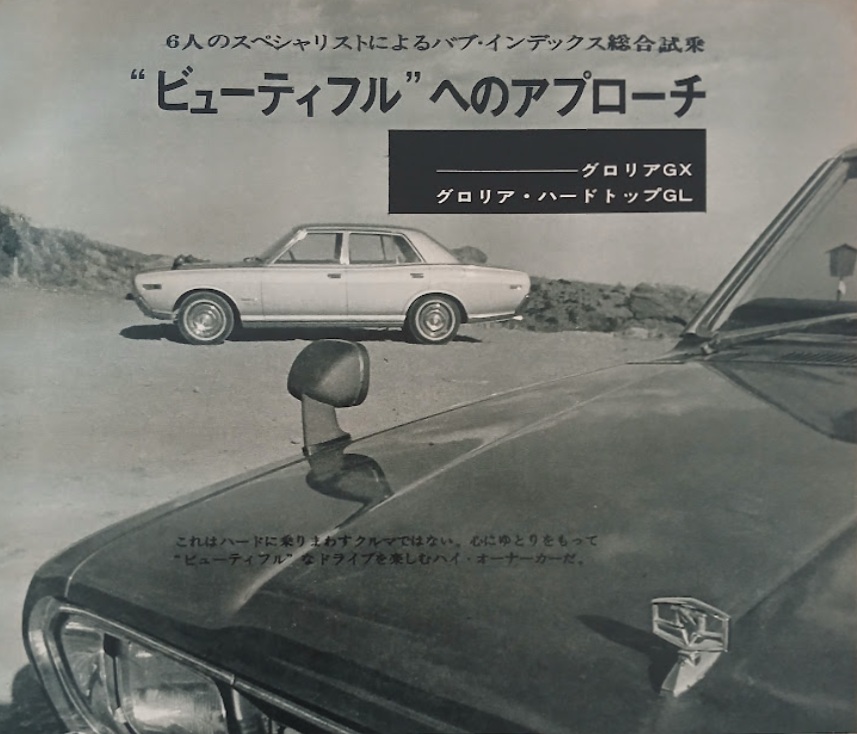
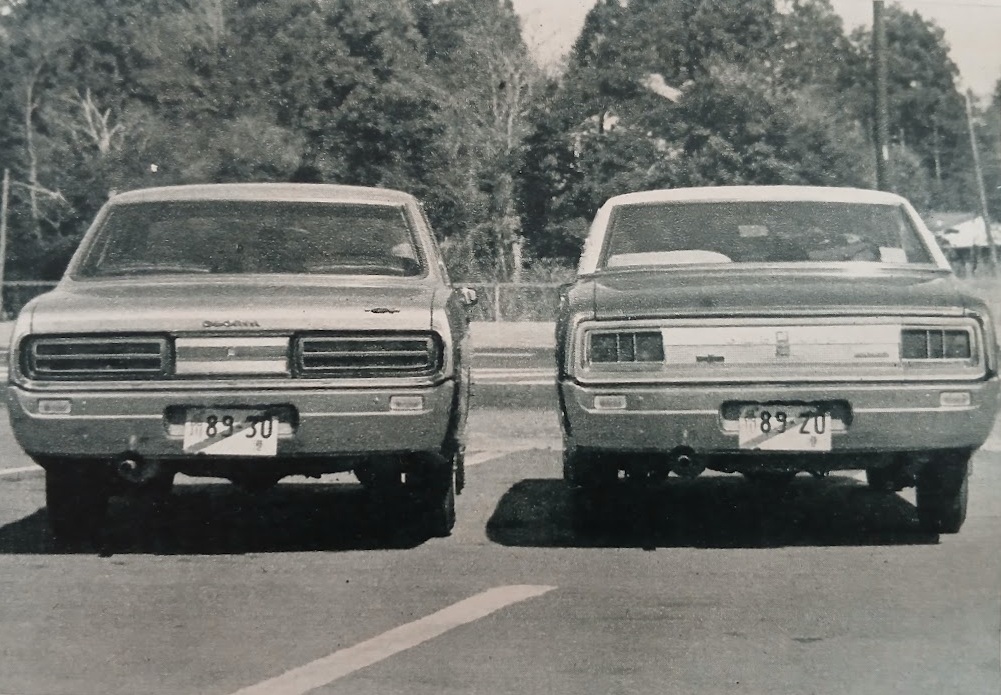
Nissan Gloria GX and Hardtop GL (1971)
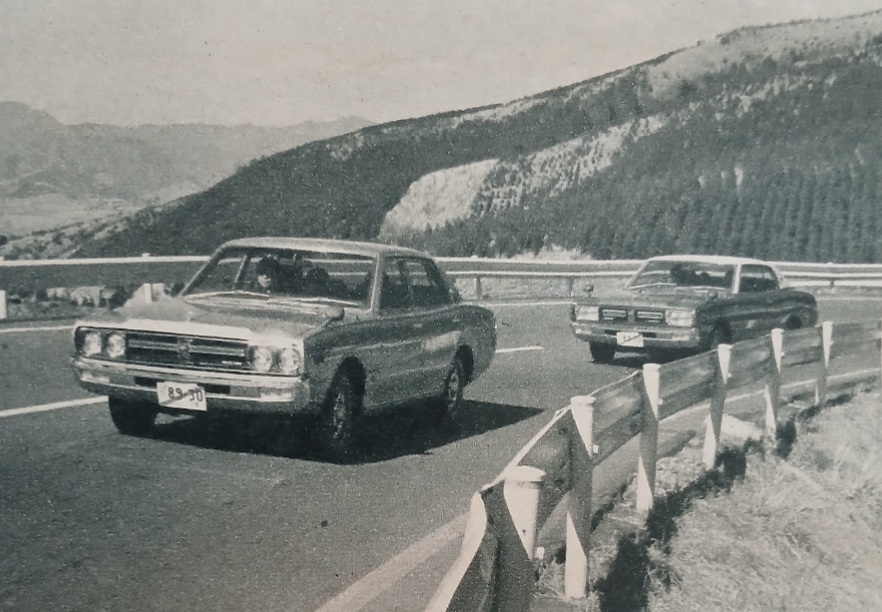
Publication: Motor Fan
Format: “Bubble Index” Road Test
Date: May 1971
Authors: Osamu Mochizuki, Katsuzo Kageyama, Shigeki Asaoka, Yasuhei Oguchi, Reiko Ikuuchi, Kensuke Ishizu
The “Beautiful” Approach
This is not a car meant to be driven hard. Rather, it is a high-grade owner’s car–one that invites its driver to relax, create a little space in the mind, and enjoy a “beautiful” drive.
A Drive That Puts the Mind at Ease
The test car this time was the Gloria, which has just undergone a full model change alongside the Cedric. Although the term “full model change” is used, it applies mainly to the exterior; the L20 engine and the suspension remain unchanged from the previous version. In other words, the revisions are limited essentially to appearance.
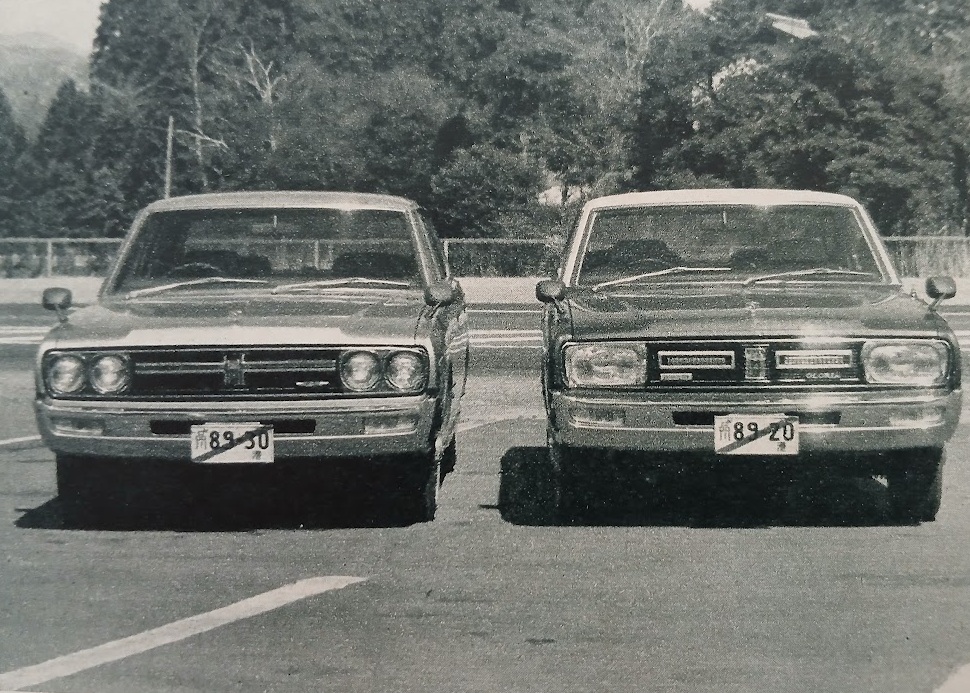
Even that appearance is, basically, almost identical to the Cedric. The Gloria has a single press line running down the center of the hood, while the Cedric has two. In addition, the Gloria GX, GL, and Deluxe models retain the traditional hood mascot at the front edge of the bonnet, and can otherwise be distinguished mainly by differences in the front grille and the trim on the rear finish panel.
The distinctive atmosphere the Gloria once possessed–styling that blended luxury with a certain sharpness–may be said to have disappeared almost entirely.
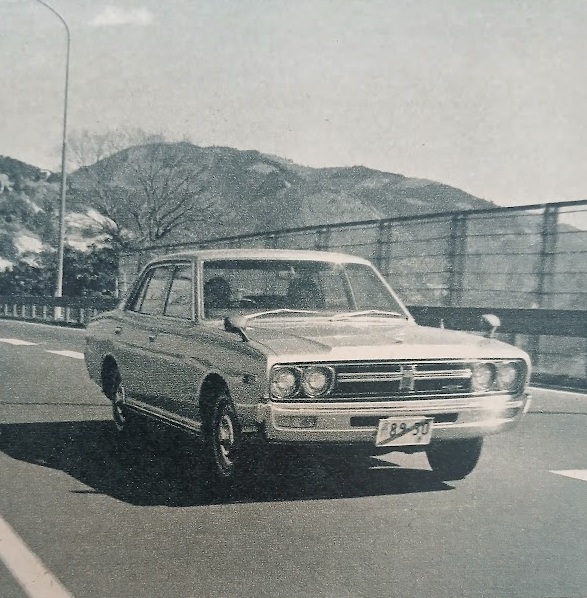
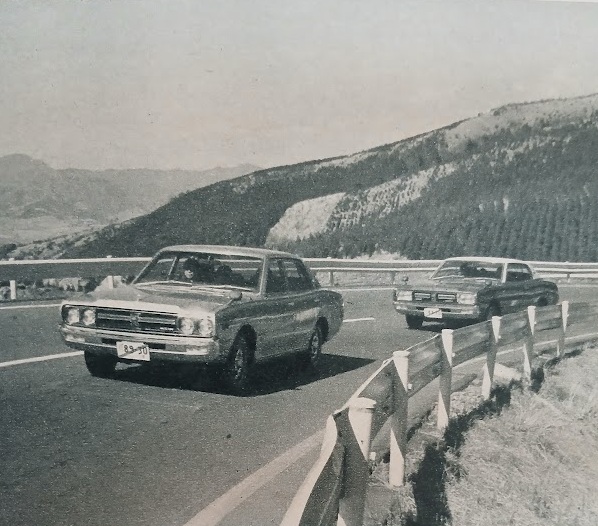
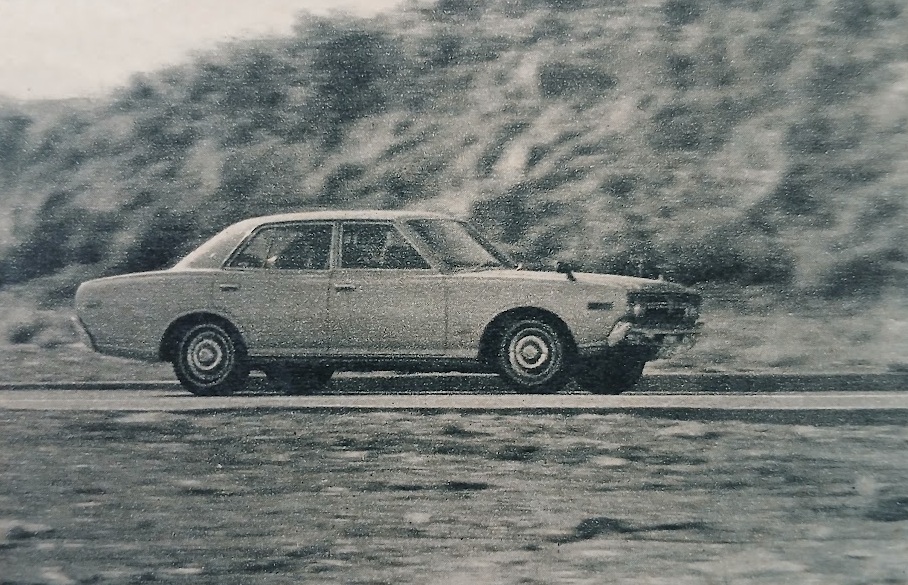
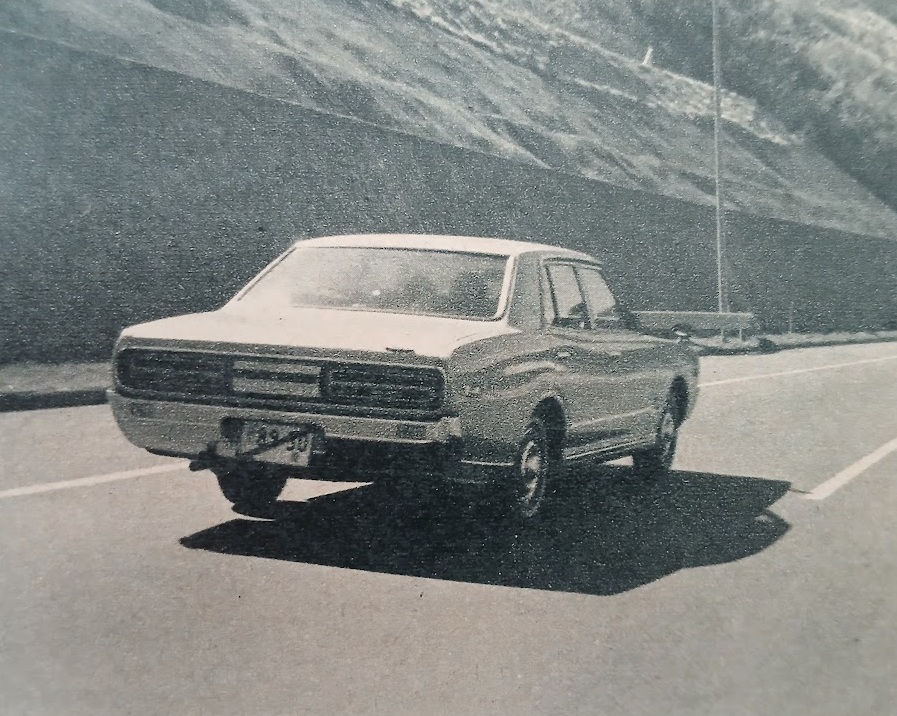
Two cars were provided for the test drive: a Gloria GX sedan with a 4-speed floor shift, and a Gloria Hardtop GL with automatic transmission.
The GX was finished in silver metallic, a color that gave it all the dignity expected of a luxury car. The Hardtop GL, meanwhile, wore a pale green body with a white vinyl top. After only a brief meeting before departure, the group set off as usual along the familiar course: onto the Tomei Expressway from Tokyo IC to Gotemba IC, over Otome Pass, up the Hakone Turnpike, back again via Otome Pass, and then onto the Tomei once more from Gotemba IC for the return to Tokyo. Instrumented tests were conducted mainly with the GX.
After completing the drive, the group gathered again at our base, the Fantasy Drive-In near the Seta entrance to the Tomei Expressway, for the customary discussion. Perhaps because we had recently been testing a succession of small cars and minicars, the conversation this time focused largely on ride comfort. Before long, the talk expanded from the car itself to the sort of driver it seemed suited for.
“This is the kind of car a mature gentleman in his prime would drive in relaxed comfort.”
“No, I’d say it’s a car for a refined woman to drive with elegance.”
Remarks like these soon began to circulate around the table.
In any case, the six specialists were unanimous on one point: this is not a car meant for scurrying through tough traffic conditions, darting here and there among the bustle of everyday drivers. For that reason, it may be beside the point to dwell on quarter-mile times or cornering performance. Indeed, the results of the instrumented performance tests showed nothing more than ordinary figures.
One comment summed up the impression neatly: “When you sit in the driver’s seat of this car, you feel remarkably calm. Your mind relaxes, and the funny speed contests you see taking place between other cars outside the window begin to seem rather foolish.”
Power Performance: Quiet and Average in Character (Osamu Mochizuki)
It is well known that new models brought to market are the result of careful demographic research conducted by the manufacturers. The Nissan Gloria we test-drove this month displayed very mild and thoroughly average driving characteristics. This may well reflect the fact that owners of 2-liter sedans generally prefer exactly that sort of behavior, something the manufacturer seems to have grasped early on.
Although the exterior has changed completely, the powertrain remains the same as before. The engine is the familiar L20 unit that has already established a solid reputation in the Cedric series. In its standard form this engine has a compression ratio of 9.5 and produces a maximum output of 130ps at 6000rpm. There is also a regular-fuel specification, like that of our test cars, in which the compression ratio is reduced to 8.6 and maximum output lowered slightly to 125ps at 6000rpm.
This inline six-cylinder engine, with a single overhead camshaft, oversquare dimensions, and twin SU carburetors, possesses a number of pleasing qualities. It runs smoothly, produces little mechanical noise, and revs willingly at higher engine speeds.
However, when combined with a vehicle whose weight reaches 1625kg when fully loaded (curb weight, 1350kg), the engine’s performance inevitably becomes somewhat subdued. As can be seen from the test data for acceleration from 0–100km/h and for hill-climbing performance, the figures are generally in line with the standard level for a 2-liter sedan. If judged in terms of acceleration alone, it would probably rank somewhere in the middle of the 1.5-liter sedan class.
Of course, Japanese passenger cars in the 1.5-liter category are often endowed with performance that seems almost excessive for their intended purpose, which partly explains such a comparison. In actual use, the Gloria GX (with 4-speed floor shift) proves capable of coping quite satisfactorily with a wide range of conditions, whether on city streets, highways, or mountain roads.
Maximum torque of 17.5kgm is produced at 4400rpm. Accordingly, when the throttle is opened from lower engine speeds, one notices the acceleration beginning to become stronger from around 4000rpm. The torque curve is somewhat peaky for a six-cylinder engine, but it already produces about 15kgm at 2000rpm, so response at low speeds presents no particular problem.
The top speed with the high-octane 130ps specification is given as 170km/h. According to the performance curve, the 125ps regular-fuel version would reach approximately 167km/h. Under favorable conditions, such speeds should be readily attainable. In practice as well, the car’s extension at higher speeds felt smooth and unstrained, aided in part by the effect of its clean, streamlined body shell.
“Since this is a heavily equipped car, it would be nice to have a little more reserve power. If Nissan installed the 2400cc engine used in export models, the difference would probably be quite noticeable.” —Oguchi
Handling and Stability: Everything Moves at an Unhurried Pace (Katsuzo Kageyama)
Since this car is clearly intended as an “elegant, high-grade owner’s car,” any discussion of its qualities must be approached with that purpose firmly in mind. Otherwise one might arrive at rather misguided conclusions.
The adoption of power steering is only natural for a car of this class. Indeed, it is around the steering itself that many of this car’s characteristics become most apparent.
The steering wheel is extremely light. Even when turning the wheel while stationary, the effort required is minimal. With steering this light, one need not break into a sweat when maneuvering into a garage or edging the car into a tight parking space. It would be perfectly suited to a well-dressed woman driving with graceful ease.
Among power-assisted systems there are many unpleasant examples in which the wheel feels heavy when initially starting to turn, and then suddenly becomes light as more lock is applied. In this car, however, the power steering remains smooth throughout its movement, and there is no sense of awkwardness at all. It can only be described as excellent.
That said, because the steering is so light, when driving at high speeds it sometimes feels rather vague and lacking in firmness. During fast cornering, the lightness of the wheel can make control somewhat difficult, and one may occasionally apply more steering than intended. For drivers who prefer a sporty style of driving this may feel unsatisfying–but in truth, this is not the sort of car that invites such treatment. Rather, it has been designed for mature gentlemen in the prime of life, or for women, to drive with elegance and composure. Among that kind of owner, it is sure to earn considerable praise.
The self-centering action of the steering is somewhat weak. When attempting a hands-off stability test, the convergence was slightly less than ideal.
However, this comparison applies mainly when measured against smaller domestic cars. Compared with larger imported cars with power steering, its convergence is entirely satisfactory.
As for its cornering characteristics, the car displays a fairly strong tendency toward understeer, which is to be expected for this type of vehicle. When the wheel is turned abruptly, the response is not particularly sharp. Everything about its behavior is relaxed and unhurried.
The Talbot-type fender mirrors, which can be adjusted from inside the cabin, are very convenient. Unfortunately, the frames are quite thick, leaving the reflective surface itself rather small and somewhat limiting their usefulness.
The turn-signal lever is positioned too close to the steering wheel. Several times, the hand resting on the wheel brushed against it inadvertently, unintentionally operating the indicators.
The 4-speed floor-mounted shift lever also has a fairly long throw. Because of this, the position of first gear is rather far away, making it somewhat difficult to engage. Driving with the optional three-point seatbelt fastened would likely make the operation even more awkward.
“The degree of understeer has been reduced somewhat, making cornering easier. Body roll has also been kept under better control.” —Mochizuki
“The action of the power steering is well matched to natural human strength, though the slight phase lag is somewhat noticeable.” —Oguchi
“For drivers who do not care for power steering, perhaps the GX and GL could also be offered with a conventional steering system.” —Ikuuchi
Ride and Comfort: A Calm and Settled Interior (Shigeki Asaoka)
It has been some time since the Gloria and Cedric last underwent a model change.
In that sense, the relationship between the two models now resembles the example of Austin and Morris under BLMC, since they share so many common components. Even so, this Gloria–whether in hardtop or sedan form–gives an impression rather similar to the Crown before its most recent model change.
Before beginning this report, I should mention that during the test drive I did not attempt any hard driving. That is simply because I did not consider this to be the sort of car in which sporting performance is expected.
The sedan we drove was equipped with a 4-speed floor shift. One feature I particularly appreciated was the clutch spring (the one on the clutch-facing side). Its strength is very well judged, making for a notably pleasant driving feel.
In the hands of an experienced driver, it would probably be possible to shift gears more smoothly than in the automatic version–and without slipping the clutch unnecessarily. Still, it might have been better if the shift lever itself were slightly longer.
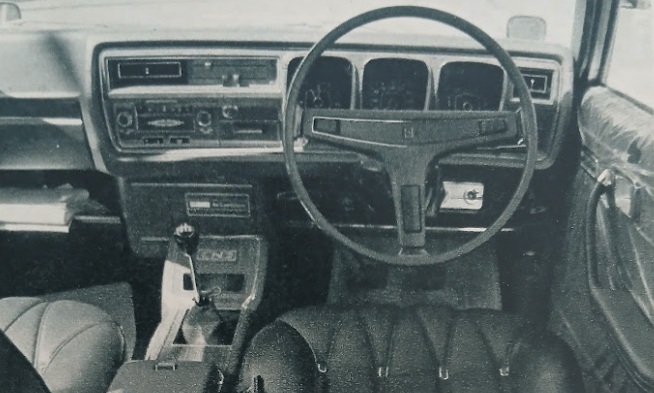
The calm, restrained interior makes a favorable impression. Some materials used in the cabin–such as the jersey fabric upholstery–are quite rich. However, the overall effect tends somewhat toward a taste that feels a bit elderly. Something with a slightly more modern sensibility might have been preferable.
In addition to the usual reclining mechanism, the seats are equipped with a height adjustment that allows the cushion to be raised. As a result, the seatback angle, fore-and-aft position, and height can all be altered freely. This means that drivers of virtually any build should be able to find a driving position that suits their preference.
Power steering is also standard equipment on the GX and GL models, which is certainly welcome. At the same time, it does not suffer from the overly vague and unreliable feel sometimes associated with American cars; the steering effort required to maintain a straight line is quite appropriate.
At the lower right of the dashboard there is a control lever for adjusting the Talbot-type fender mirrors. Being able to adjust the mirrors on both sides while seated in the driver’s seat is very convenient.
Another useful feature is the trunk release, which uses engine vacuum so that the driver can open the trunk lid while remaining seated. Naturally, it will not operate unless the engine is running.
On the expressway, wind noise seemed somewhat louder than expected. Even so, compared with most other cars it was still fairly quiet. For that reason, the noise from the engine’s camshaft and timing chain also made itself heard somewhat.
Taken as a whole, the impression is that the car is generously equipped. The hardtop makes a pleasant car for a calm and composed driver to drive for themselves, while the sedan is equally comfortable as a car in which one might ride in the rear seat.
“As one would expect, far more attention has been paid to interior space than would be possible in a smaller car.” —Kageyama
“The air-conditioning controls are excellent, though the fan noise is somewhat noticeable. The outlets in the front pillars improve ventilation, but they may also contribute to the wind noise.” —Oguchi
“For a twin-carburetor engine, the accelerator operation is very smooth. It would suit women drivers well.” —Ikuuchi
Safety: Performance That Enriches the Mind (Yasuhei Oguchi)
Being a midsize sedan, there is little in the way of particularly unusual mechanical features. Yet throughout the car there is a quiet sense of something that “enriches the mind.” It is difficult to say exactly where this feeling comes from.
Perhaps it lies in the body shell, which is modest yet refined. Or perhaps in the spacious interior design. It may also stem from the car’s comfortable nature and the reduction of operating effort through features such as power steering–elements that satisfy what might be called human performance.
In any case, it is a car in which one naturally feels at ease. Perhaps for that reason, throughout the entire test drive–from beginning to end–the driving tended to remain relaxed, always at one’s own pace. Hard driving may sound appealing, but this car seems to possess a certain quality that discourages the sort of inconsiderate behavior that often troubles others on the road.
To some extent, this may be something naturally found in cars of this class. Yet it does not arise simply from their size. A comparison with like-sized American cars makes that clear enough. It might well be described as a kind of “tertiary safety performance.”
In recent years, many aspects of preventive safety and post-accident safety have been developed with measurable physical effects in mind. Yet during rush-hour commuting or the weekend crush of traffic, with the cars as tightly crowded as potatoes being washed together—drivers often become tense and competitive, pushing aggressively to get ahead.
This may be because both our road environment and our cars lack sufficient provision for that third type of safety–the kind that restores a sense of calm and generosity of mind. Some may dismiss such thinking as overly sentimental, similar to the fashionable phrases heard lately about “human-first” or “beautiful” driving. Even so, it is not something that can simply be ignored.
At any rate, this Gloria incorporates many of the elements of human performance that we have frequently discussed in relation to safety.
For example, the air-conditioning system provides a comfortable environment in terms of both temperature and humidity. The seats are constructed with particular attention to vibration transmission, and the materials used for interior panels include supports and soundproofing designed with noise reduction in mind. As a result, the cabin is quieter than before. The power steering, which requires very little effort when turning the wheel at low speeds or when maneuvering into a garage, is another feature worth noting.
In smaller details as well, there are thoughtful provisions. The fender mirrors can be adjusted from inside the cabin, and the rear window is equipped with heating elements, both of which help ensure a clear view to the rear. From an operational standpoint, it is also convenient that the switches for the headlights, turn signals, and passing light have been combined into a single control. Power windows add further convenience.
There are, however, a couple of points that raise some concern. One is the reliability of these power windows, and the other is the use of only two-point seat belts.
“Power windows must be absolutely reliable. Otherwise, a manual system would actually feel more reassuring.” —Kageyama
“The brake pedal requires very little effort, and the braking is easy to control.” —Mochizuki
“It’s very welcome that the hardtop has centralized door locking. Still, it would be even better to see it fitted to the four-door models. Perhaps the cost makes that difficult.” —Ikuuchi
Economy: The Pluses and Minuses of Price Increases (Reiko Ikuuchi)
With this latest model change, the Gloria now shares its body shell (along with the engine, as before) with the Cedric. The Gloria originally debuted as Japan’s only domestically produced “3-number” car, and one might have hoped that its “prestige” image would be preserved more strongly, even if it meant stretching economic sense a bit. In the end, however, cost considerations likely made compromise unavoidable.
The test car, a GX 4-door sedan (with 4-speed floor shift) carries a Tokyo price of 1,320,000 yen. Since the GX grade did not exist in the previous Gloria lineup, direct comparisons are difficult, but in the current climate of rising prices, the Gloria line as a whole has seen some increases. Looking at the Standard model (3-speed column shift), the price for the old Gloria was 758,000 yen, while the new model is 774,000 yen, an increase of 16,000 yen.
That said, the Cedric–which now sells for the same price–previously sold for 753,000 yen, meaning its increase is actually larger at 21,000 yen. Meanwhile, certain models have in fact become less expensive: the Gloria GL (separate seats, 3-speed column shift), previously priced at 1,286,000 yen, is now 1,197,000 yen, a reduction of 89,000 yen.
While it is not my intention to defend price increases, even the Standard model’s 16,000 yen rise brings with it a notable amount of newly added safety equipment: a collapsible steering column, steering lock, master back brake servo, passing flasher, and tandem brake master cylinder. So, from the user’s perspective, one could say the additional cost is largely justified.
Comparing the Gloria to the recently-announced new Crown, prices for the standard models are 774,000 and 882,000 yen, respectively, while the top trim levels are listed at 1,455,000 and 1,438,000 yen.
One clear advantage of the increased commonality with the Cedric is improved access to service. Gloria owners can now more easily rely on the broader Cedric dealership network for repairs and maintenance.
Previously, Cedric service centers often carried few Gloria-specific parts, and ordering them could take time. With parts now shared, repairs can be completed more quickly, reducing vehicle downtime. In that sense, overall economic efficiency is improved.
As for the cost of owning a Gloria GX as a personal car, when one considers its status as a high-grade owner’s car—along with its safety and interior comfort—it cannot really be described as expensive.
Recently, there has been much talk of a slowdown in the automotive industry and a broader economic downturn. At the same time, however, we are entering an era in which owner-drivers—people firmly established in the middle class of society—are becoming more prominent, and there is a growing tendency to choose mid-sized cars.
If the “mid-sized car” still functions as a symbol of status, then one might think of both the purchase price and running costs as an inherent part of that status. Viewed in that light, this is not an especially expensive car.
“A car costing 1,320,000 yen feels expensive in today’s terms. But spending money for luxury is probably something that never really changes.” —Asaoka
Product Appeal: Cars as Fashion (Kensuke Ishizu)
Fashion isn’t just about clothes anymore—it has spread into almost every corner of daily life. At first, fashion applied only to clothing, but now it has extended to nearly everything; if anything is lagging behind, it’s probably food.
As clothes have lost some of their unique expressive power, the home has moved into the spotlight as a medium for fashion. Houses, once purely for sleeping, are now appreciated for their individuality and as a way to express one’s mode of living. American style magazines such as Men’s Daily Record call this kind of fashion “lifestyle.”
Cars, too, have become part of our patterns of living. Unlike a house, which can’t easily be moved around for others to see, a car can. Cars were once considered mainly in practical terms: you drove, and you carried things. But today they have become a medium for self-expression.
In that sense, the Gloria is very good. “Good” here means it is suitable for expressing one’s lifestyle. Take the Crown: it has recently been updated, but many are already circulating as taxis. The previous Crown was also widely used as a taxi. Because of that, the Crown carries a fairly common image, and it doesn’t inspire someone to express their lifestyle through it.
Driving a car in this class conveys a sense of calm richness. Social values are shifting from the “frenetic” to the “beautiful.” The Gloria, beyond simply looking beautiful, seems designed to make the driver feel beautiful too.
“It’s clearly designed with the Crown in mind.” —Asaoka
“The Hardtop could perhaps feature a more sporting body style. There’s always this strong impression of a gentleman in a navy suit and tie.” —Oguchi
“To strengthen the Gloria’s image, it would be nice to have a truly individual body color unique to Gloria—something you don’t see on the Cedric.” —Ikuuchi
How to Read the Bubble Index
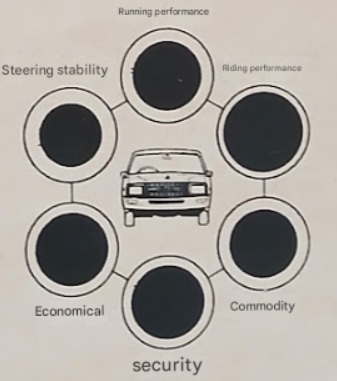
The aim of this comprehensive test drive is to assess a car’s overall performance using six key pillars: driving performance, handling and stability, ride comfort, safety, economy, and product appeal.
For evaluation, we use a format called the “Bubble Session”—a method from systems engineering in which six specialists from different fields gather around a hexagonal table (the “bubble,” or honeycomb) to exchange opinions. Each black segment within the six circles represents the evaluation for that pillar. When the black segments are roughly equal in size, the car is considered well-balanced across all areas; when the sizes vary, the vehicle can be seen as having a more distinctive, individual character.
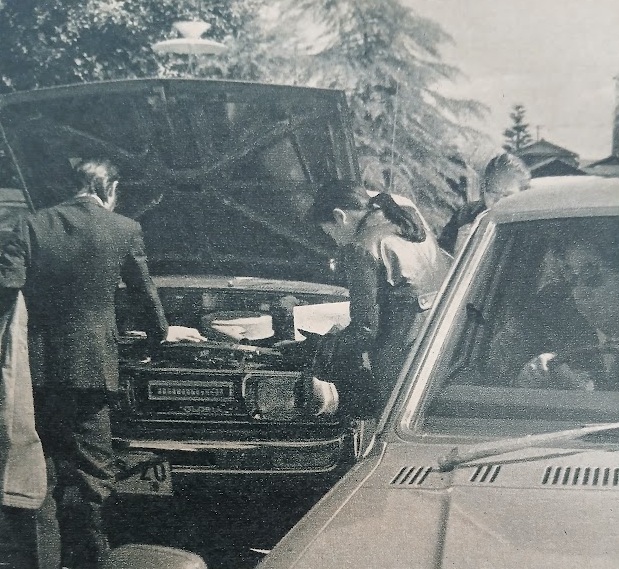
Postscript: Story Photos