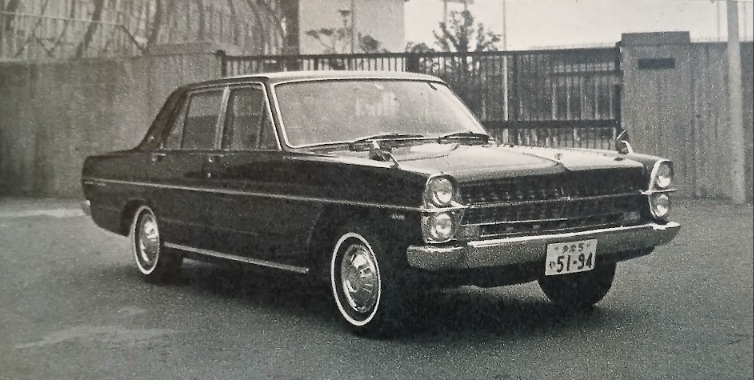
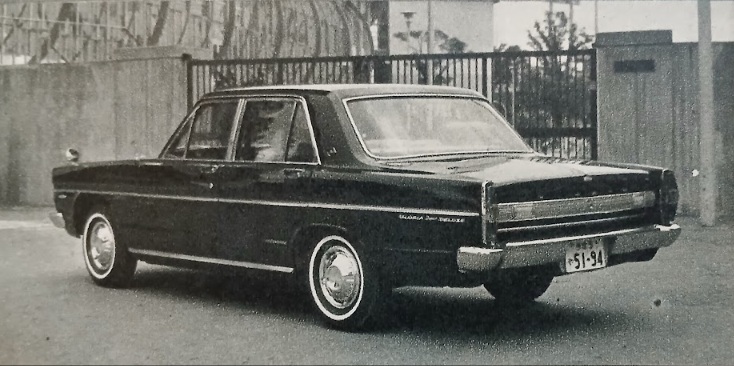
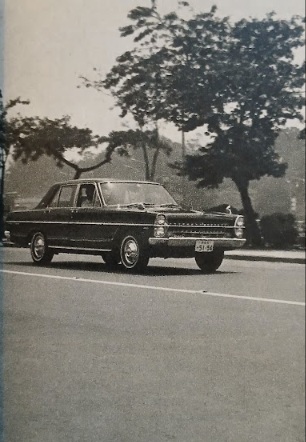
Nissan Gloria Super Deluxe (1967)
Publication: Car Graphic
Format: Road Impression
Date: September 1967
Author: “C/G Test Group” (uncredited)
Road testing the Nissan Gloria Super Deluxe
The Nissan Gloria, as its name suggests, is the first production model to emerge from the joint development efforts of the Nissan and Prince engineering teams. The passenger-car range consists of three models (there are also two van versions). The most expensive is the five-seat Super Deluxe (1,110,000 yen), intended for the luxury owner-driver market, followed by the six-seat Super 6 (1,015,000 yen), aimed primarily at corporate users. Below these is the economy-model Gloria (755,000 yen), fitted with the Cedric’s 2-liter four-cylinder OHV engine.
American-Style Interior
The car tested here is the Super Deluxe, a luxury 2-liter owner-driver model comparable in both performance and price to the Cedric Special 6 and Toyota Crown S.
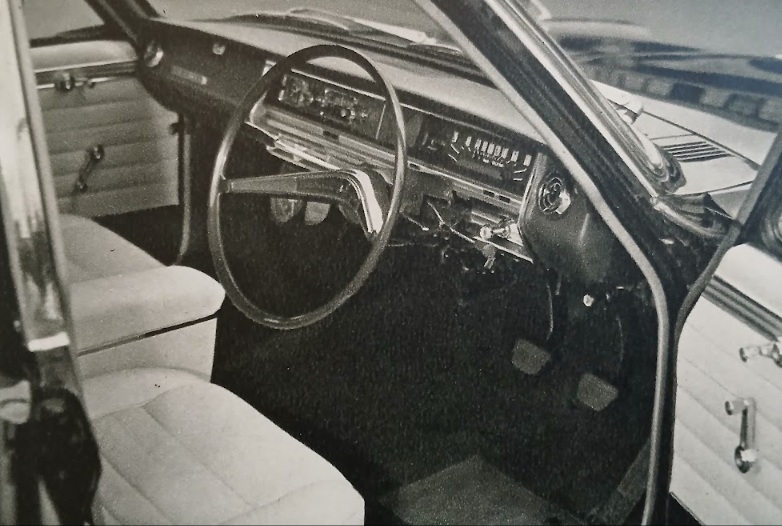
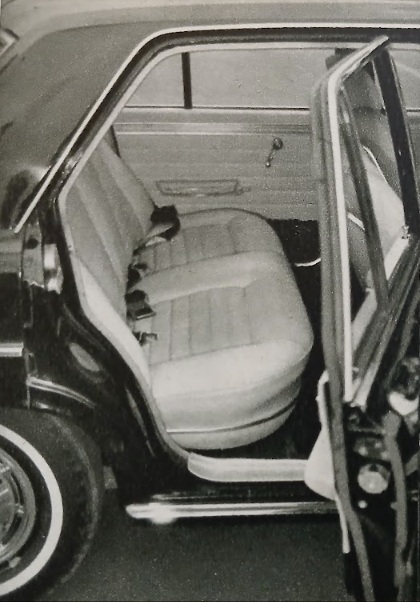
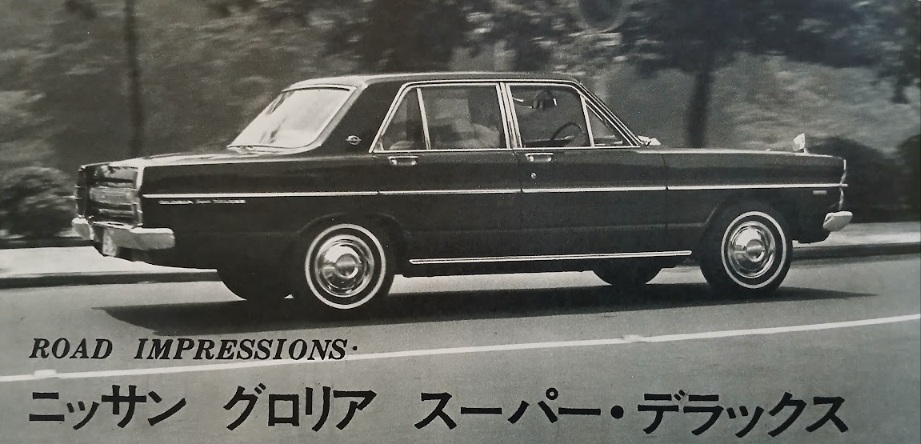
The test car was finished in black with an ivory interior, a rather formal combination that suits its character well. As might be expected from the exterior, which makes the car appear far longer and larger than it actually is (and recalls the 1967 AMC Ambassador), the interior is also designed entirely in the style of the latest American cars.
The Super Deluxe, which presents itself as a luxury family sedan, seats five, with reclining individual front seats and a rear bench. The front seats have no less than 160mm of fore-and-aft adjustment, and together with the finely-adjustable backrests, virtually anyone should be able to find a suitable driving position. Although the seats’ proportions are large, the shape of the backrest does not conform well to the back, while the front part of the cushion is insufficiently thick, leaving space under the thighs.
The upholstery is expanded vinyl leather, which at first glance resembles woven fabric. However, it has no breathability whatsoever, and we found ourselves bothered by the resulting perspiration. Furthermore, the test car’s white upholstery was already quite dirty after only 5,400km. Both in terms of practicality and appearance, we feel that this upholstery is inappropriate for the Gloria Super Deluxe’s standing, and would like to see it improved.
This is the first Japanese production car to incorporate head restraints into the seats, and they can be pulled out to any of three positions as required. However, because they curve so far backward, they are too far from the driver’s head. Taller drivers also find them insufficiently high, even when extended to their top position. We therefore question how effective they would actually be in an accident.
This criticism, however, applies to a driver seated in the proper driving position. For a passenger, who can sit in a more relaxed posture, the head restraint would probably be of some help in an emergency. At the very least, it looks considerably neater than the aftermarket types attached to standard seats.
The rear seat is, of course, spacious enough for three people, although the cushions and backrest are shaped to seat two in comfort. A wide armrest can be pulled down from the center, and height-adjustable head restraints are also incorporated into the rear seat.
As one would expect in a car of this class, just as much attention has been paid to the comfort and accommodation of rear-seat passengers as to those in front. For example, the inside of each rear quarter panel is fitted with a reading lamp like those found in jet airliners, with a beam that can be aimed freely (and which does not interfere with driving when turned on). A radio speaker is mounted on the shelf behind the rear backrest.
There is a console box between the front seats, and its rear face is used as a panel for the rear passengers’ radio and heater controls. A large ashtray and cigarette lighter are also provided for smokers.
Each door has an armrest at a convenient height that also serves as a pull handle, with an easy-to-use door-release handle at its forward end. The lock buttons are located toward the center pillars, and when pressed down, the doors cannot be opened from outside or by pulling the interior handles. As a result, they can be considered childproof.
The door strikers incorporate a safety mechanism designed to prevent accidental unlatching, conforming to American safety standards. The sound and feel of the doors when opening and closing are also suitable for a luxury car. In addition, opening any of the doors illuminates a lamp in the footwell.
The dashboard is also American in style. The instruments are quite simple, consisting only of a long, narrow gauge cluster directly in front of the driver, where it is easy to see. The speedometer (which includes an odometer and trip recorder), with the water-temperature and fuel gauge on either side, has a simple design with white lettering on a black background and red needles. All are fitted with the non-reflecting glass that has earned a good reputation in the Skyline, making them very easy to read both day and night. The speedometer also incorporates an overspeed warning device. By setting a pointer in advance, a loud buzzer sounds when the selected speed is reached.
These instruments, together with the radio and switches, are housed in a large, one-piece die-cast panel occupying approximately two-thirds of the dashboard. The dashboard itself and the locking glovebox at its left end are made of plastic, with the upper surface covered in black safety padding.
At the base of the steering column are the ignition, wiper and rear defroster fan switches, along with the cigarette lighter and other controls. The lighting switch follows a good tradition dating back to the original Prince Skyline, being a substantial lever that projects to the right of the steering wheel. Rotating the lever turns the headlights on and off, while moving it up or down changes the beam. It is such a convenient arrangement that we would very much like to see it used by other manufacturers.
Interior storage space is provided by the glovebox on the left side of the dashboard and the console box between the front seats, both of which can be locked. The glovebox is large enough to hold a single-lens reflex camera, and is illuminated at night. It also has an electrical outlet for operating an electric shaver or similar appliance. The console between the front seats is deep and spacious enough to hold several twin-lens reflex cameras. Its lid is spring-loaded to open automatically, but on the test car the balancing spring had come loose through vibration, causing the lid to open and close on its own. There is also a pocket for maps and other articles on the right side of the driver’s footwell.
Light Controls, Quiet Running
Visibility from the driver’s seat is superb, with the ends of both the front and rear fenders clearly visible. At night, small marker lamps illuminate at all four corners of the fenders when the lights are switched on. As a result, despite the car’s considerable size, even someone driving it for the first time can maneuver it into a narrow space with confidence.
The test car was equipped with the standard fully synchronized 3-speed transmission with overdrive. Designated the 71A, this gearbox was newly developed based on the unit used in the previous Gloria, with the aim of sharing components with the Cedric. A Borg-Warner 3-speed fully automatic transmission is also available as an 80,000 yen option.
The relative positions and angles of the steering wheel, column-mounted gear lever, pedals, and other controls are beyond criticism. The steering wheel is positioned fairly low and projects far outward toward the driver from the dashboard, naturally encouraging a relaxed driving posture. This, too, is characteristic of American cars.
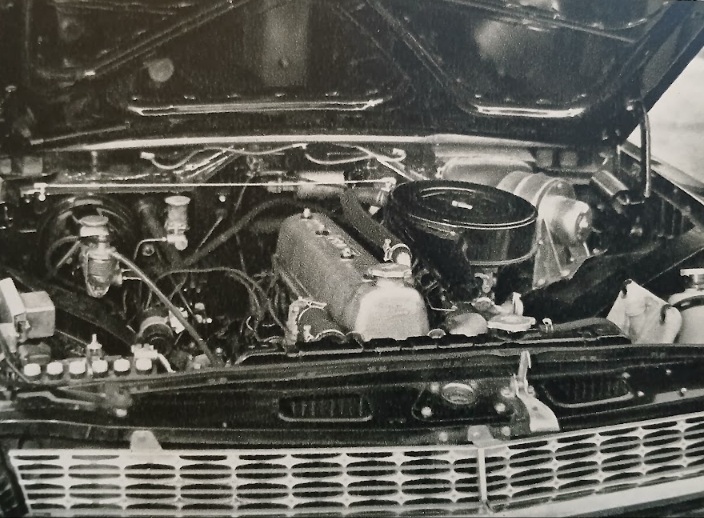
The G7 engine, a 1988cc six-cylinder SOHC unit, is basically identical to that of the previous Gloria, but in the Super Deluxe it is equipped with a four-barrel carburetor. Curiously, however, according to the specifications, its power and torque are unchanged from those of the Super 6 with its two-barrel carburetor, at 105ps/5200rpm and 16.0kgm/3600rpm, respectively.
The way the car drives exactly matches the impression suggested by its exterior and interior. It can fairly be described as an “American compact” in every respect. What one notices immediately upon driving away is the unusually light operation of the controls and the exceptional quietness and smoothness of the powertrain. The clutch is extraordinarily light (so light, in fact, that even some of the more enthusiastic drivers considered it unnatural), while the column shift is also light and positive.
We fitted the test car with a tachometer for our testing, and at its idle speed of 700rpm, vibration and noise inside the cabin were virtually nonexistent. Mechanical noise became noticeable only when the engine was taken beyond 4000rpm in first or second gear. Its flexibility at low speeds is particularly noteworthy. In direct-drive top gear, the car accelerates without the slightest hesitation from around 30km/h, while even in the 0.785 overdrive ratio it can run comfortably at 40km/h (approximately 1200rpm).
Indeed, in town it seemed almost more natural to adopt the lazy “American-style” driving technique: accelerating to around 40km/h in first gear, skipping second altogether, and shifting directly into top. Due to limitations of the test course, we were unable to measure acceleration figures this time, but it can be said that the car’s performance leaves nothing to be desired in practical use, whether in town or on the highway.
Once out on the highway and cruising at high speed, the Gloria really begins to demonstrate the capabilities of a 2-liter six-cylinder car. At 100km/h, the engine is turning approximately 4000rpm in top gear, but selecting overdrive brings this down to around 3200rpm. The reason the interior noise level does not fall as much as expected is that, at 100km/h, the wind noise from the angular body is the most noticeable sound. Even with all the windows tightly closed, there is considerable wind noise around the corners of the windshield. Conversely, this is evidence of just how well mechanical noise has been suppressed. In fact, maintaining not only 100km/h but even 120km/h involves very little strain for either the car or its occupants.
Engine and powertrain noise is so well insulated that it is barely noticeable up to around 100km/h. Noise transmitted from the road, mostly tire noise, is also suppressed to a degree comparable with American cars on good surfaces such as the Third Keihin Highway.
Quiet running at high speed is also made possible by the excellent ventilation system, which allows the windows to be kept fully closed. In addition to the fresh-air intakes at the feet of the front occupants, there are adjustable vents at both ends of the dashboard, allowing the airflow to be directed as desired. As long as the car is traveling at 40-50km/h, these provide plenty of fresh air even on a hot day, without opening the windows. Although we naturally had no opportunity to test it this time, a dedicated rear-window defogger is standard equipment, with a fan that can be switched between three speeds. Slots in the rear quarter panels allow air to escape from the cabin, contributing to effective ventilation.
There is a surprising amount of power available in overdrive. Even when overtaking a car traveling at 80km/h, as long as there is enough time, one can simply press the accelerator and pass without anxiety. Naturally, shifting down to direct-drive third gear makes the maneuver more confident. (At 80km/h, the engine is turning 3300rpm in top and 2600rpm in overdrive.) We had, of course, no opportunity to attempt the claimed maximum speed of 160km/h, but since this corresponds to the engine’s peak-power speed of 5200rpm in overdrive, we felt that with a straight as long as those found on the Meishin Expressway, the Gloria would reach this speed easily and have little difficulty maintaining it.
Directional stability at around 100km/h is exceptionally good, to the point that one can take one’s hands off the wheel without anxiety. At first, the steering seemed terribly vague and imprecise, but in fact this feeling proved to be an illusion caused by its unusual lightness. The recirculating-ball steering, with 4.75 turns from lock to lock, is as light as power steering, whether parking or negotiating a curve at high speed. Yet at speed its response is surprisingly good. For example, when changing lanes to overtake a car traveling at 80km/h on the highway, a movement of only about 7cm at the steering-wheel rim, literally no more than a light movement of the fingertips, is sufficient.
Braking performance is also well matched to the car’s capabilities. At the front are vacuum-servo-assisted discs, while the rear brakes are leading-trailing drums, with a tandem master cylinder. Braking action is very good and pedal effort extremely light. We experienced none of the weakness at low speeds or squealing sometimes regarded as inherent faults of disc brakes. It is, of course, at high speeds that the discs really come into their own. Even above 100km/h, merely resting a foot lightly on the pedal makes the speedometer needle seem to fall smoothly away. Despite the soft suspension, nose dive is very slight, and the car maintains its composure even under hard braking.
The handbrake is a pull-out type mounted under the dashboard, and is difficult to reach when wearing the seat belt (automatic-retracting three-point belts are optional in front, with two-point belts in the rear). A warning lamp comes on when the handbrake is applied.
The biggest changes in the new Gloria are in the body and suspension. The previous Gloria was distinguished by its separate backbone-tray frame and de Dion rear axle, but the Nissan Gloria uses unit body construction, while the rear suspension has been changed to a conventional rigid axle with semi-elliptic leaf springs. The ride can be described, in a word, as “soft,” and is exceptionally smooth on good roads. On rough pavement, however, one feels a fine vibration throughout the body, again in a manner similar to American cars. It must be said that the previous Gloria, with its de Dion axle, offered better rear-seat ride comfort, especially on poor roads.
Fuel consumption is probably not a major concern for owners of cars in this class, but over 400km of mostly city driving, we recorded a relatively good average of 6.75km/l. The fuel tank has a capacity of 50 liters.
In addition to the Borg-Warner automatic transmission already mentioned, available options include power windows, seat belts, and air conditioning.
The Gloria is equally thorough in its approach to maintenance-free operation. The air cleaner only needs replacing every two years or 40,000km, while the oil filter is the easy-to-replace cartridge type. The radiator incorporates an auxiliary tank and is of a virtually permanently sealed design, filled at the factory with long-life coolant that requires no replacement for two years or 40,000km. The lubrication interval for the chassis has also been doubled all at once, from the previous 30,000km to 60,000km.
The Gloria Super Deluxe should provide nearly all the merits of a modern American compact car at less than half the price.
Supplement
During the test period, we encountered an unexpected problem. While driving through the city, the engine suddenly died out and stopped. Since the test car did not carry even a single tool, there was little we could do besides cranking the starter and inspecting the engine compartment, so we had no choice but to telephone Nissan. After being transferred from one person to another several times, we were finally told to call the JAF. We contacted the Kanagawa branch of the Japan Automobile Federation, and a service vehicle arrived about 15 minutes later.
After a good deal of fiddling, it was established that the engine would start when the starter was cranked, but would stop immediately afterward. This aroused suspicion about the ignition switch and key, which indeed turned out to be the cause. Apparently, driving over the paving stones of a streetcar track had caused a faulty contact in the switch. The starter would operate, but when the key was returned to the “ON” position, the ignition would switch “OFF”. The only solution was to remove the key and insert a piece of wire into the socket to keep the engine running. Fortunately, once this had been done, the engine did not stall again.
The incident brought us into the care of the JAF, but we had some reservations about the serviceman’s methods. He casually tossed the air cleaner out into the rain and revved the engine without load to nearly 6500rpm, working in such a way that we almost wanted to cover our eyes. Perhaps the only consolation was that he had arrived surprisingly quickly. As for the roadside service charge, the call-out fee was 500 yen, plus 300 yen for 30 minutes of work, making a total of 800 yen.
Postscript: Story Photos